R E S E A R C H
Open Access
TMT social capital, network position and
innovation: the nature of micro-macro links
Guoyang Zheng
1, Li Zhu
2*, Chao Liu
1and Yu Chen
2* Correspondence:paperlizhu@nsd. pku.edu.cn
2National School of Development,
Peking University, Beijing, China Full list of author information is available at the end of the article
Abstract
Employing a sample of 1476 firms and 5130 firm-years in China, we examine the relationship between social capital and macro organizational innovation. Based on the relational view and social capital theory, this study investigates how the top management team (TMT) inside an organization bridges and bonds social capital to influence innovations combined with organizational network position. Through empirical tests based on listed companies in the whole network of the interlocking directorate using the dataset of listed companies in China from 2008 to 2014, the study finds that: (1) TMT global social capital has an essential positive effect on innovation, (2) TMT overseas social capital has significant positive consequences on prestige and power (network position), (3) network position mediates the
relationship between TMT overseas social capital and innovation, and (4) TMT bank social capital has a moderating effect on the relationship between network position and innovation.
Keywords:Top management team (TMT), Power, Prestige, Network position, Innovation
Introduction
In the era of innovation, creative or innovative capability is the vital asset or potential
capacity of a firm (Huang2011). Innovation requires a great deal of resource input;
so-cial capital may influence this process through innovation diffusion (Abrahamson and
Rosenkopf 1997; Cho et al.2012), collaboration networks (Ahuja 2000), and trust. In
the period of the transition economy in China, firms may embody more significant so-cial capital to compensate for the lack of market-supporting institutions (Peng and
Heath 1996). Given the uncertainties in the reform stage (Walder 1989, 1991; Keister
and Lu2001), firms seek help from informal institutions to support organizational goal
achievement. As one extension of the resource-based viewpoint, the relationship-based view maintains that competitive advantages not only come from resources of firms but
also from embedded networks and dyadic relationships (Lane and Lubatkin1998; Dyer
and Singh1998).
“Social capital appears to be the bedrock of innovative capabilities” (Subramaniam
and Youndt2005: p. 495). Social capital theory assumes that internal and external
net-working relationships provide both value to actors and access to resources embedded
in external linkages (Li et al.2014). Peng and Luo (2000) have demonstrated the social
context, in which ingrained managerial ties are extremely critical. Top management
© The Author(s). 2019Open AccessThis article is distributed under the terms of the Creative Commons Attribution 4.0 International
team (TMT) may also cultivate interpersonal relations and connections with actors in
other firms or government officials (Li et al. 2014) via work experience. TMT’s social
capital may include a set of assets contained in relationships (Lin et al. 2001).
Corpor-ate network relationships and social capital will be influenced by the TMT members. At the same time, the basis for the performance of the executives is the social capital they are able to utilize (Zhou et al. 2010).
Existing research on the relationship between board interlocks and corporation innovation mainly focuses on the positive effects of board interlocks on patenting and
R&D spending (Helmers et al.2017), new product introduction (Srinivasan et al.2018),
inventive capabilities (Sullivan and Tang 2013) and so on. Existing research examines
the ways in which the social capital of the TMT affects the company’s innovation such
as through information exchange, knowledge sharing and technology transfer (Lawson
et al.2008), and increases the efficiency of information flow across organizations (Ward
and Feldman2008), but has not paid attention to the impact of the micro TMT social
capital on the macro corporate social capital and the indirect effects on corporate innovation. Companies, like other actors in society, are embedded in the network of
economic and social relations (Uzzi 1996; Granovetter 1985). Our approach is
con-sistent with TMT social capital, and also in line with the viewpoint of firms
in-volved in social networks together with other actors (Granovetter 1985; Uzzi 1996;
Burt 2009; Gulati et al. 2000; Rowley et al. 2000). A firm’s network, which provides exceptional access to capabilities and resources outside the organization (e.g., cap-ital, service, goods, and innovations), can be seen as the resource in itself
(Anders-son et al. 2002). The assets obtained through this network are relatively
irreplaceable and inimitable (Gulati 1999; Gulati et al. 2000) for the
path-dependent process is idiosyncratic and difficult to imitate. The specific situ-ation provides a fascinating context through which we can explore the relsitu-ationship
between micro and macro links (Luo and Chen 1997; Peng 2000).
As an extension of resource-based theory, which shows that the quality and quantity
of resource is unevenly distributed (Barney1991), we enlarge the boundary of resource
acquisition to the embedded social networks (Inkpen and Tsang 2005). As another
ex-tension of innovation related to dynamic theory proposed by Nonaka (2000: p. 25), we
extend“input-process-output”and“how efficiently it can deal with information and
de-cisions in an uncertain environment” to a relational view by linking micro-macro
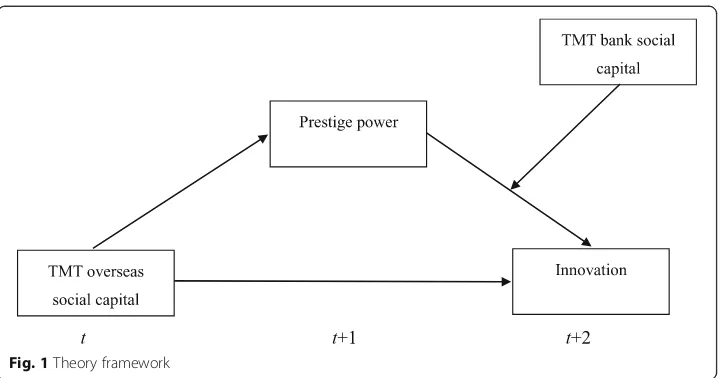
as-pects together. Overall, based on research by Peng and Heath (1996), Luo and Chen (1997), and Peng (2000), and using quantitative data to analyze the benefit in economic transitions, the extended efforts of our study combine micro TMT social capital (overseas social capital and bank social capital) and macro organizational network pos-ition (prestige and power). Thus, this study focuses on the following two questions: (1)
“what flows across the links”(Stinchcombe1990: p. 381), and (2) the mechanism of
mi-cro TMT social capital transformed into mami-cro corporate social capital and their com-bined effect on organizational innovation, based on recent calls for more attention to
influence at the organizational level (Finkelstein et al.2009).
Based on 5130 listed firms’networks constructed by interlocking directors in China,
this study attempts to reveal the transformation from micro social capital to macro so-cial capital and their joint effects on enterprise innovation. Additionally, it explores the
and provides beneficial theoretical enlightenment as well as practical suggestions for improving innovation ability through social capital.
Theoretical background and hypotheses Micro and macro social capital
Research on management issues from the perspective of social networks emerges in large numbers from the 1970s, although the definition of social capital has changed
(Bourdieu 1986; Coleman 1990; Putnam1993; Lin2008). Some researchers believe
so-cial capital is individual property (Portes 1998), while some researchers argue it is the
property of individuals and their social relations (Coleman 1990); other researchers
think social capital belongs to the group (Bourdieu and Wacquant 1992). Still others
hold the view that it belongs to groups, political groups, communities and nations
(Put-nam et al.1993).
Researchers in the fields of social capital and social networks have pointed out that resources can be obtained through social networks, which are embedded in the
interre-lated networks of individuals, groups, and nations (Bolino and Turnley 2002; Inkpen
and Tsang2005). In other words, people access tangible and intangible resources at the
individual, group and organizational levels through social interaction and connection with others. From resource-based theory, social network theory indicates that enter-prises can obtain better internal and external resources through the construction and management of network relationships. The ability to develop and manage network rela-tionships between organizations has become a core competence of an enterprise be-cause resources are of great importance to business and innovation success (Leibold et al.2007).
TMT social capital
According to Upper Echelons research, “relations of the value and cognitive bases of
powerful actors in the organizations”may explain organizational results (Hambrick and
Mason 1984: p.193). As an extension of Upper Echelons-based view, social capital
re-fers to the outcomes of networking relationships that can be described as internal char-acteristics within a group, such as connection, norms, trust, and cooperation for
universal benefit (Tsai and Ghoshal 1998). Previous researchers demonstrate two
pri-mary dimensions with respect to highest level external relationships; the former is links with business managers of other firms inside or outside the industry (Geletkanycz and Hambrick1997), while the latter lies in financial institutions, officials and political
insti-tutes (Peng and Luo2000).
Geletkanycz and Hambrick (1997) have shown that different aspects of a top
man-ager’s connections in business networks cause different benefits (such as resource or
in-formation), which may lead to various outcomes in innovation (Paananen 2009) and
ambidextrous innovations management (Li et al. 2014). The social networks of the
TMT’s social capital can be considered as a set of assets contained in relationships (Lin
et al.2001). Nahapiet and Ghoshal (2000) have also developed a framework to
demon-strate the effects of social capital on the transfer process of explicit knowledge, tacit
knowledge and new intellectual capital generation (Nahapiet and Ghoshal2000). Based
background (Shipilov and Danis 2006), educational or tenure backgrounds,
interac-tions, diversification and demography (Hambrick and D’Aveni1992; Michel and
Ham-brick 1992; Johnson and Phyllis1998; Smith et al.1994; Shipilov and Danis2006). We
focus on the TMT overseas and bank social capital to represent the micro social capital in this research.
Organizational network position
A firm’s network position, especially when central and advantageous, may influence the
actor’s innovation by accessing different knowledge, and recognizing and responding to
market opportunities (Tsai 2001). Different network position represents different
cap-ability and opportunity for an actor’s access to new knowledge, which is necessary to
generate new products and innovative ideas. Prestige, power and wealth are different
social resources in the field of social stratification research (Lin 2002), and there is an
independent relationship between prestige and power (Jianwen and Yandong 2011).
This study defines prestige and power from the perspective of the macroscopic enter-prise level rather than micro individual level, and at the same time, identifies them as essential elements obtained by an enterprise in the social network due to its network position. In a general sense, prestige is a symbol of personal status, which refers to the
recognition and evaluation that individuals receive in society (Ling 2009). According to
social stratification studies, the distribution of prestige will be significantly affected by the individual differences in class, occupation, and status. In other words, a person will have greater influence when his network position is better. In existing research, scholars use centrality to measure the prestige of an enterprise; so similar to the study at the individual level, an increase in the level of prestige depends on the corporate net-work position.
Social capital theory emphasizes that social networks and the resources brought by the system lead to the variances in power position among individuals and organizations in society. As a result, different patterns of power distribution have been formed (Put-nam1995). Over time, the network will be dominated by core enterprises that have dis-tinct advantages, and the network control power is the structural power given by the
network position (Powell et al.2005). Therefore, we conclude that the control power of
an enterprise over others depends on its network position. Even though generated by social recognition, prestige is not necessarily linked with social resources, with which power is more closely connected. However, higher-prestige enterprises will be trusted in maintaining network and more willing to cooperate than others.
TMT overseas social capital and innovation
The role of social capital in innovation is a relatively new topic, and most relevant re-search and empirical studies show that social capital is positively related to
organizational innovation (Landry et al. 2002). Thus, the social capital of the top
heterogeneous information and resources, but may also facilitates the establishment of behavioral norms, communication models and mutual-trust platforms with stake-holders inside a social network. As a result, corporate social capital has the potential to
boost business model innovation (Jing et al. 2014). Different dimensions of social
net-works exert a positive impact on enterprise growth (Qian et al.2010).
Recently, executives with overseas backgrounds have gradually attracted the attention
of business and academics. According to Upper Echelons Theory, executives’
experi-ences, values, and personalities greatly influence their interpretations of confronted
sit-uations and, in turn, affect their choices (Hambrick 2007). So, it makes sense to give
attention to how executives influence entire TMT and the enterprise when conducting a study on TMT value creation. Executives with overseas experiences have experienced professional backgrounds and international horizons, and meanwhile, they play a
lead-ing role in industrial and technological progress (de la Tour et al. 2011). They are
ex-posed to cutting-edge global technologies and familiar with the future direction of development and innovation. At the same time, they have built strong or weak ties with
international talents. So, we use executives’ overseas working experiences to measure
TMT overseas social capital (Jokinen et al.2008).
As a kind of external social capital, overseas social capital of a TMT supports the en-terprise in two ways. To begin with, executives with overseas work experiences will bring different cognitive resources and information to TMTs and enterprises through their connections with foreign enterprises. Within the TMT, this cognitive and
know-ledge diversity will improve TMT decision-making quality (Wei and Wang 2002) and
subsequently optimize corporate innovation decisions and performance. In other
words, the injection of overseas capital via the executives’ overseas network increases
the effectiveness of the executive team to some extent. What’s more, overseas social
capital of executives can provide a technical resource for enterprises, including infor-mation transfer and advanced technology introduction via network ties. Innovation is
highly dependent on knowledge (Savory2009), so corporations have relatively high
re-quirements of internal technology knowledge. Thus, executives with overseas back-grounds are competing due to their high professional level and heterogeneous resources obtained via the network.
In summary, executives with overseas backgrounds not only provide the enterprise with the appropriate knowledge and technical support but also offer specific directional guidance for innovation and deliver innovative signals. In the two ways expressed above, overseas social capital plays a role in innovation and promotes the improvement of creative ability. From theoretical and empirical research mentioned earlier, we propose the following:
Hypothesis 1: There is a positive relationship between TMT overseas social capital and innovation.
TMT overseas social capital and network position
Some studies show that education and income are two crucial factors that determine the prestige position of an individual. Compared to the impact of income, the influence
other words, the professional groups with knowledge capital have greater prestige. It is the same for the executives with overseas working experience, since they have more in-formation and knowledge in the related field and a broader field of vision.
According to Social Network theory, information will boom and flourish via ties
be-tween enterprises (Burt 2009). Hiring executives with global backgrounds will create a
significant effect as they spread unique information conveyed by enterprise-specific be-havior through networks. Enterprises gain prestige by engaging stakeholders through reputation and fame of employees with overseas backgrounds. The prestige of an
enter-prise influences stakeholders’ judgment of it; therefore, the greater prestige an
enter-prise maintains, the more support and communication it obtains (Levin et al. 1985),
and the easier it will be to have legal status in the market or legitimacy from stake-holders. Thus, an enterprise can obtain prestige and legitimacy from stakeholders due
to executives’ high professional reputation from their overseas backgrounds, and
pro-vide favorable conditions for further network prestige. To sum up, executives’overseas
social capital has a transmission effect on corporate social capital, bringing higher pres-tige to enterprises and utilizing the signal effect of executives. Taking these expectations together, we proposed the following:
Hypothesis 2a: There is a positive relationship between TMT overseas social capital and prestige.
An enterprise gains knowledge power in an innovation network through its
know-ledge resources (Latiff and Hassan 2008) and impacts the behavior of other enterprises
in the network particularly (Rajan and Zingales1997). Enterprises which hire executives
with overseas work experience are able to obtain not only their information and know-ledge about the latest technology, but also insight from different perspectives for innovation. The knowledge power generated by fundamental knowledge and
technol-ogy resources will enable enterprises to influence and control other enterprises’
stra-tegic choices and behavioral decisions in the innovation network (Xu et al. 2014).
When executives have high-level professional expertise, knowledge power could be transmitted to the corporate level owing to the key role executives play in the process of corporate operations, so that these firms gain capability in the field of innovation.
Moreover, these executives’ information and knowledge are updated continuously via
their weak ties with global networks which can reduce cognitive rigidity through receiv-ing a variety of information.
At the same time, executives with overseas social capital also provide technology re-sources to enterprises via ties with foreign technical staff, such as advanced technology in-troduced. Thus, the enterprises hiring those executives can acquire a louder voice, higher status and superior network power through the transmission of knowledge power and the access to information and technical resources. This situation further enhances an
enter-prise’s control over network resources and information, and consolidates its advantageous
network position. So, executives’overseas social capital can promote enterprises’power.
Taking these expectations together, we propose the following:
The mediating role of network position
The competition pattern of enterprises has undergone a revolutionary change from pure competition to the coexistence of competition and cooperation, so that a network among enterprises is gradually emerging. Innovation depends on network-based co-operation since there is no enterprise which has all the resources needed for
develop-ment and innovation. Industry’s technological development prospects and changes
determine the direction of innovation, while the ability to absorb resources and
infor-mation depends on the network position of the enterprise (Coleman2000). External
so-cial capital resources are embedded in interrelated soso-cial networks of individuals, groups and nations, and thus can be accessed through social networks (Bolino and
Turnley 2002; Inkpen and Tsang 2005). Existing research demonstrates that corporate
external social capital has a positive effect on innovation via knowledge spillover,
learn-ing effect (Wang 2013), the recognition of entrepreneurial opportunities (Zhang and
Sun2017) and so on. Corporations occupying good network positions may have more opportunities to contact and obtain external information and diverse resources (Cole-man 2000) and therefore have a better innovation perfor(Cole-mance.
According to social stratification, social prestige is a scarce resource distributed
un-evenly in networks (Ling 2009). At the individual level, a person’s prestige reflects his
or her popularity and individuals who have higher prestige may acquire more positive
choices (Ling2009). At the organizational level, we define the corporate network
pres-tige as recognition and evaluation the corporate obtains from the rest of the network. Hence, we infer that corporations engaged in the network will prefer to cooperate with those with higher prestige. High-prestige corporations will tend to collaborate and achieve innovative success since innovation is risky and resource-consuming and thus
requires combined efforts of enterprises (Zhu et al. 2017). Besides, an enterprise will
obtain more information and resources from external elements due to high prestige or popularity, and then boost its communication with others. Communication will en-hance the cooperation efficiency among enterprises, and the success of innovation will be further improved. According to resource-based theory, access to cooperation and practical information are different resources the enterprise has that can improve its innovation. Taking these expectations together, we propose the following:
Hypothesis 3a: Prestige mediates the relationship between TMT overseas social capital and innovation.
Enterprise network power, generated by the asymmetry of resource dependence in the network, refers to the ability of an enterprise to influence and control the strategic choice and behavior decision of other members in the process of network exchange in order to realize its own aspirations or meet its own interest demands (Olsen et al. 2014). Enterprises which obtain greater power can seize more opportunities to imple-ment controls on others in the network in order to pursue their targets, because they
can influence or even control other enterprises’behaviors due to control interest (Burt
integrating with the changing market (Maloni and Benton 2000). According to the
resource-based view, enterprises’innovation depends on the resources they can receive
from internal and external sources. Therefore, the power given by executives’overseas
social capital becomes a pivotal factor in obtaining and controlling resources, including information, for enterprises.
Thus, an enterprise can benefit from cooperation with other enterprises and access more useful information for innovation when its power is relatively high. Taking these expectations together, we propose the following:
Hypothesis 3b: Power mediates the relationship between TMT overseas social capital and innovation.
The moderating role of TMT investment bank social capital
Firms with prestige have a favorable network position, which has a positive effect on
organizational innovation (Zhu et al. 2017). Though network position provides value
and allows the actors to develop trust to access resources through embedded linkages
(Li et al. 2014), innovations also carry risks (Merton 2013). One of the biggest threats
in the process of innovation is financing constraints. According to resource-based
the-ory, the resources inside firms are insufficient for a firm’s development. Financing
con-straints occur when capital market imperfections exist (Hottenrott and Peters 2009),
thus obtaining a bank’s support is especially vital in the imperfect capital market
insti-tutional environment in China. TMT’s bank social capital, which is a shortcut to break
the funding bottleneck, naturally becomes a useful way to remedy capital market im-perfections, and is a beneficial solution to financing constraints. In the process of accel-erating enterprise human resource management and the innovation process, compensation and incentive mechanisms play a vital role in enterprise human resource management, and are important in the integration and use of corporate social capital. Additionally, they decrease the breakage risk of capital chain from firm prestige to innovation practices. Taking these expectations together, we propose the following:
Hypothesis 4a: TMT bank social capital positively moderates the relationship between prestige and innovation.
The nature of capital is chasing added value. Karl Marx stated,“for the movement, in
the course of which it adds surplus-value, is its movement, its expansion, therefore, is
automatic expansion” (Marx1887: p. 94). Although organizational power may lead to
various resource channels and promote efficient integration, TMT bank social capital shows the direction and the expansion of capital in the process of innovation projects. TMT bank social capital has access to the information on the newest capital surplus-value and may help enterprises choose the relatively correct direction of invest-ment through market experience and capital appreciation. At the same time, the bank experiences of TMT (or TMT bank social capital) will provide investment choices for
the enterprise’s high-level management decisions, and guarantee the capital input
Hypothesis 4b: TMT bank social capital positively moderates the relationship between power and innovation.
Methodology Sample and procedures
For the detailed TMT social capital information and the firms’ specific records of
innovation, we focus on the listed companies in Chinese A-share listed companies. Ac-cording to the China Stock Market and Accounting Research database (CSMAR) and
listed companies’annual reports, we have identified the interlocking directors and
cre-ated the whole network of listed companies from 2008 to 2014. Our data for the ana-lysis is from the CSMAR database, which provides the fundamental background and TMT information of listed-firms in China, the Shanghai Stock Exchange (www.sse.-com.cn), the Shenzhen Stock Exchange (www.szse.cn), and the annual report of the listed company for supplements. Finally, we obtain samples of 1476 firms and 5130 firm-years, after deleting the isolated firms, financial firms, and the ST, ZT firms.
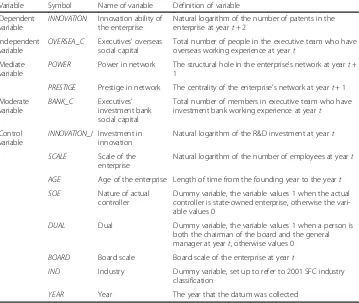
Table1shows the specific description of all variables.
A board interlock can be created between enterprises when one director in one firm joins
another firm’s board (Burt1980; Mizruchi1996). The relationship of interlocking
director-ates is one way to manage environmental uncertainty, access diverse resources, and
com-municate across firms (Salancik and Pfeffer1978). One reason why interlocking directorates
escalate is that the connections are a low-cost channel for communication across firms
Table 1Variables
Variable Symbol Name of variable Definition of variable Dependent
variable
INNOVATION Innovation ability of the enterprise
Natural logarithm of the number of patents in the enterprise at yeart+ 2
Independent variable
OVERSEA_C Executives’overseas social capital
Total number of people in the executive team who have overseas working experience at yeart
Mediate variable
POWER Power in network The structural hole in the enterprise’s network at yeart+ 1
PRESTIGE Prestige in network The centrality of the enterprise’s network at yeart+ 1 Moderate
variable
BANK_C Executives’ investment bank social capital
Total number of members in executive team who have investment bank working experience at yeart
Control variable
INNOVATION_I Investment in innovation
Natural logarithm of the R&D investment at yeart
SCALE Scale of the enterprise
Natural logarithm of the number of employees at yeart
AGE Age of the enterprise Length of time from the founding year to the yeart
SOE Nature of actual
controller
Dummy variable, the variable values 1 when the actual controller is state-owned enterprise, otherwise the vari-able values 0
DUAL Dual Dummy variable, the variable values 1 when a person is both the chairman of the board and the general manager at yeart, otherwise values 0
BOARD Board scale Board scale of the enterprise at yeart
IND Industry Dummy variable, set up to refer to 2001 SFC industry classification
(Haunschild1993). Also, extending research finds board interlocks can be considered“as a
conduit to disseminate ideas and innovations”(Galaskiewicz and Wasserman1989: p. 456).
Thus, in our study, we use interlocking directorates to construct the listed-firm network.
Operationalization of variables Innovation
Following Yu and Liu (2013), we use the patent data from the Wind database, three kinds of patents (i.e., patent of invention, patent for utility models, and appearance design) to sum innovation total ability according to the 0.5, 0.3, 0.2 ratios for the above patents’ cat-egories separately, and then obtain the innovation total ability index through logarithmic
conversion. We also use the simple sum of the three patents (provided in Table2) in a
robustness test by exchanging calculation formula of innovation capability index.
Prestige
Degree prestige, proximity prestige, and status or rank prestige are three kinds of tige evaluation. Following Ma and Li (2011) and Zhu et al. (2017), we use degree pres-tige as the measurement of the relationship between the specific actor and the others. Using software UCINET6.0, we directly measure the connections of the enterprise to stand for the prestige of the enterprise. The method of calculation is as follows:
PER¼X
n
i¼1
a pð i;pkÞ: ð1Þ
If there is one board director shared by two firms, the two firms have a connection. Thena(pi,pk) = 1,elsea(pi,pk) = 0.
Power
The network position as a “structural hole”in a loose network may bring a control
ad-vantage to firms (Burt2009). The theoretical contribution of Burt (2009) lies in the idea
that“entrepreneurs bridging structural holes have economic benefits even if the bridge
is weak”(Coulon2005). The higher the score is, the more control and bridging role
ex-ists in the network. Power is then generated by the dependence of other enterprises around them. Using software UCINET6.0, we measure power by effective size, which
means the size of the actor’s network subtracts the redundancy from the network (Zhu
et al.2017). The method of calculation is as follows:
PWR¼X
i
1−X
q Piqmjq
!
;q≠i;j: ð2Þ
Effect size stands for power because it is based on ego-network size minus
redun-dancy. A larger effective size indicates more control power. j stands for all the actors
connected with the focal actor, q stands for the third actor besidesi. Piqmjqrepresents
the redundancy between focal actor and j. mjq is the strength of the relationship
be-tween j and q; it equals the ratio of the relationship between j and q divided by the
maximum value ofjto other actors.Piqmjqmeans the ratio of the relationship between
i and j divided by the relationship between i and other actors. Our overall model is
Results
Descriptive statistics for all variables and correlations among them are presented in
Table1. We use hierarchical multiple regressions to test the hypotheses.
In the analyses, we enter R&D investment as a control variable to avoid funds’impact
on innovation. We also input enterprise size and age (Xu et al. 2014), board scale and
the nature of the actual controller (Zhang 2013; Jia and Zhang 2010) as control
vari-ables to preclude enterprise-level influence. Additionally, we control the industry and the year in which the datum was collected. All variables in our regressions are stated in
Table3, and we estimate the VIFs (variance inflation factors) to test the potential threat
of colinearity. After analysis, we find that all the variables have VIFs lower than 6,
which is below the defined ceiling of 10 (Kleinbaum et al.1988).
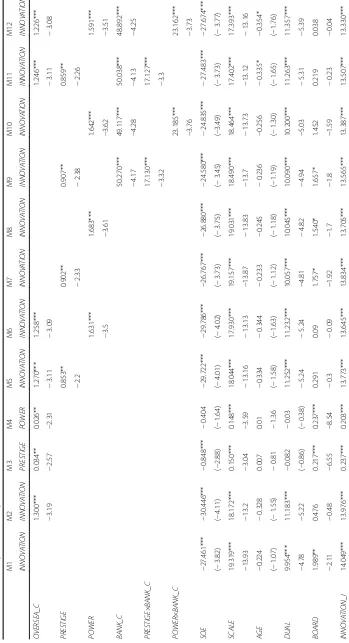
According to the second column M2 in Table 4, after controlling variables of R&D
investment, enterprise size, and age, board scale, the nature of the actual controller,
in-dustry and year, we find that overseas social capital is positively related (β= 1.30, p<
0.01) to innovation. Thus, Hypothesis 1 is fully supported. Results in the third column
M3 and the fourth column M4 show that prestige (β= 0.034,p< 0.05) and power (β=
0.026, p< 0.05) are positively related with overseas social capital which supports
Hy-pothesis 2a and HyHy-pothesis 2b. Condition (a) and Condition (b) for mediation can be supported by Hypothesis 1 and Hypothesis 2.
Table 3Result of correlation analysis
INNOVATION OVERSEA_C PRESTIGE POWER BANK_C
INNOVATION 1
OVERSEA_C 0.167*** 1
PRESTIGE 0.126*** 0.194*** 1
POWER 0.097*** 0.175*** 0.951*** 1
BANK_C 0.136*** 0.044*** 0.0120 0.008 1
MEAN 107.680 17.505 5.465 4.017 0.028
SD 256.382 4.314 3.074 2.578 0.164
Notes.* p< 0.10,** p< 0.05,*** p< 0.01
Hypothesis 3 proposes that prestige and power mediate the relationship between overseas social capital and innovation. In a study conducted by Baron and Kenny (1986), there are four essential conditions for establishing mediations: (a) The inde-pendent and mediating variables are related considerably; (b)the indeinde-pendent and dependent variables are significantly related; (c) the mediator and dependent variables are significantly related, and (d) the relationship between the independent variables and dependent variables should be insignificant or weaker when the mediator is taken into consideration. Results in the seventh column M7 and the eighth column M8 depict that prestige (β= 0.902, p< 0.05) and power (β= 1.683, p< 0.01) are positively related to innovation, and support Condition (c) for mediation. Further, after prestige and power are considered, the relationship between overseas social capital and innovation is weak-ened (β= 1.270,p< 0.01), but still significant, which suggests partial mediation. In sum-mary, prestige and power are substantial partial mediators in the model, which supports Hypothesis 3a and Hypothesis 3b.
To assess moderated mediation (Muller et al.2005; Preacher et al.2007), we examine
four conditions: (a) significant effects of overseas social capital on innovation; (b) sig-nificant interactions between two mediators and investment bank social capital (e.g., prestige and investment bank social capital in predicting innovation has significant in-teractions); (c) significant effects of prestige and power on innovation; and (d) different conditional effects of prestige and power on innovation across low and high levels of investment bank social capital. The last condition is the essence of moderated medi-ation, which establishes whether the strength of the mediation differs across the various
levels of the moderator (Preacher et al. 2007). Moderated mediation is demonstrated
when the conditional indirect effect of prestige and power on innovation differs in strength across low and high levels of investment bank social capital. Results for Hy-pothesis 1 demonstrate that overseas social capital is significantly related to innovation, and it supports condition (a) for moderated mediation.
We then examine the interaction of prestige and power with investment bank social
capital to test for Condition (b) for moderated mediation. Results from Table 3 in the
ninth column M9 and the tenth column M10 show that, the interaction terms for
invest-ment bank social capital with both prestige (β= 17.130,p< 0.01) and power (β= 23.185,
p< 0.01) are significant in predicting innovation. Condition (b) for moderated
medi-ation is approved. Condition (c) for moderated medimedi-ation is supported by the seventh column M7 and the eighth column M8. Hence, results based on the first three conditions indicate that investment bank social capital might moderate two pairs of relationships: prestige and innovation, and power and innovation. Thus, Hypothesis 4a and Hypothesis
4b are supported. Table 3 presents the descriptive statistics to test our hypothesis. The
year and industry dummy variables are used and not reported in detail to save space.
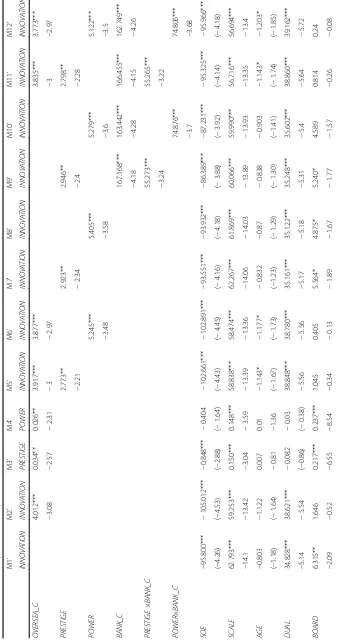
Table 4 displays the robust test by changing the dependent variables by using the total
amount of patent. Similarly, we obtain the same conclusion as formerly.
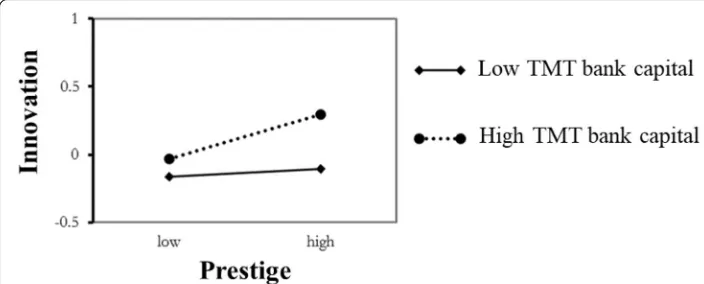
Results from Figs.2and 3demonstrate that different levels of investment bank social capital have different moderate effects on two pairs of relationships: prestige and innovation, and power and innovation. The effect of prestige or power on innovation is relatively limited when the investment bank social capital of the top management team
is low. That is to say, when the investment bank social capital is low, an enterprise’s
innovation is not very active regardless of prestige and power. Prestige and power be-come vital factors of innovation when the investment bank social capital of the top management team is high, which means prestige or power has a great effect on
innovation (Wu and Li2014). Thus Condition (d) for moderated mediation is satisfied.
Our results are also supported by using Tobit model, thus there is no censoring bias issue.
We use the method from Preacher et al. (2007) to analyze the moderated mediation.
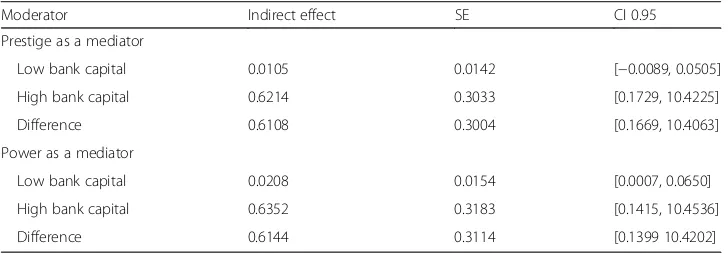
The results are shown in Table 5. The index of moderated mediation when prestige
functions as mediator is significant (estimate = 0.61, CI 0.95 [0.1669, 1.4063], sample size = 10,000). Specifically, TMT overseas social capital has a stronger indirect effect (through prestige) on innovation for those who have higher levels of bank capital (in-direct effect = 0.62, CI 0.95 [0.1729, 1.4225]), while the in(in-direct effect of those who have
lower levels of bank capital (indirect effect =0.01, CI 0.95 [−0.0089, 0.0505]) is not
sig-nificant; the strength of the indirect relation differ significantly depending on bank cap-ital levels, providing a moderated role of bank capcap-ital on the indirect effect of TMT overseas social capital on innovation via prestige.
Additionally, results reveal that the moderated effect of bank capital on the indirect effect through power is also significant (estimate =0.61, CI 0.95 [0.1399 1.4202], sample size = 10,000). TMT overseas social capital have a stronger indirect effect (through prestige) on innovation for those who have higher levels of bank capital (indirect effect = 0.64, CI 0.95 [0.1415, 1.4536]) than for those who have lower levels of bank capital (indirect effect = 0.02, CI 0.95 [0.0007, 0.0650]), thus supporting the moderating role of bank capital regarding the indirect effect via power.
Discussions and implications
How is micro social capital transformed into macro social capital and what is their combined effect on organizational innovation? This study uses the micro TMT
overseas social capital, bank social capital and macro advantage network position to-gether to answer the question critically.
Social capital is the bedrock of innovative capabilities (Subramaniam and Youndt 2005); as an extension of the resource-based view, we focus on the social capital aspect
since it is embedded in external linkages (Li et al.2014). In our study, we conclude that
a firm’s innovation is significantly increased by TMT overseas social capital. By
devel-oping links between international talents and bridging relationships between inter-national elites and companies, the TMT bonds cutting-edge interinter-national technologies to explore future directions of enterprise development and innovation. We specify the mechanism of bridging and bonding effects through extending the present result of TMT’s social capital.
Embedded in the network, these relationships may influence a firm’s R&D and
innovation opportunities (Granovetter 1985). Influence and control are correlations
with the advantages of network position (Burt 2009), while little prior research has
quantitatively measured the role of macro advantage network position in the process of
micro social capital’s macro transformation to the organization level. The result of our
research shows that the organizational advantage network has a bonding effect on the micro TMT social capital and organizational innovation. Firms occupying an
advanta-geous network location bond an individual’s prestige and trustworthiness in the process
of communication and cooperation by using the influence of prestige. Moreover, the
person with power, through whom the source’s network is embedded, bonds and
Table 5Test of moderated mediation
Moderator Indirect effect SE CI 0.95
Prestige as a mediator
Low bank capital 0.0105 0.0142 [−0.0089, 0.0505]
High bank capital 0.6214 0.3033 [0.1729, 10.4225]
Difference 0.6108 0.3004 [0.1669, 10.4063]
Power as a mediator
Low bank capital 0.0208 0.0154 [0.0007, 0.0650]
High bank capital 0.6352 0.3183 [0.1415, 10.4536]
Difference 0.6144 0.3114 [0.1399 10.4202]
bridges the innovative ideas and technologies by highly efficient utilization, high re-source integration, and control capability.
This research also demonstrates that the interaction between organizational network
position and TMT bank social capital affects a firm’s innovation. This finding is useful
for previous research which examines the combined effects, though there is no effective means of quantifying prestige and power. A central actor may access knowledge
net-work links (Tsai 2001) and promote firms to reduce environmental uncertainties (Tian
and Yan2013). We have extended the elements of resources and cost to bonding micro
TMT social capital and the transformation process to organizational innovation. The capital and experience positively moderate the relationship between prestige and innovation by decreasing the capital risk and the possibility of capital chain breakage. Furthermore, TMT bank social capital may help guarantee the capital input direction and provide investment choices by familiarity with the nature of capital and the invest-ment experience.
In conclusion, this study contributes to existing research in the following aspects. First, this study reveals the possible path of transformation of micro social capital to macro social cap-ital. It enhances our understanding of how firms use the social capital of TMT and organizational network position to improve their innovation by exploring the nature of micro-macro links. Based on the data of 5130 listed firms in China, our results contribute to the understanding of the combined effect of micro and macro social capital in TMT and organizational level respectively. The study shows that TMT overseas social capital is posi-tively associated with corporate innovation and that the organizational network position par-tially mediates the effect of TMT overseas social capital and innovation. Moreover, TMT bank social capital moderates the relationship between organizational network position and innovation. Our research then provides empirical support to understand the relationship be-tween micro TMT social capital, macro network position, and innovation. By offering both micro and macro measurements of TMT social capital and by testing two dimensions of so-cial capital, we contribute to both theoretical and empirical development of the typical stream of research on innovation. Second, our research links micro and macro social capital together to explain the innovation process to extend the resource-based theory in innovation area re-search. We also attempt to make a meaningful quantitative study to explore the nature of bonding and bridging mechanisms. Third, we link TMT social capital with the organizational network position as an explanation of firm-level advantage networking ability, thus assisting human resource management in the TMT level selection. At the same time, the enterprise should pay more attention to the TMT social capital to obtain more efficient and low-cost ac-cess to precious resources needed for the firm’s innovation. Furthermore, a suitable salary in-centive mechanism should be established to stimulate bonding and bridging to efficiently utilize existing social capital at both micro and macro levels.
Limitations and future research direction
interlocking directorate network. As for the latter category, i.e., non-listed firms, they have a completely different operating and management environment. Although our em-pirical analysis does not systematically contain all the types of firms for the data limita-tion, it undermines no referential significance of conclusions. Future researchers may examine different samples and measurements to construct the listed-firm network.
Second, we firmly believe that our findings focusing on TMT should not be biased for the accounting differences. The conceptualization of power and prestige are differ-entiated network positions and highlights the differences between listed firms in the whole interlocking directorate network. We calculate the network position using social network analysis, which has been compiled into an interlocking directorate dimension measure for simplified measurement purposes.
Third, the last limitation of this research is that we ignore the potential impact of
firm innovation on TMT social capital.“The level of casual analysis adopted in the
em-beddedness argument is a rather proximate one” (Granovetter 1985: p. 506); for
in-stance, a highly innovative entity with a promising future may attract elites to enter TMT. Given the inherent causal ambiguity, the combination of social capital and
trans-action cost theory (Williamson 1985) may help overcome the problem to some degree
by identifying and distinguishing the origins of TMT social capital growth.
Acknowledgements
Not Applicable.
Funding
Not applicable.
Availability of data and materials
For the detail TMT social capital information and the firms’specific records of innovation, we focus on the listed
companies in Chinese A-share listed companies. According to China Stock Market & Accounting Research Database
(CSMAR) and listed companies’annual report, we have identified the interlocking directors and created the whole
net-work of listed companies from 2008 to 2014. Our data for the analysis is from CSMAR database, which provides the
fundamental background and TMT information of listed-firms in China, Shanghai Stock Exchange (www.sse.com.cn),
Shenzhen Stock Exchange (www.szse.cn), and the annual report of the listed company for supplements. We identify
interlocking directors by using CSMAR and annual reports of the listed companies to construct the whole network of listed-firms in China from 2008 to 2014. At last, we obtain samples 1476 firms and 5130 firm-years, after deleting the isolated firms, financial firms, and ST, ZT firms.
Authors’contributions
LZ, LC and YC explored data and YC do the basic data processing. Then LZ and LC operated the model and LZ described samples and methods of this research while GZ reported the data analysis result. GZ and LZ worked together to finish the sections of introduction, theoretical background, hypotheses, discussion and limitation. Finally, YC polished words of this manuscript. All authors read and approved the final manuscript.
Competing interests
The authors declare that they have no competing interests.
Publisher’s Note
Springer Nature remains neutral with regard to jurisdictional claims in published maps and institutional affiliations.
Author details
1Renmin University of China, Beijing, China.2National School of Development, Peking University, Beijing, China.
Received: 8 February 2018 Accepted: 3 January 2019
References
Abrahamson, E., & Rosenkopf, L. (1997). Social network effects on the extent of innovation diffusion: A computer simulation.
Organization Science, 8(3), 289–309.
Ahuja, G. (2000). Collaboration networks, structural holes, and innovation: A longitudinal study.Administrative Science
Andersson, U., Forsgren, M., & Holm, U. (2002). The strategic impact of external networks: Subsidiary performance and
competence development in the multinational corporation.Strategic Management Journal, 23(11), 979–996.
Barney, J. (1991). Firm resources and sustained competitive advantage.Advances in Strategic Management, 17(1), 3–10.
Baron, R. M., & Kenny, D. A. (1986). The moderator-mediator variable distinction in social psychological research: Conceptual,
strategic, and statistical considerations.Journal of Personality and Social Psychology, 51, 1173–1182.
Bolino, M. C., & Turnley, W. H. (2002). Citizenship behavior and the creation of social capital in organizations.Academy of
Management Review, 27(4), 505–522.
Bourdieu, P. (1986). The forms of capital. InHandbook of theory & research of for the sociology of education(pp. 280–291).
Bourdieu, P., & Wacquant, L. J. D. (1992).An invitation to reflexive sociology. University of Chicago Press (pp. 20–53).
Burt, R. S. (1980). Cooperative corporate actor networks: a reconsideration of interlocking directorates involving American
manufacturing.Administrative Science Quarterly, 25(4), 557–582.
Burt, R. S. (2009).Structural holes: the social structure of competition(pp. 23–100). Harvard University Press.
Cho, Y., Hwang, J., & Lee, D. (2012). Identification of effective opinion leaders in the diffusion of technological innovation: a
social network approach.Technological Forecasting and Social Change, 79(1), 97–106.
Coleman, J. (1990).Foundations of social theory(pp 55–78). Belknap Press of Harvard University Press
Coleman, J. S. (2000). Chapter 2 - Social Capital in the Creation of Human Capital. Knowledge and Social Capital: Foundations and Applications.
Coulon, F. (2005).The use of social network analysis in innovation research: a literature review(pp 78–100). Lund University
de la Tour, A., Glachant, M., & Ménière, Y. (2011). Innovation and international technology transfer: the case of the Chinese
photovoltaic industry.Energy Policy, 39(2), 761–770.
Dyer, J. H., & Singh, H. (1998). The relational view: cooperative strategy and sources of inter-organizational competitive
advantage.Academy of Management Review, 23(4), 660–679.
Finkelstein, S., Hambrick, D. C., & Cannella, A. A., Jr. (2009).Strategic leadership: theory and research on executives, top
management teams, and boards. New York: Oxford University Press.
Galaskiewicz, J., & Wasserman, S. (1989). Mimetic processes within an inter-organizational field: an empirical test.
Administrative Science Quarterly, 34(3), 454–479.
Geletkanycz, M. A., & Hambrick, D. C. (1997). The external ties of top executives: Implications for strategic choice and
performance.Administrative Science Quarterly, 42(4), 654–681.
Granovetter, M. (1985). Economic action and social structure: the problem of embeddedness.American Journal of Sociology,
91(3), 481–510.
Gulati, R. (1999). Network location and learning: the influence of network resources and firm capabilities on alliance
formation.Strategic Management Journal, 20(5), 397–420.
Gulati, R., Nohria, N., & Zaheer, A. (2000). Strategic networks.Strategic management journal, 21(3), 203-215.
Hambrick, D. C. (2007). Upper echelons theory: an update.Academy of Management Review, 32(2), 334–343.
Hambrick, D. C., & D'Aveni, R. A. (1992). Top team deterioration as part of the downward spiral of large corporate
bankruptcies.Management Science, 38(10), 1445–1466.
Hambrick, D. C., & Mason, P. A. (1984). Upper echelons: the organization as a reflection of its top managers.Academy of
Management Review, 9(2), 193–206.
Haunschild, P. R. (1993). Interorganizational imitation: the impact of interlocks on corporate acquisition activity.Administrative
Science Quarterly, 38(4), 564–592.
Helmers, C., Patnam, M., & Rau, P. R. (2017). Do board interlocks increase innovation? Evidence from a corporate governance
reform in India.Journal of Banking & Finance, 80, 51–70.
Hottenrott, H., & Peters, B. (2009). Innovative capability and financing constraints for innovation: more money, more
innovation?Review of Economics & Statistics, 94(9–081), 1–40.
Huang, H. (2011). Technological innovation capability creation potential of open innovation: a cross-level analysis in the
biotechnology industry.Technology Analysis & Strategic Management, 23(1), 49–63.
Inkpen, A. C., & Tsang, E. W. K. (2005). Social capital, networks, and knowledge transfer.Academy of Management Review, 30(1), 146–165.
Jia, M., & Zhang, Z. (2010). Does political connection influence corporate philanthropy?Management World, 4(4), 99–113.
Jianwen, W., & Yandong, Z. (2011). Power or prestige? The debates and verifications in measurement of social capital.
Sociological Studies, 3, 005.
Jing, Z., Wang, M., Limin, & Ding. (2014). Corporate social capital and business model innovation: The mediating role of
organizational learning.Frontiers of Business Research in China, 8(4), 500–528.
Johnson, & Phyllis. (1998).A study of cognition and behavior in top management team interaction(pp. 101–150). Cranfield
University
Jokinen, T., Brewster, C., & Suutari, V. (2008). Career capital during international work experiences: Contrasting self-initiated
expatriate experiences and assigned expatriation.International Journal of Human Resource Management, 19(6), 979–998.
Keister, L. A., & Lu, J. (2001).The transformation continues: The status of Chinese state-owned enterprises at the start of the
Millennium(Vol. 12). (pp 23–50). National Bureau of Asian Research: .
Kleinbaum, D. G., Kupper, L. L., & Muller, K. E. (1988).Applied regression analysis and other multivariable methods. Boston: PWS
Publishing.
Landry, R., Amara, N., & Lamari, M. (2002). Does social capital determine innovation? To what extent?Technological Forecasting
and Social Change, 69(7), 681–701.
Lane, P. J., & Lubatkin, M. (1998). Relative absorptive capacity and inter-organizational learning.Strategic Management Journal,
19(5), 461–477.
Latiff, H. S. B. H. N. M. A., & Hassan, A. (2008). Rise and fall of knowledge power: an in‐depth investigation.Humanomics the
International Journal of Systems & Ethics, 24(1), 17–27.
Lawson, B., Tyler, B. B., & Cousins, P. D. (2008). Antecedents and consequences of social capital on buyer performance
improvement.Journal of Operations Management, 26(3), 446–460.
Leibold, M., Probst, G. J., & Gibbert, M. (2007). Strategic management in the knowledge economy: new approaches and
business applications (pp 78–120). Wiley.
Li, C. (2005). Prestige stratification in the contemporary Cchina: occupational prestige measures and socio-economic index. Sociological Research.
Li, C. R., Lin, C. J., & Huang, H. C. (2014). Top management team social capital, exploration-based innovation, and
exploitation-based innovation in smeSMEss.Technology Analysis & Strategic Management, 26(1), 69–85.
Lin, N. (2002).Social capital: a theory of social structure and action(Vol. 19) (pp 55–85). Cambridge University Press.
Lin, N. (2008). A network theory of social capital.The Handbook of Social Capital, 50(1), 69.
Lin, N., Cook, K. S., & Burt, R. S. (2001).Social capital: theory and research. Aldine transaction.
Ling, J. R. (2009).Social network analysis: theory, method and application.
Luo, Y., & Chen, M. (1997). Does guanxi influence firm performance?Asia Pacific Journal of Management, 14(1), 1–16.
Ma, F. P., & Li, Y. P. (2011). Top managerial social capital, resource acquisition and technological innovation performance in
resource-based enterprises.Economic Management Journal, 8.
Maloni, M., & Benton, W. C. (2000). Power influences in the supply chain.Journal of Business Logistics, 21(1), 49–74.
Marx, K. (1887).Capital(pp 322–350). Progress Publishers.
Merton, R. C. (2013). Innovation risk.Harvard Business Review, 91(4), 48–56.
Michel, J. G., & Hambrick, D. C. (1992). Diversification posture and top management team characteristics.Academy of
Management Journal, 35(1), 9–37.
Mizruchi, M. S. (1996). What do interlocks do? An analysis, critique, and assessment of research on interlocking directorates.
Annual Review of Sociology, 22(1), 271–298.
Muller, D., Judd, C. M., & Yzerbyt, V. Y. (2005). When moderation is mediated, and mediation is moderated.Journal of
Personality & Social Psychology, 89(6), 852.
Nahapiet, J., & Ghoshal, S. (2000). Social capital, intellectual capital, and the organizational advantage.Knowledge and Social
Capital, 23(2), 119–157.
Nonaka, I. (2000). A dynamic theory of organizational knowledge creation. InKnowledge, groupware and the internet(pp. 3–42).
Olsen, P. I., Prenkert, F., Hoholm, T., & Harrison, D. (2014). The dynamics of networked power in a concentrated business
network.Journal of Business Research, 67(12), 2579–2589.
Paananen, M. (2009). Exploring the relationships between knowledge sources in the innovation process: Evidence from
Finnish innovators.Technology Analysis & Strategic Management, 21(6), 711–725.
Peng, M. W. (2000).Business strategies in transition economies. Thousand Oaks: Sage.
Peng, M. W., & Heath, P. S. (1996). The growth of the firm in planned economies in transition: Institutions, organizations, and
strategic choice.Academy of Management Review, 21(2), 492–528.
Peng, M. W., & Luo, Y. (2000). Managerial ties and firm performance in a transition economy: The nature of a micro-macro
link.Academy of Management Journal, 43(3), 486–501.
Portes, A. (1998). Social capital: its origins and applications in modern sociology.Annual Review of Sociology, 24(1), 1–24.
Powell, W. W., White, D. R., Koput, K. W., & Owen-Smith, J. (2005). Network dynamics and field evolution: the growth of
inter-organizational collaboration in the life sciences.American Journal of Sociology, 110(4), 1132–1205.
Preacher, K. J., Rucker, D. D., & Hayes, A. F. (2007). Addressing moderated mediation hypotheses: theory, methods, and
prescriptions.Multivariate Behavioral Research, 42(1), 185–227.
Putnam, R. (1995). Bowling alone, America’s declining of social capital.Journal of Democracy, 6(1), 65–78.
Putnam, R. D. (1993). The prosperous community: social capital and public life.American Prospect, 13(13).
Putnam, R. D., Leonardi, R., & Nanetti, R. Y. (1993). Social capital and institutional success.Making democracy work: Civic
traditions in modern Italy, 163, 185.
Qian, X., Xu, W., & Li, K. (2010). Do entrepreneurial social networks boost enterprise growth? Evidence from the pearl river
delta in China.Frontiers of Business Research in China, 4(3), 498–513.
Rajan, R., & Zingales, L. (1997). Power in a theory of the firm.Number Working Papers, 113(2), 387–432.
Rowley, T., Behrens, D., & Krackhardt, D. (2000). Redundant governance structures: An analysis of structural and relational
embeddedness in the steel and semiconductor industries.Strategic Management Journal, 21(3), 369–386.
Salancik, G. R., & Pfeffer, J. (1978). A social information processing approach to job attitudes and task design.Administrative
Science Quarterly, 23(2), 224–253.
Savory, C. (2009). Building knowledge translation capability into public-sector innovation processes.Technology Analysis &
Strategic Management, 21(2), 149–171.
Shipilov, A., & Danis, W. (2006). TMG social capital, strategic choice and firm performance.European Management Journal, 24(1), 16–27.
Smith, K., Smith, K. A., Olian, J., Sims, H., O'Bannon, D., & Scully, J. (1994). Top management team demography and process:
The role of social integration and communication.Administrative Science Quarterly, 39(3), 412–438.
Srinivasan, R., Wuyts, S., & Mallapragada, G. (2018). Corporate board interlocks and new product introductions.Journal of
Marketing A Quarterly Publication of the American Marketing Association, 82(1), 132–147.
Stinchcombe, A. L. (1990). Weak structural data.Contemporary Sociology, 19(3), 380–382.
Subramaniam, M., & Youndt, M. A. (2005). The influence of intellectual capital on the types of innovative capabilities.Academy
of Management Journal, 48(3), 450–463.
Sullivan, B. N., & Tang, Y. (2013). Which signal to rely on? The impact of the quality of board interlocks and inventive
capabilities on research and development alliance formation under uncertainty.Strategic Organization, 11(4), 364–388.
Tian, G., & Yan, W. (2013). The network of interlocking directorates and firm performance in transition economies: Evidence
from China.Journal of Applied Business Research, 29(2), 607.
Tsai, W. (2001). Knowledge transfer in intra-organizational networks: effects of network position and absorptive capacity on
business unit innovation and performance.Academy of Management Journal, 44(5), 996–1004.
Tsai, W., & Ghoshal, S. (1998). Social capital and value creation: the role of intra-firm networks.Academy of Management
Journal, 41(4), 464–476.
Uzzi, B. (1996). The sources and consequences of embeddedness for the economic performance of organizations: the
network effect.American Sociological Review, 61(4), 674–698.
Walder, A. G. (1989). Factory and manager in an era of reform.The China Quarterly, 118, 242–264.
Walder, A. G. (1991). Workers, managers and the state: the reform era and the political crisis of 1989.China Quarterly,
Wang, L. (2013). Relation between External Social Capital and Cluster Enterprise Innovation Performance: The Effect of
Knowledge Spillover and Learning Effect.Chinese Journal of Management, 3:019.
Ward, A. J., & Feldman, D. C. (2008). Survival of the embedded: expelling and embedding forces on members of the
corporate elite.Corporate Governance: An International Review, 16(3), 239–251.
Wei, L., & Wang, Z. (2002). Empirical study on the relationship between characteristics of tmts and firm performance of
Chinese businesses.Nankai Business Review, 5(4), 16–22.
Williamson, O. E. (1985).The economic institution of capitalism. New York: Free.
Wu, S., & Li, Y. (2014). Is enterprise’alliance network diversity helpful for cooperative innovation? A model of moderated
mediator.Nankai Business Review, 17(3), 152–160.
Xu, K., He, Z., Wang, R., Management, S. O, & University, T. P. (2014). The impacts of knowledge power and structure power
on network routine in technology innovation network.Journal of Management Science, 27(5), 24–34.
Yu, Y., & Liu, D. (2013). The effect of the space outflow of china's regional innovation and the effect of the outflow of value chanins: a study, from the perspective of the innovative value chain, on the model of the panel of multidimentsional space. Management World.
Zhang, H., & Sun, X. (2017). Research on the influence of entrepreneurs’external social capital on entrepreneurial opportunity
recognition: a perspective of network embeddedness.Science of Science & Management of S & T, 38(12), 133–147.
Zhu, L., Liu, X., Liu, C., & Yang, H. (2017). Top managerial social capital, firm network position and innovation capability: the
mediating effect of prestige and power from firm network position.Science of Science & Management of S & T, 38(6), 94–
109.
Zhang, Z. (2013).An empirical study on the interactive and inter - temporal influence between corporate social responsibility and