RESEARCH ARTICLE
Comparison of the pathogen
species-specific immune response in udder
derived cell types and their models
Juliane Günther
1, Mirja Koy
2, Anne Berthold
1, Hans‑Joachim Schuberth
2and Hans‑Martin Seyfert
1*Abstract
The outcome of an udder infection (mastitis) largely depends on the species of the invading pathogen. Gram‑neg‑ ative pathogens, such as Escherichia coli often elicit acute clinical mastitis while Gram‑positive pathogens, such as Staphylococcus aureus tend to cause milder subclinical inflammations. It is unclear which type of the immune compe‑ tent cells residing in the udder governs the pathogen species‑specific physiology of mastitis and which established cell lines might provide suitable models. We therefore profiled the pathogen species‑specific immune response of different cell types derived from udder and blood. Primary cultures of bovine mammary epithelial cells (pbMEC), mammary derived fibroblasts (pbMFC), and bovine monocyte‑derived macrophages (boMdM) were challenged with heat‑killed E. coli, S. aureus and S. uberis mastitis pathogens and their immune response was scaled against the response of established models for MEC (bovine MAC‑T) and macrophages (murine RAW 264.7). Only E. coli provoked a full scale immune reaction in pbMEC, fibroblasts and MAC‑T cells, as indicated by induced cytokine and chemokine expression and NF‑κB activation. Weak reactions were induced by S. aureus and none by S. uberis challenges. In contrast, both models for macrophages (boMdM and RAW 264.7) reacted strongly against all the three pathogens accompanied by strong activation of NF‑κB factors. Hence, the established cell models MAC‑T and RAW 264.7 properly reflected key aspects of the pathogen species‑specific immune response of the respective parental cell type. Our data imply that the pathogen species‑specific physiology of mastitis likely relates to the respective response of MEC rather to that of professional immune cells.
© 2016 Günther et al. This article is distributed under the terms of the Creative Commons Attribution 4.0 International License (http://creativecommons.org/licenses/by/4.0/), which permits unrestricted use, distribution, and reproduction in any medium, provided you give appropriate credit to the original author(s) and the source, provide a link to the Creative Commons license, and indicate if changes were made. The Creative Commons Public Domain Dedication waiver (http://creativecommons.org/ publicdomain/zero/1.0/) applies to the data made available in this article, unless otherwise stated.
Introduction
The outcome of a bacterial udder infection largely depends on the species of the invading pathogen. Gram negative bacteria, such as Escherichia coli elicit in most cases an acute severe inflammation with clinical signs which however may be self-healing by eventually eradi-cating the invader [1, 2]. Gram-positive bacteria, such as Staphylococcus aureus or Streptococcus uberis fre-quently cause only mild subclinical inflammations often allowing for persistent infections [3–6]. The molecular causes underpinning these quite substantial differences in pathogen species-specific mastitis are still unclear albeit those considerable experimental efforts that have
been made during the last decade to decipher them. Sev-eral studies used transcriptome profiling of udder tis-sue retrieved from of cows having experimentally been infected with different pathogens. These studies revealed that E. coli infections elicit a strong cytokine storm [7, 8] while infections with S. aureus [9, 10] or S. uberis [11, 12] elicit a much weaker induction of proinflammatory cytokines.
Pathogens are perceived by pathogen recognition receptors (PRRs) from among which the toll-like-recep-tors (TLRs) form the best-characterized family. The ubiq-uitously expressed TLRs are activated through binding specific pathogen-derived molecular patterns (PAMPs) as ligands [13–15]. This event sets in train a signaling cascade ultimately leading to the activation of the NF-κB transcription factor complex. This serves as a master
Open Access
*Correspondence: seyfert@fbn‑dummerstorf.de
1 Institute for Genome Biology, Leibniz Institute for Farm Animal Biology,
Dummerstorf, Germany
switch to regulate the expression of more than 200 differ-ent immune genes [16, 17].
Dissecting the molecular causes behind the pathogen species-specific immune physiology of mastitis requires appropriate model cells. In this regard it was established that the mammary epithelial cells (MEC) are highly rel-evant for both sentinel as well as effector functions of immune defense in the udder [18–20]. This cell type con-tributes to more than 70% of all cells from the lactating udder [21] and therefore might dominate the immune alert within-and emanating from-the udder early on after infection. Moreover, the pathogen species-specific acti-vation profile of key immune genes in primary cultures of such cells (pbMEC) apparently reflects many aspects similar as recorded from in vivo infected udders [20, 22– 26]. The SV-40 T transformed bovine MAC-T cell line [27] has frequently been used as an easy-to-handle MEC model for both, studying aspects of lactation and milk formation [27, 28] as well as for the analysis of immune functions of MEC [29–32].
Mammary epithelial cells line the alveoli in the milk parenchyma as a layer on top of myoepithelial cells, which are structurally supported by other cell types. These additional cells are initially also co-isolated dur-ing the procedure of purifydur-ing primary cultures of bovine MEC (pbMEC). In culture dishes they acquire an approx-imately spindle shaped cell morphology which is typical for fibroblasts. We will be referring to primary cultures hereof as primary bovine mammary derived fibroblast cultures (pbMFC). Skin derived fibroblasts from cows have recently been proven to featuring a considerable diagnostic potential for the immune competence of the cow [33, 34].
Professional immune cells, such as dendritic cells and macrophages also reside in the udder tissue [35] and these cells are known for their formidable capacity to synthesizing key cytokines [36]. Their quantitative contri-bution to calibrate the pathogen species-specific immune response in the udder early on after infection has not systematically been analyzed. Experimentally amenable models for macrophages may be established by differen-tiating bovine blood derived monocytes for several days in vitro (boMdM) [35]. Global transcriptome profiling of S. aureus infected boMdM suggested [37] that this infec-tion triggered their alternative activainfec-tion into a M2 phe-notype associated with tissue remodeling rather than the M1 phenotype associated with acute inflammation (see [38] for a review on macrophage polarization).
Established murine macrophage model cell lines such as RAW 264.7 [39] or J774 [40] are more easily handled than boMdM. However, the fact that they are trans-formed through tumor viruses and that they stem from mouse rather than cattle sheds some doubts on the
relevance of their use for modeling facets of immune regulation in the udder from cows. Interspecies compari-sons of pathogen recognition may be of arguable value. Host species specific differentiated recognition of TLR4 ligands was proven by showing, for example that the lipid IVa variant of the LPS sub-fraction lipid A may act as TLR4 agonist in horse but as antagonist in human TLR4 signaling [41]. More examples have been documented [42] and X-ray crystallography revealed the structural basis for the host-species dependent PAMP recognition by TLR4 [42, 43]. Host-species dependent PAMP recog-nition was also shown for TLR2 and Dectin 1 [44].
We wanted to compare in pbMEC, primary fibroblast and macrophage model cells side-by-side the profile of the pathogen species-specific immune response, as elic-ited by challenges with E. coli, S. aureus and S. uberis. The direct comparison should validate and scale for the pbMEC the expected greatly different responses depend-ing on the species of the challengdepend-ing pathogen. Contrast-ing this profile with the response of the other cell types should allow to clearly identifying the very cell type gov-erning the pathogen species-specific immune response in the udder early on after infection. Moreover, we wanted to scrutinize the usefulness of the easily handled MAC-T and RAW 264.7 cells to modeling key aspects of the MEC and macrophage specific and pathogen species-depend-ent immune functions.
We choose as a read out for immune functions the mRNA expression levels of a variety of key cytokine- and chemokine-encoding genes as parameters. These included TNF [45] and IL1A and IL1B [46] as well known key activators of inflammation and the pro- and anti-inflammatory IL6 as a master cytokine governing also the activation of the acute phase reaction [47–49]. We included a variety of chemokines since they are key players for the recruitment of immune cells [50]. CXCL2 and CXCL8 recruit PMNs to the site of infection [50, 51] while CCL5 attracts blood monocytes, memory T helper cells and eosinophils [52]. CCL20 was included, because this chemokine is not only attracting dendritic cells, as well as T- and B-cells [53] but has also some bactericidal properties against E. coli and S. aureus pathogens [54]. NOS2A [55] and the β-defensin LAP [56, 57] served as more classical biomarkers for bactericidal functions. Expression of IL10 and the gene encoding the single-immunoglobulin interleukin-1 receptor-related (SIGIRR) served monitoring the modulation of anti-inflammatory pathways [58–60].
Materials and methods
Tissues, cells, cell line culturing and stimulation with mastitis pathogens
Tissues for the establishment of primary cultures of mammary epithelial cells (pbMEC) were retrieved from healthy first lactating Holstein Friesian heifers having been slaughtered at mid lactation in our local abattoir, complying with all pertinent ethical and legal require-ments. The abattoir is an EU licensed (ES1635) core facility of the research affiliation and serves to routinely supply samples to different laboratories. Special ethical approval was unnecessary since the cows had been culled in the normal culling regime without conducting any ani-mal experimentation.
Establishment of these cultures was essentially as described [61]. This reference describes also cultivation of the cells on collagen type I coated tissue plates (CELL-COAT, Greiner bio-one) in RPMI 1640 (Biochrom; Cat No F1215), having been supplemented with prolactin, dexamethasone, insulin and 10% FCS (PAN Biotech). The purification procedure of these cultures involves removal of fibroblasts by selective trypsinization. Such detached primary bovine fibroblast (pbMFC) cells were spun down (400 × g, 15 min) washed twice in PBS and subse-quently cultivated on collagen coated tissue culture plates in the same medium as the pbMEC. MAC-T cells were cultivated in DMEM (Lonza) supplemented with 10% FCS on polystyrene tissue culture plates (CELLSTAR, Greiner bio-one). The mouse monocyte macrophage cell line RAW 264.7 (from ATCC) were cultivated in DMEM (Biochrom) supplemented with 2 mM l-glutamine and 10% FCS.
Establishment of the in vitro differentiated bovine monocyte-derived macrophages (boMDM) from the blood of lactating cows was previously described in detail [35]. Briefly, blood from healthy cows was drawn into heparinized vacutainer tubes from the vena jugu-laris externa. Mononuclear cells (MNC) were separated by density gradient centrifugation [35], suspended in MACS (magnetic-activated cell sorting) buffer (PBS, 2 mM EDTA) and labeled with paramagnetic MicroBe-ads™ coated with a CD14-specific monoclonal antibody (15 min, 4 °C; 20 µL beads and 80 µL MACS buffer per 1 × 10⁷ cells). MNC were washed in MACS buffer and
subjected to MAC sorting. Positively selected CD14+
monocytes were suspended in RPMI 1640 culture medium (10% FCS) and labeled with PE-conjugated mouse anti-bovine CD14 antibody (1:50 in MACS buffer; ABD Serotec, Oxford, UK). Viability (≥98%) and purity (≥95%) of monocytes was flow cytometrically analyzed after addition of propidium iodide (2 µg/mL final). Cells were suspended in Iscové Medium (PAA, Pasching, Austria) supplemented with 10% (v/v) FCS and 1% (v/v)
penicillin/streptomycin and cultured in 24 well plates (1 × 10⁵ cells/well) for 4 days at 37 °C and 5% CO
2.
For challenge experiments, the cells were stimulated with 30 µg/mL of heat-killed E. coli strain 1303, S. aureus strain 1027, or S. uberis strain 233 particles for 1, 3, or 24 h. Unstimulated cultures served as controls. Heat-killed particles of E. coli strain 1303 and S. aureus strain 1027 were prepared as described [24]. S. uberis strain 233 [62] was grown in Todd Hewitt Broth (THB, Carl Roth GmbH) at 37 °C without agitation to the logarithmic phase of culture growth (0.5, OD600 nm). S. uberis
patho-gens were inactivated by heat treatment exactly as the E. coli or S. aureus mastitis pathogens (60 min, 80 °C). Based on three independent growth experiments, we found from exponentially multiplying cultures (OD600nm, 0.5) as
protein content approximately 16.8 ± 4.1, 8.8 ± 1.2 and 5.7 ± 0.9 µg/107 bacteria for of E. coli
1303, S. aureus1027
and S. uberis233, respectively. Hence, application of 30 µg/
mL of bacterial protein was approximately equivalent to MOIs of 10, 20 and 30 for E. coli, S. aureus and S. uberis, respectively.
RNA extraction and mRNA quantification
RNA from pbMEC, MAC-T, pbMFC and RAW 264.7 was extracted with TRIZOL-reagent (Invitrogen). RNA from boMdM was extracted using the RNeasy Plus Micro Kit (Qiagen) according to instructions as provided in the manual. cDNA preparation (Superscript II, Invitrogen) and real time quantification of the mRNA concentrations with the Fast-Start Sybr Green I kit and the LightCycler II instrument (Roche) were done as detailed in [18], except that per assay 75 ng of total RNA was used as input. Rela-tive copy numbers were titrated against external stand-ards prepared from dilution series (106–10 copies) of the
cloned amplicons. They were also normalized across the different cell types against the amount the input of total RNA used for cDNA generation. Values from the MEC models pbMEC and MAC-T have in addition been sep-arately normalized against copies of the not regulated CLIC1-encoding gene [63], with similar results as based on RNA input normalization. The RNA yield of from boMdMs was very limited. Hence, these data were nor-malized against copies from the GAPDH housekeeping reference gene. Sequences of oligo nucleotide primers are listed in Additional file 2.
Determination of NF‑κB activation
being difficult to transfect. Therefore we used the Neon® Transfection System (Life Technologies) following the instructions of the manufacturer for this specific cell type. Briefly, 106 cells were transfected with 5 µg reporter
plasmid with one pulse of 1580 V for 20 ms. After trans-fection the cells were seeded in a 24-well plate and were allowed to recover overnight. Then they were challenged with the E. coli, S. aureus or S. uberis for 16 h, lysed and the luciferase activity was determined using the dual luciferase assay reporter system (Promega) as described [61]. The enzyme activity was calibrated against the pro-tein content of the lysate rather than relative to the activ-ity of a co-transfected thymidine kinase (TK) promoter driven luciferase expressing control plasmid. We have noted in earlier studies that activating the NF-κBp65 fac-tor (as is the cases during induced TLR-signaling) may strongly quench the TK-promoter activity [64].
Statistical analysis and data display
The data were analysed with GraphPad Prism Version 5 (GraphPad Software, Inc., La Jolla, CA, USA). Differences were evaluated through an analysis of variance (ANOVA) including Bonferroni’s correction for multiple pairwise comparisons. The criteria for statistical significance were fold change >2 and P < 0.05. Heat maps of gene expres-sion were established with the Expander (EXPresexpres-sion ANalyzer and DisplayER) software [65].
Results
Comparison of the immune competence and reactiv-ity of different cell types has to address different levels. On the one hand, one needs to consider the basal gene expression levels in resting (unstimulated) cells. These contribute to shape the chemical environment in the surroundings. This might influence their neighboring cells or, in the case of MEC the concentration of bac-tericidal factors in the alveolar fluid, for example and thereby modulating the probability of manifestation of an infection. On the other hand, pathogen mediated modulation of gene expression represents a different key level of immune competence reflecting the capacity of the cell to respond to a given species of the attacking pathogen.
Profile of basal expression level in RAW 264.7 differed grossly from the other model cells
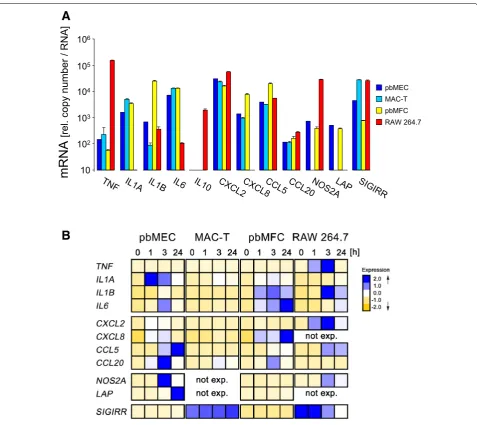
We profiled the expression levels of 12 immune genes in 4 of our 5 model cells (Figure 1A; Additional file 3 shows all data). For most genes they were quite similar between pbMEC, MAC-T and also pbMFC, with some exceptions. Key differences between pbMEC and MAC-T were that the latter cells did not express NOS2A and LAP, two of our parameters for bactericidal factors; and the
level of the SIGIRR-encoding mRNA was almost tenfold enhanced in MAC-T compared to pbMEC. The primary cultures of fibroblasts (pbMFC) expressed both bac-tericidal genes similar as pbMEC, but a highly elevated (approximately 100-fold) basal concentration of IL1B-encoding mRNA distinguished their basal expression profile from pbMEC and MAC-T.
RAW 264.7 cells revealed a greatly deviating profile of basal gene expression. These cells uniquely expressed IL10, featured an almost 1000-fold increased concentra-tion of the TNF-encoding mRNA and an approximately 40-fold higher concentration of the NOS2A-encoding mRNA than found in any of the other cells.
Primary bovine MEC dominantly upregulated bactericidal effector genes after E. coli challenge
We challenged all our model cells with a strong stimu-lus of E. coli for recording the almost full extent of the cell type specific immune response. Therefore, primary cultures of bovine mammary epithelial cells (pbMEC) and mammary gland derived fibroblasts (pbMFC) were stimulated with 30 µg/mL of heat-killed particles from the mastitis causing E. coli strain 1303 for up to 24 h. The resulting modulation of the mRNA concentration of our candidate genes was measured. We compared these data with results from parallel challenge experiments using the established bovine MEC model cells MAC-T and the murine cell line RAW 264.7, as a widely used model for murine macrophages. The E. coli challenge increased in RAW 264.7 cells the already very high basal concentra-tion of the TNF mRNA within 3 h by 80-fold (Figure 1B; Additional file 3) to eventually reaching >12 × 106
cop-ies per unit amount of RNA. The extent of increasing the TNF mRNA concentration was highest in pbMEC (>200-fold), but coming from a much lower basal level (148 ± 17 copies) of the control at t 0 h. It only reached approximately 3 × 10⁴ copies per unit amount of RNA as
maximal concentration. Induction of the TNF levels was also significant in MAC-T and pbMFCs cells. However, the maximum levels reached by either of these cells were only 25 or 10% (MAC-T and pbMFC, respectively) of that as it was reached in pbMEC. RAW 264.7 cells synthe-sized also the highest mRNA concentrations of CXCL2 exceeding by fivefold the maximum concentration found in pbMEC.
Distinguishing key features of the pbMEC were their ability to express highest levels of IL1A, CCL5 and of the bactericidal genes after the E. coli challenge (Figure 1B). This was not only very clear for the well-known antimi-crobial products from the β-defensin LAP and NOS2A-encoding genes but also for the bactericidal chemokine CCL20. Its expression increased by >1700-fold, 3 h after the E. coli stimulus (Additional file 3). These cells also revealed the highest induction (>1100-fold) for NOS2A expression, leading to a maximum mRNA concentration
of more than 0.8 × 10⁶ copies per RNA equivalent. For
comparison, RAW 264.7 reached less than 50% of that concentration and pbMFC only approximately 3% hereof.
Only RAW 264.7 cells regulated the expression of the immune dampening factors IL10 and SIGIRR
Only RAW 264.7 cells significantly expressed IL10 and the challenge increased this level by >tenfold during the first 3 h (Additional file 3). The increased expression of this dampening factor of inflammation was contrasted 10
102 103 104 105 106
pbMEC MAC-T pbMFC RAW 264.7
TNF IL1A IL1B IL6 IL10 CXCL2CXCL8CCL5 CCL20NOS2ALAP SIGIRR
mRNA
[rel. copy
number
/ RNA
]
A
B
by the observed challenge mediated downregulation of the high basal levels of the SIGIRR mRNA concentration in the same cells (Figure 1B; Additional file 3). The basal level of the SIGIRR mRNA concentration in MAC-T cells was at similar high levels as found in RAW 264.7 cells but was not downregulated during the E. coli challenge.
Gram‑positive pathogens elicited a widespread immune alert only in professional immune cells
We compared the pathogen species-specific immune response of the different cell types by challenging them with heat-inactivated preparations of S. aureus strain 1027 and S. uberis strain 233 in parallel to the E. coli chal-lenges. We added, as another cell model the response of monocyte-derived macrophages from cattle having been differentiated in vitro for 4 days (boMdM). This should allow to cross-checking the validity of conclusions drawn from the murine RAW 264.7 cells. We profiled the response of boMdM cultures established from three different cows (Additional files 1 and 5). Two of them responded quantitatively quite similar (#434, #561), while the cultures from the 3rd cow responded stronger and with faster induction of several genes. We included into the main comparison only the data from those similarly reacting cultures.
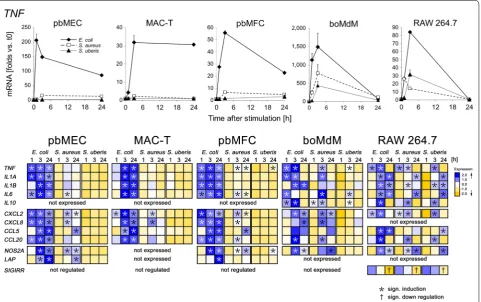
The E. coli challenge maximally induced all the can-didate genes, as expected (Figure 2; Additional file 4). The response against S. aureus was always stronger in the three cell types pbMEC, MAC-T and pbMFC than against S. uberis. Indeed, this pathogen did not induce any of the candidate genes to a significant extent in these cells. Maximum S. uberis caused gene inductions were recorded in pbMFC for TNF and NOS2A (3.1- and 4.5-fold; Additional file 4). All other S. uberis related gene inductions were well below twofold and statistically insignificant. In stark contrast, challenges with any of the three pathogens elicited in boMdM and RAW 264.7 a robust response characterized by a strong induction of immune gene expression. Again, induction of gene expression for most genes was strongest by E. coli and weakest by S. uberis, but the extent of inductions were all in the same order of magnitude for all genes (Figure 2).
S. aureus and S. uberis activated NF‑κB factors only in RAW 264.7 cells
Pathogen challenge induced activation of NF-κB factors serves as a master switch for the regulation of immune gene expression. It is also an integrating marker for any TLR-signaling. We monitored levels of active NF-κB by transfecting a NF-κB driven luciferase expressing reporter gene into those cells and subsequently chal-lenging them with the respective pathogens. BoMdMs could not be included into these experiments due to their
limited availability and their notorious poor transfec-tion efficiency. E. coli strongly (4.5- to 14-fold) activated NF-κB factors in all 4 different cell types (Figure 3). In contrast, S. aureus and S. uberis activated NF-κB only in RAW 264.7 cells, but not in the models for epithelial cells (pbMEC, MAC-T) and supporting cells (pbMFC). Of note, S. uberis induced the level of active NF-κB factors in the RAW 264.7 cells at least as strongly as E. coli.
Discussion
The udder is composed of a variety of different cell types each featuring a developmentally determined distinct immune competence. Their interplay governs the patho-gen species-specific immune physiology of the udder early on after a bacterial infection. A central goal of our study was therefore to identify the very cell type of the udder whose pathogen species-specific immune response profile conforms best with the in vivo well documented divergent physiology of the pathogen species-specific of mastitis [4, 5]. This should validate the relevance of the respective cell type for modelling molecular aspects of mastitis physiology. Our second, more technical goal was to evaluate the relevance of the established cell lines MAC-T and RAW 264.7 for modeling mastitis relevant key immune functions in MEC and macrophages from cows. Using established cell lines has the advantage of reproducibly providing a homogenous cell population ensuring good technical repeatability of experiments. Primary cell isolates inherently reflect the individual variability between donors and variance eventually intro-duced during the purification and differentiation pro-cedure. This is exemplified by our data regarding the quantitative (not qualitative) differences in the extent of immune stimulation of boMdMs through the challenges with the three pathogen species.
different pathogens are very difficult standardize. We have previously found no substantial difference in NF-κB and cytokine gene activation between short time (1 h) co-culture of MEC with live E. coli and S. aureus pathogens as compared to challenges using heat-killed preparations of the same pathogens [63]; the same was found compar-ing challenges with live vs. heat killed S. uberis [66]. This supports the value of using heat-killed pathogens in chal-lenge experiments.
Profiles of the cell type specific immune capacities
We have used a strong E. coli challenge [67] to reveal-ing the full cell type specific immune response capacity of the various cell types. As distinguishing features of the MEC emerged their high capacity to expressing the bactericidal factors β-defensins and CCL20 together with their pivotal capacity to express the cell recruiting factors CXCL2, CXCL8 and CCL5. Their sustained capacity to express and secrete bactericidal factors obviously serves Figure 2 Pathogen species-specific immune response of different cell types. Upper panel: Changes in the level of TNF expression (ordinate) over time (abscissa) after challenging with heat‑killed particles of the indicated pathogens. Lower panel: visualization of the data from several genes using the EXPANDER software. Each line displays the relative copy number of the respective gene as indicated over the time [h] of the challenge (1, 3, 24), normalized across all cell types to the average of 0 and variance 1. Data are taken from Additional file 4. Data are mean values (error bars, ±SEM) from two replica experiments, each assayed in duplicate.
to directly fighting off bacteria and preventing coloniza-tion of the alveolus. The pathogen mediated induccoloniza-tion of the PMN recruiting chemokines CXCL2 and CXCL8 was transient, while it was sustained for the monocyte recruiting factor CCL5. The only transient induction of PMN recruitment through MEC conceivably helps con-fining the danger of inducing immune pathology through overshooting secretion of aggressive factors from PMNs. This is particularly relevant considering the shear mass of MEC in the udder. In contrast, the cell types recruited by CCL5 are not known to secrete these very aggressive factors. The strong induction of IL1A gene expression in the MEC conceivably indicates that, upon injury related death of the MEC this factor is released into the sur-rounding as an inflammation mediator. It was shown that IL-1 may serve as a necrosis (but not apoptosis) related “damage-associated-molecular-pattern” capable of induc-ing sterile inflammation, for example durinduc-ing hypoxia [46].
The fibroblast pbMFC uniquely revealed after induc-tion the sustained high level expression of IL6 and CXCL8. Hence, these cells maintain secreting their danger induced signals and sustain their calling for help through cellular factors of innate immunity, since the invaded pathogens will not go away but rather keep multiplying at that specific location. However, they will contact only few cells in their immediate surrounding. This situation differs from that of epithelial cells lin-ing the alveoli. Here, the pathogens are rapidly movlin-ing around conceivably contacting many cells and hence the risk of inducing an overshooting alarm must be avoided.
Most obvious features of the RAW 264.7 macrophage model cells was their extraordinary high capacity for expressing TNF and the neutrophil attracting factor CXCL2. Hence, activation and recruitment of mac-rophages to the site of infection multiplies by orders of magnitude the initial danger signals (TNF, CXCL2) emitted by the epithelial cells. The macrophage model cells were the only to modulate the expression of two, yet unrelated dampening factors of inflammation. Only RAW 264.7 and boMdM cells expressed IL10 and stimu-lated its expression after pathogen stimulation. A promi-nent function of secreted IL10 is to confine the extent of inflammation by downregulating cytokine expression (among them IL1, IL6, TNF) in relevant target cells, such as TH1 cells [58, 68].
RAW 264.7 cells downregulated the expression of SIGIRR after pathogen stimulation. This factor is thought to interfere with TLR-signaling through preventing TLR-receptor dimerization. This prohibits formation of
productive MyD88 dependent TLR-signaling [60]. Hence, downregulating the synthesis of this factor increases the sensitivity of the TLR-signaling cascade. SIGIRR expres-sion serves also as a marker for differentiation since this factor is substantially expressed in monocytes, but only very weakly in fully differentiated macrophages [69].
Similarities and differences between the parental cell types and their established models
Comparison of the pathogen species-specific pro-file of gene induction shows for all genes that MAC-T responded weaker than pbMEC, however with the same kinetic. Importantly, it reflected the same gradation of the response as pbMEC (E. coli > S. aureus > S. uberis) including the almost complete absence of an immune reaction against the S. uberis challenge. We have previ-ously reported that the pbMEC response pattern against S. aureus strain 1027 is typical for several S. aureus strains [63] and show in a companion paper that their response against S. uberis strain 233 is typical for 20 different S. uberis strains, all having been isolated from udders of cows [66]. E. coli strain 1303 is representative for 21 other E. coli isolates from cases of both acute as well as persistent mastitis by the parameter of strong NF-κB activation in MAC-T cells (data not shown).
Moreover, we encountered in control experiments (unpublished) that different concentrations of FCS mod-ulate the response of MAC-T cells similarly as reported from pbMEC [63]. Absence of NF-κB induction through an S. aureus challenge in pbMEC was identified as key determinant for their low level immune response against S. aureus [23, 24] and S. uberis [66]. This indicates that the challenge did not activate any TLR-mediated sign-aling. MAC-T cells reflect also this highly important key feature of the pathogen species-specific immune response of pbMEC. Hence, our data together validate that MAC-T cells reflect some of the most crucial fea-tures distinguishing the immune reaction of MEC from professional immune cells.
through pathogen stimulation, in neither of both MEC model cells.
The comparison of the reaction profile of boMdM and RAW 264.7 reveals that strong induction of the immune gene expression by all three pathogen species is the com-mon and significant similarity between these two cell models. This is enabled by the strong activation of the NF-κB factor complex in these cells by all three patho-gens. This suggests that they all triggered TLR-signaling in these cells. The approximately equal immune respon-siveness against Gram-negative as well as Gram-positive pathogens appears to be an evolutionary conserved phe-notype common to cells of the macrophage lineage. We concluded in our previous studies that MEC are obvi-ously unable to unpack the relevant ligands of Gram-pos-itive cells (hence lipoproteins) for activating productive TLR2 signaling, for example [63]. Macrophages, on the other hand are known as professional antigen presenting cells. They do have the capacity to internalize bacteria, kill them (as indicated by high basal NOS2A expression, for example) and processing them for immune recogni-tion. Hence, diverse TLR-receptors and intra-cellular PRRs are likely to become activated by epitopes of Gram-positive bacteria which may not be recognizable by the trans-membrane TLR receptors [70].
However, we note three possibly significant differences between boMdM and RAW 264.7 cells. First, the extent of TNF induction was much stronger in boMdM than in RAW 264.7 cells. Second, IL1A and IL6 expression was only transiently induced in boMdM while the increase in mRNA concentration was sustained in RAW 264.7 cells. Last, SIGIRR expression was absent in boMdM, while being high in RAW 264.7 cells. This validates that the boMdM had indeed been differentiated into mac-rophages [69].
Our study shows in summary that the models for mam-mary epithelial cells and fibroblasts, but not macrophages respond with distinctly graded immune reactions against each of the three pathogens. E. coli but neither of the Gram-positive bacteria elicits in them synthesis of a strong and transient cytokine storm. This distinction is in part caused by the failure of MEC to activate TLR-mediated signaling upon challenges with S. aureus or S. uberis. Hence, the pathogen species-specific norm of the immune response of MEC appears to dictate the immune response of the udder early on after infection. Our direct comparison also reveals that S. uberis elicits in MEC an even weaker induction of immune functions than S. aureus. Both established model cell lines, MAC-T and RAW 264.7 properly reflect most of these key fea-tures of pathogen species-specific immune response of the respective parental cell type.
Abbreviations
CLIC1: chloride intracellular channel 1; GAPDH: glyceraldehyde 3‑phosphate dehydrogenase; FCS: fetal calf serum; GAPDH: glyceraldehyde‑3‑phosphate dehydrogenase; MOI: multiplicity of infection; NF‑κB: nuclear factor kappa‑ light‑chain‑enhancer of activated B‑cells; PMN: polymorphnuclear granu‑ locytes; PRR: pattern recognition receptor; TLR: toll‑like receptor; RT‑qPCR: reverse transcription quantitative PCR.
Competing interests
The authors declare that they have no competing interests.
Author details
1 Institute for Genome Biology, Leibniz Institute for Farm Animal Biology,
Dummerstorf, Germany. 2 Immunology Unit, University of Veterinary Medicine
Hannover, Foundation, Bischofsholer Damm 15, 30173 Hannover, Germany.
Authors’ contributions
MK and AB conducted the experiments; JG supervised the analysis and drafted the manuscript together with HJS and HMS, who also conceived the study. All authors read and approved the final manuscript.
Acknowledgements
We are grateful for the expert technical assistance by Angelika Deike. Prof. Ulrich Dobrindt (University of Münster, Germany) kindly provided the MAC‑T cells. We are also very grateful to Prof. Y. Schukken for providing the large collection of E. coli isolates from cases of mastitis. This study was supported by the Deutsche Forschungsgemeinschaft DFG (Grant GU 1487/1‑1).
Additional files
Additional file 1.Pathogen specific regulated gene expression in primary bovine monocyte-derived macrophages (boMdM). Extent and kinetics of modulated mRNA expression of TNF, IL6 and CCL20 after stimulating boMdM from three different animals (#434, #561, #996) with E. coli1303, S. aureus1027 or S. uberis233 for various times. Values are means from
two technical replicas (± SEM) of fold changes relative to unstimulated controls. Data are taken from Additional file 5.
Additional file 2.Sequences of the oligonucleotide primers used for real-time PCR quantification. List of the primers used for RT‑qPCR, of the pertinent source files and the resulting amplicon sizes.
Additional file 3.Modulated mRNA concentrations after stimulat-ing pbMEC, pbMFC, RAW 264.7 or MAC-T withE. coli1303for various times to illustrate basic and full-scale mRNA expression in these cell types. Values are means from two biological replica experiments, each assayed in duplicate (± SEM) of relative copy numbers; grey under‑ lay, significant induction; red underlay, significant down regulation, fold change > 2, P < 0.05 vs. unstimulated control. Bonferroni’s correction for multiple analyses was applied.
Additional file 4.Extent and kinetics of modulated mRNA concen-trations after stimulating pbMEC, pbMFC, RAW 264.7 or boMdM (#434 and #561) withE. coli1303, S. aureus1027orS.uberis233for various times. Values are means from two biological replica experiments, each assayed in duplicate (± SEM) of fold changes relative to unstimu‑ lated controls; grey underlay, significant induction; red underlay significant down regulation, fold change > 2, P < 0.05 vs. unstimulated control. Bonferroni’s correction for multiple analyses was applied.
Additional file 5.Pathogen specific regulated gene expression in primary bovine monocyte-derived macrophages (boMdM). Extent and kinetics of modulated mRNA concentrations after stimulating boMdM from three different animals (#434, #561, #996) with E. coli1303, S. aureus1027
or S. uberis233 for various times. Values are means from two technical
Received: 29 September 2015 Accepted: 17 December 2015
References
1. Burvenich C, Van M, V, Mehrzad J, Diez‑Fraile A, Duchateau L, (2003) Severity of E. coli mastitis is mainly determined by cow factors. Vet Res 34:521–564
2. Bannerman DD, Paape MJ, Hare WR, Hope JC (2004) Characterization of the bovine innate immune response to intramammary infection with Klebsiella pneumoniae. J Dairy Sci 87:2420–2432
3. Bannerman DD, Paape MJ, Lee JW, Zhao X, Hope JC, Rainard P (2004) Escherichia coli and Staphylococcus aureus elicit differential innate immune responses following intramammary infection. Clin Diagn Lab Immunol 11:463–472
4. Bannerman DD (2009) Pathogen‑dependent induction of cytokines and other soluble inflammatory mediators during intramammary infection of dairy cows. J Anim Sci 87:10–25
5. Schukken YH, Günther J, Fitzpatrick J, Fontaine MC, Goetze L, Holst O, Leigh J, Petzl W, Schuberth HJ, Sipka A, Smith DGE, Quesnell R, Watts J, Yancey R, Zerbe H, Gurjar A, Zadoks RN, Seyfert HM (2011) Host‑response patterns of intramammary infections in dairy cows. Vet Immunol Immu‑ nopathol 144:270–289
6. Zadoks R, Middleton J, McDougall S, Katholm J, Schukken Y (2011) Molec‑ ular epidemiology of mastitis pathogens of dairy cattle and comparative relevance to humans. J Mammary Gland Biol Neoplasia 16:357–372 7. Petzl W, Zerbe H, Günther J, Yang W, Seyfert H‑M, Schuberth HJ (2008)
Escherichia coli, but not Staphylococcus aureus triggers an early increased expression of factors contributing to the innate immune defense in the udder of the cow. Vet Res 39:18
8. Mitterhuemer S, Petzl W, Krebs S, Mehne D, Klanner A, Wolf E, Zerbe H, Blum H (2010) Escherichia coli infection induces distinct local and sys‑ temic transcriptome responses in the mammary gland. BMC Genomics 11:138
9. Lutzow YC, Donaldson L, Gray CP, Vuocolo T, Pearson RD, Reverter A, Byrne KA, Sheehy PA, Windon R, Tellam RL (2008) Identification of immune genes and proteins involved in the response of bovine mam‑ mary tissue to Staphylococcus aureus infection. BMC Vet Res 4:18 10. Jensen K, Günther J, Talbot R, Petzl W, Zerbe H, Schuberth HJ, Seyfert
HM, Glass E (2013) Escherichia coli‑ and Staphylococcus aureus‑induced mastitis differentially modulate transcriptional responses in neighbouring uninfected bovine mammary gland quarters. BMC Genomics 14:36 11. Moyes K, Drackley J, Morin D, Bionaz M, Rodriguez‑Zas S, Everts R, Lewin
H, Loor J (2009) Gene network and pathway analysis of bovine mammary tissue challenged with Streptococcus uberis reveals induction of cell proliferation and inhibition of PPARgamma signaling as potential mecha‑ nism for the negative relationships between immune response and lipid metabolism. BMC Genomics 10:542
12. de Greeff A, Zadoks R, Ruuls L, Toussaint M, Nguyen TKA, Downing A, Rebel J, Stockhofe‑Zurwieden N, Smith H (2013) Early host response in the mammary gland after experimental Streptococcus uberis challenge in heifers. J Dairy Sci 96:3723–3736
13. Akira S, Uematsu S, Takeuchi O (2006) Pathogen recognition and innate immunity. Cell 124:783–801
14. Uematsu S, Akira S (2008) Toll‑like receptors (TLRs) and their ligands. Handb Exp Pharmacol 2008:1–20
15. Takeuchi O, Akira S (2010) Pattern recognition receptors and inflamma‑ tion. Cell 140:805–820
16. Hoesel B, Schmid J (2013) The complexity of NF‑kappaB signaling in inflammation and cancer. Mol Cancer 12:86
17. Karin M, Lin A (2002) NF‑kappaB at the crossroads of life and death. Nat Immunol 3:221–227
18. Goldammer T, Zerbe H, Molenaar A, Schuberth HJ, Brunner RM, Kata SR, Seyfert HM (2004) Mastitis increases mammary mRNA abundance of β‑defensin 5, Toll‑like‑receptor 2 (TLR2), and TLR4 but not TLR9 in cattle. Clin Diagn Lab Immunol 11:174–185
19. Günther J, Koczan D, Yang W, Nürnberg G, Repsilber D, Schuberth HJ, Park Z, Macbool N, Molenaar A, Seyfert H‑M (2009) Assessment of the immune
capacity of mammary epithelial cells: comparison with mammary tissue after challenge with Escherichia coli. Vet Res 40:31
20. Strandberg Y, Gray C, Vuocolo T, Donaldson L, Broadway M, Tellam R (2005) Lipopolysaccharide and lipoteichoic acid induce different innate immune responses in bovine mammary epithelial cells. Cytokine 31:72–86
21. Capuco AV, Wood DL, Baldwin R, Mcleod K, Paape MJ (2001) Mammary cell number, proliferation, and apoptosis during a bovine lactation: rela‑ tion to milk production and effect of bST1. J Dairy Sci 84:2177–2187 22. Gray C, Strandberg Y, Donaldson L, Tellam RL (2005) Bovine mammary
epithelial cells, initiators of innate immune response to mastitis. Aust J Exp Agric 45:757–761
23. Yang W, Zerbe H, Petzl W, Brunner RM, Günther J, Draing C, von Aulock S, Schuberth HJ, Seyfert HM (2008) Bovine TLR2 and TLR4 properly trans‑ duce signals from Staphylococcus aureus and E. coli, but S. aureus fails to both activate NF‑[kappa]B in mammary epithelial cells and to quickly induce TNF[alpha] and interleukin‑8 (CXCL8) expression in the udder. Mol Immunol 45:1385–1397
24. Günther J, Esch K, Poschadel N, Petzl W, Zerbe H, Mitterhuemer S, Blum H, Seyfert HM (2011) Comparative kinetics of Escherichia coli- and Staphylo-coccus aureus‑specific activation of key immune pathways in mammary epithelial cells demonstrates that S. aureus elicits a delayed response dominated by interleukin‑6 (IL‑6) but not by IL‑1A or tumor necrosis fac‑ tor alpha. Infect Immun 79:695–707
25. Brand B, Hartmann A, Repsilber D, Griesbeck‑Zilch B, Wellnitz O, Kühn C, Ponsuksili S, Meyer HH, Schwerin M (2011) Comparative expression profiling of E. coli and S. aureus inoculated primary mammary gland cells sampled from cows with different genetic predispositions for somatic cell score. Genet Sel Evol 43:24
26. Fu Y, Zhou E, Liu Z, Li F, Liang D, Liu B, Song X, Zhao F, Fen X, Li D, Cao Y, Zhang X, Zhang N, Yang Z (2013) Staphylococcus aureus and Escherichia coli elicit different innate immune responses from bovine mammary epithelial cells. Vet Immunol Immunopathol 155:245–252
27. Huynh HT, Robitaille G, Turner JD (1991) Establishment of bovine mam‑ mary epithelial cells (MAC‑T): an in vitro model for bovine lactation. Exp Cell Res 197:191–199
28. Hosseini A, Sharma R, Bionaz M, Loor JJ (2015) Transcriptomics compari‑ sons of Mac‑T cells versus mammary tissue during late pregnancy and peak lactation. Adv Dairy Res 1:103
29. Almeida RA, Matthews KR, Cifrian E, Guidry AJ, Oliver SP (1996) Staphy-lococcus aureus invasion of bovine mammary epithelial cells. J Dairy Sci 79:1021–1026
30. Kim KW, Im J, Jeon JH, Lee HG, Yun CH, Han SH (2011) Staphylococ-cus aureus induces IL‑1beta expression through the activation of MAP kinases and AP‑1, CRE and NF‑kappaB transcription factors in the bovine mammary gland epithelial cells. Comp Immunol Microbiol Infect Dis 34:347–354
31. Matthews KR, Almeida RA, Oliver SP (1994) Bovine mammary epithelial cell invasion by Streptococcus uberis. Infect Immun 62:5641–5646 32. Im J, Lee T, Jeon JH, Baik JE, Kim KW, Kang SS, Yun CH, Kim H, Han SH
(2014) Gene expression profiling of bovine mammary gland epithelial cells stimulated with lipoteichoic acid plus peptidoglycan from Staphylo-coccus aureus. Int Immunopharmacol 21:231–240
33. Benjamin AL, Green BB, Hayden LR, Barlow JW, Kerr DE (2015) Cow‑to‑ cow variation in fibroblast response to a toll‑like receptor 2/6 agonist and its relation to mastitis caused by intramammary challenge with Staphylo-coccus aureus. J Dairy Sci 98:1836–1850
34. Kandasamy S, Kerr DE (2012) Genomic analysis of between‑cow vari‑ ation in dermal fibroblast response to lipopolysaccharide. J Dairy Sci 95:3852–3864
35. Düvel A, Frank C, Schnapper A, Schuberth HJ, Sipka A (2012) Classically or alternatively activated bovine monocyte‑derived macrophages in vitro do not resemble CD163/Calprotectin biased macrophage populations in the teat. Innate Immun 18:886–896
36. Gordon S, Taylor PR (2005) Monocyte and macrophage heterogeneity. Nat Rev Immunol 5:953–964
Submit your next manuscript to BioMed Central and take full advantage of:
• Convenient online submission
• Thorough peer review
• No space constraints or color figure charges
• Immediate publication on acceptance
• Inclusion in PubMed, CAS, Scopus and Google Scholar
• Research which is freely available for redistribution
Submit your manuscript at www.biomedcentral.com/submit 38. Sica A, Erreni M, Allavena P, Porta C (2015) Macrophage polarization in
pathology. Cell Mol Life Sci 72:4111–4126
39. Raschke WC, Baird S, Ralph P, Nakoinz I (1978) Functional macrophage cell lines transformed by abelson leukemia virus. Cell 15:261–267
40. Snyderman R, Pike MC, Fischer DG, Koren HS (1977) Biologic and biochemical activities of continuous macrophage cell lines P388D1 and J774.1. J Immunol 119:2060–2066
41. Walsh C, Gangloff M, Monie T, Smyth T, Wei B, McKinley TJ, Maskell D, Gay N, Bryant C (2008) Elucidation of the MD‑2/TLR4 interface required for signaling by lipid IVa. J Immunol 181:1245–1254
42. Maeshima N, Evans‑Atkinson T, Hajjar AM, Fernandez RC (2015) Bor‑ detella pertussis lipid A recognition by Toll‑like receptor 4 and MD‑2 is dependent on distinct charged and uncharged interfaces. J Biol Chem 290:13440–13453
43. Ohto U, Fukase K, Miyake K, Shimizu T (2012) Structural basis of species‑ specific endotoxin sensing by innate immune receptor TLR4/MD‑2. Proc Natl Acad Sci U S A 109:7421–7426
44. Willcocks S, Offord V, Seyfert HM, Coffey TJ, Werling D (2013) Species‑ specific PAMP recognition by TLR2 and evidence for species‑restricted interaction with Dectin‑1. J Leukoc Biol 94:449–458
45. Chu WM (2013) Tumor necrosis factor. Cancer Lett 328:222–225 46. Garlanda C, Dinarello C, Mantovani A (2013) The interleukin‑1 family: back
to the future. Immun 39:1003–1018
47. Scheller J, Chalaris A, Schmidt‑Arras D, Rose‑John S (2011) The pro‑ and anti‑inflammatory properties of the cytokine interleukin‑6. Biochim Biophys Acta 1813:878–888
48. Rincon M (2012) Interleukin‑6: from an inflammatory marker to a target for inflammatory diseases. Trend Immunol 33:571–577
49. Schaper F, Rose‑John S (2015) Interleukin‑6: biology, signaling and strate‑ gies of blockade. Cytokine Growth Factor Rev 26:475–487
50. Griffith JW, Sokol CL, Luster AD (2014) Chemokines and chemokine receptors: positioning cells for host defense and immunity. Ann Rev Immunol 32:659–702
51. Stillie R, Farooq SM, Gordon JR, Stadnyk AW (2009) The functional signifi‑ cance behind expressing two IL‑8 receptor types on PMN. J Leukoc Biol 86:529–543
52. Marques RE, Guabiraba R, Russo RC, Teixeira MM (2013) Targeting CCL5 in inflammation. Expert Opin Ther Targets 17:1439–1460
53. Schutyser E, Struyf S, Van Damme J (2003) The CC chemokine CCL20 and its receptor CCR6. Cytokine Growth Fact Rev 14:409–426
54. Yang D, Chen Q, Hoover DM, Staley P, Tucker KD, Lubkowski J, Oppenheim JJ (2003) Many chemokines including CCL20/MIP‑3 display antimicrobial activity. J Leukoc Biol 74:448–455
55. Förstermann U, Sessa WC (2012) Nitric oxide synthases: regulation and function. Europ Heart J 33:829–837
56. Ganz T (2003) Defensins: antimicrobial peptides of innate immunity. Nat Rev Immunol 3:710–720
57. Swanson K, Gorodetsky S, Good L, Davis S, Musgrave D, Stelwagen K, Farr V, Molenaar A (2004) Expression of a beta‑defensin mRNA, lingual
antimicrobial peptide, in bovine mammary epithelial tissue is induced by mastitis. Infect Immun 72:7311–7314
58. Cheng SB, Sharma S (2015) Interleukin‑10: a pleiotropic regulator in pregnancy. Am J Reprod Immunol 73:487–500
59. Trivella D, Ferreira‑Júnior JR, Dumoutier L, Renauld JC, Polikarpov I (2010) Structure and function of interleukin‑22 and other members of the interleukin‑10 family. Cell Mol Life Sci 67:2909–2935
60. Riva F, Bonavita E, Barbati E, Muzio M, Mantovani A, Garlanda C (2012) TIR8/SIGIRR is an interleukin‑1 receptor/toll like receptor family member with regulatory functions in inflammation and immunity. Front Immunol 3:322
61. Yang W, Molenaar AJ, Kurts‑Ebert B, Seyfert HM (2006) NF‑κB factors are essential, but not the switch, for pathogen‑related induction of the bovine β‑defensin 5‑encoding gene in mammary epithelial cells. Mol Immunol 43:210–225
62. Swanson KM, Stelwagen K, Dobson J, Henderson HV, Davis SR, Farr VC, Singh K (2009) Transcriptome profiling of Streptococcus uberis‑induced mastitis reveals fundamental differences between immune gene expres‑ sion in the mammary gland and in a primary cell culture model. J Dairy Sci 92:117–129
63. Bauer I, Günther J, Wheeler TT, Engelmann S, Seyfert H‑M (2015) Extracel‑ lular milieu grossly alters pathogen‑specific immune response of mam‑ mary epithelial cells. BMC Vet Res 11:67
64. Liu S, Shi X, Bauer I, Günther J, Seyfert HM (2011) Lingual antimicrobial peptide and IL‑8 expression are oppositely regulated by the antagonistic effects of NF‑[kappa]B p65 and C/EBP[beta] in mammary epithelial cells. Mol Immunol 48:895–908
65. Ulitsky I, Maron‑Katz A, Shavit S, Sagir D, Linhart C, Elkon R, Tanay A, Shara R, Shiloh Y, Shamir R (2010) Expander: from expression microarrays to networks and functions. Nat Protoc 5:303–322
66. Günther J, Czabanska A, Bauer I, Leigh JA, Holst O, Seyfert HM (2016) Streptococcus uberis strains isolated from the bovine mammary gland evade immune recognition by mammary epithelial cells, but not of macrophages. Vet Res 47:13
67. Günther J, Liu S, Esch K, Schuberth HJ, Seyfert HM (2010) Stimulated expression of TNF‑[alpha] and IL‑8, but not of lingual antimicrobial peptide reflects the concentration of pathogens contacting bovine mammary epithelial cells. Vet Immunol Immunopathol 135:152–157 68. Clipstone NA, Fiorentino DF, Crabtree GR (1994) Molecular analysis of
the interaction of calcineurin with drug immunophilin complexes. J Biol Chem 269:26431–26437
69. Drexler SK, Kong P, Inglis J, Williams RO, Garlanda C, Mantovani A, Yazdi AS, Brennan F, Feldmann M, Foxwell BMJ (2010) SIGIRR/TIR‑8 is an inhibi‑ tor of toll‑like receptor signaling in primary human cells and regulates inflammation in models of rheumatoid arthritis. Arthritis Rheumatol 62:2249–2261