R E S E A R C H A R T I C L E
Open Access
A systematic review of empirical bioethics
methodologies
Rachel Davies
1, Jonathan Ives
2*and Michael Dunn
3Abstract
Background:Despite the increased prevalence of bioethics research that seeks to use empirical data to answer normative research questions, there is no consensus as to what an appropriate methodology for this would be. This review aims to search the literature, present and critically discuss published Empirical Bioethics methodologies.
Methods:MedLine, Web of Science and Google Scholar were searched between 15/02/12 and 16/06/13 to find relevant papers. These were abstract reviewed independently by two reviewers with papers meeting the inclusion criteria subjected to data extraction.
Results:33 publications (32 papers and one book chapter) were included which contained 32 distinct methodologies. The majority of these methodologies (n = 22) can be classed as either dialogical or consultative, and these represent
two extreme‘poles’of methodological orientation. Consideration of these results provoked three central questions that
are central to the planning of an empirical bioethics study, and revolve aroundhowa normative conclusion can be
justified, theanalytic processthrough which that conclusion is reached, and thekindof conclusion that is sought.
Conclusion:When considering which methodology or research methods to adopt in any particular study, researchers need to think carefully about the nature of the claims they wish to generate through their analyses, and how these claims align with the aims of the research. Whilst there are superficial similarities in the ways that identical research methods are made use of, the different meta-ethical and epistemological commitments that undergird the range of methodological approaches adopted rehearse many of the central foundational disagreements that play out within moral philosophy and bioethical analysis more broadly. There is little common ground that transcends these disagreements, and we argue that this is likely to present a challenge for the legitimacy of the bioethical enterprise. We conclude, however, that this heterogeneity ought to be welcomed, but urge those involved in the field to engage meaningfully and explicitly with questions concerning what kinds of moral claim they want to be able to make, about normative justification and the methodological process, and about the coherence of these components within their work.
Keywords: Empirical bioethics, Method, Methodology, Integrated ethics, Coherence, Consensus, Epistemology
Background
This paper reports a systematic review of methodologies related to a particular kind of empirical bioethics (EB)
research – specifically, methodologies that seek to use
empirical data about stakeholder values, attitudes, beliefs and experiences to inform normative ethical theorising.
‘Empirical bioethics’ is a generic and broad term in-creasingly used to describe a particular kind of research
endeavour that seeks to ask and answer questions of bio-ethical interest in a way that draws on the strengths of both philosophical and empirical analysis [1-4]. Its ‘rise’ can, in part, be seen as a response to the social science cri-tique of philosophical bioethics, as described by Hedgecoe [5], which challenges what is seen as ‘traditional’ philo-sophical bioethics to become more contextually aware and more grounded in the realities of lived experience. In the context of this review we are, therefore, particularly inter-ested in looking at methodologies that seek to use social scientific data (usually about stakeholder attitudes, beliefs * Correspondence:[email protected]
2Medicine, Ethics, Society and History, School of Health and Population
Sciences, The University of Birmingham, 90 Vincent Drive, Edgbaston, Birmingham B15 2TT, UK
Full list of author information is available at the end of the article
and experiences) to inform and enhance ethical analyses of topics of bioethical interest.
Even thus specified, the term ‘empirical bioethics’ is commonly understood to refer to a wide range of vary-ing methodologies that have different views about how best to respond to the challenge of connecting normative bioethical analysis to the realities of lived moral experi-ence. There is considerable uncertainty about the range and substance of these methodologies, and there remains a difficulty in trying to articulate their aims and content. One standard response has been to articulate typologies that differentiate between different kinds of research en-deavour, and a number of useful typologies have, to date, been put forward to describe how philosophical theory and data can be combined [6-10]. DeVries [6], for ex-ample, offers a four-part typology that distinguishes be-tween practical research strategies that: (i) use empirical data to describe attitudes toward an issue; (ii) use empir-ical data to explore the likely or actual consequences of bioethical policies and decisions; (iii) use empirical data to explore the‘implicit normativity’in scientific/clinical prac-tice, and (iv) use empirical data to understand the institu-tion of bioethics.
An alternative, and quite different, typology is offered by Molewijk et al. [9] , who distinguish between differ-ent kinds of research strategy by reference to the locus of moral authority in order to clarify how best to arrive at a normative conclusion. Their typology differentiates between four research strategies that: (i) give complete authority to moral theory, and only use empirical data to provide evidence for premises or support factual claims; (ii) give precedence to moral theory but accommodate a one-way relationship between theory and data such that empirical research can be used to refine theory; (iii) give equal authority to both theory and data, such that both theory and interpretation of data can be adjusted in light of the other, and: (iv) remove theory altogether from eth-ical analysis and focus only on the particulars, which are identified through empirical research.
These typologies of general research strategies are use-ful because they begin to carve out the field according to what a piece of research might seek to achieve, and help-fully distinguishes between various ways of thinking about the research endeavour. What they do not do is explore the detail of, and differentiate between, different methodologies that fall within each of those strategies. A useful addition to this field would be, therefore, a systematic review of the methodological variation within these strategies. We note that systematic reviews in the field of bioethics are relatively rare, although their use is increasingly proposed [11,12]. The rationale for conducting a systematic review, as op-posed to the narrative reviews that we can find in the litera-ture to date, are, as Strech and Sofaer point out:“to reveal a greater range of…information than the informal reviews…
that are usual in bioethics and philosophy, which sample literature using unsystematic, undocumented search methods to the unspecified point at which it seems to the author (often the only author) that [nothing new emerges]” [11], p122.
This paper reports a systematic review focussing spe-cifically on methodological strategies that seek to draw normative conclusions through the integration of social scientific empirical data collection/analysis and normative/ ethical theorising. This might best be thought of as falling within Molewijket al's. [9] category of bothCritical Applied
Ethics orIntegrated Ethics, and which we describe simply
as being ‘integrative’. This integrative approach seems to offer the best chance, at least in theory, of genuinely acces-sing the strengths of both the empirical and the philo-sophical contributions, and through our engagement with the field to date we felt that it is the approach that has re-ceived the most methodological attention, is the most het-erogeneous, and is most in need of systematic review. In addition, the report from the first workshop of the UK based Interdisciplinary and Empirical Ethics Network (IEEN) [13], concluded that there are important questions to ask about,inter alia:
1. What kinds of normative conclusions empirical bioethics ought to be aiming for, suggesting that “[t]he debate over whether their research seeks objective and universalisable answers, or more subjective and particularist answers, is perhaps best worked out locally given the particular aims and agendas defined in each research project”. [13] p160. 2. The way that empirical bioethics seeks to provide
justification for its conclusions, stating that“The fundamental question concerning justificatory authority - how we can articulate why and how our conclusions can be considered better, or worse, than anyone else’s–remains unresolved”. [13] p160.
With this in mind, this review aimed to:
1. Identify the number and range of published ‘integrative’empirical bioethics methodologies available.
2. Explore differences and similarities between those published methodologies, with a view to identifying and discussing key questions about aims, analytic process and justification that differentiate between different kinds of methodologies.
Methods
The initial search for this review was conducted between February and March 2012. The review was conducted in accordance with the Cochrane guidelines [17]a. Three da-tabases (Google Scholar, Web of Science and MedLine) were searched, up until 16/03/2012. These three databases were chosen because we found that, between them, they indexed all the kinds of journals in which our target papers were likely to be published. Given the time and re-source restrictions on the projectb, we made a conscious decision to use databases that would index likely jour-nals; i.e. those that publish papers around the nexus of medicine, healthcare, ethics, philosophy and research methodologies.
Broad search terms were used to allow for the wide vari-ation in terms we knew to be present in the literature, with a separate set of terms to ensure that only papers including a methodology were returned. The most sig-nificant difficulty we had lay in the fact that there is no agreed terminology used to label this kind of research endeavour, and so we aimed to develop a very wide and inclusive search strategy. Numerous scoping searches were performed using Google Scholar to select terms that were able to identify relevant papers without turning up thousands of papers that were irrelevant. The initial search terms, developed after scoping searches, were:
(“Empirical Bioethics”OR“Evidence Based Bioethics” OR“Interdisciplinary Bioethics”OR“Empirical Ethics”) AND
(Methodology* OR Method* OR Process*)
This produced approximately 1240 search results, of which 37.5% of the first 150 passed title screening.
When applied to MedLine, however, this search pro-duced only 19 results of which 18 passed title screening. This indicated that our search terms were sensitive to keywords used on Google Scholar but not MedLine. The search was therefore extended to include additional and, arguably, less technical terms, that seemed likely to capture papers that talked about relevant method-ologies without naming them. These additions increased the sensitivity of the search in Medline, and had no
significant effect in Google Scholar. The final set of search terms used were:
(“Empirical Bioethics”OR“Evidence based bioethics” OR“Interdisciplinary bioethics”OR“Empirical Ethics” OR“Social sciences perspectives on bioethics”OR “Empirical Research in Bioethics”OR“ Empirical-Ethical Research”OR“”Ethics-Related Empirical Research”)
AND
(Methodology* OR Method* OR Process*)
Truncations were used to cover the second phase of the search in order to include all forms of the words. Both‘methodology’and‘method’were used, to allow for the fact that some authors may refer to the overriding process as a‘method’.
No limits were placed on the publication date, mean-ing that any relevant papers, regardless of publication date, would be found. A small secondary search was also performed using existing bibliographies of EB literaturec and by searching the references of included papers.
Search results were title screened by RD for relevance, followed by abstract review against the inclusion criteria (see List of Criteria for inclusion into review). Multiple papers by the same author could be included, as could publications not exclusively aimed at bioethics if they met all other criteriad. Abstract review was performed independently by two reviewers (RD and JI), who rated the papers as either‘accept’,‘reject’, or‘unclear’. Both re-viewers met to compare their independent reviews. All abstracts for which there were concordant‘agree’reviews were accepted for data extraction. All papers for which there was a concordant‘reject’review were eliminated. In the case of disagreement, or when either reviewer was un-sure, the entire paper was screened followed by the same review process. Included papers were subjected to data ex-traction using a pre-formed data-exex-traction sheet, which recorded details on aims, methods and epistemological/ philosophical assumptions (see List of Headings from Data Extraction sheet).
List of criteria for inclusion into review
Paper or book chapter Written in English
Discusses concept of ‘EB’, even if the phrase itself isn’t used
Details a methodology
Aims to draw normative conclusions (not just description, sociological analyses or gathering data to support factual premises in argument)
List of headings from data extraction sheet
Title of paper Author/s
Name of methodology
Stepwise procedure given/Overarching process described (tick boxes)
Linear/Cyclical/Iterative/Other or none (tick boxes) Aim of the research/conclusion
Details of data collection method
Data analysis method given (if not provided why not/what is said about data analysis)
Details of method for developing normative outcomes
Philosophical commitments stated/implied Social scientific commitments stated/implied Theories in opposition and why: Author stated/
reviewer
Strengths and weaknesses- Philosophical: Author stated/Reviewer identified
Strengths and weaknesses- Practical: Author stated/Reviewer identified
Other notes
The extracted data were then used to categorise the meth-odologies, with the aim of identifying similarities and differ-ences in the processes used and grouping them according to those similarities.. These process categories were then scru-tinised to see if further sub-categories were warranted.
In May 2013 the search was repeated to update the re-sults with a view to publication. The same search terms, databases, screening methods and inclusion criteria were used as in the initial search. This search was limited to show only results published since 2012 to minimise the number of duplications from the original search. Again,
a secondary search of included papers’ references was
undertaken, as well as any recent additions to EB read-ing list and bibliographies. Methods of review and data extraction were performed as described above.
Interpretation and analysis
Data extraction allowed the key methodological charac-teristics of each paper to be identified and summarised, which helped us begin the interpretive process of cat-egorisation. The papers were then initially categorised and sub-categorised on the basis of the methodological process they use. On occasion, multiple papers, often by the same authors, discussed the same processes and these were combined to remove duplication. One paper de-scribed three different methodologies. This resulted in the identification of 32 distinct methodologies, spread across 33 different papers.
The categorisation of papers was driven by our apriori
focus on methodology; and our analysis was directed
towards looking for methodological similarity and dis-similarity and, at least initially, informed by the work-shop report on the IEEN (13), which called for more information on justification, process and aims. Our data extraction sheet mirrored differences that we had ob-served in the literature - for example, was the research process cyclical, linear or iterative? Whilst this helped us to structure our initial thinking, those three categories were not ultimately useful, as they did not fully capture what we felt were the key aspects of the methodologies that were included.
The categories and subcategories we ended up using were generated through a process of reflection and in-duction. After data extraction was complete, RD, JI and MD met to discuss how to categorise the 32 methodolo-gies, and agreed on an initial two-way categorisation that distinguished between ‘dialogical’ and ‘consultative’ ap-proaches, based on a fundamental difference. These two categories arose naturally from the data, as the method-ologies tended to either generate normative conclusions with participants through a dialogue, or generate norma-tive conclusions after consulting with participants in some way. We then attempted to place each methodology into one of those categories, and then considered whether those methodologies that did not clearly fit into either cat-egory provided evidence that the two categories were wrong, or that these categories needed to be extended. On closer examination, a few methodologies seemed to en-compass elements of both categories, and some were clearly neither dialogical nor consultative but had nothing sufficiently in common to generate a new meaningful cat-egory. A similar reflective and inductive process was then used to examine methodologies within each category, leading to the consultative category being split into more specific groupings that shared a common and distinctive methodological characteristics.
Results
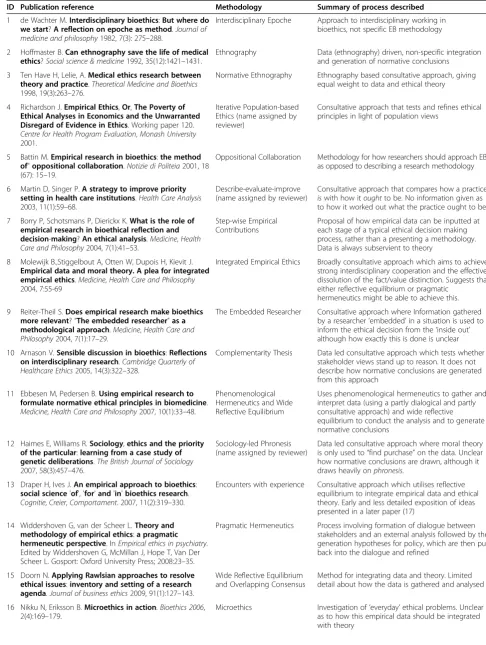
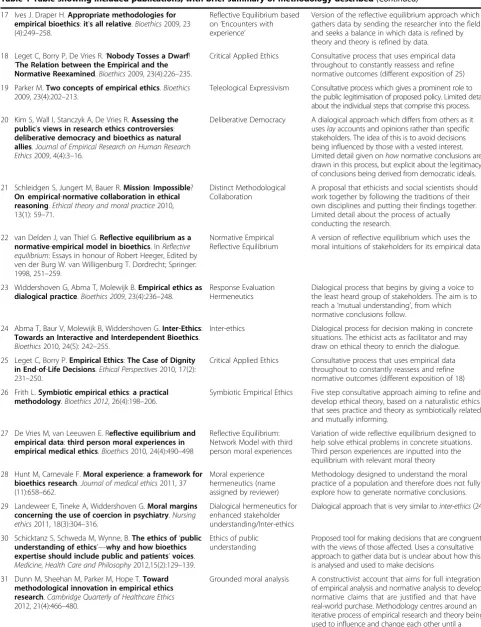
A total of 36 publications were initially selected for data extraction. Three were then excluded for not meeting the inclusion criteria, having been included on abstract alone, leaving 33 publications included (see Table 1). The PRISMA diagram in Figure 1 depicts the search and screening process over the two searches conducted.
Table 1 Table showing included publications, with brief summary of methodology described
ID Publication reference Methodology Summary of process described
1 de Wachter M.Interdisciplinary bioethics:But where do we start?A reflection on epoche as method.Journal of medicine and philosophy1982, 7(3): 275–288.
Interdisciplinary Epoche Approach to interdisciplinary working in bioethics, not specific EB methodology
2 Hoffmaster B.Can ethnography save the life of medical ethics?Social science & medicine1992, 35(12):1421–1431.
Ethnography Data (ethnography) driven, non-specific integration and generation of normative conclusions
3 Ten Have H, Lelie, A.Medical ethics research between theory and practice.Theoretical Medicine and Bioethics
1998, 19(3):263–276.
Normative Ethnography Ethnography based consultative approach, giving equal weight to data and ethical theory
4 Richardson J.Empirical Ethics,Or,The Poverty of Ethical Analyses in Economics and the Unwarranted Disregard of Evidence in Ethics. Working paper 120.
Centre for Health Program Evaluation,Monash University
2001.
Iterative Population-based Ethics (name assigned by reviewer)
Consultative approach that tests and refines ethical principles in light of population views
5 Battin M.Empirical research in bioethics:the method of"oppositional collaboration.Notizie di Politeia2001, 18 (67): 15–19.
Oppositional Collaboration Methodology for how researchers should approach EB as opposed to describing a research methodology
6 Martin D, Singer P.A strategy to improve priority setting in health care institutions.Health Care Analysis
2003, 11(1):59–68.
Describe-evaluate-improve (name assigned by reviewer)
Consultative approach that compares how a practice
iswith how itoughtto be. No information given as to how it worked out what the practice ought to be
7 Borry P, Schotsmans P, Dierickx K.What is the role of empirical research in bioethical reflection and decision-making?An ethical analysis.Medicine,Health Care and Philosophy2004, 7(1):41–53.
Step-wise Empirical Contributions
Proposal of how empirical data can be inputted at each stage of a typical ethical decision making process, rather than a presenting a methodology. Data is always subservient to theory
8 Molewijk B.,Stiggelbout A, Otten W, Dupois H, Kievit J.
Empirical data and moral theory. A plea for integrated empirical ethics.Medicine,Health Care and Philosophy
2004, 7:55-69
Integrated Empirical Ethics Broadly consultative approach which aims to achieve strong interdisciplinary cooperation and the effective dissolution of the fact/value distinction. Suggests that either reflective equilibrium or pragmatic
hermeneutics might be able to achieve this.
9 Reiter-Theil S.Does empirical research make bioethics more relevant?“The embedded researcher”as a methodological approach.Medicine,Health Care and Philosophy2004, 7(1):17–29.
The Embedded Researcher Consultative approach where Information gathered by a researcher‘embedded’in a situation is used to inform the ethical decision from the‘inside out’ although how exactly this is done is unclear
10 Arnason V.Sensible discussion in bioethics:Reflections on interdisciplinary research.Cambridge Quarterly of Healthcare Ethics2005, 14(3):322–328.
Complementarity Thesis Data led consultative approach which tests whether stakeholder views stand up to reason. It does not describe how normative conclusions are generated from this approach
11 Ebbesen M, Pedersen B.Using empirical research to formulate normative ethical principles in biomedicine.
Medicine,Health Care and Philosophy2007, 10(1):33–48.
Phenomenological Hermeneutics and Wide Reflective Equilibrium
Uses phenomenological hermeneutics to gather and interpret data (using a partly dialogical and partly consultative approach) and wide reflective equilibrium to conduct the analysis and to generate normative conclusions
12 Haimes E, Williams R.Sociology,ethics and the priority of the particular:learning from a case study of genetic deliberations.The British Journal of Sociology
2007, 58(3):457–476.
Sociology-led Phronesis (name assigned by reviewer)
Data led consultative approach where moral theory is only used to“find purchase”on the data. Unclear how normative conclusions are drawn, although it draws heavily onphronesis.
13 Draper H, Ives J.An empirical approach to bioethics:
social science'of', 'for'and'in'bioethics research.
Cognitie,Creier,Comportament. 2007, 11(2):319–330.
Encounters with experience Consultative approach which utilises reflective equilibrium to integrate empirical data and ethical theory. Early and less detailed exposition of ideas presented in a later paper (17)
14 Widdershoven G, van der Scheer L.Theory and methodology of empirical ethics:a pragmatic hermeneutic perspective. InEmpirical ethics in psychiatry. Edited by Widdershoven G, McMillan J, Hope T, Van Der Scheer L. Gosport: Oxford University Press; 2008:23–35.
Pragmatic Hermeneutics Process involving formation of dialogue between stakeholders and an external analysis followed by the generation hypotheses for policy, which are then put back into the dialogue and refined
15 Doorn N.Applying Rawlsian approaches to resolve ethical issues:inventory and setting of a research agenda.Journal of business ethics2009, 91(1):127–143.
Wide Reflective Equilibrium and Overlapping Consensus
Method for integrating data and theory. Limited detail about how the data is gathered and analysed
16 Nikku N, Eriksson B.Microethics in action.Bioethics 2006, 2(4):169–179.
Table 1 Table showing included publications, with brief summary of methodology described(Continued)
17 Ives J. Draper H.Appropriate methodologies for empirical bioethics:it's all relative.Bioethics2009, 23 (4):249–258.
Reflective Equilibrium based on‘Encounters with experience’
Version of the reflective equilibrium approach which gathers data by sending the researcher into the field, and seeks a balance in which data is refined by theory and theory is refined by data.
18 Leget C, Borry P, De Vries R.‘Nobody Tosses a Dwarf!
’The Relation between the Empirical and the Normative Reexamined.Bioethics2009, 23(4):226–235.
Critical Applied Ethics Consultative process that uses empirical data throughout to constantly reassess and refine normative outcomes (different exposition of 25)
19 Parker M.Two concepts of empirical ethics.Bioethics
2009, 23(4):202–213.
Teleological Expressivism Consultative process which gives a prominent role to the public legitimisation of proposed policy. Limited detail about the individual steps that comprise this process.
20 Kim S, Wall I, Stanczyk A, De Vries R.Assessing the public's views in research ethics controversies:
deliberative democracy and bioethics as natural allies.Journal of Empirical Research on Human Research Ethics2009, 4(4):3–16.
Deliberative Democracy A dialogical approach which differs from others as it useslayaccounts and opinions rather than specific stakeholders. The idea of this is to avoid decisions being influenced by those with a vested interest. Limited detail given onhownormative conclusions are drawn in this process, but explicit about the legitimacy of conclusions being derived from democratic ideals.
21 Schleidgen S, Jungert M, Bauer R.Mission:Impossible?
On empirical-normative collaboration in ethical reasoning.Ethical theory and moral practice2010, 13(1): 59–71.
Distinct Methodological Collaboration
A proposal that ethicists and social scientists should work together by following the traditions of their own disciplines and putting their findings together. Limited detail about the process of actually conducting the research.
22 van Delden J, van Thiel G.Reflective equilibrium as a normative-empirical model in bioethics. InReflective equilibrium: Essays in honour of Robert Heeger, Edited by ven der Burg W. van Willigenburg T. Dordrecht; Springer: 1998, 251–259.
Normative Empirical Reflective Equilibrium
A version of reflective equilibrium which uses the moral intuitions of stakeholders for its empirical data
23 Widdershoven G, Abma T, Molewijk B.Empirical ethics as dialogical practice.Bioethics 2009, 23(4):236–248.
Response Evaluation Hermeneutics
Dialogical process that begins by giving a voice to the least heard group of stakeholders. The aim is to reach a‘mutual understanding’, from which normative conclusions follow.
24 Abma T, Baur V, Molewijk B, Widdershoven G.Inter‐Ethics:
Towards an Interactive and Interdependent Bioethics.
Bioethics2010, 24(5): 242–255.
Inter-ethics Dialogical process for decision making in concrete situations. The ethicist acts as facilitator and may draw on ethical theory to enrich the dialogue.
25 Leget C, Borry P.Empirical Ethics:The Case of Dignity in End-of-Life Decisions.Ethical Perspectives2010, 17(2): 231–250.
Critical Applied Ethics Consultative process that uses empirical data throughout to constantly reassess and refine normative outcomes (different exposition of 18)
26 Frith L.Symbiotic empirical ethics:a practical methodology.Bioethics 2012, 26(4):198–206.
Symbiotic Empirical Ethics Five step consultative approach aiming to refine and develop ethical theory, based on a naturalistic ethics that sees practice and theory as symbiotically related and mutually informing.
27 De Vries M, van Leeuwen E. Reflective equilibrium and empirical data:third person moral experiences in empirical medical ethics.Bioethics 2010, 24(4):490–498
Reflective Equilibrium: Network Model with third person moral experiences
Variation of wide reflective equilibrium designed to help solve ethical problems in concrete situations. Third person experiences are inputted into the equilibrium with relevant moral theory
28 Hunt M, Carnevale F.Moral experience:a framework for bioethics research.Journal of medical ethics2011, 37 (11):658–662.
Moral experience hermeneutics (name assigned by reviewer)
Methodology designed to understand the moral practice of a population and therefore does not fully explore how to generate normative conclusions.
29 Landeweer E, Tineke A, Widdershoven G.Moral margins concerning the use of coercion in psychiatry.Nursing ethics2011, 18(3):304–316.
Dialogical hermeneutics for enhanced stakeholder understanding/Inter-ethics
Dialogical approach that is very similar tointer-ethics(24)
30 Schicktanz S, Schweda M, Wynne, B.The ethics of‘public understanding of ethics’—why and how bioethics expertise should include public and patients’voices.
Medicine,Health Care and Philosophy2012,15(2):129–139.
Ethics of public understanding
Proposed tool for making decisions that are congruent with the views of those affected. Uses a consultative approach to gather data but is unclear about how this is analysed and used to make decisions
31 Dunn M, Sheehan M, Parker M, Hope T.Toward methodological innovation in empirical ethics research.Cambridge Quarterly of Healthcare Ethics
2012, 21(4):466–480.
undertaken by the researcher and participants together. These approaches generally aim to find a resolution to a discrete problem. On the other pole we find Consultative approaches, which tend to utilise an external‘thinker’who gathers data and analyses it independently of the data col-lection process, and then develops normative conclusions. Essentially, this approach ‘consults’ with participants to
obtain their views and experiences, but participants do not take part in the process of forming a normative con-clusion. In consultative approaches the data can be gath-ered in any number of ways and may come in many different forms, and the aims of consultative approaches, vary; ranging from theory development to the generation of concrete answers to discrete problems.
Table 1 Table showing included publications, with brief summary of methodology described(Continued)
Moral conversation A dialogical approach coming from the same theoretical standpoint as above. Intended to bring about focussed engagement and reflection within practice by forming a dialogue between stakeholders
Moral participation Again, from the same theoretical standpoint as above. The researcher actively experiences a situation and then undergoes a process of critical reflection which must stand up to ethical reasoning
32 Rehmann-Sutter C, Porz R, Leach Scully J.How to Relate the Empirical to the Normative.Cambridge Quarterly of Healthcare Ethics2012, 21(4):436–447.
Phenomenological Hermeneutics
The researcher produces ethical arguments which, on phenomenological foundations, the data provides the conditions to evaluate. Involves hermeneutic‘circles’ -including whether the future‘reader’of any conclusion made will consider their findings to have any normative authority
33 Ives J.A method of reflexive balancing in a pragmatic,
interdisciplinary and reflexive bioethics.Bioethics2014. 28(6):302–312.
Reflexive Balancing Although utilising the concept of coherence this methodology is distinct from reflective equilibrium in that it gives initial weighting to certain‘boundary’ principles with which coherence is sought but which must then justify their own inclusion. This is likened to a‘null hypothesis’which must be proven or disproven. An explicitly pragmatic process, relying on a naturalistic ethics that focuses on achieving a defensible compromise in genuinely dilemmatic situations.
34 passed title screening
65 results from Web of Science
42 results from MedLine 2472 results from Google Scholar
52 passed title screening 182 passed title screening
153 results once duplicates removed
179 abstracts Screened 26 records from other sources:
23 from bibliographies 3 from secondary searches of other results
104 agreed to reject 24 agreed to include
50 full texts reviewed 38 Rejected
2 due to language 1 unable to access
12 included
36 subjected to data extraction 3 excluded at this time as ultimately did not meet inclusion criteria
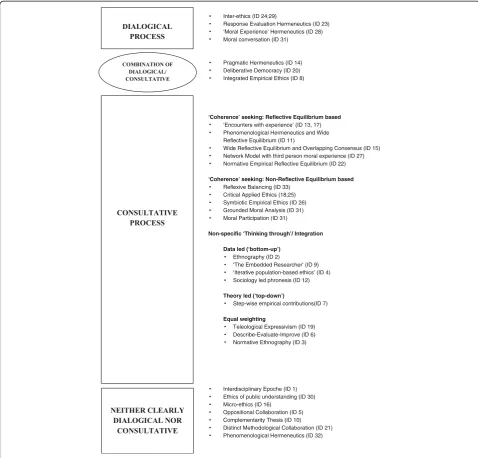
The consultative group was highly varied and could be further sub-categorised according to the process used by the
‘thinker’(or the researcher). Within the consultative group, five methodologies propose a form of Wide Reflective Equilibrium (RE), and five describe non-RE coherence based methodologies. Eight methodologies were less clear about the consultative process (or method) of drawing normative conclusions - describing a non-specific ‘ thinking-through’(our term). Within this latter group there is con-siderable variation in where the locus of authority is placed. Four give data priority over theory, one gives theory priority over data, and three give equal weight to both.
Finally, seven methodologies are neither clearly dialogical nor consultative, and three methodologies (pragmatic her-meneutics, deliberative democracy and integrated empir-ical ethics) may comprise elements of both.
Discussion
The two poles of methodological orientation that we have used to categorise the majority of methodologies are useful in the sense that they provide a very general way of thinking about how a normative conclusion can be reached. In Dialogical approaches, the ethical analysis and reaching of a normative conclusion is part of the re-search encounter itself. Reaching consensus, in one form
NEITHER CLEARLY DIALOGICAL NOR
CONSULTATIVE DIALOGICAL
PROCESS
CONSULTATIVE PROCESS
Inter-ethics (ID 24;29)
Response Evaluation Hermeneutics (ID 23) ‘Moral Experience’ Hermeneutics (ID 28) Moral conversation (ID 31)
Pragmatic Hermeneutics (ID 14) Deliberative Democracy (ID 20) Integrated Empirical Ethics (ID 8)
‘Coherence’ seeking: Reflective Equilibrium based ‘Encounters with experience’ (ID 13, 17) Phenomenological Hermeneutics and Wide Reflective Equilibrium (ID 11)
Wide Reflective Equilibrium and Overlapping Consensus (ID 15) Network Model with third person moral experience (ID 27) Normative Empirical Reflective Equilibrium (ID 22)
‘Coherence’ seeking: Non-Reflective Equilibrium based Reflexive Balancing (ID 33)
Critical Applied Ethics (18;25) Symbiotic Empirical Ethics (ID 26) Grounded Moral Analysis (ID 31) Moral Participation (ID 31)
Non-specific ‘Thinking through’/ Integration
Data led (‘bottom-up’) Ethnography (ID 2)
‘The Embedded Researcher’ (ID 9) ‘Iterative population-based ethics’ (ID 4) Sociology led phronesis (ID 12)
Theory led (‘top-down’)
Step-wise empirical contributions(ID 7)
Equal weighting
Teleological Expressivism (ID 19) Describe-Evaluate-Improve (ID 6) Normative Ethnography (ID 3)
Interdisciplinary Epoche (ID 1) Ethics of public understanding (ID 30) Micro-ethics (ID 16)
Oppositional Collaboration (ID 5) Complementarity Thesis (ID 10) Distinct Methodological Collaboration (ID 21) Phenomenological Hermeneutics (ID 32)
COMBINATION OF DIALOGICAL/ CONSULTATIVE
or another, plays a significant role here, with moral au-thority generated, for example, through a hermeneutic
‘fusing of horizons’ [18], or democratic mandate [19]. By contrast, consultative approaches involve explicit engage-ment with stakeholder views, but with the ethical analysis being undertaken post-engagement, by the researcher or the research team. In these latter accounts, stakeholders feed into the ethical analysis, but are not involved in it dir-ectly. Moral authority, in these approaches, is more likely to come from theoretical soundness.
Distinguishing between these two poles of methodo-logical orientation fails, however, to accommodate the sig-nificant differences within the orientations themselves. The consultative orientation, in particular, includes a wide range of divergent methods which assume different epistemo-logical and meta-ethical commitments. What this variation illustrates, quite strikingly, is not only the wide variation in methods, but also the attendant variation in the aims and epistemologies associated with these methods. Different methodologies produce different kinds of knowledge, such that the epistemological status of the conclusions arising out of, for example a project using ‘inter-ethics’ will be quite different from a project using ‘deliberative democ-racy’,‘symbiotic bioethics’or a‘network model with third
person moral experience’. Consequently, how normative
conclusions are justified–the source of moral authority -will be different in each, which -will affect the grounds upon which any conclusions can be accepted.
Considering the results of the systematic review, we feel that there are three further questions that are immedi-ately provoked by the data presented above and the broad differences we have observed across the methodologies
identified. These questions revolve around how a
nor-mative conclusion can be justified, the analytic process
through which that conclusion is reached, and thekindof conclusions that are sought. In the remainder of this paper we outline those questions and discuss, briefly, their rele-vance and importance.
Howa normative conclusion can be justified: can moral justification be found through consensus or coherence? This question mirrors a general philosophical debate around what justifies claims to moral knowledge, or to knowledge in general. In-depth engagement with this question may require immersion in philosophical and sociological epistemology, philosophy of science and the-ories of truth, which we do not have space for in this paper. The main point we are trying to make, here, is that there is a long tradition of philosophical thought that deals with these questions of justification, know-ledge and truth, and a commitment to any specific em-pirical bioethics methodology is likely to involve aligning oneself with a particular epistemology about how a claim to moral knowledge can be justified.
A research method that appeals to consensus to justify a normative conclusion finds moral authority in agree-ment of some kind. Some‘dialogical’methods rely on her-meneutic philosophy to explain how this agreement works, appealing to a’fusion of horizons’premised on achieving a shared understanding and interpretation of the world. These methods rely, broadly speaking, on accepting the view that a process of dialogue can lead to people under-standing the world in the same way, which leads to agree-ment on the correct solution. Many dialogical methods are based on facilitating that dialogue e.g. [18], and that facilitation comprises the empirical and ethical research project. The normative conclusion generated through that dialogical process becomes the findings of the research. Alternatively, some approaches seek a different kind of consensus: one based on a political philosophical claim about democratic authority rather than a meta-ethical claim about shared interpretation and moral knowledge [19]. Agreement, here, is not the basis of justification but, rather, justification flows from the legitimacy of the demo-cratic processes invoked to draw normative conclusions.
Conversely, a research method that appeals to coher-ence finds moral authority, broadly speaking, in rational-ity and consistency. The difficult question that needs an answer is what‘coherence’means, what it looks like, and what has to‘cohere’with what. One option is coherence with moral theory, and a conclusion is coherent if it fits, logically, with a particular theoretical viewpoint. This is one traditional (analytic) philosophical approach, which an integrative empirical bioethics would tend to reject due to the lack of attention it accords to the contingent features of ‘real-world’settings. An alternative option is that coherence may be found between data and theory (as in narrow reflective equilibrium) or between a num-ber of relevant considerations (as in wide reflective equi-librium). A research method that draws on coherence will tend to involve some process of balancing, where a coherent position is found between the various relevant considerations.
Many of the consultative approaches identified are based on coherence, the majority of which explicitly refer to wide reflective equilibrium, and seek to find a balance (an
methodological approaches put forward by Dunn et al. [4] interpret coherence with reference to argumentative stan-dards in ‘real-world’ practical reasoning, rather than in terms of any alignment between moral theory and empir-ical facts. Here, the purpose of the research is to develop normative claims in which there is coherence between universal standards of justification for convincing argu-ments of all kinds, and relevant contextual considerations that enable agents to be convinced to act in line with the requirements of these arguments.
Theanalytic processthrough which that conclusion is reached: should we prioritise the thinker, the theory or the stakeholders?
One of the most fundamental questions that must be con-sidered is who, or what, should be doing the substantive analytic work in empirical bioethics research. Broadly speak-ing, in the methods and methodologies identified above we find three possible answers to this question.
First, a methodology where the thinker does the work is reliant upon a single central person (or sometimes central team). This would usually be the researcher, or the research team, who takes the analytic burden and whose judgement is central to the analytic process. Any normative conclu-sions belong to that‘thinker’(or group of thinkers), and a different, but similarly robust and coherent, thinker (or thinkers) could reach a different conclusion, and this may impact on how the conclusions are presented, requiring, perhaps, a certain amount of reflexivity see [21]. In our sample of included methodologies those that prioritise the thinker tend to be consultative, and these include all the methodologies that draw on reflective equilibrium.
Second, a methodology that prioritises the theory still requires a person to conduct the analysis, but the focus is on the logical and consistent development and appli-cation of theory, such that the theory dominates the nor-mative analysis. This kind of method wants to generate conclusions that, once the theory is agreed upon, would be binding for all rational agents (or, at least, all rational agents who subscribe to that theory, thus expressed). In doing this, the‘correct’theory is identified in advance, and one’s normative conclusions would be the result of how the theory is applied, given the contingencies of the em-pirical data that is taken into account. It is noteworthy that some methodologies, for example Frith’s ‘symbiotic bioethics’, attempt to use data to help refine theory, and then apply that more contextualised theory to the problem in hand (rather than deciding on the theory in advance of the research process). Other methodologies, such as Borry
et al’s‘step wise empirical contributions’[22] aim to input empirical data into various stages of the ethical decision making process, but use the data to support argument defined by theory that is not subject to revision after considering the data.
Third, a methodology that prioritises the stakeholders does away with the central role of the thinker or theory. Instead, the analysis is the product of a group process that connects a broad range of voices to link relevant practical experiences to ethical considerations in a range of differently structured facilitative processes (e.g. dis-cussion groups, interviews). In doing this, the role of the researcher is less central, and becomes more one of fa-cilitation and process than substantive analytic contribu-tion–such as in the dialogical methods identified in our review. The researcher does not generate or own the normative conclusions, but rather discovers and com-municates the conclusions reached through the research process (whether that is stakeholder dialogue, demo-cratic consensus, or any other kind of process).
Thekindof conclusion that is sought: should we aim for particularity or generalisability?
The extent to which we might want our conclusions to be particular to a specific time and context, or more uni-versally applicable, will have a significant bearing on the method we choose. Methodologies that prioritise ab-stract theory may have a better claim to drawing univer-salisable conclusions than methods that tie an analysis to a specific dataset or a specific group of people. Meth-odologies that prioritise the particular [23], for example, or which seek a dialogical consensus between a specific group of people, may have difficulty drawing conclusions that go beyond that particular problem or context. One way of understanding such approaches may be to frame them as action research, with the specific aim of evaluat-ing and changevaluat-ing a discrete area of practice rather than making general claims about ethics. Other methods, for example [2], explicitly aim to use empirical studies to in-form and develop generalisable theory, which can then be applied in other contexts.
making a claim about these debates, and making a state-ment about which meta–ethical view is correct.
Limitations
Before drawing our final conclusions, we need to reflect on the limitations of this review. First, while our search strategy was robust, it is likely that some relevant papers have been missed because our search terms were not as refined and focused as they might have been. The range of different terminology used in this field is significant, and our choice of search terms was based on our exist-ing familiarity with the literature. It is possible that there are papers in existence that are highly relevant that none-theless use terminology that we are not familiar with. Should those papers exist, our search terms are unlikely to have captured them.
Second, we have been unable to include, or search for, non-English papers, meaning that our review is limited to English language publications. We are aware that there are groups and individuals working on empirical bioethics methods across Europe and beyond, and we have only been able to capture their English language papers. Many people working on this topic may not have published in English at all, and it is a limitation that this work could not be included.
Third, and finally, our analysis and subsequent classifi-cation is based on our own (systematic) interpretation of the field, and cannot be considered to be the last word. We feel that our categorisation of the papers identified in the review offers a useful way to look at the strategies, methods and methodologies in empirical bioethics, and through that we have highlighted some specific questions that we feel are important to consider when choosing a methodology. However, the questions we have interro-gated are by no means exhaustive or defining of the field.
Conclusion
It is important to recognise that the questions we have asked above, about consensus/coherence, particularity/ universalizability, or who/what takes analytic priority, are all interconnected. They concern central questions of nor-mative justification that no empirical ethicist can afford to ignore, and have significant implications for the design of empirical ethics studies. If one is going to design an empirical ethics study correctly, methodological decisions must be responsive to the different theoretical positions that underpin alternative approaches to empirical ethics research. When considering which methodology or search methods to adopt in any particular study, re-searchers need to think carefully about the nature of the claims they wish to generate through their analyses, and how these claims align with the aims of the research. In disseminating these claims, moreover, researchers must also be able to articulate and defend one or more of these
positions in order to convince their audiences about the veracity and scope of the normative conclusions they draw.
The pressing need to engage with these kinds of ques-tion is highlighted by increasing calls for more public engagement in policy relevant ethical deliberation. A good example of this is the recent Nuffield Council on Bioethics working party on emerging biotechnologies, which calls for a ‘public discourse ethics’. This report [24], in chapter 4, discusses the virtues and benefits of engaging the public in these policy debates, such as cand-our, sustainability, equity, accountability (mirroring the kind of language used to talk about patient and public in-volvement in health and policy research more gener-ally), but does not consider how this can be achieved, and seems to take for granted that it is (a) possible and (b) methodologically unproblematic.
The observations made in this paper highlight the fact that this kind of methodology is anything but unprob-lematic. Even within the relatively narrowly defined ‘ in-tegrative’approaches to empirical bioethics that we have focused on, there is little in common between the vari-ous traditions of empirical ethical enquiry that we have identified. Whilst there are superficial similarities in the ways that identical research methods are made use of, the different meta-ethical and epistemological commitments that undergird the range of methodological approaches re-hearse many of the central foundational disagreements that play out within moral philosophy and bioethical ana-lysis more broadly. There is little common ground that transcends these disagreements, and the disparate nature of the methodological literature arguably makes it difficult to view empirical bioethics as a coherent (and ultimately legitimate) research enterprise. It has not developed as a cohesive body of work with a shared intellectual heri-tage and agreed standards, as one might see in an estab-lished discipline or methodological tradition. Rather, it has emerged as a body of work comprising distinct and entirely bespoke methodological responses to a‘problem’ that is not always clearly defined, or understood in the same way.
In our view, the heterogeneity we have observed is not a problem in itself. Difference adds to the richness of the field and, certainly in its infancy, a field such as empirical bioethics will surely benefit from experimentation and var-iety. The methodological and epistemological differences we have seen, even within the narrow scope of‘integrative’ approaches, are no more trenchant than the differences we might observe, for example, within the social sci-ences, and the differences seem to reflect legitimate theoretical disagreements over the purpose and nature of ethical enquiry.
with reference to anything outside of the work itself. The fact that the emerging literature tends to focus on developing and articulating methodologies that are be-spoke to particular sets of questions, in a particular con-text, makes it difficult to look at a piece of work from an external perspective and assess its quality, because all of the justificatory work has to be done almost from scratch to validate that piece of work. The nature of this (early) work is that it is experimental, creative, and crosses discip-linary boundaries, and there is not an established canon of literature that can be referred to. A pioneer, if we might use that analogy, has to go it alone.
When we consider these characteristics alongside the requirements of funding and publication, and the (under-standable) imperfections of peer review, it is not difficult to see how work in empirical bioethics could struggle to find a place. The shortcuts that can be taken when explaining and justifying work undertaken within clear disciplinary silos are not available to empirical bioeth-ics. There is no standard approach to cite, there is no accepted methodology or set of methods to fall back on, and the process of offering justification for every methodological choice from first principles takes a lot of space, which is rarely available.
One way forward may be to attempt to find some level of consensus on what is required of an empirical bioeth-ics methodology, and what standards we might use to assess the quality of work proposed and/or undertaken under this broad umbrella. Establishing a consensus that outlines areas of agreement may be able to provide some external and relatively concrete validation for at least some kinds of work. Such areas of agreement might include, for example: what assumptions one may legitimately make, and whether the theoretical assumptions behind one’s ap-proach need to be stated, explained or fully justified (from first principles).
Our concern about that kind of solution (aside from the, perhaps obvious, difficulty of reaching a consensus), is that the field may not be mature enough to put any of these questions to bed, and given that it would be dam-aging to the legitimacy of the empirical bioethics en-deavour to try to avoid them.
For now, our view is that everyone working in this field must live with a great deal of uncertainty, and will have to work hard to explain what they are doing and why it ought to be taken seriously. If we are trying to do a new kind of ethics, using new kinds of methodologies, then we should be put under pressure to justify and ar-ticulate that new approach clearly. At this stage in the development of empirical bioethics, that means engaging explicitly and meaningfully with questions concerning the kinds of moral claim that empirical bioethicists want to be able to make, about normative justification and the methodological process, and about the coherence of
these different components of their work. So long as this is done, the evident heterogeneity doesn’t matter, and should in fact be welcomed.
Endnotes a
The Cochrane handbook is intended to be used for systematic reviews of interventions. In light of this not all stages were relevant.
b
The project was carried out as an undergraduate stu-dent project, with a strict time limit and limited resources.
c
Bibliographies were supplied by JI and MD, which were generated for teaching purposes.
d
Background reading suggested a body of literature on methodologies within business ethics which could also be relevant to this research.
Abbreviations
EB:Empirical bioethics; RE: Reflective equilibrium.
Competing interests
Two of the authors of this paper [JI and MD] are also authors or co-authors of three of the papers reviewed in this study. However, the authors believe that the systematic inquiry undertaken in this paper is transparent, reproducible, and sufficiently neutral.
Authors’contributions
All authors contributed to the design of the review. RD undertook the primary review work for an undergraduate student project, under supervision of JI and MD. RD produced the first draft of the paper, which was extensively redrafted by JI with significant input from MD. All authors read and approved the final manuscript.
Authors’information
RD is an FY1 doctor who undertook this research as part of her intercalated degree in Healthcare Ethics and Law at The University of Birmingham, UK. JI is a Senior Lecturer in Bioethics at the University of Birmingham, and MD is a Lecturer in Health and Social Care Ethics at Oxford University.
Acknowledgments
We would like to thank the four reviewers who gave us very insightful and constructive feedback on the paper. This work was supported/funded (in part) by the intercalated Population Sciences and Humanities course at the University of Birmingham.
Author details
1
C/O Medicine, Ethics, Society and History, School of Health and Population Sciences, The University of Birmingham, 90 Vincent Drive, Edgbaston, Birmingham B15 2TT, UK.2Medicine, Ethics, Society and History, School of Health and Population Sciences, The University of Birmingham, 90 Vincent Drive, Edgbaston, Birmingham B15 2TT, UK.3The Ethox Centre, Nuffield Department of Population Health, University of Oxford, Rosemary Rue Building, Old Road Campus, Headington, Oxford OX3 7LF, UK.
Received: 12 August 2014 Accepted: 20 February 2015
References
1. Ives J. A method of reflexive balancing in a pragmatic, interdisciplinary and reflexive bioethics. Bioethics. 2014;28(6):302–12.
2. Frith L. Symbiotic bioethics: a practical methodology. Bioethics. 2010;26(4):198–206.
3. Borry P, Schotsmans P, Dierickx K. The birth of the empirical turn in bioethics. Bioethics. 2005;19(1):49–71.
4. Dunn M, Sheehan M, Parker M, Hope T. Toward methodological innovation in empirical ethics research. Camb Q Healthc Ethics. 2012;21(4):466–80. 5. Hedgecoe A. Critical bioethics: beyond the social science critique. Bioethics.
6. De Vries R. How can we help? From‘Sociology In’to‘Sociology Of’ Bioethics. J Law and med Ethics. 2004;32(32):279–92.
7. Kon A. The role of empirical research in bioethics. Am J Bioethics. 2009;9(6–7):59–65.
8. Solomon M. Realising bioethics goals in practice: ten ways an“is”can help an“ought”. Hastings Centre Report. 2005;35(4):40–7.
9. Molewijk B, Stiggelbout A, Otten W, Dupois H, Kievit J. Empirical data and moral theory. A plea for integrated empirical ethics. Med Health Care Philos. 2004;7:55–69.
10. Leget C, Borry P, De Vries R.‘Nobody Tosses a Dwarf!’the relation between the empirical and the normative reexamined. Bioethics. 2009;23(4):226–35. 11. Strech D, Sofaer N. How to write a systematic review of reasons. J Med
Ethics. 2008;38:121–6.
12. McDougall R. Systematic reviews in bioethics: types, challenges, and value. J Med Philosophy. 2014;39:89–97. IEEN.
13. Owens J, Ives J, Cribb A. IEEN workshop report: aims and methods in interdisciplinary and empirical bioethics. Clinical Ethics. 2012;7:157–60. 14. McMillan J, Hope T. The possibility of empirical psychiatric ethics’. In:
Widdershoven G, McMillan J, Hope T, van der Scheer L, editors. Empirical Ethics in Psychiatry. Oxford: Oxford University Press; 2008. p. 9–22. 15. De Vries R, Gordijn B. Empirical ethics and its alleged meta-ethical fallacies’.
Bioethics. 2009;23:193–201.
16. Hurst S. What empirical turn in bioethics?’. Bioethics. 2010;24:429–44. 17. Higgins J, Green S (editors). Cochrane Handbook for Systematic Reviews of
Interventions Version 5.1.0 [updated March 2011]. The Cochrane Collaboration, 2011. Available from www.cochrane-handbook.org 18. Widdershoven G, Tineke A, Molewijk B. Empirical ethics as a dialogical
practice. Bioethics. 2009;23(4):236–48.
19. Kim S, Wall I, Stanczyk A, De Vries R. Assessing the public’s views in research ethics controversies: deliberative democracy and bioethics as natural allies. J Empir Res Hum Res Ethics. 2009;4(4):3–16.
20. De Vries M, van Leeuwen E. Reflective equilibrium and empirical data: third person moral experiences in empirical medical ethics. Bioethics. 2010;24(4):490–8.
21. Ives J, Dunn M.‘Who’s arguing? A call for reflexivity in bioethics. Bioethics. 2010;24(5):256–65.
22. Borry P, Schotsmans P, Dierickx K. What is the role of empirical research in bioethical reflection and decision-making? An ethical analysis. Med Health Care Philos. 2004;7(1):41–53.
23. Haimes E, Williams R. Sociology, ethics and the priority of the particular: learning from a case study of genetic deliberations. Br J Sociol. 2007;58(3):457–76.
24. Nuffield Council on Bioethics. Emerging Biotechnologies: technology, choice and the public good. London: Nuffield Council on Bioethics; 2012.
Submit your next manuscript to BioMed Central and take full advantage of:
• Convenient online submission
• Thorough peer review
• No space constraints or color figure charges
• Immediate publication on acceptance
• Inclusion in PubMed, CAS, Scopus and Google Scholar
• Research which is freely available for redistribution