Generalizing a Strongly Lexicalized Parser using Unlabeled Data
Tejaswini Deoskar1, Christos Christodoulopoulos2, Alexandra Birch1, Mark Steedman1 1School of Informatics, University of Edinburgh, Edinburgh, EH8 9AB
2University of Illinois, Urbana-Champaign, Urbana, IL 61801
{tdeoskar,abmayne,steedman}@inf.ed.ac.uk, [email protected]
Abstract
Statistical parsers trained on labeled data suffer from sparsity, both grammatical and lexical. For parsers based on strongly lexicalized grammar formalisms (such as CCG, which has complex lexical cate-gories but simple combinatory rules), the problem of sparsity can be isolated to the lexicon. In this paper, we show that semi-supervised Viterbi-EM can be used to extend the lexicon of a generativeCCG parser. By learning complex lexical entries for low-frequency and unseen words from unlabeled data, we obtain improvements over our supervised model for both in-domain (WSJ) and out-of-in-domain (ques-tions and Wikipedia) data. Our learnt lexicons when used with a discriminative parser such as C&C also significantly im-prove its performance on unseen words.
1 Introduction
An important open problem in natural language parsing is to generalize supervised parsers, which are trained on hand-labeled data, using unlabeled data. The problem arises because further hand-labeled data in the amounts necessary to signif-icantly improve supervised parsers are very un-likely to be made available. Generalization is also necessary in order to achieve good performance on parsing in textual domains other than the domain of the available labeled data. For example, parsers trained on Wall Street Journal (WSJ) data suffer a fall in accuracy on other domains (Gildea, 2001).
In this paper, we use self-training to generalize the lexicon of a Combinatory Categorial Gram-mar (CCG) (Steedman, 2000) parser. CCG is a strongly lexicalized formalism, in which every word is associated with a syntactic category (sim-ilar to an elementary syntactic structure)
indicat-ing its subcategorization potential. Lexical en-tries are fine-grained and expressive, and contain a large amount of language-specific grammatical information. For parsers based on strongly lexical-ized formalisms, the problem of grammar general-ization can be cast largely as a problem of lexical extension.
The present paper focuses on learning lexi-cal categories for words that are unseen or low-frequency in labeled data, from unlabeled data. Since lexical categories in a strongly lexicalized formalism are complex, fine-grained (and far more numerous than simple part-of-speech tags), they are relatively sparse in labeled data. Despite per-forming at state-of-the-art levels, a major source of error made byCCGparsers is related to unseen and low-frequency words (Hockenmaier, 2003; Clark and Curran, 2007; Thomforde and Steed-man, 2011). The unseen words for which we learn categories are surprisingly commonplace words of English; examples are conquered, apprehended, subdivided, scoring, denotes, hunted, obsessed, residing, migrated (Wikipedia). Correctly learn-ing to parse the predicate-argument structures as-sociated with such words (expressed as lexical cat-egories in the case ofCCG), is important for open-domain parsing, not only for CCGbut indeed for any parser.
We show that a simple self-training method, Viterbi-EM (Neal and Hinton, 1998) when used to enhance the lexicon of a strongly-lexicalized parser can be an effective strategy for self-training and domain-adaptation. Our learnt lexicons im-prove on the lexical category accuracy of two su-pervised CCG parsers (Hockenmaier (2003) and the Clark and Curran (2007) parser, C&C) on within-domain (WSJ) and out-of-domain test sets (a question corpus and a Wikipedia corpus).
In most prior work, when EM was initialized based on labeled data, its performance did not im-prove over the supervised model (Merialdo, 1994;
Charniak, 1993). We found that in order for per-formance to improve, unlabeled data should be used only for parameters which are not well cov-ered by the labeled data, while those that are well covered should remain fixed.
In an additional contribution, we compare two strategies for treating unseen words (a smoothing-based, and a part-of-speech back-off method) and find that a smoothing-based strategy for treat-ing unseen words is more effective for semi-supervised learning than part-of-speech back-off.
2 Combinatory Categorial Grammar
Combinatory Categorial Grammar (CCG) (Steed-man, 2000) is a strongly lexicalized grammar formalism, in which the lexicon contains all language-specific grammatical information. The lexical entry of a word consists of a syntactic cat-egory which expresses the subcategorization po-tential of the word, and a semantic interpretation which defines the compositional semantics (Lewis and Steedman, 2013). A small number of combi-natory rules are used to combine constituents, and it is straightforward to map syntactic categories to a logical form for semantic interpretation.
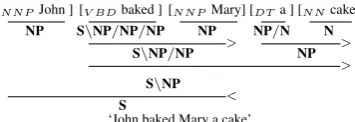
For statisticalCCGparsers, the lexicon is learnt from labeled data, and is subject to sparsity due to the fine-grained nature of the categories. Fig-ure 1 illustrates this with a simple CCG deriva-tion. In this sentence, bakeis used as a ditransi-tive verb and is assigned the ditransiditransi-tive category S\NP/NP/NP. This category defines the verb syn-tactically as mapping threeNParguments to a sen-tenceS, and semantically as a ternary relation be-tween its three arguments, thus providing a com-plete analysis of the sentence.
[NNPJohn ] [V BDbaked ] [NNPMary] [DTa ] [NNcake]
NP S\NP/NP/NP NP NP/N N
> >
S\NP/NP NP
>
S\NP
<
S
[image:2.595.91.269.568.629.2]‘John baked Mary a cake’
Figure 1:Example CCG derivation
For a CCG parser to obtain the correct deriva-tion above, its lexicon must include the ditransitive categoryS\NP/NP/NP for the verbbake. It is not sufficient to have simply seen the verb in another context (say a transitive context like “John baked a cake”, which is a more common context). This is in contrast to standard treebank parsers where the
verbal category is simply VBD (past tense verb) and a ditransitive analysis of the sentence is not ruled out as a result of the lexical category.
In addition to sparsity related to open-class words like verbs as in the above example, there are also missing categories in labeled data for closed-class words like question words, due to the small number of questions in the Penn Treebank. In gen-eral, lexical sparsity for a statistical CCG parser can be broken down into three types: (i) where a word is unseen in training data but is present in test data, (ii) where a word is seen in the train-ing data but not with the category type required in the test data (but the category type is seen with other words) and(iii)where a word bears a cate-gory type required in the test data but the catecate-gory type is completely unseen in the training data.
In this paper, we deal with the first two kinds. The third kind is more prevalent when the size of labeled data is comparatively small (although, even in the case of the English WSJ CCG tree-bank, there are several attested category types that are entirely missing from the lexicon, Clark et al., 2004). We make the assumption here that all cat-egory types in the language have been seen in the labeled data. In principle new category types may be introduced independently without affecting our semi-supervised process (for instance, manually, or via a method that predicts new category types from those seen in labeled data).
3 Related Work
score) on supertagger accuracy on Wikipedia (al-though performance on WSJ text dropped) but did not attempt to re-train the parsing model.
An orthogonal approach for extending a CCG lexicon using unlabeled data is that of Thomforde and Steedman (2011), in which aCCGcategory for an unknown word is derived from partial parses of sentences with just that one word unknown. The method is capable of inducing unseen cate-goriestypes(the third kind of sparsity mentioned in§2.1), but due to algorithmic and efficiency is-sues, it did not achieve the broad-coverage needed for grammar generalisation of a high-end parser. It is more relevant for low-resource languages which do not have substantial labeled data and category type discovery is important.
Some notable positive results for non-CCG parsers are McClosky et al. (2006) who use a parser-reranker combination. Koo et al. (2008) and Suzuki et al. (2009) use unsupervised word-clusters as features in a dependency parser to get lexical dependencies. This has some notional sim-ilarity to categories, since, like categories, clus-ters are less grained than words but more fine-grained thanPOS-tags.
4 Supervised Parser
The CCG parser used in this paper is a re-implementation of the generative parser of Hock-enmaier and Steedman (2002) and HockHock-enmaier (2003)1, except for the treatment of unseen and low-frequency words.
We use a model (the LexCat model in Hock-enmaier (2003)) that conditions the generation of constituents in the parse tree on the lexical cate-goryof the head word of the constituent, but not on the head word itself. While fully-lexicalized mod-els that condition on words (and thus model word-to-word dependencies) are more accurate than un-lexicalized ones like the LexCat model, we use an unlexicalized model2 for two reasons: first,
1These generative models are similar to the Collins’
head-based models (Collins, 1997), where for every node, a head is generated first, and then a sister conditioned on the head. De-tails of the models are in Hockenmaier and Steedman (2002) and Hockenmaier 2003:pg 166.
2A terminological clarification: unlexicalizedhere refers
to the model, in the sense that head-word information is not used for rule-expansion. The formalism itself (CCG)
is referred to asstrongly-lexicalized, as used in the title of the paper. Formalisms like CCG and LTAG are consid-ered strongly-lexicalized since linguistic knowledge (func-tions mapping words to syntactic structures/semantic inter-pretations) is included in the lexicon.
our lexicon smoothing procedure (described in the next section) introduces new words and new cat-egories for words into the lexicon. Lexical cate-gories are added to the lexicon for seen and un-seen words, but no new category types are intro-duced. Since theLexCatmodel conditions rule ex-pansions on lexical categories, but not on words, it is still able to produce parses for sentences with new words. In contrast, a fully lexicalized model would need all components of the grammar to be smoothed, a task that is far from trivial due to the resulting explosion in grammar size (and one that we leave for future work).
Second, although lexicalized models perform better on in-domain WSJ data (theLexCatmodel has an accuracy of 87.9% on Section 23, as op-posed to 91.03% for the head-lexicalized model in Hockenmaier (2003) and 91.9% for the C&C parser), our parser is more accurate on a question corpus, with a lexical category accuracy of 82.3%, as opposed to 71.6% and 78.6% for the C&C and Hockenmaier (2003) respectively.
4.1 Handling rare and unseen words
Existing CCG parsers (Hockenmaier (2003) and Clark and Curran (2007)) back-off rare and unseen words to theirPOStag. ThePOS-backoff strategy is essentially a pipeline approach, where words are first tagged with coarse tags (POS tags) and finer tags (CCG categories) are later assigned, by the parser (Hockenmaier, 2003) or the supertag-ger (Clark and Curran, 2007). As POS-taggers are much more accurate than parsers, this strat-egy has given good performance in general for CCGparsers, but it has the disadvantage that POS-tagging errors are propagated. The parser can never recover from a tagging error, a problem that is serious for words in the Zipfian tail, where these words might also be unseen for the POS tagger and hence more likely to be tagged incorrectly. This issue is in fact more generally relevant than forCCGparsers alone—the dependence of parsers on POS-taggers was cited as one of the problems in domain-adaptation of parsers in the NAACL-2012 shared task on parsing the web (Petrov and McDonald, 2012). Lease and Charniak (2005) obtained an improvement in the accuracy of the Charniak (2000) parser on a biomedical domain simply by training a newPOStagger model.
un-seen and rare words. This method is less sen-sitive to POS tagging errors, as described below. In this approach, in a pre-processing step prior to parsing, categories are introduced into the lex-icon for unseen and rare words from the data to be parsed. Some probability mass is taken from seen words/categories and given to unseen word and category pairs. Thus, at parse time, no word is unseen for the parser.
4.1.1 Smoothing
In our approach, we introduce lexical entries for words from the unlabeled corpus that are unseen in the labeled data, and also add categories to ex-isting entries for rarely seen words. The most gen-eral case of this would be to assign all known cat-egories to a word. However, doing this reduces the lexical category accuracy.3 A second option, chosen here, is to limit the number of categories assigned to the word by using some information about the word (for instance, its part-of-speech). Based on the part-of-speech of an unseen word in the unlabeled or test corpus, we add an entry to the lexicon of the word with the topncategories that have been seen with that part-of-speech in the la-beled data. Each new entry of(w, cat), wherew is a word andcatis aCCGcategory, is associated with a countc(w, cat), obtained as described be-low. Once all(w, cat)entries are added to the lex-icon along with their counts, a probability model P(w|cat)is calculated over the entire lexicon.
Our smoothing method is based on a method used in Deoskar (2008) for smoothing a PCFG lexicon. Eq. 1 and 2 apply it to CCGentries for unseen and rare words. In the first step, an out-of-the-boxPOStagger is used to tag the unlabeled or test corpus (we use the C&C tagger). Counts of words andPOS-tagsccorpus(w, T)are obtained
from the tagged corpus. For the CCGlexicon, we ultimately need a count for a word wand a CCG categorycat. To get this count, we split the count of a word andPOS-tag amongst all categories seen with that tag in the supervised data in the same ratio as the ratio of the categories in the super-vised data. In Eq. 1, this ratio isctb(catT)/ctb(T)
where ctb(catT) is the treebank count of a
cate-gorycatT seen with aPOS-tagT, andctb(T)is the
marginal count of the tagT in the treebank. This
3For instance, we find that assigning all categories to
un-seen verbs gives a lexical category accuracy of 52.25 %, as opposed to an accuracy of 65.4% by using top 15 categories, which gave us the best results, as reported later in Table 3.
ratio makes a more frequent category type more likely than a rarer one for an unseen word. For ex-ample, for unseen verbs, it would make the transi-tive category more likely than a ditransitransi-tive one (since transitives are more frequent than ditran-sitives). There is an underlying assumption here that relative frequencies of categories and POS-tags in the labeled data are maintained in the un-labeled data, which in fact can be thought of as a prior while estimating from unlabeled data (De-oskar et al., 2012).
ccorpus(w, cat) = ctbc(catT)
tb(T) ·ccorpus(w, T) (1)
Additionally, for seen but low-frequency words, we make use of the existing entry in the lexicon. Thus in a second step, we interpolate the count ccorpus(w, cat) of a word and category with the
supervised count of the samectb(w, cat)(if it
ex-ists) to give the final smoothed count of a word and categorycsmooth(w, cat)(Eq. 2).
csmooth(w, cat) = λ · ctb(w, cat) + (1−λ)·ccorpus(w, cat)
(2) When this smoothed lexicon is used with a parser, POS-backoff is not necessary since all needed words are now in the lexicon. Lexical en-tries for words in the parse are determined not by thePOS-tag from a tagger, but directly by the pars-ing model, thus makpars-ing the parse less susceptible to tagging errors.
5 Semi-supervised Learning
We use Viterbi-EM (Neal and Hinton, 1998) as the self-training method. Viterbi-EM is an alter-native to EM where instead of using the model parameters to find a true posterior from unlabeled data, a posterior based on the single maximum-probability (Viterbi) parse is used. Viterbi-EM has been used in various NLP tasks before and often performs better than classic EM (Cohen and Smith, 2010; Goldwater and Johnson, 2005; Spitkovsky et al., 2010). In practice, a given pars-ing model is used to obtain Viterbi parses of un-labeled sentences. The Viterbi parses are then treated as training data for a new model. This pro-cess is iterated until convergence.
self-trained all components of the parsing model, which is the usual case of self-training. We ob-tained negative results similar to Steedman et al. (2003), where self-training reduced the perfor-mance of the parsing model. We do not report them here. Thus, using unlabeled data only to es-timate parameters that are badly eses-timated from labeled data (lexical entries in CCG, due to lexi-cal sparsity) results in improvements, in contrast to prior work with semi-supervised EM.
As is common in semi-supervised settings, we treated the count of each lexical event as the weighted count of that event in the labeled data (treebank)4 and the count from the Viterbi-parses of unlabeled data. Here we follow Bacchiani et al. (2006) and McClosky et al. (2006) who show that count merging is more effective than model inter-polation.
We placed an additional constraint on the con-tribution that the unlabeled data makes to the semi-supervised model—we only use counts (from un-labeled data) of lexical events that are rarely seen/unseen in the labeled data. Our reasoning was that many lexical entries are estimated accu-rately from the treebank (for example, those re-lated to function words and other high-frequency words) and estimation from unlabeled data might hurt them. We thus had a cut-off frequency (of words in labeled data) above which we did not allow the unlabeled counts to affect the semi-supervised model. In practise, our experiments turned out to be fairly insensitive to the value of this parameter, on evaluations over rare or un-seen verbs. However, overall accuracy would drop slightly if this cut-off was increased. We experi-mented with cut-offs of 5, 10 and 15, and found that the most conservative value (of 5) gave the best results on in-domain WSJ experiments, and a higher value of 10 gave the best results for out-of-domain experiments.
We also conducted some limited experiments with classical semi-supervised EM, with similar settings of weighting labeled counts, and using un-labeled counts only for rare/unseen events. Since it is a much more computationally expensive pro-cedure, and most of the results did not come close to the results of Viterbi-EM, we did not pursue it.
4The labeled count is weighted in order to scale up the
la-beled data which is usually smaller in size than the unlala-beled data, to avoid swamping the labeled counts with much larger unlabeled counts.
5.1 Data
Labeled: Sec. 02-21 of CCGbank (Hockenmaier and Steedman, 2007). In one experiment, we used Sec. 02-21 minus 1575 sentences that were held out to simulate test data containing unseen verbs— see§6.2 for details.
Unlabeled: For in-domain experiments, we used sentences from the unlabeled WSJ portion of the ACL/DCI corpus (LDC93T1, 1993), and the WSJ portion of the ANC corpus (Reppen et al., 2005), limited to sentences containing 20 words or less, creating datasets of approximately 10, 20 and 40 million words each. Additionally, we have a dataset of 140 million words – 40M WSJ words plus an additional 100M from the New York Times.
For domain-adaptation experiments, we use two different datasets. The first one consists of question-sentences – 1328 unlabeled ques-tions, obtained by removing the manual annota-tion of the quesannota-tion corpus from Rimell and Clark (2008). The second out-of-domain dataset con-sists of Wikipedia data, approximately 40 million words in size, with sentence length<20 words.
5.2 Experimental setup
We ran our semi-supervised method using our parser with a smoothed lexicon (from §4.1.1) as the initial model, on unlabeled data of different sizes/domains. For comparison, we also ran ex-periments using aPOS-backed off parser (the orig-inal Hockenmaier and Steedman (2002) LexCat
model) as the initial model. Viterbi-EM converged at 4-5 iterations. We then parsed various test sets using the semi-supervised lexicons thus obtained. In all experiments, the labeled data was scaled to match the size of the unlabeled data. Thus, the scaling factor of labeled data was 10 for unlabeled data of 10M words, 20 for 20M words, etc.
5.3 Evaluation
We focused our evaluations on unseen and low-frequency verbs, since verbs are the most impor-tant open-class lexical entries and the most am-biguous to learn from unlabeled data (approx. 600 categories, versus 150 for nouns). We report lexi-cal category accuracy in parses produced using our semi-supervised lexicon, since it is a direct mea-sure of the effect of the lexicon.5 We discuss four
5Dependency recovery accuracy is also used to evaluate
All words All Verbs Unseen Verbs
SUP 87.76 78.10 52.54
SEMISUP 88.14 78.46 **57.28
SUPbkoff 87.91 76.08 54.14
[image:6.595.80.283.62.128.2]SEMISUPbkoff 87.79 75.68 54.60
Table 1: Lexical category accuracy onTEST-4SEC **: p<0.004, McNemar test
experiments below. The first two are on in-domain (WSJ) data. The last two are on out-of-domain data – a question corpus and a Wikipedia corpus.
6 Results
6.1 In-domain: WSJ unseen verbs
Our first testset consists of a concatenation of 4 sections of CCGbank (01, 22, 24, 23), a total of 7417 sentences, to form a testset called TEST-4SEC. We use all these sections in order to get a reasonable token count of unseen verbs, which was not possible with Sec. 23 alone.
Table 1 shows the performance of the smoothed supervised model (SUP) and the semi-supervised model (SEMISUP) on this testset. There is a sig-nificant improvement in performance on unseen verbs, showing that the semi-supervised model learns good entries for unseen verbs over and above the smoothed entry in the supervised lexi-con. This results in an improvement in the over-all lexical category accuracy of the parser on over-all words, and all verbs.
We also performed semi-supervised training us-ing a supervised model that treated unseen words with a POS-backoff strategy SUPbkoff. We used
the same settings of cut-off and the same scal-ing of labeled counts as before. The supervised backed-off model performs somewhat better than the supervised smoothed model. However, it did not improve as much as the smoothed one from unlabeled data. Additionally, the overall accuracy of SEMISUPbkoff fell below the supervised level,
in contrast to the smoothed model, where overall numbers improved. This could indicate that the accuracy of a POS tagger on unseen words, es-pecially verbs, may be an important bottleneck in semi-supervised learning.
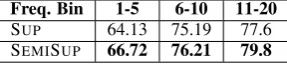
Low-frequency verbs We also obtain improve-ments on verbs that are seen but with a low fre-quency in the labeled data (Table 2). We divided category accuracy, but a dependency evaluation is more rele-vant when comparing performance with parsers in other for-malisms and does not have much utility here.
Freq. Bin 1-5 6-10 11-20
SUP 64.13 75.19 77.6
SEMISUP 66.72 76.21 79.8 Table 2: Seen but rare verbs,TEST-4SEC
verbs occurring in TEST-4SEC into different bins according to their occurrence frequency in the la-beled data (bins of frequency 1-5, 6-10 and 11-20). Semi-supervised training improves over the super-vised baseline for all bins of low-frequency verbs. Note that our cut-off frequency for using unlabeled data is 5, but there are improvements in the 6-10 and 11-20 bins as well, suggesting that learning better categories for rare words (below the cut-off) impacts the accuracy of words above the cut-off as well, by affecting the rest of the parse positively.
6.2 In-domain : heldout unseen verbs
The previous section showed significant improve-ment in learning categories for verbs that are un-seen in the training sections of CCGbank. How-ever, these verbs are in the Zipfian tail, and for this reason have fairly low occurrence frequencies in the unlabeled corpus. In order to estimate whether our method will give further improvements in the lexical categories for these verbs, we would need unlabeled data of a much larger size. We there-fore designed an experimental scenario in which we would be able to get high counts of unseen verbs from a similar size of unlabeled data. We first made a list ofN verbs from the treebank and then extracted all sentences containing them (ei-ther as verbs or o(ei-therwise) fromCCGbank training sections. These sentences form a testset of 1575 sentences, called TEST-HOV (forheld out verbs). The verbs in the list were chosen based on occur-rence frequency f in the treebank, choosing all verbs that occurred with a frequency off = 11. This number gave us a large enough set and a good type/token ratio to reliably evaluate and ana-lyze our semi-supervised models—112 verb types, with 1115 token occurrences6. Since these verbs are actually mid-frequency verbs in the supervised data, they have a correspondingly large occurrence frequency in the unlabeled data, occurring much more often than true unseen verbs. Thus, the un-labeled data size is effectively magnified—as far as these verbs are concerned, the unlabeled data is approximately 11 times larger than it actually is.
Table 3 shows lexical category accuracy on
6Selecting a different but close value offsuch asf= 10
[image:6.595.343.487.63.95.2]All Words All Verbs Unseen Verbs
SUP 87.26 74.55 65.49
SEMISUP 87.78 75.30 *** 70.43
SUPbkoff 87.58 73.06 67.25
[image:7.595.310.525.61.147.2]SEMISUPbkoff 87.52 72.89 68.05
Table 3: Lexical category accuracy inTEST-HOV. ***p<0.0001, McNemar test
55
60
65
70
0 10 20 40 140
Size of Unlabelled Data (in millions of words)
Le
xical Categor
y Accur
acy f
or Unseen V
erbs
Test:HOV Test:4Sec
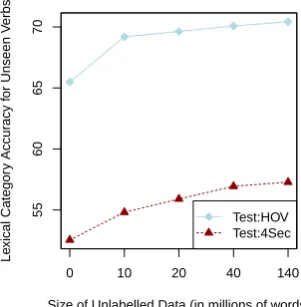
Figure 2: Increasing accuracy on unseen verbs with increasing amounts of unlabeled data.
this testset. The baseline accuracy of the parser on these verbs is much higher than that on the truly unseen verbs.7 The semi-supervised model (SEMISUP) improves over the supervised model SUPvery significantly on these unseen verbs. We also see an overall improvement on all verbs (seen and unseen) in the test data, and in the over-all lexical category accuracy as well. Again, the backed-off model does not improve as much as the smoothed model, and moreover, overall per-formance falls below the supervised level.
Figure 2 shows the effect of different sizes of unlabeled data on accuracy of unseen verbs for the two testsets TEST-HOV andTEST-4SEC. Im-provements are monotonic with increasing unla-beled data sizes, up to 40M words. The additional 100M words of NYT also improve the models but to a lesser degree, possibly due to the difference in domain. The graphs indicate that the method will lead to more improvements as more unlabeled data (especially WSJ data) is added.
7This could be because verbs in the Zipfian tail have more
idiosyncratic subcategorization patterns than mid-frequency verbs, and thus are harder for a parser. Another reason is that they may have been seen as nouns or other parts of speech, leading to greater ambiguity in their case.
QUESTIONS WIKIPEDIA
All wh All Unseen
words words words words
SUP 82.36 61.77 84.31 79.5
SEMISUP *83.21 63.22 *85.6 80.25
Table 4: Out-of-domain: Questions and Wikipedia,*p<0.05, McNemar test
6.2.1 Out-of-Domain
Questions The question corpus is not strictly a different domain (since questions form a differ-ent kind of construction rather than a differdiffer-ent do-main), but it is an interesting case of adaptation for several reasons: WSJ parsers perform poorly on questions due to the small number of questions in the Penn Treebank/CCGbank. Secondly, unsu-pervised adaptation to questions has not been at-tempted before forCCG(Rimell and Clark (2008) did supervised adaptation of their supertagger).
The supervised model SUP already performs at state-of-the-art on this corpus, on both overall scores and on wh(question)-words alone. C&C and Hockenmaier (2003) get 71.6 and 78.6% over-all accuracies respectively, and only 33.6 and 50.7 on wh-words alone. To our original unlabeled WSJ data (40M words), we add 1328 unlabeled question-sentences from Rimell and Clark, 2008, scaled by ten, so that each is counted ten times. We then evaluated on a testset containing questions (500 question sentences, from Rimell and Clark (2008)). The overall lexical category accuracy on this testset improves significantly as a result of the semi-supervised learning (Table 4). The accuracy on the question words alone (who, what, where,
when, which, how, whose, whom) also improves
numerically, but by a small amount (the number of tokens that improve are only 7). This could be an effect of the small size of the testset (500 sen-tences, i.e. 500 wh-words).
[image:7.595.102.253.180.334.2]6.3 Using semi-supervised lexicons with the C&C parser
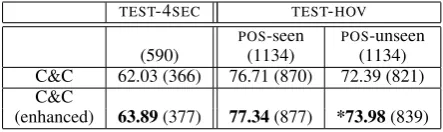
To show that the learnt lexical entries may be use-ful to parsers other than our own, we incorpo-rate our semi-supervised lexical entries into the C&C parser to see if it benefits performance. We do this in a naive manner, as a proof of concept, making no attempt to optimize the performance of the C&C parser (since we do not have access to its internal workings). We take all entries of unseen words from our best semi-supervised lex-icon (word, category and count) and add them to the dictionary of the C&C supertagger (tagdict). The C&C is a discriminative, lexicalized model that is more accurate than an unlexicalized model. Even so, the lexical entries that we learn improve the C&C parsers performance over and above its back-off strategy for unseen words. Table 5 shows the results on WSJ data TEST-4SEC and TEST-HOV. There were numeric improvements on the TEST-4SECtest set as shown in Table 58. We ob-tain significance on the TEST-HOV testset which has a larger number of tokens of unseen verbs and entries that were learnt from effectively larger un-labeled data. We tested two cases: when these verbs were seen for the POS tagger used to tag the test data, and when they were unseen for the POStagger, and found statistically significant im-provement for the case when the verbs were un-seen for the POStagger9, indicating sensitivity to POS-tagger errors.
6.4 Entropy and KL-divergence
We also evaluated the quality of the semi-supervised lexical entries by measuring the over-all entropy and the average Kullback-Leibler (KL) divergence of the learnt entries of unseen verbs from entries in the gold testset. The gold entry for each verb from theTEST-HOVtestset was ob-tained from the heldout gold treebank trees. Su-pervised (smoothed) and semi-suSu-pervised entries were obtained from the respective lexicons. These metrics use the conditional probability of a cate-gory given a word, which is not a factor in the generative model (which considers probabilities of
8There were also improvements on the question and
Wikipedia testsets (not shown) (8 and 6 tokens each) but the size of these testsets is too small for significance.
9Note that for this testsetTEST-HOV, the numbers are the
supertagger’s accuracy, and not the parser’s. We were only able to retrain the supertagger on training data withTEST
-HOVsentences heldout, but could not retrain the parser, de-spite consultation with the authors.
TEST-4SEC TEST-HOV POS-seen POS-unseen
(590) (1134) (1134)
C&C 62.03 (366) 76.71 (870) 72.39 (821) C&C
[image:8.595.306.528.62.128.2](enhanced) 63.89(377) 77.34(877) *73.98(839)
Table 5: TEST-4SEC: Lexical category accuracy of
C&C parser on unseen verbs. Numbers in brackets are the number of tokens.*p<0.05, McNemar test
words given categories), but provide a good mea-sure of how close the learnt lexicons are to the gold lexicon. We find that the average KL divergence reduces from2.17for the baseline supervised en-tries to1.40for the semi-supervised entries. The overall entropy for unseen verb distributions also goes down from 2.23(supervised) to 1.37 (semi-supervised), showing that semi-supervised distri-butions are more peaked, and bringing them closer to the true entropy of the gold distribution (0.93).
7 Conclusions
We have shown that it is possible to learnCCG lex-ical entries for unseen and low-frequency words from unlabeled data. When restricted to learning only lexical entries, Viterbi-EM improved the per-formance of the supervised parser (both in-domain and out-of-domain). Updating all parameters of the parsing model resulted in a decrease in the ac-curacy of the parser. We showed that the entries we learnt with an unlexicalized model were accu-rate enough to also be useful to a highly-accuaccu-rate lexicalized parser. It is likely that a lexicalized parser will provide even better lexical entries. The lexical entries continued to improve with increas-ing size of unlabeled data. For the out-of-domain testsets, we obtained statistically significant over-all improvements, but we were hampered by the small sizes of the testsets in evaluating unseen/wh words.
In future work, we would like to add unseen but predicted categorytypesto the initial lexicon using an independent method, and then apply the same semi-supervised learning to words of these types.
Acknowledgements
References
Michiel Bacchiani, Michael Riley, Brian Roark, and Richard Sproat. 2006. MAP adaptation of stochastic grammars.
Computer Speech and Language, 20(1):41–68.
Eugene Charniak. 1993.Statistical Language Learning. MIT Press.
Stephen Clark and James R. Curran. 2007. Wide-Coverage Efficient Statistical Parsing with CCG and Log-Linear Models.Computational Linguistics, 33(4):493–552. Stephen Clark, Mark Steedman, and James Curran. 2004.
Object-extraction and question-parsing using CCG. In
Proceedings of EMNLP 2004.
Shay Cohen and Noah Smith. 2010. Viterbi Training for PCFGs: Hardness Results and Competitiveness of Uni-form Initialization. InProceedings of ACL 2010. Michael Collins. 1997. Three generative, lexicalised models
for statistical parsing. InProceedings of the 35th ACL. Tejaswini Deoskar. 2008. Re-estimation of Lexical
Param-eters for Treebank PCFGs. InProceedings of COLING 2008.
Tejaswini Deoskar, Markos Mylonakis, and Khalil Sima’an. 2012. Learning Structural Dependencies of Words in the Zipfian Tail.Journal of Logic and Computation. Daniel Gildea. 2001. Corpus Variation and Parser
Perfor-mance. InProceedings of EMNLP 2001.
Sharon Goldwater and Mark Johnson. 2005. Bias in learning syllable structure. InProceedings of CoNLL05.
Julia Hockenmaier. 2003. Data and Models for Statistical Parsing with Combinatory Categorial Grammar. Ph.D. thesis, School of Informatics, University of Edinburgh. Julia Hockenmaier and Mark Steedman. 2002. Generative
Models for Statistical Parsing with Combinatory Catego-rial Grammar. InACL40.
Julia Hockenmaier and Mark Steedman. 2007. CCGbank: A Corpus of CCG Derivations and Dependency Structures Extracted from the Penn Treebank. Computational Lin-guistics, 33:355–396.
Matthew Honnibal, Joel Nothman, and James R. Curran. 2009. Evaluating a Statistial CCG Parser on Wikipedia. InProceedings of the 2009 Workshop on the People’s Web Meets NLP, ACL-IJCNLP.
Terry Koo, Xavier Carreras, and Michael Collins. 2008. Sim-ple Semi-supervised Dependency Parsing. InProceedings of ACL-08: HLT, pages 595–603. Association for Com-putational Linguistics, Columbus, Ohio.
LDC93T1. 1993. LDC93T1. Linguistic Data Consortium, Philadelphia.
Matthew Lease and Eugene Charniak. 2005. Parsing Biomed-ical Literature. In R. Dale, K.-F. Wong, J. Su, and O. Kwong, eds., Proceedings of the 2nd International Joint Conference on Natural Language Processing (IJC-NLP’05), vol. 3651 ofLecture Notes in Computer Science, pages 58 – 69. Springer-Verlag, Jeju Island, Korea. Mike Lewis and Mark Steedman. 2013. Combined
Distribu-tional and Logical Semantics.Transactions of the Associ-ation for ComputAssoci-ational Linguistics.
David McClosky, Eugene Charniak, and Mark Johnson. 2006. Effective Self-Training for Parsing. InProceedings of HLT-NAACL 2006.
Bernard Merialdo. 1994. Tagging English Text with a Prob-abilistic Model. Computational Linguistics, 20(2):155– 171.
Radford M. Neal and Geoffrey E. Hinton. 1998. A view of the EM algorithm that justifies incremental, sparse, and other variants. InLearning and Graphical Models, pages 355 – 368. Kluwer Academic Publishers.
Slav Petrov and Ryan McDonald. 2012. Overview of the 2012 Shared Task on Parsing the Web. In First Work-shop on Syntactic Analysis of Non-Canonical Language (SANCL) Workshop at NAACL 2012.
Randi Reppen, Nancy Ide, and Keith Suderman. 2005. LDC2005T35, American National Corpus (ANC) Second Release.Linguistic Data Consortium, Philadelphia. Laura Rimell and Stephen Clark. 2008. Adapting a
Lexicalized-Grammar Parser to Contrasting Domains. In
Proceedings of the Conference on Empirical Methods in Natural Language Processing (EMNLP-08).
Valentin I. Spitkovsky, Hiyan Alshawi, Daniel Jurafsky, and Christopher D. Manning. 2010. Viterbi Training Improves Unsupervised Dependency Parsing. In Proceedings of CoNLL-2010.
Mark Steedman. 2000. The Syntactic Process. MIT Press/Bradford Books.
Mark Steedman, Steven Baker, Jeremiah Crim, Stephen Clark, Julia Hockenmaier, Rebecca Hwa, Miles Osbornn, Paul Ruhlen, and Anoop Sarkar. 2003. Semi-Supervised Training for Statistical Parsing. Tech. rep., CLSP WS-02. Jun Suzuki, Hideki Isozaki, Xavier Carreras, and Michael Collins. 2009. An Empirical Study of Semi-supervised Structured Conditional Models for Dependency Parsing. In Proceedings of the 2009 Conference on Empirical Methods in Natural Language Processing, pages 551– 560. Association for Computational Linguistics, Singa-pore.