Published online March 10, 2013 (http://www.sciencepublishinggroup.com/j/ajmp) doi: 10.11648/j.ajmp.20130202.19
Point groups in solid state physics I: point group O
h
Ayse Delibas, Vildan Aykan, Deniz Turkkan, Harun Akkus*
Physics Department, Faculty of Science, Yuzuncu Yil University, 65080 Van, Turkey
Email address:
[email protected] (H. Akkus)
To cite this article:
Ayse Delibas, Vildan Aykan, Deniz Turkkan, Harun Akkus. Point Groups in Solid State Physics I: Point Group Oh, American Journal of Modern Physics. Vol. 2, No. 2, 2013, pp. 81-87. doi: 10.11648/j.ajmp.20130202.19
Abstract:
The definitions of all symmetry operations, their permutation counterparts and matrix representations, the multiplication table, all classes, abelian subgroups, and some other subgroups of point group Oh are clearly obtained. Forevery symmetry operation (or element) of Oh, appropriate figures are pictured for the sake of clarity.
Keywords:
Point Groups, Solid State Physics, Symmetry1. Introduction
Group theory studies the groups in mathematics. A group in mathematics is both an algebraic and an abstract struc-ture. As an abstract structure a group is a set of elements. The set of elements must satisfy the following four axioms, which are called “group axioms”, with a law of composi-tion or multiplicacomposi-tion to be a group. (1) Closure: the prod-uct of any two elements of the set with the law of composi-tion, must be one of the elements in the set, that is, the result of the multiplication is itself an element which has to appear in the set. (2) Unit element: the set must include a unit element such that the product of any element in the set with the unit element according to the law of composition of set leaves the element unchanged, for example, for any element a, should be ae=ea=a where e is the unit element of the set. (3) Inverse element: a inverse element must exist for every element in the set and the set has to include all inverse elements, for example, for any element a,
where is the inverse element of a. (4) Asso-ciative law: the set must exhibit the assoAsso-ciative law, for example, for any three elements a, b, and c, a(bc)=(ab)c has to be provided. Furthermore, if all elements in the group commute, that is, for any two elements ab=ba, then the group is called an Abelian group.
There exist a lot of applications of the group theory in physics. One of important application area is solid state physics. The crystals in solid state physics are divided into thirty two classes according to their point groups or sym-metry groups. Although the point groups are often used in the solid state physics and involved in many solid state physics textbooks [1-15], realizing them is hard because the
imagination of successive applications of the symmetry operations is complicated. The aim of this paper is to pro-vide a better understanding of the point groups used in solid state physics. But we have restricted the paper to the cubic point group Oh. We have worked the other cubic
point groups O, T, Th, and Td as well, however, we have
made them the topics of another paper unpublished yet.
2. Symmetry elements of O
hIn crystal physics, a symmetry element is a symmetry operation that converts the crystal structure into itself. A symmetry group is a group which consists of symmetry operations. A point group is also a symmetry group but its elements leave one point of the crystal unchanged.
Symmetry group Oh and one of the subgroups of
permu-tation group P (8) are isomorphic groups. We can learn and investigate the point group Oh using the isomorphism
be-tween these groups. Using the isomorphism bebe-tween Oh
and the subgroup of P (8) enables us to define every sym-metry element of Oh. To do this, first let us point the
cor-ners of a cube with the digits from one to eight. Fig. 1 shows such a cube. Three twofold axes (C2), eight threefold
axes (C3), and six fourfold axes (C4) are also shown in this
figure. To avoid confusion, we mark the symmetry axes, C2,
C3, C4, with the digits parenthetically in Fig. 1. Now, let us
Figure 1. Illustration of two-fold (C2), three-fold (C3), and four-fold (C4)
axes for a cube.
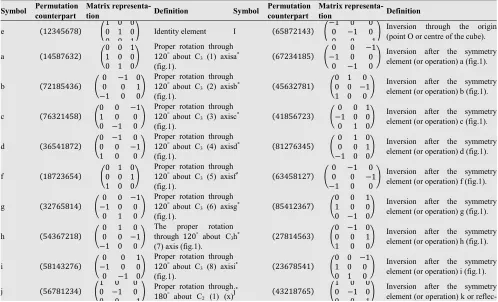
We match every symmetry operation (or symmetry ele-ment) in the group Oh with an element in P (8). The first symmetry element is naturally identity element, e in Table
1 and its counterpart is the element of 12345678
12345678 in P (8).
The second symmetry element a in Table 1, is a proper rotation through 120° about C3 (1) axis in Fig. 1 and its counterpart is element of 12345678
14587632 in the group P (8).
However, we can use briefer symbols for simplicity. That is why we can use symbols (12345678) and (14587632) to denote the elements e and a, respectively. For a better un-derstanding the symmetry operations which will be defined, for example, we have demonstrated the effect of the opera-tion a on a cube in Fig. 2. The symbols of counterparts in P (8) and definitions of all symmetry elements which are the proper rotations through 120° about C3 axes in Fig. 1 are given in Table 1. They are elements a, b, c, d, f, g, h, and i
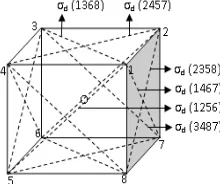
in Table 1. The symbols j, k, and l in Table 1 represent the elements which are the proper rotations through 180° about C2 (1) (or x), C2 (2) (or y), and C2 (3) (or z) axes in Fig. 1, respectively. As to the elements m, n, o, p, r, and s in Table 1, they are the proper rotations through 90° about C4 (1) (or x), C4 (2) (or -x), C4 (3) (or y), C4 (4) (or -y), C4 (5) (or z), and C4 (6) (or -z) axes in Fig. 1, respectively. Fig. 3 shows different six symmetry axes (1, 2, ..., 6). The symmetry elements which are the proper rotations through
180° about these axes are represented symbols t, u, v, w, y,
and z in Table 1.
Figure 2. Illustration of symmetry element a.
Figure 3. Illustration of two-fold axes.
Table 1. Symmetry elements of point group Oh and their permutation counterparts and matrix representations.
Symbol Permutation counterpart
Matrix
representa-tion Definition Symbol
Permutation counterpart
Matrix
representa-tion Definition
e 12345678
1 0 0 0 1 0
0 0 1 Identity element I 65872143
1 0 0
0 1 0
0 0 1
Inversion through the origin (point O or centre of the cube).
a 14587632
0 0 1 1 0 0 0 1 0
Proper rotation through
120° about C
3 (1) axis
(fig.1).
a* 67234185
0 0 1
1 0 0
0 1 0
Inversion after the symmetry element (or operation) a (fig.1).
b 72185436
0 1 0
0 0 1
1 0 0
Proper rotation through
120° about C
3 (2) axis
(fig.1).
b* 45632781
0 1 0
0 0 1
1 0 0
Inversion after the symmetry element (or operation) b (fig.1).
c 76321458
0 0 1
1 0 0
0 1 0
Proper rotation through
120° about C
3 (3) axis
(fig.1).
c* 41856723
0 0 1 1 0 0 0 1 0
Inversion after the symmetry element (or operation) c (fig.1).
d 36541872
0 1 0
0 0 1
1 0 0
Proper rotation through
120° about C
3 (4) axis
(fig.1).
d* 81276345
0 1 0 0 0 1 1 0 0
Inversion after the symmetry element (or operation) d (fig.1).
f 18723654
0 1 0 0 0 1 1 0 0
Proper rotation through
120° about C
3 (5) axis
(fig.1).
f* 63458127
0 1 0
0 0 1
1 0 0
Inversion after the symmetry element (or operation) f (fig.1).
g 32765814
0 0 1
1 0 0 0 1 0
Proper rotation through
120° about C
3 (6) axis
(fig.1).
g* 85412367
0 0 1 1 0 0
0 1 0
Inversion after the symmetry element (or operation) g (fig.1).
h 54367218
0 1 0
0 0 1
1 0 0
The proper rotation
through 120° about C
3
(7) axis (fig.1).
h* 27814563
0 1 0
0 0 1 1 0 0
Inversion after the symmetry element (or operation) h (fig.1).
i 58143276
0 0 1
1 0 0
0 1 0
Proper rotation through
120° about C
3 (8) axis
(fig.1).
i* 23678541
0 0 1
1 0 0 0 1 0
Inversion after the symmetry element (or operation) i (fig.1).
j 56781234
1 0 0
0 1 0
0 0 1
Proper rotation through
180° about C
2 (1) (x)
j* 43218765 1 0 00 1 0
0 0 1
reflec-axis (fig.1). tion through the plane σh (1)
(fig.4).
k 78563412 0 1 01 0 0
0 0 1
Proper rotation through
180° about C
2 (2) (y)
axis (fig.1).
k* 87654321 1 0 00 1 0
0 0 1
Inversion after the symmetry element (or operation) l or reflec-tion through the plane σh (2)
(fig.4)
l 34127856 01 0 01 0
0 0 1
Proper rotation through
180° about C
2 (3) (z)
axis (fig.1).
l* 21436587 0 1 01 0 0
0 0 1
Inversion after the symmetry element (or operation) j or reflec-tion through the plane σh (3)
(fig.4).
m 43658721
1 0 0
0 0 1
0 1 0
Proper rotation through
90° about C
4 (1) (x) axis
(fig.1).
m* 78123456 01 0 00 1
0 1 0
Inversion after the symmetry element (or operation) m (fig.1).
n 87214365
1 0 0 0 0 1
0 1 0
Proper rotation through
90° about C
4 (2) (-x)
axis (fig.1).
n* 34567812 0 01 0 01
0 1 0
Inversion after the symmetry element (or operation) n (fig.1).
o 81456327
0 0 1 0 1 0 1 0 0
The proper rotation
through 90° about C
4
(3) (y) axis (fig.1).
o* 36721854 0 00 1 01
1 0 0
Inversion after the symmetry element (or operation) o (fig.1).
p 27634581
0 0 1
0 1 0 1 0 0
Proper rotation through
90° about C
4 (4) (-y)
axis (fig.1).
p* 54187236 00 0 11 0
1 0 0
Inversion after the symmetry element (or operation) p (fig.1).
r 23418567
0 1 0
1 0 0 0 0 1
Proper rotation through
90° about C
4 (5) (z) axis
(fig.1).
r* 58763214 0 1 01 0 0
0 0 1
Inversion after the symmetry element (or operation) r (fig.1).
s 41236785
0 1 0 1 0 0 0 0 1
Proper rotation through
90° about C
4 (6) (-z)
axis (fig.1).
s* 76581432 01 01 00
0 0 1
Inversion after the symmetry element (or operation) s (fig.1.)
t 65432187 01 00 01
0 1 0
The proper rotation
through 180° about C′ (1) axis (fig.3).
t* 56341278 1 00 0 01
0 1 0
Inversion after the symmetry element (or operation) u or reflec-tion through the plane σd (3487)
(fig.5).
u 21876543 0 0 11 0 0
0 1 0
Proper rotation through
180° about C′ (2) axis (fig.3).
u* 12785634 1 0 00 0 1
0 1 0
Inversion after the symmetry element (or operation) t or reflec-tion through the plane σd (1256)
(fig.5).
v 63278145 00 01 01
1 0 0
Proper rotation through
180° about C′ (3) axis (fig.3).
v* 72365418 0 00 1 01
1 0 0
Inversion after the symmetry element (or operation) w or reflection through the plane σd
(2358) (fig.5).
w 45812763 0 0 10 1 0
1 0 0
Proper rotation through
180° about C′ (4) axis (fig.3).
w* 18543672 0 0 10 1 0
1 0 0
Inversion after the symmetry element (or operation) v or reflec-tion through the plane σd (1467)
(fig.5).
y 85672341 0 1 01 0 0
0 0 1
Proper rotation through
180° about C′ (5) axis (fig.3).
y* 32145876 01 0 01 0
0 0 1
Inversion after the symmetry element (or operation) y or reflec-tion through the plane σd (2457)
(fig.5).
z 67854123 01 01 00
0 0 1
Proper rotation through
180° about C′ (6) axis (fig.3).
z* 14327658 0 1 01 0 0
0 0 1
Inversion after the symmetry element (or operation) z or reflec-tion through the plane σd (1368)
(fig.5).
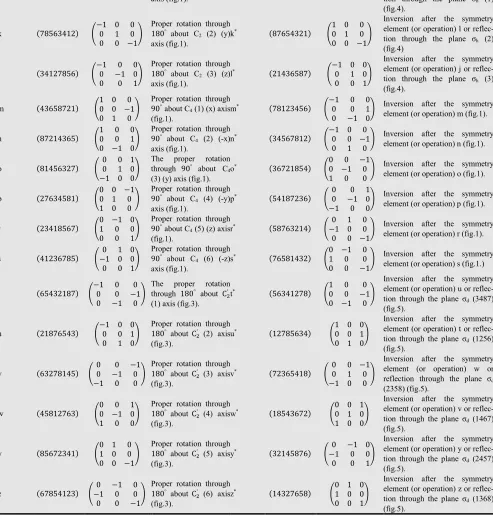
So far we have totally defined twenty four symmetry elements. Next one is the inversion, I, through the origin (or the centre of cube). The inversion converts the vector r to the vector –r and its permutation counterpart in P (8) is the element of (65872143). Each inversion performed after implementing the elements a, b, c, d, f, g, h, and i, gene-rates new symmetry elements which are a*, b*, c*, d*, f*, g*, h*, and i* in Table 1, respectively. For example element a* is the inversion after the symmetry operation (or element) a, and its permutation counterpart in P (8) is the element of (67234185). Fig. 4 represents three reflection planes, σhs. Next symmetry element is the reflection through the plane σh (1) in Fig. 4 and the symbol of this element is j*, and its
Table 1. While symmetry element u* is the reflection through the plane σd (1256) in Fig. 5 or the inversion after symmetry operation t, symmetry element v* is the reflec-tion through the plane σd (2358) in Fig. 5 or the inversion after symmetry operation w. Symmetry elements w* and y* are the reflections through the planes σd (1467) and σd (2457) in Fig. 5, respectively, or the inversions after sym-metry operations v and y, respectively. And finally, the reflection through the plane σd (1368) in Fig. 5 or inversion after symmetry operation z is represented with symbol z* in Table 1. Therefore we have totally defined all symmetry operations (or symmetry elements) of point group Oh, which leave the cube unchanged.
Figure 4. Illustration of reflection planes, σh, perpendicular to a principal
axis of symmetry.
Figure 5. Illustration of reflection planes, σd, contain a principal axis of
symmetry and bisect the angle between two two-fold axes perpendicular to the principal axis.
3. Matrix Representations
Seeing geometrically the results of successive applica-tions of the symmetry operaapplica-tions is pretty hard. To over-come this difficulty we can find a matrix representation for every symmetry elements. The matrix representations ena-ble us to perform the complicated and successive symmetry operations easily. The matrices form a group as well and they obey the same law of multiplication of the symmetry group itself. To explain finding the matrix which is corres-ponds to a symmetry element in the group, for example, let us find the matrix which is the representation of element a in Table 1 using Fig. 6. The coordinates of corners of the cube are given in this figure. The corners of cube replace after symmetry operation a, as follows: 1→1, 2→4, 3→5, 4→8, 5→7, 6→6, 7→3, and 8→2. The matrix A which creates this change in the coordinates of corners should be in the form
Figure 6. Illustration of the coordinates of corners of cube.
.
To determine the coefficients we need nine equations which contain the coefficients themselves. The systems
of equation , !, " give the equations
we need; where A is the matrix corresponds to the symme-try element a, , , , !, and " are the coordinates of the corners 1, 2, 3, 4, and 5, respectively. Therefore we obtain the equations,
# # 1, # # 1, # #
1
# # 1, # # 1, #
# 1
# 1, # 1,
# 1
from the systems of equation above. Solving these equa-tions together we find the coefficients , therefore, the A becomes
0 0 1 1 0 0
0 1 0 .
We can similarly find the matrix representations of all symmetry elements which are given in Table 1.
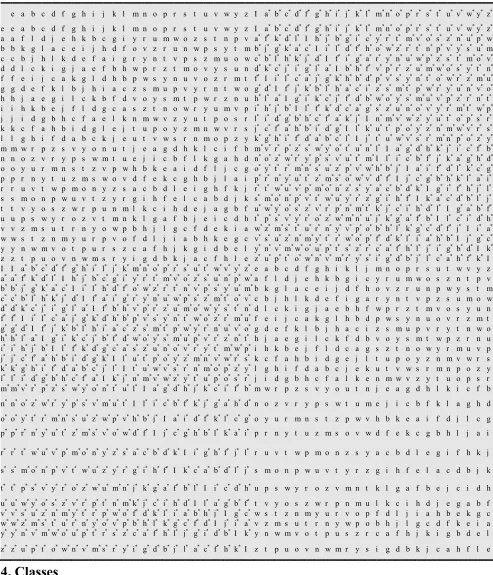
The multiplication table of symmetry group Oh, obtained
using the permutation counterparts or matrix representa-tions of all symmetry elements of symmetry group Oh, is
given in Table 2. To obtain multiplication of any two ele-ments in the group one can use the permutation counter-parts of the elements, for example,
$ 1234567814587632 1234567872185436 1234567834127856 %,
or use the matrix representations of them,
& 0 0 11 0 0 0 1 0
0 1 0
0 0 1
1 0 0
1 0 0
0 1 0
0 0 1 %.
column in the multiplication table in Table 2 contains every element once. Hence, the first group axiom, the closure, is provided. The second axiom, the existence of unit element is already provided. Third axiom, the existence of inverse of every element, can be seen in the multiplication table. If we go to the right along the row of any element in the
mul-tiplication table, we really reach the unit element. If we go up from here we can reach the inverse element for element under consideration. Using the multiplication table, it can be easily shown that the fourth axiom, the associative law, is provided.
Table 2. Multiplication table of point group Oh.
e a b c d f g h i j k l m n o p r s t u v w y z I a* b* c* d* f* g* h* i* j* k* l* m* n* o* p* r* s* t* u* v* w* y* z*
e e a b c d f g h i j k l m n o p r s t u v w y z I a* b* c* d* f* g* h* i* j* k* l* m* n* o* p* r* s* t* u* v* w* y* z*
a a f l d j e h k b c g i y r u m w o z s t n p v a* f* k* d* l* I h* j* b* g* i* c* y* r* t* m* v* o* s* z* n* u* p* w*
b b k g l a c e i j h d f o v z r u n w p s y t m b* j* g* k* a* c* I i* l* d* f* h* o* w* z* r* t* n* p* v* y* s* u* m*
c c b j h l k d e f a i g r y n t v p s z m u o w c* b* l* h* k* j* d* I f* i* g* a* r* y* n* u* w* p* z* s* t* m* o* v*
d d l c k i g j a e f b h w p r z t m o v y s u n d* k* c* j* i* g* l* a* I b* h* f* v* p* r* z* u* m* w* o* s* y* t* n*
f f e i j c a k g l d h b p w s y n u v o z r m t f* I i* l* c* a* j* g* k* h* b* d* p* v* s* y* n* t* o* w* r* z* m* u*
g g d e f k l b j h i a c z s m u p v y r n t w o g* d* I f* j* k* b* l* h* a* c* i* z* s* m* t* p* w* r* y* u* n* v* o*
h h j a e g i l c k b f d v o y s m t p w r z n u h* l* a* I g* i* k* c* j* f* d* b* w* o* y* s* m* u* v* p* z* r* n* t*
i i h k b e j f l d g c a s z t n o w r y u m v p i* h* j* b* I l* f* k* d* c* a* g* s* z* u* n* o* v* y* r* m* t* w* p*
j j i d g b h c f a e l k n m w v z y u t p o s r l* i* d* g* b* h* c* f* a* k* j* I n* m* v* w* z* y* u* t* o* p* s* r*
k k c f a h b i d g l e j t u p o y z m n w v r s j* c* f* a* h* b* i* d* g* I l* k* u* t* p* o* y* z* n* m* w* v* r* s*
l l g h i f d a b c k j e u t v w s r n m o p z y k* g* h* i* f* d* a* b* c* l* I j* t* u* w* v* s* r* m* n* p* o* z* y*
m m w r p z s v y o n u t j e a g d h k l c i f b m* v* r* p* z* s* w* y* o* t* u* n* l* I a* g* d* h* k* j* i* c* f* b*
n n o z v r y p s w m t u e j i c b f l k g a h d n* o* z* w* r* y* p* s* v* u* t* m* I l* i* c* b* f* j* k* a* g* h* d*
o o y u r m n s t z v p w h b k e a i d f l j c g o* y* t* r* m* n* s* u* z* p* v* w* h* b* j* I a* i* f* d* l* k* c* g*
p p r n y t u z m s w o v d f e k c g h b j l a i p* r* n* y* u* t* z* m* s* o* w* v* d* f* I j* c* g* b* h* k* l* a* i*
r r u v t w p m o n y z s a c b d l e i g h f k j r* t* w* u* v* p* m* o* n* z* s* y* a* c* b* d* k* I g* i* f* h* j* l*
s s m o n p w u v t z y r g i h f e l c a b d j k s* m* o* n* p* v* t* w* u* y* r* z* g* i* h* f* I k* a* c* d* b* l* j*
t t v y o s z w r p u n m l k c i h d e j a g b f u* w* y* o* s* z* v* r* p* n* m* t* k* j* c* i* h* d* l* I g* a* b* f*
u u p s w y r o z v t m n k l g a f b j e i c d h t* p* s* v* y* r* o* z* w* m* n* u* j* k* g* a* f* b* I l* c* i* d* h*
v v z m s u t r n y o w p b h j l g c f d e k i a w* z* m* s* t* u* r* n* y* v* p* o* b* h* l* k* g* c* d* f* j* I i* a*
w w s t z n m y u r p v o f d l j i a b h k e g c v* s* u* z* n* m* y* t* r* w* o* p* f* d* k* l* i* a* h* b* I j* g* c*
y y n w m v o t p u r s z c a f h j k g i d b e l y* n* v* m* w* o* u* p* t* s* z* r* c* a* f* h* l* j* i* g* b* d* I k*
z z t p u o v n w m s r y i g d b k j a c f h l e z* u* p* t* o* w* n* v* m* r* y* s* i* g* d* b* j* l* c* a* h* f* k* I
I I a* b* c* d* f* g* h* i* l* j* k* m* n* o* p* r* s* u* t* w* v* y* z* e a b c d f g h i k l j m n o p r s u t w v y z
a* a* f* k* d* l* I h* j* b* c* g* i* y* r* t* m* v* o* z* s* u* n* p* w* a f l d j e h k b g i c y r u m w o s z n t p v
b* b* j* g* k* a* c* I i* l* h* d* f* o* w* z* r* t* n* v* p* s* y* u* m* b k g l a c e i j d f h o v z r u n p w y s t m
c* c* b* l* h* k* j* d* I f* a* i* g* r* y* n* u* w* p* s* z* m* t* o* v* c b j h l k d e f i g a r y n t v p z s u m o w
d* d* k* c* j* i* g* l* a* I f* b* h* v* p* r* z* u* m* o* w* y* s* t* n* d l c k i g j a e b h f w p r z t m v o s y u n
f* f* I i* l* c* a* j* g* k* d* h* b* p* v* s* y* n* t* w* o* z* r* m* u* f e i j c a k g l h b d p w s y n u o v r z m t
g* g* d* I f* j* k* b* l* h* i* a* c* z* s* m* t* p* w* y* r* n* u* v* o* g d e f k l b j h a c i z s m u p v r y t n w o
h* h* l* a* I g* i* k* c* j* b* f* d* w* o* y* s* m* u* p* v* r* z* n* t* h j a e g i l c k f d b v o y s m t w p z r n u
i* i* h* j* b* I l* f* k* d* g* c* a* s* z* u* n* o* v* r* y* t* m* w* p* i h k b e j f l d c a g s z t n o w y r m u v p
j* j* c* f* a* h* b* i* d* g* k* I l* u* t* p* o* y* z* m* n* v* w* r* s* k c f a h b i d g e j l t u p o y z n m v w r s
k* k* g* h* i* f* d* a* b* c* j* l* I t* u* w* v* s* r* n* m* o* p* z* y* l g h i f d a b c j e k u t v w s r m n p o z y
l* l* i* d* g* b* h* c* f* a* I k* j* n* m* v* w* z* y* t* u* p* o* s* r* j i d g b h c f a l k e n m w v z y t u o p s r
m* m* v* r* p* z* s* w* y* o* n* t* u* l* I a* g* d* h* j* k* c* i* f* b* m w r p z s v y o u t n j e a g d h l k i c f b
n* n* o* z* w* r* y* p* s* v* m* u* t* I l* i* c* b* f* k* j* g* a* h* d* n o z v r y p s w t u m e j i c b f k l a g h d
o* o* y* t* r* m* n* s* u* z* w* p* v* h* b* j* I a* i* d* f* k* l* c* g* o y u r m n s t z p w v h b k e a i f d j l c g
p* p* r* n* y* u* t* z* m* s* v* o* w* d* f* I j* c* g* h* b* l* k* a* i* p r n y t u z m s o v w d f e k c g b h l j a i
r* r* t* w* u* v* p* m* o* n* y* z* s* a* c* b* d* k* I i* g* h* f* j* l* r u v t w p m o n z s y a c b d l e g i f h k j
s* s* m* o* n* p* v* t* w* u* z* y* r* g* i* h* f* I k* c* a* b* d* l* j* s m o n p w u v t y r z g i h f e l a c d b j k
t* t* p* s* v* y* r* o* z* w* u* m* n* j* k* g* a* f* b* l* I i* c* d* h* u p s w y r o z v m n t k l g a f b e j c i d h
u* u* w* y* o* s* z* v* r* p* t* n* m* k* j* c* i* h* d* I l* a* g* b* f* t v y o s z w r p n m u l k c i h d j e g a b f
v* v* s* u* z* n* m* y* t* r* p* w* o* f* d* k* l* i* a* b* h* j* I g* c* w s t z n m y u r v o p f d l j i a h b e k g c
w* w* z* m* s* t* u* r* n* y* o* v* p* b* h* l* k* g* c* f* d* I j* i* a* v z m s u t r n y w p o b h j l g c d f k e i a
y* y* n* v* m* w* o* u* p* t* r* s* z* c* a* f* h* l* j* g* i* d* b* I k* y n w m v o t p u s z r c a f h j k i g b d e l
z* z* u* p* t* o* w* n* v* m* s* r* y* i* g* d* b* j* l* a* c* f* h* k* I z t p u o v n w m r y s i g d b k j c a h f l e
4. Classes
group is determined using the relation
' .
The smallest value of n in the relation above is the order of element a. For example, for element ( in Table 1 we can show using Table 2 that
() (! ( ( (!* ( (* ( + ( (+ ( ( ( (*( .
Then, the order of element ( becomes six. The obtained orders of elements in symmetry group Oh using the relation
above are given in Table 3.
Table 3. Orders of all elements in point group Oh.
Order Symmetry elements
1 e
2 j, k, l, j*, k*, l*,t, u, v, w, y, z, I, t*, u*, v*, w*, y*, z*
3 a, b, c, d, f, g, h, i
4 m, n, o, p, r, s, m*, n*, o*, p*, r*, s*
6 a*, b*, c*, d*, f*, g*, h*, i*
To find the classes in a given group we use the conjuga-tion. If a, b, and c are three arbitrary elements in the group, and if the elements a and b satisfy the condition
,$, ,
then the element a conjugate to the element b, or vice versa, since
$ , ,,
the element b conjugate to the element a as well. An ar-bitrary element in a given group and all elements which obtained from this element by conjugation form a class for the group. All elements which belong to same class have the same order. Thus Table 3 can give a prior idea about the answer of question that which elements can be form same class? For example, let us use the relation of conjugation for the element j. If we use the element j and all elements in group Oh instead of b and c in the relation, respectively,
- --- .-. %-% /-/ 0-0
1-1 2-2 +-+ -(--( .(-.( %(-%(
/(-/( 0(-0( 1(-1( 2(-2( -,
- ,-, 3-3 4-4 - 5-5
6-6 7-7 (- ( ,(-,( 3(-3(
4(-4( (- ( 5(-5( 6(-6( 7(-7( .,
$-$ 8-8 *-* 9-9 :-: ;-;
<-< =-= $(-$( 8(-8( *(-*(
9(-9( :(-:( ;(-;( <(-<( =(-=( %,
then we get the elements j, k, and l. Thus we see that the
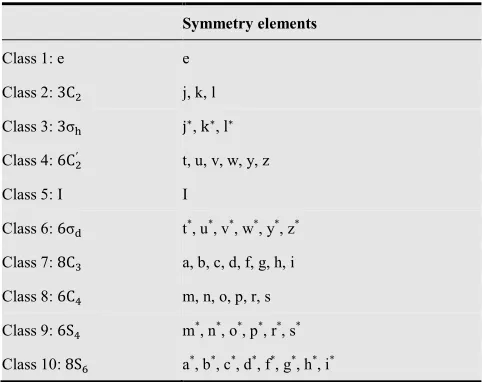
elements j, k, and l form a class. The obtained all other classes for the symmetry group Oh, using the definitions of
conjugation and class, are presented in Table 4.
Table 4. All classes in point group Oh.
Symmetry elements
Class 1: e e
Class 2: 3C j, k, l
Class 3: 3σ> j(, k(, l(
Class 4: 6C′ t, u, v, w, y, z
Class 5: I I
Class 6: 6σB t*, u*, v*, w*, y*, z*
Class 7: 8C a, b, c, d, f, g, h, i
Class 8: 6C! m, n, o, p, r, s
Class 9: 6S! m*, n*, o*, p*, r*, s*
Class 10: 8S) a*, b*, c*, d*, f*, g*, h*, i*
5. Subgroups
Let a be any element in a given group. The set elements , , , , ' is called the period of element a, where n is the order of a. The period forms an Abelian subgroup. Let us now find the periods of elements in group Oh. For example, the order of element ( is six, therefore, the pe-riod of ( becomes
D , (, ( , ( , (!, ("F G , +, , (, *, *(H
which is an Abelian subgroup of group Oh. The obtained
all Abelian subgroups for group Oh, using the definition of
the period of an element, are given below:
G H, G , -H, G , .H, G , %H, G , 1H, G , 2H, G , <H, G , =H, G , 6H,
G , 7H, G , +H, G , -(H, G , .(H, G , %(H, G , 1(H, G , 2(H, G , <(H,
G , =(H, G , 6(H, G , 7(H, G , , *H, G , $, 3H, G , ,, 9H, G , 8, 4H,
G , -, /, 0H, G , ., :, ;H, G , %, , 5H, G , -, /(, 0(H, G , ., :(, ;(H,
G , %, (, 5(H, G , +, , (, *, *(H, G , +, $, $(, 3, 3(H
G , +, ,, ,(, 9, 9(H, G , +, 8, 8(, 4, 4(H.
i, k, l. Namely, the set should be G , , $, ,, 8, *, 3, 9, 4, ., %H. But the set is not a subgroup yet because it is not close with respect to the law of multiplication. The order of this set is also not a divisor of the order of group Oh. We easily see that the set must contain element j as well in order to satis-fy the first group axiom, the closure. The set of
G , , $, ,, 8, *, 3, 9, 4, -, ., %H is now a subgroup of group Oh. It can easily be shown that the set satisfies four group axioms, that is, it is a subgroup of group Oh. Some sub-groups of group Oh, which are obtained using the same method above according to the set of elements G , (, 7(H,
G , $(, 6(H, G , ,(, <(H, G , 8(, =(H, G , , /H, G , , (H, and
G , , /(H, respectively, are given below:
G , , *, 1, <, 7, +, (, *(, 2(, =(, 7(H,
G , $, 3, 1, =, 6, +, $(, 3(, 2(, <(, 6(H,
G , ,, 9, 2, =, 7, +, ,(, 9(, 1(, <(, 7(H,
G , 8, 4, 2, <, 6, +, 8(, 4(, 1(, =(, 6(H,
G , , $, ,, 8, *, 3, 9, 4, -, ., %, /, 0, :, ;, , 5, 1, 2, <, =, 6, 7H,
, , $, ,, 8, *, 3, 9, 4, -, ., %, /(, 0(, :(, (, 5(, 1(, 2(, <(, =(,
6(, 7(, , , $, ,, 8, *, 3, 9, 4, -, ., %, +, (, $(, ,(, 8(, *(, 3(, 9(, 4(, -(, .(, %(.
The subgroups of
G , , $, ,, 8, *, 3, 9, 4, -, ., %, /, 0, :, ;, , 5, 1, 2, <, =, 6, 7H
and
G , , $, ,, 8, *, 3, 9, 4, -, ., %, +, (, $(, ,(, 8(, *(, 3(, 9(, 4(, -(, .(, %(H
correspond to the point groups O and Th, respectively.
6. Conclusions
We have clearly defined all elements of point group Oh
using appropriate figures. Then we have found the matrix representations for every element. We have formed the multiplication table for point group Oh using the matrix
representations and the permutation counterparts for every element. Furthermore, we have determined the order and period of every element, then, we have found all classes. Finally, we have found all Abelian subgroups and some other subgroups of Oh.
References
[1] H. F. Jones, “Group, Representations and Physics”, London: IOP Publishing, 1998.
[2] L. Mariot, “Group Theory and Solid State Physics”, London: Prentice-Hall International Inc, 1962.
[3] W. Ledermann, “Introduction to Group Theory”, London: Longman, 1973.
[4] U. Shmueli, “Theories and Techniques of Crystal Structure Determination”, Oxford: Oxford University Press, 2007. [5] P. Ramond, “Group Theory A Physicist’s Survey”,
Cam-bridge: Cambridge University Press, 2010.
[6] A. O. Barut and R. Raczka, “Theory of Group Representa-tions and ApplicaRepresenta-tions”, Warszawa: Polish Scientific Pub-lishers, 1980.
[7] Z. –Q. Ma and X. –Y. Gu, “Problems and solutions in Group Theory for Physicists”, Singapore: World Scientific Publish-ing, 2004.
[8] J. Q. Chen, J. Ping and F. Wang, “Group Representation Theory for Physicists”, Singapore: World Scientific Publish-ing, 2002.
[9] M. S. Dresselhaus, G. Dresselhaus and A. Jorio, “Group Theory Application to the Physics of Condensed Matter”, Berlin-Heidelberg: Springer-Verlag, 2008.
[10] M. A. Armstrong, “Groups and Symmetry”, Berlin-Heidelberg: Springer-Verlag, 1988.
[11] M. Hamermesh, “Group Theory and Its Applications to Physical Problems”, New York: Dover, 1989.
[12] F. D. Murnaghan, “The Theory of Group Representations”, Baltimore: The Johns Hopkins Press, 1938.
[13] M. A. Naimark and A. I. Stern, “Theory of Group Represen-tations”, New York: Springer-Verlag, 1982.
[14] G. F. Koster, “Space Groups and Their Representations” New York and London: Academic Press, 1957.