Malaysian Journal of Computing Vol. 2, Issue 1, 2014
ISSN 2231-7473
©2014 Faculty of Computer and Mathematical Sciences, Universiti Teknologi MARA (UiTM), Malaysia
MODELLING COMPLEXITIES OF LEARNER’S IN HANDLING
WEB TEXTS VIA ABSTRACT SCENE ANALYSIS
Nasiroh Omar
Faculty of Computer and Mathematical Sciences, Universiti Teknologi MARA, 40450 Shah Alam, Selangor, Malaysia
Abstract
Handling Web texts is a must activity for learners in higher education. Learners constantly seek, read and retrieve text from the Web. Yet, there is lack of existing system that provides an integrated environment for learners to self-assess their capability of handling the Web text and receive instant feedback in a real-life setting. This paper presents a grounding work on understanding complexities in Web text-handling activities at temporal level to gain its temporal contexts and interaction semantics. This work employs goal directed approach to orchestrate four personas in their respected scenarios. Then, the personas and scenarios are carefully examined by using abstract scene analysis in order to produce two models of Web text-handling activities. These models have been used as the bases for the Web Text-handling Support System implemented as part of the research.
Keywords: Web-text handling, instant feedback, goal directed approach, abstract scene analysis, temporal context, interaction semantics
1. Introduction
Learners in higher education must handle a finite collection of Web texts in order to complete an academic written task. They accomplish the written task via searching and reading in increasingly complex forms of Web information and interaction (Bateman et. Al., 2012; Ageev et. al., 2011; Aula et.al., 2010, Downey et.al, 2010; Marchionini, 1998). Many studies analyzing learners’ behavior have reported that some learners encounter searching and reading problems while handling Web text and are in need of various types of support (Moser et. al., 2011; McEneaney, 2000). However, there is also a lack of models that represent the complexity of Web text-handling, especially ones that focus on the learner’s behavior.
Understanding human behaviour is a challenge and crucial need especially in the context of analysing and modelling social behaviour (Salah et. al., 2010). The human behaviour represents physical actions which can be detected and non-physical actions where their existence can only be inferred. The human behaviours are dynamic and keep on changing over times. Thus, the behaviours must be examined at temporal levels.
14 cues were observed under experimental environment. The environment is set up within a predefined scope but participants are free to behave at their own pace. Their temporal data can be captured, collected and analysed without compromising its richness.
This paper describes a qualitative experiment that gathers data about the Web text-handling behavior of learners. The goal directed approach is employed in order to convert the collected qualitative data into personas and their respected scenarios. Then, the personas and scenarios are carefully examined by using abstract scene analysis to produce a general model of how task-driven learners (in higher education) handle Web text in a real-life setting. As a result, seven Web text-handling processes are derived from the outcomes of the experiment and the approach, forming a model of the learners’ processes in task-driven Web text-handling. Then, the model is substituted into the model of learners’ behavior in Web text-handling in figure 5 (Omar, Higgins, & Harrison, 2005).
2. Methodology
This section describes how behavioural data is stimulated, observed and captured in experimental environment. The experimental environment is designed in such a way behavioural data can be captured at real-time and real-life settings. Capturing real-life data (especially digitally) is important to this research for two reasons: first, it provides valuable insight about learners in a real-life situation; and second, it produces empirical data in digital form that can be automatically processed. The digital data is the primary source of interest, as they reveal potential Web text-handling contextual cues and semantic reasoning to be used and investigated within the scope of this research.
The study employs a combination of technologies to manually capture the richness of the Web text-handling process. These are:
Web logging – a method used to keep track of the learner’s Web data in the form of navigation trails.
Video camera – a method used to capture the learner’s observable behaviour. Audio recorder – a method used to capture the learner’s talk-aloud and a short
interview.
Screen recorder – a method used to capture the learner’s screen content and screen interaction activities.
A. Participants
Six experienced computer users, with backgrounds in the fields of linguistics, history and computer science, took part in the experiment. Although they were all regular computer users, they were chosen in anticipation of portraying distinguishable styles of information-seeking behaviour due to their differences in background, skills and knowledge.
B. Task Design
15 given 60 minutes to respond on the topic of Socialism. The task was presented as follows:
“The Web offers many definitions of the term Socialism. Perhaps this is because it is a term that produces strong emotions, and it is a word that is considered important by groups as well as individuals. Your task is to spend an hour looking at the information available to you using whatever Web resources you are able to locate, and then to produce a document in MS-Word that presents and comments on some definitions of Socialism. The total document should be succinct, no more than 500 words in length (you can count them using the Word Count tool in the Tools menu of Word), of which up to 300 words (60%) can be quotation, so you will not be writing more than 200 of your own words. If you produce a good deal less than 500 words that will be fine, too.”
C. Procedure
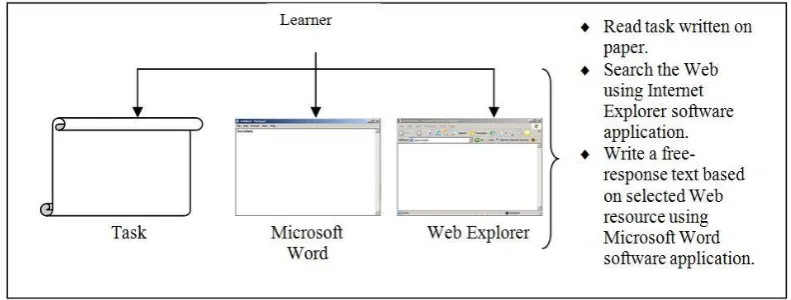
Participants were expected to read the task written on paper, search the Web using the Internet Explorer software application and write a free-response text based on selected Web resources using the Microsoft Word software application. The three activities were presented concurrently (as shown in Figure 1) and were accessed interchangeably throughout the session.
Figure 1. The setting for Web text-handling experiments
D. Data
The participant saved his or her written text through the use of the text editor (Microsoft Word). Their Web navigation trails and text editing were recorded using the Camtasia software package that allowed screen and audio recordings. This combination of data from different sources, allows the data to be triangulated. Capturing audio data allows participants to think-aloud and explain why they perform specific actions at specific times; this represents their implicit actions. The data captured by the video and screen recorders provide us with the learners’ explicit actions in step-by-step form. Thus, the triangulations of this data provide a fuller picture of the learners’ reasoning and interactions while Web text-handling is taking place.
3. Result and Analysis
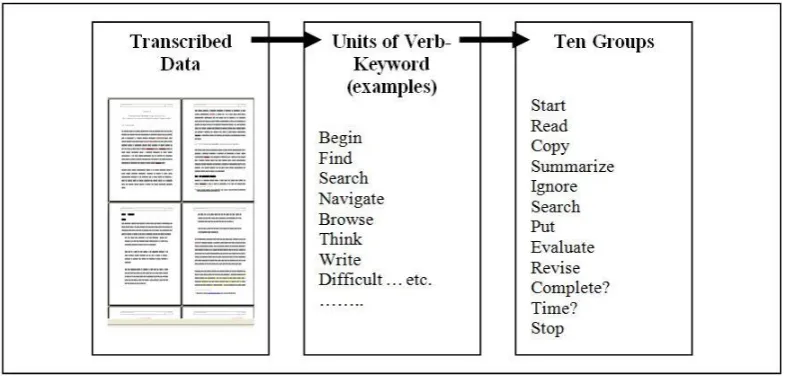
16 The transcripts are extracted in order to determine keywords that represent participants’ activities. Figure 2 depicts the data analysis process.
Figure 2. The data analysis process
Data in the transcripts is broken into human characteristics and activities. Based on the transcribed data, the participants’ actions which are in the form of verbs are extracted and then these verbs form units of verb-keyword. In order to reduce the number of keyword units, a single verb-group was used to represent keywords with similar meaning, i.e., the ‘find’ and ‘search’ keywords were grouped into the ‘search’ group. Each of these groups represents a distinct Web text-handling process, which will aid in modelling the characteristics, behaviour, motives and goals of personas.
The humans with selected features are abstracted into four personas to represent four groups of people. Their activities are abstracted into respective scenarios with the carefully preserved verbs. Then, the personas and scenarios are orchestrated to form abstract scenes. Lastly, the abstract scenes are analysed in order to produce work flow which will be embedded into a model of human behaviour.
A. Creating Personas and their Respective Scenarios
In the goal directed approach, Cooper (1999) uses three tools: persona, goal and scenario. The first tool is a fictional user to improve the representation of a product user, referred to as a persona. He argues that using real users to design a product is “frequently useless and often detrimental to the design process” where personas have the potential to help us achieve the adage fundamental to user-centered design: ‘know thy user, for she is not you’ (Miaskiewicz & Kozar, 2011).
17 Huang et al., 2012; Wills et al., 2007; Adler, 2005; Pruitt and Grudin, 2003; Randolph, 2004).
Cooper (1999) suggests that, for every product, at least three unique personas are adequate for articulating the user population. Adler (2005) suggests that the creation of personas, goals and scenarios is best based on empirical data obtained qualitatively through interviews or observations. Junior and Filgueiras (2005) recommend personas are described around their behaviour patterns. The patterns may comprise of attributes such as probable usage environments, time relevant to the context, solutions, relevant relationship and goals.
In this work, the product is a model. In this modelling work, four distinguishable action-figure personas were developed based on the previously collected data. The four personas were chosen to represent four different groups of learners based on recommendation by experts in the reading domain. The personas’ actions were identified by observing the learners’ pattern of Web text-handling behaviour towards accomplishing the given task. In addition, the personas were also crafted to represent learners in higher level institutions.
a. Persona 1 – Open-Oliver
Open-Oliver is a first year student at the Department of Computer Science. He has good knowledge in his own subject area, but has fair background knowledge on the topic of socialism. However, he is full of enthusiasm to finish the given task and to produce a good answer. He has always considered himself as an organized person. When he works on the computer, he likes to have all files he needs opened and ready to be used.
Scenario:
(1) He reads the task quickly and he reads it only once. (2) He starts Internet Explorer.
(3) He puts keywords in the search engine.
(4) Then, he searches the list of URLs displayed by the search engine. (5) He selects the URL which he finds interests him most.
(6) He reads the associated Web pages quickly. (7) He leaves the window open.
(8) He repeats step 2-7 several times until he is sure that he has enough information.
(9) He opens a Microsoft Word document and starts writing. He alternatively switches to one of the opened windows, he reads, sometimes he summarizes the Web text and sometimes he copy-and-pastes to his document straight away.
(10) He does not bother to read the task again to make sure whether his answer is correct or not, or to check whether he has enough time or not. He continues his work splitting his time between writing, reading, summarizing and copying until he feels satisfied.
18 b. Persona 2 – Choose-Charlie
Choose-Charlie is a first year student at the Department of Engineering. She is an average student and Socialism is definitely not her favourite topic. She has a long list of things to do today, she has to finish her Math assignment, she must get something to eat and she must submit her lab work by half-past two. Therefore, she has to find a way to finish this task quickly.
Scenario:
(1) She reads the given task quickly, but she has to read again and again in order to get some idea on how to answer. Finally, she plans to find good lecture notes related to the given task somewhere on the Web and to work around them.
(2) She starts the Internet Explorer application. (3) She puts keywords in the search engine.
(4) Then, she searches the list of URLs displayed by the search engine. (5) She selects a URLs.
(6) She reads the associated Web pages quickly.
(7) She continues searching by repeating steps 4 and 5 until she confirms she cannot find what she wanted to find.
(8) She repeats steps 3 to 7 until finally she finds what she is looking for. (9) She opens a Microsoft Word document and starts writing.
(10) She switches between the selected Web page and copy-and-pasting here and there in her document. She reads and revises her sentences and paragraphs. While alternating between writing and reading, she keeps on looking at her watch. Every time she writes or deletes a few words, she uses the Word Count Tool to check her words limit. Time is very precious to her and achieving the word limit is the vital signal for her to stop and submit her work. Sometimes she reads again the task to check whether she is answering the given task. She is not very sure whether her answer is correct or not. But she is confident with the content on the lecture notes she found.
(11) Finally, she decides that she wants to stop and submits her work. She still has a long list of ‘things to do’ in her bag.
c. Persona 3 – Smart-Sam
Smart-Sam is a first year student at the Department of Education. He is good in his own subject area and even more in the topic of socialism because it is among his favourite topics. He has always considered himself as a competent computer user. He is very confident he can produce a good answer for the given task. For him, the given task is easy and he starts immediately.
Scenario:
(1) He skims through the task and he does it only once. (2) He starts the Internet Explorer application.
(3) He puts keywords in the search engine.
19 (6) He reads the associated Web pages quickly.
(7) He opens a Microsoft Word document.
(8) He summarizes what he found and develops sentences and paragraphs in his document.
(9) He repeats step 3-8 (except 7) several times until he is sure that he has enough information. Once in a while, he checks his word count.
(10) He is satisfied with his work and he decides to submit.
d. Persona 4 – Copy-Cathy
Copy-Cathy is a first year student at the Department of Education, specialized in History. She considers herself as fairly competent in both areas: computers and socialism. She always thinks doing a ‘Web text-handling’ task is a fairly easy job. She has nothing to worry about. The Web has always given her an answer if she needs one.
Scenario:
(1) She reads the task twice to make sure she really understands what she has to do.
(2) She opens a Microsoft Word document. (3) She starts the Internet Explorer application. (4) She puts keywords in the search engine.
(5) Then, she searches the list of URLs displayed by the search engine. (6) She selects the URL which she finds interests her most.
(7) She scans the associated Web pages quickly.
(8) She copy-and-pastes a few sentences to her document.
(9) She rearranges sentences, rearranges paragraphs, and adds or deletes a few words.
(10) She repeats steps 4-9 several times until she is sure that she has enough information. Once in a while, she checks her word count and the time. (11) Sometimes she feels that her answer is not complete, she reads the task
again.
(12) She is satisfied with her work and she decides to submit. She asks how to submit her work and how to stop the application.
B. Analysing Abstract Scenes
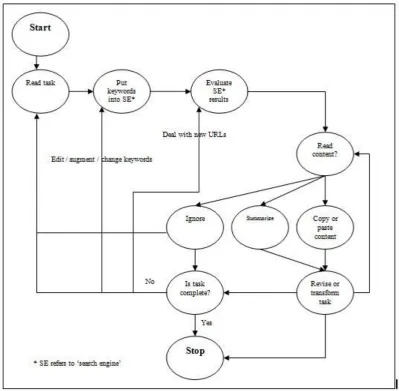
20 Figure 3. A model of learner's behaviour in task-driven Web text-handling
Five generalized groups of processes can be derived from the Web text-handling model (Omar, Higgins, & Harrison, 2005; Omar, Harrison, & Higgins, 2004): . (1) The first group: high-inference. The high-inference processes include any
personas’ cognitive behaviours, which cannot be digitally detected or captured by a standard computer system. This is due to the computer’s lacks of ability to handle such data. Examples of the personas’ high-inference behaviours are reading and understanding the task, timing and planning their progress.
(2) The second group: seeking list of URLs. The second group includes the personas’ ability to type keywords in the search engine; and to retrieve lists of search results supplied by the search engine.
(3) The third group: reading and comprehending the Web contents. The learners might read the content of the visited Web site in one of three ways: read the content of the Web page but be unsatisfied with the reading material and start the Web search again; read the Web page, then copy-and-paste some of its content onto their working file; read the Web content and summarize it in their working file.
21 (5) The fifth group: high inference. This group included processes that are
carried out when the learner decides the task is complete. They were classified as high inference sub-processes since they are primarily related to the technical side of the software and hardware used in the experiment. For example, the learner asks a technician how to stop the software application and the learner wants to make sure all the files produced during the Web research session were saved.
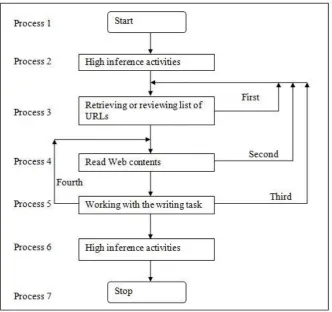
The model of learners’ behaviour in task-driven Web text-handling as presented in figure 3 is collapsed into a simplified model of seven processes (Omar, Harrison, & Higgins, 2004)) based on the groups of processes identified in the previous section. This is depicted in Figure 4.
Figure 4. The model of processes involved in Web text-handling
22 C. Modelling Complexity of a Web Text-handling Scenario
In handling Web text, learners are expected to be involved in two complex activities concurrently: information-seeking activities and Web text reading activities. Marchionini (Marchionini, 1998) defines seeking Web information as an
intentional activity of open-ended seeking of electronic information and suggests
that “the ability to locate and apply information is an important component of what it means to be literate”. These definitions are consistent with what was found in other reviewed literature (Broder, 2002, Comer, 2000, Marques et al., 2004). Hendry and Harper (Hendry and Harper, 1997) describe the information seeker as “a problem solver, who sets goals, monitors progress, explains solutions, and optimizes for solution quality in the time available” and as “a designer who often produces an artefact” in task-oriented information-seeking.
Marchionini (Marchionini, 1998) describes the information seeker in a wider perspective covering pertinent factors of human-centred information-seeking in electronic environments. In the framework, he specifies six information-seeking factors as follows:
Information seeker – the person who is expected to initiate the act upon his or
her information gap/problem/task.
Task – the element that triggers the information seeker to act and comprehend some document and enhance/change his or her knowledge state.
Search system – the system which is responsible for representing knowledge
and regulating the information seeker on how to access and use the knowledge.
Domain – any elements of knowledge in any field.
Setting – the place or the situation where the information-seeking activities
take place.
Outcomes – the products (tangible/intangible) and processes (high/low
inference) produced during the information-seeking activities or after they have taken place.
Derived from the framework, in an information-seeking setting, the learner interacts with the computer search system in a task-driven manner in order to acquire domain-specific knowledge. The outcome is an artefact which consists of a trail of processes and products (e.g. in written form containing a description or summary) as described by Hendry and Harper in the previous paragraph.
Reading is an extremely complex process (Pressley, 1997) with products (Dreyer and Nel, 2003, Snow, 2002). The reading process consists of only three elements: the reader, the text and the activity (Snow, 2002). The activity involves the reader to interact with transactions the published text (Goodman, 1994), think (Pumpfrey, 1977) and construct meaning (Rose and Dalton, 2002), and also to integrate information from a variety of sources (Goodman, 1994, Harrison, 2004).
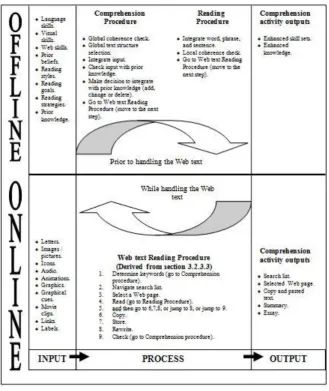
23 reading comprehension in (Omar, Higgins, & Harrison, 2005)) that will be used in this study (depicted in figure 5).
Figure 5. The model of learners’ behaviour in Web text-handling (the offline materials are derived from literature, the online materials are derived from experiment).
Based on the model of learners’ behaviour in Web text-handling shown in Figure 5, learners are affected by various factors before and during online reading. Learners’ reading skills, vision skills, Web skills, reading styles, goals and strategies, prior belief and the knowledge which they possess, guide them while reading and comprehending the current Web text.
Based on the described personas and their respective scenarios, the following reading activity cycles were identified:
(1) Upon reading the task, learners determine the keywords.
(2) To determine the keywords, the Comprehension procedure is called where learners check their global coherence and global text structure selection. (3) They integrate input, check input with prior knowledge and make a decision to
24 (4) Learners then determine keywords and search the Web by using a search
engine.
(5) Then, learners return to the next step in the Web text Reading Procedure, which is to navigate the search list provided by the search engine.
(6) In the next step, learners select a Web page and read it.
(7) Upon reading, learners will activate the Reading Procedure, where they integrate words, phrases and sentences while at the same time checking their local reading coherence.
(8) After reading the selected Web page, learners decide whether to accept the content (copy and paste or summarize the content in the working document) or to reject the content and follow by activating the Comprehension Procedure again in order to check their current comprehension and to come up with a different keywords.
The activation cycles of Web text Reading, Reading and Comprehension procedures continue until the learners are satisfied with their Web text handling and can then produce Web-text handling outputs as temporal contexts which can be seen: search lists (i.e. general search URLs), selected Web pages (i.e. specific Web pages’ URL) , copy-and-pasted text and rewritten text (in the form of free-response text). Furthermore, the cycles show how the learners’ crucial activities are interconnected. Nevertheless, the flows of activities are not static and uniform which is regarded as individual learner’s interaction semantics which can only be inferred.
4. Conclusion
In summary, this paper has presented a grounding work on understanding complexities in Web text-handling activities at temporal level to gain its temporal contexts and interaction semantics. This work described a qualitative experiment which was conducted to obtain data on learners’ behaviour whilst handling Web text. The captured data was used to create four personas and their respective scenarios by following the goal directed approach. The personas were orchestrated in their respective scenarios to derive the processes that are involved in a Web text-handling activity. The processes were then used to develop a general model of learner’s behaviour in handling Web text. This model was combined with existing theory of Web text reading and searching to form a model of a Web text-handling that have been used as the basis of a research on providing Web text-handling support for learners in higher institution.
References
Adler, P. J. (2005, 27-28 January). Dealing with Interviews when Creating Personas: A Practical Approach. Paper presented at the Proceedings of Student Interaction Design Research Conference SIDER05, University of Southern Denmark, Sønderborg.
25 Aula, A., Khan, R. M., & Guan, Z. (2010, April). How does search behavior change as search
becomes more difficult?. In Proceedings of the SIGCHI Conference on Human Factors in Computing Systems (pp. 35-44). ACM.
Bateman, S., Teevan, J., & White, R. W. (2012, May). The search dashboard: how reflection and comparison impact search behavior. In Proceedings of the SIGCHI Conference on Human Factors in Computing Systems (pp. 1785-1794). ACM.
Broder, A. (2002). A Taxanomy of Web Search. SIGIR Forum, 36(2).
Björndal, P., Rissanen, M. J., & Murphy, S. (2011). Lessons learned from using personas and scenarios for requirements specification of next-generation industrial robots. In Design, User Experience, and Usability. Theory, Methods, Tools and Practice (pp. 378-387). Springer Berlin Heidelberg.
Comer, E. D. (2000). The Internet Book: Everything You Need to Know about Computer Networking and How Internet Works (3rd. ed.). New Jersey, USA.: Prentice Hall, Inc.
Cooper, A. (1999). The Inmates are Running the Asylum: Macmillan.
Dreyer, C., & Nel, C. (2003). Teaching Reading Strategies and Reading Comprehension within a Technology-Enhanced Learning Environment. System, 31(3), 349-365.
Downey, D., Dumais, S., Liebling, D., & Horvitz, E. (2008, October). Understanding the relationship between searchers' queries and information goals. In Proceedings of the 17th ACM conference on Information and knowledge management (pp. 449-458). ACM.
Friess, E. (2012, May). Personas and decision making in the design process: an ethnographic case study. In Proceedings of the SIGCHI Conference on Human
Factors in Computing Systems (pp. 1209-1218). ACM.
Goodman, K. S. (1994). Reading, Writing, and Written Text: a Transactional Sociopsycholinguistic View. In H. Singer & R. B. Ruddell (Eds.), Theoretical Models and Processes of Reading (4th. ed., pp. 1093-1130). Newark, Delaware: International Reading Association.
Harrison, C. (2004). Understanding Reading Development. London: Sage Publications.
Hendry, G. D., & Harper, J. D. (1997). An Informal Information-Seeking Environment. Journal of the American Society for Information Science, 48(11), 1036-1048.
Huang, K. H., Deng, Y. S., & Chuang, M. C. (2012). Static and dynamic user portraits. Advances in Human-Computer Interaction, 2012, 2.
Marchionini, G. (1998). Information Seeking in Electronic Environments (1st. ed.). Cambridge: Cambridge University Press.
Marques, E., Garcia, A. C., & Ferraz, I. (2004, Jan 13). RED: A Model To Analyze Web Navigation Patterns. Paper presented at the Workshop on Behavior-based User Interface Customization (IUI/CADUI 2004), Maderia, Portugal.
26 Miaskiewicz, T., & Kozar, K. A. (2011). Personas and user-centered design: How can
personas benefit product design processes?. Design Studies, 32(5).
McEneaney, J. E. (2000, May). Navigational Correlates of Comprehension in Hypertext. Paper presented at the 11th Hypertext Conference of the Association for Computing Machinery, San Antonio, Texas.
Moser, C., Fuchsberger, V., & Tscheligi, M. (2011, November). Using probes to create child personas for games. In Proceedings of the 8th International Conference on Advances in Computer Entertainment Technology (p. 39). ACM.
Nielsen, L., Nielsen, K. S., Stage, J., & Billestrup, J. (2013). Going global with personas. In Human-Computer Interaction–INTERACT 2013 (pp. 350-357). Springer Berlin Heidelberg.
Omar, N., Harrison, C., & Higgins, C. (2004, December 16-18). Online Reading and Web Navigation: A Computer-Based Low Inference Model of Expert Reader Behaviour. Paper presented at the The 5th. International Conference on Recent Advances in Soft Computing, Nottingham, UK.
Omar, N., Higgins, C., & Harrison, C. (2005, July 5-8). Investigating an Approach for Online Reading Assessment. Paper presented at the 5th IEEE International Conference on Advanced Learning Technologies, ICALT 2005 Nottingham, UK.
Pressley, M. (1997). The Cognitive Science of Reading. Contemporary Educational Psychology, 22(2), 247-259.
Pruitt, J., & Grudin, J. (2003). Personas: Practice and Theory. Paper presented at the Proceedings of the 2003 Conference on Designing for User Experiences.
Pumpfrey, P. D. (1977). Measuring Reading Abilities: Concepts, Sources and Applications. London: Hodder and Stoughton.
Randolph, G. (2004). Use-Cases and Personas: A Case Study in Light-Weight User Interaction Design for Small Development Projects. Informing Science Journal 7, 105-116.
Rose, D., & Dalton, B. (2002). Using Technology to Individualize Reading Instruction. San Francisco: Josey Bass Publishers.
Salah, A. A., Gevers, T., Sebe, N., & Vinciarelli, A. (2010). Challenges of human behavior understanding. In Human Behavior Understanding (pp. 1-12). Springer Berlin Heidelberg.
Snow, C. E. (2002). Reading for Understanding: Toward a Research and Development Program in Reading Comprehension. Santa Monica, CA & Washington: RAND Reading Study Group.