COMMUNITY BASED TOURISM RE-VISIT INTENTION:
TOURISTS’ PERSPECTIVE
Teck-Weng Jee
Swinburne University of Technology Sarawak Campus
Hui-Bun Ting
UCSI University Sarawak Campus
Md. Abdul Alim
University of Rajshahi, Bangladesh
ABSTRACT
This study attempts to determine tourists’ re-visit intention towards community based tourism destinations in the context of a developing country. Atmosphere, cultural environment, destination brand, and destination attachment towards community based tourism destinations in a developing country are investigated to determine what contributes to tourists’ re-visit intention. In this study, a causal research design was adopted, and employed descriptive and Partial Least Squares-Structural Equation Modeling (PLS-SEM). This study surveyed 114 tourists from different community-based tourism destinations in Sarawak, Malaysia. Findings of this study provide partial supports towards the effect of atmosphere, cultural environment, and destination brand on tourists’ re-visit intention towards community-based tourism destinations, mediated by destination attachment. The study suggests to practitioners that it is crucial to understand the impact of atmosphere, cultural environment, and destination brand of community-based tourism destinations, as well as destination attachment and re-visit intention, especially, in developing effective marketing strategies for better market segmentation and targeting. Thus, the outcome of this study will help to expand the current knowledge on similar areas of community-based tourism destinations, and contributively effect of atmosphere, cultural environment, and destination brand on re-visit intention towards community-based tourism destination in a developing country context.
Keywords: Atmosphere; Cultural environment; Destination brand; Destination attachment; Re-visit Intention; Community-based tourism destination.
___________________________________
Received: 20 July 2018 Accepted: 23 February 2019
1. INTRODUCTION
Tourism is well-recognised as one of the largest and fastest growing industries today (Daniloska & Hadzi Naumova-Mihajlovska, 2015). This industry has gained exciting progress to emerge as a key contributor towards the overall economic development. The World Tourism Organization-UNWTO (2014) reported that tourism industry is responsible for 9% of total GDP in the world. It is also estimated that the global tourism industry is backing for over 1050 million international,
and over 5 billion domestic tourists visited several tourism destinations in different countries in 2013.
Furthermore, the South East Asian countries also had witnessed significant growth of tourism over the last couple of decades both locally and internationally (Turner & Freiermuth, 2016). Tourism as an important industry in South East Asia, it anticipates of Gross Domestic Product (GDP) with 15,510,000 employment opportunities as direct contributions or over USD 528 billion by 2025. This growth of tourism industry has also contributed to the welfare of local communities and tourists’ experiences in South East Asian countries (Chin & Lo, 2017). After the manufacturing and agriculture industry, the tourism industry is ranked as one of the most major industries among most developing countries in South East Asia particularly in Malaysia and Thailand (Bhuiyan, Siwar, Ismail, Islam, & Ehsan, 2011).
Like others developing countries, tourism is also one of the rapidly growing industries in Malaysia (Shariff & Abidin, 2013). It greatly contributes to improve the country’s Gross Domestic Product (GDP) by earning foreign currencies, ensuring employment opportunities, increasing tax revenues, and expanding economic opportunities to local communities (Ibrahim, 2010; Jalis, Zahari, Izzat, & Othman, 2009). The government of Malaysia has been taken realistic measures to promote this industry (Siti-Nabiha, Abdul Wahid, Amran, Haat, & Abustan, 2008). The government has formed Tourism Policy in 1992 to be enhanced the development of tourism industry in Malaysia. However, the significance of the development of tourism industry towards local economies differs across Malaysia as the country belongs a heterogeneous society. The country has enormously developed tourism in its main cities, but the remote areas like Sarawak may lag behind (Lo, Ramayah, & Yeo, 2016). Thus, focusing on community based tourism in the remote areas in Malaysia can be an opportunity to be successfully implemented the government’s tourism plan as community-based tourism destinations are a growing segment of tourism in developing countries especially in Malaysia (Chin & Lo, 2017).
Community based tourism (CBT) is a latest form of tourism product in which most of the tourism activities are managed and organised by the local communities (Kaur, Jawaid, & Othman, 2016). The inhabitants of the local communities are solely accountable to be executed each aspect of tourism management as CBT does not allow external parties to be involved (Osman et al., 2010). The main purpose of CBT is to produce and deliver the tourism services to tourists in an organised manner. Tourists are also provided with the learning process through community based tourism about the lifestyle of the community, its culture and customs (Kaur et al., 2016). Although the acceptable development of community based tourism has been established in Sarawak, the destination images of tourists’ and their re-visit intention still to be researched (Abdul & Lebai, 2010).
particularly in Malaysia (Abdul & Lebai, 2010). Therefore, this study raised the issues whether the different cognitive attributes of destination images towards community-based tourism destinations have any effect on re-visit intention, and mediating role of destination attachment between destination images and re-visit intention? The rest of the paper is developed through the discussion of relevant literature and methods of the study. The analysis and findings of the study is also discussed followed by the discussion of the study. Finally, the study is decided to inform the conclusions and the implications of the study at the last part of the paper.
2. LITERATURE REVIEW
2.1. Community-Based Tourism
Community Based Tourism (CBT) is related to host community involvement in sustainability through planning and development (Hall, 1991). The business of selling goods and services, job creation, and enhancement of the relationship between the community and the tourists directly benefit the tourism industry and economy (Chin & Lo, 2017). Hence, CBT is based on the creation of tourist products characterized by community participation in their development (Russell, 2000).
Community Based Tourism (CBT) is an effective way of implementing policy coordination, avoiding conflict among different tourism stakeholders, and obtaining synergies based on the exchange of knowledge, analysis and ability among all members of the community (Kibicho, 2008). In this regards the study of Salazar (2012) stressed that the aims of the CBT is to create a more sustainable tourism industry both formally and informally which focused on the planning and maintaining tourism development by the participation of the communities.
CBT is recognized as a viable rural development strategy, emphasizing active community participation in all tourism activities such as- hosting tourists in their homes, and managing activities of interest to tourists to ensure economic and social returns (Tolkach & King, 2015; Zapata, Hall, Lindo, & Vanderschaeghe, 2011). Studies further acknowledged that community-based tourism provides greater economic benefits to the residents of the local community, provides visitors from tourism activities with high-quality experiences and greater environmental awareness (Lepp, 2007), it helps to provide employment opportunities to the local communities of tourism destinations (Mbaiwa & Stronza, 2010), community-based tourism also contributes in alleviating poverty from the destination community as well as promotes host destinations (Boo & Busser, 2006). Therefore, community-based tourism is considered as one of the development options for local community and tourism industry as well.
2.2. Destination Images
Destination image is widely used as a construct in marketing and behavioural sciences research to be demonstrated the perceived beliefs, feelings, and impressions of clients on a product, object, behaviour and event (Baloglu & Brinberg, 1997). However, various scholars of destination marketing for example; Fakeye and Crompton (1991) defined destination image as a comprehensive set of mental representation of knowledge, feelings, and perceptions of an individual toward a particular destination. In other words, destination image is “an interactive system of thoughts, opinions, feelings, visualizations, and intentions toward a destination” (Tasci & Gartner, 2007).
Destination image is primarily composed by three dimensions such as- cognitive, affective, and conative (Beerli & Martin, 2004; Prayag, 2007). However, the cognitive and affective dimensions are widely recommended by various scholars to be studied destination image in order to gain basic understanding on it (Beerli & Martin, 2004; Sonmez & Sirakaya, 2002). Cognitive dimension is the beliefs and knowledge of an individual about the attributes of a destination image, while affective dimension is the emotion or feelings of an individual involved to a destination (Baloglu & McCleary, 1999). However, cognitive dimensions of destination image is the key focus of this study in particular, which directly affects tourists’ destination attachment (Veasna, Wu, & Huang, 2013) and behavioral intentions for re-visit in the future (Chew & Jahari, 2014; Chi & Qu, 2008; Choi, Tkachenko, & Sil, 2011; Ramkissoon, Uysal, & Brown, 2011). Such cognitive dimension of destination image will influence tourists in the process of selecting and evaluating a specific destination for leisure or recreation.
In this paper, atmosphere, cultural environment, and destination brand is involved as the key antecedents of destination images. Atmosphere refers as the peaceful environment and the appropriate to rest and relaxing the destination, while studies in community-based tourism explained that cultural environment and its values is closely associated with destination image (Frías, Rodríguez, Alberto Castañeda, Sabiote, & Buhalis, 2012), which is considered as one of the important antecedents of destination image (Baloglu & McCleary, 1999). A more recent study conducted by Michael, James and Michael (2018) suggested that the image of a destination can be strengthen by the cultural environment of a particular tourist destination. Furthermore, destination brand also identified as another antecedent of destination image (Qu, Kim, & Im, 2011). Such destination brand contributes to build image of the destinations that positively influence to the potential tourists for selecting a destination (Blain, Levy, & Ritchie, 2005; Pike & Page, 2014; Qu et al., 2011; Zenker, Braun, & Petersen, 2017). In fact, destination brand are mainly used as a process to communicate the distinctive identity of a destination which differentiate itself from its competitors (Morrison & Anderson, 2002).
2.3. Destination Attachment and Re-visit Intention
Destination attachment is formed between people and buildings, environments, homes, objects, landscapes, neighborhoods, towns, and cities (Cresswell, 2015). In the domain of tourism, destination attachment is defined as “the strength of the cognitive, emotional, functional and autobiographical bonds connecting the tourist with a destination” (Yuksel, Yuksel, & Bilim, 2010). These components of destination attachment comprises destination dependency as functional attachment, destination identity which is also treated as tourist identity in relation to the destination development, affective bond refers as positive emotion, and automatic prominence that is positivity of thoughts and feelings for a destination (Huang, Qu, & Cao, 2016).
On the other side, re-visit intention is the readiness of an individual to make a visit to the same destination in future in order to purchase a vacation package (Han & Kim, 2010). The greater impression of a tourism destination and its associated attributes plays an important role to be formed an individual’s intention to re-visit towards a particular destination (Cooper, Fletcher, Fyall, Gilbert, & Wanhill, 1993). Moreover, Zhang, Fu, Cai, and Lu (2014) argued that repeat visitation is considered to the most destination marketing organizations as a cost-effective and desirable market segment. Thus, destination marketers should consider the antecedents of a destination that influence re-visit intention of tourists towards community-based tourism destinations for successful tourism development.
Previous studies proposed that destination attachment connects both the tourists’ cognitive and affective engagement with tourism activities at a particular destination (Williams & Vaske, 2003). It is formed as a sign of affective attachment to those places through the process on which individuals form affective connections to these places (Yuksel et al., 2010), and affective connections comprised through positive, or negative or mixed feelings of tourists about a destination (Kil, Holland, Stein, & Ko, 2012), which in turn create re-visit intention towards a particular tourism destination (Cheng & Kuo, 2015). Past studies in this line constantly argued that destination attachment influence visitors to be repeatedly visits the same destination (Song, Kim, & Yim, 2017; Stylos, Bellou, Andronikidis, & Vassiliadis, 2017).
2.4. Conceptual Framework
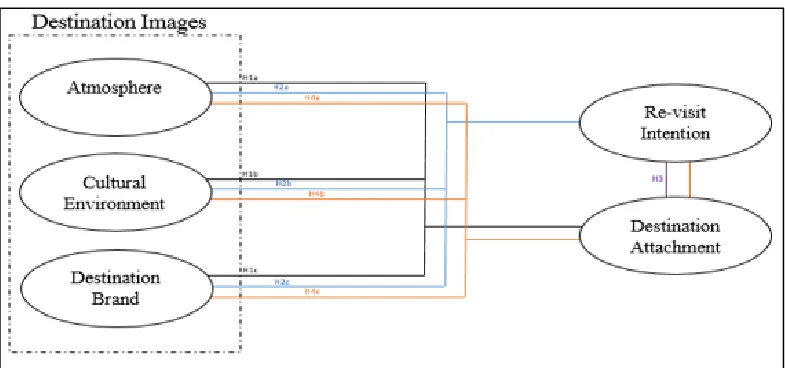
The conceptual framework of this study is built on extant of destination attachment and re-visit intention. This study proposes that destination images (atmosphere, cultural environment, and destination brand) may or may not affect destination attachment and re-visit intention towards community-based tourism destinations. Destination attachment is also proposed as the mediating construct between destination images (atmosphere, cultural environment, and destination brand) and re-visit intention towards community-based tourism destinations. The relational paths are illustrated in a conceptual framework for destination attachment and re-visit intention towards various local community tourism destinations in the context of Malaysia.
attachment, and destination image has a significant influence on destination attachment (Prayag & Ryan, 2011). However, as presented in Figure-1, it can be anticipated that destination images (atmosphere, cultural environment, and destination brand) have direct impact on destination attachment (Veasna et al., 2013). Therefore, it is expected that the strong destination image of a destination positively influences to the destination attachment. On the other hand, studies on community-based tourism claimed that destination images has a direct and positive effect on tourists’ re-visit intention (Chew & Jahari, 2014; Chi & Qu, 2008; Choi et al., 2011; Ramkissoon et al., 2011). Moreover, scholars also argued that destination attachment has a direct effect on re-visit intention (Moore & Graefe, 1994; Song et al., 2017; Stylos et al., 2017).
The framework also revealed that destination attachment is suggested to mediate the relationship between destination images (atmosphere, cultural environment, and destination brand) and re-visit intention (Moore & Graefe, 1994). The rationale behind such a relationship can be explained through the lenses of place attachment which is predicted by the activity involved and place characteristics (Gross & Brown, 2008). In particular, sense of belonging and being identified with a place contributes to attachment that could clearly promote re-visit intention (Wickham, 2000). The above discussions and arguments leads to the following hypotheses:
H1: Destination images ([a] atmosphere, [b] cultural environment, and [c] destination brand) positively affect destination attachment towards community based tourism destination.
H2: Destination images ([a] atmosphere, [b] cultural environment, and [c] destination brand) positively affect re-visit intention towards community based tourism destination.
H3: Destination attachment positively affect re-visit intention towards community based tourism destination.
H4: Destination images ([a] atmosphere, [b] cultural environment, and [c] destination brand) positively affect re-visit intention, mediated by destination attachment towards community based tourism destination.
3. METHODS
3.1. Study Site
With an aim to generalize the findings on tourists’ perspection on community based tourism in Malaysia, the population of the present study consists of tourists who visited the various community based tourism destinations in Sarawak, Malaysia. Sarawak been chosen to represent Malaysia due to the popularity of Sarawak state for its nature tourism and diverse culture heritage attractions as compare to other states in Malaysia (Weaver, 2010). A total of 200 questionanires were distributed in 34 sites of rural tourism destinations in Malaysia (Lo et al., 2013) community based tourism destinations in Sarawak, Malaysia. From 124 completed questionaires, 114 sets of questionnaires were collected back from 14 community based tourism in Sarawak, Malaysia. Among these, near to 90% of the survey was taken from site of Kampung Santubong, Kampung Anas Rais, Borneo Heights, Gunung Gading, and Kampung Bako. The sites are the important topical area with a high potential for effective strategic market differentiation for local community-based tourism destinations that still remains unexplored in Malaysia. The destinations have been gained popularity among local and international tourists as community-based tourism destinations in the country. The destinations are surrounded by unpopulated natural environment and resources which shared the most common and unique features for tourism activities. These community-based tourism destinations are owned and operated by the local communities.
3.2. Survey Measures
The survey was carried out to collect data to be tested the significance of the relationships between the constructs as proposed in the conceptual framework (also see Figure 1). The survey instrument is developed through using observed variables followed by demographic questions such as gender, age, nationality of the tourists, and visited destination of the tourists. Items used to measure the various constructs under study were derived from existing tourism literature. Cognitive attributes of destination image were adopted from the study of Baloglu and McCleary (1999), Beerli and Martin (2004), and San Martin and Del Bosque (2008), cultural environment and atmosphere San Martin and Del Bosque (2008), destination brand Chen and Tsai (2007), destination attachment (Yuksel et al., 2010), and re-visit intention was adopted from the study of (Maxham & Netemeyer, 2002).
3.3. Sampling procedures and data collection
The judgmental and snowball sampling approaches were applied to meet the aim of this study and respondents were selected purposefully to be confirmed the intended respondents (Newby-Clark, McGregor, & Zanna, 2002). The study was obtained 124 completed questionnaires where 10 questionnaires were removed due to a large proportion of incomplete responses during the screening process. Finally, 114 usable questionnaires were used for data analysis as the sample size meets the requirements of the minimum sample size to be employed Partial Least Squares-Structural Equation Modeling (PLS-SEM)1 (Akter, D'Ambra, & Ray, 2011; Hair, Hollingsworth,
Randolph, & Chong, 2017; Hoyle, 1995). However, no incentive was offered to the respondents for their participation in this study, it was completely voluntary and prior to their participation an informed consent was obtained.
3.4. Data Analysis Techniques and Procedures
This study used partial least squares SmartPLS-3.0 software as analytical tool and employed structural equation modeling to assess the proposed relationships in the conceptual model under study. The data analysis technique is suitable for exploratory and confirmatory research that aims to investigate the extent to which exogenous or independent latent constructs which predict the endogenous or dependent latent constructs (Hair et al., 2017; Ringle, Wende, & Becker, 2015). PLS-SEM is preferred to avoid bias estimation due to the unknown nature of the data, which may results in Type I and Type II errors (Sarstedt, Hair, Ringle, Thiele, & Gudergan, 2016). PLS-SEM was considered most appropriate to explain the complexity of the tourists’ behavior in the present study. This is because most of the constructs applied in the social sciences field are design constructs (Henseler, 2017), thus leads to the applicability of a composite measurement model as the case of the present study.
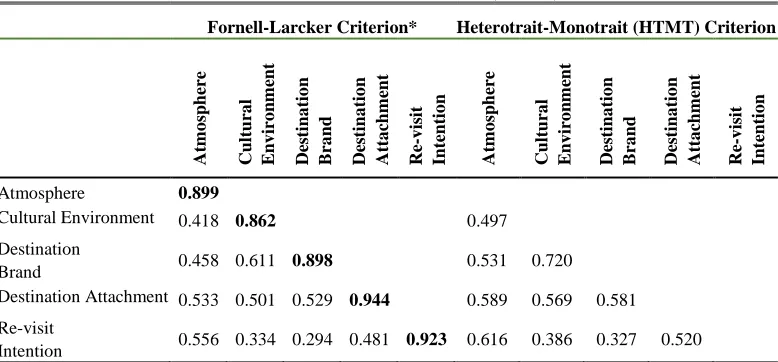
In PLS-SEM procedures, three steps were used to be assessed the conceptual model of this study. The first step commenced with the test for common method bias using Harman’s (1976) single-factor test and collinearity of indicators by computing the variance inflation single-factor (Hair et al., 2017). The second step strives to establish convergent and discriminant validity in the measurement model by conducting confirmatory factor analysis and correlation analyses. Moreover, factor loadings, composite reliability, average variance extracted (AVE), and Heterotrait-Monotrait (HTMT) were tested against the recommended threshold values (Byrne, 2010; Fornell & Larcker, 1981; Hair, Anderson, Babin, & Black, 2010; Henseler, Ringle, & Sarstedt, 2015; Sarkar, Echambadi, & Harrison, 2001). HTMT with a threshold of 0.85 was used in the present study to indicate any multi-collinearity issues between the construct items (Henseler et al., 2015). Finally, the significance and the effect size of the path relationships in, variance explained by, and predictive relevance of the structural model was examined through using bootstrapping and blindfolding procedures (Hair et al., 2017; Ringle et al., 2015).
4. FINDINGS AND DISCUSSION
4.1. Manipulation Checks
In addition, this study was tested the collinearity of indicators, determined by the Variance Inflation Factor (VIF), was below the critical value of five (Hair et al., 2017). Thus, there is no issue of collinearity of indicators in both the measurement model and structural model of this study. Next, a two-step procedures were employed to be assessed the measurement model of the constructs under study and discriminant validity. Finally, the proposed hypothesizes of the study were tested in structural model (Anderson & Gerbing, 1988).
4.2. Profile of the Respondents
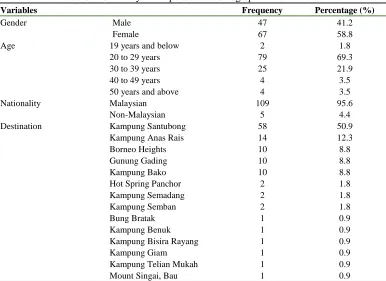
As mentioned earlier the study investigated tourists who recently visited at different community-based tourism destinations in Sarawak, Malaysia and consists of a total of 114 tourists as respondent for final analysis. Table 1 illustrates that the ratio of female respondents is higher than the male respondents which is 58.8 and 41.2 percent respectively, while in terms of range of age, the dominant respondents are 20 to 29 years of age which is 69.3 percent followed by 30 to 39 years which is 21.9 percent. However, respondents with the range of age 19 years and below and 40 years and above is less than 10 percent in total. On the other side, most of the respondents of this study are Malaysian nationals and a very few are internationals which are 95.6 and 4.4 percent respectively, while the most common destination they visited was Kampung Santubong (50.9%) and Kampung Anas Rais (12.3%).
Table 1: Summary of Respondent’s Demographic Information
Variables Frequency Percentage (%)
Gender Male 47 41.2
Female 67 58.8
Age 19 years and below 2 1.8
20 to 29 years 79 69.3
30 to 39 years 25 21.9
40 to 49 years 4 3.5
50 years and above 4 3.5
Nationality Malaysian 109 95.6
Non-Malaysian 5 4.4
Destination Kampung Santubong 58 50.9
Kampung Anas Rais 14 12.3
Borneo Heights 10 8.8
Gunung Gading 10 8.8
Kampung Bako 10 8.8
Hot Spring Panchor 2 1.8
Kampung Semadang 2 1.8
Kampung Semban 2 1.8
Bung Bratak 1 0.9
Kampung Benuk 1 0.9
Kampung Bisira Rayang 1 0.9
Kampung Giam 1 0.9
Kampung Telian Mukah 1 0.9
4.3. Assessment of Measurement Model
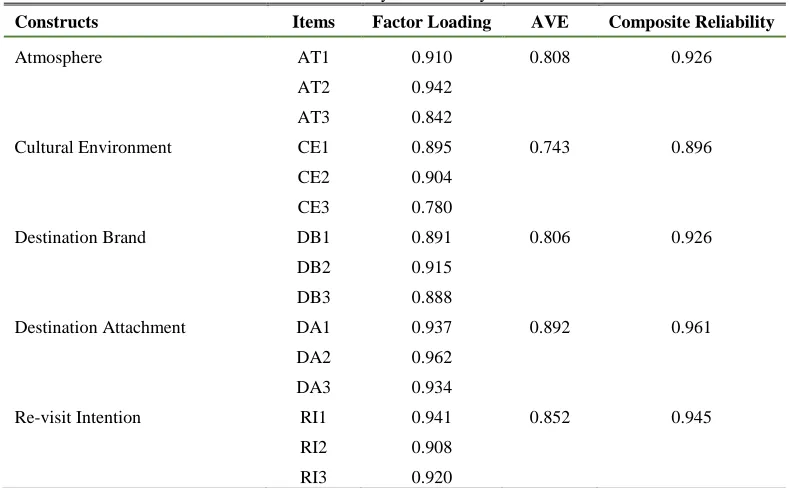
In assessing the measurement model, convergent validity was evaluated by examining factor loadings, composite reliability, and Average Variance Extracted (AVE) (Fornell & Larcker, 1981). As presented in Table 2, standardize factor loadings in the measurement model were above 0.70, which exceeds the recommended threshold value of 0.60 (Byrne, 2010; Hair et al., 2010). The Composite Reliability (CR) of all constructs under study were above 0.80, which exceeds the recommended threshold value of 0.70 (Sarkar et al., 2001). Likewise, according to the suggestions of Fornell and Larcker (1981), the AVE values of all research constructs were above the recommended threshold value of 0.50. Therefore, this study satisfactorily met all the three conditions of convergent validity.
Table 2: Confirmatory Factor Analysis Results
Constructs Items Factor Loading AVE Composite Reliability
Atmosphere AT1 0.910 0.808 0.926
AT2 0.942
AT3 0.842
Cultural Environment CE1 0.895 0.743 0.896
CE2 0.904
CE3 0.780
Destination Brand DB1 0.891 0.806 0.926
DB2 0.915
DB3 0.888
Destination Attachment DA1 0.937 0.892 0.961
DA2 0.962
DA3 0.934
Re-visit Intention RI1 0.941 0.852 0.945
RI2 0.908
RI3 0.920
a. Average variance extracted (AVE) = (summation of the square of the factor loadings) / ([summation of the square of the factor loadings] + [summation of the square of the error variances]).
b. Composite Reliability (CR) = (square of the summation of the factor loadings) / ([square of the summation of the factor loadings] + [square of the summation of the error variances]).
Table 3: Fornell-Larcker and Heterotrait-Monotrait (HTMT) Criterion Results
Fornell-Larcker Criterion* Heterotrait-Monotrait (HTMT) Criterion
Atm o sph er e Cul tu ra l En v iro n m en t De stin a tio n Br a n d De stin a tio n Atta ch m en t Re -v isit Intenti o n Atm o sph er e Cul tu ra l En v iro n m en t De stin a tio n Br a n d De stin a tio n Atta ch m en t Re -v isit Intenti o n
Atmosphere 0.899
Cultural Environment 0.418 0.862 0.497
Destination
Brand 0.458 0.611 0.898 0.531 0.720
Destination Attachment 0.533 0.501 0.529 0.944 0.589 0.569 0.581 Re-visit
Intention 0.556 0.334 0.294 0.481 0.923 0.616 0.386 0.327 0.520
*Note: Bold diagonals represent the square root of the AVE while the off-diagonal represent the correlations.
4.4. Assessment of Structural Model
The structural model of this study was assessed using SmartPLS-3.0 and bootstrapping procedures were used. The analytical technique was utilized to estimate the precision estimates and significance of path relationships between the constructs under study (Hair et al., 2017; Ringle et al., 2015). This was done by generating the T-statistics for significant testing through the bootstrapping procedures (Hair, Hult, Ringle, & Sarstedt, 2014). A total of 5,000 cases of sub-samples in bootstrapping procedures were drawn to allow the procedure in estimating the model of each of the sub-samples (Hair, Ringle, & Sarstedt, 2011).
In the structural model, the study further assesses the predictive capability or predictive relevance of the structural model through using blindfolding procedures followed by the assessment of the cross-validated redundancy. The study was used Stone-Geisser’s predictive relevance (Q2) to
estimates and co-efficient of determination (R2) values to indicates the levels of predictive accuracy
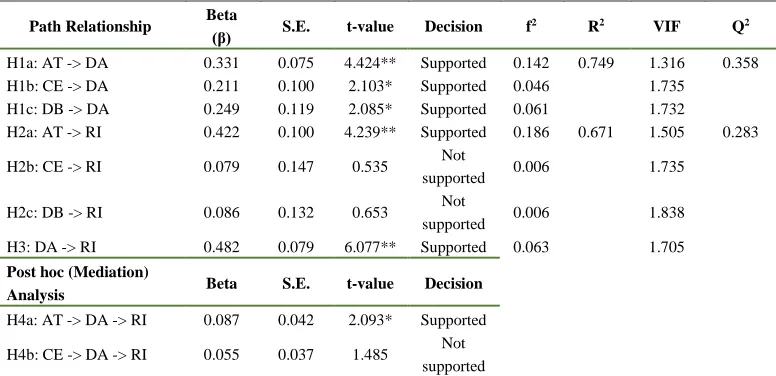
of the model (Hair et al., 2014). As seen in the table 4, the value of R2 for destination attachment,
and re-visit intention is 0.749, and 0.671 respectively. The results suggested that atmosphere, cultural environment, and destination brand explain 74.9%, and 67.1% of variance in destination attachment, and re-visit intention respectively which is considered as strong in both the cases. Moreover, the results also show that the Q2 values of destination attachment, and re-visit intention
is 0.358, and 0.283 respectively which suggests that there is a predictive relevance as both the results are larger than 0. Thus, given the findings of R2 and Q2, it can be concluded that the model
has a predictive quality in explaining the relationships between the constructs in structural model.
Furthermore, based on the suggestions of Hair et al. (2014), this study assessed the collinearity issue in the inner model through using VIF and effect size (f2) of the constructs. As the threshold
value of VIF ≥ 3.3 indicates a potential collinearity problem (Diamantopoulos & Siguaw, 2006), as the results of all the constructs of the structural model are under the threshold value, thus, the result demonstrated that each constructs of the model is distinguished and suitable for structural equation modeling test. Effect size (f2) is another path coefficient measure. The threshold value of
0.02, 0.15, and 0.35 interpreted as small, medium, and large effect size (Hair et al., 2014). Table 4 shows that atmosphere had a medium effect size and significant positive relationship to destination attachment (f 2 = 0.142, β = 0.331), followed by destination brand (f 2 = 0.061, β = 0.249), and
cultural environment (f 2 = 0.046, β = 0.211). When atmosphere was tested on re-visit intention, it
showed a medium effect size and significant positive relationship (f 2 = 0.186, β = 0.422), but a
small effect size with no significant relationship was observed for cultural environment and destination brand on re-visit intention. Finally, destination attachment had a medium effect size and significant positive relationship to re-visit intention (f 2 = 0.063, β = 0.482) of the study.
Table 4: Results of the Structural Model
Path Relationship Beta
(β) S.E. t-value Decision f
2 R2 VIF Q2
H1a: AT -> DA 0.331 0.075 4.424** Supported 0.142 0.749 1.316 0.358
H1b: CE -> DA 0.211 0.100 2.103* Supported 0.046 1.735
H1c: DB -> DA 0.249 0.119 2.085* Supported 0.061 1.732
H2a: AT -> RI 0.422 0.100 4.239** Supported 0.186 0.671 1.505 0.283
H2b: CE -> RI 0.079 0.147 0.535 Not
supported 0.006 1.735
H2c: DB -> RI 0.086 0.132 0.653 Not
supported 0.006 1.838
H3: DA -> RI 0.482 0.079 6.077** Supported 0.063 1.705
Post hoc (Mediation)
Analysis Beta S.E. t-value Decision
H4a: AT -> DA -> RI 0.087 0.042 2.093* Supported
H4b: CE -> DA -> RI 0.055 0.037 1.485 Not
Path Relationship Beta
(β) S.E. t-value Decision f2 R2 VIF Q2
H4c: DB -> DA -> RI 0.065 0.044 1.485 Not
supported
Note: VIF = Variance inflation factor. **p<0.01, *p<0.05 (two-tailed). S. E= Standard errors.
AT= atmosphere, CE= cultural environment, DB= destination brand, DA= destination attachment, and RI= re-visit intention.
4.5. Discussion
The atmosphere, cultural environment, and destination brand of community-based tourism destinations in a developing country are investigated as the antecedents of destination images and the mediating effect of destination attachment was also investigated between the effect of destination images (atmosphere, cultural environment, and destination brand) and tourists’ re-visit intention. The study revealed a mixed finding, with important implications for community-based tourism studies and practices. The importance of destination image is on the rise and many researchers have used this construct to explain destination attachment (Veasna et al., 2013) and re-visit intention (Stylos et al., 2017). It is noteworthy to explain that tourists’ perception of the destination image is subjective and it is influenced by many factors (Beerli & Martin, 2004; Pike, 2017). The current study has shown clearly the significant impact of atmosphere, cultural environment, and destination brand on destination attachment. This results are similar with the previous study (Veasna et al., 2013). However, tourists of the community-based tourism destinations prefer a suitable atmosphere of the destination such as- peaceful and relaxing environment to visit the destinations, but, cultural environment and the destination brand is not a must requirement to them. This study clearly found that the atmosphere has a significant influence on tourists’ re-visit intention of tourists towards the community-based tourism destinations, while cultural environment, and destination brand do not have influence on re-visit intention of the tourists.
that tourism can have a role in the development of a national identity in the macro level perspective (Hall, 2002).
5. CONCLUSIONS AND IMPLICATIONS
This study provides valuable insights of the antecedents of destination images and mediating role of destination attachment between destination images and re-visit intention. The study presented a comprehensive framework to study destination images and re-visit intention of the tourists in community-based tourism destinations. The effects of the antecedents of destination images (atmosphere, cultural environment, and destination brand) on destination attachment and re-visit intention were further examined using structural equation modeling. The findings indicate a partial effect of all the direct and indirect effects (mediated) tested, thus partial support for the hypotheses listed. The findings provide further discussions on the effect of destination image and re-visit intention, as well as the mediating effect of destination attachment towards community-based tourism destinations.
In the study, it is clearly seen that atmosphere, cultural environment, and destination brand is more likely to the tourists to be formed destination attachment in community-based tourism destinations. Therefore, this study suggested to the policy makers and destination operators to improve more the quality of atmosphere, cultural environment, and destination brand. On the other hand, planners ought to be aware that tourists consider more attractive atmosphere of the destinations, while, cultural environment, and destination brand is less preferred to them in revisiting the community-based tourism destinations. This study also suggests to focus the destination attachment to attract tourists and to influence their re-visitation tendencies as the study found the significant positive effects between destination attachment and re-visit intention, it translates relationships between the antecedent atmosphere and revisit intention.
However, the study is not without its limitations. First, the variety of places and people taken as samples provide a wide diversity to be considered, but the study also did not take into account the different ethnicities. The tourists with different ethnic groups may have differing perceptions into destination images and their re-visit intention. Second, the samples were also limited to tourists’ visiting various community-based tourism destinations in Sarawak, Malaysia. A higher sample could provide more robust results. Third, some conceptual problems arise into the notion of destination attachment and re-visit intention. In fact, the Malaysian tourists may have more opportunities to be repeatedly visited a particular community-based tourism destination, while it is not often easy for international tourists as various constraints are involved over there such as- visa processing, geographical distance, and financial. Thus, this study suggests to look tourists’ perceptions on re-visit intention separately for domestic tourists and international tourists.
ACKNOWLEDGEMENT
This paper is revised and rewritten based on the working paper presented at International Symposium of Applied Structural Equation Modeling (SASEM-2017) which was held at Hilton, Kuching, Sarawak on 10-14 October, 2017.
REFERENCES
Abdul, K., & Lebai, D. (2010). Malaysia as an Imagined Destination: The Selling Points: Universiti Utara Malaysia Press.
Agapito, D., Valle, P., & Mendes, J. (2014). The sensory dimension of tourist experiences: Capturing meaningful sensory-informed themes in Southwest Portugal. Tourism Management, 42, 224-237.
Akter, S., D'Ambra, J., & Ray, P. (2011). An evaluation of PLS based complex models: the roles of power analysis, predictive relevance and GoF index. Paper presented at the AMCIS 2011.
Anderson, J. C., & Gerbing, D. W. (1988). Structural equation modeling in practice: A review and recommended two-step approach. Psychological Bulletin, 103(3), 411-423.
Bagozzi, R. P., Yi, Y., & Phillips, L. W. (1991). Assessing construct validity in organizational research. Adminstrative Science Quarterly, 36(3), 421-458.
Baloglu, S., & Brinberg, D. (1997). Affective images of tourism destinations. Journal of Travel Research, 35(4), 11-15.
Baloglu, S., & McCleary, K. W. (1999). A model of destination image formation. Annals of Tourism Research, 26(4), 868-897.
Beerli, A., & Martin, J. D. (2004). Factors influencing destination image. Annals of Tourism Research, 31(3), 657-681.
Bhuiyan, M. A. H., Siwar, C., Ismail, S. M., Islam, R., & Ehsan, D. (2011). Potentials of Islamic tourism: A case study of Malaysia on east coast economic region. Australian journal of basic and applied sciences, 5(6), 1333-1340.
Blain, C., Levy, S. E., & Ritchie, J. B. (2005). Destination branding: Insights and practices from destination management organizations. Journal of Travel Research, 43(4), 328-338. Boo, S., & Busser, J. A. (2006). The hierarchical influence of visitor characteristics on tourism
destination images. Journal of Travel & Tourism Marketing, 19(4), 55-67.
Byrne, B. M. (2010). Multivariate applications series. Structural equation modeling with AMOS: Basic concepts, applications, and programming (2nd ed.). New York: Routledge/Taylor & Francis Group.
Chen, C. F., & Tsai, D. (2007). How destination image and evaluative factors affect behavioral intentions? Tourism Management, 28(4), 1115-1122.
Cheng, C. K., & Kuo, H. Y. (2015). Bonding to a new place never visited: Exploring the relationship between landscape elements and place bonding. Tourism Management, 46(February), 546-560.
Chin, C. H., & Lo, M. C. (2017). Rural tourism quality of services: Fundamental contributive factors from tourists’ perceptions. Asia Pacific Journal of Tourism Research, 22(4), 465-476.
Choi, J. G., Tkachenko, T., & Sil, S. (2011). On the destination image of Korea by Russian tourists. Tourism Management, 32(1), 193-194.
Cole, S. T., & Chancellor, H. C. (2009). Examining the festival attributes that impact visitor experience, satisfaction and re-visit intention. Journal of Vacation Marketing, 15(4), 323-333.
Cooper, C., Fletcher, J., Fyall, A., Gilbert, D., & Wanhill, S. (1993). Tourism: Principles and Practice. London, England: Piman.
Cresswell, T. (2015). Place: An introduction. West Sussex, UK: John Wiley & Sons.
Daniloska, N., & Hadzi Naumova-Mihajlovska, K. (2015). Rural tourism and sustainable rural development. Economic Development, 17(3), 307-320.
Diamantopoulos, A., & Siguaw, J. A. (2006). Formative versus reflective indicators in organizational measure development: A comparison and empirical illustration. British Journal of Management, 17(4), 263-282.
Fakeye, P. C., & Crompton, J. L. (1991). Image Differences between prospective, first-time, and repeat visitors to the Lower Rio Grande Valley. Journal of Travel Research, 30(2), 10-16.
Fornell, C., & Larcker, D. F. (1981). Evaluating structural equation models with unobservable variables and measurement error. Journal of Marketing Research, 18(1), 39-50.
Frías, D. M., Rodríguez, M. A., Alberto Castañeda, J., Sabiote, C. M., & Buhalis, D. (2012). The formation of a tourist destination's image via information sources: The moderating effect of culture. International Journal of Tourism Research, 14(5), 437-450.
George, B. P., & George, B. P. (2012). Past visits and the intention to revisit a destination: Place attachment as the mediator and novelty seeking as the moderator. The Journal of Tourism Studies, 15(2), 51-66.
Gross, M. J., & Brown, G. (2008). An empirical structural model of tourists and places: Progressing involvement and place attachment into tourism. Tourism management,, 29(6), 1141-1151. Hair, J. J. F., Anderson, R. E., Babin, B. J., & Black, W. C. (2010). Multivariate data analysis: A
global perspective (Vol. 7). Upper Saddle River, NJ: Pearson.
Hair, J. J. F., Hollingsworth, C. L., Randolph, A. B., & Chong, A. Y. L. (2017). An updated and expanded assessment of PLS-SEM in information systems research. Industrial Management & Data Systems, 117(3), 442-458.
Hair, J. J. F., Hult, G. T. M., Ringle, C., & Sarstedt, M. (2014). A primer on partial least squares structural equation modeling (PLS-SEM): Sage Publications.
Hair, J. J. F., Ringle, C. M., & Sarstedt, M. (2011). PLS-SEM: Indeed a silver bullet. Journal of Marketing Theory and Practice, 19(2), 139-152.
Hall, C. M. (1991). Introduction to Tourism in Australia: Impacts, Planning and Development. Melbourne, Australia.: Wesley and Longman.
Hall, D. (2002). Brand development, tourism and national identity: The re-imaging of former Yugoslavia. The Journal of Brand Management, 9(4), 323-334.
Han, H., & Kim, Y. (2010). An Investigation of Green Hotel Customers’ Decision Formation: Developing an Extended Model of the Theory of Planned Behavior. International Journal of Hospitality Management, 29(4), 659-668.
Henseler, J. (2017). Using variance-based structural equation modeling for empirical advertising research at the interface of design and behavioral research. Journal of Advertising, 46(1), 178-192.
Henseler, J., Ringle, C. M., & Sarstedt, M. (2015). A new criterion for assessing discriminant validity in variance-based structural equation modeling. Journal of the Academy of Marketing Science, 43(1), 115-135.
Hoyle, R. H. (1995). The structural equation modeling approach: Basic concepts and fundamental issues (R. H. Hoyle ed.). Ca: Sage: Thousand Oaks.
Huang, Y., Qu, H., & Cao, Y. (2016). Towards an integrative model of destination attachment: dimensionality and influence on revisit intention. Tourism Travel and Research Association: Advancing Tourism Research Globally, 11.
Ibrahim, Y. (2010). Tourism development and community perception towards socio-cultural change in Tioman Island. Tourism Research in Malaysia (eds.), Din K and Mapjabil J. Universiti Utara Malaysia Press: Sintok, 159-178.
Jalis, M. H., Zahari, M. S. M., Izzat, M., & Othman, Z. (2009). Western tourists perception of Malaysian gastronomic products. Asian Social Science, 5(1), 25.
Kaur, P., Jawaid, A., & Othman, N. B. A. (2016). The impact of community-based tourism on community development in Sarawak. Procedia-Social and Behavioral Sciences, 2(1), 15-26.
Kibicho, W. (2008). Community-based tourism: A factor-cluster segmentation approach. Journal of Sustainable Tourism, 16(2), 211-231.
Kil, N., Holland, S. M., Stein, T. V., & Ko, Y. J. (2012). Place attachment as a mediator of the relationship between nature-based recreation benefits and future visit intentions. Journal of Sustainable Tourism, 20(4), 603-626.
Lepp, A. (2007). Residents’ Attitudes towards tourism in Bigodi Village, Uganda. Tourism Management, 28(3), 876-885.
Lo, M. C., Ramayah, T., & Yeo, A. W. (2016). Harmonizing Rural Tourism and Rural Communities in Malaysia. Journal of Sustainable Development, 9(4), 27.
Lo, M. C., Songan, P., Mohamad, A. A., & Yeo, A. W. (2013). Rural tourism and destination image: Community perception in tourism planning. The Macro-theme review, 2(1), 102-118.
Maxham, J. G., & Netemeyer, R. G. (2002). A longitudinal study of complaining customers’ evaluations of multiple service failures and recovery efforts. Journal of Marketing, 66(4), 57-71.
Mbaiwa, J. E., & Stronza, A. L. (2010). The effects of tourism development on rural livelihoods in the Okavango Delta, Botswana. Journal of Sustainable Tourism, 18(5), 635-656. Michael, N., James, R., & Michael, I. (2018). Australia’s cognitive, affective and conative
destination image: an Emirati tourist perspective. Journal of Islamic Marketing, 9(1), 36-59.
Moore, R. L., & Graefe, A. R. (1994). Attachments to recreation settings: the case of rail-trail users. Leisure Sciences, 16(1), 17-31.
Morrison, A., & Anderson, D. (2002). Destination Branding. Paper presented at the Annual Meeting of the Missouri Association of Convention and Visitor Bureaus.
Oh, H. (1999). Service quality, customer satisfaction, and customer value: A holistic perspective. International Journal of Hospitality Management, 18(1), 67-82.
homestay entrepreneurs in West Malaysia. A preliminary analysis. Paper presented at the ICSB World Conference Proceedings.
Pike, S. (2017). Destination positioning and temporality: Tracking relative strengths and weaknesses over time. Journal of Hospitality and Tourism Management, 31, 126-133. Pike, S., & Page, S. J. (2014). Destination marketing organizations and destination marketing: A
narrative analysis of the literature. Tourism Management, 41, 202-227.
Podsakoff, P. M., MacKenzie, S. B., Lee, J. Y., & Podsakoff, N. P. (2003). Common method biases in behavioral research: A critical review of the literature and recommended remedies. Journal of Applied Psychology, 88(5), 879-903.
Podsakoff, P. M., MacKenzie, S. B., & Podsakoff, N. P. (2012). Sources of method bias in social science research and recommendations on how to control it. Annual Review of Psychology, 65, 539-569.
Prayag, G. (2007). Assessing international tourists' perceptions of service quality at Air Mauritius. International Journal of Quality & Reliability Management, 24(5), 492-514.
Prayag, G., & Ryan, C. (2011). Antecedents of tourists’ loyalty to mauritius: The role and influence of destination image, place attachment, personal involvement, and satisfaction. Journal of Travel Research, 10(5), 1-15.
Promsivapallop, P., & Kannaovakun, P. (2017). A comparative assessment of destination image, travel risk perceptions and travel intention by young travellers across three ASEAN countries: a study of German students. Asia Pacific Journal of Tourism Research, 22(6), 634-650.
Qu, H., Kim, L. H., & Im, H. H. (2011). A model of destination branding: Integrating the concepts of the branding and destination image. Tourism Management, 32(3), 465-476.
Ramkissoon, H., & Mavondo, F. T. (2015). The satisfaction–place attachment relationship: Potential mediators and moderators. Journal of Business Research, 68(12), 2593-2602. Ramkissoon, H., Uysal, M., & Brown, K. (2011). Relationship between destination image and
behavioral intentions of tourists to consume cultural attractions. Journal of Hospitality Marketing & Management, 20(5), 575-595.
Ringer, G. (2013). Destinations: cultural landscapes of tourism. NY: Routledge.
Ringle, C. M., Wende, S., & Becker, J. M. (2015). SmartPLS 3. Boenningstedt: SmartPLS GmbH. from http://www. smartpls. com.
Russell, P. (2000). Community-based tourism. Travel and Tourism Analyst(5), 89-116.
Salazar, N. B. (2012). Tourism imaginaries: A conceptual approach. Annals of Tourism Research, 39(2), 863-882.
San Martín, H., & Del Bosque, I. A. R. (2008). Exploring the cognitive–affective nature of destination image and the role of psychological factors in its formation. Tourism Management, 29(2), 263-277.
Sarkar, M. B., Echambadi, R. A. J., & Harrison, J. S. (2001). Alliance entrepreneurship and firm market performance. Strategic management journal, 22(6-7), 701-711.
Sarstedt, M., Hair, J. F., Ringle, C. M., Thiele, K. O., & Gudergan, S. P. (2016). Estimation issues with PLS and CBSEM: Where the bias lies! Journal of Business Research, 69(10), 3998-4010.
Siti-Nabiha, A., Abdul Wahid, N., Amran, A., Haat, H. C., & Abustan, I. (2008). Towards a sustainable tourism management in Malaysia. LESIJ-Lex ET Scientia International Journal, 15(2).
Song, H. M., Kim, K. S., & Yim, B. H. (2017). The mediating effect of place attachment on the relationship between golf tourism destination image and revisit intention. Asia Pacific Journal of Tourism Research, 22(11), 1182-1193.
Sonmez, S., & Sirakaya, E. (2002). A distorted destination image? The case of Turkey. Journal of travel research, 41(2), 185-196.
Stylos, N., Bellou, V., Andronikidis, A., & Vassiliadis, C. A. (2017). Linking the dots among destination images, place attachment, and revisit intentions: A study among British and Russian tourists. Tourism Management, 60, 15-29.
Tapachai, N., & Waryszak, R. (2000). An examination of the role of beneficial image in tourist destination selection. Journal of Travel Research, 39(1), 37-44.
Tasci, A. D., & Gartner, W. C. (2007). Destination image and its functional relationships. Journal of Travel Research, 45(4), 413-425.
Tolkach, D., & King, B. (2015). Strengthening community-based tourism in a new resource-based island nation: Why and how? Tourism Management, 48(June), 386-398.
Turner, R., & Freiermuth, E. (2016). Travel and Tourism: Economics Impact 2016 World.
https://www.wttc.org/-/media/files/reports/economic%20impact%20research/regions%202016/world2016.pdf UNWTO. (2014). World Tourism Organization.
Veasna, S., Wu, W. Y., & Huang, C. H. (2013). The impact of destination source credibility on destination satisfaction: The mediating effects of destination attachment and destination image. Tourism Management, 36(June), 511-526.
Wang, C. Y., & Hsu, M. K. (2010). The relationships of destination image, satisfaction, and behavioral intentions: An integrated model. Journal of Travel & Tourism Marketing, 27(8), 829-843.
Weaver, D. (2010). Indigenous tourism stages and their implications for sustainability. Journal of Sustainable Tourism, 18(1), 43-60.
Wickham, T. D. (2000). Attachment to places and activities: the relationship of psychological constructs to customer satisfaction. The Pennsylvania State University.
Williams, D. R., & Vaske, J. J. (2003). The measurement of place attachment: Validity and generalizability of a psychometric approach. Forest science, 49(6), 830-840.
Yoon, Y., & Uysal, M. (2005). An examination of the effects of motivation and satisfaction on destination loyalty: A structural model. Tourism Management, 26(1), 45-56.
Yuksel, A., Yuksel, F., & Bilim, Y. (2010). Destination attachment: Effects on customer satisfaction and cognitive, affective and conative loyalty. Tourism Management, 31(2), 274-284.
Zapata, M. J., Hall, C. M., Lindo, P., & Vanderschaeghe, M. (2011). Can community-based tourism contribute to development and poverty alleviation? Lessons from Nicaragua. Current Issues in Tourism, 14(8), 725-749.
Zenker, S., Braun, E., & Petersen, S. (2017). Branding the destination versus the place: The effects of brand complexity and identification for residents and visitors. Tourism Management, 58, 15-27.
Appendix A: Cross Loadings Analysis for Checking Discriminant Validity for Measurement Model
Constructs Atmosphere Cultural
Environment
Destination Brand
Destination Attachment
Re-visit Intention
Atmosphere AT1 0.910 0.341 0.324 0.488 0.487
AT2 0.942 0.302 0.317 0.443 0.588
AT3 0.842 0.495 0.611 0.511 0.415
Cultural Environment
CE1 0.397 0.895 0.565 0.410 0.298
CE2 0.397 0.904 0.584 0.444 0.263
CE3 0.285 0.780 0.428 0.436 0.300
Destination Brand
DB
1 0.483 0.587 0.891 0.443 0.253
DB
2 0.399 0.547 0.915 0.510 0.212
DB
3 0.358 0.515 0.888 0.470 0.324
Destination Attachment
DA
1 0.498 0.461 0.546 0.937 0.444
DA
2 0.497 0.488 0.487 0.962 0.468
DA
3 0.514 0.470 0.465 0.934 0.452
Re-visit Intention
RI1 0.479 0.353 0.25 0.464 0.941
RI2 0.546 0.229 0.276 0.448 0.908