The Effect Of Coating With Chitosan Of Some
Degrees Of Concentration On Fruit Quality
Lince Romauli Panataria, Dharma Bakti, Elisa Julianti
Abstract: Strawberries are kind of fruit that easily go bad after they are harvested from the orchards. Thus it is needed good post-harvest handlings to retain the fresh quality of the fruits. One of the handlings is coating the fruits with chitosan. It is expected that this coating the fruits with chitosan can prolong the storage of the fruits after they are harvested. This occurs because chitosan can slow down the ripening process of the fruits wheile they are stored. Research has been done to derive what the best concentration of chitosan used in storing some varieties of strawberries is. This research was conducted in Medan, North Sumatera. The design was Random, Complete Factorial Plan consisting of two factors namely, three varieties of strawberries and chitosan of (0-150 ml/L) concentration at environmental temperature of 25°C. The statistics showed that the application of the highest water content and CO2 was on the application of V1K0 (local variety, no chitosan); the lowest was on the application V2K2 (Chandler variety, 150 ml/L liquid chitosan). The highest O2 was on the application V2K0 (Chandler variety,nochitosan); and the lowest oxygen was on the application V1K3 (Loal variety, 150 ml/L liquid chitosan). The application of the highest fiber content was on V2K3 (Chandler variety, 150 ml/ L liquid chitosan); the lowest was on the V1K0 (Local variety, no chitosan). The highest vitamin C content was found in the application of coating with 150 ml/L liquid chitosan; and the lowest was on the application with no chitosan applied.
Index Terms: Chitosan, storage, strawberry
————————————————————
1 INTRODUCTION
Strawberries are one kind of fruits which is favored by society and the fruit has high economical value because it tastes good and contains vitamins which ae needed for human health. As it has high economical value, many farmers in Indonsia very eagerly grow it. Meanwhile the fact is that the fruit does not stay good for long after it is harvested, but goes bad so easily. This condition occurs because the fruit still experiences metabolism even after it is harvested. The food supplies in the fruit will diminish and are not replaced as the fruit is already separated from its tres. That is why the nutrients and the fresh quality of the fruit are reduced. For this reason, it needed a way to retain the good quality of the fruit. One of the handlings is by coating the fruit which has been harvsted with chitosan to extend the storage time. Coating the fruit on the surface of it is to prevet the gases from going out and into the fruit; avoid transpirational process that can cause the loss of water content in the fruit. The frequent coating material is chitosan as this element can be coated over the thin surface of the fruit and protect it from harmful microorganisms (Hardjito, 2006). Chitosan is also edible and safe to consume as it is made from natural polysaccaride amino (Fernandez, 2012). The chitosan can maintain the freshness of the fruit such as strawberries (Karina et al, 2012), lanzones (Widodo and Zulferiyenni, 2008), ―chrystal‖ guavas (Widodo et al., 2013).
2 MATERIALS AND METHODS
This research was conducted in Laboratory of Analisis Kimia Pangan, North Sumatera University. It was conducted on May 2011 and the experimental design used was Randomize Block Design (RBD) with two (2) factors; factor 1 is varieties of fruit (V) namely, V1: Local variety, V2: Chandler varity, V3: California variety, and factor 2 is chitosan dosage/ concentration (K) namely, K0: without chitosan, K1: 50 cc/L liquid chitosan, K2: 100 cc/L liquid chitosan, K3: 150 cc/L liquid chitosan. Parameters to be observed were water content (%), respirational speed (ml/kg/hour) and vitamin C content (mg/100gram of material). The coating was done after the fruit was picked off its trees, with different concentrations of chitosan as shown in following Picture 1:
Figures 1. Immersion chitosan on different concentration.
The fruits coated for 20 seconds then dried for 5 minutes and then placed in container styrofoam tray and packed according to the applications and finally stored at 25%C temperature.
chitosan 50cc/L
water
chitosan 100cc/L
water
chitosan 150cc/ L water Without
Chitosan immersion
FRUIT
Immersion with 20 sec
Filter and dry with winds blow
__________________________
Lince Romauli Panataria: Dept. of Agrotechnology,
Faculty of Agriculture, Methodist University of
SIndonesia, Medan, 20132, Indonesia, Email:
Darma Bakti: Dept. of Agroecotechnology, Faculty of Agriculture, University of Sumatera Utara, Medan, 20155, Indonesia
Elisa Julianti: Dept. of Food Science and Technology,
3 RESULT AND DISCUSSION
Water content is one of the indicators to measure the quality of the fruit. The loss of water within the fruit can be caused by the respirational processes which occurs through the thin peel of the fruit (Hernandez- Munoz et al., 2008). Whe the fruit loses its water content, it will appear on the texture and the taste of the fruit. The destroyed texture of the fruit which is the wrinkled and is caused by the high transpirational process will affect the appearance of the fruit. The transpirational process on the fruit can be prevented by the application of coating the fruit after it is harvested (Sitorus et al., 2014). The higher the concentration of the chitosan, the less the loss of the water content will be (Nur‘aini and Apriyani, 2015). The statistics on table 1 shows that the application of coating Chandler variety with water chitosan of 150 ml/L and this chitosan can maintain the lowest water content.
Table 1. Water content after several strawberry varieties immersed into chitosan concentration with the age of 0, 24,
48 hours after harvest.
Varieties Chitosan
Concentration
Water content Age (hours)
24 24 48
... (%) ...
V1 (Local)
K0 (Without Chitosan) 95.56a 95.42a 95.37a K1 ( 50 cc/L water) 93.41b 93.09b 94.50b K2 (100 cc/L water) 92.90bc 92.44b 94.16c K3 (150 cc/L water) 92.89bc 92.49b 93.8cd
V2 (Chandler)
K0 (Without Chitosan) 92.86bc 92.33bc 93.46e K1 ( 50 cc/L water) 90.19e 89.83e 93.24e K2 (100 cc/L water) 89.26f 88.67f 92.93f K3 (150 cc/L water) 86.74g 86.11g 92.62g
V3 (California)
K0 (Without Chitosan) 93.45b 92.92b 94.11c K1 ( 50 cc/L water) 92.22cd 91.63cd 93.78d K2 (100 cc/L water) 91.87d 91.18d 93.47e K3 (150 cc/L water) 90.41e 89.69e 93.31e
Note: Average numerical followed by the same Alphabetical at the same column shows no significantly at
p˂0.05 using DMRT.
In table 1, it is showed that the application V2K3 (Chandler variety with 150 cc/L water chitosan) has the lowest water content on the first day, the second day, and the third day of storing the fruit, subsequently the amount is 86.74, 86.11, and 92.62. Meanwhile the application V1K0 (Local variety with no chitosan) has the highest water content which is in sequence from the first day up to the third day, 95.56, 95.42, and 95.37. The higher the water content within the fruit, the shorter the good quality of the fruit sustains. Strawberries contain much vitamin C (ascorbic acid). Vitamin C will get more value and then diminishes (Diana et al., 2009) along with the ripening of the fruit. The more ripe the fruit, the higher the vitamin C content within the fruit. During the ripening, the fruit will experience the degradation on cellular wall, synthesis of sugar and the changing color of the fruit. This will cause the damage of the fruit on the cells which can cause the lowering ascorbic acid. Table 2 shows that the highest vitamin C content was found on the application of 150 cc/L water chitosan during 0.24 and 48 hours storage. The effect of coating with chitosan on vitamin C can be seen in table 2.
Table 2. Vitamin C content after several strawberry varieties immersed into chitosan concentration with the age
of 0, 24, 48 hours after harvest.
Chitosan Concentration
Vitamin C content Age (hours)
24 24 48
... (mg/100 g ingredients) ...
K0 (Without Chitosan) 739.67d 815.26d 857.97d K1 ( 50 cc/L water) 889.08c 961.88c 1012.84c K2 (100 cc/L water) 1018.31b 1090.47b 1126.46b K3 (150 cc/L water) 1179.03a 1242.57a 1286.43a
Note: Average numerical followed by the same Alphabetical at the same column shows no significantly at
p˂0.05 using DMRT.
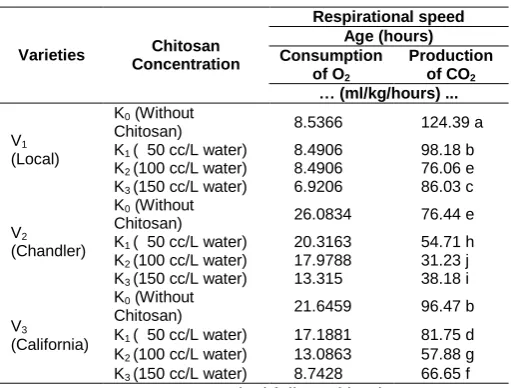
Table 3. Respirational speed after several strawberry varieties immersed into chitosan concentration with the age
of 0, 24, 48 hours after harvest.
Varieties Concentration Chitosan
Respirational speed Age (hours) Consumption
of O2
Production of CO2
… (ml/kg/hours) ...
V1 (Local)
K0 (Without
Chitosan) 8.5366 124.39 a
K1 ( 50 cc/L water) 8.4906 98.18 b K2 (100 cc/L water) 8.4906 76.06 e K3 (150 cc/L water) 6.9206 86.03 c
V2 (Chandler)
K0 (Without
Chitosan) 26.0834 76.44 e
K1 ( 50 cc/L water) 20.3163 54.71 h K2 (100 cc/L water) 17.9788 31.23 j K3 (150 cc/L water) 13.315 38.18 i
V3 (California)
K0 (Without
Chitosan) 21.6459 96.47 b
K1 ( 50 cc/L water) 17.1881 81.75 d K2 (100 cc/L water) 13.0863 57.88 g K3 (150 cc/L water) 8.7428 66.65 f
Note: Average numerical followed by the same Alphabetical at the same column shows no significantly at
p˂0.05 using DMRT.
The lowest intake speed of the O2 was on the application on Local variety with 150 ml/L water chitosan by 6.92 ml/kg/h, meanwhile the highest was on Chandler variety with no chitosan coated by 26.0834 ml/kg/h. The lowest production speed was on Chandler variety with 100 ml/L water chitosan applied by 31.23 ml/kg/h and the highest was on Local variety with no chitosan applied by 124.39 ml/kg/h. The coating with chitosan can diminish the speed of respirational process on the fruit (Noor, 2007) by preventing gases from like moving O2 into and CO2 out of the fruit. The coating with chitosan can halt the respirational process speed on strawberries (Karina et al., 2011), guavas and bananas (Zulferiyenni and Widodo, 2010), tomatoes (Novita et al., 2012), lanzones (Widodo et al., 2007).
4. CONCLUSION
Based on the result of the research, it is found that the coating with 150 ml/L water chitosan was the best concentration. This is supported by the lowest speed of the respirational process (consumption of O2) namely 6.92 ml/kg/h, the lowest water content 86.74 % (0 hour of storage), 86.11 % (24 hours of storage), and 92.65 % (48hours of storage) and the highest vitamin C content namely 1179.03 mg/100gram material (0 hour of storage), 1242.57 mg/100gram material (24 hours of storage), and 1286.43 mg/100gram material (48 hours of storage), and the best variety was Chandler variety which had the lowest water content by 0,24 and 48 hours of storage, and also the lowest speed of respirational process (production of CO2).
ACKNOWLEDGMENT
The authors would like to extend his gratitude to Methodist University of Indonesia for its financial support during the research, and also to University of North Sumatera for allowing the using of facilities to conduct the research.
REFERENCES
[1] Abbasi. N. A., Iqbal, Z., Maqbool, M., dan Hafiz, M. A, 2009, Postharvest Quality Of Mango (Mangifera indica L.) Fruit As Affected By Chitosan Coating, Pak. J. Bot., Vol. 41, (1): 343-357.
[2] Diana. A.B.M, Daniel, R. Barat, J.M. dan Catherine. B.R. 2009. Orange juices enriched with chitosan: Optimisation for extending the shelf-life. Innovative Food Science and Emerging Technologies. 10: 590–600.
[3] Fernandez, S. P. 2012. Chitosan and Chitosan Blends as Antimicrobials. In: Lagaron et al., Antimicrobial Polymers. USA: A Jhon Wiley & Sons, Inc., Publication. P.74.
[4] Hardjito L. 2006. The application of chitosan as additive and as preservative. Department of Teknologi Hasil Pertanian. Faculty of Perikanan and Ilmu Kelautan IPB. Posiding Seminar Nasional Kitin Kitosan. Bogor.
[5] Hernandez-Munoz, P. , E. Almenar, V. D. Valle, D. Velez and R. Gavara. 2008. Effect of Chitosan Combined with Postharvest Calcium Treatment on Strawberry (Fragaria x ananassa) Quality During Refrigerated Storage. Food Chemistry. 110:428-435.
[6] Karina A. R, S. Trisnowati, D. Indradewa. 2012. The Effect Of Kinds And Concentrations Of Chitosan On Shelf Life And Quality Of Stawberries (Fragaria x ananassa Duch.). Vegetalika Journal. Vol 1st (3): 163-169.
[7] Noor. Z. 2007. The attitude of cellulose of bananas at air-modified storage. Technology National Seminar (SNT) in Yogyakarta, November 24 2007. Pages A1-A8.
[8] Novita. M, Satriana, Martunis, S. Rohaya, dan E. Hasmarita. 2012. Effects Of Chitosan Coating On Physico-Chemical Characteristic Of Fresh Tomatoes (Lycopersicum pyriforme) In Different Maturity Stages. Jurnal Teknologi dan Industri Pertanian Indonesia Vol. (4) No.3: 1-8.
[9] Nur‘aini. H, S. Apriyani. 2015. The Used Of Chitosan To Extend The Lanzones‘s (Lansium Domesticum Corr) Shelf Life. Agritepa Journal, ISSN : 2407-1315. Vol. I, No. 2: 195-210.
[11]Sitorus. R. F, T. Karo-karo, Z. Lubis. 2014. The Effect Of Concentration Of Chitosan As Edible Coating And Storage Time On The Quality Of Guava Fruits. Rekayasa Pangan dan Pertanian Journal. Vol. 2nd. Number 1st.
[12]Sritananan. S, A. Uthairatanakij, P. Jitareerat, S. Photchanachai dan S. Vongcheeree. 2005. Effects of irradiation and chitosan coating on physiological changes of mangosteen fruit stored at room temperature. Int. Symp. New Frontier of Food and Non-Food Products 22-23 Sept. 2005, KMUTT, Bangkok, Thailand.
[13]Widodo, S. E, D. K. Abdullah, K. Setiawan, and Zulferiyenni. 2007. Technological modified atmosphere packaging of lanzones with Chitosan. National Seminar of Horticulture in Indonesia. University of Sebelas Maret Indonesia, Surakarta, November 17 2007. Pages 639- 644.
[14]Widodo, S. E. And Zulferiyenni. 2008. The Application of Chitosan in Technological Packaging lanzones at modified atmosphere. Prosiding National Seminar 2008: The Improvement of Food to Sell on Global Market. Perhimpunan Ahli Teknologi Pangan Indonesia dan Jurusan Teknologi Pangan dan Hasil Pertanian UGM Yogyakarta, January 17 2008. Pages TP278- TP287.
[15]Widodo, S. E. dan Zulferiyenni. 2010. Technology of passive packaging for chitosan-coating ‗Mutiara‘ and ‗Muli‘ banana. Proceeding International Seminar on Horticulture to Support Food Security. Bandar Lampung 22-23 June 2010. p.B36-B43.
0 10 20 30 40 50 60 70 80 90 100 110
Var.Lokal Var.Candler Var.California
W at er c on ten t (% ) Varieties
0 hours after harvest without chitosan
chitosan immersion with 50 cc/l water chitosan immersion with 100 cc/l water chitosan immersion with 150 cc/l water 0 10 20 30 40 50 60 70 80 90 100 110
Var.Lokal Var.Candler Var.California
W at er c on ten t (% ) Varieties
48 hours after harvest without chitosan
chitosan immersion with 50 cc/l water chitosan immersion with 100 cc/l water chitosan immersion with 150 cc/l water 0 5 10 15 20 25 30
Var.Lokal Var.Candler Var.California
C on su m p ti on o f O2 (m l/ k g/ jam ) Varieties
Respirational speed without chitosan
chitosan immersion with 50 cc/l water chitosan immersion with 100 cc/l water chitosan immersion with 150 cc/l water 0 10 20 30 40 50 60 70 80 90 100 110 120 130
Var.Lokal Var.Candler Var.California
P ro d u ct io n o f C O2 (m l/ k g/ jam ) Varieties
Respirational speed without
chitosan
chitosan immersion
with 50 cc/l
water chitosan immersion with 100 cc/l water chitosan immersion with 150 cc/l water 0 10 20 30 40 50 60 70 80 90 100 110 120 130
0 24 48
V it am in C c on ten t (m g/ 10 0 g i n gr ed ien ts )
Age (hours)
Vitamin C content wit hout ch itosan
ch itosan im mers ion wit h 50 cc/ l water
ch itosan im mers ion wit h 100 cc /l water
ch itosan im mers ion wit h 150 cc /l water
Fiq 1. Strawberry water content (%) with chitosan after storing for 0 hours.
Fiq 2. Strawberry water content (%) with chitosan after storing for 24 hours.
Fiq 3. Strawberry water content (%) with chitosan after storing for 48 hours.
Fiq 4. Strawberry vitamin C content (mg/100 g ingredients) with chitosan.
Fiq 5. Strawberry consumption of O2 (ml/kg/jam) with
chitosan.
Fiq 6. Strawberry production of CO2 (ml/kg/jam) with
Fiq 7. Strawberry total solidity dissolve with chitosan after storing for 0 hours.
Fiq 8. Strawberry total solidity dissolve with chitosan after storing for 24 hours.