761
Three Levels Of Feature Extraction From Multi-
Domain Images
T. Dharani, Dr. I. Laurence AroquiarajAbstract: In the digital era, the labeled and unlabeled images play a vital role in any person's life. Recognizing the labeled images from multi-domain image databases by using the low-level image feature is still a critical task in research. The multi-domain images are large scale, and also include the relevant irrelevant semantic concept. The research gaps of the image retrieval system are more consuming time and money, low quality of image, recognizing a newly added images and poor knowledge of multi-domain image. So the people are using irrelevant images with some alterations image, so, they are affected in the semantic gap and requirement-wise. The multi-domain images due to their uniqueness, it plays a key role in each field. It removes the unlabeled images in the image database. The Pattern Based Image Retrieval System (PBIRS) helps rectify the above research gaps and retrieve the relevant image. To overcome the above gaps by using PBIRS with three-level features extraction are color-RGB color channels and pixel counts, texture-GLCM, shape-region and contour-based features and Fuzzy Edge Detection. Finally, evaluate the performance with Mean Square Error (MSE), Root Mean Square Error (RMSE), Peak Signal Noise Ratio (PSNR) and Signal to Noise Ratio (SNR) for better accuracy.
Index Terms: Color feature, GLCM, Fuzzy Edge Detection, Pattern Based Image Retrieval system, Shape-Region and Contour Features, Multi-Domain Images, Unlabeled Images.
—————————— ——————————
1.
INTRODUCTION
In the digital world, we are facing many problems during searching the relevant digital images from retrieval systems. The main problems of fields are in our life there are healthcare, commerce, security, and agriculture. In this paper, we are considering the four social problems that are overcome by using the PBIR system. A clear explanation is given in the following sections of the paper.
1.1 Healthcare Field
Breast cancer may be a kind of cancer that starts within the breast. Cancer starts once cells begin to grow out of management. Breast cancer cells usually form a tumor that can often be seen on a mammogram or felt as a lump. Breast cancer happens nearly entirely in girls, however men will get carcinoma, too. It’s important to understand that most breast lumps are benign and malignant.
Stages of Breast Cancer
A doctor says concerning carcinoma stages per the scale of the tumour and whether or not it's unfold to liquid body substance nodes or alternative elements of the body.
TABLE1
STAGES OF BREAST CANCER
S.No Stages Description
1 Stage 0 Ductal Carcinoma In Situ (DCIS), the cells are limited.
2 Stage 1 The tumor measures up to 2 cm across. 3 Stage 2 It has started to spread to nearby
nodes.
4 Stage 3 The tumor is up to 5 cm across, and it has spread to several lymph nodes. Stage 4 The cancer has spread to distant
organs, most often the bones, liver, brain, or lungs.
1.2 Commerce Field
The WIPO is used to perform a trademark search by text or image in brand data from multiple national and international sources, including trademarks, appellations of origin and official emblems. In India is totally originating 953 for active, 125 for pending, two for inactive of trademark images. The trademark images are classified into 45 classes. All the images are appearing RGB and gray scale color images. Totally 549 images are unique class and the remaining images are multiclass. A trademark image is a unique distinct sign used by any individual, business organization or any judicial legal entity as intellectual property. It can be a logo, an image, word, design, phrase, text, clip-art or a combination of all these entities. A Trademark basically originates from or belongs to a unique source and is used to distinguish one business organization or legal entity, and its product and services from another. Since the trademark is a property right belongs to an individual owner that refers to its services and product, if any other entity mistreats or misuses the trademark, then the owner may initiate legal proceedings against the unauthorized entity.
1.3 Agriculture Field
The Mango fruit images are affected by the disease from the initial stage. This type of fruit has a healthy look but inside attack the unknown disease. These fruits are consuming more without knowledge of the disease, so people are affected more in health-wise. We are saving our national fruit mango because it has many good things for human life. For example, it is used to preventing breast cancer disease from the beginning stage. It has more medicinal values of vitamins to human being life.
1.4 Security Field
In the security field, any human images are proof of the particular happened events. The spatial disturbance and leave a small portion of things or images are more valuable evidence to solve the problem. So the investigation may occur time-consuming and confusing state during searching the particular human from the image database. To solve all the above research gaps by using the following sections of the paper. Section II of this paper presents the research background of the study. Section III of this paper is the ————————————————
Dharani .T is currently pursuing Ph.D degree program Full Time in Department of Computer Science in Periyar University, Salem-636 011, TamilNadu, India. E-mail: [email protected]
762
proposed method is an essential preprocessing and enhancements, extracting three levels of image features are low level is color, the middle level is texture and high level is the shape and finally evaluation measures for pattern-based image retrieval system for improving the performance. Section IV is placing the results of processes for better understand. Section V is placing performance evaluation measures. Section VI is placing the conclusion of this paper.
2 RESEARCH BACKGROUND
The image retrieval system is used to classify the images with various classes [1]. An existing image retrieval systems are working based on text, content, shape, semantic. The Text-Based Image Retrieval (TBIR) is working with the text of the image. TBIR is having demerits of efficiency, loss of information, more expensive task and time-consuming. Overcome these problems by using the Content-Based Image Retrieval (CBIR) system for image retrieval [2]. CBIR system working based on the features as a content of the image. The major categories of features, that is low, middle and high. Low-level features are color, texture and middle-Low-level feature is the shape and the high-level feature is a semantic gap between objects. An edge detection work is finding the three parts of an image are outlines, boundaries, and background [5]. The previous image retrieval system is working with different types of image databases [3]. Nowadays, the information is transmitting in the form of pictures for better understand while reading the text. The positions, sizes, and inter-relationships between objects are the features of the picture [4]. Image enhancement filters can predict the location of an image. Whether enhancements might lose their power to protect geo-privacy as the number of enhanced images in the background collection grows. In real life, there are two considerations that would impact how filtered images would accumulate in the background collection: first, the number of images that are filtered overall, and second, the number of images that are filtered with a given type of filter [6]. A grayscale image is one that has only the intensity value ranging from 0 to 1. Zero represents black and 1 represents white. An edge is a feature of an image. It is also a fundamental step in image pattern recognition, image analysis, and computer vision techniques [7]. Image segmentation work displays the portioning of a digital image [8]. The morphological operation may be a broad set of image process operations that method pictures supported shapes. In morphological operation, a structuring element is applied as an input image and creates an output image of the equal size [9]. Big Data is the advancement storage of multimedia database, which can be termed as tremendously huge sets of image feature data that may be examined computationally to reveal patterns, trends, and associations. Big data analytics refers to the process of collecting, organizing, analyzing, inspecting, cleaning, transformation and modeling large sets of data to discover patterns and other useful information [10]. To overcome the above CBIR system problems by using Pattern Based Image Retrieval (PBIR) system is a search engine for retrieving relevant images from the heterogeneous image database. The PBIR system works by pattern recognition techniques. A pattern is a visible entity of the image. Recognition is a label learning process [11]. In the trademark field, brand logo image quality is degraded by the color, texture, spatial features and using the same alteration logo, so people are affected in business. Logo due to their uniqueness, it plays a key role in
e-business. Because it removes the fake products in the market. The fake products are giving the wrong way to the people, for example, duplicate ATM Debit and Credit cards. The PBIR system helps product analysis to recognize the right product [12]. To improve the real-time trademark image search process by using multi-object similarity. The fuzzy inference system is used to processing multi-object similarity between trademark images in an efficient manner [13]. The trademark images are designed with complex patterns for uniqueness purposes. At the time retrieval and recognition, processes are very critical tasks. So, to rectify the shape of an image by using an orthogonal representation to obtain accurate results [14]. The color and shape features are most important for matching trademark images in an efficient manner [15]. The edge point feature extraction is used to obtain the corner pixel from trademark images for a better recognition process [16]. To improve the significance of trademark image retrieval by using hybrid features. The most important hybrid technique is the invariant moment's feature of the trademark is achieved 85 percent efficient [17]. The mammogram images are having an errors and noises during acquisition process affect the entire image processing and diagnosis of disease [18]. Identify the quality of mango by using some morphological operations are the close, open, dilation, erosion and contours for assessment in the meeting market requirements [19].
3
PROPOSED
METHODOLOGY
The Pattern Based Image Retrieval (PBIR) system is consisting of image acquisition from a multi-domain image database, preprocessing and enhancements process, extracting three levels of image patterns or features from a heterogeneous image database and finally evaluating the system performance by various measures.
763
Fig. 2. Proposed Method Diagram
3.1 Image Acquisition
TABLE2
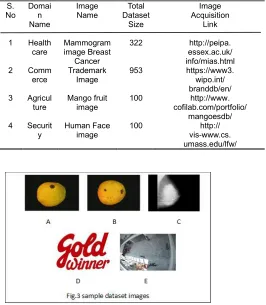
MULTI-DOMAIN IMAGE DATASET DESCRIPTION
3.2 Preprocessing Step
The preprocessing is the most essential task in image processing. Because each and every digital image is default include the noise due to some environment issue during taking image. The preprocessing steps are,
1. Resizing the image – The unequal size to uniform size is [256,256].
2. Color conversion step – Converting the RGB to Gray color for further better processing.
3. Adding noise – Adding noise to the query image for removing existing noise.
4. Denoising the image – Removing the noise by using filters.
3.3 Enhancement Step
The enhancement steps process with the Contrast – Limited Adaptive Histogram Equalization (CLAHE) Algorithm. The algorithm steps are,
1. Adjusted the query image. 2. Sharpened the adjusted image.
3. Find the histogram of the sharpened image.
4. Find the adaptive histogram equalization of histogram image.
5. Find the CLAHE histogram of the image.
3.4 Feature Extraction Step
The feature extraction step is used to extract the image patterns for understanding the image concept to humans. The existing image retrieval system is working with one or two levels of image features. But in this paper combining the three levels of image features for improving the system performance. Nowadays all the digital images are presenting the global levels of image features. The global level features are,
3.4.1 Color – Low-Level Feature
The color image feature is the primary color is RGB. This is the human understating image feature from the initial step of image processing. In this paper considering the color feature as the RGB pixel counts.
3.4.2 Texture – Middle - Level Feature
The texture image feature is the most important feature for the analysis of the medical images. This middle-level image feature is used to identify the foreground and background of the image.
Gray Level Co-Occurrence Matrix
A statistical method for examining the texture that considers the spatial relationship of pixels. The GLCM functions characterize the feel of a picture by conniving however usually pairs of the constituent with specific values and in an exceedingly such spatial relationship occur in a picture. Here consider the texture features are Entropy, Contrast, Homogeneity, Correlation, and Energy.
3.4.3 Shape – High-Level Feature
The shape image feature is the most promising high-level image feature for recognizing any domain of image patterns. In the digital era, multi-domain image databases are very large scale and incomplete knowledge of the meaning of the image. This image feature is used to recognizing the patterns of image. The shape features are again classified into two main kinds.
1. Contour-based shape feature globally identifies the perimeter of the image.
2. Region-based shape feature globally identifies the area, eccentricity of image.
The standard shape features are Centroid, Eccentricity, EquivDiameter, Perimeter, and Area for better understanding the complex shape of the query image.
S.
No Domain Name
Image
Name Dataset Total Size
Image Acquisition
Link 1 Health
care
Mammogram image Breast
Cancer
322 http://peipa. essex.ac.uk/ info/mias.html 2 Comm
erce
Trademark Image
953 https://www3. wipo.int/ branddb/en/ 3 Agricul
ture Mango fruit image 100 cofilab.com/portfolio/ http://www. mangoesdb/ 4 Securit
y
Human Face image
100 http://
764 Fuzzy Edge Detection
The fuzzy edge detection is used to recognizing the complex structure elements of image. In this method working with the graythreshold concept of image for appearing the structure of image.
TABLE3
COLOR FEATURE EXTRACTION-RGBPIXEL COUNTS
TABLE5
SHAPE FEATURE EXTRACTION-REGION AND CONTOUR
5 PERFORMANCEEVALUATIONMEASURES
TABLE6
STATISTICAL MEASUREMENTS
Where
f
(
i
,
j
)
is the original image, F (i, j) is an enhancedimage,
2is a variance of the original image and 2
e
is a variance of the enhanced image. If the value of RMSE is low and the values of SNR and PSNR are larger than the enhancement approach is better.TABLE7
FUZZY CANNY EDGE DETECTION RESULTS
STATISTICAL
MEASUREMENTS FORMULAS
MSE
MN
j
i
F
j
i
f
2))
,
(
)
,
(
(
RMSE
MN j i F j i f
2)) , ( ) , ( (
SNR 2
2
10
log
10
e
PSNR
RMSE
255
log
20
10S. NO
AVG. IMG DOM
CENT- ROID
ECCEN- TRICITY
EQUIV- DIAMETER
PERI- METER
AREA
1 A 2 0.8660 1.5958 1.9600 2
2 B 2 0.8660 1.5958 1.9600 2
3 C 47.3463 0.9998 18.0893 497.8570 257 4 D 23.4444 0.7957 12.6660 205.4420 126 5 E 2.1304 0.9982 5.4115 43.6080 23
S.NO AVG.IMAGE
DOMAIN R G B
1 A 0 0 0
2 B 123 0 0
3 C 0 0 0
4 D 6454 3596 2941
5 E 2006 1727 2505
S.NO IMG DOM
MSE RMSE PSNR SNR
1 A 0.2775 0.5268 5.5679 10.0778
2 B 0.2813 0.5304 5.5086 12.2256
3 C 0.2654 0.5152 5.7611 7.4685
4 D 0.5745 0.7580 2.4070 7.0623
5 E 0.3287 0.5733 4.8325 10.1381
S. NO
AVG.IMG DOM
ENT ROPY
CONT RAST
HOMO- GENEITY
CORRE- LATION
ENERGY
765
Figure 5: Pictorial Representation - Fuzzy Canny Edge Detection Results
6
CONCLUSION
In this paper, introducing the multi-domain image database for the PBIR system. The preprocessing and enhancement steps of the system is working with the CLAHE algorithm for many complex structural elements of image retrieval purpose. The three levels of image feature extraction methods are proposed. The color feature is RGB pixel count values, texture feature is GLCM statistical values and the shape feature is extracting by using region and contour-based structure elements of the image. The fuzzy-based new edge detection algorithm is proposed. Experimental results show the higher quality and superiority of the extracted edges compared to the canny and fuzzy canny. To achieve good results, some parameters and thresholds are experimentally set. Automatically determining these values needs further researches. To overcome the above gaps by using PBIRS with preprocessing and enhancements, three levels of feature extraction methods and Finally, evaluate the performance with Mean Square Error (MSE), Root Mean Square Error (RMSE), Peak Signal Noise Ratio (PSNR) and Signal to Noise Ratio (SNR) for better accuracy.
ACKNOWLEDGMENT
The first Author of this paper acknowledges University Research Fellowship (Ref. No: PU/AD-3/URF/2017) for the financial support.
REFERENCES
[1] T. Dharani, I. Laurence Aroquiaraj, ―A Survey on Content Based Image Retrieval‖, IEEE-2013 International Conference on Pattern Recognition, Informatics and Mobile Engineering (PRIME), PRIME 2013, 978-1-4673-5845-3/13/2013.
[2] T. Dharani, I. Laurence Aroquiaraj, ―Content based image retrieval system with modified knn algorithm‖, International Journal of Innovations in Scientific and Engineering Research (IJISER), Vol. 1 Issue 1 Jan 2014.
[3] T. Dharani, I. Laurence Aroquiaraj, ―Content Based Image Retrieval System Using Feature Classification with Modified KNN Algorithm‖, International Journal of Computer Trends and Technology (IJCTT), ISSN: 2231 - 2803, volume 4 Issue 7–July 2013.
[4] T. Dharani, I. Laurence Aroquiaraj, ―An appraisal of content based image retrieval by means of unlabelled images‖, International Journal of Advanced Research in Biology
Engineering Science and Technology, Vol. 2, Special Issue 10, March 2016.
[5] T. Dharani, I. Laurence Aroquiaraj and V. Mageshwari, ―Comparative Analysis of Edge Detection Algorithms Based on Content Based Image Retrieval With Heterogeneous Images‖, International Journal of Computational Intelligence and Informatics, ISSN: 2349 – 6363, Vol. 5: No. 4, March 2016.
[6] T. Dharani, Dr. I. Laurence Aroquiaraj and V. Mageshwari, ―Diverse Image Investigation using image metrics for Content Based Image Retrieval system‖, IEEE Xplore, August 2016.
[7] V. Mageshwari, Dr. I. Laurence Aroquiaraj and T. Dharani, ―A Resourceful Comparison of First Order Edge Detections Using Grayscale Intensities‖, Imperial Journal of Interdisciplinary Research (IJIR), ISSN: 2454-1362, Vol-2, Issue-5, 2016.
[8] V. Mageshwari, Dr. I. Laurence Aroquiaraj and T. Dharani, ―A Proficient Segmentation of Remote Sensing Images using Modified Kernel Fuzzy C-Means Algorithm‖, International Journal of Computational Intelligence and Informatics, ISSN: 2231 – 0258, Vol. 6: No. 1, June 2016. [9] V. Mageshwari, Dr. I. Laurence Aroquiaraj and T. Dharani,
―A Realistic Medical Image Segmentation of Abnormal HIV in Blood Cells Using Morphological Operations‖, IEEE Xplore, August 2016.
[10] V. Mageshwari, Dr. I. Laurence Aroquiaraj and T. Dharani, ―Big data in health care revolut ion – a survey‖, International Research Journal of Engineering and Technology (IRJET) e -ISSN: 2395 -0056, p- ISSN:2395-0072, Volume: 03 Issue: 09, Sep-2016.
[11] T. Dharani, Dr. I. Laurence Aroquiaraj, ―Pattern Based Image Retrieval System built with Object Tracking and Segmentation Concepts‖, International Journal of Computer & Mathematical Sciences (IJCMS), Volume 6, Issue 9, ISSN 2347 – 8527, September 2017.
[12] T. Dharani, Dr. I. Laurence Aroquiaraj, ―An Essential Image Augmentation Processes for Pattern Based Image Retrieval System‖, Elsevier’s SSRN eLibrary – Journal of Information Systems & eBusiness Network -ISSN: 1556-5068, 2017.
[13] Chin-Sheng Chen * ID and Chi-Min Wen, ―An Efficient Retrieval Technique for Trademarks Based on the Fuzzy Inference System‖ Appl. Sci. 2017, 7, 849; doi:10.3390/app7080849 www.mdpi.com/journal/applsci. [14] BEN YE, ZHANCHUAN CAI, TING LAN, AND YOUQING
XIAO, ―A Novel Shape Representation Method for Complex Trademark Image‖, IEEEAccess EEDigital Object Identifier 10.1109/ACCESS.2019.2912230.
[15] Preeti Patel1, Ajay Kr Indoria2, ―Preprocessing and Similarity Matching Trademark Images Based on Color and Shape‖, International Journal of Science and Research (IJSR) ISSN (Online): 2319-7064 Index Copernicus Value (2013): 6.14 | Impact Factor (2013): 4.438 Volume 4 Issue 1, January 2015.
[16] Saurabh Agarwal1, Nikhil Chaturvedi2 and Punit Kumar Johari3, ―An Efficient Trademark Image Retrieval using Combination of Shape Descriptor and Salience Features‖, International Journal of Signal Processing, Image Processing and Pattern Recognition Vol.7, No.4 (2014), pp.295-302, ISSN: 2005-4254, 2014.
766
TECHNIQUE FOR TRADEMARK IMAGE RETRIEVAL‖, International Journal on Information Theory (IJIT), Vol.3, No.4, October 2014.
[18] ARDRA MARIYA JOSEPH, GRACE JOHN M., ANTO SAHAYA DHAS and ―MAMMOGRAM IMAGE DENOISING FILTERS: A COMPARATIVE STUDY‖, Proc. IEEE Conference on Emerging Devices and Smart Systems (ICEDSS 2017), 3-4 March 2017.