3452
An Efficient Design Implementation Of OFDM
Based Transmission System.
Ravi kumar.M, Dr.Eranna.U
Abstract: In present generation health has rooted its importance deeper than anything else in human life cycle. With the latest
innovations and inventions the telecommunication has extended its path in medical field to provide health care to remote places from far distances. The distances between regions, countries and continents are no longer a barrier for telemedicine as the rural areas are reachable saving lives in medical emergency from distant places is now a reality. This paper details on efficient design and implementation of OFDM (orthogonal frequency division multiplexing) based Cognitive Radio for achieving a quality transmission and reception of biomedical data through the wireless channel. The Cognitive Radio employs smart wireless devices with awareness and sensing along with a learning and adaptation capability. Therefore proving to be the best solution in solving the problem of spectrum scarcity. Implementing this concept in a wireless healthcare applications helps to transfer medical information through wireless networks for remote medical analysis and examinations. The primary purpose of choosing Cognitive Radio is to utilize the available spectrum and advantage of using OFDM is it reduces ISI Interference and multi path fading. Hereby proposing a framework for the remote monitoring and analysis of patient health by using the concept of wireless networks.
Keywords: Cognitive radio, Telemedicine, ISI interference, Multipath fading, Spectrum sensing.
————————————————————
1. INTRODUCTION
The proposed telemedicine system can provide an effective solution for various healthcare needs, including emergency medical services and rural healthcare services. Addressing healthcare problems in villages and tribal areas with fewer doctors and a lack of basic healthcare infrastructure is a major issue in most of the countries.
Mobile Medical Units (MMUs) are used to connect such remote areas and specialty hospitals through wireless networks. In MMUs, the basic tests like body temperature, pulse rate, blood pressure, ECG, are conducted for the tele-consultation of the patient. Telemedicine technology ambulances is desirable, wherein critical parameters like pulse rate, ECG, and blood pressure are transmitted from the ambulance to a hospital for interpretation and guidance on providing appropriate pre-hospital care to the patient as described in fig 1.1.
________________
Ravi Kumar M is a research scholar in BITM, Bellary, Karnataka,
India. He is currently pursuing Doctoral program in electrical
engineering in Visveswaraiah Technological University,
Karnataka, India.
E-mail: [email protected].
Dr.Eranna. is a Professor & HOD,Dept. of Electronics and
communication engineering, Ballari Institute of Technology and
Figure 1.1 Spectrum sensing of cognitive radio.
2. RELEVANT WORK
Cognitive Radio has turned out to be the promising solution for the spectral crowding issue. The idea of cognitive radio assists the coexistence of key users (PU) and secondary users (SU) which are also termed as legacy users and new users through dynamic spectrum access [1]. A CR transceiver has the ability to detect both occupied and unused communication channels in a wireless spectrum. Once identified it instantly moves into unused channels while avoiding employed ones. Henceforth this optimizes the use of the available radio-frequency spectrum and avoids interference with existing primary users. The two key features of Cognitive Radio are observation and adaptability. In a radio environment by the means of spectrum sensing, channel estimation, and modulation identification it can observe and learn then, through adaptability characteristic the cognitive radio dynamically changes its parameters of communication protocols through various approaches like power and channel allocation, variation, coding scheme selection and waveform adaptation, based on its empirical results. With some minor modifications orthogonal frequency division multiplexing (OFDM) proves its potential in fulfilling the need of CR. OFDM is a
multicarrier transmission technique [2]. Its importance and
usage can be seen in several wireless multimedia transmission standards such as Digital Video Broadcasting (DVB-T), Digital Audio Broadcasting (DAB).OFDM has a wide range of usage in multimedia data transmission in wireless telemedicine applications.
3. DESIGN
Spectrum sensing
Spectrum management
Signal processing and modulation
Biomedical instrument
Biomedical signal conditioning
Biomedical data acquisition Spectrum database
Wireless environment
Wireless Network
Figure 3.1 Flow diagram for wireless transmission
system.
4. IMPLEMENTATION
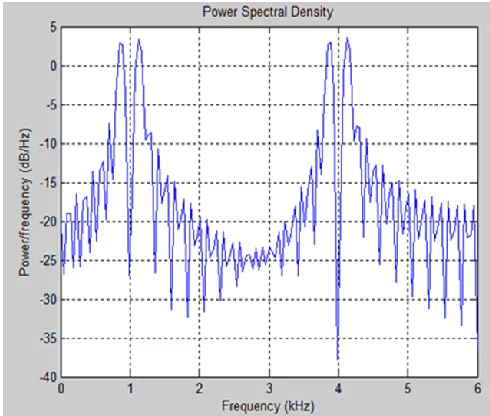
Based on power spectral density CR takes the decision of the channel and the power spectral density is based on the concept of spectral hole. In the absence of user data in a frequency band, it remains empty and it is popularly known as spectral hole[5]. There are two ways to implement a CR- Offline implementation and direct spectrum sensing. Offline implementation is achieved using MATLAB and direct spectrum sensing is achieved using RTL-SDR hardware and SDR sharp software[6]. For offline implementation, code is written in matlab to determine allocated and unallocated channels. In direct spectrum sensing, the RTL-SDR hardware consists of two components- RF antenna and a Dongle. The RF antenna is used to transmit and receive signals. Dongle that features Realtek RTL2832U chip, through the USB interface which is used to sample and sense the empty frequency band present in the spectrum [7]. The SDR sharp software is used to support the hardware. It can tune into frequencies from 24MHz to 1.8GHz. This implies using the RTL-SDR hardware and software a PC can be transformed into radio to tune into: FM radio, AM signals, decode radio signals [8]. Software called Zadig is used to ease the driver installation.
5. RESULTS AND DISCUSSION
5.1: Offline implementation
Fig 5.1. Command prompt for user allocation.
The allocation of users as shown in fig 4.1 and a particular frequency band is assigned in a command prompt during simulation analysis as shown in 4.2.
Fig 5.2. Spectral density analysis
Fig 5.3. Command prompt for noise allocation for
users.
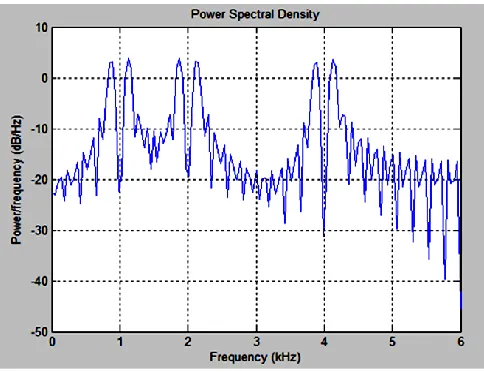
If we add another user, now the system will pursuit for the initial obtainable gap from the spectrum and allots it to the new user automatically.
Fig 5.4. Spectral gaps
The above image shows that 1st spectral gap is filled by the incoming data from the new user.
Fig 5.5. Command prompt for noise and signal
attenuation for users.
Out of all available bands now we are left with only one unoccupied slot which can be occupied by adding another primary handler to the band.
Fig 5.6. signal attenuation in Spectral gaps.
Fig 5.7. Command prompt for user slot selection.
If all frequency slots are allocated, then the system doesn’t accept further allocation of users until the band is
freed up.
5.2: Direct spectrum sensing implementation
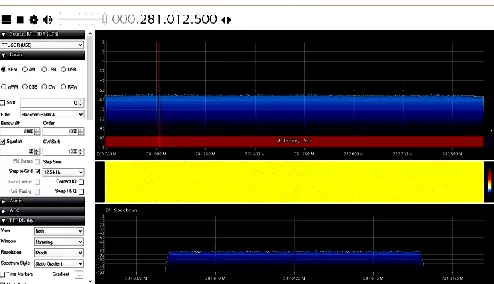
To obtain the real-time spectrum SDR sharp is used. The frequency ranges from 25MHz to 1GHz.
Fig 5.8. Frequency band reserved for defence usage.
Fig 5.9.Frequency band implemented for FM
broadcasting.
4.
CONCLUSION
In conclusion, this study shows that the idea behind choosing Cognitive Radio is because to efficiently utilize the entire available spectrum. Cognitive Radio capability in sensing, learning, and adaptation capabilities proves to be the finest solution in resolving the problem of spectrum scarcity. The unused bands which weren’t utilized by
primary (licensed) users were used by Cognitive Radio users. The firmness against NBI (Narrow band Interference), high spectral efficiency, ease implementation by use of FFT, and the transmission parameter’s re-configurability proves how advantageous
it is. In total all these abilities along with the capability of spectrum sensing by using FFT makes OFDM very suitable for transmission technology in CR systems. Future considerations of this system include the compression of the biomedical signals before transmission, and multiplexing biomedical images along with the EEG and ECG signals.
ACKNOWLEDGMENTS
REFERENCES.
[1]
N. Gupta and V. A. Bohara, "An AdaptiveSubcarrier Sharing Scheme for OFDM-Based Cooperative Cognitive Radios", in IEEE Transactions on Cognitive Communications and Networking, vol. 2, no. 4, pp. 370-380, Dec. 2016.
[2]
U. T. Pandya, U. B. Desai, “A Novel Algorithm forBluetooth ECG”, IEEE Transactions on Biomedical Engineering, vol. 59, no. 11, pp. 3148-3154, 2012.
[3]
S. K. Chen, et al., “A Reliable TransmissionProtocol for ZigBee-Based Wireless Patient Monitoring”, IEEE Transactions on Information
Technology in Biomedicine, vol. 16, no. 1, pp. 6-16, 2012.
[4]
Warren, S., Craft, R. L., & Bosma, B, “Designing smart health care technology into the home of the future”, In Workshops on Future Medical Devices:Home Care Technologies for the 21st Century (Vol. 2, p. 667), 1999.