Enhanced Attendance System Using Intensity
Normalization, Face Alignment And LBPH
Nupur Somwanshi, Sushama S. Agrawal
Abstract: Attendance is a crucial part of any institution and is difficult to obtain if there are a large number of data-se, Face Recognition based attendance are growing popular recently and there is lot of research going on in this field. This paper is a contribution towards improvising the system in place for face recognition. In this paper Face Alignment and Normalization is used to enhance the accuracy of LBPH algorithm. The algorithm proposed here uses pre-processing stages which makes it impervious to change in lighting conditions and head poses. Once the training of dataset it completed, the prediction of face recognition module is obtained within 2-3 seconds thus turning out to be a time efficient system. Some other features of the system propose dare user friendly and easy to interface with other platforms because of the GUI presented.
Index Terms: Attendance System, OpenCV, LBPH, face recognition, Intensity normalization, Face Alignment.
————————————————————
1 INTRODUCTION
With the advent of fast processing computers and tremendous development in GPU there is very significant research taking place in machine learning algorithms in the last decade. The machine learning algorithms were a topic of research since 1960s but the availability of fast computers to the common people due to reduction in cost of electronic devices has made it more popular these days. Humans have developed the skill of recognizing faces through evolution and now are able to perform it without even thinking about it. The popularity of face recognition for biometric is also popular because it is the method that humans use for recognizing each other. The use of face recognition for attendance systems in schools, colleges and offices simplifies the tedious task of going through each individual person‟s presence or absence and maintaining the data manually in excel sheets and updating them and this is prone to degradation with increasing data. By making the computer capable of performing this function on their own we are freeing ourselves of lot of time, energy and resources of maintaining these manual sheets. And since there are very fast processing computers available in market, we can easily outsource this work to different platform to get performed in lesser time. Immense attention towards this field of face recognition is because of its myriad uses in fields of authentication, security, legal enforcements, communication through internet, pattern recognition, surveillance. In this paper face recognition is used for the attendance system. The presence of the students will be uploaded in a comma separated vector file that is .csv files and also in MySQL database. Face recognition will mainly include making a dataset consisting of sufficient images of a student to be recognized, then corresponding to each of these images the encodings are stored in .yml file, when that individual appears infront of camera again the system will recognize. After getting recognized the system marks the attendance in an csv file which is as default is opened by Microsoft excel along with the name, ID along with date and time of that instant.
—————————————
Nupur Somwanshi is currently pursuing Masters’s degree program in Electronics Engineering in Government College of Engineering Aurangabad, Maharashtra, India, PH-918411099849. E-mail: [email protected]
Sushama S. Agrawal is currently a professor in Electronics and Telecommunication Department in Government College of Engineering Aurangabad, Maharashtra, India, E-mail: [email protected]
2 LITERATURE SURVEY
In paper [1] by Ming-Hsuan Yang, D. J. Kriegman and N. Ahuja, there is a study in face detection techniques. Some of the methods of face detection are principally based on Knowledge, Feature, Appearance and Template Matching. Knowledge Based approach comprise of a sequence of rules such as a face must consist of a nose, eyes, mouth etc. but the problem with this approach is that it gives a lot of false positives if the rules are very general and gives a lot of false negatives if the rules are very strict and detailed. Feature Based method approach is when a classifier is trained by extracting structural features of faces. Template Based method is when parametrized template of face is made from the dataset images and then a given image is correlated with the template and thus a face gets detected. Appearance based method is based on finding out the important characters of the face images using machine learning and statistical features. Ghorbani, Mohsen & Targhi, Alireza & Dehshibi, Mohammad Mahdi stated that LBP was initially developed for surface difference classification descriptor. LBP doles out a mark to each pixel in a picture by thresholding of a neighborhood of 3*3 block every pixel with the middle intensity value and calculating its result as a binary measure which is further converted into decimal number. Thus, the labels of histogram area method to be used as a surface descriptor. The authors proved very elaborately how HOG and LBP have proved to be very effective in object detection and in particular face recognition as well.[2] Sudha Narang, Kriti Jain, Megha Saxena, Aashna Arora discusses the most competent OpenCV algorithm for FR that can be used in Attendance Management Application. The system made with Eigen factor PCA, Fisherface and LBPH algorithm and designed and then compared. LBPH has much better performance compared to other two algorithms when its confidence value is in range 2-5 and has lowest effect of light and rotation. The conclusion derived from the comparison is that there is a compromise between the threshold values and true recognition rate. With high threshold value, the number of negatives starts to decrease probably ensuing in misclassification. For FR LBPH is the most accurate and efficient algorithm as compared to the other two obtainable from OpenCV to detect the attendance of students in an institution and mark the attendance accurately by dodging false acceptance [3]. D. Nithya developed a system which records student‟s attendance at the time of entrance and at the time of departing from the classroom routinely and along with providing additional data about the student to the faculty by keeping a record of exit and entry time. By means of SMTP protocol and IOT protocol, respective attendance can be sent to their parents through mail. This system uses database of only 4 students for training and testing of the system. The attendance is updated daily on a singular spreadsheet [4]. In [5] S. Z. Li, R. Chu, S. Liao and L. Zhang presents use of an active near IF (infrared) imaging system capable of producing images of decent condition irrespective of environment and also it uses local LBP to compensate for the monotonic transform, therefore obtaining a radiance invariant face recognition. The only problem with this is that it employs an active NIR imaging hardware and thus capable of providing solutions to cooperative users for indoor applications. In outdoor applications with this we will get strong NIR component from the sun therefore the applications are very limited. T. Ahonen, A. Hadid and M. Pietikainen paper in which author performed
an LBP experiment on FERET database which was classified in 5 parts i.e. frontal faces, faces with expressions, faces with different lightning conditions, images taken at later time of the day and images taken a year later. LBP produces visibly higher recognition rates than other control algorithms in all the FERET datasets and also all in the statistical tests. Additional returns are the calculation proficiency of the LBP operator and also for LBPH the gray-scale normalization is not required former to the use of LBP operator of the face image. It also shows how local feature-based approaches and hybrid approaches are better for pose and illumination invariant.[6] Kawaguchi, Yohei & Shoji, Tetsuo explains development of attendance system which continuously takes the video of whole class and identifies where the students are seating and directs the camera to the position of seat. The occurrence of a student on a seat is calculated by doing the background deduction and inter-frame deduction of the image from the identifying camera on the ceiling for FR. In the background deduction method, noise factors like coats, books and bags of each student are also detected, and the detection of student doesn‟t happen if the dress color of a student is similar to the seat. The problem with above system is that the camera and system need to be kept turned on for the whole duration of class which is not very power efficient.[7] E. Varadharajan, R. Dharani, S. Jeevitha, B. Kavinmathi and S. Hemalatha used a background deduction method is done for face detection Thus the background of an image continues to be static therefore background of an image is subtracted only once in an image. The image is used for face detection after background subtraction. Rectangle or Circle is used to mark the detected face in the image. They used eigen values for face recognition and tested the performance for Veil, Unveil and Bearded images. The results were good for Unveil images to about 87% recognition rate[8]. Kar, Nirmalya & Deb Barma, Dr. Mrinal & Saha, Ashim & Rudra Pal, Dwijen used two main components which are generally used in the implementation of systems for face recognition and those are open source computer vision library (OpenCV) and Light ToolKit (FLTK). OpenCV library comprises of over 500 functions which covers many of the areas of computer vision functionality. PCA method is employed on the images and an xml file is generated to store the eigen values extracted. Image compression and Face recognition widely employs PCA algorithm. Continuous observation at entry and exit point is used for attendance. They also published the results obtained by different orientations of the face and its effects on face detection and recognition rate [9].
3
P
ROPOSEDM
ETHODThe Attendance System proposed in this system has following major steps:
3.1 Creation of Dataset
expressions, in different lightning conditions and at different distances from the camera. For creating the dataset, it is mandatory for the administrator or teacher to enter the Name and ID of the student only in numeric and alphanumeric characters respectively. Then click on TakeImage button on the GUI. This action gives the algorithm a command to obtain a video feed. The GUI after detecting action on the button call the respective function of TakeImage which has the functionality of activating the system camera and initializing a counter to zero and incrementing it after each frame is obtained. This image frame undergoes preprocessing stages discussed below before getting stored in the TrainingImages folder. Since the video is basically a collection of frames in a sequence, these frames are taken as images and stored in the database folder. After taking 40 consecutive photos the camera shuts down once the counter exceeds its limit.
3.2 Pre-processing Stage
This stage consists of 3 sub stages:
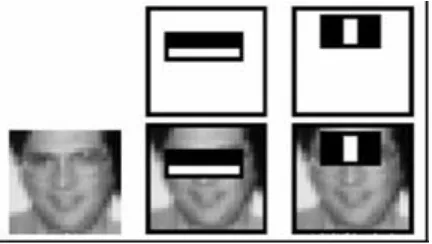
Face Detection: Haar cascade classifier is used for detection of faces. In python OpenCV there is a previously trained .xml file which is used for detecting faces. There are also files for recognition of various body parts such as eyes, ears, nose, upper body and lower body. Training on a large number of positive and negative images is done in haar cascade classifier. In this project we used Haar cascade for frontal face. By deducting the sum of pixel under the white rectangular part from the sum of pixels under the black rectangular part we get a singular value. Haar cascade uses various edge and line detection features for detecting faces. Fig. 1. shows how haar cascade classifier works.
Fig. 1. Working of Haar Cascade using Edge features.
Converting to Gray Scale: The images obtained through Python are in BGR format. This image format needs to be converted to gray for further processing. This can be done by using the function provided by OpenCV i.e. cv2.cvtColor(img, cv2.COLOR_BGR2GRAY). Here img is the image obtained from camera.
Histogram Equalization: Histogram basically represents number of pixels of each intensity in an image. Histogram equalization is used for contrast improvement of any image. This is done by stretching out the intensity range of an image. The effect of histogram equalization can be seen below.
Face Alignment: This project uses face alignment provided
by imutils.face_utils library. The
dlib.get_frontal_face_detector() is used to get the frontal face area of the detected face. The dlib.shape_predictoris
used along with pre-trained
shape_predictor_68_face_landmarks.datto get the landmarks on the face image. The landmarks of the corners of the eye are used to align the image.
Fig. 2. Results of Histogram Equalization.
The Alignment purpose is to basically be able to make the horizontal line joining the landmarks at the corners of the eyes to be parallel to the X-axis. The result of Face Alignment is shown in Fig.3.
Fig. 3. Results of Alignment of face.
Intensity Normalization: For getting the intensity normalized image, the aligned faces are first converted into frequency domain by fast Fourier transform and the high frequency region on the left corner of the transformed image is shifted to the center by the following command available in NumPy: np.fft.fftshift(). The center pixel for this is found and made zero to get the intensity normalization. Then the inverse shift and inverse transforms are applied to get back the intensity normalized image for storing in database. The effect of intensity normalization can be seen in Fig. 4
Fig. 4. Results of Alignment of Intensity Normalization.
keep track of the images captured and it also helps to uniquely identify each image of an individual.
The Dataset generation stops at two conditions:
1. When 40 images for the individual are obtained: Once the counter reaches 40 the video feed stops and the message is displayed on the GUI video updating the end user about the successful creation of database. After this the system is ready for training.
2. When „q‟ from the keyboard is pressed: This will immediately stop the video feed and whatever number of images are stored in the database can be further used for training.
The Name of the student along with the Id is also updated in a csv file named StudentDetails once the dataset corresponding to the student is obtained.
3.3 Face Recognition
The notion of LBP is to recapitulate the local region in an image by comparing every pixel value with its neighbors. Steps occurring in LBPH in OpenCV are:
1. Dataset image is given to the recognizer which is
created by using the function
cv2.face.LBPHFaceRecognizer_create().
2. The recognizer does the training process by recognizer.train() and histogram gets generated which is stored in a Trainner.yml file by using recognizer.write(). It stores image data corresponding to each name and ID of student in a text readable file. The yml stands for YAML Ain‟t Markup Language. This is a very common file type for storing data of such image database.
3. Once the training is complete it will be informed to the user with display of message on the GUI screen saying “Image Trained”.
4. After the training is completed in the same way for all the students the system is ready for marking attendance using face recognition. The attendance can be taken by clicking on TrackImage button and thus the camera gets activated. Again, the frames obtained are tracked for faces which are converted to gray and undergo all the pre-processing discussed above. These pre-processed images are used for making the prediction about the Id. It will obtain continuous image feed which is compared with the stored histogram and returns the ID which best matches with the stored information of histograms. 5. If a student is present it is marked in a csv file against
the name of the student and also the date and time are noted in the excel sheet. This is very easy to manage and the data remains easily accessible for future reference. These excel sheets can also be manually updated. This data can be sent by email to the respective parents of the students for behavioral correction purpose or to the administration department for maintaining.
Fig. 5. Theoretical working of LBPH.
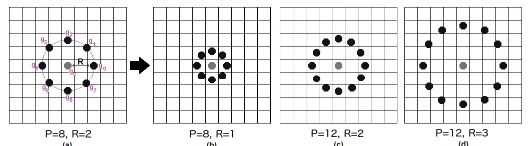
LBPH working is explained above in which there is an image with pixel intensities and here there is a 3*3 window. The number of neighbors to be considered can be changed. After getting the binary number the center pixel is replaced by the decimal value for the binary. LBPH algorithm is an idea of sliding window, based on the constraints neighbors which is represented by P and radius which is represented by R and thus an LBP operator is represented as LBPP,Ru2,u2 stands for usage of uniform patterns only and other remaining patterns with a predefined single label. Different examples of taking the windows is given in Fig.6.
Fig. 6. Variations of LBPH windows and neighborhood.
3.4 Distance And Accuracy
To find the image matching the input image, the histograms for both the images are compared and the image with the least distance i.e. which has the closest histogram is chosen. There are several ways of comparing the histograms e.g.:
Euclidean distance, chi-squared distance, absolute value distance etc. In this paper, Euclidean distance is used which is based on the following formula.
The code outputs ID of the image from the database which has nearest histogram. The calculated distance is also returned by the algorithm, which is a parameter value called „confidence‟. The lower the confidences the better it is since it means the measurement of distance between the two histograms is smaller.
After the predictions and respective confidences are obtained then the algorithm counts for maximum times an Id is predicted.
The Id which is predicted maximum number of times in tracking is considered for attendance. The date and time and name of the student is displayed on GUI. This is also updated in the excel sheet in the Attendance folder.
4 FLOWCHART
4.1 Training Phase
3.5 Recognition Phase
5 RESULTS
The home window is created using tkinter and looks like as shown below and here the ID and Name of the student needs to be entered. After the ID and Name are correctly entered as number and alpha numeric data type respectively. Confidences corresponding to each prediction is printed on the console window as shown. The threshold of confidence for the system to recognize the person is set to be lying between 50 and 85. The maximum times the prediction is in this range the Id is considered for attendance otherwise the predicted output will be Unknown.
Fig. 7. Home Window.
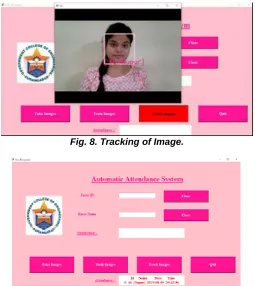
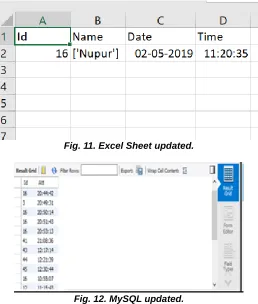
Once the student is recognized the attendance is marked and shown in the GUI and also in the excel sheet.
Fig. 8. Tracking of Image.
Fig. 9. Message after student is recognized successfully.
Fig. 11. Excel Sheet updated.
Fig. 12. MySQL updated.
MySQL database is updated as shown below with respect to the corresponding time. After the recognition an email is sentto the respective administratorusing python smtplib library using smtp.login () and smtp.send_message() functionsfor further monitoring ofattendance on institute on level. The functionsmtplib.SMTP('smtp.gmail.com',587)is used when the server is localhost.
6
C
ONCLUSIONFace Recognition is a field which will alwayshave room for researchbecauseface recognition is a very complex processwith very little details getting changed from face to face. Humans have perfectedafter centuries ofevolution and still facedifficulty if the face to be recognizedwas seen long back.This paperis an effort to use techniquesi.e.Intensity Normalization&Face Alignment and LBPH and use the application for Attendance Systemin large institute. Attendance is always complicatedwhen somany students are skippingclassesand manipulating paper records of attendancesheets. Thetechnique proposed attempts to increase the accuracy of the LBPH recognizer provided by OpenCV library.
REFERENCES
[1] Ming-Hsuan Yang, D. J. Kriegman and N. Ahuja, "Detecting faces in images: a survey," in IEEE Transactions on Pattern Analysis and Machine Intelligence, vol. 24, no. 1, pp. 34-58.
[2] Ghorbani, Mohsen & Targhi, Alireza & Dehshibi, Mohammad Mahdi. (2015). HOG and LBP: Towards a
robust face recognition
system.10.1109/ICDIM.2015.7381860
[3] Sudha Narang, Kriti Jain, Megha Saxena, Aashna Arora., “Comparison of Face Recognition Algorithms
Using Opencv for Attendance System” in International Journal of Scientific and Research Publications, Volume 8, Issue 2, February 2018
[4] D. Nithya, “Automated Class Attendance System based on Face Recognition using PCA Algorithm” in International Journal of Engineering Research & Technology (IJERT),Vol. 4, Issue 12, December-2015. [5] S. Z. Li, R. Chu, S. Liao and L. Zhang, "Illumination Invariant Face Recognition Using Near-Infrared Images," in IEEE Transactions on Pattern Analysis and Machine Intelligence, vol. 29, no. 4, pp. 627-639, April 2007.
[6] T. Ahonen, A. Hadid and M. Pietikainen, "Face Description with Local Binary Patterns: Application to Face Recognition," in IEEE Transactions on Pattern Analysis and Machine Intelligence, vol. 28, no. 12, pp. 2037-2041, Dec. 2006.
[7] Kawaguchi, Yohei & Shoji, Tetsuo. (2005). “Face Recognition-based Lecture Attendance System.” [8] E. Varadharajan, R. Dharani, S. Jeevitha, B.
Kavinmathi and S. Hemalatha, "Automatic attendance management system using face detection," 2016 Online International Conference on Green Engineering and Technologies (IC-GET), Coimbatore, 2016, pp.1-3.