662
Performance Analysis Of Adaptive MIMO-Of
Dmcognitive Wireless System With Joint Rate,
MIMO Profile, And Power Adaptation
Santosh Itraj, Dr. Uttam Bombale, Pravinkumar Patil, Dr. Meenakshi PatilAbstract— The cognitive radio resolves the spectrum scarcity issue in wireless communication networks by utilizing the spectrum in an opportunistic way. The CR network yet inflicts peculiar challenges because of the dynamic spectrum, high quality of service requirements and the higher data rate. Integration of the multiple input multiple output-orthogonal frequency division multiplexing (MIMO-OFDM) with the cognitive radio offers robustness and the diversity gain in a hostile wireless environment. In this treatise, we propose a link adaptation strategy for the MIMO-OFDM based cognitive radio system. In our adaptation scheme, Cognitive radio-adaptive modulation coding, MIMO profile, power controller (CR-AMCMPPC) adapts the MIMO profile space-time block code (STBC) or spatial division multiplexing (SDM) along with the modulation coding scheme (MCS) and the transmit power. This adaptation works on each of the packets to be transmitted on the selected channel. The novel power-adaptation scheme time-domain water-filling power adaptation (TWFPA) is proposed. The TWFPA adapts transmit power to improve energy efficiency instead of the throughput of the system. We evaluate the performance of the adaptive MIMO-OFDM cognitive system. We perceive through the simulation results that the proposed adaptation scheme procures significant enhancement in the throughput of the system with an efficient power utilization under the constraint of targeted bit error rate (BER) and the transmit power. We consider both the interweave and underlay cognitive schemes in the proposed controller. System performance is investigated for the interweave channel sharing scheme.
Index Terms— BER, Cognitive radio, Interweave scheme, MIMO-OFDM, SDM, STBC, Throughput.
————————————————————
1
I
NTRODUCTIONThe prominent resources in the wireless communication network are bandwidth and energy. The scarcity of these resources limits the performance of the wireless system in terms of quality of service and the channel capacity. The most eminent solution to deal with the scarcity of these resources is a cognitive radio (CR) technology. It can utilize these resources in the most intelligent and efficient manner [1]. The CR allows secondary users (SUs) to access the licensed spectrum owned by the primary users (PUs) in an opportunistic manner under the constraint of maintaining the quality of service for the primary user. Cognitive radio shares channel in either interweave or underlay manner [2]. Cognitive radio enables secondary users to not only select the best available channel but also to adapt the transmission parameters like modulation, coding rate, transmit power, etc. quickly. This allows enhancement in the performance of the system in a hostile wireless environment [1]. However, to ensure further performance improvement integration of MIMO-OFDM with CR technology can be the best possible solution.
MIMO provides multiple benefits such as capacity enhancement without extra bandwidth [3], dramatic boost in the transmission reliability using space-time coding [4], and the minimal co-channel interference in the multi-user communication environment [5]. There has been immense research work in various domains of CR technology with an objective of improving the capacity and energy efficiency of the cognitive network. One of the areas of interest of many researchers is the adaptation of various parameters or resources in a cognitive system. However, no much more attention has been given to exploit the benefits of MIMO technique in the CR network. In [6], the author has given a focus on the various research activities on energy efficiency improvement in wireless communication. It can be seen that the link adaptation in a wireless communication system using MIMO-OFDM technology results in an energy-efficient solution. The parameters that can be adapted include MIMO mode, modulation, code rate, and the transmit power. However, most of the research work considered the non-cognitive single-user and single-channel environment. The MIMO-OFDM schemes in the channel and the multi-user cognitive environment need to be further investigated. S. Hua et al. [7] proposes a novel MIMO co-operative cognitive radio network (CCRN) framework. This system consists of MIMO SUs. These act as relaying nodes and co-operates PUs in relaying their traffic. Concurrently SUs use the same channel for communicating their own data. The motive behind the design of the system was to optimize spectrum efficiency of PUs and SUs. It has been proved that both primary and secondary networks give enhanced performance in MIMO-CCRN. However, authors have considered only power adaptation and discussed the relay node selection in an optimum way to enhance the capacity of the cognitive network. It can be realized that many researchers [8], [9] have focused on the enhancement of energy efficiency of cognitive radio with or without MIMO technology. In [9], _________________________________
Santosh Itraj is currently pursuing a Ph.D. in Electronics Engineering at Shivaji University Kolhapur, Maharashtra, India., PH-9422405192. E-mail: [email protected]
Dr. Uttam Bombale received the Ph.D. in Electronics Engineering from the (D.A.I.I.C.T.), Gandhinagar, Gujarat, India Presently he is working as a Professor in D.O.T. Shivaji University, Kolhapur, India. E-mail: [email protected]
Pravinkumar Patil is currently pursuing a Ph.D. in Electronics Engineering at VTU, Belgavi, India. E-mail: [email protected]
authors have addressed the joint optimization problem with reference to spectrum sensing duration and the transmit power of the cognitive users to improve energy efficiency. The authors in [10] used singular value decomposition technique to optimize the capacity of the secondary network by adapting transmit power. However, it is computationally complex in case of MIMO-OFDM CR system. Authors in [11] investigated the joint dynamic channel and rate selection in the CR system to optimize the throughput. The considered system is a single antenna-based system and with the assumption that channels are primary user free. In [12], underlay single antenna CR system is validated with power adaptation. In [13], authors have investigated the single input single output (SISO) system performance with rate and power adaptation. In [14], authors have proposed a link adaptation scheme for MIMO cognitive multi-carrier code division multiple access (MC-CDMA) system. System performance is investigated by adapting MIMO mode (STBC/SDM) and modulation (16QAM/QPSK) in single-user and single-channel environment. As evident from the above discussion, it can be seen that the link adaptation with MIMO-OFDM in CR optimizes the performance of the system. However, in most of the proposals for MIMO CR either power or MIMO mode is adapted. Power adaptation distributes total power among the channels based on the channel condition to enhance the capacity of the system. In addition, most of the work considers the single-channel environment and underlay cognitive scheme. Motivated by these facts, in this treatise, we investigate the performance of adaptive MIMO-OFDM cognitive system. We propose the novel link adaptation algorithm (CR-AMCMPPC) adapting MCS, MIMO profile and the transmit power based on channel state information (CSI) and the status of the primary users. In this algorithm, the MCS and MIMO profile adaptation scheme is proposed for throughput optimization, whereas power adaptation scheme is proposed for improving the energy efficiency of the system. We consider the multi-user and a multi-channel cognitive system with interweave as well as underlay channel-sharing schemes.
2
S
YSTEM MODEL2.1 System environment
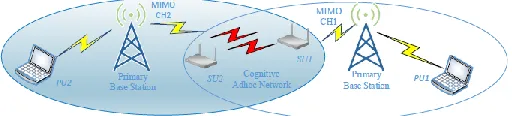
The cognitive system environment as illustrated in Fig. 1 constitutes two secondary users SU1 and SU2, two primary users PU1 and PU2 with multiple antennas at both transmitter and receiver forming a (2 x 2) MIMO system. PU1 is a licensed user of CH1 whereas PU2 is a licensed user of CH2. PU2 always allow SU1 to communicate with SU2 on CH2. In the presence of PU2, there is a constraint on the transmit power of
Fig. 1. System Environment.
SU1 to minimize the interference to the primary user. Use of CH2 in the presence of the PU2 by secondary users defines underlay channel sharing scheme in CR. However, PU1 allows secondary users to use CH1 in an opportunistic manner i.e. in his absence. Thus, SU1 uses CH1 only in absence of the PU1, while communicating with SU2. This defines the interweave channel sharing scenario. SU1 is assigning the highest priority to CH1. Secondary nodes in the system are assumed to be operating in the full-duplex mode. The system performance can be evaluated for different channel detection probabilities.
2.3 System description
664 .
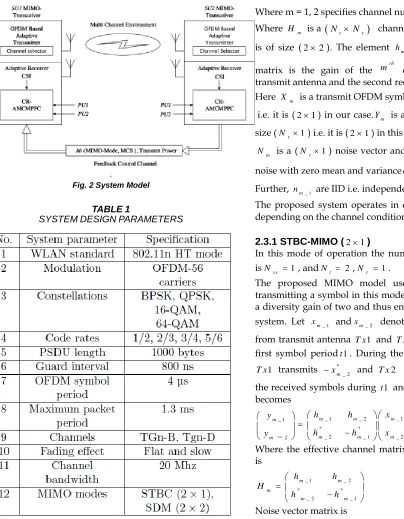
Fig. 2 System Model
TABLE1
SYSTEMDESIGNPARAMETERS
2.3 Mathematical Model
We consider a CR-MIMO system with two flat fading MIMO channels CH1 (TGn-D) and CH2 (TGn-B). The MIMO system consists of Nt transmit antennas and Nr receive antennas. In
the proposed systemNt Nr 2. The transmit power is assumed to be equally distributed among the transmit antennas. In the proposed system, SU1 transmits the signal
m
X to SU2 over the selected MIMO channel either CH1 or
CH2. The received signal at SU2 on the th
m channel is [16]
m m m m
Y H X N
(1)
Where m = 1, 2 specifies channel number.
Where H m is a
Nt Nr
channel matrix and in our case, itis of size (22). The element hm_i j hm_ 1 2 of the channel
matrix is the gain of the mth channel between the first
transmit antenna and the second receive antenna.
Here Xm is a transmit OFDM symbol vector of size (Nt 1) i.e. it is (21) in our case.Ym is a received symbol vector of
size (Nr 1) i.e. it is (21) in this case.
m
N is a (Nr1) noise vector and nm_i is a white Gaussian
noise with zero mean and variance 2
m n
.
Further, nm_i are IID i.e. independent identically distributed.
The proposed system operates in either STBC or SDM mode depending on the channel condition.
2.3.1STBC-MIMO (21)
In this mode of operation the number of space-time streams isNs s 1, andNt 2,Nr 1.
The proposed MIMO model uses Almouti coding while transmitting a symbol in this mode of operation. This ensures a diversity gain of two and thus enhances the reliability of the system. Let xm_ 1 andxm_ 2 denote the symbols transmitted
from transmit antenna T x1 and T x2 respectively during the first symbol periodt1. During the second symbol periodt2 ,
1
T x transmits xm_ 2 and T x2 transmitsxm_ 1. Combining
the received symbols during t1 andt2, the net system model becomes
_ 1 _ 2 _ 1 _ 1
_ 1
* * *
_ 2 _ 1 _ 2 _ 2
2
_
m m m m
m
m m m m
m
h h x n
y
h h x n
y
(2)
Where the effective channel matrix with orthogonal columns is
_ 1 _ 2
* *
_ 2 _ 1
m m
m
m m
h h
H
h h
(3) Noise vector matrix is
_ 1
*
_ 2
m
m
m
n N
n
(4)
The diversity order for (21) MIMO with Almouti STBC coding is
1
t r
L N N (5)
Thus, this mode provides diversity gain with the full coding rate (R 1). This ensures mitigation of BER without affecting data rate.
2.3.2SDM-MIMO (22)
Spatial multiplexing in MIMO ensures data transmission at a higher rate than diversity based MIMO systems. The system model for the th
_ 1 _ 1 1 _ 1 2 _ 1 _ 1
_ 2 _ 2 1 _ 2 2 _ 2 _ 2
m m m m m
m m m m m
y h h x n
y h h x n
(6) This is a matrix form representation of the (1).
2.3.3Signal Detection
The received signal Ym is recovered at the receiver by using
the MMSE detector in which it minimizes mean square error. MMSE minimizes total power of noise and inter symbol interference (ISI) components in the recovered signal. Considering Ym and Xm to be zero mean
2
ˆ
m m
M S E E X X (7)
Here, X m is a transmitted signal vector.
ˆ
m
X is an estimated
signal vector and is given as ˆ
m m
X W Y (8)
Here Ym is a received signal vector. W is an MMSE weight
matrix to maximize signal to interference plus noise ratio (SINR) after detection and is given as
12
H H
m m m n m
W H H I H
(9)
HereHm is a channel matrix. th
m is a matrix Hermitian. I is
an identity matrix. 2
m n
is a noise variance given as
2 H
m n E Nm Nm
(10)
In the proposed system adaptive controller (CR-AMCMPPC) adapts MCS, MIMO profile (STBC/SDM) and the average transmit power by using CSI i.e. SNR estimate at the receiver. We consider the average S N Re to reflect the MIMO
channel condition and is computed by using channel estimate
_
m e s t
h k for N subcarriers (k varies from one toN ). The
average signal power estimate at the receiver is defined as
2
_ _ _
1
1 N
m a v g e s t m e s t
k
S h k
N
(11)Here hm_e s t
k is the mth channel coefficient estimate fort h
k subcarrier. N Defines the total number of subcarriers
and for STBC and SDM it is defined as 1 1 2
S T B C
N N (12)
2 2 4
S D M
N N (13)
Hence the SNR ratio at the receiver is
_ _
_ v a r_
_ m a v g e s t
m e s t
S S N R r a t i o
n
(14)
Here nm_ v a r _e s t is noise variance
2
m n
at the receiver.
Thus the average SNR estimate ind B is
_ 1 0 lo g1 0 _
a v g e s t
S N R S N R r a tio d B (15)
2.3.4Performance Metrics
The performance of the system is investigated by computing the throughput of the system under the constraint of the targeted BER and the average transmit power. The approximate expressions for the BER for different modulation and coding schemes and L independent identically distributed Rayleigh
paths are depicted [17]. The average BER for BPSK is
2
2
2 0
1 1
lo g b s i n
L
b
g
P M d
M
(16)Where ( )
b
M s is the moment generating function (MGF) of the
average SNR per bit b for all L channels and for Rayleigh
fading channel it is given as
11
b b
M s s (17)
Here
2
s i n
g s
(18)
Here g is of value one for coherent BPSK constellation.
Average BER for QPSK is defined as
2 2 4 3 1 0 1 1
lo g b l s i n
L
b
l
g
P M d
M
(19)Here g .5 for QPSK constellation. Where
b l
M is MGF of the
SNR per symbol b l of the path l and for Rayleigh channel, it is
defined as
11
bl b l
M s s (20)
Here
2
s i n
g s
(21)
Average BER for M QAM is given as
1 2
2
4
lo g
b b b
P P P
M
(22)
Where Pb1andPb2 are defined as
1 2 1 0 2 1 1
s i n
b l
L
Q A M
b
l
g
P M d
M
(23) 2 2 2 1 0 4 1 1s i n
b l
L
Q A M
b
l
g
P M d
M
(24) Here
3 2 1Q A M
g
M
(25) MGF
b l
M is as defined in (20). In the defined BER equations
2
666 the above equations of the BER can be expressed in terms of
SNR and coding gain by replacing b by
m i n
b c
b
B
S N R R d R
(26) Where B 2 5 0 KHz defines the signal bandwidth. Rbis the
maximum achievable bit rate depending on the modulation technique. R dc m i n is a coding gain in which Rc is a code rate
and dm i n is the free distance defined by the code rate.
The throughput of the system is
1
T h r u P E R (27)
Where P E R is given as
1 1 Pl
P E R B E R (28)
Here Pl is a packet length.
The proposed MIMO cognitive system uses CH1 in an opportunistic manner and hence it operates on both CH1 and CH2. Hence, the average throughput of the proposed system is given as
d1
1
d2
2
T h r u P T h r u P T h r u (29)
1
T h r u reflects the average throughput of the system when
communication is over CH1.r signifies the average throughput of the system while communicating over CH2. Pd1andPd2are
channel detection probabilities for CH1and CH2 respectively.
3
ALGORITHMS
3.1 CR-AMCMPPC Algorithm
This is a novel algorithm used to optimize the performance of MIMO cognitive system. This algorithm at the secondary receiver deals with the tradeoff between the throughput and the energy efficiency of the system. It invokes the AMC-AMP algorithm to optimize the average throughput of the system. Further, this throughput of the system is retained and energy efficiency is improved by calling TWFPA algorithm. This algorithm supports both interweave and underlay channel sharing schemes in a cognitive radio environment. For adapting MCS, MIMO profile and average transmit power over the selected channel in the multi-channel environment this algorithm uses the CSI and the soft information about the activities of the primary users. The channel selection is based on the availability of the channels as described in Table 2. For example if primary user1 is absent (PU1 = 0) and primary user2 is present (PU2 = 1) then CH1 is available (A1 = 1) and CH2 is available (A2 = 1). Then, in this case, CH1 is selected for communication. These algorithmic steps are applied for each of packet being transmitted i.e. to all the symbols in a packet.
TABLE2
CHANNELAVAILABILITYSTATUS
3.2 Adaptive Modulation Coding and MIMO Profile Selection Algorithm (AMC-AMP)
This proposed algorithm is applied to the 802.11n (WLAN) based MIMO cognitive system. AMC-AMP algorithm in the controller adapts modulation, coding rate and MIMO profile (STBC/SDM) by comparing SNR estimate S N Re with the empirically found
SNR thresholds S N Rt. It selects higher MCS in the best channel
condition to enhance the throughput of the system. It also defines the MIMO mode based on the channel condition. It ensures reliability in lower SNR range by selecting diversity mode (21) STBC and in higher SNR range it goes for (22) SDM mode to optimize the throughput of the system. The operating modes defining modulation coding MIMO index with concern parameters are illustrated in Table 3. The algorithm considers CSI i.e. S N Re and the information about the status of the primary
users for adapting the transmit parameters. The information about these parameters is generated in the form of single MCS and MIMO profile index as MCMI index i.e. M i. This ensures
minimum overhead on the feedback channel to the transmitter. The SNR threshold used in this algorithm defines the minimum SNR required to ensure the maximum throughput with BER less than the targeted BER. Hence for optimum throughput
I f B E R B E Rta r ge t
TABLE3
MCS-MIMOPROFILE
i
M is defining the control parameters MCS, Ns s(Number of
space-time streams) and the number of receiving antennas
r
N i.e. MIMO profile.
3.3 Time-domain Water Filling Power Adaptation Algorithm (TWFPA)
In this treatise, we propose the novel simple power adaptation algorithm for multi-user and multi-channel MIMO cognitive system. We assume that the maximum average transmit power in the system is two. The conventional water filling power adaptation algorithm operates in the frequency domain. It distributes the constraint power among subcarriers as well as the MIMO channels based on the channel condition with an objective of throughput optimization. In this existing technique, the average transmit power remains constant. This conventional approach is based on the SVD technique and is mathematically complex. However, we have modified water filling power adaptation scheme and it operates in the time domain i.e. per-packet basis in spite of per channel. This computing power after receiving a packet is used for all symbols in the next packet to be transmitted. The proposed power adaptation scheme inserts maximum power within the specified limit in best channel condition and assigns minimum
minimizes the transmit power without affecting the throughput of the system. Thereby proposed power adaptation scheme improves energy efficiency without affecting the throughput of the system. This effect is realized in the simulation results. The average power to be inserted for transmission of the next packet over the selected MIMO channel is
2
2 2 2
_ _
1 1 1
,
0 ,
m n
m t m s y m m m m n
F o r
P P
o t h e r w i s e
(31)
In this case 2
m
is the average channel power for the received
packet over mt h the channel. is Langrage multiplier defined
by the power constraint. 2
m n
is noise variance at the receiving end.
6
S
IMULATION RESULTS668 channel detection probabilities Pd1 and Pd2 . In this case, the
use of CH1 is in an opportunistic manner. Table 1 summarizes the simulation parameters involved in the system analysis. The system performance analysis computes the average throughput, average transmit power and BER over the selected channel CH1 or CH2 or both CH1 and CH2 (Pd1 Pd2 5 0 % ) i.e. CH12. The adaptation strategies
considered in performance evaluation of the system are 1. Effect of the AMC-TWFPA algorithm
2. Effect of the AMC-AMP algorithm 3. Effect of the CR-AMCMPPC algorithm
4.1 Effect of the AMC-TWFPA Algorithm
In this case, the system performance is evaluated by applying adaptive modulation and coding algorithm (AMC) along with the time domain water filling power adaptation algorithm (TWFPA). The system performance evaluation considers SDM MIMO mode. Fig. 3 and Fig. 4 illustrate the throughput and BER curves of MIMO-OFDM cognitive system in two different cases. In the first case, computation of the throughput is with AMC and the constant power (CP) and in the second case; throughput computation is with AMC-TWFPA. Table 4 illustrates the numerical values associated with the average throughput for constant power and adaptive power. The performance is evaluated over different channels CH1 or CH2 or CH12 (CH1 and CH2 both with (Pd1 Pd2 5 0 % )). From Fig. 3 and Table 4, it can be seen that TWFPA scheme improves the energy efficiency of the system. It successfully maintains the throughput of the system to the level as that of the throughput with the constant power, that too by using less average transmit power. This improvement in energy efficiency is observed in all three-channel cases. For example in the case of the transmission over CH1, the average throughput of the system is 51.98 Mbps with a constant power of two. However, with adaptive power (TWFPA) the average throughput of the system is 51.79 Mbps and the average transmit power is 1.7W. This shows 15% power saving is achieved with TWFPA scheme. The performance evaluation of the system also considers a noisy channel (NCH2). Fig. 5, Fig. 6, and Fig. 7 illustrate the curves corresponding to this performance. The average throughput of the system over a noisy channel (NCH2) is 41.35Mbps with a constant power of 2W. However, with TWFPA scheme throughput is 41.32Mbps and the average transmit power is 1.35W. This shows the significant improvement in the energy efficiency of the system as the channel becomes worst.
TABLE4
AMC-TWFPA:THROUGHPUT-MEAN-AVERAGE-POWER
Fig. 3. AMC-TWFPA: Throughput v/s SNR.
Fig. 4. AMC-TWFPA: BER v/s SNR.
Fig. 5.AMC-TWFPA: Throughput v/s SNR over noisy channel
4.2 Effect of the AMC-AMP Algorithm
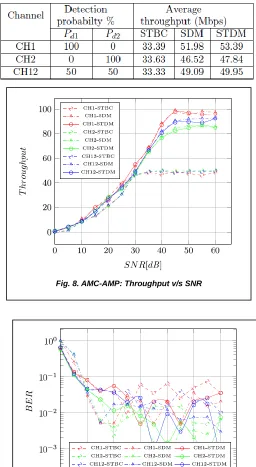
To analyze the effect of AMC-AMP, the rate adapted MIMO system is operated in three different modes STBC, SDM, and STDM (adaptive selection between STBC and SDM). The system performance in these three modes is compared. Fig. 8 and Fig. 9 illustrate the throughput and BER curves corresponding to these modes. Table 5 summarizes the concern numerical values. In this case, the transmit power is constant and is having a value of two. The performance investigation considers communication over CH1, CH2 or CH12 (CH1 and CH2 both withPd1 Pd2 5 0 % ). From Fig.
8 it can be realized that AMC-STBC offers higher performance in lower SNR range. However, AMC-SDM outperforms in higher SNR range. Hence, further enhancement in the throughput of the MIMO system is possible with adaptive MIMO profile selection as shown in Fig. 8. For example in the case of transmission over CH1, the average throughput of the system with AMC-STBC is 33.39 Mbps, AMC-SDM is 51.98
adaptive MIMO profile selection outperforms STBC or SDM transmission in the cognitive environment.
TABLE5
AMC-AMP:MIMOPROFILE
4.2 Effect of the CRAMCMPPC Algorithm
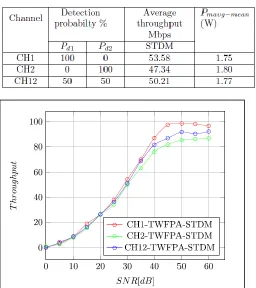
Fig. 10 and Fig. 11 illustrate the throughput and BER performance of the adaptive cognitive system with (CR-AMCMPPC) controller adapting modulation, coding, MIMO profile and the average transmit power. Table 6 illustrates the corresponding numerical values. The performance evaluation considers communication on CH1, CH2, and CH12 (CH1 and
Fig. 6. AMC-TWFPA: Throughput v/s SNR over noisy channel
CH2
Fig. 7. AMC-TWFPA: Mean-Avg-Power v/s SNR over noisy
channel CH2
Fig. 8. AMC-AMP: Throughput v/s SNR
670 CH2 both withPd1 Pd2 5 0 % ). It can be seen that this
adaptive cognitive system outperforms with respect to the throughput of the system and the average transmit power. In this controller algorithm, AMC-AMP (Adaptive MCS and MIMO profile) optimizes the throughput of the system whereas TWFPA algorithm ensures throughput retention with the minimal average transmit power. For example, referring the case of the transmission over both channels CH1 and CH2 with channel detection probabilities of 50% (Interweave channel-sharing scheme), the throughput of the system as illustrated in Table 6 is 50.21 Mbps with the average transmit power of 1.77W. However, from Table 5 it can be seen that with constant average transmit power of two the throughput with AMC-AMP is 49.95 Mbps. This signifies the improvement in the throughput and energy efficiency of the cognitive system is possible with the adaptive controller (CR-AMCMPPC).
TABLE6
AMC-CRAMCMPPC:THROUGHPUT-MEAN-AVERAGE-POWER
C
ONCLUSIONThe work presented in this treatise represents a novel design of adaptive MIMO-OFDM based cognitive radio system. We design the adaptive controller CR-AMCMPPC to adapt MCS, MIMO profile (STBC/SDM) and the average transmit power based on the channel condition for multi-user, multi-channel Cognitive system. In the designed system AMC scheme ensures the improvement in the throughput of the system. Further enhancement in the performance of the system with respect to the reliability and throughput is observed using MIMO profile adaptation. The simulation results reflect significant improvement in the throughput of the system with joint AMC-AMP algorithm. Capacity and energy efficiency trade-off play a vital role in defining the performance of the cognitive wireless system. Therefore, we have suggested a novel packet-based TWFPA scheme for adapting the average transmit power to optimize energy efficiency rather than the throughput of the system. Simulation results show that significant power saving is achieved in the worst channel condition without affecting the throughput of the system. Further, system performance is investigated with CR-AMCMPPC controller and it is observed that there is a significant improvement in the throughput of the system with 10% to 20% energy saving by adapting the transmit power of the system. The system performance is analyzed in a single and fixed channel (CH1 or CH2) as well as dynamic channel switching environment (CH12-Interweave case) based on the status of the primary users. In all these cases, the system shows improvement in the performance in terms of throughput and energy efficiency. In the future, this controller can be used at multiple secondary nodes in the cooperative cognitive ad-hoc networks. In such networks, these intelligent nodes can act as virtual antennas and assist in boosting the performance of the entire network.
Fig. 10.CR- AMCMPPC: Throughput v/s SNR
References
[1]. B. Wang and K. R. Liu, ―Advances in cognitive radio networks: A survey,‖ IEEE Journal of selected topics in signal processing, vol. 5, no. 1, pp. 5–23, 2010, doi: 10.1109/JSTSP.2010.2093210
[2]. G. Scutari, D. P. Palomar, and S. Barbarossa, ―Cognitive mimo radio,‖ IEEE Signal Processing Magazine, vol. 25, no. 6, pp. 46–59, 2008, doi: 10.1109/MSP.2008.929297
[3]. E. Telatar, ―Capacity of multi-antenna gaussian
channels,‖ European transactions on
telecommunications, vol. 10, no. 6, pp. 585–595, 1999, doi: 10.1002/ett.4460100604
[4]. V. Tarokh, H. Jafarkhani, and A. R. Calderbank, ―Space-time block codes from orthogonal designs,‖ IEEE Transactions on Information theory, vol. 45, no. 5, pp. 1456–1467, 1999, doi: 10.1109/18.771146 [5]. F. Rashid-Farrokhi, L. Tassiulas, and K. Liu, ―Joint
optimal power control and beamforming in wireless networks using antenna arrays,‖ IEEE Transactions on Communications, vol. 46, no. 10, pp. 1313–1323, 1998, doi: 10.1109/26.725309
[6]. D. Feng, C. Jiang, G. Lim, L. J. Cimini, G. Feng, and G. Y. Li, ―A survey of energy-efficient wireless communications,‖ IEEE Communications Surveys & Tutorials, vol. 15, no. 1, pp. 167–178, 2012, doi: 10.1109/SURV.2012.020212.00049
[7]. S. Hua, H. Liu, M. Wu, and S. S. Panwar, ―Exploiting mimo antennas in cooperative cognitive radio networks,‖ in 2011 Proceedings IEEE INFOCOM.
IEEE, pp. 2714–2722, 2011, doi:
10.1109/TVT.2013.2297438
[8]. M. Costa and A. Ephremides, ―Energy efficiency versus performance in cognitive wireless networks,‖ IEEE Journal on Selected Areas in Communications, vol. 34, no. 5, pp. 1336–1347, 2016, doi: 10.1109/JSAC.2016.2520219
[9]. L. Zhang, M. Xiao, G. Wu, S. Li, and Y.-C. Liang, ―Energy-efficient cognitive transmission with imperfect spectrum sensing,‖ IEEE Journal on Selected Areas in Communications, vol. 34, no. 5, pp. 1320–1335, 2016, doi: 10.1109/JSAC.2016.2520166
[10]. R. Zhang and Y.-C. Liang, ―Exploiting multi-antennas for opportunistic spectrum sharing in cognitive radio networks,‖ in 2007 IEEE 18th International Symposium on Personal, Indoor, and Mobile Radio Communications. IEEE, pp. 1–5, 2007, doi: 10.1109/PIMRC.2007.4394811
[11]. R. Combes and A. Proutiere, ―Dynamic rate and channel selection in cognitive radio systems,‖ IEEE Journal on Selected Areas in Communications, vol. 33, no. 5, pp. 910–921, 2014., doi: 10.1109/JSAC.2014.2361084
[12]. S. S. Borkotoky, S. L. Kottapalli, and M. B. Pursley, ―Analytical methods for performance evaluations of adaptive modulation and coding in cognitive radio systems that employ distance statistics,‖ IEEE Transactions on Cognitive Communications and Networking, vol. 5, no. 1, pp. 73–81, 2019, doi: 10.1109/TCCN.2018.2890620
[13]. V. Asghari and S. A¨ıssa, ―Rate and power adaptation for increasing spectrum efficiency in cognitive radio networks,‖ in 2009 IEEE International Conference on
Communications. IEEE, pp. 1–5, 2009, doi: 10.1109/ICC.2009.5199391
[14]. S. Leela and K. S. Vishvaksenan, ―Performance of adaptive mimo switching for cognitive MC-CDMA system,‖ Cluster Computing, pp. 1– 9, 2017, doi: 10.1007/s10586-017-1322-5
[15]. I. . W. Group et al., ―Part 11: wireless LAN medium access control (mac) and physical layer (phy) specifications, amendment 5: enhancements for higher throughput,‖ IEEE Std, vol. 802, pp. 345-346, 2009, doi: 10.1109/IEEESTD.2009.5307322
[16]. Y. S. Cho, J. Kim, W. Y. Yang, and C. G. Kang, MIMO-OFDM wireless communications with MATLAB. John Wiley & Sons, pp. 281-370, 2010, doi: 10.1002/9780470825631