An Error Students In Mathematical Problems
Solves Based On Cognitive Development
Sri Adi Widodo, Turmudi, Jarnawi Afgani Dahlan
Abstract: The purpose of this research is to find out the profile of students' mistakes in solving quadrilateral problems based on the cognitive development of middle school students. This research is included in qualitative research with detailed research. This research is a preliminary study on 4D research and development. This preliminary study aims to study the characteristics of students in solving mathematical problems based on cognitive development from Piaget. The instrument used in this study is that researchers, Test Logical of Operation and problem-solving test. The stages for analyzing data are (1) preparing and organizing data for analysis, (2) exploring and coding data, (3) coding for constructing descriptions, (4) representing and reporting findings, (5) interpreting findings, and (6) validate the accuracy of the results. At the stage of understanding the problem, in general, the subjects did not make mistakes in the first stage even though some subjects did not write down what was known and asked about the problem at hand. At the stage of planning to resolve subject formal is experience principle errors and procedural errors. At the stage of carrying out the transitional and concrete subject plan experience the mistakes of concepts and procedures, whereas in the formal subject, because in the previous step it cannot arrange the scenario to solve the problem, the formal subject cannot implement the plan to solve the problem. In the fourth stage, in general, subjects interpret the overall steps of solving the problem.
Index Terms: Error, Mathematical Problem, Cognitive Development, Problem Solving
————————————————————
1
I
NTRODUCTIONSolving problems is essential in learning mathematics. At least there are three things that underlie the importance of problem-solving as a goal in mathematics learning, first problem problem-solving can train students to make decisions, in other words, become problem solvers, the second problem solving can be used to develop ideas or ideas they have, and capital success for students in solving mathematical problems, and third problem solving becomes one of the focuses in learning mathematics at national and international levels in addition to reasoning, verification, connection, communication, and representation [1]–[4]. In dealing with mathematical problems, a student performs a thought process in the brain until the student can solve the problem at hand. By trying to describe students' thinking processes, in this case the educator can interpret information collected through observing students' behavior while studying mathematics so that the teacher has indirectly carried out the task of an educator in Mathematics learning that is to explain students' thinking processes in learning mathematics and how Mathematical knowledge is interpreted in mind with the aim of improving mathematics teaching in schools [5], [6]. Describing student profiles in dealing with mathematical problems is still the focus in several studies [5], [7], [16], [17], [8]–[15]. One of the profiles of students that can be considered for research includes describing students' mistakes in solving problems [18]–[23]. By knowing the forms of mistakes made by students, the teacher can make a learning scenario so that the mistakes that are often caused by students can be avoided in solving problems [4]. Also, by describing the forms of errors made by students, the teacher is expected to be able to know the causes of students experiencing errors in solving mathematical problems [22]. There has been a lot of research done regarding errors made by students in solving mathematical problems [18]–[22], [24]. But research on student errors based on cognitive
development is still not yet done. This is because cognitive development is one of the characteristics of students who are rarely noticed by educators [3], whereas one of the factors that determine the success of the learning process includes the compatibility between the subject matter and the level of cognitive development of students [25], [26]. The cognitive development of each individual always goes through four stages, namely sensory-motoric, pre-operational, concrete operational, and formal operations [27]–[35]. Every stage of Piaget's cognitive development must go through the previous stages and do not apply backwards [25], [36], [37], meaning that if a person has reached the concrete stage, the person has gone through the sensory-motoric and pre-operational stages, and the person is left to form a formal development. The age of junior high school students according to Piaget's cognitive development is at the scene of formal development because it is at the age of more than 11 years [4], but the age limit for children to distinguish between stages of Piaget's cognitive development is different in nature [25]. Based on this, it is possible for junior high school students to still be at the stage of development before formal, which is still concrete and the phase of transition from concrete to formal [3], [25], [37]–[39]. So that confirmation is needed for junior high school students related to cognitive development that has been achieved, whether junior high school students are already in formal age or are still in a concrete period. This is so that the mathematics learning process can be planned to adjust to the level of cognitive development of students so that mathematics learning can be more meaningful [25], [26]. Based on this, the purpose of this research is to find out the profile of students' mistakes in solving quadrilateral problems based on the cognitive development of middle school students.
2
M
ETHODThis research is included in qualitative research with descriptive analysis. This research is a preliminary study on 4D research and development. This preliminary study aims to study the characteristics of students in solving mathematical problems based on cognitive development from Piaget. The selection of research subjects was based on the purposive sampling technique. This side taking technique is a sampling ————————————————
Sri Adi Widodo is currently pursuing a doctoral degree program in Mathematics Education, Universitas Pendidikan Indonesia, Indonesia. E-mail: [email protected]; [email protected]
Turmudi, Mathematics Education, Universitas Pendidikan Indonesia, Indonesia. Email: [email protected]
Jarnawi Afghani Dahlan, Mathematics Education, Universitas Pendidikan Indonesia, Indonesia. Email: [email protected]
434 that is carefully chosen so that it is relevant to the research
design [40]–[42], This sampling technique can be done if the researcher has specific considerations, including taking someone who according to the researcher meets the requirements so that the purpose of this study is achieved [43], [44]. As for the researchers 'consideration in choosing a subject are (1) communication skills in order to be able to express the thought process and validity, (2) the test results solve the problem of rectangular problems, (3) the teacher's consideration, and (4) students' cognitive development can be seen from the results of the Test Logical of Operations (TLO). The instrument used in this study is that researchers act as planners, implementers of data collectors, analysts, data interpreters, and reporters on the results of their research, supported by TLO and problem-solving test. TLO is compiled based on the results of research that aims to classify students at sublevel of cognitive, formal cognitive development, including the transition from concrete to formal [30], [36]. Problem-solving tests contain questions related to rectangles. Before being used, the problem-solving test is validated first by experts, both in terms of mathematical content, language, and suitability between the indicator indicators with the purpose of the study. To get research data, the first step students are given a logical operations test to see the cognitive development of students in the initial concrete phase, final concrete, in formal development and final form. Henceforth the initial final and formal concrete phases are grouped in the development of the transition. In the next step, 2 students are selected (at least) each phase of cognitive development to be used as research subjects. The students were asked to convey what they thought when solving mathematical problems, then interviewed. Data obtained during interviews were recorded using a Handycam or walkman. In this case, the method used to collect data is Think Aloud. Think aloud is a method, where the subject is asked to voice his mind during resolving the problem and asks him to repeat it if there is something to be said during the problem-solving process, in this case giving the subject the opportunity to say something or what he is thinking [45]. The analysis will be carried out to find out the thinking process of students in each phase of the transition in solving Mathematics problems. Stages for analyzing data are (1) preparing and organizing data for analysis, (2) exploring and coding data, (3) coding for constructing descriptions, (4) representing and reporting findings, (5) interpreting findings, and (6) validate the accuracy of the findings [42]. At the stage of preparing and organizing the data is done by preparing the results of student answers related to quadrilateral problems. At the stage of exploring and encoding data is done or the stage of reducing information is done by analyzing all the data collected from various sources, especially sources derived from students' answers in dealing with quadrilateral problems. At the coding stage to build description or coding stage is done by giving coding to students and the type of mistakes students make in solving quadrilateral problems. At the stage of representing and reporting the findings carried out by way of displaying the data that has been reviewed. At the stage of interpreting the findings carried out by concluding the results of the analysis of the mistakes made by students in solving quadrilateral problems. In the step of validating the accuracy of the findings or the validity stage of the data is to make careful observations, carefully and continuously during the research, and confirm data obtained from a source with other sources by
comparing the data from the written test results.
3
R
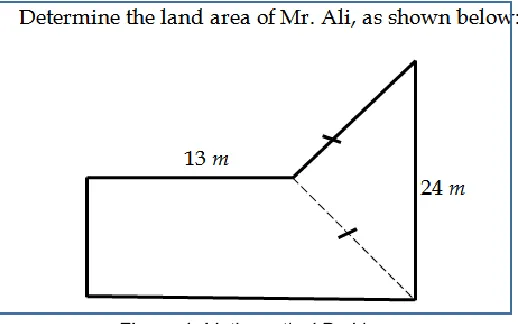
ESULT AND DISCUSSIONIn general, the task of mathematics education is to clarify the thinking process of students in learning mathematics and how mathematical knowledge is interpreted in mind. In this regard, one of the roles of the teacher in learning school mathematics is to help students express how the process runs in their mind when solving problems. To find out the thinking process of students, the teacher can ask students to show or tell the steps that are in his mind. By revealing this thinking process, students indirectly help teachers to understand heterogeneous students. In the process of solving mathematical problems, students carry out thought processes in the brain until the student can resolve the issue at hand. By describing the thinking process, the teacher can interpret the information gathered through observing students' behavior while studying mathematics. Indirectly the teacher has carried out the task of an educator in Mathematics learning, namely to explain the thinking process of students in learning mathematics and how mathematical knowledge is interpreted in mind to improve mathematics teaching in school [17]. In addition, by describing the thinking process in solving mathematical problems, the teacher is expected to know the form or type of error that is often done by students [18]–[23]. By describing the form of mistakes made by students, the teacher is expected to know the causes of students experiencing errors in solving mathematical problems [22], [46]. Also, by knowing the types of errors that are often made by students, the teacher can design learning scenarios including mathematical learning tools so that the mistakes often made by students can be avoided in solving problems. [24]. To find out errors, students are given a problem, see figure 1.
Figure 1. Mathematical Problem
(hereinafter referred to as T1 , T2 and T3), and 3 subjects in formal cognitive development (hereinafter referred to as F1, F2, and F3).
3.1 Error understanding the problem
To find out the errors that occur in the thinking process, the students understand the problem, the indicators (1) cannot determine the information on the question about what is known, (2) cannot determine the information on the question about what is asked, and (3) cannot retell about problems faced with their own language. In subjects with concrete cognitive development, it was obtained that K1 subjects did not write anything at the stage of understanding the problem, K2 subjects wrote down what was known and asked. In subjects with concrete cognitive development, it was found that T1 and T2 subjects did not write anything, whereas T3 subjects wrote what was known and asked about the mathematical problems they faced. In subjects with formal cognitive development, it was found that subjects F1 and F2 did not write anything at the stage of understanding the problem. But the F3 subject can describe what is known without writing down what was asked on the second problem. Errors by not writing down what is known or not writing down what was asked what happened to most subjects can be categorized as misconceptions [47], [48]. One of the effects of conceptual errors is that students cannot solve problems students or students cannot continue at the stage of solving the next problem [23]. At the stage of understanding the problem provides a foundation for students to be able to step in the next stage [49], this is because students are not likely to solve the problem correctly without understanding the problem at hand [50]. The problem is that most subjects do not write information about what is known from the problem at hand, or do not write information about what was asked of the problem at hand. Although the subject does not write down the information on the problem, the subject can continue the steps to solve the problem. In connection with this condition, the subject may have known the information on the problem so that the subject cannot be categorized as making a misconception. This is because the main impact of conceptual errors is that the subject cannot continue the steps to resolve the problem that cannot be proven. There is a tendency that students have a habit in solving mathematical problems never writing what is known and what is asked, but students do the next step in solving problems [23], [51].
3.2 Error of Planning To Resolve Problems
To find out the mistakes that occur at the stage of planning to solve the problem include students knowing enough conditions and conditions need a problem, and students use all information that has been collected [46], [49], [51]. Student, by writing formulas, linking information between what is known and asked, including determining or calculating unknown variables, can be categorized at the planning stage to solve the problem. The results of observations on subjects with concrete cognitive development obtained that the K1 subjects planned to solve the problem by determining the area of the trapezium ABCE and the area of the triangle CDE. K2 subjects in planning to solve design problems by determining the height of the triangle first to determine the area of the triangle, then determine the area of the trapezium so that the problems faced can be resolved. T1 subjects are also able to connect between known variable variables to determine new variables.
The subject of T2 in determining the land area of Pak Ali uses the area of a triangle and the area of the trapezium because the shape of the image which is the second problem consists of a triangle and a trapezium. The subject of T3 in determining the land area of Mr. Ali uses the area of a triangle and the area of the trapezium because the shape of the image which is the second problem consists of a triangle and a trapezium. F1 subjects in determining the land area of Pak Ali use the area of the rectangle and the area of the trapezium because the shape of the image that becomes the second problem consists of a square and a trapezium. F2 subjects cannot plan to solve the problem well; even the subject can be categorized as unable to plan to solve the problem correctly. F3 subjects can plan to solve problems. It can be seen that the subject's knowledge of the shape of the wake that exists in the second problem consists of two flat shapes, namely the triangle and the trapezium. So to solve the area of build on the second problem, the area of the triangle and the area of the trapezium must be searched. The subject by writing a plan in solving a problem is useful for a role or rule in solving a problem so that the subject is not out of the way to solve the mathematical problem at hand. By using this step, the subject indirectly calls back the scheme that is in mind by recalling the knowledge that has been possessed [52]. But if the subject does not make a plan in solving the problem, there is a possibility of mistakes made by students in the second stage by not being able to plan to solve the problem mostly because the subject cannot be able to sketch (draw pictures) to solve problems, connect known variables become a new variable. Errors do not know enough conditions, and the requirements in the second step to solving the problem can be categorized as a principle error. One indicator of principle faults can be shown from the way students are wrong in using mathematical rules or formulas [53], the principle error made by students in solving mathematical problems can occur if between concepts or facts on problems faced by students cannot become new concepts or events [54]. In addition to the principle mistakes made in planning to solve mathematical problems, the subject also made a procedure error. Procedure errors are errors in applying specific steps or stages in an improper problem solving [55], in other words, procedural errors can occur in the subject if the scenario used to solve the problem is incorrect. To avoid procedural errors or principle errors such as those that occur in subjects F2 and F3 can be done by familiarizing students with finding out the relationship between data or information that is already known to the unknown, in other words, looking for unknown elements of existing information. Also, it is necessary to get used to making scenarios for solving problems before students solve mathematical problems faced.
3.3 Error Implementing the Plan
436 problem is wrong for the K1 subject. The K2 subject uses the
sum of the triangle area with the area of the trapezium. In the area of the triangle, the subject determines the height of the triangle first, then uses the triangle area formula, namely ½ × 𝑎 × 𝑡. For the trapezium area, K2 subjects use the trapezoid formula ½ × (𝑎 + 𝑏) × 𝑡, where for the length of the parallel sides are used 13 and 18. The answers to K2 subjects are by the scenario planned in the previous stage. The situation outlined by K2 subjects in solving mathematical problems is (1) determine the height of the triangle, (2) determine the triangle, (3) determine the area of the trapezoid, (4) the area of land obtained from the sum of the area of the triangle and the area of trapezium. On the second mathematical problem, K2 subjects did not experience errors in solving problems and the stages to solve problems were by the scenario planned in the previous stage. The T1 subjects used the sum of the two flat shapes, namely triangles and trapeziums. In the area of the triangle, the subject looks for the height of the triangle first before determining the area of the triangle. The subject of T1 obtained the area of a triangle of 60 sql from ½ × 24 × 5, with 24 is the base of the triangle and 5 is the height of the triangle. For the area of the trapezium, subjects use ½ × (13 + 18) × 5 with parallel sides the length is 13 and 18 while the trapezium height is 5. By what was planned by the T1 subjects that to determine the land area of Mr. Ali was obtained from the sum of the area of the triangle and the area of the trapezium so that it received 246 sql. Related to this, T1 subjects did not experience errors in solving problems, and subjects could implement plans to solve mathematical problems. T2 subjects used the sum of the two flat of shapes; they are triangles and trapeziums. In the trapezium wake the subjects obtained parallel lengths of 13 m and 25 m, while trapezium height was 12 m. Subjects can explain verbally the origin of one of the lengths of the parallel sides of 25 m and the height of 12 m, as revealed during interviews with T2 subjects.
R : How can you get this length 25 m? (while showing the trapezium image on the question)
T2 : In this triangle (pointing to a triangle),
Given the base, the length is 24 m and the length of this side, and this is 13 m (looking to the triangle image). Because the shape of this triangle (pointing to the image of a triangle) is isosceles, to determine the height of the base divided by 2 so that it is obtained by 12.
If this length is 12 m (pointing to the base of the triangle) and this length is 13 m (looking at the hypotenuse of the triangle), using triple Pythagoras then this length is 12 m (looking to the height of the triangle).
Because the height of the triangle is 12 m, the length of the longest side is 13 plus 12 results 25.
R : where is the trapezium height of 12 m?
T2 : this is the base of the triangle (pointing to a triangle) divided by two results 12 m.
Whereas to determine the area of a triangle, the subject uses a triangular base and the height that was previously obtained. These two things are then substituted on the triangle area formula so that the triangle area is 144 sql. T2 subjects experienced errors in understanding the concept between the height of the triangle and the height of the trapezium. T2 subjects assume that the trapezium height and the height of the triangle are the same two things. Even if you refer to the image on the second problem, between the trapezium height
problem, the subject can easily carry out the next stage to solve the mathematical problem. But if the subject is not able to make a plan in solving the problem well as in the subject F2 and F3, the possibility of the subject being able to solve the mathematical problem is very small. This is supported by the results of observations which show that subjects F2 and F3 cannot solve mathematical problems. Errors that are like calculation errors do not occur in the subject. This shows that the subjects include being careful in carrying out calculations. But the subject experienced a procedure error in solving the problem; this error could occur because, in the previous stage, the subject had experienced a procedure error. Another mistake that occurs at the stage of implementing the plan to solve the problem is a misconception. Concept errors occur in the subject due to the subject's initial knowledge such as the concept of the triangle, and the formula for the area of the flat building is very weak. To avoid mistakes like this, the teacher can do this by repeating the material that has been given to students in the form of apperception during the learning process. So that apperception is not always repeated so that students can become saturated, learning media can be used as a substitute for the teacher to convey this message. The form of book media can be used to help the learning process carried out by the teacher. Books used in learning are expected to increase students' interest in reading and studying Mathematics, so the design of the books used is not like the design of textbooks that have been used by students in Mathematics learning.
3.4 Error of Look back at the completed solution In general, the subject is used to find out the characteristics of students in solving problems, writing conclusions from all the steps taken to solve the problem. Unlike the F2 and F3 subjects who did not write findings from all the actions taken to solve the problem, this was because the subjects F2 and F3 did not carry out the planning stage (second stage) and the stage of implementing the plan to solve the problem (third stage). One step that can be used by students to do the re-checking phase is to interpret the answers obtained by giving conclusions at the end of the students' answers [56]. By giving conclusions at the end of each answer, it can be stated that students have believed that students' answers in solving problems. By understanding this answer, indirectly, the students' answers are by the wishes or scenarios that have been determined by the students. Although there are subjects who already believe that they have done all the stages and there are no errors in solving the problem, the final results show that there are still errors such as the subjects who made mistakes in the previous stages. Look back at the completed solution has the smallest weight among the other stages of the policy, but if this step is not done the student cannot make corrections or correct mistakes such as conceptual errors, procedural errors and calculation errors that have been done at the previous stages [57]. By doing this last stage, students can minimize mistakes that might appear in the previous stages [58], students can check the systematics and the stages of completion whether it is good and right or not, students can carefully review each step of the solution they do. This last stage is sometimes not done carefully by students so that the process of checking back done by students has not shown the expected results.
4
C
ONCLUSION ANDS
UGGESTIONAt the stage of understanding the problem, in general, the subjects did not make mistakes in the first stage even though some subjects did not write down what was known and asked about the problem at hand. At the stage of planning to resolve formal subject problems experience principle errors and procedural errors. At the stage of carrying out the transitional and concrete subject plan experience the mistakes of concepts and procedures, whereas in the formal subject because in the previous stage it cannot arrange the scenario to solve the problem, the formal subject cannot implement the plan to solve the problem. In the fourth stage, in general, the subjects interpret the overall stages of solving the problem. To avoid mistakes like this, the teacher can do this by repeating the material that has been given to students in the form of apperception during the learning process. So that apperception is not always repeated so that students can become saturated, learning media can be used as a substitute for the teacher to convey this message. The form of book media can be used to help the learning process carried out by the teacher. Books used in learning are expected to increase students' interest in reading and studying Mathematics, so the design of the books used is not like the design of textbooks that have been used by students in Mathematics learning.
R
EFERENCES[1] National of Council Teacher of Mathematics, Principles and Standards For School Mathematics. Virginia: NCTM, 2000.
[2] BSNP, Peraturan Mentri Pendidikan Nasional Republik Indonesia No 22 Tahun 2006 Tentang Standar Isi Untuk Satuan Dasar dan Menengah. 2006.
[3] S. Adi Widodo, T. Turmudi, J. Afgani Dahlan, I. Istiqomah, and H. Saputro, ‘Mathematical Comic Media for Problem Solving Skills’, in International Conference on Advance & Scientific Innovation, 2018, pp. 101–108.
[4] S. A. Widodo, Istiqomah, Leonard, A. Nayazik, and R. C. I. Prahmana, ‘Formal student thinking in mathematical problem-solving’, J. Phys. Conf. Ser., vol. 1188, p. 012087, 2019.
[5] M. Rizal, ‘Proses Berpikir Siswa SD Berkemampuan Matematika Tinggi dalam Melakukan Estimasi Masalah Berhitung’, in Prosiding Seminar Nasional Penelitian, Pendidikan, dan Penerapan MIPA Tanggal, 2011. [6] W. Hidayat, ‘Adversity Quotient dan Penalaran Kreatif
Matematis Siswa SMA dalam Pembelajaran Argument Driven Inquiry pada Materi Turunan Fungsi’, KALAMATIKA J. Pendidik. Mat., vol. 2, no. 1, pp. 15– 28, 2017.
[7] M. . D. Sunarto, ‘Karakteristik Proses Berpikir Siswa Dalam Mempelajari Matematika Berbasis Tipe Kepribadian’, Pros. Semin. Nasional, Pendidik. dan Penerapan MIPA, Fak. MIPA, Univ. Negeri Yogyakarta, pp. 481–492, 2009.
[8] T. Y. E. Siswono, ‘Identifikasi Proses Berpikir Kreatif Siswa dalam Pengajuan Masalah ( Problem Posing ) Matematika Berpandu dengan Model Wallas dan Creative Problem Solving (CPS)’, Bul. Pendidik. Mat., vol. Vol 6, no. 2, pp. 1–16, 2004.
438 Matematika’, in Prosiding Seminar Nasional
Matematika dan Pendidikan Matematika Pendidikan Matematika, 2012, no. November, pp. 978–979. [10] R. Widyastuti, B. Usodo, and Riyadi, ‘Proses Berpikir
Siswa Smp Dalam Menyelesaikan Masalah Matematika Berdasarkan Langkah- Langkah Polya’, J. Pembelajaran Mat., vol. 1, no. 3, pp. 239–249, 2013. [11] L. N. Safrida, S. Susanto, and D. Kurniati, ‘Analisis
Proses Berpikir Siswa Dalam Pemecahan Masalah Terbuka Berbasis Polya Sub Pokok Bahasan Tabung Kelas Ix Smp Negeri 7 Jember’, Kadikma, vol. 6, no. 1, pp. 25–38, 2015.
[12] T. A. Kusmayadi, I. Sujadi, and Muhtarom, ‘proses Berpikir Siswa Kelas IX Sekolah Menengah Pertama Yang Berkemampuan Matematika Tinggi Dalam Memecahkan Masalah Matematika’, JMEE, vol. 1, no. 2, pp. 60–71, 2011.
[13] R. Widyastuti, ‘Proses Berpikir Siswa dalam Menyelesaikan Masalah Matematika berdasarkan Teori Polya ditinjau dari Adversity Quotient Tipe Climber’, Al-Jabar J. Pendidik. Mat., vol. 6, no. 2, pp. 183–193, 2015.
[14] I. N. L. Fauziyah, B. Usodo, and H. E. Ch, ‘Proses Berpikir Kreatif Siswa Kelas X dalam Memecahkan Masalah Geometri berdasarkan Tahapan Wallas ditinjau dari Adversity Quotient (AQ) Siswa’, J. Pendidik. Mat. Solusi, vol. 1, no. 1, pp. 1–16, 2013. [15] Mulyono, ‘Proses Berpikir Mahasiswa Dalam
Mengkonstruk Konsep Matematika’, in Prosiding Seminar Nasional Sains dan Teknologi, 2010, pp. 1–8. [16] D. A. Ngilawajan, ‘Proses Berpikir Siswa SMA Dalam
Memecahkan Masalah Matematika Materi Turunan Ditinjau Dari Gaya Kognitif Field Independent Dan Field Dependent’, Pedagogia, vol. 2, no. 1, pp. 71–83, 2013.
[17] S. A. Widodo and Turmudi, ‘Guardian Student Thinking Process in Resolving Issues Divergence’, J. Educ. Learn., vol. 11, no. 4, pp. 431–437, 2017.
[18] S. Irpan, ‘Proses Terjadinya Kesalahan Dalam Penalaran Proporsional Berdasarkan Kerangka Kerja Asimilasi Dan Akomodasi’, Beta, vol. 3, no. 2, pp. 100– 117, 2010.
[19] S. H. Wiwin and Nurwiani, ‘Analisis kesalahan menyelesaikan soal program linear siswa kelas XI SMK Tribuana Jombang Tahun 2008/2009’, pp. 1–7, 2009.
[20] R. Agustiawan, Ha. B. Uno, and Y. Ismail, ‘Analisis Kesalahan Matematika Siswa Dalam Menyelesaikan Soal Cerita Pada Pembelajaran Sistem Persamaan Linier Dua Variabel’, KIM Fak. Mat. dan IPA, vol. 1, no. 1, pp. 1–12, 2013.
[21] Y. Arnidha, ‘Analisis Kesalahan Siswa Dalam Menyelesaikan Soal Operasi Hitung Bilangan Cacah’, e-DuMath Vol., vol. 1, no. 1, pp. 52–63, 2015.
[22] S. Satoto, H. Sutarto, and E. Pujiastuti, ‘Analisis Kesalahan Hasil Belajar Siswa Dalam Menyelesaikan Soal Dengan Prosedur Newman’, Unnes J. Math. Educ. Res., vol. 2, no. 1, pp. 76–83, 2013.
[23] S. A. Widodo, ‘Error Analysis Of Guardians Student In Understanding The Problem Of Divergence’, in Proceeding of International Conference On Research, Implementation And Education Of Mathematics And Sciences 2014, 2014, no. May, pp. 18–20.
[24] S. A. Widodo and A. . Sujadi, ‘Analisis Kesalahan Mahasiswa Dalam Memecahkan Masalah Trigonometri’, Sosiohumaniora J. Ilmu Sos. dan Hum., vol. 1, no. 1, pp. 51–63, 2015.
[25] B. Ojose, ‘Applying Piaget ’ s Theory of Cognitive Development to Mathematics Instruction’, Math. Educ., vol. 18, no. 1, pp. 26–30, 2008.
[26] R. A. Reiser and R. M. Gagne, ‘Characteristics of Media Selection Models’, Rev. Educ. Res., vol. 52, no. 4, pp. 499–512, 1982.
[27] J. R. Hopkins, ‘The Enduring Influence of Jean Piaget’, Association For Psychological Science, 2011. .
[28] J. Piaget, The Psychology of Intelligence. New York: Routledge, 2003.
[29] R. Lahti, ‘Does Attainment Of Piaget’s Formal Operational Level Of Cognitive Development Predict Student Understanding Of Scientific Models?’, University of Montana, 2013.
[30] B. Inhelder and J. Piaget, The Early Growth Of Logic In The Child, Clasification And Seriation. New York: Harper & Row, 1964.
[31] J. Piaget, The Language And Thought of The Child. London: Routledge, 2005.
[32] J. C. Moore, ‘Transitional to Formal Operational: Using Authentic Research Experiences to Get Non- Science Students to Think More Like Scientists’, Eur. J. Phys. Educ., vol. 3, no. 4, pp. 1–12, 2007.
[33] S. Urbina, Essentials of Psychological Testing. New Jersey: John Wiley & Sons, Inc, 2004.
[34] P. Barrouillet, ‘Theories of cognitive development : From Piaget to today’, Dev. Rev., vol. 38, pp. 1–12, 2015.
[35] M. F. Joubish and M. A. Khurram, ‘Cognitive Development in Jean Piaget’s Work and its Implications for Teachers’, World Appl. Sci. J., vol. 12, no. 8, pp. 1260–1265, 2011.
[36] J. A. Leongson and A. A. Limjap, ‘Assessing The Mathematics Achievement of College Freshmen Using Piaget’s Logical Operation’, in The Hawaii international conference on education, 2003, pp. 1–25.
[37] S. A. Widodo, ‘Selection of Learning Media Mathematics for Junior School Students’, Turkish Online J. Educ. Technol. - TOJET, vol. 17, no. 1, pp. 154–160, 2018.
[38] A. Syahbana, ‘Peningkatan Kemampuan Berpikir Kritis Matematis Siswa SMP Melalui Pendekatan Contextual Teaching And Learning’, EDUMATICA| J. Pendidik. Mat., vol. 2, no. 1, pp. 45–57, 2012.
[39] I. Alhaddad, ‘Penerapan Teori Perkembangan Mental Piaget Pada Konsep Kekekalan Panjang’, J. Ilm. Progr. Stud. Mat., vol. 1, no. 1, pp. 31–44, 2012.
[40] Nasution, Metode Research. Jakarta: Bumi Aksaara, 2003.
[41] J. W. Creswell, Research Design Qualitative,Quantitative,and Mixed Second Edition. 2012.
[42] J. W. Creswell, Educational Research: Planning, Conducting and Evaluating Quantitative and Qualitative Research. London: Pearson, 2012.
Informan Selection’, Ethnobot. Res. Appl., vol. 5, pp. 147–158, 2007.
[45] M. W. Van Someren, Y. F. Barnard, and J. A. C. Sandberg, The Think Aloud Method: A Practical Guide To Mcognitive Processes, vol. 31, no. 6. London: Academic Press, 1994.
[46] S. A. Widodo, ‘Analisis Kesalahan Dalam Pemecahan Masalah Divergensi Tipe Membuktikan Pada Mahasiswa Matematika’, J. Pendidik. dan Kegur., vol. 46, no. 2, 2013.
[47] K. S. Perbowo and R. Anjarwati, ‘Analysis of Students’ Learning Obstacles on Learning Invers Function Material’, Infin. J., vol. 6, no. 2, p. 169, 2017.
[48] C. W. Suryaningrum, Purwanto, Subanji, and H. Susanto, ‘Why Do Students Make Errors when Solving Problem in Semiotic Representation ?’, in Advances in Social Science, Education and Humanities Research, 2018, vol. 218, no. ICoMSE 2017, pp. 8–11.
[49] S. A. Widodo, ‘Keefektivan Team Accelerated Instruction Terhadap Kemampuan Pemecahan Masalah dan Prestasi Belajar Matematika Siswa Kelas VIII’, Kreano, J. Mat. Kreat., vol. 6, no. 2, pp. 127–134, 2015.
[50] D. Indarwati, Wahyudi, and N. Ratu, ‘Peningkatan Kemampuan Pemecahan Masalah Matematika Melalui Penerapan Problembased Learning Untuk Siswa Kelas V SD’, Satya Widya, vol. 30, no. 1, pp. 17–27, 2014. [51] Pardimin and S. A. Widodo, ‘Increasing Skills of
Student in Junior High School to Problem Solving in Geometry with Guided’, J. Educ. Learn., vol. 10, no. 4, pp. 390–395, 2016.
[52] S. D. Pratiwi and M. T. Budiarti, ‘Profil Metakognisi Siswa SMP dalam Memecahkan Masalah Matematika Ditinjau dari Kemampuan Matematika Siswa’, Mathedunesa, vol. 3, no. 2, 2014.
[53] L. Rahmania and A. Rahmawati, ‘Analisis Kesalahan Siswa Dalam Menyelesaikan Soal Cerita’, J. Mat. dan Pendidik. Mat., vol. 1, no. 2, pp. 165–174, 2016. [54] B. R. Hidayat, B. Sugiarto, and G. Pramesti, ‘Analisis
Kesalahan Siswa Dalam Menyelesaikan Soal Pada Materi Ruang Dimensi Tiga Ditinjau Dari Gaya Kognitif Siswa ((Penelitian dilakukan di SMA Negeri 7 Surakarta Kelas X Tahun Ajaran 2011/2012)’, J. Pendidik. Mat. Solusi, vol. 1, no. 1, pp. 39–46, 2013. [55] A. Isgiyanto, ‘Diagnosis Kesalahan Siswa Berbasis
Penskoran Politomus Model Partial Credit Pada Matematika’, J. Penelit. dan Eval. Pendidik., vol. 15, no. 2, pp. 308–325, 2011.
[56] Wahyudi and I. Budiyono, Pemecahan Masalah Matematika, Widya Sari. Salatiga, 2012.
[57] D. P. Utomo, ‘Pembelajaran Lingkaran Dengan Pendekatan Pemecahan Masalah Versi Polya Pada Kelas VIII di SMP PGRI 01 Dau’, Widya War., vol. 36, no. 1, pp. 145–158, 2012.