Themed Section: Science and Technology
An Experimental Study on The Properties of A Self
Compacting Concrete Using Phosphogypsum
K. Sravani1, A. B. S. Dadapeer2, D. Mohammed Rafi2
1M.Tech Student, Chiranjeevi Reddy Institute of Engineering & Technology, Anantapur, Andhra Pradesh, India 2Assistant Professor, Chiranjeevi Reddy Institute of Engineering & Technology, Anantapur, Andhra Pradesh,
India
ABSTRACT
Concrete permeability may be the most relevant property affecting its durability, especially under exposure to aggressive environment, as permeability is an aspect of concrete performance that must be specified, designed for monitoring in the production of concrete. Current research studies dealing with normal to moderate concrete strengths have questioned the validity of AASHTO T277, has sole indicator of concrete permeability it has been suggested that for specific concrete mixes AASHTO T277 should not be solely without developing initial correlation data with AASHTO T259 resistance of concrete to chloride penetration. The main objective of this study is been to evaluate the permeability of concrete with phosphogypsum as admixture by using the “Rapid chloride ion permeability test (RCPT)”. Replacement of cement by phosphogypsum as 0%, 10%, 20% and 30% for water / powder ratio 0.50 of M20 grade concrete for every mix 3 cubes of size 150mmX150mmX150mm and 6 cylinders of size 95mm diameter and 50mm height were casted. Cubes were tested at 28 days after casting and the statistical data presented. 3 cylinders were tested at 28 days after casting and remaining 3 cylinders were tested at 90 days after casting. Based on the amount of charge passed in coulombs, Chloride ion permeability of the concrete may be defined as high, moderate, low and very low. The statistical data of chloride ion permeability at 28 days and 90 days is presented.
Keywords : Permeability, Phosphogypsum, AASHTO, RCPT
I.
INTRODUCTION
In India, the manufacturing of Portland cement was commenced around the year 1912. The beginning was not very promising and growth of cement industry was very slow. At the time of independence in 1947, the installed capacity of cement plants in India was approximately 4.5 million tons and actual production around 3.2 million tons per year. The large construction activity undertaken during the various 5 years plans necessitated the growth of cement industry. However, until the year 1982, the growth remained stinted due to the complete control exercised by the Government over the cement industry. The partial deep control in 1982 prompted
cements, such as sulphate resisting Portland cement, pozzolana cement and blast furnace slag cement found their way to improve quality and prompted the structural engineers and major consumers to adopt higher grades of concretes in the construction work. This has been marked difference in the quality of concrete during this period primarily due to the availability of superior quality of cements in the market. In addition there has been a continuous up gradation in the availability of product knowledge, product quality and marketing services to the consumers. The trend is continuing and more and more varieties of cements are coming to the market which help the consumers to make appropriated grade and quality of concrete to meet the specific construction requirement.
II.
PHOSPHOGYPSUM
With the advancement of technology and increased field application of concrete and mortars the strength, workability, durability and other characteristics of the
ordinary concrete is continually undergoing
modifications to make it more suitable for any situation. The growth in infrastructure sector led to scarcity of cement because of which the cost of cement increased incrementally. In India, the cost of cement increasing day to day. In order to combat the scarcity of cement and the increase in cost of concrete under these circumstances the use of recycled solid wastes, agricultural wastes, and industrial by-products like fly ash, blast furnace slag, silica fume, rise husk ash, phosphogypsum, etc. came into use. The use of above mentioned waste products with concrete in partial amounts replacing cement paved a role for (i) modifying the properties of the concrete, (ii) controlling the concrete production cost,(iii) to overcome the scarcity of cement, and finally (iv) the advantageous disposal of industrial wastes. The use of particular waste product will be economically advantageous usually at the place of abundant availability and production. Much of the literature is available on the use of fly ash, blast furnace slag, silica
fume, rise husk, etc. in manufacture of cement concrete. However, the literature on the use of phosphogypsum in construction industry is in the budding stage. This thesis tries to focus on the use of phosphogypsum in partial replacement of cement in Self Compacting concrete.
In India, about 6 million tons of waste gypsum such as
phosphogypsum, flourogypsum etc.,are being
generated annually.
Phosphogypsum is a by-product in the wet process for
manufacture of phosphoric acid (ammonium
phosphate fertilizer) by the action of sulphuric acid on the rock phosphate. It is produced by various processes such as dehydrate, hemihydrates or anhydrite processes. In India the majority of phosphogypsum is produced by the dehydrate process due to its simplicity in operation and lower maintenance as compared to other processes. The other sources of phosphogypsum are by-products of hydrofluoric acid and boric acid industries.
III.
NEED OF THE PRESENT INVESTIGATION
IV.
PREVIOUS RESEARCH WORKS ON
PHOSPHOGYPSUM
Phosphogypsum is a by-product of phosphate fertilizer plants and chemical industries. As it is contaminated with the impurities that impair the strength development of calcined products, it can be used as partial replacement of cement. T. Siva Sankar Reddy, D. Rupesh Kumar and H. Sudarsana Rao(2010) studied the compressive, tensile and flexural strength
characteristics of partially cement replaced
phosphogypsum concrete using 0%., 10%, 20%, 30% and 40% replacement with different water-binder ratios of 0.40, 0.45, 0.50, 0.55, 0.60 and 0.65. The strength characteristics are studied by casting and testing a total of 450 specimens, which consists of 270 cubes, 90 cylinders and 90 beams for 7, 28 and 90 days. It is shown that a part of Portland cement can be replaced with phosphogypsum to develop a good and hardened concrete to achieve economy; above 10% replacement of phosphogypsum in concrete lead to drastic reduction not only in the compressive strength but in the split-tensile strength also; the flexural strength decreases as width and number of cracks increases significantly at replacement above 10% of cement with phosphogypsum at different water binder ratios.
M.A. Taher (2007) studied, thermal treatment of phosphogypsum (PG) at different temperatures 200, 400, 600 and 800o C were attempted to purify PG and improve its quality to make it fit for the manufacture of Portland slag cement (PSC). PG is a waste of phosphoric acid manufacturing by dehydrate process in Egypt. It is a fine powder with high calcium sulphate content. This waste causes various environmental problems when discharged directly to the environment. The thermally treated PG was found to have lesser amount of impurities of phosphates, fluorides and organic matter than the impure material. In this investigation, preparation of Portland slag cement (PSC) in laboratory was carried out by mixing
Portland cement clinker (PCC) and blast furnace slag (BFS) with thermally treated PG at different temperatures instead of raw gypsum (RG). The characteristics of prepared mortars were investigated by determination of compressive strength, bulk density and total porosity. The hydration kinetics of cement mortars was evaluated by determination free lime and chemically combined water contents. IR spectroscopic analysis was used for investigates the change in structure of mortars after curing.
V.
PROPERTIES OF PHOSPHOGYPSUM
Physical Properties
Depending on the reaction temperature used to produce phosphoric acid, calcium sulfate in either the
dihydrate (CaSO4.2H20) or the hemihydrate
(CaSO4.½H20) form is generated as a by-product filter cake. The gypsum cake, after filtration, usually has free moisture content between 25 and 30 percent. Hemihydrate, in the presence of free water will, fairly rapidly, convert to dihydrate (gypsum) and in the process, if left undisturbed, will set up into a relatively hard cemented mass. Dihydrate consists of relatively soft, principally silt-size (<0.075mm) aggregates of crystals, the morphology of which depends on the source of the phosphate rock and the reactor conditions.
Engineering properties
Chemical Properties
Phosphogypsum consists primarily of calcium sulphate dihydrate with small amounts of silica, usually as quartz, and unreacted phosphate rock. Radium and uranium, as well as minor amounts of USEPA toxic metals, namely, arsenic, barium, cadmium, chromium, lead, mercury, selenium and silver and phytotoxic fluoride and aluminum are also present in
phosphogypsum and its pore water. The
concentrations of the heavy metals and radionuclides depend on the composition of the phosphate rock feed.
VI.
TESTING OF CONCRETE SPECIMENS
Workability of concrete is one of the important properties of fresh concrete; it can be determined by the following methods
1. Slump test
2. Compacting factor test
3. Vee – Bee consistometer test
4. Slumptest
The slump test is used to determine the workability of fresh concrete .slump test is as per IS199-1959 is follows.
Procedure
The internal surface of the mould is thoroughly cleaned and applied with light coat of oil. The mould is placed on a smooth horizontal, rigid and non absorbent surface .The mould is then filled in four
layers with freshly mixed concrete each
approximately one fourth of the height of mould. Each layer is compacted 25 times by round end tamping rod (strokes are distributed evenly over the cross- section). After the top layer is rodded the concrete is struck off the level with trowel. The mould is removed from the concrete immediately by raising it slowly in the vertical direction. The difference in height in mm of subsidence of the
specimen during the test. Slump depends on many factors like property of concrete ingredients such as aggregates etc., temperature is also has its effect on concrete
Figure 1. Slump cone
i) Compaction factor test:
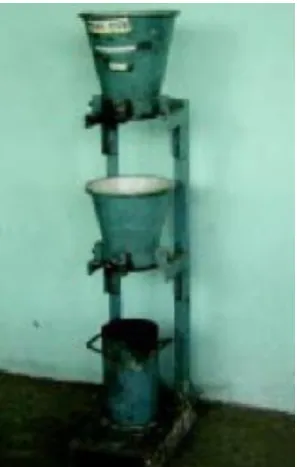
The Compacting factor test is used to determine the workability of fresh concrete Compaction factor test is as per IS199-1959 is follows.
Procedure:
The sample of is placed in the upper hopper up to the brim. The trap-door is opened so that the concrete falls in the lower hopper. With the tap- door of lower hopper is opened and concrete is allowed to fall into the cylinder. The excess concrete remaining above the cylinder is then cut off with the help of the plane blades. The concrete in the cylinder is weighted; this is known as weight of partially compacted concrete. The cylinder is again filled with sample of fresh concrete and vibrated to the full compaction, the concrete in the cylinder is weighted again, this weight is known as weight of fully compacted concrete.
ii) Vee – Bee Consistometer Test
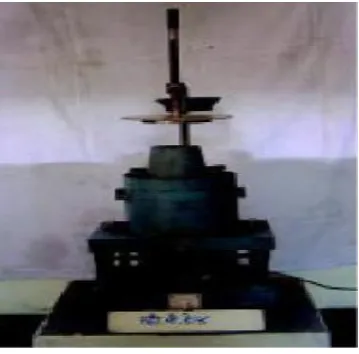
The Vee – Bee consistometer test is used to determine the workability of fresh concrete Vee – Bee
consistometer test is as per IS199-1959 is follows.
Figure 3. Vee-Bee Consistometer test
Procedure:
The conventional slump test is performed, placing the slump cone inside the cylinder part of the consistometer. The glass disc is attached to the swivel arm is turned and placed on the top of concrete in the pot. The Electrical vibrator is switched on stop watch is started simultaneously. Vibration is continued till the conical shape disappears and the concrete assumes cylindrical shape. When concrete is fully assumes the
cylindrical shape the stop watch is switched off immediately the time is noted. The consistency of concrete is noted in vee-bee degrees, which is equal to the time in seconds.
VII.
COMPRESSIVE STRENGTH OF
CONCRETE
Out of many test applied to the concrete, this is the utmost important which gives an idea about all the characteristics of concrete. By this single test one judge that whether concreting done properly or not. For cube test two types of specimens either cubes of 15cmX15cmX15cm or 10cmX10cmX10cm depending on the size of aggregate used. For most of the works cubical moulds of size 15cmX15cmX15cm are commonly used.
Figure 4. Concrete Cube Moulds
Procedure for Compressive strength test of concrete cubes:
Hand mixing:
Mix the cement and fine aggregate on a water tight non absorbent platform until the mixture is thoroughly blended and is uniform color. Add the coarse aggregate and mix with cement and fine aggregate until the coarse aggregate is uniformly distributed throughout the batch. Add water and mix it until the concrete appears to be homogeneous and of the desired consistency
Sampling:
Clean the moulds and apply thin coat of oil. Fill the concrete in the moulds in layers approximately 5cm thick. Compact each layer with not less than 25 strokes per layer using a tamping rod (Steel bar of 16mm diameter and 60 cm long, bullet pointed at lower edge). Level the top surface and smooth en it with a trowel.
Curing:
The test specimens are stored in moist air for 24 hours and after this period the specimens are marked and removed from the moulds and kept submerged in clear fresh water until taken out prior to test.
VIII.
DISSCUSSION OF TEST RESULTS
This Chapter presents the results of the tests conducted for ascertaining the Phosphogypsum concrete properties such as workability, compressive strength and permeability for different mixes by replacing the cement content with Phosphogypsum from 0% to 30%.
WORKABILITY OF PHOSPHOGYPSUM CONCRETE
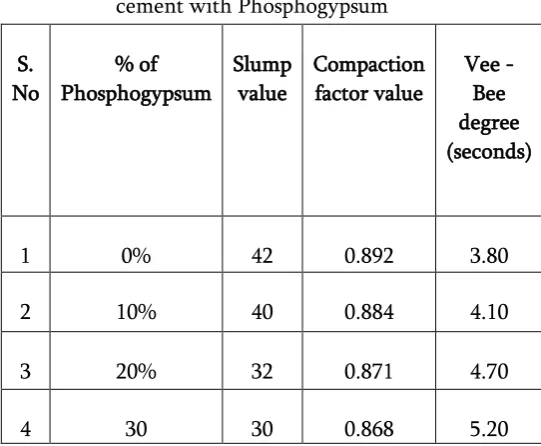
The workability tests such as Slump test, Compaction factor test and Vee-Bee tests were conducted on fresh concrete mixes with different percentages of Phosphogypsum and tabulated as follows
Table 1. Variation of workability with Replacement of cement with Phosphogypsum
S. No
% of Phosphogypsum
Slump value
Compaction factor value
Vee - Bee degree (seconds)
1 0% 42 0.892 3.80
2 10% 40 0.884 4.10
3 20% 32 0.871 4.70
4 30 30 0.868 5.20
From above table it is observed that, percentage replacement of cement with phosphogypsum increases the Slump value and Compaction factor value decreased but, Vee-Bee degree increased. The variation of workability at 10% replacement of cement with Phosphogypsum is very nominal.
COMPRESSIVE STERNGTH OF PHOSPHOGYPSUM CONCRETE
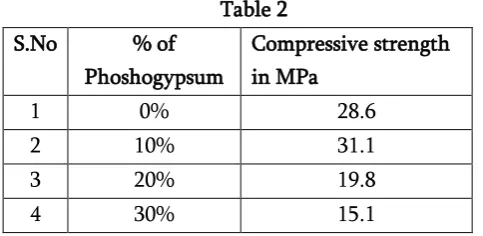
Variation of compressive strength with replacement of cement with Pohosphogypsum
Table 2
S.No % of
Phoshogypsum
Compressive strength in MPa
1 0% 28.6
2 10% 31.1
3 20% 19.8
4 30% 15.1
From the above table it is observed that as percentage replacement cement with phosphogypsum increases from 0% to 10% the compressive strength increased, but as percentage of phosphogypsum increased from 10% to 20% and above the compressive strength reduced . Hence, from compressive strength point of view it is not advisable to increase the % of phosphogypsum more than 10%.
IX.
CONCLUSIONS
Based on the results obtained from this study, the following Conclusions seems to be valid.
1. The increase in percentage replacement of cement with Phoshogypsum from 0% to 30% causes decrease in Slump value and Compaction factor value, but increase Vee-bee degree. This shows workability is reducing as percentage of Phosphogypsum increasing. However at 10% replacement of cement with Phosphogypsum the reduction in workability is very nominal. The increase in percentage replacement of cement with Phosphogypsum from 0% to 10% causes increase in compressive strength of concrete from 28.60MPa to 31.10MPa.
2. Further increase in percentage replacement of cement with Phosphogypsum from 10% to 30% causes decrease in the compressive strength from 31.10MPa to 15.10MPa. Hence, 10% replacement of cement with Phosphogypsum is advisable from compressive strength point of view.
3. The increase in percentage replacement of cement with Phosphogypsum from 0% to 30% causes reduction in Chloride ion permeability from 3076 Coulombs to 2426 Coulombs, when tested for Chloride ion permeability at the age of 28 days
4. The increase in percentage replacement of cement with Phosphogypsum from 0% to 30% causes reduction in Chloride ion permeability from 1879 Coulombs to 1525 Coulombs, when tested for Chloride ion permeability at the age of 90 days.
X.
REFERENCES
[1].Atkins, H. N., "Highway Materials, Soils, and Concretes", 4th Edition, Prentice Hall, pp.277-330(2003).
[2].B. Krishna Rao et. al. "steel fiber reinforced Self Compacting concrete incorporating class F fly ash" International Journal of Engineering Science and Technology Vol. 2(9), 2010, 4936-4943
[3].Bentz, D. P., "Drying/hydration in cement pastes during curing", Materials and Structures, Vol.34, No. 243, pp.557-565 (2001).
[4].Concrete Technology- M.S.Shetty
[5].Dodson, V., "Concrete Admixtures", VNR Structural Engineering Series (1990).
[6].Duval, R. and E. H. Kadri, "Influence of Silica Fume on the Workability and the Compressive Strength of High-Performance Concretes", Cement and Concrete Research Journal, Vol. 28, Issue 4, pp.533-547 (1998).
[7].Ferraris, C. F., "Concrete Mixing Methods and Concrete Mixers: State of the Art", NIST Journal, Vol. 106, No. 2, pp.391-399 (2001).