© 2018 IJSRST | Volume 4 | Issue 2 | Print ISSN: 2395-6011 | Online ISSN: 2395-602X Themed Section: Science and Technology
Application of Multi-Objective Optimization on The Basis of Ratio Analysis
(MOORA) in Strategic Location Marketing
Kimberly Febrina Kodrat1, S Supiyandi2, M Mesran3
1 Departement of Industrial Engineering, ITM, North Sumatra, Indonesia
2 Departement of Computer Engineering, Universitas Pembangunan Panca Budi Medan, North Sumatra,
Indonesia
3 Department of Computer Science, STMIK Budi Darma, North Sumatra, Indonesia
ABSTRACT
Determination of the location or area of marketing is a very decisive process of success in the sale of a product to be marketed. The best marketing does not mean there are no competitors in the location. The presence of a competitor in a marketing location can affect the competitiveness of the product. The decision to be taken by the business owner against a strategic marketing location is very risky. In this case, the role of the computer as a more effective information processor is needed. Use of methods in determining the effectiveness of a decision. Many methods can be used decision support system, one of them Multi-Objective Optimization on The Basis of Ratio Analysis or known as MOORA. This study will discuss the use of MOORA methods in generating effective information about decisions in determining strategic marketing areas.
Keywords: MOORA, Strategic Location, Marketing Location, Decision Support, DSS
I.
INTRODUCTION
The rapid development of a region, causing the emergence of many sales companies that cause competition in business. This requires every business owner to be more careful in determining the strategy in marketing their products. One of the decisive factors in the success of sales of a product, namely the selection of strategic marketing locations. Medan is the city with the largest population ranked 3rd in Indonesia. Rapid development of the city, with the number of malls that stood in the city of Medan, making business actors have a high enthusiasm in marketing a product. The rapid development of a region makes the business climate improving.
One of the most influential activities in the sales process is marketing. Good marketing can increase the sales volume of a product. The best marketing does not mean that there are no competitors in the marketing location. But with many competitors in a
marketing location, it can affect the competitiveness. The best marketing can also be done by opening a business branch at a different location. The number of sales branches, then the marketing activities of a product will be better, because consumers more easily obtain information about the marketed products.
other business owners, there is also consider the availability of labor and transportation. So every business owner has a difference in choosing the location of his business. The more strategic the chosen marketing location, the higher the sales process will occur and this will affect the profit earned by the business owner. In order for the decision obtained by business owners to be more effective, then the role of computers is needed to process data that can produce the best decisions. In support of a decision using a computer, it can be applied a method capable of processing the criteria that affect a decision produced. The implementation of MCDM in making effective decisions has been widely practiced[2]. Among the MCDM methods are TOPSIS, EXPROM2, ELECTRE, Preference Selection Index [3][4][5].
Many studies use method methods ineffective decision-making, such as those conducted by Garuda (2017) that analyze the use of the TOPSIS method to assist in making a decision[6]–[10]. Putri Sianturi (2017) is using ELECTRE in determining the eligibility of BOP recipients for Early Childhood Education (PAUD) in Simalungun district [4]. In the same year Mesran, also used the MOORA method to determine the assessment in the process of admission of new students [11].
In this study, the authors conducted research to determine the location of strategic marketing by taking 6 (six) alternatives. In the determination of the author using the method MOORA. The MOORA method was developed by Brauers (2004) which is a multiobjective optimization method[12].
II.
METHODS AND MATERIAL
2.1 Product Marketing
Marketing is a coordinated and market-focused and consumer-oriented effort with the goal of providing satisfaction to the consumer as a key to achieving organizational goals [13][14].
2.2 Strategic Location
The marketing location is the place or area used by the business owner in running the business. In that area, the business owner can display his / her merchandise, serve the consumer, so that the sales process can be created. In order for a business to run to make a profit, then the selection of a strategic location is very important. There are several factors to be considered, namely the location of the intended market, means of communication, the availability of labor, means of transportation [1].
2.3 Decision Support System
Little (1970), defines DSS as a collection of procedures consisting of data processing and assessment aimed at helping managers make decisions. Implementation of DSS in order to use the computer as a tool can more effectively streamline the decisions generated by managers[11], [15]–[17].
2.4 Multi-Objective Optimization on The Basis of Ratio Analysis (MOORA) Method
A multi-objective (or programming) optimization, also known as a multicriteria or multiple attribute optimization, is the process of simultaneously optimizing two or more conflicting attributes (goals) subject to certain restrictions. The MOORA method, first introduced by Brauers (2004) is a multiobjective optimization technique that can be successfully applied to solve various types of complex decision-making problems in a manufacturing environment[18].
The procedure of MOORA method [11][18] can be seen below:
Step 1: Create a Decision Matrix.
A decision matrix can be represented as in the matrix below.
[
] ……….. (1)
Step 2: Normalize the Decision Matrix
To normalize the decision matrix using equation 2.
√[∑ ] ……...(2)
There are two ways to optimize attributes. Can use the equation to 3, or use an equation to 4. The difference is that in the equation to 4, the weight of each criterion is used in yielding better optimization value.
∑ ∑ ………....(3)
∑ ∑ …...(4)
Where g is the number of attributes to be maximized, (n-g) is the number of attributes to be minimized, and yi is the normalized value of the alternative value
against all attributes.
The ordinal rank of yi shows the final preference. The
best alternative has the highest yi value, while the worst alternative has the lowest Yi value.
III.
RESULTS AND DISCUSSION
Determination of a good marketing location, of course must be done first analysis of the location of the location of choice. The business owner will take several options against the location that is considered strategic. Once in the list of locations, then the criteria used as a reference should also be specified. The number of criteria used, this will result in a more effective decision so that business owners will be confident with the decision obtained. Using MOORA method, it becomes the right solution for the owner of capital/effort in getting a support for the decision to be generated. MOORA is a simple method with a few easy steps, but consider the criteria to be both profit and loss.
Here is a list of criteria (table 1) and alternatives (table 2) specified in the calculations using the MOORA method.
Table 1. List of Criteria
Criteria Weighted Type Description
Area(C1) 15% Benefit Extensive
location Competitor
(C2)
20% Benefit Number of
competitors
on similar products
Distance (C3) 35% Cost Distance
from city center
Price (C4) 30% Cost Rental
price
Table2. List of Alternative
Alternative Location
A1 SUN Plaza, Lt 2
A2 Suzuya Tj Morawa
A3 Plaza Medan Fair, Lt 3
A4 Suzuya Marelan, Lt 1
A5 Suzuya Katamso, Lt 1
A6 Center Point
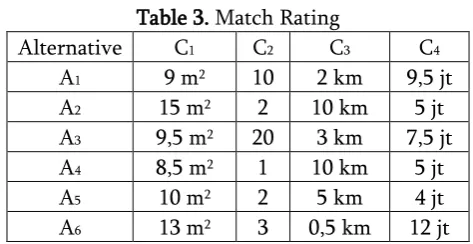
In table 3, the rating data matches between criteria and alternatives.
Table 3. Match Rating
Alternative C1 C2 C3 C4
A1 9 m2 10 2 km 9,5 jt
A2 15 m2 2 10 km 5 jt
A3 9,5 m2 20 3 km 7,5 jt
A4 8,5 m2 1 10 km 5 jt
A5 10 m2 2 5 km 4 jt
A6 13 m2 3 0,5 km 12 jt
From the data in table 4, taken as a decision matrix like the following table.
Table 4. Alternative Match Rating and Criteria
Alternative C1 C2 C3 C4
A1 9 10 2 9,5
A2 15 2 10 5
A3 9,5 20 3 7,5
A4 8,5 1 10 5
A5 10 2 5 4
A6 13 3 0,5 12
Then form a normalized matrix using equation 2.
√
= 8,06
√
= 6,16
√
= 5,25
√
= 6,56
The result of calculation is, the normalization matrix ( ).
Table 5. The Matrix
Alternative C1 C2 C3 C4
A1 1,12 1,62 0,36 1,45
A2 1,86 0,32 1,81 0,76
A3 1,18 3,24 0,54 1,14
A4 1,05 0,16 1,81 0,76
A5 1,24 0,32 0,91 0,61
A6 1,61 0,49 0,09 1,83
Then determine the value of yi using equation 4.
1,12 1,62 0,36 1,45
1,86 0,32 1,81 0,76
1,18 3,24 0,54 1,14 x Wj
1,05 0,16 1,81 0,76
1,24 0,32 0,91 0,61
1,61 0,49 0,09 1,83
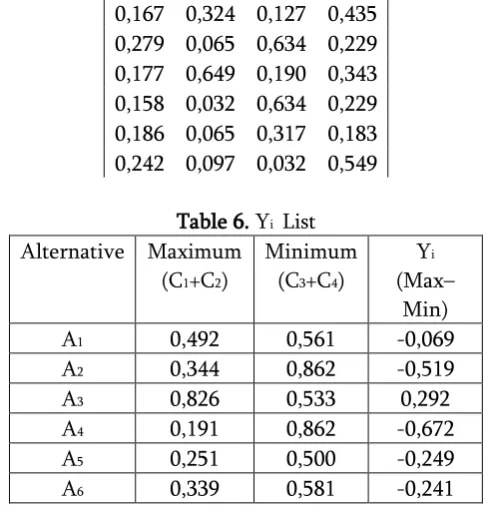
The multiplication result is seen as follows.
0,167 0,324 0,127 0,435 0,279 0,065 0,634 0,229 0,177 0,649 0,190 0,343 0,158 0,032 0,634 0,229 0,186 0,065 0,317 0,183 0,242 0,097 0,032 0,549
Table 6. Yi List
Alternative Maximum (C1+C2)
Minimum (C3+C4)
Yi
(Max– Min)
A1 0,492 0,561 -0,069
A2 0,344 0,862 -0,519
A3 0,826 0,533 0,292
A4 0,191 0,862 -0,672
A5 0,251 0,500 -0,249
A6 0,339 0,581 -0,241
The final step of ranking the table 6 of Yi value, which can be seen in table 7 below.
Table 7. Results Rank
Alternative Results Rank
A3 0,292 1
A1 -0,069 2
A6 -0,241 3
A5 -0,249 4
A2 -0,519 5
A4 -0,672 6
From the calculation, it is found that the alternative A3=0.292, has a higher value than A1 = -0.069, A6 =
-0.241, A5 = -0.224, A2 = -0.519, A4 = -0.672. So from
the discussion can be decided that alternative Plaza Medan Fair (A3) is the best alternative compared with
other alternatives.
From the discussion that researchers do, it can be taken some conclusions, namely:
I. Determination of strategic marketing locations by applying the MOORA method can result in more effective and objective decisions.
II. The adoption of MOORA methods in
decision-based decision-based systems for the
determination of marketing locations can be more effective in making decisions for business owners.
V.
REFERENCES
[1]. Suliyanto, Studi Kelayakan Bisnis Pendekatan Praktis. Yogyakarta: Andi Offset, 2010.
[2]. S. Kusumadewi, S. Hartati, A. Harjoko, and R. Wardoyo, Fuzzy Multi-Attribute Decision Making (Fuzzy MADM). Yogyakarta: Graha Ilmu, 2006.
[3]. J. Jasri, D. Siregar, and R. Rahim, "Decision Support System Best Employee Assessments with Technique for Order of Preference by Similarity to Ideal Solution,” Int. J. Recent Trends Eng. Res., vol. 3, no. 3, pp. 6–17, Mar. 2017.
[4]. P. Sianturi, Mesran, P. Ramadhani, and N. W. Al-Hafiz, "SISTEM PENDUKUNG KEPUTUSAN
PENENTUAN PENERIMA BANTUAN
OPERASIONAL PENYELENGARAAN ( BOP ) PAUD ( PENDIDIKAN ANAK USIA DINI ) MENERAPKAN METODE ELECTRE ( STUDI
KASUS : DINAS PENDIDIKAN KABUPATEN
SIMALUNGUN ),” KOMIK (Konferensi Nas. Teknol. Inf. dan Komputer), vol. I, no. 1, pp. 20– 26, 2017.
[5]. Mesran, K. Tampubolon, R. D. Sianturi, F. T. Waruwu, and A. P. U. Siahaan, "Determination of Education Scholarship Recipients Using Preference Selection Index,” Int. J. Sci. Res. Sci. Technol., vol. 3, no. 6, pp. 230–234, 2017. [6]. G. Ginting, Fadlina, Mesran, A. P. U. Siahaan,
and R. Rahim, "Technical Approach of TOPSIS
in Decision Making,” Int. J. Recent Trends Eng. Res., vol. 3, no. 8, pp. 58–64, 2017.
[7]. S. Syamsudin and R. Rahim, "Study Approach Technique for Order of Preference by Similarity to Ideal Solution (TOPSIS),” Int. J. Recent Trends Eng. Res., vol. 3, no. 3, pp. 268–285, Apr. 2017.
[8]. N. Nurmalini and R. Rahim, "Study Approach of Simple Additive Weighting For Decision Support System,” Int. J. Sci. Res. Sci. Technol., vol. 3, no. 3, pp. 541–544, 2017.
[9]. R. Risawandi and R. Rahim, "Study of the Simple Multi-Attribute Rating Technique For Decision Support,” Int. J. Sci. Res. Sci. Technol., vol. 2, no. 6, pp. 491–494, 2016.
[10]. D. Siregar, D. Arisandi, A. Usman, D. Irwan, and R. Rahim, "Research of Simple Multi-Attribute Rating Technique for Decision Support,” J. Phys. Conf. Ser., vol. 930, no. 1, p. 12015, Dec. 2017. [11]. Mesran, R. K. Hondro, M. Syahrizal, A. P. U.
Siahaan, R. Rahim, and Suginam, "Student Admission Assessment using Multi-Objective Optimization on the Basis of Ratio Analysis (MOORA),” J. Online Jar. COT POLIPT, vol. 10, no. 7, pp. 1–6, 2017.
[12]. P. Karande, E. K. Zavadskas, and S. Chakraborty, "A study on the ranking performance of some MCDM methods for industrial robot selection problems,” Int. J. Ind. Eng. Comput., vol. 7, no. 3, pp. 399–422, 2016.
[13]. K. Philip and G. Amstrong, Dasar - Dasar Pemasaran Edisi Kesembilan Jilid 1. Jakarta: PT. Indeks Kelompok Gramedia, 2004.
[14]. Rusdiana, Manajemen Operasi. Bandung: CV. Pustaka Setia, 2014.
[15]. Kusrini, Konsep dan Aplikasi Sistem Pendukung Keputusan. Yogyakarta: Andi, 2007.
Expressing Reality ( ELECTRE ) Method in Selecting the Best Lecturer ( Case Study STMIK BUDI DARMA ),” Int. J. Eng. Res. Technol., vol. 6, no. 2, NaN-2017, pp. 141–144, 2017.
[17]. R. Rahim, Mesran, A. Putera, U. Siahaan, and S. Aryza, "Composite performance index for student admission,” Int. J. Res. Sci. Eng., vol. 3, no. 3, pp. 68–74, 2017.