INTEGRATED SCHOOLS IN NAIROBI COUNTY, KENYA
NYAGA MICHAEL SIMON
E55/12032/2009
A RESEARCH THESIS SUBMITTED IN PARTIAL
FULFILLMENT
OF THE REQUIREMENTS
FOR THE AWARD
OF THE DEGREE OF MASTER OF EDUCATION (SPECIAL
NEEDS EDUCATION) IN THE SCHOOL OF EDUCATION,
KENYATTA UNIVERSITY
DECLARATION
This thesis is my original work and has not been presented for award of degree in any other university, or any other award.
Signature~
Nyaga
Mi:Jl:.lSiD1OJl
Date
C~
Ott\
:l.~\\0
•
E55/12032/2009
SUPERVISORS
We confirm that the work reported in this thesis was carried out by the candidate under our supervision.
Signature ~
Prof. Geoffrey K.Karugu
Department of Special Needs Education Kenyatta University
Signature
,~
• Date
Z.
tp
r0
'f-'
~l.h
Prof. James E.Otiende
Department of Education Foundations Kenyatta University
DEDICATION
iii
ACKNOWLEDGEMENT
TABLE OF CONTENT
e
DECLARATION i
DEDICATION ii
ACKNOWLEDGEMENT .iii
TABLE OF CONTENT iv
LIST OF TABLES ix
LIST OF FIGURES x
LIST OF PLATES xi
ABBREVIATIONS AND ACRONYMS xii
ABSTRACT xiv
CHAPTER ONE: INTRODUCTION 1
1.0 Introduction 1
1.1 Background of the Study 1
1.2 Problem Statement 4
1.4 Objectives of the Study ~ 6
1.5 Research Questions 7
1.6.Significance of the Study 7
1.7 Scope 8
1.8'Limitations of the Study 8
1.9Assumptions of the Study 9
1.10 Theoretical Framework ; 9
1.11 Conceptual Framework : II
1.12 Operational Definition of Terms 15
.CHAPTER TWO: LITERATURE REVIEW 17
2.0 Introduction 17
v
2.2 Childrens' Practices in Physical Activity 19
2.3 School Provisions for Physical Activity 23
2.3.1 Opportunities for Physical Activity 25
2.4 Constraints inAccessing Physical Activity Opportunities 27
CHAPTER THREE: METHODOLOGY 32
3.1 Introduction 32
3.2 Research Design 32
3.3 Variables 33
3.3.1 Independent Variables 33
3.3.2 Dependent Variables 33
3.3.3 Extraneous Variables 34
3.4 Location of the Study 34
3.4.1 Descriptions of Locations of the Sampled Schools 35
3.4.1.1 ELI Primary School. 35
3.4.1.2 EL2 Primary School 35
3.4.1.3 EL3 Primary School. 36
3.5 Target Population 36
3.6 Sampling Technique and Sample Size 37
3.6.1 Sampling Technique 37
3.6.2 Sample Size 38
3.7 Research Instruments 39
3.7.1 Observation 39
3.7.2 Focus Group Discussions (FGDs) 39
3.7.3 Pedometers 39
3.8.1 Validity : 40
3.8.2 Reliability 41
3.9 Data Collection Techniques 41
3.10 Data Analysis 42
3.11 Logistical and Ethical Considerations .42
CHAPTER 4:DATA PRESENTATION, ANALYSIS AND DISCUSSION 43
4.1 Introduction 43
4.2 Learners Perceptions of the Adequacy of Physical Activity Opportunities in
Schools , 43
4.2.1 The Physical Environment in Schools 44
4.2.2 Physical Facilities and Equipment.. .47 4.2.3 Availability of Time for Physical Activity .49
4.2.4 Utilitarian PA inSchool 50
4.2.5 Opportunities for LWSN 51
4.3 Learners Participation inPA inSchool, Home and the Neighbourhood 53 4.3.1 Environments Attracting Physical Activity 53
4.3.2 Learners' Trends of Engagement in PA 54
4.3.3 Physical Activities Engaged in by Learners 58
4.3.4 Practices for LWSN 62
4.4 Schools' Practices in Provision of Adequate PA Opportunities to Learners 65
4.4.1 School Routine 65
4.4.2 School Programmes and Provisions for PEIP A 68 4.4.3 Teachers' Enthusiasm towards PE and PA 72 4.4.3.1 Learners Perceptions of Teachers' Enthusiasm on PA and PE 72 4.4.3.2 Teachers' Self Reflections on their Enthusiasm in PA 75
Vll
4.5 Learners' Constraints in Accessing Physical Activity Opportunities 85 4.5.1 Learners Observations oftheir Constraints in PA 85
4.5.2 Constraints forLWSN 92
4.5.2.1 Observations by LWSN ontheFactors thatLimited their Access to PA ..92 CHAPTER 5: SUMMARY, CONCLUSIONS AND RECOMMENDATIONS ..96
5.1 Introduction 96
5.2 Summary 96
5.2.1 Adequacy ofPA Opportunities to Learners in School... 97
5.2.1.1 The Physical Environment 97
5.2.1.2 Availability of Time for PA 98
5.2.1.3 Utilitarian PA for Learners in Schools and Home 99 5.2.1.4Physical Facilities and Equipment 99
5.2.1.5 PA Opportunities forLWSN 99
5.2.2 Learners Levelof Engaging inPA 100 5.2.2.1 Physical Environments Encouraging PA 100 5.2.2.2 Learners' Trends of Engaging in PA 102 5.2.2.3 Physical ActivitiesEngaged in by Learners 102
5.2.2.4PA Levels for LWSN 103
5.2.3 School Practices in the Provision of Adequate PA Opportunities to
Learners 103
5.2.3.1 School Routines and Practices 104
.5.2.3.2 School Provisions for PA 105
,
5.2.3.3 Teachers Enthusiasm in PA and PE I06 5.2.4 Learners Constraints in Accessing PA Opportunities.. 108
5.2.4.1 Learners' Opinions on Constraints to PA 108
5.3 Conclusions 112 5.3.1 Perceptions on the Adequacy of PA Opportunities in School I12 5.3.2 Learners' Level of Participation in PA in School, Home and the
Neighbourhood 113
5.3.3 School Practices in Providing for Adequate Environment for PA for
Learners 115
5.3.4 Learners Constraints in Accessing PA Opportunities 116
5.4 Recommendations , 118
5.4.1 Adequacy ofPA Opportunities to Learners in Schools 118
5.4.2 Learners Level of Participation in PA 120
5.4.3 School Practices in Provision of Adequate PA Opportunities to Learners. 121 5.4.4 Learners' Constraints in Accessing PA Opportunities 122
5.5 Further Research 123
REFERENCES 124
.
Appendix I: Interview Guide for Class Teachers 129 Appendix II: Interview Guide for P.E Teachers 130 Appendix III: Interview Guide for Games Masters 131 Appendix IV: Interview Guide for Head-Teachers 132 Appendix V: Interview Guide for Parents 133 Appendix VI: FGD Guide for Learners .•... 134 Appendix VII: Pedometer Counts Table 136
Appendix IX: Research Budget 137
Appendix X: Research Time Schedule 138
Appendix Xl: Research Authorization (Kenyatta University) 139
IX
LIST OF TABLES
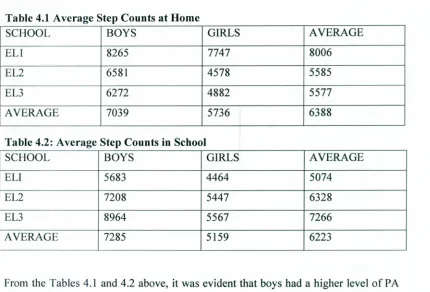
Table 4.1: Average Step Counts at Home _ 54
Table 4.2: Average Step Counts in School 54
x
LIST OFFIGURES
Figure 1.1 Conceptual Framework 13
xi
LIST OF PLATES
Plate 1: Barbed wire around the school assembly ground at ELl School. .46 Plate 2: A Dusty Field, and a Limited and Unsafe Playground at ELl and EL2
Schools Respectively 47
Plate 3: A Boy with an Improvised Football Ball 48 Plate 4: An Expansive Golf Course Adjacent to El.Z'School.. 57 Plate 5: Girls Playing Katolo on aPavement at EL2 School.. 59
Plate 6: Grassed playground atEL3 70
Plate 7: An Open Area inEL2 Opposite the LRR 84
Plate 8: Part of EL2 School Playground 88
ABBREVIATIONS AND ACRONYMS AAP
BMD BMI CEFPI CHD CHF CHP COPD DH DHT DTE EFA EL EST FGD GoK HT KCPE KIE KNH LWSN LRR MoE MoH
American Academy of Pediatrics
Bone Mineral Density Body Mass Index
Council for Education Facilities Planners Association Chronic Heart Disease
Chronic Heart Failure Chronic Health Problem
Chronic Obstructive Pulmonary Disorder Department of Health
Deputy Headteacher
Diploma Teacher Education Education for All .
Economic Level
Ecological systems Theory Focus Group Discussion Government of Kenya Headteacher
Kenya Certificate of Primary Education Kenya Institute of Curriculum Development Kenyatta National Hospital
MPHS NASPE NCSL NICE NSHG PA PCEA PE PLWD PTE SIMSC SDT QAS QAS UAE UAP
•
xiii
Ministry of Public Health and Sanitation
National Association for Sport and Physical Education National Conference of State Legislatures
National Institute for Health and Clinical Excellence National School Health Guidelines
Physical Activity
Presbyterian Church of East Africa Physical Education
Persons Living With Disability Primary Teacher Education
School Instructional Materials Selection Committee Self Determinism Theory
Quality Assurance and Standards
Quality Assurance and Standards Officer(s) United Arab Emirates
ABSTRACT
CHAPTER ONE INTRODUCTION
1.0 Introduction
This chapter presents the background to the study, the problem statement, purpose of the study, objectives of the study, research questions, significance of the study, scope,
limitations of the study, assumptions of the study, theoretical and conceptual
frameworks, and operational definition of the key terms.
1.1 Background of the Study
The importance placed on health by the Kenya Educational System is evident in the Eighth National Goal of Education which emphasizes the need for positive attitudes towards good health and need for a healthy environment (KIE, 2004).The Ministry of Education (MoE) in conjunction with the former Ministry of Public Health and Sanitation (MPHS) have outlined the National School Health Guidelines (NSHG) whose purpose is to operationalize the National School Health Policy by providing specific guidelines which ensure that school-age children, teachers, support staff and
community members access quality and equitable services for improved health. These
guidelines suppose that physically active children perform well inschool and promote
their health resulting in ahealthy and productive population (MPHS and MoE, 2009).
The NSHG recognize children with Special Needs to include; those living in
especially difficult circumstances, those with chronic health problems, those with emotional and behavioural difficulties, and the orphaned. These are children who for health reasons are unable to reach their highest possible developmental potential of
Chronic health problems which include cardiovascular diseases, metabolic disorders, pulmonary diseases, musculoskeletal disorders and neurological disorders (Booth, Chakravarthy, Gordon, and Spangenburg, 2002), may have seemed alien in children about thirty years ago but have unfortunately caught up with them at a worrying rate towards the turn of the 21st century (WHO, 2000).
According to Booth et ai, (2002), research confirms that these chronic health problems can be avoided <?r mitigated through physical activity. Advances in technology and consequent sedentary lifestyles have led to life threatening lifestyle diseases not only among adults but also among children and youth. Hallahan, Kauffman, and Pullen (2009), affirm that Chronic Health Impairments (CHI) may be prevented by among other th}ngs having a healthy diet, lowering obesity and through Physical Activity (PA).
Hallahan et ai, (2009) contends that learners with.Special Needs (L WSN) have erratic school attendance because of hospitalization, visits to physicians and bed-rests. These cause them to fall behind their age peers in academic achievements despite normal intelligence and motivation. They are usually rejected, feared, pitied or discriminated. The more obvious the physical flaw, the more likely it is for that person to be perceived in negative terms by the public.
3
obesity caused about two thirds of deaths resulting from diabetes and heart diseases as well as 15% and 20% of cancer in men and women respectively (NCSL, 2006). In Iceland, lower Body Mass. Index (BMI), PA and good dietary habits were all associated with higher academic achievements, while self-esteem was negatively influenced by increasing levels of BMI (Krist jansson, Alfegier, Sigfusdottin, Inga, Allegrante and John, 2000). "THE FAT TRUTH" campaign launched in 2009 in the United Arab Emirates (UAE) linked obesity to lack of exercise and increased consumption of fatty and sugary food items. Between 1990 and 2000, countries in the European Union reported obesity growth rates from 10% to 27% in men and 10% to 38 % in women. Childhood obesity in Canada between the years 1989 and 2004 increased from 2% to 10% and from 2% to 9% among boys and girls respectively. In China, this obesity trend was attributed to changing dietary habits and technological advancements which have led to a decline in PA, (UAE, 2009).
In Kenya, 16.7% of girls and 6.8% of boys in urban dwellings are overweight (Onywera, 2010, a). Medics have observed an increasing trend in disease prevalence among children, attributing this to obesity and lack of physical activity. Onywera (2010, a) reports that studies at Kenyatta National Hospital (KNH) have found that rheumatoid arthritis was increasingly attacking younger Kenyans, especially those lacking in PA.
Availability of a suitable outdoor play environment and appropriate and stimulating play materials depend mostly on the teachers' and parents' choice. The school and .horne environments created by the teachers and parents may dictate the levels at which learners engage in PA. With many more people in their twenties and thirties succumbing to chronic health problems, medical professionals are concerned that unless children are encouraged to exercise early in life, they risk setting the foundations for unhealthy adulthood. Children's Bill of 2001 (GoK, 2002), advocates that chi Idren need to be listened to, because their own experiences have influence on the health decisions that they may make on a daily basis.
Informed of the significance of PA as an agent in promotion of a healthy living, improving academic performance and
a
means to mitigate the prevalence of chronic health impairments/ disability (Booth, 2002), this study explored the perceptions and practices of learners towards physical activity.1.2 Problem Statement
5
the increase. Parents in urban centers do not only opt for motor transport for their children to school but also engage hired labour to do most of the household chores. In
Kenya, walking to school has often been associated with poverty causing parents to avoid it where possible. Most urban schools in Kenya have limited playgrounds a
situation which compromises PA opportunities for learners. Schools have placed a lot of emphasis on learners' academic achievement. Time allocated for PE and games is spent for regular classroom teaching. Consequent to improved per capita income in
Kenya, a lifestyle drift into consuming polished and fast foods has been on the rise. These foods are rich in energy and require an active lifestyle to ensure that consumers
(learners) do not have positive energy balance in their body which may likely cause obesity and possible health impairments.
Studies have demonstrated how various disabling health conditions can be avoided or controlled through PA. However, this information has not dissuaded the continuity of sedentary lifestyle amongst the Kenyan population where 16.7% and 6.8% of girls and boys respectively in urban dwellings are overweight. Research has indicated an increase in cases of chronic diseases among younger Kenyans attributed to physical inactivity.
on how learners -with or without impairments perceive and engage in PA within the school, home and their neighbourhood environments is vital. Learners' perspective may introduce ideas on how best to deal with the challenges of creating lifelong lifestyles in children that ensure a healthy adult population. Decisions on improving the natural and built environments within the learners' habitat may be realized through such a study. Since "Childhood" is "adults' pasts" (old age is a product of childhood life), it would therefore translate into a healthier population reduced cases or chronic health impairments.
1.3 Purpose of the Study'
The purpose of this study was to evaluate learners' perceptions and practices in regular and integrated schools on PA as a means to attaining healthy living in some selected schools in airobi County.
1.4 Objectives ofthe Study
This study was guided bythe following objectives:
a. Evaluate learners' perceptions on the adequacy of physical activity opportunities inschools.
b. Finding out the learners' level of participation in physical activities in school, home and the neighbourhood. '
c. Analyze learners' views on the schools' practices in provision Of materials and facilities for physical activity.
7
1.5 Research Questions
This study sought to answer the following questions;
a. What are the perceptions of learners on the adequacy of physical activity opportunities in the schools?
b. What are the learners' level of participation in physical activities in school, home and the neighbourhood?
c. How do learners view the school practices in provision of materials and facilities forPA to them.
d. What constraints do learners face in accessing physical activity opportunities in school, home and the neighborhood?
1.6.Significance of the Study
1.7 Scope
The study appreciated the existence of different ways of promoting health among differing demographics. However, this study focused on health promotion through physical activity among learners in regular and integrated primary schools. However, for purposes of interviews and data collection using pedometers, the researcher used class six learners because of their relatively long interaction with the school environment and their better ability to comprehend interview questions (Nyamai, 2005). Learners in class six (12 years of age) lie on a transition period just before adolescence when engagement in play and PA begins to decline, which made them suitable for the study. Though sedentary lifestyle is predominant in most urban areas, Nairobi County was purposively selected for the study. The study involved three primary schools distributed over the socio-economic strata of low, middle and high income levels coded as ELl, EL2 and EL3 respectively.
1.8 Limitations of the Study
9
1.9 Assumptions of the Study
The study assumed the following circumstances would prevail throughout the study
period.
a) That the school administration would co-operate and allow the researcher to
undertake the study successfully.
b) That teachers, parents and learners would be willing to cooperate with the
researcher.
c) That risk of chronic health impairments due to physical inactivity was real to all
the learners, teachers, and parents in general.
1.10 Theoretical Framework
The study was anchored on the Self-Determination Theory (SOT) by Deci and Ryan
(1985), and Ecological Systems Theory (EST) by Bronfenbrenner (1979). SOT is a theory concerned with the development and functioning of personality within social
contexts. SOT encompasses concepts such as free will, freedom of choice, independence, personal agency, self-direction and individual responsibility; it focuses
on the degree to which human behaviours are made by personal choice. It affirms that
people are active organisms with innate tendencies towards psychological growth and
development and that they strive to master challenges and to integrate experiences
into a coherent sense of self. According to SOT, these innate tendencies do not operate automatically but depend on the extent to which the social context provides
basic psychological needs. If the social environment satisfies these needs, a person
Bronfenbrenner's (1979) EST analyses the social factors that influence the development of children. These factors according to EST are tiered around the epicenter which is the child. Factors that have direct contact and most close to the child are referred to as microsystems. They comprise of the family (home) and the school. The relationship at this mesosystem level have impact in two directions (Berk, 2000), both away from the child and towards the child. This means that children can either affect or be affected by the social structures close or distant from them. Factors in other levels indirectly affecting the child and which Bronfenbrenner (1979) refers to as exosystem, macrosystem and chronosystem respectively represent the larger social, structural, economic, political and cultural environments. These may be referred to as the child's neighbourhood.
11
while creation of the safe routes to school in California was noted to increase the
number of children who walked.
According to AAP (2009), a pediatrician's recommendation that a patient gets regular physical activity loses its salience if this patient's everyday world lacks opportunities to walk, play and run. This perception was shared by Schmid (1995) in NICE, (2008) who noted that it is unreasonable to expect people to change their behaviour when the environment discouraged such changes. The two statements explain learners'
dependence on what the family, the neighbourhood and the school provide; for them
to behave and become. The three institutions above shape the learners perceptions and practices through the habitat they create for them.
evertheless, the learners' will and motivation also influence the environment to meet their PA needs. In school, learners supplement the available play materials by improvisations like skipping ropes, polythene-bag balls, innovative play activities and
games that utilize the available space and time as well as bridge the gap of their teachers' absence during games and PE. The learners' will to engage in utilitarian PA
like walking to school and markets demonstrates their will for self-determination.
These two theories (SDT & EST) converge on the agreement that children have the
potential to achieve desirable human behaviours but within a supportive social framework.
1.11 Conceptual Framework
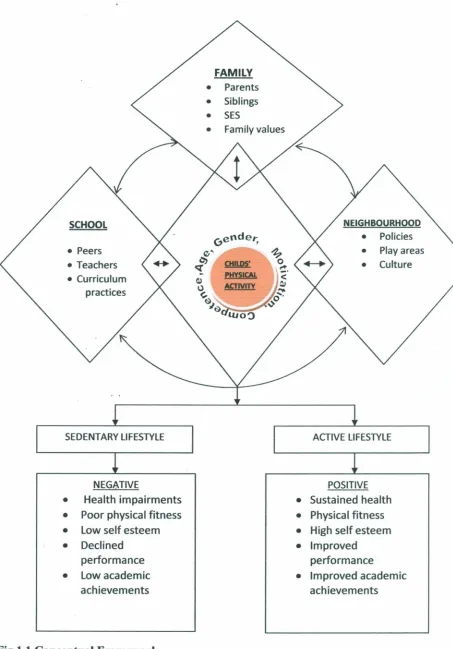
Learners have the potential to map their lifestyle (Deci and Ryan, 1985) but the social settings which include family, neighbourhood and the school and other intervening factors actualize or thwart these potentialities (Bronfenbrenner, 1979).
Learners' engagement in PA is influenced by their age, gender, the degree of motivation and their competencies in performing some specific physical activities. However, learners have limited control over the intervening variables. What they practice and how they perceive it is a product of their interaction with the school, the family and their neighbourhood. The three institutions are composed of subsets that influence and determine how learners interact with them. The ecosystem in which all these players operate gives room for them to influence each other bringing forth an intricate web of interaction.
13
FAMILY
•
Parents•
Siblings•
SES•
Family valuesSCHOOL • Peers • Teachers • Curriculum practices SEDENTARY LIFESTYLE NEGATIVE
• Health impairments
• Poor physical fitness • low self esteem • Declined
performance
• low academic achievements
Fig 1.1 Conceptual Framework
NEIGHBOURHOOD • Policies • Play areas • Culture
ACTIVE LIFESTYLE
POSITIVE • Sustained health • Physical fitness • High self esteem
• Improved performance
• Improved academic achievements
The conceptual framework above shows the learner (child) as the epicenter of an
ecological system within which PA is the variable that is being influenced. The
learners' gender, their physical ability (competence: which could be as a result of physical impairment), extrinsic and intrinsic motivation and the learners' age determine how the learner influences or is influenced by the mesosystem. A positive interaction will nurture healthy active lifestyle and better academic achievements
15
1.12 Operational Definition of Terms
Brooding: To nurture (consciously or unconsciously) habits and environments that gradually influences the end result of a process.
Brooding Disability: Nurturing habits and environments (consciously and or unconsciously) that gradually cause loss or reduction of functional ability in
persons.
Disability: Any loss or reduction of functional ability to perform an activity in the manner or within the rage considered normal for human beings within a cultural context.
Health: A state of complete physical, mental, and social sell being, not merely the absence of disease or infirmity.
Health Education: The process of instruction and acquisition of health knowledge aimed at increased awareness of self, change of attitudes and acquisition of skills and to ensure individual and communal well being.
Learners' Perceptions of PA: The general understanding by the learner about what PA entails and its significance to them.
Learners' Practices of PA: The general activities/exercises that learners engage in that exert the body energy expenditure beyond resting condition.
Mean Score Syndrome: A unreasoned desire to by teachers (and parents to some
extent) to have learners post high grades on aggregate in examinations at all costs.
Mungiki: A proscribed gang in Kenya operating mainly in Central and Metropolitan regions ofthe country.
Physical Activity: Any force exerted by skeletal muscle that results in energy expenditure above resting condition.
Regular Learner: Learners who do not require any modifications or adaptations for instructional purposes in school.
Special Needs: Inability to reach the highest possible developmental potential of life
due to physical, biological, psychological, social or other environmental circumstances.
Orange Book: KJE official catalogue with approved instructional materials purchasable with FPE funds.
Walking School Bus: An organized group of school children who walk to school
17
CHAPTER TWO
LITERATURE REVIEW
2.0 Introduction
Literature under the study is reviewed under the following subheadings; Physical Activity Opportunities in Schools, Childrens' Practices in Physical Activity, School
Provisions for Physical Activity, Constrains in Accessing Physical Activity Opportunities, and Relations between Academic Achievements and Physical Activity.
2.1 Physical Activity Opportunities in Schools
Physical activity is any force exerted by skeletal muscle that results in energy expenditure above resting (WHO, 2000). Children engage in physical activity as part of their daily lives when they travel to school, play around with other children or with
apparatus on their own. The physical environment in which a child or an adult lives greatly influences the motivation and choice of physical activity in which to engage.
The "built environment" of a community affects childrens' opportunities for physical activity (AAP, 2009). This type of an environment should address the concerns and risks that dissuade children from engaging in active lifestyle. Such concerns and risks which include automobile traffic, cramped apartments, lack of parks and sidewalks, insecurity, long walks to schools and busy streets may prevent children from getting
the physical activity they need to be healthy (Amanda, 2009; AAP, 2009).
environment, they engage more in movement activities than in the traditional school environment (Foster et aI., 2008). Environments that encourage utilitarian PA such as bicycling to school are an important part of a child's daily living. This active lifestyle translates into habits that children adapt through adolescence and old age. To achieve this, the environment should be structured so that it allows for a variety of play activities and sport. In Britain, National Institute for Health and Clinical Excellence (NICE) was mandated to give recommendations on creating environments that could best motivate and support PA (NICE, 2008). It came up with the following recommendations:
a. Ensuring that local facilities and services are easily accessible on foot, bicycle and other modes of transport involving PA.
b. Ensuring that pedestrians, cyclists and users of other modes of transport that involve PA are given the highest priority when developing and maintaining streets and roads. This should include people whose mobility is impaired.
c. Widening pavements and introducing cycle lanes.
d. Introduction of traffic-calming schemes to restrict vehicle speed.
e. Creating safer routes to school and improving walking and cycle routes to school. f. Ensure routes offer convenience, safety and attractive access to work places,
homes, schools and other public facilities.
g. Ensure that public open spaces are accessible on foot, bicycle and other modes of transport involving PA and should also be accessible by public means.
h. Ensure public open spaces and public paths are maintained to a high standard, and that they are safe, attractive and welcoming to everyone.
19
j. Designers and facility managers should ensure stair cases are designed and positioned to encourage people to use them.
k. Ensure tha~ stair cases are clearly supported and are attractive to use. This could be done byhaving them well lit and well decorated.
1. The school governing bodies and head-teachers should ensure that the school playgrounds are designed to encourage varied physically active play.
m. Primary schools should create areas that promote diverse individual and group PA.
These recommendations served to back remarks by AAP (2009) that, "a pediatricians recommendation that a patient gets regular physical activity loses its salience
if
this patient's everyday world lacks opportunities to walk,play and run."This position is also shared by NICE, (2008) in an observation that it was unreasonable to expect people to change their behavior when their environment discouraged such changes. Though recommendations by NICE (2008) may not be fully operationalized in the current African context, it would be imperative for Kenya to learn from these recommendations as it achieves the status of a middle income economy. This study observed how home, the neighbourhood and the school environments worked to provide learners' with PA opportunities.2.2 Childrens' Practices in Physical Activity
development (KIE, 2004). The .congruence of these two documents confirm the significant value placed on PA to learners by legislation and policy.
Studies indicate that PA has a multiplicity of benefits to a persons' health. Nancy (20] 1) and Hope (2011) reported of research findings in USA (Harvard School of Public Health and University of California) which found that PA lowers mortality risk on men diagnosed with prostate cancer. The 18 year old study (1990-2008) observed the effect of exercise on 2,705 persons diagnosed with non-metastatic cancer. Both overall death risks and risk of dying from prostate cancer were reduced. The Physical activities reported by the patients included cycling, walking, swimming and running among other activities performed weekly. Both vigorous and non-vigorous forms of PA were found to be beneficial, though lesser workouts gave less positive results. Intensive PA for more than three hours a week reduced the mortality risk by 61% as opposed to,those who exercised for less than one hour per week. Men who did more vigorous activities had the lowest chance of dying from the disease, cutting the risk by 60%. Hope (2011), reports that each year, nearly 350,000 British men are diagnosed with prostate cancer while 10,000 die from it. Being the first study of its kind on men with this type of cancer, the researchers concluded their findings as reported by Hope (2011), saying:
We have observed the health benefits at very attainable levels of activity and our results suggest that men with prostate cancer should do
I
some PA for their overall health, even ifit is a small amount such as 15 minutes of activity per day of walking, jogging, biking or gardening.
21
elevated BMI is considerably reduced by increased PA levels. However, the risk is not completely eliminated reinforcing the importance of being lean and physically active. Weinston et al (2008) in a study of 38,987 women free of cardiovascular disease, cancer and diabetes at baseline in the Women's Health Study with 10.9 mean
years of follow-up found that the individual predictors of the disease were higher BMI and physical inactivity.
Graham (2008) advocates engagement in PA to trim down obesity. He observes that despite passing scores on mandated high stake tests in reading mathematics, science and social studies, parents and health experts are now asking schools to do their part to stem obesity epidemic. In a study conducted by the Medical College of Georgia, School of Medicine in 2008, exercise was shown to have a significant impact on
anger expression in children (Onywera, 2010). The' study looked at a group of typically sedentary 7 -11 year olds who showed aggressive behaviours such as hitting
and slamming doors. With exercise, major improvements were realized within 10-15 weeks.
Onywera (2010), reports that there was a significant relationship between academic achievement and physical fitness among 9-14 year olds at racially and economically diverse urban public schools. The odds of passing English and Mathematics
examinations were shown to increase in proportion to the number of fitness tests passed. Solmon and Lee (2008) outlines benefits associated with engaging in PA; decreased risks of cardiovascular diseases, Type 2 diabetes and certain kinds of
physically active lifestyles are likely to live longer and enjoy a higher quality of life
during the aging process.
Children who have difficulties executing tasks are at risk for lower perception of competence if they struggle to succeed where others can perform skills easily, this may cause their social status to suffer. The fink between competence beliefs and social status can ultimately affect self-esteem (Solmon et al. 2008). The learning environment for children with exceptional abilities must therefore be individualized and appropriate. The Public Law 94-142 requires that education be provided for all students within the least restrictive environment, this includes the provisions for P.E. According to U.S. Department of Health and Human Services (USDHHS) (2000), people with mental health problems are more susceptible to a range of physical health conditions including CHD and diabetes. Lifestyle issues such as smoking and sedentary behaviours in the mental health population contribute to their poor health. Further, some antipsychotic medications have sid~ effects on weight gain leading to increased obesity. This leaves doctors torn between the need for mental health and the risks associated with increased weight gain.
23
Economic implications associated with physical inactivity cannot be overemphasized.
According to 2004 estimates in Britain, DR (2004) points out that physical inactivity
cost 8.2 million pounds annually. This included rising cost of treating chronic diseases
such as CHD and diabetes. It is also estimated that a further 2.5 billion US dollars
each year is spent on dealing with consequences of obesity largely resulting from
physical inactivity (DR, 2004). According to NCSL (2006), obesity has doubled for .
children and tripled for adolescents since 1980. This has resulted to 16% of children
and adolescents in USA to be either overweight or obese causing a direct cost
implication on medical expenses estimated at $ 75 billion (about 6 trillion Kenya
shillings) in2003. Obesity caused about two thirds of deaths resulting from diabetes
and heart diseases as well as 15% and 20% of cancer in men and women respectively
(NCSL, 2006).
To mitigate the negative health consequences that young children and adolescents
may suffer due to sedentary lifestyle, the study sought to determine how learners
engaged in PA within their school, home and the neighbourhoods. This created the
basis upon which strategies for intervention on how to improve the PA levels of
learners and the youth by the stakeholders and learners themselves would be
discussed from an informed position.
2.3 School Provisions for Physical Activity
During the launch of "The Fat Truth Campaign" in the United Arab Emirates (UAE,
2009) Prince Haya remarked:
Our children are the foundation of the future of our society, our
commitments as parents, governments and institutions should be to
chi Idren the opportunity, to enjoy a better life full of health and
energy.
The UAE has 70% and 12% of overweight adults and children respectively. The campaign aimed at calling all the stakeholders in the fight against the rising rates of obesity and physical inactivity, and hence the slogan "Get Involved So They Can
Too" (UAE, 2009).
The "built environment" of a community affects children practices in PA. Location of • the school and the provisions therein can cause children to engage in PA as part of their daily lives (AAP, 2009). Physical Education (PE) is traditionally thought of as the primary means of offering physical exercise in the school environment. However, studies indicate that only 17% to 22% of elementary schools offer daily PE with a cumulative duration of about 85-98 minutes per week despite the 60 minutes per day
in USA as recommended by the National Association for Sport and Physical
Education (NASPE) (David, 2008).
The Australian Federal Government in 2005 introduced a legislation requiring all
primary and junior schools to provide a minimum of two hours per week for PA to be implemented within the curriculum during class time (Cleland, Dweyer Blizzard and
,
Yen, 2008). This legislation is vital considering the opinions of Corder et al. (2010) that physical activity declines with age and habits so formed during early years will
last into adulthood, including prevention of further decline in PA. Malia (2004) points out that 80% of obese children become obese adults. According to Corder et al
25
This overestimation may have led to an assumption that all was well therefore, influence the practices that could provide for suitable and adequate environment for activity.
According to McNeil, et al. (2009), there is international commonality in the constraints that are faced in the provision of PE in schools. In their study on the impact and status of facilities, staffing, timetabling and curriculum time that involved 78 primary schools, 74 secondary schools, 12 junior colleges and 474 teachers,
McNeil et al. (2009) found out that Singapore had inadequate facilities and
equipment, insufficient allocation of time. Primary schools had staff shortage and limited facilities and equipment for PA. PE lessons were found to be both inadequate in number and duration to achieve the desired outcomes of the syllabus. Class sizes were found to be too large for any meaningful learning to occur, hence teachers prioritized management issues instead. This compares to the introduction of Free Primary Education in Kenya which caused a strain to the existing PA facilities in public primary schools. It further decreased the teacher-learner ratio making it difficult to effectively offer individualized instructional attention during PE lessons.
By understanding the entry levels of the schools in providing for the PA needs of the learners, the study was able to make constructive recommendations on better ways of improving PA in schools.
2.3.1 Opportunities for Physical Activity
an enabling environment that provides for opportunities to engage in incidental or utilitarian PA. These opportunities according to AAP (2009) could be realized by; -a. Having a neighbourhood design that motivates children and adults to be
physically active. This includes positioning homes, school, business, parks and sidewalks within a neighbourhood.
b. Having smaller street blocks. c. Having a higher residential density. d. Having access to walkways.
e. Building communities that are more less car dependent to reduce the level of air
pollution associated with exacerbation of asthma. Low density sprawl promotes vehicle dependence.
f. Creative design solutions that blend connected streets with green space protected from automobile traffic.
g. Shared outdoor set aside within the heart of a cluster of residence. Entrances of homes face the street and the back entrance faces the shared outdoor spaces which are only accessible to the residents. This separates the recreational areas from traffic and increased sense of supervision while .allowing people to walk along the streets to the neighbourhoods.
27
day that provides for planning time. In Kenya's primary schools, the MoE through the
Kenya Institute -of Curriculum Development (KICD) saw the introduction of Life
Skills as a subject which took one of the PE lessons from classes 4 to 8. This reduced
the learners' time to engage in PA far below the recommended 60 minutes on all or
most days ofthe week (David, 2008).
In USA, 81% of parents wished PE to be compulsory in schools (Graham, 2008).
However, no such study has been done in Kenya hence making it imperative for this study to find out the suitability of the school environments for learners to engage in PA/PE. From the reviewed literature, suitable environments increased the activity
levels of learners while the reverse was fundamentally true.
2.4 Constraints in Accessing Physical Activity Opportunities
Physical activity is a global term referring to any bodily movement produced by the skeletal muscle that results in a substantial increase over the resting energy expenditure, whereas physical inactivity or sedentary behaviour can be defined as a state when the body movement is minimal and energy expenditure approximates
resting metabolic rate (WHO, 2000). Since PA declines with age (Corder et ai., 2010), it is important that habits are formed during childhood that will last into adulthood including prevention of a decline into physical inactivity.
Research has shown that provrsion of an open-supervised school yard leads to
increased levels of PA and less television and video game use (AAP, 2009). In the
1950's, many states in USA established policies on the size and location of school
be at least 10 .acres with an extra acre for every additional 100 students. These recommendations from the Council of Education Facilities Planners International (CEFPI) were revised in 2004 and no longer recommend for minimum acreage (AAP, 2009).
In USA, parents' concerns about the danger from traffic and crime have been addressed in many cities by organizing for 'walking school bus '. Groups of school children supervised by volunteer adults walk together through the neighbourhood to 'pick up' other children waiting with their parents at designated' bus stops' (AAP,
2009). In 1999, California passed the Safe Routes to School Legislation which funded improvements such as pedestrian crossing, sidewalks and bicycle routes. Subsequent data demonstrated that children walked to school more frequently after the improvements were made. This hatched the Federal Safe Routes to School programme in 2005 which emphasized the 'walking school bus', traffic calming and sidewalks improvements (AAP, 2009).
According to Graham (2008), some school principals view PE as the period in the day that provides needed planning time for classroom teachers. Others view it as a break
i
29
Constraints of achieving significant progress in the teaching of PE in schools has been
outlined by Locke and Graber (2008) to include; underprepared classroom teacher, insufficient time provided in the school schedule and absence of knowledge base for
the design of programmes that influence subsequent lifestyles. They further contend
that whether tacit or explicit, there is growing expectation among both professionals
and the public that a good PE programme will set children firmly on the path to
healthy lifestyle as adults.
According to NICE (2008), increasing PA levels in a population helps to prevent or manage a myriad of health conditions and diseases. These include CHD, diabetes, and
some forms of cancer. It helps improve mental health and also helps older people to maintain independent and better quality lives. AAP (2009) observes that in 1969, 40%
of all American children walked to school. Currently, only about 12.9% of the total school population walks to school and in some areas as few as 5%. Further, levels of
.
inactivity reported by NICE (2008) indicate that 65% and 76% of men and women in Britain respectively do not reach the recommended 30 minutes of at least moderate
intensity activity on most days of the week, while 30 and 39% of boys and girls aged 2-15 years do not meet their requirements of 60 minutes of activity each day. WHO
(2000) shows that the amount of television watching by young children is predictive
of BM! some years later. Analyses of mortality rates show that there is an almost linear relationship between BMJ and death with the risk increasing with the duration
I
lived with obesity. Though obesity should be viewed as a disease in its own right,
severe obesity is associated with a 12 fold increase in mortality in 25-35 year olds
compared with lean individuals. This explains the importance of preventing obesity in
Limitations to achieving optimal PA levels from a learners' perspective was paramount to the study because they were the prime beneficiaries of the study recommendations. Through a participatory approach, recommendations for countering the learners' constraints of engaging in PA would be learner centered and tailor made developments.
As demanded by Public Law 94-142, education should be provided for all students within the Least Restrictive Environment (LRE). This includes provision of facilities for PE to learners with impairments that limit their full participation in physical activities within the regular and inclusive school settings. Learners with exceptional abilities must also be provided with individualized and appropriate facilities, equipments and an enabling environment to attain their fullest potential in physical health.
From the reviewed studies, there iscritical need to assess and address the PA trends in children who happen to be the adults of tomorrow (Allison et ai, 1998). Evidence of increasing chronic health conditions among children and adolescents and the magnitude of its costs is worrying. However, studies indicate that participation in PA by children and people across all age brackets has helped to prevent and or controlled the adverse effects of impairing health conditions adding to the individuals' improved quality of life, productivity and averted disabilities.
31
their challenges in the environments in which they live through a participatory
approach. It is inaccurate to assume that learners do not understand their needs and
challenges they face in accessing PAIPE and play opportunities in general. It is therefore imperative to find out from learners how they perceive and engage in PA
CHAPTER THREE METHODOLOGY 3.1.Introduction
This chapter comprises of research design, variables, the study location, target population, sampling technique and sample size, research instruments, pilot study, data collection techniques, data analysis and logistical and ethical considerations.
3.2.Research Design
The study adopted a case study design under aqualitative approach. However, limited use of quantitative approach was employed to tap some limited but vital information. Qualitative research refers to a set of methods, techniques or procedures which provide a means of accessing unquantifiable facts about actual people that researchers observe (Berg, 1989). The following considerations were made to justify the use of qualitative approach,
a. That possible range of responses were not to be pre-set as this allowed more
time with the participants in the field which allowed for development of good rapport.
b. That the flexibility of qualitative research techniques gave room for probing and pursuing leads on serendipity emergence of data or phenomenon which may not have been initially anticipated. This lacks in quantitative research (Chamber, 1992).
33
d. That the design allowed the researcher to become an instrument of research in
the- process through the use of multisensory approaches in collection and
compilation ofrelevant information,
However, cautiously the researcher was aware of the challenges of using the approach.
which included; adequate time and sufficient preparations prior to commencing the
study, expected capacity of the researcher to be flexible and patient as the pace of data
collection at times- could be determined by contextual factors some of which could
have been beyond his control (Patton, 1990).
3.3. Variables
Variables are the dynamic sets that influence astudy. This study had three sets of
variables namely independent, dependent and extraneous variables.
I
~ 3.3.1. Independent Variables
i
Independent variables comprised three interacting sections ofthe social system thatact upon the dependent variables. These variables included the school which
comprised of peers, teachers and the core and co-curriculum practices; the family
which encompassed the parents, siblings and the socioeconomic status (SES); and
finally, the neighbourhood comprising of policies, religion, culture and the physical
environment.
3.3.2. Dependent Variables
Dependent variable was the factor under observation. The dependent variables were
3.3.3. Extraneous Variables
Extraneous variables were variables that remained constant but could have influence
on the dependent variables. These variables included age, gender, motivation, and
competence. They defined the child (learner) whose perceptions and practices were
under observation.
3.4. Location of the Study
The study was conducted in three schools from Nairobi County. The schools were
representative of the diverse social economic classes of the catchment area ranging
across low, middle tohigh classes. Nairobi County hosts the capital city of Kenya and
has a wide continuum in her populations' socioeconomic potentials. It is divided into
nine administrative districts namely Westlands, Dagoreti, Kasarani, Starehe,
Kamukunji, Embaksi, Njiru and Makandara. According to the 2009 population
census, (Republic of Kenya, 2010), Nairobi has a population of 3,138,369
(1,605,230 male and 1,533,139 female). Children aged 5-14 years total to 553,843
with 271,851 and 281,991beig male and female respectively.
Nairobi is a cosmopolitan county inhabited by people who represent the country's
diverse cultural, ethnic, and socio-economic backgrounds. It has a good network of
public and private primary schools whose admission trends are influenced by the
economic status of the parents or guardians. Mostly, public schools tend to attract the
lower income populations while private schools appeal more to those in the middle
and upper segments of the income brackets. However, the location and the economic
levels of the schools' neighbourhood community shaped the economic profile of
35
selection of this study location. The study schools selected for this study were coded
as (Economic Level) ELl, EL2 and EL3 for ethical considerations.
3.4.1 Descriptions of Locations of the Sampled Schools
3.4.1.1ELI Primary School
Ell Primary School isa public day mixed primary school. It is located to the extreme
East of Nairobi bordering Kiambu County. It has pre-school and primary school
sections with a population of 1260 learners and 15 teachers. It embraces inclusion and
had a unit for learners with MH. The school lies on an 8 acre piece of land which was
sufficient for its current and future expansion plans according to the school
administration. The school draws her learners from areas around Kiwanja market and
the adjacent informal settlements of Kamae, Garissa, and Kamiti prisons area. Some
learners come from areas around Githurai a distance of about 8km from the school.
Noticeably, the school has a public borehole which serves the local community .with
clean water. Neighbours fetch water on their backs, bicycles, donkey carts,
wheelbarrows and a few others use motorbikes. At the time of the study the nearest
road for public transport service was about 200 metres away from the school.
3.4.1.2 EL2 Primary School
EL2 Primary School is located in Nairobi West district. It neighbours a prestigious
and popular high-end "estate. The estate houses many foreign diplomats and senior
government officials. The school is located on an approximately 2.5 acre piece of
land with apopulation of 1245 learners, 36 teachers, and 20 members of support staff.
It borders' a super highway, a slum and major public hospital on the eastern end. The
about three kilometers from Nairobi city centre. Most of the learners in the school are
from middle level social-economic backgrounds. A noticeable feature in the school is
the limited play area available for such a large population of learners.
3.4.1.3 EL3 Primary School
EL3 primary school is located to the west of Nairobi County. It had a population of
1300 pupils spread from preschool to class eight. It had a teacher population of25 and 14mem bers of support staff. It has a large grassed playground which accommodates
football, netball and volleyball pitches. In the field is a concrete basketball court.
Around the field are some metallic benches used for resting. The compound too has a
large open space used as a car park. This area is also commonly used by lower
primary and preschool learners as a play area. There are some slides, swings, ladders
and merry-go-round for use by the preschool and lower primary school children
adjacent to their classes. Foot paths that link various sections in the school are paved.
EL3 school had a majority of its learners from high social economic background.
Most of the parents ofthis school were either in'well-to-do self employment or in
relatively well-paying formal employment. This was evident by the number of children who were picked from the school by either hired family drivers or parents
themselves.
3.5 Target Population
The target population comprised of learners, parents and teachers in the three selected
schools inNairobi County. Class 6 learners were targeted for in-depth interviewing
because of their relatively long interaction with the school environment and their
37
level may tend to focus more on their core curriculum work therefore could
jeopardize the study. Learners below class 6 were unsuitable because of the depth of
understanding of the anticipated interviews. It was relatively easy to train this study
class on how to record data and take care of the pedometers. Due to the nature of their
responsibilities, the class teachers, the PE teachers, the games masters, and the
Headteachers (HT) from the study schools were involved in the study. Parents of 8
learners (top 4 and bottom 4 learners from each study class) were selected from each
of the schools for follow-up key informants in the study.
3.6 Sampling Techni9ue and Sample Size
3.6.1 Sampling Technique
Participants in this study included learners, teachers and parents from the three
selected schools. The schools were purposively sampled; one each from across the
social economic status (SES) backgrounds categorized as low, medium and high. This
was arrived at based on a simple of economic indicators which include annual levies
to the school, means of transport used by learners, the of cost of housing in the
neighbourhood and the general economic worth of the school neighbourhood. ,
Learners were purposively sampled from standard six because of their relatively long
interaction with the school environment and their fairer ability to comprehend
interview questions (Nyamai, 2005). Parents were conveniently sampled to represent
learners equally by gender from a pre-selected group of learners' based on their PA
levels determined from pedometer counts. Sampling for teachers in the study was also
purposefully done. These included the standard six class and PE teacher, the school
games teacher and the HT. Purposive sampling allowed the researcher to select a
3.6.2 Sample Size
Sample size in qualitative studies depends on what the researcher wants to know, the
purpose of the study, what is useful and what can be done within the available time
and resources (Patton, 1990). The sample size for this study consisted of the following
informants.
a. Learners
A sample of45 learners representing 33% of the study class from each ofthe three
sampled primary schools and 5 learners with MH totaling to 150 learners. This
total included 16 Learners with Special Needs (L WSN) drawn from ELl and EL2
schools and 134 regular school learners. LWSN were comprised 4 learners with
PH representing 100% from the study class and 5 trainable learners with MH
representing 20% of this category of learners in the ELl school. There were 7.
learners with VI representing 35% of this category of learners from EL2 school. b. Teachers
Teachers were drawn from four categories of teacher-respondent groups from
each of the three study schools. These four categories were HTs, games teachers,
class 6class-teachers, and class 6 PE teachers. These categories represented 25%
of teachers of the study class. All games teachers in the schools were sampled
representing 100%. However, in the sampled schools, the class teachers also
served as the PE teachers. This caused the interviews for class teacher and PE
teacher to be answered by one person.
c. Parents
A sample size of 24 parents out of 135 parents was used in the study. 8 parents
were sampled from each study class per school representing 18% of the parents'
39
the pedometer PA level ranking per study class.from the three study schools. This
sample represented 17.78% of parents in the study class per school.
3.7 Research Instruments
The study used observation, Focus Group Discussions (FGD), pedometers, and
interviews.
3.7.1Observation
Observation is a technique that involves systematically selecting, watching, and
recording behaviour and. characteristics of living beings, objects or phenomena
(Rardon, Boonmongkon and Streefland 2001). It entailed making observations in the
areas of interest that contributed to achieving the objectives of the study.
3.7.2 Focus Group Discussions (FGDs)
FGDs involve organized discussions with a selected group of individuals to gain
insight into their views, feelings, beliefs and experiences regarding a.certain topic
(Rardon, et ai, 2001). This study made use of 4 FGDs in each school with 3 FGDs for
learners (boys, girls and mixed gender) and another one for all the parents in each
school making atotal of 12 FGDs.
3.7.3 Pedometers
A pedometer is a simple instrument for measur!ng the level of physical activity
through movement by recording the number of steps a person makes. Pedometers
were used to establish the activity levels of individual learners in school and in the
physical activity levels and practices in children at school and home. Data gathered
from the pedometer counts was used in ranking learners according to their PA levels
.
which helped to identify key informants among parents, Step data from pedometers
was also useful in identifying environments that favoured learners' engagement in
PA.
3.7.4 Key Informant Interviews (KII)
KIIs were used to make in-depth interrogation of issues pertinent to the study. KII
respondents were parents, class teachers, PE teachers, games teachers and HTs. The
interviews were used to crosscheck, confirm and validate information from the other
sources. Structured interviews were tailored to suit the individual categories of
respondents while ensuring that the basic points were covered (Kane, 1995).
3.8 Pilot Study
The purpose of the pilot study was to pre-experience the realities on the ground before
the actual study and to pretest the study tools. Pilot study was conducted at Kenyatta
University Primary' School. This was a school with characteristics expected during the actual study in the field. The school had some learners who walked to school and
others used motorized public transport: The learners were from a fairly divergent
economic background. The schools' population compared well with the sampled
schools making it ideal for piloting.
3.8.1Validity
Validity is concerned with ability of the instrument.to measure what it is intended to
41
based on the data collected using aparticular instrument and the degree to which results obtained actually represent the phenomenon under study (Kombo &Tromp, 2006; Mugenda & Mugenda, 2003; Orodho, 2009). Validity of instruments was ensured through piloting and triangulation of information from the various data sources.
3.8.2 Reliability
Reliability means that another researcher is likely to arrive at the same results in a similar study using the same participants (Fraenkel & Wallen, 2009). It defines the extent to which results are consistent over time and an accurate representation of the
total population under study (Joppe, 2000). It also means that the research instruments are dependable and can produce similar results under similar circumstances. Golasfshani (2003) argues that the basis of reliability enables the researcher to secure consistency, stability and the ability to repeat measurements within a given period.
Through piloting of research tools the researcher ensured that the tools collected accurate and reliable data.
3.9.Data Collection Techniques
Before data collection process commenced instruments for gathering data were
prepared. The instruments were composed of open observation, FGDs, pedometers, Key Informant Interviews and walk-and-talk. A research authorization letter (Appendix XI)was obtained from the National Commission for Science, Technology
establish rapport and familiarize himself with the participants. Data collection tools
were administered at different times to the corresponding respondents.
3.10. Data Analysis
Data collection, analysis, verification and the development of theoretical explanations
occurred simultaneously throughout the study period as applies in qualitative studies
(Bogdan and Biklen, 1992). Data analysis was therefore a continuous process
throughout the study period. However, this was done at two levels; first along the
course of study where field notes, interviews 'and various observations were analyzed.
The data w,as manually coded according to the study objectives and the emerging
themes aligned to the theoretical model that guided this study. Finally, the coded
information was analyzed incontent and then descriptively and thematically presented
to give meaning and answer the research questions ofthis study.
3.11Logistical and Ethical Considerations
This study dealt with primary school children who were not in a position to give
consent for research. Ethical considerations were therefore taken into account to
prevent abuses as well as to delineate responsibility. The researcher sought consent
from informants who are minors by proxy from their parents and HTs for them to
voluntarily participate in the study. The researcher ensured that the school authorities
and all informants of the study were properly informed of what the study entailed. All
confidential information was treated as so and informants were made aware of their
liberty to withdraw from the study if they deemed it fit. The study findings were
43
CHAPTER 4
DATA PRESENTATION, ANALYSIS AND DISCUSSION
4.1 Introduction
This chapter presents data collected from the study, analysis and discussion of the
findings. Data presented in this chapter was generated from interviews with the
pupils, parents and teachers; FGDs' with the pupils; 'observations made in the school,
home and the neighbourhoods, and pedometer step data collected from pupils both at
home and within the school environment.
4.2 Learners Perceptions of the Adeq uacy of Physical Activity Opportunities in
Schools
PA is vital in promotion of healthy living and its sustenance. It entails any force exerted by skeletal muscle that results in energy expenditure above resting (WHO,
2000). Data collected showed that learners perceived adequacy of PA opportunities
in terms of the available time and equipment devoted to them for play activities and
games. To the learners, PE meant the designated play time during class hours while
games meant play and sports activities after regular school lessons. Limitations to
access PE and games opportunities were seen as an impediment to PA in general. Learners considered Utilitarian Physical Activity (UPA) in school which included
sweeping, cleaning classes, gardening and fetching water as burdensome work which
was unnecessary; they wished they could avoid :it altogether. They felt that their
perceived PA (play and games) opportunities needed to be provided to them by
members of the wider society including but not limited to parents and their teachers
alone.
• ., .- »..r LWt"\
RAR~~
;. . ~~."' ; J" ~;-~ • ~
4.2.1 The Physical Environment in Schools
The physical environment of a school plays a key role in determining the extent to which learners engage in and perceived. PA. Factors which affected PA included safety, access by LWSN, size of the school compound, school policies, cleanliness. To the learners, the school compounds were the officially designated areas.that were used as playgrounds. The researcher observed a lot ofPA going on around the school compound. Play activities were observed in front and behind the classrooms, along footpaths, between flower gardens, entrances to the schools, pavements, walkways connecting various blocks and on idle land within the school compounds. Learners perceived the adequacy of PA opportunities within the school environment as a product of the user friendliness of the school compounds and the physical size of the playgrounds.
a) Size of the School Compound
Learners felt that the school compound had a big influence on the way they engaged in PA. They believed that a playground proportionate to the number of learners was crucial in ensuring that all learners interested in engaging in PA in the field got a chance to do so. Learners reported incidences where smaller children were chased away from the playgrounds to give room for the senior ones to play. As observed by the games teacher at ELl primary school; "When one team isplaying football there, another team is playing volleyball here (pointing to an unmarked open space littered
with stones and concrete chippings) and another one playing netball there. Those
who are not engaged in any of the three games play behind there" (pointing to
another open space -which had trenches, compost pits, some tree stumps and
adjacent to the pupils toilets). This indicated' that not all learners could be
45
opportunities was available. During an FGD with boys at EL2 primary school, a learner said; "Some pupils bully others away from the playground" Another boy interjected; "Sometimes class 8pupils chase us out of the field, but when we tell the HIT they are chased awayandwe continueplaying".
;
The Hff confirmed the leamer's views by saying, "We do not have a play field and
thisis a major problem considering our hugeenrollment".
A girl at ELl primary school said, "The field is so congested All pupils flock to the
field at the same time denying us .space to play". This "all" implied boys who
dominated the field with football at every opportunity they got.
b) UserFriendliness of the Compound
During an FGD with girls at ELl school, a girl pointed that "Thefield is toosmallfor
verymany children. Thefield is not grassed which makes us tofear to get dirty". The
games teacher at EL1 school noted, "When the field is dusty they avoid it, they
concentrate around the grassed area near the co.ffeefarm." Learners with (Visual
I
Impairments) VI observed the use of barbed wire in fencing off of the pathways inside the school compound as limiting their PA. This made them cautious as they moved and played around in the school compound.
At EL2 School, learners play area which they referred to as Banguu (plate 9)was a
hilly place with many protruding roots and stones. It had a deep gully on one end and
other smaller gullies cutting across. A very small section towards the lower fence was
level, but got waterlogged during rainy weather. A girl in the school observed that