Supervised Content Aware Online Review Spam
Detection
N. Nageswari, J.I. Sheeba, S. Pradeep Devaneyan
Abstract: In today’s world, where internet has become a convenience for household, reviews posted in online. It became a critical tool for business to control their online reputation. Reviewing has drastically changed the face of marketing in this era. Nowadays, majority of the companies invest money to gain competitive intelligence in mining the reviews and are hiring individuals to write fake reviews. The fraudster’s activities redirect the potential customers to mislead and organizations reshaping their business and opinion mining techniques from reaching accurate conclusions. Hence, it is very essential to detect fake reviews among them using supervised learning techniques using synthesized fake reviews as training dataset. Large volume of user generated content become available to help people to make reasonable judgments about quality and services. In this proposed work, a review spam detection scheme based on the deviation between the aspect specific opinion extracted by LDA from individual review and aggregated opinions. Additionally, this work can able to measure the user’s trustworthiness and faithfulness based on opinions expressed.
Keywords: LDA, Opinion mining, Polarity, Sentiment analysis, Spam detection, Supervised learning techniques, Trustworthiness
Abbreviations: LDA- Latent Dirichlet Allocation; UGC- User Generated Content; URL- Uniform Resource Locator; OM- Orientation Modifier; OS- Opinion Status.
—————————— ——————————
1
INTRODUCTION
Customer opinions play a vital role in buying decisions. These days most of the customers post their opinion for products on blogs, e-commerce sites, review sites and social networking sites. These informations are consumed by the business or corporate organizations, as they are eagerly interested in analysing the consumer views about their products, services and support [1]. As people buy products after reading the reviews, the kind of reviews that a product attracts of concern to the sellers. This means that a positive review of product would bring in sales and a negative one would reduce them. As a result, a vast amount of User-Generated Content (UGC) [2] has been made available online. To make things worse, deceptive reviews have been purposely inserted into the online review systems by individual or professional spammers [3]. A recent study on Yelp [4] showed that about 16% of restaurant reviews are flagged by Yelp’s review filter as “not recommended.” Compared with other forms of spamming, such as web spams and email spams, the review spamming is much more difficult to detect. The content of spam reviews does not contain clear clues about spamming, such as a malicious URL or a malicious attachment. In this proposed work to use the inconsistency in the opinions expressed in one’s review and the consensus opinions shared by a group of anonymous users to determine the trustworthiness of a review and the corresponding reviewer. This is inspired by the approaches that identify opinion spams whose ratings are inconsistent with the opinions expressed in the review text [1].
2
LITERATURE
SURVEY
Fengjun Li et al proposed a model to find the content aware trust propagation by outnumber spammers [1]. Mukherjee et al 2014 proposed Exploiting burstiness in reviews for review spammer detection [2] which show the form of fake reviews filtered. Warren et al, 2009 proposed a model to deception detection [3] which add unconventional angle to prior literature in some conditions for emotional and unemotional cues. Kurian et al proposed the review spam detection using Hadoop computation capability [4]. M.N. Patra et al proposed an online review spam detection using Active learning technique [5] which takes high cost for training dataset. Rout et al proposed a semi-supervised recursive auto encoding algorithm for detecting spam reviews [6]. Bagheri et al proposed a fake review detection using Latent Dirichit Allocation (LDA) but it focus only a verbal level analysis [7]. Bo Pang and Lillian Lee propose a recognizing contextual polarity in phrase-level analysis [8] this compares the phases and predict the output. Kaleda, K., and Fenstermacher .L proposed automated defences and crowd surfing attacks in the online review systems [9][20] which is suitable for live systems. Ayday et al. 2011 proposed Content-driven trust propagation framework [10] again a verbal level perception. Ee-Peng Lim et al proposed a mode for detecting product review spammers using rating behaviours [11]. Fellbaum et al. 2010. proposed a WordNet: A lexical database for English Communications of the ACM [12]. Most of the existing system deals with detecting spam reviews only by lexical i.e, word level and some approaches only suitable for large datasets. These may costs high and do false prediction. To overcome these problems, in the proposed system, the aspect [13] specific supervised content aware spam detection using LDA, sentiment analysis by removing brute words using HowNet dictionary [19] and trust, faithfulness and honest score of the user and their reviews could be calculated in single system itself.
_______________________________________
N Nageswari is currently pursuing masters degree program in Computer Science and Engineering in Pondicherry Engineering College, India, PH-8807618112. E-mail: [email protected]
J.I, Sheeba is currently working as Assistance Professor in Computer Science and Engineering in Pondicherry Engineering College, India, PH-9443084976. E-mail: [email protected] S. Pradeep Devaneyan is currently working as Professor in
641
3
PROPOSED
FRAMEWORK
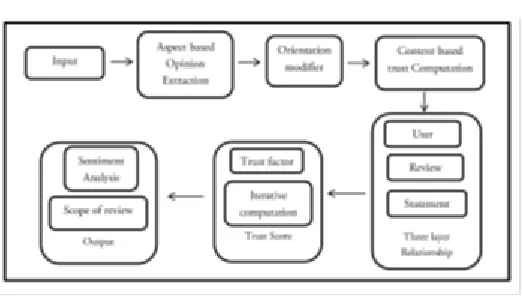
Figure 1: Proposed framework for identifying the
trustworthiness
In figure 1, the proposed framework is given above, clearly explains the proposed system. This proposed framework is to maximize the percentage of trustworthiness without affecting the sensitivity of the review reader. In this framework, the restaurant reviews are taken as the input from the Yelp.com. That input is pre-processed by aspect [8][15] based opinion extraction by LDA method is used to get entities. LDA is known as a Bayesian model, it is utilized to model the relationship of reviews, topics and words. This extraction separates the entities along with its category. Then the categorized output of LDA moves to the Orientation Modifier (OM). OM fines some implicit polarity (i.e., it converts categorized words into vectors that is capable to compute f factor) of the objects being talked about in the blog. This converted words moves to content based trust propagation that aggregates the aspect-specific opinion vector as a quality measure and use the individual aspect-specific opinion vector as a credibility measure. The output from the content based trust propagation undergoes to the three-layer architecture to model the relationships among three types of nodes (i.e., users, reviews, and statements) in this review system, in which the interdependencies between nodes and on the links are completely different from the ones. After finding the interdependency the trust score is computed by calculating f factor. After completing the trust score, the next phase is sentiment analysis. In sentiment analysis, the sentimental and brute words are removed with the help of HowNet dictionary. The scope of the review shows the total percentage of positive and negative feedback [20] of review element and trust percentage too. Finally, the trusted reviews with removing sensitive words and both positive and negative percentage of reviews will be personalized.
4
MODULE
DESCRIPTION
In order to find the trustworthiness of the user and their review the following steps are followed in the proposed framework.
Input
Aspect based Opinion Extraction
Orientation modifier
Content based trust Computation
Three Layer Relationship
Trust Score
Output
4.1 Input
Textual content of a review as input, and those contents are taken from the Yelp.com. To test content-aware trust propagation model data are taken from Yelp.com restaurant reviews. It contains 128,361 reviews about 1,144 restaurants from 45,180 users [2].
4.2 Aspect based Opinion Extraction
Unprocessed reviews are taken as input for extraction. This module extracts product features from textual reviews using LDA extraction. Latent Dirichlet Allocation (LDA) is a Bayesian model, which is utilized to model the relationship between reviews, topics and words. This framework mainly wants to get the product features including some named entities and some product/ item/ service/ attributes [16].
Data pre-processing for LDA
To construct the vocabulary, firstly regard each user’s review as a collection of words without considering the order. Then filter out “Stop Words” from the input. A stop word can be identified as a word that has the same likelihood words of occurring in those documents which is not relevant to a query as in those documents relevant to the query. Hence the LDA model processes the data by two classifications namely:
The generative process of LDA model
Extracting product features
Consider this is the posted review:
TABLE 1:EXAMPLE FOR ASPECT CATEGORY SPECIFICATION
Si.no Restaurant Name Food Items Review opinion
1 Paradise
Milkshakes, ice cream sundaes, French rings, fries, Burger
Good
2 Hot Kings
Fresh juice Good Desserts Bad
From the above example, the aspect categorisation extracts the words by LDA method. These extracted words are classified and ordered into aspect entity such as restaurant name, food items and review opinion. Finally from this classification, opinion of the particular dish in a specific restaurant is accurately predicted [17].
4.3 Orientation Modifier (OM)
The output from the Aspect categorisation is taken as an input in OM. OM consists of every adjective, adverb and verb have any implicit polarity (positive, negative or neutral) associated with them. This OM will do word to vector conversation. With this polarity they modify the orientation of the objects. Once getting the objects being talked about in the blog and also have the modifiers with respect to each of these objects, the next important task is to assign subjectivity scores to these modifiers. Then use SentiWordNet to determine the polarity of each modifier. Finally, the vectored words will get as an output.
4.4 Content-Based Trust Computation
This module computes the aggregated aspect-specific opinion vector as a quality measure and use the individual aspect-specific opinion vector as a credibility (or trust) measure by Apriori algorithm. Apriori is an algorithm for frequent item set mining and association rule learning [16] over relational databases. It proceeds by identifying the frequent individual items in the database and extending them to larger and larger item sets as long as those item sets appear sufficiently often in the database. To integrate trust measures across multiple users and multiple entities, trust propagation models are commonly used. In this work, the relationships and interdependencies between user, review, and the entity being reviewed, and adopt a three-layer trust propagation model to compute the trust-related scores of users, reviews, and aspect-specific [18] statements iteratively. Hence the below table 2 consists of the notations of terms and concepts used in this work.
TABLE 2:NOTATION OF THE TERMS
Notation Definition u a user
r a review s a statement e an entity
ai the ith aspect word aci The ith aspect category
li ith sentiment label
aou,e the aggregated opinion of user u to entity e o an opinion vector
os an opinion status vector
h(n)(ui) honesty score of user ui in round n f (n)(ri) faithfulness score of review ri in round n t (n)(si) truthfulness score of statement si in round n h(n)(ui) average deviation of user ui in round n
(ui,ri) the confidence of ui on ri about the target entity (ri,si) the relevance of ri to si
4.5 Three Layer Relationship
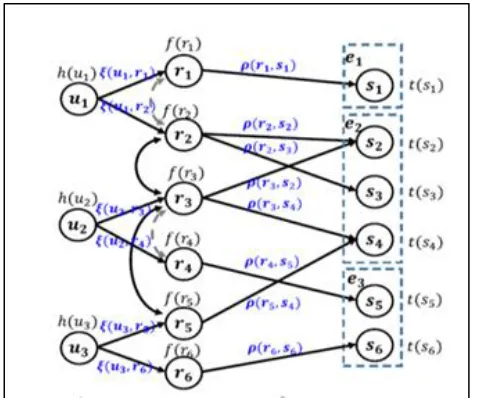
The figure 2 represents the inter connectivity of the user, review and statement. This shows the confidence level of the user who generates trusted reviews or not by finding the relationship between the particular user and their posted reviews and commends.
Figure 2: Three layer (user, review and statement) trust propagation
Here,
u1, u2 and u3 are users. r1, r2….r6 are reviews and s1, s2,….s6 are statements posted.
(ui,ri) is the confidence of ui on ri about the entity.
(ri,si) is the relevance of ri to si
f(ri) is faithfulness of the review.
t(si) is trust score of the statement.
643
idea of adopting the three-layer architecture is to use the intermediate layer to model the inter-review interactions and the influence on one review due to the other reviews about the same entity (or more precisely the same aspect of that entity). Here, the different users of different reviews are taken. This three layer protocol compares the reviews of the individual user and their statement accordingly. By comparing will get the overview about the trust of posted reviews.
4.6 Trust score
Trust factor: In this model, consider only the influences on the trust score of each node due to trust scores of other connected nodes. It shows the confidence and trust level of the review posted. Thus truthfulness score of a statement si is relevant to the average trustworthiness of all the reviews regarding the aspect expressed in the statement. The honesty scores of the users whose reviews are relevant to this statement [1]. Iterative computation: The scores of users, reviews, and statements are computed in an iterative computational module. In the beginning, the nodes of users, reviews, and statements are generated from reviews data. The textual content of reviews is processed for extracting the aspect category-based opinions. In each round, all nodes update their scores accordingly and do normalization after all scores are updated. After the model converges, the final result is output as the measurement of modeled trust of users, reviews, and statements.
4.7 Output
The output of this module is segmented into two steps. One is Sentiment analysis and other is the scope of the review. Sentiment analysis is something beyond the theoretical. i.e., removing sentimental words, removing item reputations, removing influencing statements are removed during this sentimental analysis. After analyzing the sentiment factors for both positive and negative factors will be calculated to get the trustworthy scope of the given reviews. Sentiment Analysis: This work extends HowNet Sentiment Dictionary [18] to calculate social user’s sentiment on items. In this step, the positive sentiment words list and positive evaluation words list merged into one list, and named it as POS-Words; also, the negative sentiment words list and negative evaluation words list merged into one list, and named it as NEG-Words [8][10]. Hence the listings of words are done by the following features:
User Sentiment Similarity:
Generally, user’s friends are trustworthy. If a user has similar interest preferences with his/her friends, then he/she may hold similar attitudes towards the item. Based on this view, firstly get all users’ sentiment, and then calculate the sentiment similarity between the user and his/her friends.
Interpersonal Sentiment Influence:
When searching the internet for purchasing, people are more concerned with those users who posted five-star reviews or critical reviews. Especially, the critical reviews can reflect the deficiency of a product. In this case, it is necessary to observe that reviewers’ sentiment will influence others, if a reviewer expressed clear like or dislike sentiment, other users will obtain the specific advantages or weaknesses about a product.
Item Reputation Similarity:
From typical item-based collaborative filtering algorithms, to know that similar items can help predicting ratings. Thus, it is important to find items that have similar features. In this work, assume that item’s reputation can indirectly reflect its real ratings. Leverage users’ sentiment distribution to infer item’s reputation. Based on users’ sentiment, which common that if two items have similar sentiment distribution, then they may have a similar reputation, and they will be posted with similar ratings. In this module, compares the each review with the HowNet dictionary to remove trained words such as sentimentality, brute and influenced words. Finally, the trusted reviews will be obtained.
Scope of review: After sentiment analysis that output will compute to exact finalized trust percentage of both positive and negative scores of review statements will be calculated. This scope is analysed by calculating the mean value of both positive and negative reviews from the total number of reviews. This will be the final output of finding trustworthiness. Hence, the final output might be averaged, trusted and sentimentally strong output.
5
METRICS
FOR
EVALUATION:
The trustworthiness of the proposed framework was measured in terms of honesty score, faithfulness, trustworthiness, average deviation of user [1], precision and recall [7].
Faithfulness: The faithfulness score for the review, which represents the confidence in the trustworthiness of the review. Initially, the faithfulness score of review ri is f(0) (ri ). It can be set to 1, denoting an equal confidence in the trustworthiness of all reviews, or estimated by other spamming detection algorithms based on content, structure, or behavior-based features.
n n i n
i i
f
( 1)( )
r
f
( )( ) (1
r
)
h
( )( ( ))
u r
Where, (1,0) is an interpolation coefficient that controls the bias of prior knowledge of f(0) on future estimates of the review faithfulness. h(n) is honesty score.
Trustworthiness: The truthfulness score of a statement can be calculated as
Where, r(si) is the collection of all the reviews about statement si (on a particular aspect of the target entity).
Honesty score: Finally, the honesty score of a user depends on the average trustworthiness of all the statements that supports. Therefore, which is calculate
n
j i j
n i
i
s S u t s
h u
S u
( ) ( 1) ( ) ( )
( )
( )
where S(ui) is the set of statements about which the user ui posts reviews.
Average deviation of user: Based on assumption that the benign users outnumber the spammers, the overall influence introduced by all deviations across multiple entities and aspects should reflect the changes of trust scores correctly.
( ) ( )
( 1) ( )[ ( ) ( ( ))]
( )
( )
n n
j i j j
n i
i
r R s f r h u r
t s
Therefore, the overall deviation for each user, and use the average deviation in the computing:
j j ui j j j
n i
i
s d t n s o r s s ao s u
S u
( 1) ( ( )( ),( ( ( ), ), ( )))
( )
( )
Where the function d models the deviation caused by the opinion difference expressed between a user’s review and a statement and the trustworthiness of the statement. Precision and Recall [7]: Precision is the fraction of retrieved non-spammed reviews extracted from the posted reviews on the basis of aspects. Recall is the fraction of the spammed reviews that are relevant to the aspects that are successfully retrieved.
R( s) T ( s) Recall
R( s)
R( s)
T ( s)
precision
T ( s)
Where R(s) is the number of annotated spam reviews and T(s) is number of spam reviews detected by the existing system.
Since f measure = precision recall
precision recall
2
Figure 3: User distribution faithfulness.
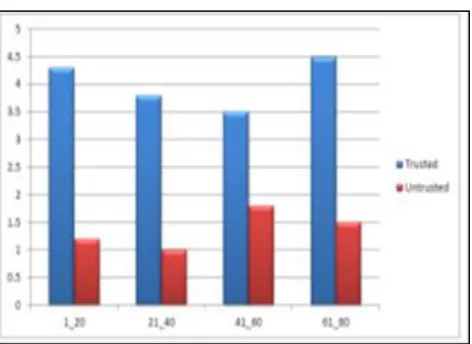
Figure 4: User distribution in trustworthiness.
Figure 5: Honesty score of the user
Figure 6: f-measure of the review and user
Figure 3 shows faithfulness of the user distributed reviews, hence the reviews are collected from yelp dataset. In figure 4 it is absorbed that trustworthiness of reviews. Figure 5 shows the honesty score of posted reviews. Finally figure 6 shows the result of f measure.
6
CONCLUSION
645
7
FUTURE
SCOPE
This work can be further extended in the following ways:
To extract a new knowledge discovery process and tools for analyzing and detecting review spam. To improve the sentiment word identification and apply sentiment analysis on short sentence like abbreviations and short words.
8
REFERENCES
[1] Xue, H., Wang, Q., Luo, B., Seo, H., & Li, F. (2019). Content-Aware Trust Propagation Toward Online Review Spam Detection. Journal of Data and Information Quality (JDIQ), 11(3), 11.
[2] John Krumm, Nigel Davies, and Chandra Narayanaswami. (2008) User-generated content. IEEE Pervasive Computing, 7(4), 10-11 [3] Liu, B., Mukherjee, A., & Shao, J. (2014). Spotting
fake reviews using positive-unlabeled learning. Computacion y Sistemas, 18(3), 467-475. [4] Luca, M. (2016). Reviews, reputation, and revenue: The case of Yelp. com. Com (March 15, 2016). Harvard Business School NOM Unit Working Paper, (12-016).
[5] Patra, S., & Bruzzone, L. (2014). A novel SOM-SVM-based active learning technique for remote sensing image classification. IEEE Transactions on Geoscience and Remote Sensing, 52(11), 6899-6910.
[6] Kurian, D. D. M. K., Vishnupriya, S., Ramesh, R., Divya, G., Divya, D., Kurian, M. K., ... & Divya, D. (2015). Big data sentiment analysis using hadoop. International Journal for Innovative Research in Science and Technology, 1(11), 92-96. [7] Ghose, A., Ipeirotis, P. G., & Li, B. (2012). Designing ranking systems for hotels on travel search engines by mining user-generated and crowd sourced content. Marketing Science, 31(3), 493-520.
[8] Rout, J. K., Dalmia, A., Choo, K. K. R., Bakshi, S., & Jena, S. K. (2017). Revisiting semi-supervised learning for online deceptive review detection. IEEE Access, 5, 1319-1327.
[9] Bagheri, A., Saraee, M., & De Jong, F. (2014). ADM-LDA: An aspect detection model based on topic modelling using the structure of review sentences. Journal of Information Science, 40(5), 621-636.
[10]Bo Pang and Lillian Lee. (2008) Opinion mining and sentiment analysis. Foundations and trends in information retrieval, 2(1-2).1-135.
[11]Kaleda, K., & Fenstermacher, L. (2018, April). Analyst as data scientist: surfing vs drowning in the information environment. In Next-Generation Analyst VI (Vol. 10653, p. 106530B). International Society for Optics and Photonics.
[12]Ayday, E., & Fekri, F. (2011). Iterative trust and reputation management using belief propagation. IEEE Transactions on Dependable and Secure Computing, 9(3), 375-386.
[13]Li, N., & Wu, D. D. (2010). Using text mining and sentiment analysis for online forums hotspot detection and forecast. Decision support systems, 48(2), 354-368.
[14]Liu, Q., Wei, S., Hu, Y., Guo, W., & Wang, R. H. (2007). The linguistic knowledge based improvement in automatic putonghua pronunciation quality assessment algorithm. Journal of Chinese Information Processing, 21(4), 92-96.
[15]Di Fabbrizio, G., Aker, A., & Gaizauskas, R. (2013). Summarizing online reviews using aspect rating distributions and language modeling. IEEE Intelligent Systems, 28(3), 28-37.
[16]Crawford, M., Khoshgoftaar, T. M., Prusa, J. D., Richter, A. N., & Al Najada, H. (2015). Survey of review spam detection using machine learning techniques. Journal of Big Data, 2(1), 23.
[17]Gayatree Ganu, Noemie Elhadad, and Amélie Marian. (2009). Beyond the stars: Improving rating predictions using review text content. WebDB, 9: 1-6.
[18]Manek, A. S., Shenoy, P. D., Mohan, M. C., & Venugopal, K. R. (2017). Aspect term extraction for sentiment analysis in large movie reviews using Gini Index feature selection method and SVM classifier. World wide web, 20(2), 135-154.
[19]Zhu, Y. L., Min, J., Zhou, Y. Q., Huang, X. J., & Wu, L. D. (2006). Semantic orientation computing based on HowNet. Journal of Chinese information processing, 20(1), 14-20.