A Simple And Rapid Spectrophotometric Method
For Determination Of Organonitrogen
Functionalities (Amino Group) And Commercial
Drugs Based On It.
Singh Jasvir
Abstract: Amines serve as starting materials for the preparation of dithiocarbamates and are used largely used in pharmaceutical industry. The reaction of dithiocarbamates with anhydrous manganese (II) acetate in dimethyldulphoxide (DMSO) to form soluble coloured manganese (II) - dithiocarbamate complexes has been made the basis of spectrophotometric (direct colorimetric as well as photometric titrimetric) methods for their determination. The direct colorimetric method consists in adding to DMSO solution of amino compound, an excess of carbon disulphide followed by addition of anhydrous manganese (II) acetate and measuring the resulting colour of metal complex spectrophotometrically at 360 nm (λmax of metal-dithiocarbamets complexes). Alternatively, carbon disulphide was added to the sample solution in DMSO and resulting solution titrated photometrically with standard anhydrous manganese (II) acetate at the respective wavelength. The above spectrophotometric methods have been successfully applied for analysis of amino drugs. The recoveries of procaine penicillin and dopamine hydrochloride from their commercial drug formulations have been found in the ranges 99.0-99.4 and 99.3-100.3% with RSD's in the 0.3-0.4 and 0.2-0.5% respectively
Keywords: Manganese (II) acetate; Dimethylsulphoxide (DMSO); Procaine penicillin G and Dopamine hydrochloride.
————————————————————
1.
INTRODUCTION
Among organic compounds containing nitrogen functions, amine derivatives are widely used in many drug formulations. The amino functionalities have been determined by numerous methods involving a variety of procedures and techniques like; chromatography [1], [2], [3] Gas chromatography-Mass spectroscopy[4],[5], Voltametry [6], [7] , spectrophptometry [8], [9], [10] has been employed. Procaine penicillin G, and dopamine hydrochloride are commercial drugs containing amino function used in antibacterial and antiarrhytic drug formulations. Largely, the methods for determining amino function depend on one of the following fundamental procedures, i.e., acylation, diazotisation, Schiffs base formation. Almost any amine can be titrated either in water or in certain organic solvents like acetic acid, nitromethane, methylene chloride or chlorobenzene. The aliphatic amines are usually basic enough to be titrated directly in aqueous solutions using standard acids. The aromatic amines or other weakly basic amines i.e. symmetrical aliphatic diamines cannot be titrated in water but can be successfully titrated in non-aqueous solventsAromatic amines have reactions specific to them which can be used for their analysis. For example, primary aromatic amines can be diazotised with nitrous acid, which can be measured. In addition, primary, secondary and tertiary aromatic amines can be brominated much like phenols. The bromination proceeds in the unoccupied o-and-p-positions. Some aromatic amines couple with diazonium compounds and this also serves as the basis of an analytical method [11] The reactions of primary amines with a carbonyl group to form Schiff's base (azomethane group) and the measurement of the Schiff's base or water produced form
the basis of a method for the determination of primary amines. The Schiff's base produced by condensation of an amine with an aldehyde in strong acid solution, which could be oxidised to give coloured product has been utilised by various workers [12],[13],[14],[15] for the colorimetric determination of amines. Organic compounds containing amino function also find use in chemotherapy, as they possess antihistamine, antiarrhythmic and antibacterial properties. Procaine-2- diethylamino-p-amino benzoate is a compound of pharmaceutical importance. It has been used as an antiarrhythmic agent for the last 30 years. But as it undergoes rapid enzymatic hydrolysis, it duration is short and due to its toxicity to central nervous system, the use of this drug as such is limited. Though procaine as a local anaesthetic agent is superior to cocaine, these days, procaine is used widely in combination with penicillin G, (an important broad spectrum antibiotic) and is marketed as procaine penicillin G in the form of injections to aid in prolonging
Figure 1: Structure of procaine penicillin G
duration of the drug dose in the the treatment of respiratory disturbances and several viral ailments. The official method, for the assay of this drug involves two steps; first the determination of total penicillins followed by determination of procaine content [16]
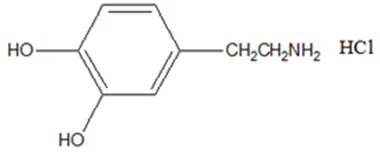
aqueous and non aqueous solvents. . Dopamine HCl is responsive to alkalies, iron salts, and oxidizing agents. It plays significant roles in the brain and body and function both as hormone and neurotransmitter. For the treatment of
Figure 2: Structure of Dopamine hydrochloride
hypertensive, it is given intravenously in the form of injection. The analysisof this drug is done by titrating the drug in glacial acetic acid in the presence of mercuric acetate against 0.1N perchloric acid using crystal violet solution as indicator [17]
METHODS AND MATERIALS
Dopamine hydrochloride: {2-(3,4-Dihydroxyphenyl) ethylamine hydrochloride} (Fluka) has been procured from local market and used as received, Procaine penicillin G Procaine hydrochloride (Fluka) has been used as received. Its purity has been checked by I.P. method [18]. Procaine penicillin injections were procured from local market. Anhydrous manganese (II) acetate has been prepared by keeping the hydrated sample of manganese (II) acetate. 4H2O overnight under acetic anhydride. The white anhydrous compound was filtered and washed with ether, dried and kept in tightly closed bottle. The solution was prepared by dissolving a little more than calculated amount of the sample in DMSO and standardised against EDTA [19]. Carbon disulphide (Baker analysed, 100% estimated chromatographically) was used as received. Absorption spectral measurements have been carried out with a UV- visible spectrophotometer (Shimadzu Model) using UV Probe software version 2 with spectral bandwidth of 1 nm and wavelength accuracy of 0.3 nm (with automatic wavelength correction with a pair of 5 cm matched quartz cells)
EXPERIMENTAL PROCEDURE
Determination of procaine penicillin, dopamine hydrochloride and drugs based on them, through formation of corresponding dithiocarbamates:
Spectrophotometric methods using anhydrous manganese (II) acetate in DMSO:
Aliquots (0.2-2.0 ml) of solutions in DMSO of procaine penicillin compound (except dopamine hydrochloride whose aliquots of its acetonitrile solution were taken) have been mixed with 1 drop (~50 μl) of carbon disulphide and anhydrous manganese (II) acetate (1 ml, 0.01 M in DMSO) and the volume made to 5 ml with DMSO. The absorbance of each of the resulting solution has been measured at 360 nm for procaine penicillin and dopamine hydrochloride (spectrum of coloured product shown in Fig. 1) against a reagent blank. The calibration curve has been constructed for each drug compound. The proportionality between absorbance and concentration has been 120 μg
ml-1 for procaine penicillin and dopamine hydrochloride. The results of analysis have been summarised in Table. 1. Known volumes of solutions in DMSO of each drug compound (except dopamine hydrochloride in acetonitrile) have been mixed with 1 drop (~50 μl) of carbon disulphide and volume made to 5 ml with DMSO. Each solution was titrated photometrically at room temperature (~24o) with standard anhydrous manganese (II) acetate at 360 nm. Dilution corrections have been applied and titration curves have been plotted in the usual manner. A typical plot of absorbance versus ml of the titrant added has been shown in Fig. 1. The results of analysis have been given in Table.2.
Drug Analysis
One formulation of procaine penicillin viz. procaine penicillin (G) injection containing 300 mg per vial of active ingredient and one formulation of dopamine hydrochloride injection containing 40 mg ml-1 active ingredient have been used. A single large sample of each formulation has been weighed and shaken with dimethylformamide (in case of dopamine Hydrochloride the solution was prepared in acetonitrile) and filtered. The residue has been washed 2-3 times with 4-5 ml instalments of respective solvent. The washings and filtrate have been diluted to known volume with same solvent. Aliquots have then taken and processed for analysis in the same manner as described above for pure compounds. The results of analysis have been obtained and summarized in Tables. 3. Aliquots of extracts in DMSO (acetonitrile extract in case of dopamine hydrochloride injection) of drug formulations have been taken and processed for analysis in the same manner as described above for pure compounds. The results of analysis have of the analysis recorded in Table.4.
RESULTS AND DISCUSSION
The most widely used method for determining amines is based on titration with an acid. This approach is universal for primary, secondary, tertiary as well as other amino derivatives and can be carried out with very simple apparatus. Although this approach is preferred because of speed and simplicity, it is not specific. The author in his efforts to evolve simple, rapid, reliable and economic methods for the analysis of amino compounds/drugs, investigated for the first time the reaction of amines with carbon disulphide with respect to its application for the analysis of drug compounds. In the course of investigations, it has been found that amine - carbon disulphide reaction besides serving as a means of preparing dithiocarbamates, shows promise of considerable analytical utility. The transformation of amines with an excess of carbon disulphide in the presence of alkali to the corresponding alkali dithiocarbamates has been smooth, rapid and quantitative at room temperature; alkali derives
O
H
SK
CS
RHN
KOH
CS
RNH
2
2
.
.
2
CS
RNH
CS
S
NH
R
RNH
2 2.
.
32
These observations prompted the author to make use of formation of dithiocarbamates in the determination of amines and drugs based on them. The spectrophotometric methods based on the coloured reaction of didithiocarbamates (formed from amines through reaction with carbon disulphide) with anhydrous manganese (II) acetate in DMSO, are simple rapid and sensitive. The colour development is instantaneous and colour has been stable for at least 2 hours in each case (spectrum of the respective manganese (II) complexes illustrated in Fig. 3). Using direct colorimetry, procaine penicillin and dopamine hydrochloride in the range 5-80 μg have been determined with maximum RSD's of 0.8 and 0.9% respectively (Table. I). The method has successfully been applied to the analysis of some commercial drugs containing these compounds. The recoveries in case of procaine penicillin (G) and dopamine hydrochloride were in the ranges 99.0-100.8 and 99.2-99.0-100.8% with RSD's of 0.3-0.4 and 0.3-0.5% respectively, Table.3. The smooth and quantitative nature of the transformation of dithiocarbamates to the respective coloured manganese (II) complexes and stability of the reagent prompted thge author to work out photometric titrimetric procedures for determination of amino drug compounds. In these titrations the absorbance increases linearly till the quantitative formation of coloured products and thereafter it attains almost constant values. An inverted L-shaped titration curve has been obtained in each case (Fig. 4). The maximum RSD's calculated from the pooled data of all the titrations performed with 10-80 μg of each listed hydrazine and amine drug compound have been found to be 0.6 and 0.5% respectively. The recoveries of procaine penicillin and dopamine hydrochloride from their commercial drug formulations have been found in the ranges 99.0-99.4 and 99.3-100.3% with RSD's in the 0.3-0.4 and 0.2-0.5% respectively, Table 4. It is worthwhile to mention here that whereas direct colorimetric method is more sensitive, the photometric titrimetric method is rapid, since no calibration curve is required to be prepared. Moreover, the photometric titrimetric method is more accurate and precise than direct colorimetric method.
CONCLUSION
9.5
Figure 4: An inverted L-shaped titration curve
Table 1: Direct colorimetric determination of procaine penicillin and dopamine hydrochloride with anhydrous manganese(II) acetate in DMSO
Amount taken, μg
Values are mean of five determinations with standard deviation(+)
Amount found*, μg
Procaine penicillin Dopamine hydrochloride 5.0
4.95+0.040 4.98+0.044
10.0
9.94+0.042 9.98+0.050
20.0
20.12+0.050 19.96+0.054
60.0 59.84+0.048 60.06+0.048
80.0
Table. 2: Photometric titrimetric determination of procaine penicillin and dopamine hydrochloride with anhydrous manganese (II) acetate in DMSO
Amount taken, μg
Values are mean of five determinations with standard deviation(+)
Amount found*, μg
Procaine penicillin Dopamine hydrochloride
10.0
9.94+0.048 10.02+0.042
20.0 20.02+0.066 19.94+0.056
30.0 29.84+0.088 29.88+0.028
60.0 59.76+0.052 59.78+0.050
80.0
79.68+0.048 79.72+0.038
Table.3. Recovery of procaine penicillin and Dopamine hydrochloride from their commercial drug formulation: Direct colorimetric determinations.
Drug formulation
Maker's specification*
Values are mean of five determinations with standard deviation(+)
Amount taken,
μg Amount found, mg
Recovery, %
Procaine penicillin
injection 300 mg per vial (1.3 ml)
2.5 5.0 10.0 20.0 40.0
2.48 4.98 9.90 20.02 39.72
99.2+0.3 99.6+0.4 99.0+0.3 100.1+0.3 99.3+0.4
Dopamine
hydrochloride injection 40 mg per ml
2.5 5.0 10.0 20.0 40.0
2.52 4.96 9.96 19.88 39.76
Table 4: Recovery of procaine penicillin and dopamine hydrochloride from their commercial drug formulation: Photometric titrimetric determination.
Values are mean of five determinations with standard deviation(+)
Drug formulation
Maker's specification*
Amount taken,
μg Amount found, μg Recovery, %
Procaine penicillin injection
300 mg per vial (1.3 ml) 6 12 24 48
5 .94 11.90 23.84 47.72
99.0+0.3 99.2+0.3 99.3+0.3 99.4+0.4
Dopamine hydrochloride injection
40 mg per ml 6
12 24 48
6.02 11.94 23.82 47.70
100.3+0.5 99.5+0.3 99.3+0.2 99.4+0.3
REFERENCES:
[1] W. Jeffrey Hurst, Journal of Liquid Chromatography., 13(1), pp. 1-23, 1990.
[2] Peace R.W. and Gilani G.S. J AOAC Int., 88(3), pp. 877-87, May-June 2005.
[3] P. Nikitas, A.Pappa-Louisi, J.Liq. chromatogr. Relat. Technol., 32,1527, 2009.
[4] Florian Kugler,, Stephan Graneis,, Pat P.-Y. Schreiter,‡ Florian C. Stintzing, and, and Reinhold Carle, Journal of Agricultural and Food Chemistry, 54 (12), pp. 4311-4318, May 2006.
[5] R. Kronstrand, M. Forsman, M. Roman M, Forensic Sci Int., 283, pp.9-15, Feb. 2018.
[6] A. Navalón, R. El-Khattabi, A. González-Casado, et al., Mikrochim Acta, 130, pp. 261-265, Dec.1999. [7] L.G haidarova, A.V. Gedmina, E.R. Zhaldak, et al. J
Anal Chem., 69: pp. 741, Aug. 2014.
[8] E.M. Mabrouk , R.N. Felaly and E.H. El-Mossalamy, Int. J. Electrochem. Sci., 11,pp. 4892 – 4908, May. 2016.
[9] A. Malik. Hussien, E. Mohamed. W. Adam, Shaza. A.E. Shantier, A.E. Elrasheid, A. Garalnabi and Elrasheed . Gadkariem, Journal of Applied Pharmaceutical Science. 7 (04), pp. 163-167, Apr. 2017.
[10] W. Shaza Shantier, M. E. Adam, S. Rashida Mohamed, E. A. Gadkariem, JIPBS, 4 (3), pp. 67-70, 2017.
[11] F.J. Bandelin andC.R. Kemp, Ind. Eng. Chem. Anal. Ed., 18, pp. Pp. 470, Aug. 1946.
[12] W. Hawkins, D. M. Smith and J. Jr. Mitchell, J. Am. Chem., 66, pp. 1662, 1944.
[13] J.B Johnson. , Anal. Chem., 28, pp. 1977, Dec.1956.
[14] F. Critchfield, J.B. and Johnson., Anal. Chem., 29, pp. 1174, Aug.1957.
[15] J. L. Burguera and M. Burguera J. Anal. At. Spectrom., , 12, (1997), pp. 643-651, 1997.
[16] Pharmacopoeia of India, Published by the Controller of Publications, New Delhi; Vol. I; p. 415, (1985).
[17] International Pharmacopocia, 3rd Edn, Vol. III, p p. 103 (1988).
[18] Pharmacopoeia of India, Published by Controller of Publication, New Delhi, IIIrd Ed, Vol. 1, pp. 415-6 (1985).