168
Role Of Non-Governmental Organizations
Leadership In The Implementation Of Community
Development Projects In Arumeru District,
Tanzania
Rajabu Ally Mtunge, Samuel Obino Mokaya
Abstract: The purpose of this study was to examine the role of leadership in the implementation of community development projects by local non-governmental organizations in Arumeru District, Tanzania. The study applied survey design, which covered the sample of 46 respondents including District Executive Director, District Social Workers, Non-Governmental Organization leaders, workers and volunteers and community members in Arumeru district, Tanzania. The study employed simple random sampling technique in order to ensure equal chance of an individual being involved in this study as inferential statistics considered. Data collected from a sample of 46 NGOs‘ employees using a semi-structured questionnaire with both closed and open-ended questions. The collected data analyzed using both descriptive and inferential statistics. The descriptive statistical tools used included frequencies, mean and standard deviation while inferential statistical tool used was correlation. Statistical Package for the Social Sciences (SPSS) version 19 used for analyzing the data collected. The study achieved a response of 46 out of a sample of 47, representing a response rate of 97.87%. The results show that a significant number of NGOs (34.8%) had not completed their projects, 21.7% stated that less than five projects were complete and 43.5% of the respondents confirmed that more than five projects not completed over the last one year. Regarding the influence of leadership on implementation of project; spearman‘s rank correlation revealed a very strong positive correlation (0.910) between of leadership vision and implementation of community development projects, a strong, positive correlation between communication and implementation of community development projects (rho = 0.730, n = 46, p < .001), strong positive correlation between commitment and implementation of community developmental projects, which was statistically significant, rs = .601, p = .000 and a positive correlation between accountability and implementation of community
development projects which was statistically significant, rs = .355, p = .015. The study concludes that the implementation of community development
projects in Arumeru District by NGOs was below average and greatly influenced by leadership vision, communication, accountability and commitment. There is an urgent need to take NGOs performance assessment seriously in order to justify activities with substantiated evidence rather than with anecdote or rhetoric. Further investigations need to be conducted to establish the challenges facing NGOs in the implementation of the projects.
Key terms: Leadership, Non Governmental Organization, Community development projects, Communication, Vision, accountability and Commitment.
————————————————————
1.0 Introduction:
Leadership is the claimed to be the cornerstone of the whole development process from family to great levels of country and world pitch. The fact is that local non government organizations depend much on the leadership since leadership is concerned with accomplishing of the task through people. Arumeru district is the part of Arusha region which also have more than 79 non-governmental organizations which operating in different fields of development including developmental and service provision areas. Yet, these organizations confronted many difficulties such as financial and leadership. The area of interest for this paper was in the leadership, so the study surveyed the challenges faced by leaders of NGOs operating in Arumeru district with the focus of only Five NGOs. The result obtained generalized to all NGO as far as case study is concerned.
1.1 Background:
Leadership is not a new phenomenon in the world. Scholars indicate that the development of Leadership dates back to the early centuries. Leadership, and the study of it, has roots in the beginning of civilization. Africans experienced powerful leadership from kings, priests and rulers. African people are religious by nature. Prior to Christianity, African religious ceremonies in the community or village led by leaders who held offices in a powerful way. Their leadership was effective and it touched the hearts of people. Their wisdom in leading and helping the villagers/ community opened up new relationships between leaders and the people. Theorists began to consider behavioral concepts in
169 implementation of community development projects in the
country.
1.2 Research problem:
The literature available acknowledged that leadership was important in the development of community projects when applied by NGO leaders. Despite of being a crucial prerequisite and solution to the implementation of community development, leadership was haunted by complex challenges that threaten and undermined their effectiveness in fostering of implementation of community development projects. However, there has been limited research and for those that are available none exhaustively and exclusively dealt with the effectiveness in achieving the vision of Non-governmental Organization in Tanzania. Indeed, they were silent on information about the role of leadership in the implementation of community development projects by local non-governmental organizations in Arumeru District. Research objectives: General objective The general objective of the study was to explore the role of leadership in the successful implementation of community development projects by Local Non-Governmental Organizations in Arumeru District in Arusha, Tanzania.
1.3 Research Objectives:
The study sought to achieve the following objectives: i. To identify the role of leadership vision in
implementation of community development projects in Arumeru District.
ii. To examine the influence of leadership communication in implementing community development projects in Arumeru District.
iii. To determine the extent leadership commitment enhances implementation of community developmental projects in Arumeru District.
iv. To evaluate how leadership accountability facilitates implementation of community development projects in Arumeru District.
1.4 Research questions:
The study guided by the following research questions; i. What is the role of leadership vision in
implementation of community development projects in Arumeru District?
ii. How leaders‘ communications influence the implementation of community development projects in Arumeru District?
iii. To what extent leadership commitment enhances implementation of community developmental projects in Arumeru District?
iv. How does leadership accountability influence implementation of community development projects in Arumeru district?
1.4 Scope of the study:
This study was limited to the influence of NGOs leadership in the implementation of community development projects in Tanzania, with special attention to 5 out of 79 local NGOs operating in Arumeru district, Arusha. The study established the aspects of leadership, examined their impacts to the local NGO leaders‘ implementation of community development projects. Specifically, the study focused on the
leaders of local NGOs, District Executive Director, District Social Workers, NGO workers and volunteers and the community benefited by projects implemented. Both qualitative and quantitative methods of data generation and analysis employed for obtaining the relevant information.
2.0 Conceptual framework:
Smyth (2004) described that, conceptual frameworks are structured from a set of broad ideas and theories that help a researcher to properly identify the problem they are looking at, frame their questions, find suitable literature, and designed to identify the variables and their interactions. In this research independent variable of the study is aspects of leadership that include vision, communication, accountability and commitment. Contemporary and traditional theorist have presented three basic theories of leadership which are theory X and Y of McGregor, the transformational leadership, servant leadership and the trait theory of leadership which carries elements such as vision, communication, commitment, empowerment and accountability. These conceptual framework only four elements used in guiding the researcher to collecting relevant data from the field, the spotted elements were directly reflecting the implementation of community projects. This conceptual framework shows independent variables and dependent variable.
2.1 Vision
Dale and Derek (2011), stressed that, There has been considerable attention given to contributing factors to project success and failure. Included in these have been the examination of project manager competence but little has been written about the concepts and constructs of the role of project leaders in developing and communicating a project vision and the impact of this on project success. One of the most significant contributions that any leader can make to an organisation or project is that of creating and clearly communicating a shared vision. Therefore we argue in this paper that, ‗project vision‘ is a significant contributing factor to project success, and, the communication and maintenance of a ‗project vision‘ will impact project outcomes. According to D‘Souza, 2001, a vision is a portrait of the future to which people can commit. It is articulation of values. It empowers and inspires people to do a job and to contribute ideas or actions beyond themselves. Leaders are people to whom others are drawn because they have a vision, a dream, an agenda, and a frame of reference. The researcher guided to find out to what extent the leadership vision contributed the attainment of the community development projects during data
Independent variables Dependent variable Vision
Accountability
Commitment Communication
Implementation of Community
170 collection process in the field. That was regarded as the
benchmark to the conducted study.
2.2Communication
D‘souza (1994) described that; effective communication is the core of all leadership activity. Leaders know they can best achieve their goals if they have the cooperation of the people they work with. Their ability to communicate effectively enables them to influence the attitudes and actions of their colleagues and subordinates. According to Barrett, (2006), Leaders lead through effective communication. Good communication skills enable, foster and create the understanding and trust necessary to encourage others to follow a leader. Without effective communication, a manager accomplishes little. Without effective communication, a manager is not an effective leader. In fact, being able to communicate effectively is what allows a manger to move to a leadership position
Managerial communication; Managerial communication capabilities build on the core abilities. It is the capabilities more directly involved in managing others. It is the skills needed to interact with individuals and to manage groups.
Corporate communication; Corporate communication involves expansion from the managerial skills to those abilities needed to lead an organization and address a broader community. Communication becomes even more complex when managers move into a position where they need to think about the best way to communicate to all internal and external stakeholders. Communication therefore is a strong force that influences project success. The study admitted that, project leader needs to develop a leadership style that fosters effective and efficient communication with stakeholders.
2.3 Commitment
Jeffrey (2010) explains that as foundations for leadership, passionate commitments are to futures that are bigger than any individual can accomplish alone. Leading creates opportunities for others to contribute and the bigger the future to which one is committed, the bigger the opportunity for others to participate in its accomplishment. This means that any commitment can be the basis for leadership, as long as it calls for the contribution of others and are sufficiently passionate about its accomplishment. An increase of affective commitment to change (behavioral intention) contributes to the prediction of change-relevant behavior. Building on this notion, the study suggests that followers with high levels of affective commitment to change are more likely to exhibit innovation implementation behavior. Subsequently, the findings suggest that charismatic leadership contributes to affective commitment to change, which, in turn, contributes to innovation implementation behavior.
2.4 Accountability
Stefano and Clay(2011), quoted the definition of accountability as; For this evaluation, accountability refers to the process of holding to account, overseeing and keeping in check those persons who are entrusted with public responsibilities in the fulfillment of their tasks or functions (see Schedler et al 1999). At its core,
accountability is about trust. Nonprofit leaders tend to pay attention to accountability once a problem of trust arises – a scandal in the sector or in their own organization, questions from citizens or donors who want to know if their money is being well spent, or pressure from regulators to demonstrate that they are serving a public purpose and thus merit tax-exempt status. Amid this clamor for accountability, it is tempting to accept the popular normative view that more accountability is better. The challenge for leadership and management is to prioritize among competing accountability demands. This involves deciding both to whom and for what they owe accountability
3.0 Research methodology:
This chapter describes the research design and methodology that has been used to gather and analyze data. According Kothari (2004), research methodology refers to a systematic way applied to solve the research problem. Hence, this part of the research presents research design, area of the study and population of the study, sample and sampling techniques, data collection methods and lastly data analysis.
3.1 Research Design
According to Kothari (2004), research design is the framework that specifies the types of information to be collected, source of data and data collection procedures. Also Aaker et al. (2002) define a research design as the detailed blue print used to guide a research study toward its objectives. This study employed a case study research design, which focused on a single area and allowed variety of data collection method to be deployed. This type of study design allowed the researcher to intensively explore and analyze information over the life of a single unit (Tripath, 2002). On the other hand, Stake cites in Bryman (2008) that a case study research is concerned with the complexity and particular nature of the case in question. Case study entails the detailed and intensive analysis of a single case. However, one major critic of using case study research design was that; the findings generated from it was generalized, however its generalization could be hasty and thus it was difficult to get magnitude of the problem. Due to vastness of the District and number of NGOs with community development projects the researcher preferred the use of case study so that the small manageable group of representative explored and the results were considered in its vastness and still the information was valid.
3.2 Target Population
Crowl (1993) defines population as, a group, which the researcher is interested in gathering the information from, as well as drawing conclusion on. Therefore, the target population of this study is 790 people from 79 NGOs operating in Arumeru District where the projects implemented. They involved the following groups;
171 Community development department leader; this
category is where all NGOs are registered through and it is a unit where reports on the progress of all NGOs implementing community projects are destined. Their inclusion to this study determined by the fact that they expected to have relevant information about the role of leadership in the implementation of community development projects in the area of study.
Directors of NGOs; this category is the in charge of the particular NGO who practiced leadership skills in their day-to-day responsibilities. They are the one who possess crucial information for this study. Information brought by this group was worth to the study where it will prove the link between the application of aspects of leadership and the implementation of community development projects in Arumeru district.
Heads of departments; this category is the one which communicate directly to the other important subordinates of an NGO, so their information will help this study to draw the relevant conclusion. They play an important role in the implementation of community development projects in Arumeru district.
Community members; this category is the direct beneficiary of all projects conducted by this study hence it is the core of relevant information this study was seeking to obtain. Involving this group ensured obtain of accurate and valid data because they are the important source which receive those projects, they can prove the failure or success of the planned community development projects directed to their areas.
3.3Sample Size
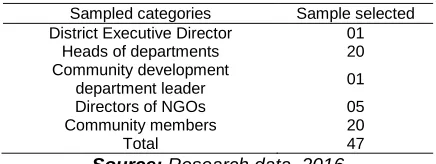
The sample size comprised of 47 respondents, obtained as, 5 directors/head of NGOs, 10 heads of departments within 5 selected NGOs, 10 employees/volunteers and 20 community members who benefited from projects implemented 1 District Executive Director and 1 Community development department leader who are directly involved in the implementation of the projects.
Table 3.1: Sample size
Source:Research data, 2016
3.4 Sampling Techniques
The sampling techniques employed in this study were purposive sampling at different points in time and simple random technique on the other hand. Therefore, Simple random sampling technique used to ensure that key informants to be involved in implementation of projects are persons who will provide accurate information and every one will have equal chance to be involved in responding of questionnaire.
3.5 Data Collection Instruments
According to Elhouse as cited in Rwegoshora (2006), primary data are those that are collected for the time and are thus original in character. The Researcher used only primary data source in collection of data. Data collected through questionnaire by using English language in simplified communication. The questionnaire was comprised of six main sections namely; respondent‘s characteristics, leadership vision, leadership communication, leadership commitment, leadership accountability and implementation of community development projects. The questionnaire was semi structured as it had both open ended and closed ended items. The closed ended were in measured in Likert scale of 1 to 5 where 1 meant strongly disagree and 5 implied strongly disagree.
3.6 Data Collection Procedures
The questionnaires were self-administered at the respondents‘ workstations. The researcher delivered the questionnaires to each respondent with an allowance of one week for filling upon which they were collected. Each questionnaire was accompanied with covering letter explaining the purpose of the study, assuring on confidentiality and use of the study results.
3.7 Data Analysis and Presentation
Data analysis involved processing, analyzing, acting, encoding categorizing the collected data to fulfill the objective of the researcher. In analyzing the data collected, the study used both quantitative and qualitative techniques whereby through Statistical Package for Social Studies (SPSS), factual and logical interpretation, comparison and explanation of the study findings explained by using tables which means the data grouped in charts according to their classes in terms of percentages and groups to brought meaningful information.
4.0 Research findings:
These are the results from the respondents that collected by the researcher which the to be judged as the entire results.
4.1 Introduction:
Chapter three was concerned with the methodological procedures that guided the generation of data relevant to the problem and knowledge gap articulated in chapter one and two respectively. This chapter deals with data presentation and discussion of the research findings regarding the contribution of leadership of local NGO in the implementation of community development projects in Tanzania. The chapter draws on the research tasks and questions presented in Chapter one. To recap, the research tasks included;
i. To identify the role of leadership vision in implementation of community development projects in Arumeru District.
ii. To examine the influence of leadership communication in implementing community development projects in Arumeru District.
iii. To determine the extent leadership commitment enhances implementation of community developmental projects in Arumeru District.
Sampled categories Sample selected District Executive Director 01
Heads of departments 20
Community development
department leader 01
Directors of NGOs 05
Community members 20
172 iv. To evaluate how leadership accountability
facilitates implementation of community development projects in Arumeru District.
4.2 Response Rate
The research instruments were distributed to a sample of 47 people who comprised of 5 directors/head of NGOs, 10 heads of departments within 5 selected NGOs, 10 employees/volunteers and 20 community members. The study achieved a response of 46 out of a sample of 47, representing a response rate of 97.87% as shown in Table 4.1. This shows that the findings are of good quality and legitimate as suggested by Dillman et. al., (2009).
Table 4.1: Response rate
Category Frequency Percent
Directors 1 2.2
Dept. heads 11 23.9
Community members 14 30.4
Volunteers 10 21.7
Employees 10 21.7
Total 46 100.0
Source: Research data, 2016
4.2.1 Respondents Characteristics
The demographic characteristics evaluated in this study were included age, gender, nationality, education level, professional qualification and name of the organization.
4.2.2 Age of the Respondents
The results further indicate that majority of the respondents (60.9%) were aged between 18 and 35 years while 39.1% were aged above 35 years as presented in Figure 4.1. This shows that most of the research participants were youths.
Figure 4.1: Age of the respondents
Source: Research data, 2016
4.2.3 Gender
An assessment of the respondents‘ gender revealed that 58.7% were male while 41.3% were female as shown in Figure 4.2. This shows that majority of the respondents were male.
Figure 4. 2: Gender of the respondents
Source: Research data, 2016
4.2.4 Nationality
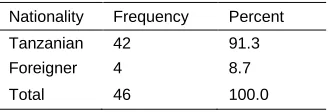
The results in Table 4.2 indicate that out of the 47 respondents that were engaged in the research, 91.3% were Tanzanians while 8.7% were foreigners. This implies that majority of the NGOs were run by locals.
Table 4. 2: Respondents nationality
Nationality Frequency Percent
Tanzanian 42 91.3 Foreigner 4 8.7
Total 46 100.0
Source: Research data, 2016
4.2.5 Educational Level
The results indicate that 40% of the respondnets had primary education while 60% had secondary level of education as shown in Figure 4.3.
Figure 4. 3: Educational level
Source: Research data, 2016
4.3 Professional Qualification
The results further indicated that majority of the respondents (56.5%) had training in social development while 43.5% were educators as depicted in Figure 4.4. This indicates that most of the people who worked with the NGOs were professionally trained.
Figure 4. 4: Professional qualification
Source: Research data, 2016
4.3.1 NGOs and their Activities
The results also indicate that 21.7% of the respondents were from Usariver Youth Organization and Development. 21.7% from Tumaini Children Foundation, 21.7% from Sibusiso Foundation, 21.7% from Deafblind Assistance Services and 13% from Community Knowledge Center King'ori as shown in Table 4.3. the results further indicate that 65.2% of the NGOs were involved in advocacy; advocacy seeks to ensure that people, particularly those who are most vulnerable in society, are able to: have their voice heard on issues that are important to them, defend and safeguard their rights, have their views and wishes
0
20
40
60
Below
degree
Degree
and above
23
23
50
50
Freq
ue…
20
26
43.5
56.5
0
20
40
60
173 genuinely considered when decisions are being made
about their lives. Approximately 35% of the NGOs were purely involved in community development
Table 4.3: Names of the NGOs
Source: Research data, 2016
4.3.2 Leadership Vision and Implementation of Community Development Projects
Objective one sought to identify the role of leadership vision in implementation of community development projects in Arumeru District.
4.4 Organization’s Vision
The study revealed that 87% of the NGOs were guided by an advocacy vision while 13% were finance oriented. All the respondents confirmed that they were responsible for the implementation of their organization‘s vision.
4.4.1 Influence of Vision on Implementation of Community Development Projects
The leader must also possess the desire to change community circumstances and have a vision for accomplishing that change. In academia a long running debate has centered on the difference between transactional and transformational change. A leader who is ―transactional‖ is a person who manages the resources and people of their organization to efficiently maintain the status quo. A transformational leader seeks to fundamentally change the practices of an organization, their community and more broadly of society (Hyman, 2005). In order to address objective one, the respondents were asked to indicate the level to which they agreed or disagreed with a set of statements regarding leadership vision in a scale of 1 to 5, where 1 meant strongly disagree and 5 meant strongly agree. The results (Table 4.4) indicate that most of the NGOs employees were aware of their organization‘s vision (5.0000) and they were responsible for its implementation (5.0000). The respondents confirmed that vision had contribution to their daily activities but it did not make our responsibilities easy to run our (1.4348). The results also indicate that majority of the respondents were well informed of the vision and its interpretation (5.0000). Moreover, they (5.0000) stated that had been involved in its evaluation every year in order to make it active and current. Overall, the respondents pointed out that vision of an organization influenced project implementation (5.0000). Most of standard deviations were too small as shown in Table 4.4; a standard deviation of 0.0000 indicate that all the respondents gave the same response while that of 0.83406 indicates a slight variation of the responses from the mean.
Table 4.4: Influence of vision on implementation of community development projects
Source: Research data, 2016
4.4.2 Research question 1
What is the role of leadership vision in implementation of community development projects in Arumeru District? As presented in Table 4.5, there was a very strong positive correlation (0.910) between of leadership vision and implementation of community development projects. The p-value was 0.000 and thus, less than the alpha level of 0.01 hence establishing a high significant relationship between variables. This implies that leadership vision is a basic requirement for successful implementation of community development projects. This confirms the argument of Fieldstone Alliance (2005) that the most important thing in a leader is not whether the leader is able to move quickly or not, but that they possess a long-term vision of transformational change. In other words, that they not only manage people, but that they also inspire people to change things in the long run.
Table 4.5: Correlation between of leadership vision and implementation of projects
174 4.4.3 Leadership Communication and Implementation
of Community Development Projects
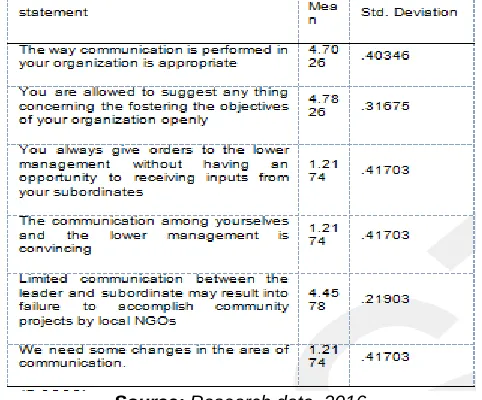
The second objective sought to examine the influence of leadership communication in implementing community development projects in Arumeru District. An assessment of the influence of leadership communication in implementing community development projects involved a set of statement which the respondents were asked to indicate the extent to which they agreed with them. The results (Table 4.6) indicate that communication was appropriately executed in most of the NGOs (4.7026) suggestions regarding the objectives of the organizations were solicited from the other all staff members (4.7826) however, all the respondents disputed the claim that the organization‘s leaders gave orders to the lower management without having an opportunity to receiving inputs from your subordinates (1.2174). The results further indicate that there was open communication in the NGOs among employees irrespective of their job positions (4.4578) and limited communication between staff members would have resulted to failure to accomplish community projects (4.4578). The respondents disputed the claim (1.2174) that there was need for some changes their communication systems indicating that the systems were efficient. The standard deviations were small and they ranged from 0.21903 to 0.41703 indicating that the item responses were slightly varied.
Table 4. 6: Influence of communication on implementation of development projects
Source: Research data, 2016
4.4.4 Research question 2
How leaders‘ communications influence the implementation of community development projects in Arumeru District? A Spearman's correlation was run to determine the relationship between communication and implementation of community development projects. Spearman Correlation Coefficient is also referred to as Spearman Rank Correlation or Spearman's rho. It is typically denoted either with the Greek letter rho or rs. There was a strong, positive correlation between the two variables (rho = 0.730, n = 46, p < .001) as shown in Table 4.7. The findings confirm D‘souza (1994) argument that effective communication is the core of all leadership activity. Leaders know they can best achieve their goals if they have the cooperation of the people they work with. Their ability to communicate effectively enables them to influence the attitudes and actions of their colleagues and subordinates.
Table 4. 7: Correlation between of leadership communication and implementation of projects
Source: Research data, 2016
4.4.5 Leadership Commitment and Implementation of Community Development Projects
Objective three sought to determine the extent leadership commitment enhances implementation of community developmental projects in Arumeru District. The objective was addressed through a set of statements measured in Likert scale. The respondents were asked to rate whether they strongly agreed, agreed, somehow agreed disagreed, or strongly disagreed with a set of statements on conditions of service. As shown in Table 4.8, majority of the respondents felt that they were comfortable with the responsibilities they performed at their organization (4.9130) and free to make suggestions regarding work activities (4.6522). They also pointed out that in cases where the office missed some working materials involving little amount of money they could use their own to facilitate the performance of particular tasks (4.6522). Majority of the respondents disputed that claim that they were working in their organization because they didn‘t have a choice to work somewhere else (1.2309) instead they felt that working their organizations was pleasurable and enjoyable. Most of them noted that they were not more committed than other members of this organization (1.3109). The respondents further noted that projects accomplished in last two years were still operational and in a good condition (4.6087). The standard deviations were less than 0.50553 an indication that the responses were slightly varied.
Table 4.8: Influence of commitment on implementation of development projects
4.4.6 Research question 3:
175
Table 4. 9: Correlation between of leadership commitment and implementation of projects
Leader commitment Project implementation
Spearm an's rho
Leader commitment
Correlation
Coefficient 1.000 .601
**
Sig. (2-tailed) . .000
N 46 46
Project implementation
Correlation
Coefficient .601
**
1.000
Sig. (2-tailed) .000 .
N 46 46
**. Correlation is significant at the 0.01 level (2-tailed).
Source: Research data, 2016
4.4.7 Leadership Accountability and Implementation of Community Development Projects
The fourth objective sought to evaluate how leadership accountability facilitates implementation of community development projects in Arumeru District. According to Ebrahim (2009) NGOs face demands for accountability from multiple actors, it follows that they are expected to be accountable for different things by different people. These expectations may be broken down into four broad, but far from comprehensive, categories: accountability for finances, governance, performance, and mission. The results (Table 4.10) indicate that the community seems to take care of the projects accomplished in last two years; they are still operating and in a good condition (4.2174). The respondents noted that they had a job description for the position they held in their organization (4.1304) and even if they are given a chance to shift to another section they would not (2.0870). The respondents further stated that in case they came across something not going well, they would make suggestions on how to address the issue (4.7391). The standard deviations were small and they ranged from .00483 to .66812 indicating that the item responses were slightly varied.
Table 4. 10: Influence of accountability on implementation of development projects.
Statement Mean Std.
Deviation The community seems to take care of
the projects accomplished in last two years; they are still operating and are in a good condition
4.2174 .41703
I have a job description for the position
or tasks I have in this organization 4.1304 0.66812 If given a chance to choose I would be
happy to change to another section of work due to the hardship of the current section I am working in
2.0870 0.60314
If some of your responsibilities you find not going well, will you be able to suggest the changes for the sake of your organization.
4.7391 .00483
Source: Research data, 2016
4.4.8 Research question 4:
How leadership accountability influence implementation of community development projects in Arumeru district? The fourth research question sought to explore relationships between these eight variables were assessed for associations using Spearman‘s rho correlation analysis.
176
Table 4.11: Relationship between accountability and implementation of development projects
Leader‘s Accountability
Project implementation
Spearman's rho
Leader‘s Accountability
Correlation
Coefficient 1.000 .355
*
Sig. (2-tailed) . .015
N 46 46
Project implementation
Correlation
Coefficient .355
*
1.000
Sig. (2-tailed) .015 .
N 46 46
*. Correlation is significant at the 0.05 level (2-tailed).
Source: Research data, 2016
4.4.9 Community Project Implementation in Arumeru District, Tanzania
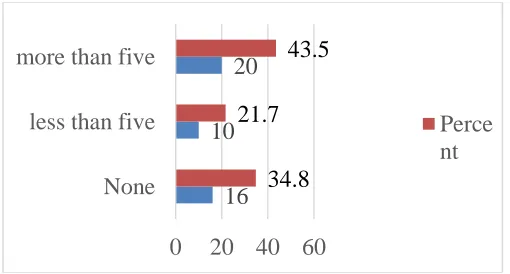
The study also sought to evaluate the level of implementation of community projects in the district. The results show that 34.8% of the respondents noted that none of their projects was complete, 21.7% stated that less than five projects were complete and 43.5% of the respondents confirmed that more than five projects had been accomplished over the last one year as shown in Figure 4.5.
Figure 4.5: Number of completed projects
The results further indicate that among the completed projects only 21.7% were successfully completed while 78.3% were not. When asked to give the reasons why there was unsuccessful completion of projects, 34.8% cited poor management while 56.5% felt that it was because of limited financial resources.
5.0 Conclusion:
The study concludes that the implementation of community development projects in Arumeru District by NGOs was below average and was greatly influenced by leadership vision, communication, accountability and commitment. The presence of vision differed depending on the nature of the NGO, that is advocacy, economic empowerment or service provision. It is also based on the nature of NGO and the field of specialization. Presence of vision in the NGO has great contribution to the ability of the NGO to implement community development projects. It was clear that the NGOs employees were aware of their organization‘s vision and they were responsible for its implementation. This helped in shaping their effort in fulfilling duties and achievement of the organizational objectives. Communication in NGOs had a significant contribution to
the implementation of community development project, which took different forms depending on the category of project and the vision to be accomplished. Communication indicated as the major tool for leaders to link with their subordinates and their donors; which created an important tool for the implementation of community development projects. Ideas, policies, project activities communication was properly executed and suggestions regarding the objectives of the organizations were solicited from the other all staff members. The commitment had significant contribution to the implementation of community development projects as well. The NGOs employees were comfortable working in their organization and they found it pleasurable and enjoyable. Although in certain instances the leader‘s commitment to their subordinates was not robust as it would have been expected. Although it emerged that accountability is a key element in transformational leadership, some NGOs were not accountable to their stakeholders. This is the reason why a significant number of projects had not been completed successfully as expected.
6.0 Recommendations:
Based on the study findings the following recommendations are made;
6.1 The NGOs should inform and motivates their leadership to create a supportive environment to achieve programme objectives and development goals, Leaders can easily motivated through recognitions at work place and sometimes can be given chance to perform their abilities so that, they may become highly motivated.
6.2 There is need for behavior change communication that involves face-to-face dialogue with individual staff members or groups to inform, motivate, problem-solve or plan with them, with the objective to promote and sustain behaviour change. The organizations should organize internal meetings to evaluate their communication dimensions to check whether are right or may need some changes. Suggestion box when fixed in work places and considered can help on getting information of any issue can be modified.
6.3 The NGOs need to organize training programs to equip it leaders with relevant skills and knowledge necessary for transformational leadership. This may be through internal program plans for developing the ability of their leaders. These on job training can be organized by other NGOs familiar with leadership skills. Sometimes short courses provided at centers such as MS-TCDC could help sharpening the leaders when attended.
16
10
20
34.8
21.7
43.5
0
20
40
60
None
less than five
more than five
177 6.4 There is an urgent need to take NGOs performance
assessment seriously in order to justify activities with substantiated evidence rather than with anecdote or rhetoric. Funders and regulators also bear responsibility in this regard. The board regulating the NGOs activities can have plan for visiting them in actual environment in order to identify the leadership challenges and discuss plans to improve situations identified.
Reference:
[1] A. Thomas, S. Carr and D. Humphreys (eds.) (2001), Environmental Policies and NGO Influence. Land Degradation and Sustainable Resource Management in Sub-Saharan Africa, (London: Routledge).
[2] Archambault, S. (2002). Spearman rho. Retrieved from
http://www.wellesley.edu/Psychology/Psych205/sp earman.html
[3] Bass, B. M. (1985). Leadership and performance beyond expectations. New York: Free Press.
[4] Bass, B. M., & Avolio, B. J. (1994). Improving organizational effectiveness through transformational leadership. Thousand Oaks, CA: Sage.
[5] Bass, B. M. (1996).Anew paradigm of leadership: An inquiry into transformational leadership.
[6] Chiang Pei-heng (1981), Non-Governmental Organizations at the United Nations. Identity, Role and Function, (New York: Praeger). [An important early study of the origins and operation of the consultative arrangements in ECOSOC.
[7] Cole, G.A. (2006) Management Theory and Practice.(6th Ed.) London: Book Power Cocks, M., Dold, A. and Grundy, Is. (2001). Challenges Facing a Community Structure to Implement CBNRM in the Eastern Cape South Africa." African Studies Quarterly 5, no.3: Retrieved From http://web.africa.ufl.edu/asq/v5/v5i3a4.htm
[8] D. Josselin and W. Wallace (eds.) (2001), Non-State Actors in World Politics, (Houndmills: Palgrave).
[9] Ebrahim, A. (2009) "Placing the Normative Logics of Accountability in 'Thick' Perspective", American Behavioral Scientist 52(6), 885-904.
[10] Eisenbeiß, S. A. and Boerner, S. (2013) A Double-edged Sword: Transformational Leadership and Individual Creativity. British Journal of Management. 24(1): 54–68.
[11] Fieldstone Alliance (2005). ―Stewardship Helps Get More Mission for the Money‖. Available at: http://www.fieldstonealliance.org/client/tools_you_c
an_use/05-24-5_a_better_way_to_lead_org.cfm#good
[12] Gary, A. D. (2005). Financial Globalization, Social Exclusion and Financial Crisis, International Review of Applied Economy. Vol. 19. No.4, pp 439- 457
[13] Garcıa-Morales, V.J. et al (2008) The Effects of Transformational Leadership on Organizational Performance through Knowledge and Innovation. British Journal of Management. 19(4): 299–319
[14] Hargis, M. B., Wyatt, J.D., Piotrowski, C. (2001). Developing Leaders: Examining the Role of Transactional and Transformational Leadership across Contexts Business. Organization Development Journal 29 (3): 51–66
[15] Hay, I(2012)Transformational Leadership Characteristics and Criticisms. Retrieved 17th
March, 2013. Retreaved from http://www.leadingtoday.org/weleadinlearning/trans
formationalleadership.htm
[16] Howell, J. M., & Avolio, B. J. (1993). Transformational leadership, transactional leadership, locus of control and support for innovation: Key predictors of consolidated-business unit performance. Journal of Applied
Psychology, 78, 891-902.
http://www2.fcsh.unl.pt/docentes/luisrodrigues/text os/Lideran%C3%A7a.pdf
[17] IFAD (2009) Rural Finance Policy. Enabling poor rural people to overcome poverty. Retrieved from http://www.ifad.org/pub/basic/finance/eng.pdf
[18] J. Fisher (1998, Nongovernments. NGOs and the Political Development of the Third World, West Hartford: Kumarian Press).
[19] Jordan, L. (2007) "A Rights-Based Approach to Accountability", in A. Ebrahim and E. Weisband (eds) Global Accountabilities: Participation, Pluralism, and Public Ethics, pp. 151-67, Cambridge, UK: Cambridge University Press.
[20] Judge, T. A. and Bono, J. E. (2000) Five-Factor Model of Transformational Leadership. Journal of Applied Psychology. Pp 751 – 765
[21] Jung, D.D., and Sosik, J.J. (2002). Transformational Leadership in Work Groups: The Role of Empowerment, Cohesiveness, and Collective-Efficacy on Perceived Group Performance. Small Group Research. 33, 313 – 336
178 [23] Kothari, C.R (2004) Research Methodology:
Methods and Techniques 2nd Edition, New Age International (P) Ltd, New Delhi.
[24] Kouzes M. & Barry Z. (2007), The Leadership Challenge, 4th Edition, Jossey‐Bass.
[25] Lowe, K. B., Kroeck, K. G., & Sivasubramaniam, N. (1996). Effectiveness correlates of transformational and transactional leadership: A meta-analytic review. Leadership Quarterly, 7, 385-425.
[26] MS-Training Centre for Development and Cooperation (2007). The role of ngos in the 20th century, Dar-es salaam university press, Dar es salaam.
[27] P. J. Nelson (1995), The World Bank and Non-Governmental Organizations. The Limits of Apolitical Development, (New York: St. Martin's Press and Houndmills: Macmillan Press).
[28] Piccolo, R.F, and Colquitt, J.A. (2006) Transformational Leadership and Job Behavior: The Mediating Role of Core Job Characteristics. Academy of Management Journal. Pp 327 – 340