United Kingdom Vol. V, Issue 5, May 2017
Licensed under Creative Common Page 141
http://ijecm.co.uk/
ISSN 2348 0386
COMPARATIVE ANALYSIS OF THE BANKING SECTOR
IN KOSOVO CONFRONT THAT OF EU
Fidane Spahija
Lecturer, University “Haxhi Zeka”, Kosovo
Abstract
The banking sector is one of the most important sectors of the economy of any country,
especially those countries that are in transition, which includes over 80% of the structure of
financial system assets in general. Destabilization of the banking sector can bring a great mess
in the economy that why it is necessary to have a permanent supervision by the government
and by the central bank. The global financial crisis which began in the U.S. and is continuing in
Europe further highlights how the banking sector can be destabilized. The banking sector
continues to remain the dominant segment of financial intermediation in Kosovo and dominated
by foreign capital. Despite the difficult economic environment, the financial and banking sector
has maintained its stability due to public deposits and loans for businesses. As a result of higher
perceived credit risk, banking sector in Kosovo has reduced the annual pace of credit growth,
has cut the average maturity time and has further reduced its consumption credit amount. The
Indicator loans / deposits for our banking system are still presented at low levels if compared to
most countries of the region and the European Union (EU). Low rate of indicators for Kosovo is
linked to the simple structure of the sources of our banks, where deposits generally dominate,
and if the debt taken by banks within the country or abroad is limited. The advantages of the
banking sector in the EU integration are numerous, and the challenges are great as well. For
this reason it is the most important to make a comparative analysis of banking sector in Kosovo
against that of EU countries, and at the end to draw conclusions and concrete
recommendations that will serve to improve the situation of the banking sector in Kosovo for an
easier integration in the EU.
Licensed under Creative Common Page 142 INTRODUCTION
Banks are an important part of the financial system of a country. No country can imagine its economy without a banking sector. Banking system includes all banks dependant of their services. These banks can be: Banks of the first level ( central banks}, and the banks of the second level: (commercial banks, investment banks, deposit banks,mortgage banks etc.}.The analysis of the bank system was more focused around the years 2008-2009, phase which was considered as one of the most difficult once for the whole financial system of the world, because the global financial crisis had captured almost every country, and because the crisis started exactly from the banking system. The data given in this work show the differences between the banking system in Kosova and that of EU, especially the banking system in Germany. The comparative analysis show these differences and the recomandations will serve to build a stable banking system towards the integration in the EU.
BANKING SECTOR IN KOSOVA
Banking sctor in Kosova is monitored by the Central Bank of Kosova ( KCB}as a descendant of the Central Banking Authority (KCBA), which based on the Kosova Constitution dispozitions, has an administrative, financial and managerial autonomy. The KCB has strongly contributed in the proces of becoming a member of International Monetary Fund and in the World Bank too, in drawing the national payment strategy , in the continuous development and in advancing the monetary and statistical quality, in bringing the legislature closer to that of the EU as well as in intensive international cooperation with the sister institutions and differnt financial regulations of the region, EU and even wider
From the institutions of financial system in Kosova there are eight commercial banks, six of which are with a foreign ownership and two with a local ownership.About 91.5% of all assets of the banking system are with foreign ownership, while only 8.5% are assets of the banking sector with the local ownership.
Licensed under Creative Common Page 143 the Pension Savings Trust of Kosova ( KPST}which had decreases in the value of the invested shares in the international stock markets, then the decrease in remittances and foreign investments, especially there was realised an indirect factor in the strengthening of lending conditions, in increase of expenditures and a considerable decrease in deposits.
Expansion of branch network until 2009, had a much slower pace compared to previous years, as a result of the slowdown in the banking sector activity from the global financial crisis. Number of branches and sub branches of commercial banks amounted to 292 (five more than in 2008), while the number of workers employed in this sector dropped to 3.444 (from 3.607 as at the end of 2008). During 2009, the expansion of banking infrastructure continued in terms of the number of ATM, POS terminals and electronic banking accounts to facilitate the access of clients in banking services (Table 1). Moreover, the number of electronic accounts (e-banking) has tripled, thus reaching at 40.924.
Table 1. The network of banking sector in Kosovo
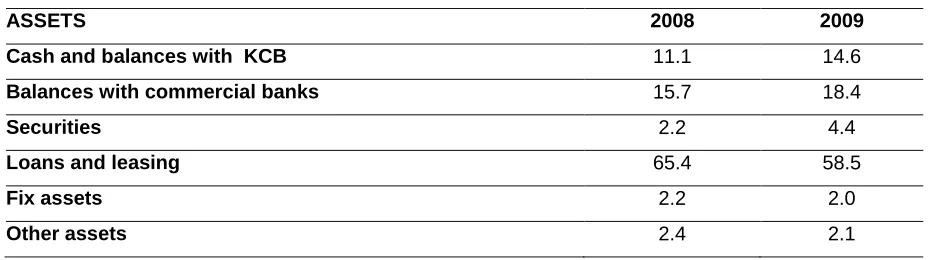
The structure of banking sector assets until 2009 has not undergone any fundamental change compared with the previous year. Loans continue to comprise the majority of assets with a participation of about 58.5 percent. However, due to the tightening of lending, the share of loans in 2009 was lower compared to 2008. On the other hand, almost all other categories have increased their participation in the general structure of banking sector assets
Table 2. Structure of assets, in the percentage of banking sector in Kosovo
2008 209
Number of branches and sub branches 287 292
Number of employed 3,607 3,444
Number of ATM 240 339
Number of POS 3,426 5,251
Number of accounts- E-banking 13,051 40,924
ASSETS 2008 2009
Cash and balances with KCB 11.1 14.6
Balances with commercial banks 15.7 18.4
Securities 2.2 4.4
Loans and leasing 65.4 58.5
Fix assets 2.2 2.0
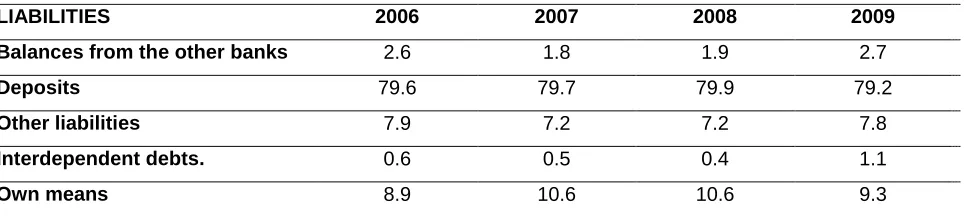
Licensed under Creative Common Page 144 Lending slowdown has made commercial banks to orient a portion of their investments to other asset categories. More emphatic increase is seen in investments in securities, which in2009 came up to 97 million from 40.5 million in 2008 (Table 2). The growth of these investments is also a result of stabilizing the capital markets in the external sector, which has contributed the increase of the security of these investments. Structure of credits is dominating by loans to enterprises. However, their share in total loans fell to 73.3 percent (76.3 percent in 2008), while the share of loans to households rose to 26.7 percent of total loans (23.7 per cent in 2008). Low levels of high production and support of Kosovo's economy in import reflected in the sector distribution of loans to private enterprises. Most of these loans absorbed by the firms in the trade (56.4 per cent of loans to enterprises),while the industrial sector has 25 percent of total loans of enterprises. The sector with the lowest participation continues to be the agricultural sector, with only 4 percent of total loans to enterprises. Regarding the maturity of most loans consist of loans with maturity of more than two years, representing 70 percent of total loans. Deposits include about 79.5 percent of the liabilities of the banking sector in Kosovo. In 2009 the deposits of the banking sector recorded an annual growth of 21 per cent (26.3 per cent in 2008), reaching a value of 1.74 billion euros. This increase was due to increased household deposits, deposits of enterprises as commercial banks declined (from 20.7 per cent). Within the banking sector liabilities, there is seen a continuous increase in interdependent debts and in placements of commercial banks abroad, which indicates that the banking sector of Kosovo is increasing the use of financial resources from abroad.
Table 3. Structure of liabilities as a percentage of the banking sector in Kosovo
Most of the deposits of the banking sector consist of deposits of households with a turnout of around 60 percent in total deposits, while deposits of private enterprises make up 15.3 percent. Until the year 2009, a substantial portion of deposits in the banking sector belonged to public enterprises, but the transfer of dividend in the amount of 200 million Euros from PTK to Kosovo government, the public enterprise deposits recorded a significant decline of 7.0 percent of total banking sector deposits. Consequently, the share of government deposits on commercial banks
LIABILITIES 2006 2007 2008 2009
Balances from the other banks 2.6 1.8 1.9 2.7
Deposits 79.6 79.7 79.9 79.2
Other liabilities 7.9 7.2 7.2 7.8
Interdependent debts. 0.6 0.5 0.4 1.1
Licensed under Creative Common Page 145 in 2009 reached 9.4 per cent and 4.1 per cent share of deposits belonged to the other financial institutions. Based on maturity date 29.5 percent of deposits are transferable deposits, while the rest consists of savings deposits and time restricted. Within these deposits dominate the deposits with maturity up to one year, which represent 84.1 percent of total savings deposits and time restricted. Deposits with a maturity from one to two years represent 7.7 percent of savings deposits and futures while 8.2 percent of these deposits have a maturity of more than two years
The difference between interest rates on loans and deposits is 10.5%.Which means that interest rates for loans reach the value of up to 16% and interest rates for deposits up to 5.5%. Interest rates on loans to enterprises remained higher compared to those to households, while the opposite stands on the interest rates on deposits where companies benefit from higher rates of interest. However, based on the standard of living, the number of unemployment and social problems, we can say that these rates are very high and there is a very little to help businesses.
The performance of the banking system in Kosovo
Kosovo's banking sector closed the year 2009 with a net profit of 29.6 million euros compared to 30.5 per cent lower than in 2008, which indicates a poorer performance of the banking sector. Reduction of profit is the result of slowing revenue growth of commercial banks, mainly due to the slowdown of lending activity, while spending followed a trend of increasing faster than revenues. Reduction of net profit caused the decrease of profitability indicators of the banking sector, such as return on average assets (ROAA) and return on average equity (ROAE) ROAA banking sector in 2009 decreased by 1.4 % from 2.4 %, as it was in 2008. A significant decrease as well marked ROAE, dropping to the level of 13 percent in 2009 (24.7 % in 2008).
Licensed under Creative Common Page 146 represents the main source of banking sector revenue, representing 81 percent of total revenue. The level of expenditure of the banking sector in 2009 was 17.7 percent higher compared with 2008, reaching a value of 171.2 million euros. General and administrative expenses continue to represent the large banking sector spending, representing 50.6 percent of total expenditures.
A noticeable increase can be seen in spending provisions on loans which are included within non-interest expenses, which in 2009 amounted the value of 25.7 million euros, or an annual increase of 51.3 percent. Increase of provisions for loans was caused by increased by Non – Performing Loans (NPL) during 2009, the share of which in total loans reached the value
of 4.3 percent (3.3 percent in 2008). Moreover, the results of the 'stress test' suggests that the banking sector is able to keep the Capital Adequacy Ratio (CAR) upon the level of 12 percent even if the NPL's will increase up to 150 percent. Kosovo's banking sector is well capitalized, with a CAR of 18 percent, which exceeds the minimum level of 12 percent set by Central Bank, which indicates a satisfactory level of stability of the banking sector.
EU BANKING SECTOR
Being part of the EU means to work together with other countries for peace and prosperity, to create a market without border barriers and circulation of the same currency Euro. It is the Europe Central Bank with its headquarters in Frankfurt Germany which takes care of the administration of the EU monetary policies, about the movement of interest rates, about maintaining inflation, price stability etc, which is in close cooperation with central banks of member countries of the Union European. There is also the European Investment Bank which provides loans at interest to European countries by financing various projects for sustainable development and expansion of processes for developing new countries. This bank is based in Luxembourg and provides funds through capital markets. To be a member of the European Union, a country must have a stable democracy and to guarantee the rule of law, human rights and protection of minorities, as well as to have a functional market economy and a human capacity to implement and administer the European Union laws.
As the theme is more focused on the banking sector, the following will present an analysis of the banking sector of the Central Bank of Germany, as a founder country of the European Union.
The banking sector in Germany (Deutsche Bundesbank)
Licensed under Creative Common Page 147 The work of the banking sector in Germany continued to operate but under the supervision of two regulators: that of the Basel Committee of Banking Supervision (BCBS) and that of European level.
The banking sector in Germany is administered and supervised by two central banks, the one of Germany called Deustche Bundesbank and the ECB (European Central Bank), which are located in Frankfurt.
Germany's banking system consists of large groups of state-owned banks such as Pfandbriefbank, Kreditanstalt für Wiederaufbau - KFW, NRW.BANK.
In addition, the banking system includes the major commercial banks, regional banks, and savings banks, investment banks which have their own sub branches in other cities of Germany and contain their own capital. Also, we have thousands of other banks that are managed by foreign capital, mainly from European countries, Switzerland, etc. The banking sector in Germany has a very wide range of different types of banks that offer multiple services in order to beat the competition in the market.
These types of services are different, both in terms of cash and in terms of securities. Regarding the number of employees, there are about 700,000 thousand employees in the banking sector in Germany.
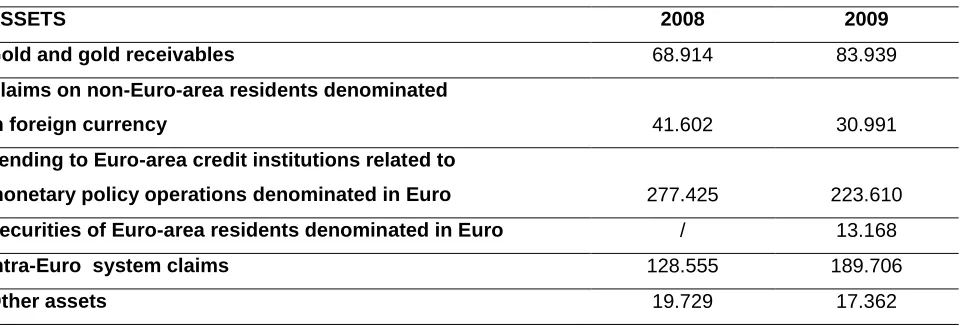
From Table 4 and 5 we can see that the assets and liabilities of the Bundesbank in Germany, which at the end of 2009, reach the total amount of € 588.043 million, an amount that
is less about 24.520 (compared to 2008 which was 612.563 ).
Table 4. Structure of assets in € million, of the banking sector in Germany
Considering the wide banking network that Germany possesses and the amount of movement of each item of the balance sheet are quite large. But these sums are small compared with the previous year because of disorders caused by the last global financial crisis.
ASSETS 2008 2009
Gold and gold receivables 68.914 83.939
Claims on non-Euro-area residents denominated
in foreign currency 41.602 30.991
Lending to Euro-area credit institutions related to
monetary policy operations denominated in Euro 277.425 223.610
Securities of Euro-area residents denominated in Euro / 13.168
Intra-Euro system claims 128.555 189.706
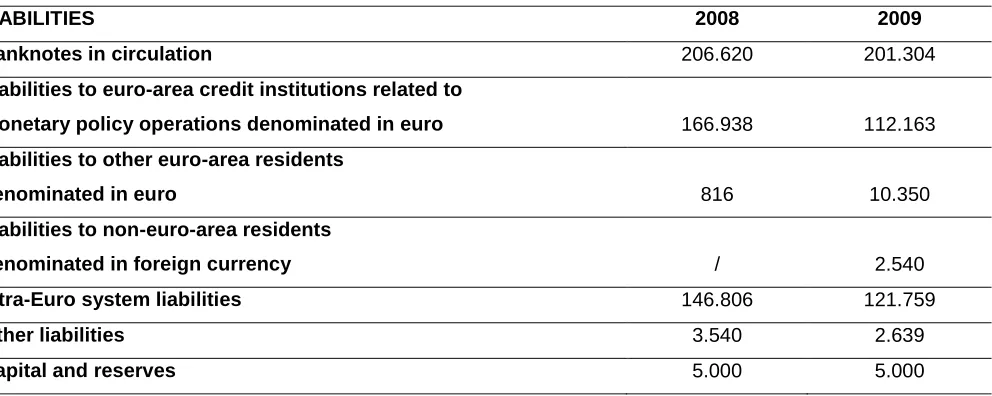
Licensed under Creative Common Page 148 Table 5. Structure of liabilities in € million, of the banking sector in Germany
If we do a little comparison of the above tables we can see that the amounts of loans to the banking system in Germany are higher than deposits.
Regarding credit rates in Germany they can be fixed and variable rates of interest, depending on the method of application of banks or customers.
Interest rates of loans to borrowers brought to 6% and in terms of interest rates on deposits range up to 3.5%. Besides, interest rates are considered good and very fruitful for the German economy; Germany's banking system provides various kinds, to stay closer to customers and their needs. Required reserves for commercial banks by the monetary policy of the Bundesbank in Germany brought about 11.9%. So, overall banking sector in Germany represents one of the most developed of all the EU countries.
COMPARATIVE ANALYSIS OF THE BANKING SECTOR
IN KOSOVO CONFRONT THAT OF EU
Kosovo, like Albania and other regional countries have the same objective that of European integration. One of the main goals stated in the strategic plan 2010-2015, the CBK is to contribute to processes of integration in the European Union and other international institutions. We have therefore taken for analysis one of the most economically developed countries of the European Union - Germany, so that the advantages of their banking system to serve us for the near future. Priorities for EU integration are numerous; this is also noted in banking supervision in Germany, where except Bundesbank which is on supervision, as is the ECB, which means Germany's banking system is protected from any danger that threatens.
LIABILITIES 2008 2009
Banknotes in circulation 206.620 201.304
Liabilities to euro-area credit institutions related to
monetary policy operations denominated in euro 166.938 112.163
Liabilities to other euro-area residents
denominated in euro 816 10.350
Liabilities to non-euro-area residents
denominated in foreign currency / 2.540
Intra-Euro system liabilities 146.806 121.759
Other liabilities 3.540 2.639
Licensed under Creative Common Page 149 Some of the main advantages of the banking sector in Kosovo, which at the same time assist faster European integration, are: Euro currency possession and management of about 91.5 percent of banks with foreign capital.
Using the Euro currency is one of the conditions for joining the EU, therefore we consider that Kosovo has the advantage, which facilitates the work towards EU integration. Also, management of foreign-owned banks, especially European countries, helps us to develop experience, to offer products and to raise awareness like the base bank and sister banks that are integrated into the EU. Increased economic cooperation and economic exchanges help towards EU integration process.
Although Germany is one of the countries with large numbers of population, and with a wide array of banking sector we have focused our comparison only on some key points that need to emphasize for the banking system.
The analysis of the data, although limited show that changes toward the process of EU integration of the banking sector, revolve around these factors:
~ deposit interest rates, ~ interest rates of loans,
~ in the creation of investment banks,
~ in the preparation of capital investment or sale of securities
~ in the percentage growth rate of mandatory reserves of banks, etc..
Graphic interest rates on loans and deposits are given below:
Graphic1. Interest rate on loans and deposits in Kosovo and Germany
The chart shows that the interest rates of loans and deposits in the banking sector are almost twice as high in comparison with interest rates of German banking sector. Interest rates that are
0 2 4 6 8 10 12 14 16
Kosovë Gjermani
5.5
3.5 16
6
Licensed under Creative Common Page 150 brought into the EU countries are lower than those in Kosovo. Compared with the banking sector in EU countries we can see that there are different types of banks, one of the banks that has high impact in economic development of a country are investment banks too. The attempt to open an investment bank in Kosovo is a step towards European integration.
EU banking sector has a significant development in trading and in investment securities compared to our state. So we must therefore create a considerable experience in trading securities in different markets of the EU countries. Drawing plans, participation in various international conferences and education of new staff will help towards this process. Monetary and fiscal policies of the EU countries, the concrete case of Germany, are more stimulating and more efficient than in our country. Within the framework of German central bank policy, reservations required for second-tier banks is 11.9%, while based on the Central Bank of Kosovo, this reserve is 8%. Based on this we can say that monetary and fiscal policies of the country that are drawn by the government and central banks need to adapt rules and standards of EU countries.
CONCLUSION
Integration into the EU requires medium and long term strategic plans, perfectionism, sustainable economic development and the degree of democratization of all Albanian society , keeping inflation at a stable rate, efforts should be made for the standardization and harmonization of our legislation with the EU , to join the SWIFT (Society for International Financial Telecommunication World) and the Bureau of the Green Card, the move towards implementation of Basel II (for banks) and Solvency II (for insurance), raising the deposit insurance scheme, the implementation of project for the national payments strategy, the link of cooperation agreements with counterpart institutions in the region and the EU, continued capacity building and training of the CBK staff, continuous informing of public about developments in the financial sector of the Republic of Kosovo. With this paper we can draw the conclusion that the banking sector in Kosovo must preserve financial stability through constant surveillance by the authorities of the country, further cooperation of foreign investors and the preparation of entry into the market for buying and selling securities. With the perfection of economic development interest rates on loans and deposits will reduce, it will increase interest in new investments from abroad and the creation of investment banks. Integration into the EU will be the most important step for economic development of Albania, Kosovo and other regional countries. In the future, this topic can be further expanded by exploring and comparing other EU countries for other years that I did not include in this paper.
Licensed under Creative Common Page 151 REFERENCES
Civici, Adrian “Kriza financiare apo globale”, Universiteti Evropian i Tiranës, Tiranë, 2010 Luboteni, Gazmend, “Menaxhmenti bankar”, University of Prishtina, Prishtinë, 2006 Luboteni, Gazmend, “Bankat dhe afarizmi bankar”, University of Prishtina, Prishtinë, 2008 Paca, Agim, “Bankat dhe sistemi bankar”, University of Prishtina, Prishtinë, 2005