R E S E A R C H A R T I C L E
Open Access
Can elearning be used to teach palliative
care?
–
medical students
’
acceptance,
knowledge, and self-estimation of
competence in palliative care after
elearning
Christian Schulz-Quach
1,3, Ursula Wenzel-Meyburg
2and Katharina Fetz
4*Abstract
Background:Undergraduate palliative care education (UPCE) was mandatorily incorporated in medical education in Germany in 2009. Implementation of the new cross-sectional examination subject of palliative care (QB13) continues to be a major challenge for medical schools. It is clear that there is a need among students for more UPCE. On the other hand, there is a lack of teaching resources and patient availabilities for the practical lessons. Digital media and elearning might be one solution to this problem. The primary objective of this study is to evaluate the elearning coursePalliative Care Basics, with regard to students’acceptance of this teaching method and their performance in the written examination on the topic of palliative care. In addition, students’ self-estimation in competence in palliative care was assessed.
Methods:To investigate students’acceptance of the elearning coursePalliative Care Basics, we conducted a cross-sectional study that is appropriate for proof-of-concept evaluation. The sample consisted of three cohorts of medical students of Heinrich Heine University Dusseldorf (N= 670). The acceptance of the elearning approach was investigated by means of the standard evaluation of Heinrich Heine University. The effect of elearning on students’ self-estimation in palliative care competencies was measured by means of the German revised version of the Program in Palliative Care Education and Practice Questionnaire (PCEP-GR).
Results:The elearning coursePalliative Care Basicswas well-received by medical students. The data yielded no significant effects of the elearning course on students’self-estimation in palliative care competencies. There was a trend of the elearning course having a positive effect on the mark in written exam.
Conclusions:Elearning is a promising approach in UPCE and well-accepted by medical students. It may be able to increase students’knowledge in palliative care. However, it is likely that there are other approaches needed to change students’self-estimation in palliative care competencies. It seems plausible that experience-based learning and encounters with dying patients and their relatives are required to increases students’self-estimation in palliative care competencies.
Trial registration:Heinrich Heine University Medical School Clinical Trial Registry No. 4876 (date of approval 26.11.2014).
Keywords:Medical education, Undergraduate palliative care education, Palliative care, Palliative medicine, Education assessment, Evaluation
* Correspondence:[email protected]
4Chair of Research Methodology and Statistics in Psychology, Department of
Psychology & Psychotherapy, Faculty of Health, Witten/Herdecke University, Witten, Germany
Full list of author information is available at the end of the article
Background
Undergraduate palliative care education (UPCE) was man-datorily incorporated in medical education in Germany in 2009 [1]. Implementation of the new cross-sectional examination subject of palliative care (QB13) continues to be a major challenge for medical schools [2]-The discrep-ancy between student numbers, limited teaching re-sources, and clinically and ethically acceptable patient contact is also a challenging task in the development of palliative care teaching [3]. However, numerous studies describe students’ explicitly and clearly communicated suggestions. Students reported only limited confidence re-garding their knowledge base in palliative care, and felt ra-ther non-confident or non-confident in communicating the change from a curative treatment to palliative care to patients, or the treatment and provision of care for ter-minally ill patients [4]. Students asked for well-grounded basic teaching and more lessons on end-of-life care and role modelling from residents and attendings [5, 6]. Stu-dents wished for more opportunities and time to deal with their own emotions and to adequately meet patients’ needs and wishes [7]. Rhodes-Kropf found that medical students experienced patient deaths as emotionally power-ful even when they were not close to the patients and they felt inadequately supported by their supervisors [8]. Stu-dents also expressed the wish to be provided with a self-awareness training and the opportunity to reflect on their own death [9].
In light of the above, there is a need among students for more UPCE. On the other hand, there is a lack of teaching resources and patient availability for the practical lessons. Digital media and elearning might be one solution to this dilemma. The use of electronic devices in medical educa-tion has been widely accepted [10,11]. Consequently, stu-dents evaluate internet-based learning as useful [12, 13]. According to our knowledge, the use of elearning in UPCE has not yet been fully investigated. It has been in-vestigated in first studies [14, 15] but never in Germany and never on a large scale. Hence, we developed a UPCE elearning course comprising ten teaching units.
The primary objective of this study is to evaluate the elearning course Palliative Care Basics with regard to students’acceptance of this teaching method and their performance in the written examination on the topic of palliative care. In addition, students’competence in pal-liative care was assessed by means of PCEP-GR [16]. It was hypothesised that the acceptance of this new ap-proach would be high. Regarding the effect of elearning on students’ self-estimation and knowledge concerning palliative care, we had four major hypotheses:
1. Elearning increases students’self-estimation of com-petence in communication with dying patients and their relatives.
2. Elearning increases students’self-estimation of knowledge and skills in palliative care.
3. Elearning increases students’preparation to provide palliative care.
4. Elearning increases students’knowledge in palliative care (measured by the mark in the written
examination).
Methods
Data collection
Data was collected either after participation in the elearn-ing course or after individual preparation by means of textbooks and self-guided learning and prior to the written examination on the topic of palliative care. All students who participated in the multiple choice examination were previously informed about the study via email. Students were informed via written and oral communication that their participation in the study was on a voluntary basis. The response rate of the questionnaires was 97%. Twenty students chose not to participate in this study.
Sample
The study sample consisted of three cohorts. In the first study cohort, 329 (49.1%) undergraduate medical stu-dents completed the elearning course during the sum-mer semester of 2013. The second study cohort consisted of 222 (33.1%) students completing the course during the winter semester of 2013/2014, and 119 (17. 8%) students completed the elearning-course in the summer semester of 2014, resulting in a total of 670 par-ticipants for all three cohorts. The students’average age was 28 years. The participants’ average duration of studies was 11 semesters. The participants were 65.5% (n= 439) female and 34.5% (n= 231) male.
Study design
To investigate students’ acceptance of the elearning course, we conducted a cross-sectional study that is ap-propriate for proof-of-concept evaluation. Data was col-lected via written self-assessment. Ethical approval was obtained from the Ethics Committee of the Medical Fac-ulty of Heinrich Heine University Dusseldorf, Germany (Ethics committee approval No. 4876). The study was conducted in accordance with the Declaration of Helsinki on Ethical Principles for Medical Research in-volving Human Subjects. This report complies with the Strengthening the Reporting of Observational Studies in Epidemiology (STROBE) 22-item checklist to improve the quality of reporting of observational research [17].
Independent variables
Elearning course: Palliative care basics
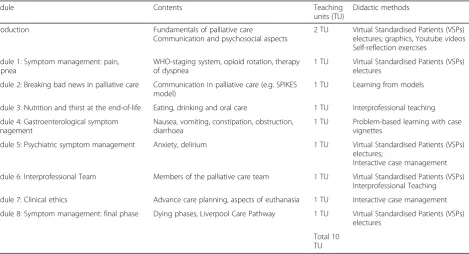
interaction, interprofessionalism, ethical/legal/societal aspects, and self-reflection. Thematic contents and di-dactic methods of the elearning course are presented in Table1. In addition to the content of these modules, the course includes multiple-choice questions to help stu-dents prepare for the final exam. The included reflection questions are aimed at providing the participating stu-dents with the opportunity to reflect on their own atti-tudes towards death and dying.
The elearning course comprises ten teaching units (TU) and was developed for clinical medical students. It is part of the mandatory palliative care curriculum and is taught on an interdisciplinary and interprofessional basis to fourth- and fifth-year medical students at Hein-rich Heine University Dusseldorf, Germany. All students who had been enrolled in the elearning course were in-cluded in the study. The technical realisation of the course was effected via the Casus online platform®. The elearning course is based on systematic education research and the deliberate use of elements promoting successful learning in virtual teaching environments (engendering affective impressions, the experience of success, and quick succes-sions of user repetition) in order to effectively teach highly sensitive and complex issues of palliative care [18,19]. In this course, the use of virtual standardised patient contact (VSPC) and interprofessional teaching constitute the cen-tral didactic elements [20]. Other educational methods and tools used are e-lectures, patient case vignettes, and reflective study questions with experts’ answers. A mul-tiple choice test at the end of the module prepares
students for the mandatory final examination. The partici-pating students completed the paper-based questionnaires immediately before the exam.
Dependent variables PCEP questionnaire
The effect of elearning on students’ self-estimation in palliative care was measured by means of the German revised version of theProgram in Palliative Care Educa-tion and Practice QuesEduca-tionnaire [GR, 16]. PCEP-GR was developed on the basis of theProgram in Pallia-tive Care Education and Practice Questionnaire of Har-vard Medical school [21].
Items were translated into German and the question-naire was shortened to a set of 36 items measured on a 5-point Likert-scale It includes four subscales: preparation to provide palliative care,attitudes towards palliative care, self-estimation of competence in communication with dying patients and their relatives, and self-estimation of knowledge and skills in palliative care. Additionally, it pro-vides a PCEP-GR global index for the global evaluation of UPCE programs. A recent validation study [16] investigat-ing PCEP-GR questionnaires’psychometric properties re-vealed a good content validity, a good split-half-reliability of the global index (Spearman-Brown-Coefficient = .90), and acceptable reliability indices of the subscales (Cron-bach’s alpha = .66–.83).Acceptance questionnaire.
Students’ acceptance of the elearning course was de-termined by means of the obligatory course evaluation of Heinrich Heine University. Standard items in this
Table 1Thematic content and didactic methods of the elearning course Basic Topics in Palliative Care
Module Contents Teaching
units (TU)
Didactic methods
Introduction Fundamentals of palliative care
Communication and psychosocial aspects
2 TU Virtual Standardised Patients (VSPs) electures; graphics, Youtube videos Self-reflection exercises
Module 1: Symptom management: pain, dyspnea
WHO-staging system, opioid rotation, therapy of dyspnea
1 TU Virtual Standardised Patients (VSPs) electures
Module 2: Breaking bad news in palliative care Communication in palliative care (e.g. SPIKES model)
1 TU Learning from models
Module 3: Nutrition and thirst at the end-of-life Eating, drinking and oral care 1 TU Interprofessional teaching
Module 4: Gastroenterological symptom management
Nausea, vomiting, constipation, obstruction, diarrhoea
1 TU Problem-based learning with case vignettes
Module 5: Psychiatric symptom management Anxiety, delirium 1 TU Virtual Standardised Patients (VSPs) electures;
Interactive case management
Module 6: Interprofessional Team Members of the palliative care team 1 TU Virtual Standardised Patients (VSPs) Interprofessional Teaching
Module 7: Clinical ethics Advance care planning, aspects of euthanasia 1 TU Interactive case management
Module 8: Symptom management: final phase Dying phases, Liverpool Care Pathway 1 TU Virtual Standardised Patients (VSPs) electures
Total 10 TU
questionnaire have been developed by the medical fac-ulty and have not yet been validated for their psycho-metric properties. The questionnaire consists of ten items focussing on the preparation for the exam (elearn-ing, textbook, other preparation,andnone), evaluation of didactic elements, and an overall grading. Items were scored on a five-point Likert-scale (range: 0–5). An add-itional free-text field provided students with the oppor-tunity to express their own wishes and suggestions regarding the elearning course.
Written examination
Finally, a 20-item multiple choice questionnaire (mul-tiple choice test) was used for the purpose of assessment and verification of the acquired knowledge.
Statistical analysis
All statistical analyses were performed using IBM SPSS 22. Data was controlled for missing values and plausibil-ity prior to analyses. Two students were excluded from the sample due to missing values. The PCEP global index and subscales were calculated following the sug-gestion of [16]. The descriptive statistics are reported. Prior to inferential analyses, data was controlled for normal dis-tribution by means of the Kolmogorov-Smirnov Test (KS-Test), and homogeneity of variances by means of Levene’s Test. The KS-Test revealed significant deviation from the normal distribution (allp-values < .00). Therefore, hypoth-eses 1–4 were tested by means of nonparametric Mann-Whitney-U-Tests with elearning (yes vs no) as inde-pendent variables, and self-estimation of competence in communication with dying patients and their rela-tives, self-estimation of knowledge and skills in palliative care, and preparation to provide palliative care and know-ledge (mark in the written exam) as dependent variables, respectively. Because of multiple comparisons, the statistical level of significance was Bonferroni-adjusted top< .01.
Results
Descriptives
592 (99.5%) students made a statement about their elearning behaviour. 569 (96.1%) used elearning as prep-aration for the exam. 23 (3.4%) did not use elearning for exam preparation. Descriptive statistics for elearners and non-elearners concerning students’ self-estimation of competence in communication with dying patients and their relatives, self-estimation of knowledge and skills in palliative care, preparation to provide palliative care, and knowledge in palliative care are shown in Table2.
Acceptance questionnaire
Acceptance was measured on a Likert scale between 1 (= high acceptance) to 5 (=low acceptance). Students’ acceptance of the elearning course in UPCE was high
(n= 680; mean = 1.8 [1–5]; SD = 0.8). In preparation for the examination, 83,8% (n= 570) of the students completed the elearning course and 7.4% (n= 45) used the textbook Basics in palliative care. 35,3% (n= 240) of the students used other teaching materials to prepare for the examination and 1.3% (n= 9) did not prepare for the examination. Upon completion of the elearning course, the students felt well-prepared for the examination (n = 570; mean = 3.9 [1–5]; SD = 0.8); and the included multiple choice questions were regarded as useful to prepare for the written examination (n= 563; mean = 4.2 [1–5]; SD = 0.8).
The elearning format made it easier for the students to approach the difficult topics of palliative care (n= 578; mean = 4.3 [1–5]; SD = 0.8), they reported increased interest in palliative care issues (n= 577; mean = 3.9 [1–5]; SD = 1), and they reported the elearning course as being fun (n= 559; mean = 3.9 [1–5]; SD = 0.9). The inclusion of case studies was regarded as helpful (n= 579; mean = 4.3 [1–5]; SD = 0.8). The students also reported other elements of the course as being helpful, i.e. the inclu-sion of sequences of the video“I see you”(n= 568; mean = 3.9 [1–5]; SD = 1.1), the electure sequences (n= 566; mean = 3.8 [1–5], SD = 1.1), and other included video sequences (e.g. Youtube videos) (n= 569; mean = 3.7 [1–5]; SD = 1.1).
Inferential statistics
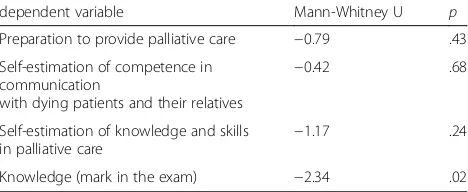
The Mann-Whitney-U-Tests yielded no significant re-sults (allp-values > .01) supporting hypothesis 1–4. Stu-dents who prepared for the exam by means of elearning (M = 1.8) had better marks in the exam than students who did not prepare by means of elearning (M = 2.5); however, this effect did not reach statistical significance (U =−2.34;p= .02). Test statistics of the Mann-Whitney U Tests and corresponding p-values are presented in Table3.
Discussion
There are still discrepancies between existing teaching resources and the high number of students in UPCE. Hence, a new model of elearning teaching delivery in palliative care was introduced and tested. In Germany, most curricula today only describe overall learning ob-jectives, while a specific curriculum and a detailed teach-ing objective catalogue are absent [22]. There is also a discrepancy between desire and reality with respect to the number of teachers and students [23]. Against this background, the innovative elearning concept “teaching palliative care using virtual standardised patients (VSP)” was developed as part of a curricular development cycle for UPCE at the University of Dusseldorf [24].
this study was to evaluate the effects of elearning on stu-dents’ self-estimation of competence in communication with dying patients and their relatives, self-estimation of knowledge and skills in palliative care, preparation to provide palliative care, and knowledge (measured by the mark in the written exam). The data did not yield sig-nificant results for our hypothesis that elearning would increase these factors. We were not able to detect any effects of elearning on students’self-estimation of com-petence in communication with dying patients and their relatives, self-estimation of knowledge and skills in pal-liative care, or preparation to provide palpal-liative care. This may be due to the fact that these factors are more practical aspects of the construct of competence in pal-liative care. It is possible that elearning is not the appro-priate approach to gain practical competency, and that real life contact with dying patients and their relatives is necessary to gain such skills, and consequently to in-crease self-estimation of competence in communication with dying patients and their relatives, self-estimation of knowledge and skills in palliative care, and preparation to provide palliative care.
We were able to show that elearning is a practical way to teach palliative care topics. The elearning course was well-received by students and has the potential to in-crease knowledge in palliative care. Other studies have shown similar effects [3, 24]. Successful elearning for-mats and methods necessitate adequate and reliable technical support and a suitable structural environment. It is of critical importance that elearning teaching units may be accessed and completed via various mobile de-vices. Such new technologies create more mobility, while on the other hand necessitating a higher level of
technical prerequisites, which may quickly lead to user frustration without adequate support [3].
The results of the present study are limited on the basis of the methodological restrictions of a proof-of-concept study. The unique survey does not allow causal assumptions but is suited to exploring new concepts. Acceptance of the presented concept was high. However, the results also show the limitations of online teaching in palliative care education. Students ask for instruction and training regarding attitudes toward death and dying through experience-based teaching [25]. The students’ free-text responses revealed that students accepted and appreciated the elearning course, but that the elearning contents could not replace direct encounters and prac-tice, which is why the students expressed their wishes for a higher degree of real patient contact. These results correlate with other studies [26]. Gibbins showed that students’suggested including real patients in UPCE.
Blended learning models might be used as a middle course between students’ expectations and wishes, and structural limitations. According to a study on student evaluations of a blended course, [15] demonstrated the success of a blended-learning approach in UPCE in com-parison to a traditional face-to-face teaching approach. Ruiz et al. highlighted evidence for the effectiveness and acceptance of elearning within medical education, in par-ticular with regard to the blended-learning approach com-bining elearning and traditional face-to-face teaching formats [10]. Blended learning formats also enable educa-tors to realistically design and edit online tools about topics and situations which do not lend themselves to traditional teaching formats (e.g. final phase, rituals fol-lowing the death of a loved one, and family conflicts) [27]. In light of the increasing use of elearning in medical edu-cation, further studies are deemed necessary and therefore highly recommended.
Limitations
We admit that questionnaire-based evaluation of the ef-fects of elearning courses in UPCE has its limitations. The self-efficacy expectation and knowledge of the construct of competence in palliative care include practical aspects in providing palliative care and communication with pa-tients and relatives. Consequently, it would be helpful to Table 2Mean PCEP-GR subscale scores and PCEP-GR index scores for elearners and non-elearners
Scale Non-Elearner Elearner Overall
Preparation to provide palliative care 3.29 (0.54) 3.36 (0.53) 3.37 (0.54)
Self-estimation of competence in communication with dying patients and their relatives
3.18 (0.56) 3.12 (0.62) 3.14 (0.62)
Self-estimation of knowledge and skills in palliative care
3.38 (0.70) 3.54 (0.56) 3.53 (0.59)
Knowledge (mark in the exam) 1.83 (0.85) 1.80 (0.81) 1.83 (0.85)
Mean (SD)
Table 3Test Statistics of Mann Whitney U-Tests
dependent variable Mann-Whitney U p
Preparation to provide palliative care −0.79 .43
Self-estimation of competence in communication
with dying patients and their relatives
−0.42 .68
Self-estimation of knowledge and skills in palliative care
−1.17 .24
supplement questionnaire-based evaluation of elearning courses in UPCE programs by means of objective clinical examinations [28, 29] in order to gain valuable behav-ioural outcome data [30–33]. Due to limited resources this option is often not feasible at university medical centres.
The study also has some methodological limitations. There were no baseline measurements of students’ knowledge and perceived self efficacy in palliative care prior to the elearning course. Consequently, no pre- vs post-elearning analyses concerning the dependent vari-ables were possible. Due to missing sample characteris-tics no subgroup analyses concerning age and gender were possible. Due to inhomogeneous sample sizes of subgroups (elearners vs. non-elearners) results need to be interpretated with caution. It is possible that we were not able to detect an effect due to a type two error (is the failure to reject a false null hypothesis).
Abbreviations
OSCE:objective structured clinical examination; PCEP-GR: German revised version of the Program in Palliative Care Education and Practice Questionnaire; UPCE: undergraduate palliative care education
Acknowledgements
The authors thank all the students for their participation in the evaluation. The authors thank the staff of the Dean’s office (Dr. Judith deBruin, Dr. Wiebke Glowatz, Doris Nord) for also supporting the evaluations and test results. We thank Manuela Schatz for her language editing. The development of the elearning course was funded by the Promotion Fund of the Heinrich Heine University, Dusseldorf, Germany.
Ethical approval and consent to participate
Ethical approval was obtained from the Ethics Committee of the Medical Faculty of Heinrich Heine University Dusseldorf, Germany (Ethics committee approval No. 4876). Participants consented to participate in the study and consented that results are published according to the ethical approval. The study was conducted in accordance with the Declaration of Helsinki on Ethical Principles for Medical Research involving Human Subjects. This report complies with the Strengthening the Reporting of Observational Studies in Epidemiology (STROBE) 22-item checklist to improve the quality of reporting of observational research [17].
Availability of data and materials
Data and material of this study will be made available on the public platform researchgate.net.
Authors’contributions
CS designed the study, supervised data collection, and analysed the data. UWM supervised data collection. KF designed the study, supervised data analysis, analysed the data, performed all statistical analyses, and wrote the manuscript. All authors read and approved the final manuscript.
Authors’information
CS is a consultant in psychosomatic medicine, medical psychotherapy, and palliative medicine in Germany. He is a training psychiatrist in the Maudsley Training Programme, affiliated with the Institute for Psychiatry, Psychology and Neuroscience (IoPPN) at King’s College, London, UK. Additionally, he pursues a doctorate in professional studies (DProf) in
existential-phenomenological psychotherapy at the New School of Psychotherapy and Counselling in London, UK. UWM is a scientist in behaviour and education, and a research associate for teaching at the Heinrich Heine University, Med-ical Faculty, Interdisciplinary Centre of Palliative Care, Dusseldorf, Germany. KF is a psychologist, doctoral candidate, freelance consultant for research methodology, and statistics and research associate at the Chair for Research Methodology and Statistics in Psychology at the Department of Psychology and Psychotherapy, Faculty of Health at Witten/Herdecke University, Witten, Germany.
Competing interests
The authors declare that they have no competing interests.
Publisher’s Note
Springer Nature remains neutral with regard to jurisdictional claims in published maps and institutional affiliations.
Author details 1
Institute of Psychiatry, Psychology and Neuroscience (IoPPN), Department of Psychological Medicine, King’s College, London, UK.2Interdisciplinary Centre
for Palliative Medicine, Medical Faculty, Heinrich Heine University Dusseldorf, Dusseldorf, Germany.3St Christopher’s Hospice London, Dusseldorf, UK. 4
Chair of Research Methodology and Statistics in Psychology, Department of Psychology & Psychotherapy, Faculty of Health, Witten/Herdecke University, Witten, Germany.
Received: 11 January 2017 Accepted: 9 April 2018
References
1. Hoppe J, Wiesing U. Ethikkommission bei der Bundesärztekammer zum
Umgang mit Vorsorgevollmacht und Patientenverfügung in der ärztlichen Praxis. Dtsch Arztebl. 2010;107:877–82.
2. Schulz C, Möller MF, Seidler D, Schnell MW. Evaluating an evidence-based curriculum in undergraduate palliative care education: piloting a phase II exploratory trial for a complex intervention. BMC Med. Educ. 2013;13(1) 3. Schulz C, Wenzel-Meyburg U, Karger A, Scherg A, in der Schmitten J, Trapp
T, et al. Implementation of palliative care as a mandatory cross-disciplinary subject (QB13) at the Medical Faculty of the Heinrich-Heine-University Düsseldorf, Germany. GMS Z. Für Med. Ausbild. [Internet]. 2015 [cited 2016 Aug 22];32. Available from:http://www.ncbi.nlm.nih.gov/pmc/articles/ PMC4330636/
4. Schulz C. The encounter between dying patients and medical
untergraduates during a course in end-of-life communication in the medical communication: a qualitative approach to insights into the patient perspective. Policy Rehabil: Rehabil; 2010.
5. Wear D. Face-to-face with it. Medical Students’Narratives about Their End-of-life Education Acad Med. 2002;77:271–7.
6. Weber M, Schmiedel S, Nauck F, Alt-Epping B. Knowledge and attitude of final-year medical students in Germany towards palliative care-an interinstitutional questionnaire-based study. BMC Palliat Care. 2011;10(1)
7. Traoré J, Schildmann J, Weber M. 90 minutes compulsory course of
palliative care on the Ward: teaching concept and qualitative results of an evaluation study. Z Für Palliativmedizin. 2012;13:229–35.
8. Rhodes-Kropf J, Carmody SS, Seltzer D, Redinbaugh E, Gadmer N, Block SD, et al.“This is just too awful; I just can’t believe I experienced that…”: medical students’reactions to their“most memorable”patient death. Acad Med. 2005;80:634–40.
9. Hildebrandt J, Ilse B, Schiessl C.“Traumcurriculum” –Wünsche Medizinstudierender an die Ausbildung in Palliativmedizin. Z. Für Palliativmedizin. 2013;3:80–4.
10. Ruiz JG, Mintzer MJ, Leipzig RM. The impact of e-learning in medical education. Acad Med. 2006;81:207–12.
11. Chojecki D. Personal digital assistant usage among undergraduate medical students: exploring trends, barriers, and the advent of smartphones. J Med Libr Assoc. 2010;98:157.
12. Link TM, Marz R. Computer literacy and attitudes towards e-learning among first year medical students. BMC Med. Educ. 2006;6(1)
13. Wong G, Greenhalgh T, Pawson R. Internet-based medical education: a realist review of what works, for whom and in what circumstances. BMC Med Educ. 2010;10(1)
14. Kim S, Farber S, Kolko BE, Kim W, Ellsbury KE, Greer T. Faculty and student participation in online discussions of palliative care scenarios. Fam Med-Kans CITY. 2006;38:494.
15. Kavanaugh K, Andreoni VA, Wilkie DJ, Burgener S, Buschmann MT,
Henderson G, et al. Developing a blended course on dying, loss, and grief. Nurse Educ. 2009;34:126.
17. Vandenbroucke JP, Von Elm E, Altman DG, Gøtzsche PC, Mulrow CD, Pocock SJ, et al. Strengthening the Reporting of Observational Studies in Epidemiology (STROBE): explanation and elaboration. Ann. Intern. Med. 2007;147:W–163.
18. Choules AP. The use of elearning in medical education: a review of the current situation. Postgrad Med J. 2007;83:212–6.
19. Lewin LO, Singh M, Bateman BL, Glover PB. Improving education in primary care: development of an online curriculum using the blended learning model. BMC Med. Educ. 2009;9:33.
20. Schulz C, Wenzel-Meyburg U, Fetz K, Karger A, Scherg A, Schmitz A. Students’use of e-learning in undergraduate palliative care education (UPCE). 4th Research in Medical Education (RIME) Symposium 2015. Munchen, 19.-21.03.2015., Dusse - Google Scholar [Internet]. [cited 2016 Aug 22]. Available from:http://www.egms.de/static/en/meetings/rime2015/ 15rime28.shtml.
21. Sullivan AM, Lakoma MD, Billings JA, Peters AS, Block SD. Others. Teaching and learning end-of-life care: evaluation of a faculty development program in palliative care. Acad Med. 2005;80:657–68.
22. Schiessl C, Walshe M, Wildfeuer S, Larkin P, Voltz R, Juenger J.
Undergraduate curricula in palliative medicine: a systematic analysis based on the palliative education assessment tool. J Palliat Med. 2013;16:20–30. 23. Schiessl C, Ilse B, Hildebrandt J, Scherg A, Giegerich A, Alt-Epping B.
[implementation of intersectional field 13: a survey of medical faculties in Germany]. Schmerz Berl. Ger. 2013;27:275–88.
24. Karger A, Scherg A, Schmitz A, Wenzel-Meyburg U, Raski B, Vogt H, et al. A Pilot Study on Undergraduate Palliative Care Education â A Study on Changes in Knowledge, Attitudes and Self-Perception. J Palliat Care Med. [Internet]. 2015 [cited 2016 Aug 22];2015. Available from:https://goo.gl/ 4nfsZX.
25. Ilse B, Hildebrandt J, Posselt J, Laske A, Dietz I, Borasio GD, Kopf A, Nauck F, Elsner F, Wedding U, Alt-Epping B. Palliative Care teaching in Germany– concepts and future developments. GMS Z Med Ausbild. 2012;29(3):Doc47. 26. Gibbins J, McCoubrie R, Forbes K. Why are newly qualified doctors unprepared
to care for patients at the end of life. Med Educ. 2011;45:389–99. 27. Weissman DE, Quill TE, Block SD. Missed opportunities in medical student
education. J Palliat Med. 2010;13:489–90.
28. Harden RM, Gleeson FA. Assessment of medical competence using an
objective structured clinical examination (OSCE): ASME; 1999. 29. Harden RM. What is an OSCE. Med Teach. 1988;10:19–22.
30. Mason SR, Ellershaw JE. Preparing for palliative medicine; evaluation of an education programme for fourth year medical undergraduates. Palliat Med. 2008;22:687–92.
31. Mason SR, Ellershaw JE. Undergraduate training in palliative medicine: is more necessarily better? Palliat. Med. [Internet]. 2010 [cited 2016 Aug 10]; Available from: http://pmj.sagepub.com/content/early/2010/02/01/ 0269216309351867.abstract
32. Eva KW, Regehr G. Self-assessment in the health professions: a reformulation and research agenda. Acad Med. 2005;80:S46–54.