Human Intent Representation in Knowledge
Intensive Product Model
L. Horváth
Budapest Tech, John von Neumann Faculty of Informatics, Budapest, Hungary Email: horvath.laszlo @nik.bmf.hu
I. J. Rudas
Budapest Tech, John von Neumann Faculty of Informatics, Budapest, Hungary Email: [email protected]
Abstract—Success in engineering activities mostly depends on success in transfer of human intent into product. Recently, product development applies product model as medium to describe product information in product data base. While modeling gives a great chance for the description of engineer’s intent, current information based product models are not capable of this description. Human intent remains in the mind of engineers and its description in interrelated data of engineering objects is still at a shallow level. Because the main barrier is information based nature of current product models, the authors propose a method to extend this product model to the background of modeled object information to include human intent. Called as information content based modeling, this new product modeling method is developed starting from modeled intent of engineers and other influencing people. Definition of information in the product model is controlled by human intent and other information content entities that are also defined by using of model of human intent. This paper concentrates on definition of human control on product model information, modeling of human intent, human intent based definition of information content and some implementation issues.
Index Terms—product development, product lifecycle management, modeling of human intent, information content based product model.
I. INTRODUCTION AND PRELIMINARIES
One of the recent development areas in application of information technology is lifecycle management of products (PLM). Massive PLM systems with robust product modeling capabilities are available for the creation and application of well-structured product information at extended companies. Product development projects are organized around special portals resulting unlimited product development irrespective of geological position of engineers, engineering systems, and production systems.
While the above improvements are well-established and gained wide acceptance, increasing number of engineering objects and huge number of relationship definitions to be described in the product model are impossible to survey by conventional modeling methods.
At the decision on engineering objects, two main problems are consideration of affects of influencing humans and tracking consequences of a changed engineering object in a labyrinthine crowd of relationship definitions in a large product model.
In this paper, the authors introduce and explain their achievements for the solution of the first of the above two problems. The research was motivated by the problem in present product modeling that humans can not communicate content of their mind during thinking process about definition of engineering objects with modeling procedures. Instead, they are forced to communicate the result of this thinking process as interrelated data describing engineering objects such as parts, their features, analysis results, manufacturing operations, etc. in the product model. The consequence is a product model that does not include information about background of decisions on engineering objects. When an engineer other than who made the original decision applies a product model at its revision, development, or correction, no information is available for the reconstruction and revising of the original decision.
Knowledge transfer from the human mind to modeling system has critical role. Most of current knowledge-based product modeling techniques is based on analyses of objects in the structure of the product depending on category of product. One of the primary objectives is organized knowledge. A transformation of an existing set of heterogeneous product knowledge into a coherent design repository is described in [1]. Existing product information was analyzed and compared against desired outputs to ascertain what information management structure was needed to produce design resources pertinent to the design process. Knowledge about product functionality is analyzed in the phase of conceptual design by the authors of [2]. Aimed at capturing such functional knowledge that can easily be applied to other domains, they developed an ontological framework to systematic description.
extended companies on the Internet. As a solution for the complexity problem, paper [3] describes integrated product and process modeling (IPPM) framework for collaborative product design through the Internet. An agent-based approach is proposed for the computer support of hierarchical and heterarchical design topologies.
Personal nature, acceptance and application of knowledge constitute one of the challenges at the development of knowledge-based solutions for engineering. Authors of [4] give an overview of approaches to knowledge management through personalization, including human and organizational approaches, concentrating on the establishment of communities of engineers.
One of the problems in product engineering is about support for coordination of distributed design tasks. Product data management (PDM) systems are often not suitable for distributed engineering environment. As a solution for this problem, the authors of [5] present agent-based process coordination (APC) framework for distributed design process management. In this approach, embedding of autonomous agents is applied in a workflow-based distributed system infrastructure.
Consequence of increasingly frequent changes of engineering objects during product development is very complex information processing. In [6], a parameter-basedapproach is introduced for improving the handling of changesacross collaborating enterprises.
Leading PLM systems include more or less knowledge advising functions as a result of efforts to integrate knowledge based modeling procedures in product model descriptions. In [7] an application tool is shown that utilizes the knowledge-based-engineering environment in a PLM system. This application tool uses design rules for aerospace structures to add details to a conceptual design. It can modify the structures to achieve the design goal of compliance with performance criteria with minimum weight.
One of the main efforts in development of product modeling in the past decades was the STEP product model standard development project by the ISO (ISO 10303). Objective of this work was data exchange without loss of information during interoperation of different modeling systems. In order to implementation of the STEP, Standard Application Protocols are being developed for different industries. STEP supports product data representations of interim and final results of product development. Considering the purpose of this paper, it is important that attempts to include knowledge in product model generally get start from STEP. In [8], a framework for the development, usage, and extension of integrated data and knowledge models, using standard-based protocols is proposed.
As an earlier effort, the authors proposed the application of integrated model object (IMO) for data communication in case of high number of associative product objects [10]. IMO is suitable for communication and store of more information for decisions than
conventional solutions. IMO represents data oriented modeling.
It has been concluded from a comprehensive analysis of models and modeling techniques in recent PLM systems [11] that, despite efforts towards knowledge intensive modeling, current product models in the industry are composed by pure interrelated data structures. At a low level of automation of the decision process, information content is handled in mind of humans. Alternatively, explanation and evaluation functions are included in information based procedures in order to achieve a slight representation of human intent.
The remaining of this paper introduces, explains and exemplifies definition of human control on product model information, modeling of human intent, human intent based definition of information content and some implementation issues.
II. HUMAN CONTROL OVER PRODUCT MODEL ENTITY GENERATION
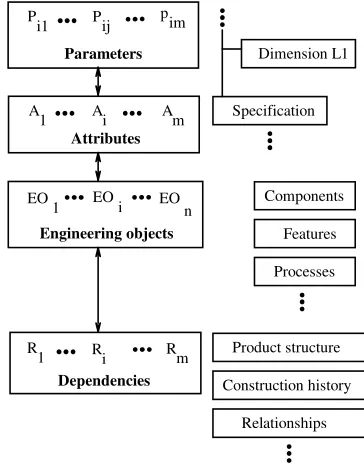
Current Product lifecycle management systems use 3D model space in which engineers define and relate shape engineering objects. Information about any other engineering object is mapped to shape objects. Model space serves as a medium that represents a space from the real world for the product under development. It allows the description of interrelated engineering objects, and it is developed by using of a set of purposeful modeling procedures. Decisions on engineering objects need much more knowledge about origin and background of model information than that current product modeling systems can provide.
R
1 Ri Rm
Dependencies P
i1 Pij pim
Parameters
Components
Features
Processes Specification
Product structure
Construction history
Relationships Dimension L1
A
1 Ai Am
Attributes
Engineering objects 1
EO EOi
n EO
Figure 1. Product model space in classical product modeling.
important groups of attributes are specification such as dimensions, capacity, etc. and measured or analyzed characteristics such as temperature in a node of a finite element mesh.
Suppose that modeling product uses advanced knowledge based methodology. In an engineering process for product development active engineers use own mind to define, cite, and apply knowledge during their activities (Fig. 2). Knowledge is used at control of the knowledge based modeling procedures. Some of the knowledge is communicated with knowledge representation procedures that apply, store, and create knowledge. Low percent of the knowledge that is emerged at active engineers is embedded, integrated and referred in the product model, as it is discussed by the authors of this paper in [9]. The problem is that knowledge representation capability in current product modeling assures storage only low percentage of the knowledge from the mind of active engineer. Engineer uses knowledge that is not communicated with knowledge based modeling procedures. These procedures use knowledge that is not stored. In this way, most of the knowledge is not accessible at the application of the product model or lost. Fortunately, high percentage of this knowledge is recorded by the engineer. However, it is not available at the application of the product model.
.
Store and retrieve product information Control of operation of a procedure in dialogue Knowledge related activities of an active engineer
Defines Cites Applies
Knowledge representation by procedure
Applies Stores Creates
Knowledge representation in product model
Referred Integrated
Non-accessible
and lost
knowledge
Stored
and lost
knowledge
Embedded
Figure 2. Human control over definition of product objects.
III. KNOWLEDGE IN PRODUCT MODELING
As a conclusion of the discussion in the previous chapter of this paper, key aspect of product modeling is transfer of knowledge from the human’s mind to product model in an extent that is necessary to apply the model in absence of the engineer who decided the information in it. The problem is that a decision is affected directly or indirectly by different humans (Fig. 3.). Besides the engineer who responsible for a decision, collaborating engineers have influence on it. Active engineers are supported by experts and scientists. Corporate knowledge resources are to be considered such as company strategy, specifications, engineering objectives, and reusable practice. Supervisors, customers, legislation, and
standards represent direct and indirect controls over decisions on engineering objects.
Supervisors Reusable practice
Legislation
Standards Experts
Scientists Engineers Responsible
Company strategy
Models Methods
Supports
Knowledge
Customers Related product
objects
Product model Engineering objects
under processing in the responsibility
of engineer "A"
with engineer "A"
Specifications
Engineering objectives
Standards engineer "A"
in collaboration
Active engineers
Corporate resources
Controls
Figure 3. Affects on decisions by engineers responsible for engineering objects.
Share knowledge in a work group Practice
Validation
Correction
Threshold
Consistency Purpose of knowledge
Repetitive task Defined
Collected Captured
Sources of knowledge
Rules Checks
Situations Behaviors Reactions Conditions
Context Parameter range Products view
Formulas Representations Representation of knowledge
for application
Application
Procedures (for processing)
Models (for embedding)
Humans (as information) Parameter sets
Networks Agregats Acceptance
Responsibility Hierarchy
Evolutionary
Due to organized and controlled nature of engineering processes, knowledge should be processed in an organized and controlled nature. Moreover, high percentage of engineering decisions is confident and protected by law and copyright.
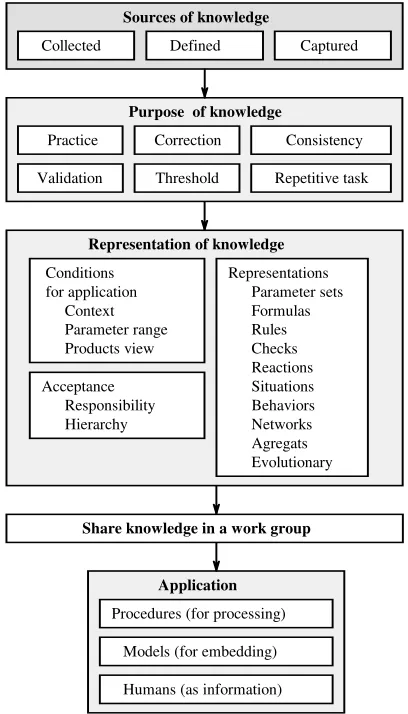
Knowledge is collected, defined or captured in modeling environments (Fig. 4). Application of knowledge is affected by its purpose. Model representation must include information about conditions of application and acceptance. Known knowledge representations can be applied. Currently, simple representations that are easy to understand by engineers are preferred. The authors anticipate an extension of the applications to more advanced representations by the introduction of information content based product modeling.
Knowledge is shared in work groups according to measures in the actual engineering organization. For its application, knowledge can be available for modeling procedures, in product models, and for humans.
IV. MODELING OF HUMAN INTENT FOR PRODUCT DEVELOPMENT
Knowledge is personal or corporate nature. It is based on intent of humans. Consequently, modeling of human intent is essential. Human intent carries decisive information content from authorized human to the definition process of engineering objects. Intent model can be considered as an intelligent version of the conventional history of model construction in that information about steps of model construction is completed by a simplified description of human thinking process.
Status of human
Status of intent
Information content Motivation for intent
Thinking process Authorization and access
Content of intent Human
Characteristics
Purpose of intent
related information
for engineering objects LEVEL 1
LEVEL 2
LEVEL 3
Figure 5. Three leveled model of human intent in engineering.
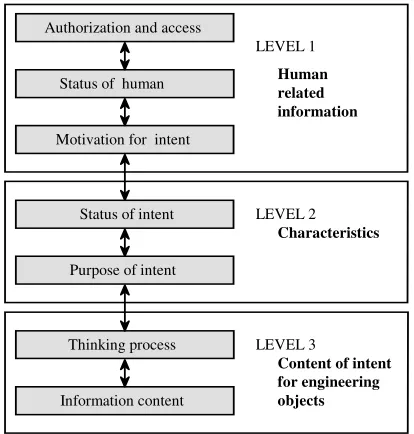
In the reported research, modeling of human intent is considered as information content that consists of three groups of entities for information about the owner of the intent, characteristics of intent, and content of intent (Fig. 5). Information about human is composed by
authorization and access, status of the owner human, and motivation of human for the intent. Characteristics of intent are its status and purpose. Human thinking process information and information content constitute the content of intent.
Authorization and access information connects intent with project and engineer organizations. Motivation of intent (Fig. 6) informs about cause that initiated the human thinking process for the intent. It refers to the situation specific nature of human thinking process. Status of the owner human informs about the position and influence strength of the human who defined the intent. Roles of human in projects or in a work group are to be listed in the choice of status of humans.
Proposer
Decides on
Approver Analyzer
Responsible for Authority
b) Status of human Worrying about
a) Motivation of the communicated intent To be informed
Asking
Suggested
For discussion
To be improved
For approval
Approved
For decision
Decided
Command
Result of test
Figure 6. Examples for human related intent information.
Purpose of intent refers to its application (Fig. 7). Besides definition of parameters for engineering object, intent may serve a strategy, a counter-proposal, aspect of application, etc. Status of intent informs about its strength. It varies from the strong standard to the weak maybe.
Alternative
Allowable range
Application
Strategy Counter-proposal
Compatibility
Fix parameter value
Pros and contras
Standard
Opinion Wished
Maybe
Experience Customary
Regulation b) Purpose of intent
b) Status of intent
Figure 7. Examples for characteristics of intent.
V. EXTENSION OF PRODUCT MODEL FOR HUMAN INTENT
process, and content of information for these entities (Fig. 8).
Content of information Practical entities in human thinking process at the definition
of engineering objects
decision points Partial (Interim)
Stages
Logical connections
Figure 8. Human source of content of intent.
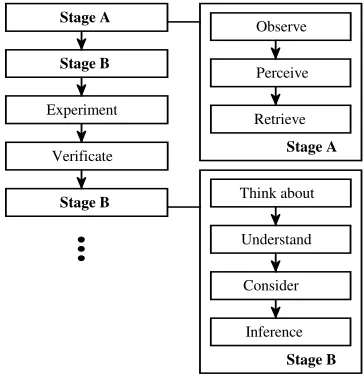
Figs. 9 and 10 show possible sequences for partial decision points and stages of thinking process, respectively. These sequences represent logical routes to the solution.
Method Goal
Rule
Dependence
Procedure Taxonomy
Experience
Parameter
Figure 9. Example for a sequence of partial (interim) decision points.
Observe
Perceive
Inference Understand Think about Experiment
Consider Retrieve
Stage A
Stage B Verificate
Stage B Stage A
Stage B
Figure 10. Examples for stages of human decision process.
Human produces results at interim decision points (Fig. 9). Any result is mapped to the actual engineering objects as intent. Structure of elements of thinking process may be represented in three or network. One of the knowledge or fact carriers accepted in the product development and management organization is produced as result at a partial or interim decision point.
In the course of thinking process, engineer observes related physical and logical phenomena, perceives
relevant real world information, and retrieves product model and other stored information and information content from the computer system. Engineer also retrieves related information and information content stored in mind as knowledge and fact-like experience. This is the stage A of the thinking process on engineering object related decision. Having all initial information, human understands the problem, thinks about it, considers the circumstances, and inferences. This is the stage B of the thinking process on engineering object related decision. Human conducts experiments, and evaluates and verifies results then interprets results or goes back to the stage B.
The analysis in the reported research resulted that information content in a product model should be represented by intent of humans, meaning of concepts, engineering objectives, contexts, and decisions (Fig. 11). At the same time, this is also a chain of decision of information content.
Meaning of concepts
Contexts Intent of humans
Decisions Engineering objectives
Figure 11. Content of information in product model.
Decision on engineering objects should be done as it is required by influencing humans. Intent of influencing humans should be recorded together with the agreed hierarchy of them. Definition of intents includes concepts. Meaning of these concepts is the next element of the modeled information content. Engineering objects should match with engineering objectives. These objectives are specified directly by influencing humans or they come from human intent definitions. An engineering object is defined in the knowledge of information about engineering objects that are in relationship with it. These relationships are generally coming from human intent and engineering objective definitions. For this purpose, contextual and non-contextual dependencies are to be modeled. Content is necessary to know about decisions because it is the basic of control engineering objects in the product model space. Decision changes engineering objects. Consequences of these changes are change of other engineering objects that are in direct or indirect dependence connection with the originally changed engineering objects.
Procedures generate Human
Defines information content and controls procedures indirectly by
information content
Control of
by information content
Procedures generate
PRODUCT MODEL information content for engineering objects
engineering objects
information for engineering objects
Figure 12. Information content based product modeling.
VI. HUMAN INTENT BASED DEFINITION OF PRODUCT
BEHAVIOR
The engineering object centered definition in current product modeling is replaced by engineering objective centered definition. Engineering objectives are defined in accordance with human intent. In the reported research, engineering objectives are represented by extended definition of behaviors of engineering objects. Behavior is evaluated for values of well-defined parameters of engineering objects called as circumstances (Fig. 13). A set of circumstances actual for a behavior is called as situation.
Engineering object or
Behaviors for the
Situation definitions for behaviors relationship between engineering objects
Engineering objectives
description of engineering objectives
Circumstances for situations
Figure 13. Behaviors for engineering objectives.
Figs 14 and 15 show examples for behaviors of an engineering object and relationships between engineering objects, respectively.
In Fig. 14 two behaviors are defined for a swept surface. They are for shape and continuity engineering objectives. A single surface is defined. At the same time, it fits to the adjacent surfaces with specified continuity in
the boundary geometry of a part. The first behavior for engineering objective shape is defined by situation control. This situation is composed by circumstances for input parameters of the relevant shape creation procedure. These parameters describe control of shape of the swept surface by generator, path, and spine curves as well as by base function and weighting of a rational B-spline (NURBS) surface. The second behavior for engineering objective continuity defines connections with adjacent surfaces. The connection situation is composed by circumstances for intersections with adjacent surfaces, border curves, as well as second order continuity along borders allowed by same tangents and curvatures at mating points.
c g
s sw
c p = c s
Control Connection
Type Generator Path Spine Weight Function
Intersections Borders Tangent Curvature
Shape Continuity
Engineering object:
swept surface in the boundary of a solid part
Behaviors
Situations
Circumstances
Figure 14. Example for behaviors in case of engineering object.
Part instances Constraints Geometry
Placing
Collision-free Connection
Volumes
Self-locking
Cones Self-locking connection of cones
Solid geometry Volumes Paths
Form features Forces path
Relationship of two engineering objects:
Behaviors
Situations
Circumstances
Figure 15. Example for behaviors in case of relationship between engineering object.
situation of placing of mated surfaces. Collision avoidance behavior depends on moving and fixed volumes of parts. Appropriate cones provide for self-locking behavior.
VII. IMPLEMENTATION ISSUES
In order to fit to local measures, demands, and circumstances in real world engineering environments, responsible engineers first define role both of data and content orientation. Role of data and content orientation must be predefined mainly in order to set functions and weight of content based definition of model data.
A locally applied PLM system includes a single modeling system or several different modeling systems according to the type of product and the configuration of product development environment. Content oriented modeling extension handles own entities and communicates with modeling systems by using of their open surface. Data and content oriented model entities exchange information by using of a special communication.
Modeling systems in PLM system
Ms1 Ms2 Msn
Information content oriented extension to modeling system Role of
information and
orientation
product model sector
Information orientated Information content oriented product model sector
Entities
Entities Communication
Communication Engineers
information content
Figure 16. Method of implementation.
PLM systems include extensive modeling software tool sets (Fig. 17). Related functional units of PLM systems are for management of product data from different modeling systems, for interoperability to enable data exchange with non-integrated modeling systems, as well as for group work and Internet portal communication. Modeling procedures, model data structures, and the graphic user interface can be accessed from programs in the information content extension, developed by using of tools that are available in PLM systems. Access is available through standard application programming interface (API).
Laboratory of Intelligent Engineering Systems (LIES) of the Institute of Intelligent Engineering Systems, John von Neumann Faculty of Informatics, Budapest Tech. has been equipped with leading industrial PLM, intelligent computing, and mathematics software, among others for
the purpose of experiments with information content oriented modeling.
Open surface of PLM system to access modeling procedures, model data and
for outside programs
Application programming interface (API)
Professional PLM system
Group work management
Internet portal and specialized browser Product model
Extension for information content human interface
Multilevel organization of model for data
Multilevel model for information content Modeling procedures for data orientation
Product data management (PDM)
Interoperability tools
Development tools in the PLM system
Figure 17. Development of professional modeling software using API.
VIII. CONCLUSIONS AND FUTURE RESEARCH This paper introduces and discusses results of a research in development of product modeling towards intelligent problem solving. According to the essential concept of this research, information in current product model should be completed by its content. This content must be based on intent of directly and indirectly influencing humans. The strategy is representation of elements from the human meaning in an extent that can effectively support the definition of human intent, meaning of related concepts, engineering objectives, contexts, and decisions as entities in model description of information content.
The main purpose of this new modeling is human oriented automation of control at the definition of information for engineering objects. The authors consider this approach to the development of industrial product modeling as a means for solution of the problem of very complicated and large information based product models that are impossible to survey by conventional modeling methods.
information based current product model in order to its control. Other challenge is extract minimum design intent from human thinking processes to product model. The utmost goal is an enhanced human-computer interaction (HCI) in product development and lifecycle management of product information.
ACKNOWLEDGMENT
The authors gratefully acknowledge the grant provided by the NKTH-OTKA Fund for Research of the Hungarian Government. Project number is K 68029.
REFERENCES
[1] Bohm, Matt R; Stone, Robert B and Szykman, Simon, “Enhancing Virtual Product Representations for Advanced Design Repository Systems,” Journal of Computing and Information Science in Engineering (Transactions of the ASME). Vol. 5, no. 4, pp. 360-372. December 2005.. [2] Yoshinobu Kitamura, Masakazu Kashiwase, Masayoshi
Fuse and Riichiro Mizoguchi, “Deployment of an ontological framework of functional design knowledge,” Advanced Engineering Informatics, Volume 18, Issue 2, pp 115-127 April 2004..
[3] Yoon-Eui Nahm and Haruo Ishikawa, “Integrated Product and Process Modeling for Collaborative Design Environment,” Concurrent Engineering, Vol. 12, No. 1, pp 5-23, 2004..
[4] Chris McMahon, Alistair Lowe and Steve Culley, “Knowledge management in engineering design: personalization and codification,” Journal of Engineering Design, Volume 15, Number 4, pp. 307 – 325, August 2004.
[5] Therani Madhusudan, “An agent-based approach for coordinating product design workflows,” Computers in Industry 56, pp. 235–259, 2005..
[6] Jeongsam Yang, Michael Goltz and Soonhung Han,
“Parameter-based Engineering Changes for a Distributed Engineering Environment,”Concurrent Engineering, Vol. 12, No. 4, pp. 275-286, 2004..
[7] Jin-Woo Choi, Donald Kelly, John Raju and Carl Reidsema, “Knowledge Based Engineering System to Estimate Manufacturing Cost for Composite Structures,” Journal of Aircraft, vol.42, no.6, pp. 1396-1386, 2005. [8] Ricardo Jardim-Goncalves, Nicolas Figay and Adolfo
Steiger-Garcao, “Enabling interoperability of STEP Application Protocols at meta-data and knowledge level,” International Journal of Technology Management, Volume 36, Number 4, pp. 402 – 421, 2006.
[9] L. Horváth and I. J. Rudas, “Human Intent Description in Environment Adaptive Product Model Objects,” in Journal
of Advanced Computational Intelligence and Intelligent Informatics, Tokyo, Vol 9, No.4, pp. 415-422, 2005 [10]I. J. Rudas and L. Horváth, “Emphases on Human Intent
and Knowledge in Management of Changes at Modeling of Products,” WSEAS Transactions on Information Science and Applications, Issue 9, Volume 3, September 2006, ISSN 1790-0832, pp 1731-1738.
[11]L. Horváth and I. J. Rudas, “Modeling and Problem Solving Methods for Engineers “, ISBN 0-12-602250-X, Elsevier, Academic Press, 2004, p. 330
László. Horváth author received the M.Sc. degree in control of manufacturing processes and Ph.D. in modeling and computer aided development of industrial processes from the Budapest University of Technology and Economics (BME). He also received Ph.D. degree from the Hungarian Academy of Sciences. He is currently a full university professor at the Institute of Intelligent Engineering Systems, John von Neumann Faculty of Informatics, Budapest Tech. His current research interests are intelligent modeling of products, human-computer interaction in engineering processes, and virtual spaces for engineers. He has authored and coauthored more than two hundred journal and conference papers in these areas. He is a senior member of IEEE.