THE GENERATION OF RHYTHMIC ACTIVITY IN A
DISTRIBUTED MOTOR SYSTEM
BY CHRISTOPHER S. COHAN* AND GEORGE J. MPITSOSf
Department of Anatomy, Case Western Reserve University, Cleveland, Ohio 44106
{Received 18 March 1982—Accepted 29 July 1982)
SUMMARY
Rhythmic activity that is distributed to the brain and buccal ganglia and which underlies several types of behaviour, can be evoked from isolated nervous systems of Pleurobranchaea califomica by tonic nerve stimulation. The experiments presented here were designed to test whether this rhyth-mic activity is produced by independent neuronal oscillators located in each ganglion or whether the rhythmic activity arises from a single oscillatory locus in the buccal ganglion and is transmitted passively to the brain. By interrupting the conduction of activity in the cerebrobuccal connectives (CBC) between brain and buccal ganglia we show that motor output from the brain depends on sustained, cycle to cycle input from the buccal gang-lion and cannot be reset with respect to the buccal activity. The production of rhythmic activity in the brain depends on the generation of rhythmic activity in the buccal ganglia whether the rhythms are activated by stimula-tion of buccal roots or paracerebral command cells in the brain. Simul-taneous intracellular recordings from brain motoneurones and buccal inter-neurones which project to the brain indicate that these interinter-neurones provide both the drive and the pattern for rhythmic motor output in the brain. Tonic stimulation of the CBC can produce rhythmic activity in isolated brains in which all nerve roots and connectives have been cut. This can be explained by the fact that tonic stimulation of the connectives is transformed into phasic activity by the axons within the connective. We conclude therefore, that rhythmic, coordinated activity in the brain and buccal ganglia of Pleurobranchaea arises from oscillatory circuits that are located only in the buccal ganglia.
INTRODUCTION
The present understanding of the generation of behaviour by nervous systems has arisen primarily from studies on relatively stereotyped movements such as swimmeret beating (Hughes & Wiersma, 1960; Davis, I969a,b,c), postural control (Evoy & Kennedy, 1967; Kennedy, Evoy, Dane & Hanawalt, 1967; Bowerman & Larimer, 1974a,b), walking (Pearson, 1972), and escape responses (Wine, 1977a,b; Zucker, Kennedy & Selverston, 1971) in arthropods, swimming in annelids (Kristan, 1974;
• Present address: Department of Zoology, University of Iowa, Iowa City, Iowa 52242.
f University of Oregon, Health Science Center, Department of Medical Psychology, Portland, Oregon, and Marine Sciences Center, Newport, Oregon,
Stent etal. 1978), and swimming (Willows, Dorset &Hoyle, 1973a,6; Getting, 1977J and feeding in molluscs (Kater, 1974; Davis, Siegler & Mpitsos, 1973; KupfermanS & Cohen, 1971; Gelperin, Chang & Reingold, 1978). Traditionally, individual sensory-to-motor neurocircuits have been isolated for study in experiments in which a specific stimulus is applied to produce a definable response. Some functions of neurones, such as command (Kupfermann & Weiss, 1978), trigger (Getting, 1975), coordination (Stein, 1971, 1974), and oscillation functions (Wilson, 1961; Delcomyn, 1980) have emerged from such studies and extended the notion of the neurocircuit beyond that of the simple reflex. Nonetheless, this experimental approach has forced a reductionist perspective that, although heuristically useful, views behaviour as a repertoire of independent responses and is inconsistent with the observed behaviour of animals.
The behaviour of freely moving animals appears as smooth transitions between different responses rather than sequences of independent movements; one behavioural pattern 'blends' into another such that the execution of one response is affected by the attempt to produce another (Bellman, 1979). Animals continuously receive many different stimuli simultaneously, some of which may require contradic-tory responses, and all of which produce some effect in the nervous system. An understanding of the integrative properties of the nervous system, and even of the applicability of the extant concepts of neurone functions and circuits to the analysis of behaviour, requires a holistic perspective in which the interactive effects produced by many stimuli and different motor activities are considered.
We have studied the neuronal basis of different types of behaviour that involve relatively similar movements in the marine gastropod, Pleurobranchaea. The buccal and anterior head structures of Pleurobranchaea, namely, the buccal mass, radula, mouth, lips, jaws, and oral veil, are used in at least five types of behaviour: feeding, regurgitation (active and passive phase), rejection, defensive bite, and self and interanimal gill grooming. At least three of these - feeding, regurgitation, and rejec-tion - can be reliably elicited and have been studied extensively (McClellan, 1982a). All five types of behaviour involve similar observed movements of the buccal struc-tures, yet the consequences of these movements are quite different. For example, during feeding, a substance is sequentially ingested and swallowed by cyclical ments, and during rejection the ingested substance is sequentially expelled by move-ments that are outwardly similar. Although some muscles must be activated different-ly in the two sets of movements to account for the different effects, there is much similarity in the underlying motor programmes recorded from muscles in behaving animals and from nerves in isolated nervous systems. In fact, at present it is possible to distinguish only two rhythmic patterns, one attributable to the active phase of regurgitation and another which may represent aspects of the different types of behaviour (McClellan, 1982a,6).
|hile activity in the buccal muscles was observed, and (2) muscle potentials were Rund to occur at constant latency in relation to identified action potentials which were recorded from the innervating nerves (Davis et al. 1973; Lee &Liegeois, 1974). Since the different behavioural sequences require movements of intrinsic and extrinsic muscles, there must be coordination of activity between the brain and buccal ganglia so that the appropriate motor patterns are produced. Moreover, since these patterns are expressed in the motor output of deafferented brain and buccal ganglia (McClellan, 19826) it is possible to use isolated preparations to enquire into the principal mechanisms of coordination.
Previous studies have suggested that patterns of rhythmic activity in the brain and buccal ganglia require coordination of independent neuronal oscillators located in each ganglion (Davis et al. 1973, 1975). In the present paper, however, it will be shown that oscillatory activity is generated only in the buccal ganglion, and that this provides the cyclic drive for responding centres in the brain which are not inherently oscillatory. In the following study (Cohan & Mpitsos, 1983) it will be shown that the different motor patterns which can be obtained in isolated nervous systems are produced by the selective action of an intermediary group of functionally heterogeneous neurones in the buccal ganglion, buccal-cerebral interneurones (BCI), that connect the driving with the responding loci. A third paper (C. S. Cohan & G. J. Mpitsos, in preparation), will discuss how the multifunctional properties of neurones in the nervous system of Pleurobranchaea allow the drive of an oscillator to be expressed in a variety of motor patterns and will also suggest mechanisms by which different motor patterns and smooth transitions between them might be produced by a limited number of neurones.
MATERIALS AND METHODS
Specimens of Pleurobranchaea califomica were obtained from Pacific Biomarine Labs (Venice, California). These animals ranged in size from 100-300ml body volume and were housed individually in a circulating seawater system. Preparations of the nervous system, consisting of buccal, cerebral, pedal, visceral and stomatogastric ganglia (Fig. 1) were dissected from the animals and pinned through their connective tissue sheaths to a Sylgard (Corning) platform in a Lucite prepara-tion chamber. After desheathing the nerves, sucprepara-tion electrodes were attached for recording and stimulating. Ganglia were bathed in artificial sea water (Instant Ocean) supplemented with 1 % dextrose (denoted by ASW) and maintained at 11°C by a circulating cooler (Haake).
Conduction blocks
Sucrose perfusion
CPG
LOVN
MN
SD
[image:4.451.108.331.92.429.2]MGON
Fig. 1. Drawing of the ventral surface of an isolated nervous system. Abbreviations are as follows: LOVN, large oral veil nerve; SOVN, small oral veil nerve; T N , tentacle nerve; MN, mouth nerve; CPC, cerebropedal connective; CVC, cerebrovisceral connective; BWN, body wall nerve; PC, pedal connective; CBC, cerebrobuccal connective; R3, R2 and Rl are the third, second and first roots of the buccal ganglion, respectively; STGN, stomatogastric nerve; SN, salivary nerve; MGON, medial gastroesophageal nerve; STMG G, stomatogastric ganglion; BG, buccal ganglion; CPG, cerebropleural ganglion; PG, pedal ganglion; 3D, salivary duct.
Wnodai block
Anodal blocks were used when immediate conduction block of CBC activity was required. This was achieved by applying anodal current to the nerve via a suction electrode, exactly as for an en passant recording. A nearby indifferent lead served as the positive current source. Its placement did not affect block efficacy. Activity within the nerve was monitored by an appropriately placed additional electrode either up-stream or downup-stream from the blocking electrode. The blocking electrode could be switched easily to record mode if so desired.
Square wave, d . c , constant current pulses of approximately 10 fiA in amplitude and of durations equal to the intended blocking time were used. Generally, the amplitude of the blocking current was set at a value just greater than threshold for conduction block. This point could easily be found by slowly increasing the amplitude of the blocking current while applying short (0-5 s) d.c. pulses. This caused stimula-tion of the nerve, at first, until the current at the anode became large enough to suppress conduction. This method resulted in the least amount of anode break excita-tion when the current was switched off. Greater amplitude currents progressively increased the amplitude and duration of break excitation and irreversibly damaged the nerve. With anodal block, activity in the CBC could be blocked immediately at stimulus onset and was reversible for durations up to 1 min.
Identification of motor patterns
Rhythmic motor patterns can be obtained reliably from the isolated nervous system (Fig. 1) by a variety of methods, among which are tonic stimulation of the stomatogastric (Davisetal. 1973) and gastro-oesophageal (McClellan, 19826) nerves, and by tonic depolarization of the paracerebral cells in the brain (Gillette, Kovac & Davis, 1978). Originally, all such patterns were presumed to represent the feeding behaviour. More recent work (McClellan, 1980, 1982a), however, has suggested that the buccal structures which are innervated by these ganglia are used in at least five types of behaviour. In accordance with this it has been shown that stimulation of the medial gastro-oesophageal (MGON) or stomatogastric (STGN) nerves at low current levels evokes motor patterns that may represent rejection and the passive phase of regurgitation as well as feeding, whereas higher current levels evoke a second type of motor pattern which has been identified with the active phase of regurgitation (McClellan, 19826). We shall therefore refer to the first type of motor output as the primary pattern rather than as the feeding motor pattern, and to the second type of motor output as the vomiting motor pattern.
Identification of cells
potential in the cell body of the neurone. These antidromic potentials followed ol for one at frequencies of 10 Hz.
Intracellular recording
Ganglia were prepared for intracellular recording by removing their connective tissue sheath in a high osmolarity (1500 ITIOSM) sucrose-supplemented bathing solution to preserve ganglionic morphology. Before recording, the bathing solution was replaced several times with ASW. Single and double barrelled glass capillary micropipettes were filled with 3 M-KCI and beveled (Ogden, Citron & Pierantoni,
1978) to a final impedance of 5-20 MQ. Activity was displayed via capacitively com-pensated amplifiers (McClellan, 1980) on an oscilloscope and simultaneously stored on magnetic tape using an FM tape recorder (Vetter). Records were photographed with a 35 mm oscilloscope camera and image intensifier (McClellan, 1980). A PDP-11 minicomputer was used to analyse data. Graphs were constructed using Fortran programmes (Cohan, 1980) and a Hewlett-Packard plotter.
RESULTS
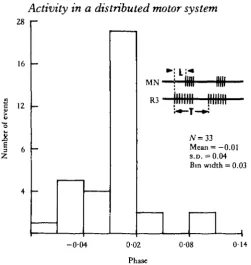
The primary and vomiting motor patterns (defined in Materials and Methods) both exhibit cyclical motor activity in the brain that is phase-locked with alternating bursts of activity in roots Rl and R3 of the.buccal ganglion (Fig. 2). The only brain roots that consistently fire cyclically are the SOVN and MN. Both appear to be primarily motor nerves, as shown by recordings that were made from the distal nerve stumps during tactile and chemosensory stimulation of the oral veil (Lee & Liegeois, 1974). Cobalt backfills of the proximal nerve stumps indicate that these nerves contain about 20-30 neurones. In the primary pattern, bursts of activity in the SOVN and MN characteristically occur in phase with bursts in R3 (Figs 2A, 3), whereas in the
MN
SOVN
R3 Rl CBC
2
16
12
6
4
-—
-• ! 1 !-•
: iitil nm
m Illlllll Illlllll
JV=33 Mean= -0.01
S.D. = 0.04 Bin width = 0.03
1
- 0 - 0 4 0-02
Phase
[image:7.451.102.354.50.316.2]0-08 0 1 4
Fig. 3. Histogram of phase position of MN bursts relative to R3 bursts during MGON-evoked primary rhythms. Phase is defined as latency (L) of the onset of the burst in MN divided by the cycle time (T). Negative phases indicate occurrence of MN burst prior to onset of R3 activity. Data from a single representative animal.
vomiting pattern, the MN becomes more tonically active and the SOVN responses occur in phase with Rl rather than R3 (Fig. 2B).
In order to understand the integrative mechanisms that produce these coordinated patterns, and eventually to understand the mechanisms that underlie the types of behaviour that are related to these motor patterns, it is necessary to determine whether the cyclical characteristics of the brain and buccal ganglion motor outputs occur as the result of phasing between independent oscillators or whether the activity of one ganglion arises passively in response to cyclical input from the other. In the following sections we shall enquire into the ability of each ganglion to produce cyclical activity independently of the other by applying sucrose gap and anodal current blocks to the CBC, which are the only connections between the brain and buccal ganglion in the isolated preparation. We shall also examine some of the properties of the inter-neurones that interconnect the two ganglia, and enquire into previous evidence which originally suggested that there may be separate oscillators.
Interruption of activity in the CBC during ongoing motor patterns
A
[image:8.451.76.361.49.302.2]HCBC
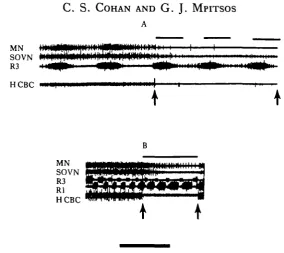
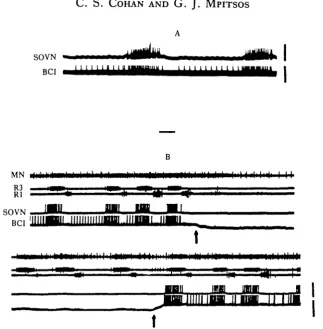
Fig. 4. Effect of long duration anode block of CBC activity on bursts of activity in roots of the brain. Activity in brain roots (top two traces) ceases when CBC's are blocked (between arrows) either during primary pattern (A) or during a bout of vomiting (B). Rhythms were evoked by tonic MGON stimulation. Here and in subsequent figures H CBC activity is recorded at a point between the site of block and the brain in order to monitor block effectiveness. Bars above records indicate where brain activity would have occurred. Calibration: (A) 10 s, (B) 20sJV= 19 in 11 animals for (A) and iV = 7 in 5 animals for (B).
buccal ganglion when rhythms are activated by stimulation of nerves of the buccal ganglion, namely the MGON. The remaining experiments were performed solely on the primary pattern because its longer time course permitted more extensive experi-mental analysis.
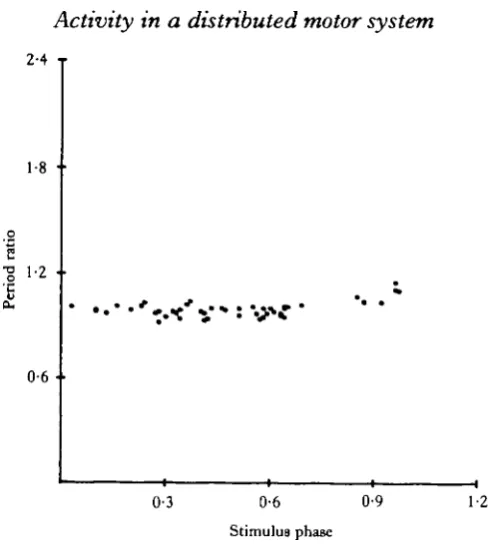
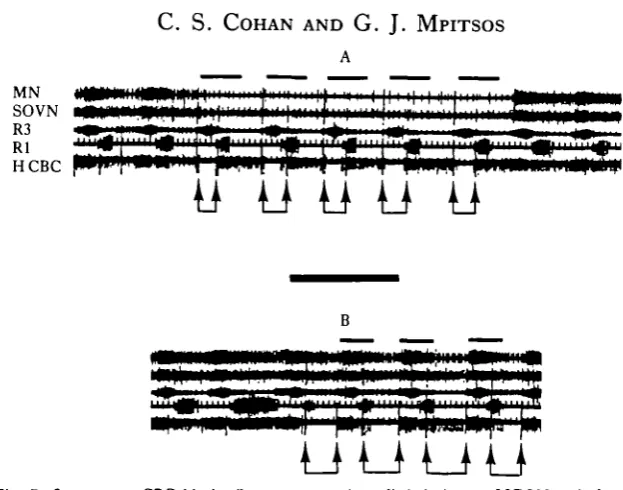
In further contrast to what would be expected of phase-locked oscillators, short duration blocks that were applied during different portions of the buccal cycle did not reset or shift the phase of the brain output in the subsequent cycles (Fig. 5). However, blocks that were applied during the entire R3 phase deleted one set of bursts in the output of the brain (Fig. 6A). If the onset of the blocks occurred after the R3 burst had begun, the brain response abruptly ceased (Fig. 6B), and when the block was removed before the end of the R3 burst, the brain activity immediately commenced (Fig. 6C). This indicates that continued drive from the buccal ganglion is necessary for even a single, complete burst in the brain roots and that the driving input to the brain occurs during the R3 phase of buccal activity.
2-4
1-8
o
e
•g i - 2I
0-6
.*.
0-3 0-6 0-9 1-2
[image:9.451.96.345.57.330.2]Stimulus phase
Fig. 5. Phase response curve. Plot of the effect of anodal blocks on the onset of MN bursts when the blocking pulse is applied at different phase positions of the rhythm cycle. The stimulus phase is defined as the latency of the block onset, measured from the beginning of the previous MN burst, divided by the R3 period. The period ratio is the ratio of the perturbed MN period to the correspon-ding R3 period. (N *= 50, 4 animals.)
B MN
m> m* 11'
R3 #» » i mt»
HCBC
I I
MN
R3 HCBC
• I
[image:9.451.56.371.402.575.2]A
MN
SOVN MMNMMHMl
R3 Rl HCBC
iiiTyaiiuu
UM^UMUl^Ul
u
;:,;:i,> i,:.., i
y
x
[image:10.451.69.381.56.301.2]UULJU
Fig. 7. Consecutive CBC blocks (between arrows) applied during an MGON-evoked primary rhythm demonstrate that CBC activity during the R3 phase of the buccal cycle is (A) necessary and (B) sufficient for the brain rhythm. Same preparation in (A) and (B). Bars as in Fig. 6. (N = 5 animals.) Calibration: 20s.
PCC
l l l l l I I I l l l l l l l l l l l l l l l
J
[image:10.451.80.375.368.593.2]*>rain root bursts. These findings show, furthermore, that the drive as well as the timing for brain output occurs during the R3 phase of the buccal cycle, and that the production of rhythmic brain output requires rhythmic input from the buccal gang-lion.
In the experiments described above, the motor patterns were elicited by electrical stimulation of buccal nerves. Although cyclical responses are difficult to produce by stimulation of afferent roots of the brain, they can be elicited by stimulation of neurones that are located in the brain and that send their axons to the buccal ganglion via the CBC (Davis et al. 1973; Gillette et al. 1978). The most effective of these neurones are the paracerebral cells (PCC), and the coordinated rhythm that is produced by tonic depolarization of one of the PCC is shown in Fig. 8A. When conduction in the CBC is blocked, depolarization of the PCC does not evoke activity in either the brain or the buccal ganglion (Fig. 8B). The return of conduction in the CBC by perfusion with ASW restores activity in both ganglia (Fig. 8C). Findings such as these show that the PCC cannot drive motor output in the brain by local connections they might have there. They also show that, regardless of whether the rhythms are activated by stimulation of the brain or buccal ganglion, the production of cyclical activity in the brain depends on the generation of cyclical activity in the buccal ganglion.
Buccal intemeurvnes provide the drive for brain motoneurones
The general class of neurones which we shall refer to as the buccal-cerebral inter-neurones (BCI; see Discussion) provide the only connection from the buccal ganglion to the brain in the isolated nervous system (Davis et al. 1973). Simultaneous intracellular recordings from cells in both ganglia showed that, although there are differences among the BCI in the strength of their effects on the brain motoneurones, some are closely coupled as indicated by one-to-one postsynaptic potentials in the motoneurones with respect to action potentials in the BCI (Fig. 9A). Such pairs of cells were found in three of nine different preparations in which simultaneous penetra-tions were made to find these cells. Recordings that were obtained during rhythms showed that hyperpolarization of one such BCI suppressed the phasic activity of some motoneurones while others in the preparation continued to fire (Fig. 9B). These data indicate that the BCI supply the drive as well as the pattern for rhythmic activity in the brain motoneurones and also that several BCI are coactivated to produce the motor output. The close association between the BCI and motoneurones suggests, in support of the findings presented in the previous section, that a brain oscillator is not interposed between them.
From the findings presented here and in the preceding section, we conclude that the rhythmic activity which is generated in the buccal ganglion, and conveyed to the brain by the BCI, is both necessary and sufficient for producing the cyclic motor output of the brain. That is, rhythmic patterns of coordinated motor output of the brain and buccal ganglion do not appear to be produced by the phasing of independent oscillators, but rather that the output of the brain occurs in response to rhythmic input from the buccal ganglion.
SOVN
BCI
BCI H I
Mil
f m i iiiiin
mi m
ininmBi m mii nil
m i l
t
[image:12.451.64.388.53.383.2]inn Ifflfl
1
Fig. 9. BCI drive brain motoneurones that are active during the primary pattern. (A) Postsynaptic potentials in an SOVN motoneurone follow 1-1 spikes in a BCI. (B) Hyperpolarization (between arrows) of this BCI during an MGON-evoked primary rhythm is correlated with absence of activity in the SOVN motoneurone. Other brain motoneurones continue to fire phasically. Absence of buccal and brain activity which occurs just after hyperpolarization begins probably is not causally related and is within the normal variation of the rhythm period. Continuous record. Same preparation in (A) and (B). (AT= 3, 3 animals.) Calibration: (A) upper 30mV, lower ISOmV, 3 s; (B) upper 180mV, lower 120mV, 6s.
was recorded in the CBC can occur independently of rhythmic activity in the buccal roots (Davis et al. 1973). In addition, we have found that intracellular stimulation of BCI never evoked rhythmic activity from buccal roots. Thus, the BCI may not be part of the CPG or else, insufficient numbers of BCI were stimulated to show this effect. Nonetheless, stimulation of some BCI did produce tonic activity in the motor roots of the buccal ganglion (Cohan & Mpitsos, 1983).
Rhythmic activity in isolated brain ganglia
g experiments, we obtained the same results (Fig. 10). We found that the production of rhythmic brain output depends critically on the parameters of the electrical stimuli that are applied to the CBC. By positioning a suction recording electrode between the site of stimulation on the CBC and the brain, it was observed that cyclic brain output occurred when the stimulus parameters were near the threshold for evoking action potentials in the CBC. Moreover, we observed that bursts in the CBC preceded or occurred simultaneously with the bursts in the brain (Fig. 11). The shorter latency of the bursts in the CBC suggested the possibility that the axons of the CBC themselves are capable of generating rhythmic bursts of activity when they are tonically stimulated. Surprisingly, this proved to be the case, as shown by experiments in which isolated segments of the CBC were stimulated at one of their cut ends and the resulting activity that was evoked was recorded at the opposite end. The cycle period of bursts in the isolated segments of the CBC (Fig. 12) was similar to that of the brain output and the stimulus parameters that produced the bursts in the CBC were the same as those which produced the bursts in isolated brains. We propose, therefore, that the cyclical output of isolated brains is driven by the cyclical
MN SOVN
CBC
4-4
Fig. 10. Rhythmic activity produced by isolated brains after cutting all connectives to other ganglia. (A) Spontaneous rhythm and (B) rhythm evoked by tonic stimulation (at arrow) of the ipsilateral CBC with l m s , 10/iA pulses at 10 Hz. Calibration: 20s.
CBC
ST1M
Fig. 12. Tonic stimulation (10 Hz) at one end of an isolated segment of CBC, severed from brain and buccal ganglia, results in phasic activity at the other end. (N•= 6 animals.) Calibration: 20s.
activity in the CBC. Thus, the original conclusion may well have been based on findings that were produced by an artifact of stimulation rather than by a centrally programmed'oscillator in the brain.
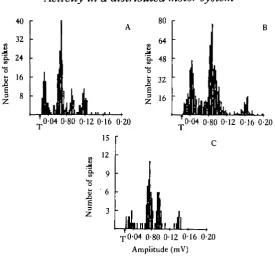
One of the implications of the above proposal is that the motor units which are activated by CBC stimulation in isolated brain ganglia should be different from those in rhythms produced by other methods of stimulation. This is because electrical stimulation of the CBC would indiscriminately activate not only the BCI but also other axons in the CBC, whereas electrical stimulation of the MGON, for example, would activate the BCI as required by the buccal rhythm. Accordingly, not only are there considerable differences between the units that comprise the CBC-evoked and MGON-evoked rhythms, but these units are also different from those of spontaneous-ly occurring rhythms (Fig. 13). Intracellular records from brain motoneurones show, moreover, that individual units can have different response properties, depending on the type of pattern that occurs and how it is activated (Fig. 14). Thus, while the patterns of bursts that are elicited by different methods of stimulation may often appear similar, the bursts themselves can have different microstructures since a vari-ety of units may selectively come into play or respond differently.
DISCUSSION
40 32 8
1 24
16
80 A
% 48
| 32
4 16
Jj
^0-04 0-80 0 1 2 0-16 0-20
IS
12
9
6
3
0-04 0-80 0-12 0-16 0-20
B ' a CO
T0 - 0 4 0-80 0 1 2 0 1 6 0-20
[image:15.451.77.353.60.317.2]Amplitude (mV)
Fig. 13. Spike height histograms of MN motoneuronea that became active during MN bursts which occurred (A) during an MGON-evoked primary pattern in an intact buccal-cerebral preparation or (B) spontaneously and (C) as a result of tonic CBC stimulation in isolated brains. All histograms are from the same preparation. T represents threshold value of spike amplitudes.
MN
R3 Rl
M T N 1
M T N 2
•Wh
IIIII Illllllllllll IIIIIIMIIIIIIIIIIII Illlllllll
MN
[image:15.451.94.340.361.602.2]M T N 1 M T N 2
that the latency of brain output to buccal activity remains constant during variation in the cycle period (Cohan, 1980). The major conclusion is that the rhythmic, coordinated activity in the brain and buccal ganglia of Pleurobranchaea arises from oscillatory circuits (or neurones) that are located only in the buccal ganglia.
The original proposal of distributed oscillators was based on the observation that tonic stimulation of a ganglionic nerve root led to rhythmic output from other roots of the ganglion. This test has been used traditionally to determine the presence of oscillators in deafferented nervous systems (Hughes & Wiersma, 1960). Our findings show, however, that the cyclical activity that is produced by such tests in
Pleurobran-chaea may be attributable to an artifact by which tonic stimulation of axons produces
bursts of action potentials in the axons themselves rather than activating a central oscillator in the ganglion that they innervate.
The remarkable ability of axons to produce bursts of activity when they are tonically stimulated has also been observed in dorsal root fibres of cats (Barron & Matthews, 1935) and sciatic nerve fibres of the frog (Newman & Raymond, 1971). It has been proposed that variations of spike thresholds can give rise to intermittent conduction in which action potentials do not follow each stimulus pulse. Under appropriate stimulus conditions it is possible that cyclical variation in the threshold can delete sequences of action potentials such that the tonic stimulation is converted into phasic bursts of activity (Raymond & Pangaro, 1975; Raymond, 1979). Such oscillatory properties of spike thresholds may be generally applicable to nerves, and, therefore, caution should be taken in attributing rhythmic output to a ganglionic oscillator when the criterion for rhythmicity is based on tonic stimulation of the connectives.
Although it has not been extensively documented, the functional organization described here for Pleurobranchaea, whereby a centralized oscillator provides the drive for distributed motor output may be a common feature in the gastropod molluscs. It has been found recently that transection of the CBC during feeding rhythms in Aplysia causes the cessation of brain output but not of buccal ganglion output (B. Jahan-Parwar, personal communication), much as the activity of the brain of Pleurobranchaea relies on activity in the buccal ganglion. And, as in
Pleurobran-chaea , it has been suggested that neurones in the buccal ganglion of Tritonia diomedia
The authors gratefully acknowledge the help of Dr A. D. McClellan in planning these experiments and Drs A. G. M. Bulloch and D. Barker for helpful criticism of the manuscript. This work was supported by NSF grant BNS 76-8123, AFOSR grant 82-0043A, and PGR grant to G.J.M. and a Sloan Foundation Fellowship and NIH predoctoral fellowship HD 07104-03 to C.S.C.
R E F E R E N C E S
BARRON, D . H. & MATTHEWS, B. H. C. (1935). Intermittent conduction in the spinal cord. J. Physiol. 85, 73-103.
BELLMAN, K. L. (1979). The conflict behaviour of the lizard Sceloporus ocadentalis, and its implication for the organization of motor behaviour. Ph.D. thesis, University of California, San Diego.
BOWERMAN, R. G. & LARIMER, J. L. (1974a). Command fibres in the circumoesophageal connectives of the crayfish. I. Tonic fibres. J. exp. Biol. 60, 95-117.
BOWERMAN, R. F . & LARIMER, J. L. (19746). Command fibres in the circumoesophageal connective of the crayfish. I I . Phasic fibres. J . exp. Biol. 60, 119-134.
COHAN, C. S. (1980). Centralized control of distributed motor networks inPleurobranchaea calijbmica. Ph.D. thesis, Case Western Reserve University, Cleveland, Ohio.
COHAN, C. S. & MPITSOS, G. J. (1983). Selective recruitment of interganglionic interneurones during different motor patterns in Pleurobranchaea. J. exp. Biol. 102, 43-57.
DAVIS, W. J. (1969a). The neural control of swimmeret beating in the lobster.7. exp. Biol. 50, 99—117. DAVIS, W. J. (19696). Reflex organization in the swimmeret system of the lobster. I. Intrasegmental reflexes.
J. exp. Biol. 51, 547-563.
DAVIS, W. J. (1969c). Reflex organization in the swimmeret system of the lobster. II. Reflex dynamics. J . exp.
Biol. 51, 565-573.
DAVIS, W. J., SIEGLER, M. V. S. & MPITSOS, G. J. (1973). Distributed neuronal oscillators and efference copy in the feeding system of Pleurobranchaea. J. Neuropkysiol. 36, 258-274.
DAVIS, W. J., MPITSOS, G. J., SIEGLER, M. V. S., PINNEO, J. M. & DAVIS, K. B. (1975). Neuronal substrates
of behavioural hierarchies and associative learning in Pleurobranchaea. Am. Zool. 13, 1037-1049. DELCOMYN, F. (1980). Neural basis of rhythmic behaviour in animals. Science, N.Y. 210, 492-498. EVOY, W. H. & KENNEDY, D . (1967). The central nervous organization underlying control of antagonistic
muscles in crayfish. I. Types of command fibres. J. exp. Zool. 165, 223-238.
GELPERIN, A., CHANG, J. J. & REINGOLD, J. C. (1978). Feeding motor program in Limax. I. Neuromuscular correlates and control of chemosensory i n p u t s . ^ Neurobiol. 9, 285.
GETTING, P. A. (1975). Tritonia swimming: triggering of a fixed action pattern. Brain Res. 96, 128-133. GETTING, P. A. (1977). Neuronal organization of escape swimming in Tritonia. J. comp. Physiol. A 121, 325. GILLETE, R., KOVAC, M. P. & DAVIS, W. J. (1978). Command neurons in Pleurobranchaea receive synaptic
feedback from the motor network they excite. Science, N.Y. 199, 798.
HUGHES, G. M. & WIERSMA, C. A. G. (1960). The coordination of swimmeret movements in the crayfish,
Procambarus clarhii (Girard)..?. exp. Biol. 37, 657-670.
KATER, S. B. (1974). Feeding in Helisoma trwolvis; the morphological and physiological bases of a fixed action pattern. Aw. Zool. 14, 1017-1036.
KENNEDY, D . , EVOY, W. H., DANE, B. & HANAWALT, J. T . (1967). The nervous organization underlying
control of antagonistic muscles in the crayfish. II. Coding of position by command fibres. J. exp. Zool. 165, 239-248.
KRISTAN, W. B., JR. (1974). Neural control of swimming in the leech. Am. Zool. 14, 991-1001.
KUPFERMANN, I. & COHEN, J. (1971). The control of feeding by identified neurons in the buccal ganglion of
Aplysia. Am. Zool. 11, 667.
KUPFERMANN, I. & WEISS, K. R. (1978). The command neuron concept. Behavl. and Brain Sci. 1, 3-39.
LEE, R. M. & LIEGEOIS, R. J. (1974). Motor and sensory mechanisms of feeding in Pleurobranchaea. J.
Neurobiol. 5, 545-565.
MCCLELLAN, A. D . (1980). Feeding and regurgitation in Pleurobranchaea califomica: multibehavioural or-ganization of pattern generation and higher order control. Ph.D. thesis, Case Western Reserve University, Cleveland, Ohio.
MCCLELLAN, A. D . (1982a). Movements and motor patterns of the buccal mass of Pleurobranchaea during feeding, regurgitation and rejection. J . exp. Biol. 98, 195-211.
MCCLELLAN, A. D. (19826). Re-examination of presumed feeding motor activity in the isolated nervous system of Pleurobranchaea. J. exp. Biol 98, 213-228.
NEWMAN, E. A. & RAYMOND, S. A. (1971). Activity dependent shifts in excitability of peripheral nerve axons.
OGDEN, T . E., CITRON, M. C. & PIERANTONI, R. (1978). The jet stream microbeveler: an inexpensive wa^a to bevel ultrafine glass micropipettes. Science, N.Y. 201, 469.
PEARSON, K. G. (1972). Central programming and reflex control of walking in the cockroach. J . exp. Biol. 56, 173-193.
RAYMOND, S. A. (1979). Effects of nerve impulses on threshold of frog sciatic nerve fibres. J . Physiol. 290, 273-303.
RAYMOND, S. A. & PANGARO, P. (1975). Explanation of intermittent conduction based on activity-dependent changes in nerve threshold. R.L.E. Prvg. Rep. MIT 116, 273-281.
STEIN, P. (1971). Intersegmental coordination of swimmeret motoneuron activity in crayfish. J. Neurophysiol. 34,310-318.
STEIN, P. S. G. (1974). Neural control of interappendage phase during locomotion. Am. Zool. 14, 1003-1016.
STENT, G. S., KRISTAN, W. B., FRIESEN, W. O., O R T , C. A., POON, M. & CALABRESE, R. L. (1978). Neuronal
generation of the leech swimming movement. Science, N.Y. 200, 1348—1357.
WILLOWS, A. O. D . (1978). Physiology of feeding in Tritonia. I. Behaviour and mechanics. Marine Behavl.
Physiol. 5, 115-135.
WILLOWS, A. O. D., DORSETT, D. A. & HOYLE, G. (1973a). The neuronal basis of behaviour in Tritonia. I. Functional organization of the central nervous system. J. Neurobiol. 4, 207—237.
WILLOWS, A. O. D., DORSETT, D. A. & HOYLE, G. (19736). The neuronal basis of behaviour in Tritonia. I I I . Neuronal mechanism of a fixed action pattern. J. Seurobiol. 4, 255-285.
WILSON, D . M. (1961). The central nervous control of flight in a locust. J . exp. Biol. 38, 471-490.
WINE, J. J. (1977a). Crayfish escape behaviour. 2. Command-derived inhibition of abdominal extension. J.
comp. Physiol. A 121, 173.
WINE, J. J. (19776). Crayfish escape behaviour. 3. Monosynaptic and polysynaptic sensory pathways involved in phasic extension..?, comp. Physiol. A 121, 187.