ISSN: 2334-2366 (Print), 2334-2374 (Online) Copyright © The Author(s). 2014. All Rights Reserved. Published by American Research Institute for Policy Development
Towards an Optimization Framework for E-Learning in Developing Countries: A Case of Private Universities in Kenya
Peter Namisiko1 , Catherine Munialo2 and Stephen Nyongesa3
Abstract
E-learning systems have become popular in many Learning Institutions due to advancements in technology such as web 2.0 and Free Open Source Softwares. Worldwide, the E-Learning market has a growth rate of 35.6%, but failures exist. Little is known about why many users stop their online learning after their initial experience in institutions of Learning in Kenya. Previous research done under different task environments has suggested a variety of factors affecting user satisfaction with E-Learning. Increased numbers of users, services, education contents and resources have made E-Learning systems to face challenges of optimizing resource allocations, dealing with dynamic concurrency demands, handling rapid storage growth requirements and cost controlling. This paper sought out to determine the challenges facing the actual deployment and adoption of E-Learning systems with a view to determining the optimal framework for deployment and adoption of E-learning systems by Private Universities in Kenya. The study employed quantitative research design to collect and analyse the data about the Challenges facing E-learning in Private Universities in Kenya. The study identified the following as the major challenges facing Deployment and Adoption of Learning in Private Universities in Kenya: Availability of ICT infrastructure, E-Learning Curriculum, Instructors’ competencies, Performance Expectancy, Perceived Usefulness of Learning by Students and Perceived Ease of Use of E-Learning by students. It is hoped that the findings of this study will serve as a basis for educational institutions seeking cost effective alternatives to implement eLearning in developing countries.
Keywords: E-Learning, Optimization Framework, Private Universities in Kenya, Challenge
1 Department of Information Technology, Mount Kenya University, PO BOX 1869-30200, Kitale, Kenya. Email: [email protected] Cell: +254(0)722848386
2 Department of Early Childhood Studies, Mount Kenya University, P.O BOX 1869-30200, Kitale, Kenya.
1 Introduction
Improved and modern education in developing countries provides the promise of meaningful employment for graduates, movement towards a knowledge based economy, and rapid national economic growth (Olson Kurt deMaagd, Tarkleson, Sinclair, Yook, & Egidio, 2011). It is for this reason that Governments and Stakeholders in Education are investing heavily in education. This building of the Information Communication Technology (ICT) infrastructure as well as the knowledge infrastructure base such as teacher training, teaching materials and Internet facilities are necessary before the full benefits of the educational investments can be realized. The Developing countries are lagging behind Developed countries in educational attainment and other aspects of the human capital development required in knowledge based global economy. For instance secondary school enrolment rates in Developing countries are 50 percentage points below other Developed country averages (Olson Kurt deMaagd et al., 2011). New programmes in Africa promoting universal primary school enrollment are leading to increased demand for Private Universities, and a rapid expansion of Private Universities and students. In Kenya, the introduction of Free Primary Education in 2003 has resulted in increased enrolments in Private Universities thereby necessitating the need for utilization of ICTs. The increasing interest by Governments to utilize the current ICTs and to widen participation of education cannot be overemphasized. A study conducted by Gakio found out that 47 percent of 54 tertiary institutions from 27 African countries have installed educational technologies in their institutions (Gakio, 2006). A similar study conducted by Isaacs and Hollow found that 52 percent of 447 respondents African institutions were using E-Learning systems by the end of the year 2012 (Isaacs & Hollow, 2012). Research conducted in this area has attributed the interest in E-learning to Web 2.0 technologies and Free Open Source Softwares (FOSS). For instance, a study conducted by Namisiko, Mindila, Chepkoech and Nyeris found out that Web 2.0 technologies that have diversified the needs of contemporary learners and widen the participation of education include: RSS, Wikis, Tagging, Blogs and Podcasts (Namisiko, Mindila, Chepkoech, & Nyeris, 2014). Another study conducted by Selim found out that FOSS such as Moodle, Dokeos, EFRONT and Claroline have facilitated E-learning (Selim, 2007).
Data available indicate that secondary school enrolment in African countries averages only about 30%, compared to 65% for developing countries worldwide, and close to 100% in East Asia. Education quality in most cases is not where it needs to be, either, with outdated curricula (Alptekin & Karsak, 2011). Meanwhile, in middle-income economies, quality and quantity of secondary and tertiary graduates are among the driving factors behind economic and social performance (Chen, Chen, Huang, & Ching, 2006) Increased numbers of users, services, education contents and resources have made E-Learning systems to face challenges of optimizing resource allocations, dealing with dynamic concurrency demands, handling rapid storage growth requirements and cost controlling (Singh, 2003). Other studies conducted have identified economic, governance and infrastructure problems, and difficulties faced by the educational systems.
So far, however, there are few studies that have been conducted to ascertain the challenges of implementing E-learning in Private Universities in Kenya with a view to proposing a framework for its proper implementation. The research undertaken by Ondago, Ondimu, and Muketha on Mombasa Polytechnic University College (MPUC) students found out that majority of MPUC students would accept E-Learning in conjunction with f2f learning (Blended learning). They recommended that the institutions should adopt OSS(Open Source Softwares) preferably Moodle LMS( Learning Management Systems) as opposed to COTS (Commercial Off the Shelf softwares), whereby it can easily undertake benchmarking as Moodle is already widely used in most Kenyan institutions of higher learning (Ondago, Ondimu, & Muketha, 2012). The study however covered only the students among stakeholders. The extent of Academic staff views and need for more bandwidth was not ascertained in order to determine the optimal institutional requirement. This paper set out to fill this gap by finding out the main challenges facing adoption of effective E-learning systems in Private Universities in Kenya. Specifically, the main objectives of this paper were:
a. To determine the main challenges of implementing effective E-learning systems in Private Universities in Kenya
It is hoped that the findings of this study will serve as a basis for Educational Institutions seeking cost effective alternatives to implement E-Learning in developing countries since the situation of Kenya reflects many Developing countries in parts of the World.
2. Literature Review
This section presents the Theoretical Framework, Conceptual Framework and a Review of Related Literature on E-Learning.
2.1 Theoretical Framework
Understanding what constitutes user acceptance is important in determining the challenges facing Deployment and Adoption in E-learning implementation in Private Universities. The factors influencing user acceptance of a technology have been thoroughly researched and a number of theoretical frameworks have been developed in an attempt to explain the variables influencing the intention to use a specific technology. The theoretical framework adopted for this study was a combination of Technology Organization Environment (TOE) and Technology Acceptance Model (TAM), from which appropriate constructs were made as possible challenges to deployment and adoption of E-learning in Private Universities in Kenya. These frameworks offer various variables to a complete framework for implementation of E-learning in Private Universities in Kenya since the aim of this paper was to incorporate all variables to E-learning deployment and adoption into a single framework which would comprehensively cover all aspects of E-learning adoption.
2.1.1 Technology Organization Environment (TOE) Framework for Technology Adoption
According to this theory, these factors may negatively or positively influence the decision to adopt a technological innovation. In this study, the main challenges to implementation of E-learning from Technology point of view will include cost, reliability compatibility, complexity, and performance expectancy. Teachers’ innovativeness and competitiveness will be studied.
2.1.2 Technology Acceptance Model (TAM)
The TAM theory is a model that tries to explain how users come to accept and use a technology. The model suggests that when users are presented with a new technology, a number of factors influence their decision about how and when they will use it, namely: Perceived Usefulness (PU) and Perceived Ease of use (PEOU (Legris, Ingham, & Collerette, 2003). ICT adoption and diffusion has been studied in great detail lately by researchers in the information systems area. It can be studied at two levels: the first is at the organizational level and the other is at the individual level. If the unit analysis is an individual, then emphasis is on the acceptance of technology. The user’s attitude toward using and the actual usage of a technology are addressed in the technology acceptance model (TAM) (Koohang & Du Plessis, 2004)
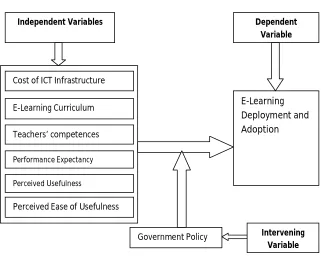
2.2 Conceptual Framework
Figure 1: Conceptual Framework
Source: Researchers own
2.3 Review of Related Literature
2.3.1 E-Learning in Perspective
E- Learning is a type of learning that uses electronic technologies to access educational curriculum outside the traditional classroom (Olson Kurt deMaagd et al., 2011). In most cases, it may refer to a course, programme or degree delivered completely online. There are many terms used to describe learning that is delivered online, via the internet, ranging from Distance Education, to computerized electronic learning, online learning, e-resourcing, internet learning and many others. In this study, we define e-Learning as courses that are specifically delivered via the internet to somewhere other than the classroom where the teacher is teaching. It could be a course delivered via a DVD or CD-ROM, video tape or over a television channel. It may be interactive in that a learner can communicate with his/her teachers, professors or other students in the class. Sometimes it is delivered live electronically or interaction in real time and sometimes prrecorded (Selim, 2007). The urge to e-learn balances the state of management in pursuance to recover contact hours among elements of curriculum, disengaging learners and lecturers to account for dwindling rates and ratios of education.
Cost of ICT Infrastructure
E-Learning Curriculum Independent Variables
E-Learning Deployment and Adoption
Government Policy
Dependent Variable
Intervening Variable Teachers’ competences
Performance Expectancy
Perceived Usefulness
The merger of e-learning to lectures on elements of curriculum apart from step – down on learners due to individual differences, it cushions the physical unprecedented degeneration of lecturers in line and course of duty to earn royalties. Still when officially off duty one can learn from use of e-resource storage technology for some contact hours as student consumers benefit too no wonder protection of intellectual property rights.
2.3.2 Challenges facing Deployment and Adoption of E-Learning in Universities
Literatures available from Scholarly articles have identified the following as the major challenges facing deployment and adoption of E-Learning in Private Universities.
2.3.2.1 Cost of ICT Infrastructure
The cost of acquiring, managing, and maintaining ICT infrastructure has been identified as the major stumbling block in deployment and adoption of E-Learning by institutions of Learning (Mtebe & Mtebe, 2014). For example, the cost of deploying eLearning System at the University of Education, Winneba, in Ghana was estimated to be $20 a year per student with a minimum of 15,000 students in 2008 (Unwin, 2004). Poorly equipped classrooms, lack of electricity, especially in rural areas are some of the factors that have hindered the deployment and subsequent adoption of E-Learning especially in rural set ups in Kenya (Alemneh & Hastings, 2006). The cost of internet bandwidth is still very high despite the Government’s efforts in addressing the issue. As a result, very few schools have an Internet connection (Ndou, 2004).
2.3.2.2 E-Learning Curriculum
Another study conducted by Saddler and Badge, recommended that the E-Learning curriculum must work with the technology and be appropriate to the knowledge needed for the students learning (Sadler-Smith & Badger, 1998). Content also changes fast in some fields so content must be examined from both the use of it though e-technology and the learning that will take place.
2.3.2.3 Instructors’ Competencies
According to Guri-Rosenblit (2005), teachers who are insufficiently trained in their own subjects, and have little or no computer experience are a hindrance to effective deployment and adoption of E-Learning in institutions of Learning. A study conducted by Olson Kurt deMaagd et al. (2011) recommended that integration of ICT technologies in schools would require significant pre-service and in-service teacher training in basic computer literacy as well as how to teach with e-learning technologies for effective deployment and adoption of E-Learning in Private Universities.
2.3.2.4 Performance Expectancy
Performance expectancy is defined as the extent to which students believe that using E-Learning will help them achieve the learning goals. Excelling in examinations is a major factor that may influence a student either to adopt or not to adopt E-Learning as Learning approach. A study conducted by Sun, Tsai, Finger, Chen, & Yeh (2008), found out that students in higher educational institutions that engaged in E-Learning, generally performed better than those in f2f courses in Malaysian Universities. A similar study conducted by Tynjälä & Häkkinen (2005) established that students who participate in online and E-Learning achieve better grades than students who studied traditional approach. However, there is minimal research conducted in Developing countries to establish if E-Learning has positive outcome on performance of students in Examinations. It is for this reason that some students may be encouraged or discouraged to adopt E-Learning in Kenya.
2.3.2.5 Perceived Usefulness of E-Learning by Students
The presumption in this model is that the more learners’ perceive usefulness in delivering media, such as course websites and file transmitting software, the more positive their attitudes are toward e-Learning, consequently improving their learning experiences and satisfaction, and increasing their chances for using e-Learning. In this study, Learners’ perceived usefulness in an E-Learning system is defined as the perception of degrees of improvement in learning effects because of adoption of such a system.
2.3.2.6 Perceived Ease of Use of E-Learning by Students
Perceived ease of use is users’ perception of the ease of adopting a system. Perceived Ease of Use may affect learners’ attitudes toward a software tool and further affect individuals’ beliefs and behaviours when adopting E-Learning (Sun et al., 2008). The presumption in this model is that the more learners’ Perceive Ease of Use in delivering media, such as course websites and file transmitting software, the more positive their attitudes are toward E-Learning, consequently improving their learning experiences and satisfaction, and increasing their chances for using e-Learning.
3. Research Methodology
This study employed Quantitative study design approach in which data was collected from students pursuing both f2f and E-Learning courses at Universities. Online Questionnaires were submitted to a total of 500 participants which included Lecturers, Students and Administrators as shown by the table below:
Table 1: Sampling Criteria
The initial and follow up mailing generated 272 usable responses, resulting in a response rate of 54.2%.
Category of participant
Number Responses
Generated
% Response Rate
Students 400 224 56
Lecturers 50 31 62
Administrators 50 17 34
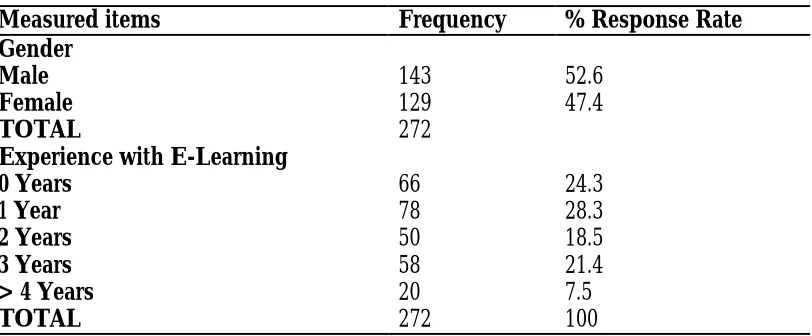
This response rate from an unsolicited mailed questionnaire suggested that respondents found the topic interesting and relevant. The subjects were nearly evenly men and women, with only slightly more men (52.6%) responding than women (47.4%). Sixty six respondents (24.3%) had never used E-Learning while Seventy Eight respondents (28.3%) were first year E-Learning users, whereas 128 (47.5%) had taken 2 years and more with E-Learning.
Table 2: Descriptive Statistics of Measured Items
This study sought to determine the main challenges facing effective deployment and adoption of E-learning system in Private Universities in Kenya with a view to proposing a complete framework for use in implementation of E-Learning in Kenya. Based on the Conceptual Framework the following variables were identified:
a. Cost of ICT infrastructure b. E-Learning Curriculum c. Instructors’ competencies d. Performance Expectancy
e. Perceived Usefulness of E-Learning by Students f. Perceived Ease of Use of E-Learning by Students
This study employed both descriptive and inferential statistics to analyse the data. Descriptive statistics used included use of histograms, frequency tables and pie charts to represent data. This was mainly used to determine main challenges to effective deployment and adoption of E-learning system in Private Universities in Kenya.
Measured items Frequency % Response Rate
Gender
Male 143 52.6
Female 129 47.4
TOTAL 272
Experience with E-Learning
0 Years 66 24.3
1 Year 78 28.3
2 Years 50 18.5
3 Years 58 21.4
> 4 Years 20 7.5
On the other hand, inferential statistics was used to verify a number of hypotheses concerning the correlations of some of the survey’s variables as indicated in the table below:
H1: Availability of ICT infrastructure in a University will positively influence E-Learner s’ adoption of E-Learning
H1a: Unavailability of ICT infrastructure in a University will not positively influence E-Learner s’ adoption of E-Learning
H2: Availability of curriculum will positively influence Learners’ adoption of E-Learning.
H2a: Unavailability of E-curriculum will positively influence E-Learners’ adoption of E-Learning.
H3: Instructor attitudes toward E-Learning will positively influence E-Learners’ adoption of E-Learning.
H3a: Instructors competencies’ with Learning will not positively influence E-Learners’ adoption of E-Learning.
H4: Improvement in Examination pass rates will positively influence E-Learners’ adoption of E-Learning.
H4a: Improvement in Examination pass rates will not positively influence E-Learners’ adoption of E-Learning.
H5: Perceived Usefulness of Learning by Students will positively influence E-Learners’ adoption of E-Learning.
H5a: Perceived Usefulness of Learning by Students will not positively influence E-Learners’ adoption of E-Learning.
H6: Perceived Ease of Use of Learning by Students will positively influence E-Learners’ adoption of E-Learning.
H6a: Perceived Ease of Use of E-Learning by Students will not positively influence E-Learners’ adoption of E-Learning.
3.1 Research Findings
This study sought to determine the main challenges facing deployment and adoption of in Higher learning institutions in Kenya.
3.1.1 Descriptive Statistics
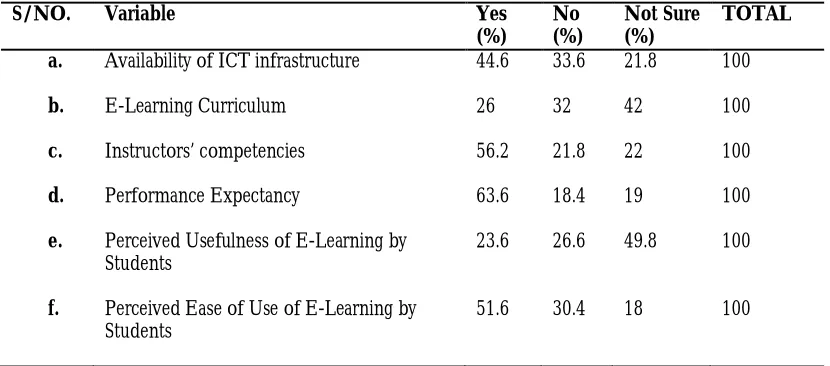
Table 3: Descriptive Statistics of Variables among Variables (n=272)
S/NO. Variable Yes
(%)
No (%)
Not Sure (%)
TOTAL
a. Availability of ICT infrastructure 44.6 33.6 21.8 100
b. E-Learning Curriculum 26 32 42 100
c. Instructors’ competencies 56.2 21.8 22 100
d. Performance Expectancy 63.6 18.4 19 100
e. Perceived Usefulness of E-Learning by
Students
23.6 26.6 49.8 100
f. Perceived Ease of Use of E-Learning by
Students
51.6 30.4 18 100
From the results, the following can be concluded:
3.1.2 Hypothesis Testing
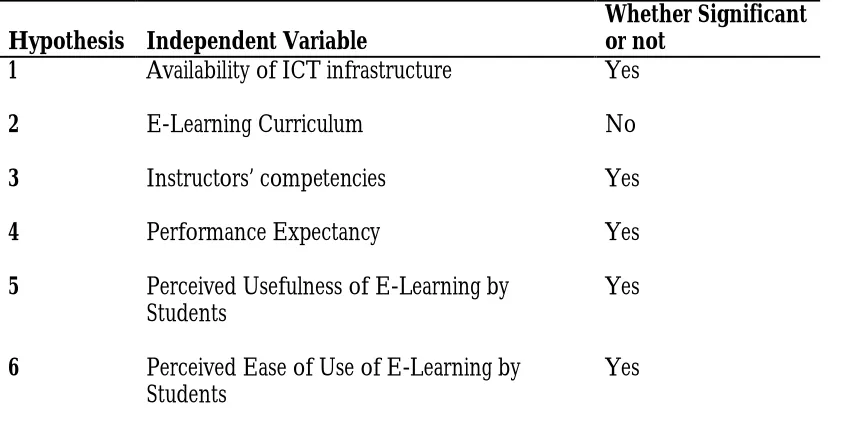
A stepwise multiple regression analysis was conducted to test the hypotheses. Six variables were applied as independent variables, while perceived E-Learning Deployment and Adoption the dependent variable. Table 4 summarises the results of regression analysis. Among 6 independent variables, 5 are considered to have critical relationships with E-Learning Deployment and Adoption with p-values less than .05. These factors are Availability of ICT infrastructure, Instructors’ competencies, Performance Expectancy, Perceived Usefulness of E-Learning by Students and Perceived Ease of Use of E-Learning by Students. Only Hypothesis 2 was not supported. These is summarised in the table below:
Table 4: Summary of Hypothesis Results (Regression Testing for n=272)
Hypothesis Relationship Results
R2 P
H1 Availability of ICT infrastructure in a University will positively influence Learner s’ adoption of E-Learning
0.612 0.001
H2 Availability of curriculum will positively influence E-Learners’ adoption of E-Learning
0.013 0.001
H3 Instructor competencies’ with E-Learning will positively influence Learners’ adoption of E-Learning
0.734 0.001
H4 Improvement in Examination pass rates will positively influence E-Learners’ adoption of E-Learning
0.734 0.001
H5 Perceived Usefulness of E-Learning by Students will positively influence Learners’ adoption of E-Learning
0.501 0.001
H6 Perceived Ease of Use of E-Learning by Students will positively influence Learners’ adoption of E-Learning
0.503 0.001
Table 5: A summary of Hypothesis Results
Hypothesis Independent Variable
Whether Significant or not
1 Availability of ICT infrastructure Yes
2 E-Learning Curriculum No
3 Instructors’ competencies Yes
4 Performance Expectancy Yes
5 Perceived Usefulness of E-Learning by
Students
Yes
6 Perceived Ease of Use of E-Learning by
Students
Yes
4. Proposed Framework for E-Learning Deployment and Adoption
This study identified the following as the major challenges facing Deployment and Adoption of E-Learning in Private Universities in Kenya: Availability of ICT infrastructure, E-Learning Curriculum, Instructors’ competencies, Performance Expectancy, Perceived Usefulness of E-Learning by Students and Perceived Ease of Use of E-Learning by Students. Based on the results obtained; Availability of ICT infrastructure, Instructors’ competencies, Performance Expectancy, Perceived Ease of Use of Learning were found to have a major effect in determining whether E-Learning will be adopted by students or not in Private Universities in Kenya with Availability of ICT infrastructure at 44.6%, Instructors’ competencies at 56.2%, Performance Expectancy at 63.6% and Perceived Ease of Use of E-Learning at 51.6%.
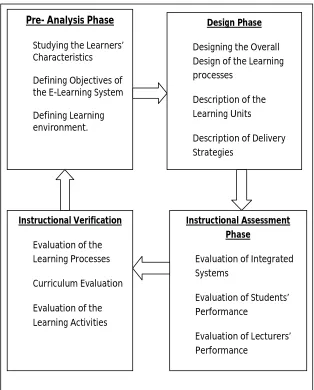
The blending of f2f learning together with E-Learning can address the challenges encountered in the adoption of E-Learning. Nonetheless, a successful Blended learning should be implemented in four phases namely: Pre-Analysis, Design of activities and resources, Instructional Assessment, and Instructional verification (Kerres & Witt, 2003). Through this model, the challenges that were found to restrict the adoption of E-Learning will be addressed.
1. Pre-Analysis phase: This entails studying the learners’ characteristics, objectives and learning environment. This includes setting out students and academic staff requirements. Training of the academic staff and learners on utilization of ICT will play a key role in promoting the adoption of E-Learning. The objectives of the E-Learning system should be understood from the onset.
2. Design phase: The blended learning implementing institutions are supposed to come up with the overall design of the learning processes, clearly showing the learning units, delivery strategies and required resources. The learning resources that should be highlighted include: Availing the ICT infrastructure through purchase of computers and required softwares. Studies have shown that Institutions can save on cost through the use of Open Source Softwares as opposed to proprietary softwares (Namisiko et al., 2014)(Dong, Zheng, Qiao, Shu, & Yang, 2009)(Mtebe & Mtebe, 2014).
3. Instructional Assessment Phase: The implementing institution carries out an evaluation of the learning processes, Curriculum Evaluation, and Evaluation of the learning activities identified in phase two. For effective E-Learning strategy, a proper E-Learning curriculum that is not pulled directly from books and class room courses should be designed. The E-Learning curriculum must work with the technology and should be appropriate to the knowledge needed for the students learning (Kituyi & Tusubira, 2013).
Figure 2: Proposed Framework for E-Learning Deployment and Adoption
5. Conclusion and Future Work
This study identified the following as the major challenges facing Deployment and Adoption of E-Learning in Private Universities in Kenya: Availability of ICT infrastructure, E-Learning Curriculum, Instructors’ competencies, Performance Expectancy, Perceived Usefulness of E-Learning by Students and Perceived Ease of Use of E-Learning by Students. The study has proposed a framework that can in the Deployment and Adoption of E-Learning in Private Universities. The proposed framework can be used to guide University Management on which areas to concentrate in order to achieve the positive effects of E-learning.
Pre- Analysis Phase
Studying the Learners’ Characteristics
Defining Objectives of the E-Learning System
Defining Learning environment.
Design Phase
Designing the Overall Design of the Learning processes
Description of the Learning Units
Description of Delivery Strategies
Instructional Verification
Evaluation of the Learning Processes
Curriculum Evaluation
Evaluation of the Learning Activities
Instructional Assessment Phase
Evaluation of Integrated Systems
Evaluation of Students’ Performance
This study concentrated on Private Universities in Kenya as the reference point. Further studies should be conducted to determine challenges facing deployment and adoption of E-Learning in Secondary Schools and other Higher Institutions of Learning. The proposed framework relied solely on Blended Learning Theory (BLT) which may have limitations hence not conclusive. Other studies should be conducted to determine other Frameworks that Institutions of Higher Learning can adopt in implementing E-Learning.
Acknowledgement
We wish to thank Mount Kenya University, Research and Development Directorate for assisting us with the funds for publication.
References
Al-Taie, N. (2013). The Effect of Using E-Learning Curriculum And Traditional Classroom Curriculum: Comparison &Merits.
Alemneh, D. G., & Hastings, S. K. (2006). Developing the ICT Infrastructure for Africa: Overview of Barriers to Harnessing the Full Power of the Internet. Journal of Education for Library and Information Science, 47(1), 4–16. DOI:
10.2307/40324333
Alptekin, S. E., & Karsak, E. E. (2011). An integrated decision framework for evaluating and selecting e-learning products. Applied Soft Computing, 11(3), 2990–2998.
Chen, Y. N., Chen, H. M., Huang, W., & Ching, R. K. (2006). E-government strategies in developed and developing countries: An implementation framework and case study. Journal of Global Information Management (JGIM), 14(1), 23–46.
Dong, B., Zheng, Q., Qiao, M., Shu, J., & Yang, J. (2009). BlueSky cloud framework: an e-learning framework embracing cloud computing. In Cloud Computing (pp. 577–582). Springer.
Gakio, K. (2006). African tertiary institutions connectivity survey (ATICS). Ottawa, IDRC. Guri-Rosenblit, S. (2005). Eight paradoxes in the implementation process of e-learning in
higher education. Higher Education Policy, 18(1), 5–29.
Isaacs, S., & Hollow, D. (2012). The eLearning Africa 2012 Report. ICWE.
Kerres, M., & Witt, C. D. (2003). A didactical framework for the design of blended learning arrangements. Journal of Educational Media, 28(2-3), 101–113.
Lee, O.-K., Wang, M., Lim, K. H., & Peng, Z. (2009). Knowledge management systems diffusion in Chinese enterprises: A multistage approach using the technology-organization-environment framework. Journal of Global Information Management (JGIM), 17(1), 70–84.
Legris, P., Ingham, J., & Collerette, P. (2003). Why do people use information technology? A critical review of the technology acceptance model. Information & Management, 40(3), 191–204.
Mtebe, J., & Mtebe, R. (2014). ELearning Cost Analysis of On-Premise versus Cloud hosted Implementation in Sub-Saharan Countries. African Journal of Information Systems, 6(2).
Namisiko, P., Mindila, R., Chepkoech, E., & Nyeris, R. (2014). A Review of Application of Web 2.0 and Open Source Softwares in E-learning: A Baseline Survey in a Private University, Kenya. International Journal of Computer Science Issues, 11(2).
Ndou, V. (2004). E-government for developing countries: opportunities and challenges. The Electronic Journal of Information Systems in Developing Countries, 18.
Olson Kurt deMaagd, J., Tarkleson, E., Sinclair, J., Yook, S., & Egidio, R. (2011). An Analysis of e-Learning Impacts & Best Practices in Developing Countries.
Ondago, C. O., Ondimu, K. O., & Muketha, G. M. (2012). A Framework for E-Learning Implementation in Developing Countries: A Students’ Perspective. International Journal of Emerging Sciences, 2(4). Sadler-Smith, E., & Badger, B. (1998). Cognitive style, learning and innovation. Technology Analysis & Strategic Management, 10(2), 247–266.
Selim, H. M. (2007). Critical success factors for e-learning acceptance: Confirmatory factor models. Computers & Education, 49(2), 396–413.
Singh, H. (2003). Building effective blended learning programs. EDUCATIONAL TECHNOLOGY-SADDLE BROOK THEN ENGLEWOOD CLIFFS NJ-, 43(6), 51–54.
Sun, P.-C., Tsai, R. J., Finger, G., Chen, Y.-Y., & Yeh, D. (2008). What drives a successful e-Learning? An empirical investigation of the critical factors influencing learner satisfaction. Computers & Education, 50(4), 1183–1202.
Tynjälä, P., & Häkkinen, P. (2005). E-learning at work: theoretical underpinnings and pedagogical challenges. Journal of Workplace Learning, 17(5/6), 318–336.