Modeling and Analysis of Power Engineering by Using Cognitive Approach
Irakli RODONAIA* Zurab GASITASHVILI**
Abstract
Important problem areas of power engineering (by the example of energetics of Georgia) based on the cognitive approach have been determined in the paper. The system analysis with taking into consideration strong and weak properties, risks and chances, environ-mental, political, legal, social, economic, psychological and other factors has been conducted. The methodology of constructing cognitive models is proposed. As a result of modeling the possible scenarios of development of energetics have been investigated.
Keywords: power engineering, selection of scenarios, cognitive map, reciprocal influence of factors, self-development of processes
Introduction
Model Representation of Energetics
There are various ways of studying and interpreting re-alistic situation in power engineering. For example, the de-velopment of energetics may be considered in the aspects of political decisions or macroeconomic rules and trends, or technological issues. At the same time psychological factors such as private interests, workers motivation, etc. become very important.
Decision making in management of energetics is
dif-ficult due to the following factors:
• Processes being developed inside the energetics are
closely interrelated, therefore, it is impossible to choose a single aspect and study it in details; all process inside the system must be studied in complex
• Lack of quantitative information about process dy
-namics, this forces the qualitative data to describe these
processes to be used
• Time-varying (transient) nature of processes, at the
same time the nature of change of some process
character-istic are often unknown, which makes it difficult to build their quantitative models.
The above-mentioned peculiarities are reason to call such systems as weakly structured ones. Study of these systems by traditional econometric methods is often im-possible. The alternative is to apply cognitive structuring of processes and generating of corresponding decisions.
Definition of the Problem
The cognitive analysis implies the cause-and-effect structuring of process information according to the
following scheme (Kosko, B. 1986, Alekseev, N.A 1998):
1. Any event in the system is caused by the move-ment of material (resources, money, etc.) and
non-mate-rial (information) flows. Any movement of a flow can be
described by a chain of cause-and-effect relations, which represents knowledge of an analysts about processes in
the system; the reveal of such flows is the first step in the
cognitive analysis of the system under study.
2. Each flow from the selected ones is described by the
relevant factors, their integration represent the factor set, in terms of which the process being developed in the system are described.
3. Interaction of factors is considered in terms of
cause-and-effect chains describing the movement of each flow. The strength of reciprocal influence of factors is de
-scribed by such linguistic variables as “significant”, “nor
-mal”, “weak”, etc.
The reciprocal influence of factors is represented by so
called cognitive map which in fact is weighted organiza-tional graph of a system being investigated.
When building a cognitive map the following methods may be applied:
1. The analyst builds the cognitive map based only in his knowledge, without using expert’s knowledge and
other information; the efficiency of this method depends on the qualification of the analysts, his ability to determine
the interrelation between basic system factors. It seems to be the fastest way of building cognitive maps, which at the
same time provides confidence.
2. The analyst builds the cognitive maps based on the expert documentation, the advantage of this approach is its
flexibility, but, on the other hand, it is rather labor-intensive and requires co-ordination of the experts knowledge
3. The analyst builds the cognitive map with the help of a group of experts.; the advantage of this method is the aggregation of individual knowledge
4. The analyst builds the cognitive map based on open polls; its advantage is an active dialog with sources of in-formation.
Graphic models of weakly structured systems are built with two purposes:
• More detailed structuring of the system under study • Using structuring solution of the initial problems
within the system under study.
We call factors that represent the essence of the system behavior as objective factors. The control factors (model’s
“input” factors) are those factors that the analyst can use to control the system processes by applying certain influence
signals.
Model’s External Factors
They are model graph’s hanging nodes. They cor-respond to those environmental factors whose dynamics does not depend on the state of the weakly structured sys-tem. Hence, the external factors are not devoted to control
the system but to reflect the influence of the environment
on the system being modeled.
The problem of controlling model’s dynamic consists of selection of such control impacts set which compensate the undesirable results of initial conditions and provide the necessary dynamics of change of the objective factors. When modeling the weakly structured system it is
neces-sary to pass from the graphic model to the time equations when in these equations are represented graph’s structural
properties. The computer realization of model of such systems implies the initial description in the discrete times intervals.
The initial state of a model is a unity of changes of directions and speeds of all factors in an initial moment of time. Objectives of control (objective vector) are a vector of objective factors, given values of changes of all their coordinates.
Self-Development of Model’s Processes
Before solving the problem of control, which provides the desired development of processes in the system, it is necessary to analyze the free development of processes (without control impacts) from a given initial state. The structure of the model and initial conditions may happen to be such ones that the free self-development of the system will lead to the desired objective state, i.e. the tendency of changes of objective factors will approach to the desired change tendency. If objective factors move away from the desired tendency then the correction of objective factors
by yielding the correspondent control impacts is required.
Basic Part
Principles of Determination of Cognitive Modeling Factors and Interrelations between them in Power
Engineering
Energetics as a production system operates in certain environment and interrelates with its various subjects, such as the government, regions, international partners, state and commercial organizations, etc. The environment changes its state and conditions which creates additional
difficulties and risks to the energy economy. For purpose -ful development of the energy economy it is necessary to
develop new tools to represent such difficulties and risks.
When studying the problem situation the great importance has also a human element (in this case the management of the production system), that is, the internal understanding
of current situation in the system (the picture “Model of the World”). The “Model of the World” [Alekseev, N.А.(1998), Kulinich A.A (2010)] contains set of grounds, perception of special valuable and practical principles which the subject uses in his managerial activity of generating impacts for development of situations.
When constructing the “Model of the World” not only the “picture of the present” is created, but the future of de -velopment of the energy economy is considered as well.
Hence, the “preventive” research may be used for creation
of the space of possibilities, which we can use in one of the method of perception - modeling.
The cognitive modeling, which is the continuation of representing processes, allows us to explore the space of opportunities of the energy economy development. Using
the cognitive modeling the “Compact model of the World” can be constructed. Here non-significant factors are iso -lated and are excluded from the consideration.
When determining the basic factors the main criteria are:
• Mechanisms that support the purposeful develop -ment of the energy economy in the conditions of interac-tions with environment
• Interests and expectations of participants of aroused
problem situation
In the cognitive modeling each factor is determined
by its influence on other factors. This type of interaction
allows the interests and expectations of participants to be taken into account.
The interaction between factors can be positive, when growth (reduction) of a factor causes growth (reduction) of other related factors, or negative, when growth (reduc-tion) of a factor causes reduction (growth) of other related factors.
with factors and arcs represent the connections between factors.
Development of Model of Interaction between Energy
Sectors with other State Subjects
The development of this model begins with the build-ing of the cognitive map that represents the real situation. Various factors of development of the energy economy can be considered: for example, political decisions or macro economic rules and trends, or social conditions in the so-ciety. On the basis of the built cognitive map the self-de-velopment of the system is being modeled. The goal is revealing the positive tendency in the development of the energy economy. With the aid of cognitive modeling it is
possible to fix the evolution of the situation consisting of
2 components:
• Self-development of the situation , that is, the free
development
• Control of development of the situation determined
by the selected control objective
Factors of the Cognitive Factors which Characterizes the Situation “Today”
In this situation the following problems can be selected:
• In the control of energetics the strategic interests of
the country are not determined
• Extremely hard situation in energetics from the point
of security
• Financial state of is anxious
All above-mentioned aspects create many unsolved problems for the fuel and energy complex. These problems are very critical for the country because they generate so-cial tension in the society and reduction of living standards of population.
Internal Factors of the Energy Economy
Financial and production activity of energetics is based on the following: energetics at the expense of rather modest turnover means receives energy. Then the complex makes realization of energy to customers. They are genera-tion objects, energy transmission, distributive companies, wholesale market, dispatching services. Each of them represents independent juridical person. For their normal
functioning and reproduction the full financial flows are
necessary.
The analysis shows that many factors influence the
process: commercial losses, technical losses ( above the standard), technical failures, lack of turnover means, in-creased expenses, low collection of payments for energy consumed, etc.
External Factors of the Energy Economy
The successful functioning of energetics is impossible without the impacts from the outer world (social, econom-ic, political, etc.) On cognitive maps these impacts (direct or indirect) can be expressed by means of a “boundary
layer” and “outer field”.
In the completed model the external factors, which represent other subjects of the country and governmental
influence on the fuel and energy complex, are very impor -tant not only during the analysis of the current situation, but for the prediction of the behavior of the system. These factors are: social situation in the country, economic situa-tion, tax situasitua-tion, political situasitua-tion, etc.
Cognitive Map of a “Boundary Layer”
Determination of Degree of Reciprocal Influence of
Factors Characterizing the Situation “Today”
The unity of an internal field, a boundary layer and ex
-ternal fields creates the complete field of factors of the fuel
and energy complex. In an interdependency matrix imme-diate relations between factors are presented. The columns and rows of the matrix correspond to the factors of the cognitive map, and numerical values at the intersection of an i-th row and a j-th column show hose weights and
di-rection by which i-th row influences on the factor of the j-th column. To describe the reciprocal influence of fac
-tors the set of linguistic variables such as “strong”, “mod
-erate”, “weak”, and etc., is used. The numerical values of linguistic variables are reflected on the closed interval [0, 1] as follows: “very weak” – 0.1, “moderate” – 0.3, “significant”- 0.5, “strong”- 0.7, “very strong”- 1.0. The direction of influence is determined by its sign: a positive
one, when growth (reduction) of a factor also will cause growth (reduction) of another related factor, and a negative sign, when growth (reduction) of a factor will cause reduc-tion (growth) of another factor. For example, the moderate
(-0.3) reduction of the second factor “Tax Benefits of the Fuel and Energy Complex” causes the growth of first fac
-tor “Tax Values”. That is, the more is the tax benefits, the less are taxes, the more is “profit”, the more is” turnover means”. This relation is reflected by the values of coef
-ficients 0.2 and so on (filling matrices is done by experts)
Modeling of Self-Development Scenario in the Energy Economy (Scenario “Today”)
This scenario is based on observation of changes in the system (in fact, it is the task of exploitation). It is possible
system. These results of modeling
answers, in fact, the question “What can happen in fu
-ture, if “today” tendency will hold out?” In this case the
following must be entered in the model:
• interdependency matrix • initial values of factors
The initial tendencies represent the current situation in the fuel and energy complex. They are given in the form of linguistic variables.
The concrete values of linguistic variables are given
according to the poll of experts in 10-point scale and 3 – positional tendency scale: growing “+1”, unchanged “0” and decreasing “-1”.
The First Scenario –“today”
The starting data of the model (values of the factors) are selected on the basis of the current crisis in the energy. The model corresponds to the self-development scenario.
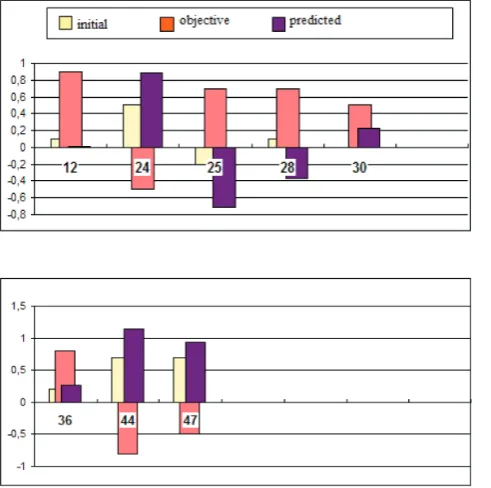
The results of modeling are given below. This
situa-tion is represented by the first scenario. The factors to be
observed or objective functions and their predictions are given on the graph. The yellow colored rectangles show the initial tendencies, the red colored ones - objective ten-dencies that correspond to the desired development of the situation, and blue colored ones- the predicted results tendencies:
Figure 1: Graph of the results (First Scenario)
12. profit from sales does not change 24. shadow turnover significantly increased 25. efficiency of energetics significantly decreased
28. ecological security moderately decreased 30. rehabilitation slightly increased 44. corruption strongly increased
47. social tension strongly increased
As the results show, in the condition of self-develop-ment the situation is not only improved, but, on the
con-trary, became significantly worse and became the source of
new problems. In particular, the 12-th factor is the collec-tion of payment for the consumed energy and it decreased compared with the today collection (it is contrary to de-sired dynamics of changes); the 24-th factor, the shadow
turnover, is increased; the 25-th factor, the efficiency, is de -creased; the 28-th factor, ecological security, is de-creased;
the speed of change of the 30-th factor is insufficient; the
44-th factor, the level of corruption, is increased. First Scenario’s Conclusion
All the above – said makes it necessary to intervene
radically in operation of the fuel and energy complex, to
change significantly the strategy and tactics of its develop -ment. That implies the use of the second modeling option (modeling of controlling development of the fuel and en-ergy complex).
Modeling Using Control (on the Basis of the Starting Scenario “Today Situation”)
The controlling factors from the list of existing ones
were selected. Predictions for not only variants were ob -tained, but for the set of accepted variants, each of which is determined by concrete values of controlling parameters (these are selected according to experts’ knowledge).
The factors selected as controlling ones:
• 2 - tax benefits in the fuel and energy complex • 6 - turnover means of the fuel and energy complex • 8 - commercial losses
• 12 - profit from realization • 17 - tariff on electric power
• 30 - ecological security in the fuel and energy complex • 33 - state order
• 34 - level of participation in transnational unions • 37 - demand on electric power
• 43 - state grants for the fuel and energy complex • 49 - export of peak
• 50 - level of legislative base in the fuel and energy com -plex
the governmental control.
- The 30th controlling factor provides actions accord-ing to the Kioto protocol.
-The factors 39 and 49 represent actions reflecting
participation of the Georgian fuel and energy complex in transnational unions.
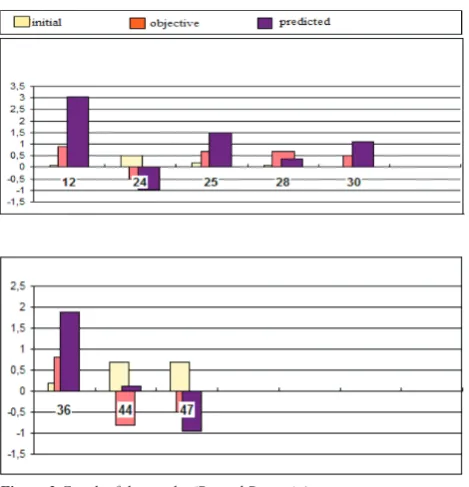
The starting data of the second scenario correspond to the today situation. The model correspond to the control scenario (parameters to regulate crisis situation are deter-mined).
The results of modeling (the second scenario) are shown below
Figure 2 Graph of the results (Second Scenario)
12. profit from sales strongly increased
24. shadow turnover strongly increased
25. efficiency of energetics strongly increased
28. ecological security moderately decreased 30. rehabilitation strongly increased 44. corruption strongly increased
47. social tension strongly increased Second Scenario’s Conclusion
The second scenario shows that the Georgia has to participate more intensively in various transnational un-ions. It shows also that the governmental intervention must be strengthened (of course, if it is compatible with the market economy principles and if there is analogue in the world practice) . The membership of the Georgia in the
international energy system guarantees that the intensifi -cation of the governmental control is not contrary to the market economy principles.
Modeling of the Self-Development in the Good Start -ing Conditions
(Scenario “Tomorrow”)
For this scenario modeling of self-development of en-ergetics was conducted. The relevant values of factors and tendencies of stable successful countries were selected as initial factors.
The Third Scenario
The starting values of parameters were selected with accordance of their desirability.
The graph of results of modeling is given below:
Figure 3 Graph of the results (Third Scenario)
12. profit from sales strongly increased
24. shadow turnover strongly decreased
25. efficiency of energetics strongly increased
28. ecological security moderately decreased 30. rehabilitation strongly increased 44. corruption moderately decreased
47. social tension strongly decreased
Third Scenario’s conclusion
As one can see, the results are very good and their economic action principles are based on monetary devel-opment theory.
Conclusions
of energetics have been investigated. On the basis of the conclusions of 3 scenarios considered recommendations on further possible development of energetics are pro-posed.
References
Alekseev, N.А.(1998). Chaotic events in nature: demonstration, efectivenes of protection., (in Russian), Moscow
Kosko, B. (1986). Fuzzy Cognitive Maps. Man-Machine Stud -ies., Vol 24 , pp.65-75