SAMIRA MABTOUL1 EL HASSAN IBN ELHAJ2
DRISS ABOUTAJDINE3
1Laoratoire LRIT, unité associée au CNRST, Faculty of Sciences, Mohamed V Agdal University 2National Institute of Post and Telecommunications Rabat, Morocco
3Laoratoire LRIT, unité associée au CNRST, Faculty of Sciences, Mohamed V Agdal University
1[email protected], 2[email protected], 3[email protected]
Abstract. In this paper, a novel copyright protection method that combines the Singular Value Decomposition (SVD) and the Dual Tree Complex Wavelet Transform (DT-CWT) is presented. After applying the 2-level DT-CWT to the original image, we apply the SVD to each high-pass subband obtained. The singular values in each subband are then modified by the singular values of the DT-CWT- transformed watermark. Experimental results demonstrate that the proposed scheme can effectively resist several common attacks.
Keywords: Image watermarking, copyright protection, SVD, DT-CWT.
(Received February 04, 2010 / Accepted November 18, 2010)
1. Introduction
Recently, with developing of computer network and information technology, lots of digital multimedia data (such as image, video and audio) are stored, transmitted and distributed through Internet, which lead to illegal copy or user for the electronic content. A digital watermarking technique has been developed to protect intellectual property from illegal duplication and manipulation. Digital watermarking means embedding information into digital media in such way that it is imperceptible to a human observer but easily detected by means of computing operations in order to make assertions about the data. A digital watermark is an invisible information pattern that is inserted into a suitable component of the data source by using a specific computer algorithm. Thus by means of watermarking, the data is still accessible but permanently marked [1, 2, 3, 4].
Watermarking systems can be classified on the basis of their requirements [3, 4]. However, digital watermarking and their techniques can be subdivided and segmented into various categories; for example, they can be classified according to the application, source data (image, video, audio, and text), availability of original data during extraction (non-blind, semi-blind, blind), human perception, and technique used. Current watermarking techniques described in the literature can
be grouped into two main classes. The first includes the spatial domain techniques. These embed the watermark by directly modifying the Least Significant Bits (LSB) plane of the original image. Such methods are low computational complexity but vulnerable to attacks [5, 6, 7]. The second class includes the transform domain methods, which to embed a watermark, a transformation is first applied to the host data, and then modifications are made to the transform coefficients. The watermarking scheme based on the transform domains can be further classified into the Discrete Cosine Transform (DCT) [8], Discrete Fourier Transform (DFT) [9], Discrete Wavelet Transform (DWT)[10], Dual Tree Complex Wavelet Transform (DT-CWT) [12, 13, 14] and SVD [11]. However, frequency domain techniques have provided more advantages and better performances than those of spatial ones in most of digital watermarking development and researches.
the watermark, the dual-tree complex wavelet transform DT-CWT is used, in [14], the DT-CWT-based
watermarking algorithm, robust for affine
transformation and time varying according to the degree of distortion, is given.
Recently, some watermarking schemes based on Singular Value Decomposition (SVD) have been developed and applied with success to protect digital image. In [11], the authors have proposed a new approach that showed a good robustness and can embed two different kinds of watermarks, a pseudo-random sequence or visual watermarks. However, their detection process cannot recreate the true watermark [15]. Other scheme has been recently proposed by [16, 17, 18] which used a combination of other transforms such as DCT and DWT or applied the above schemes on blocks of the host and watermark images instead of whole images.
In this paper, we propose a new digital image watermarking approach, which combines both the DT-CWT and the SVD. In next Section, we recall the Dual Tree Complex Wavelet Transform. A brief description of Singular Value Decomposition is introduced in section 3. Section 4 presents the different steps for the proposed scheme. In Section 5, we present the experimental results, and finally the paper is ended by a conclusion in Section 6.
2. Dual Tree Complex Wavelet
Transform (DT-CWT)
Kingsbury [21, 22] introduced a new kind of wavelet transform, called the Dual-Tree ComplexWavelet Transform that exhibits approximate shift invariant property and improved angular resolution. DT-CWT consists of two trees, each of it has linear phase filters that give the real and imaginary coefficients in its forward transform. Odd-length filters in one tree are paired with even-length filters in another tree. The final outputs are averaged to give approximate shift invariance. In its inverse transform, biorthogonal filters are applied in each tree separately. The filters used in the forward transform and inverse transform are almost orthogonal. This transform has both the advantages of being approximately shift-invariant and having additional directionalities (±15;±45;±75) compared to three directionalities (H, V, D) for traditional DWT [23].
3. Singular Value Decomposition (SVD)
Singular value decomposition is one of the numerical analysis tools used in image coding and other signalprocessing applications. The main theoretical backgrounds of SVD from the viewpoint of image processing are [19]:
� SVD is able to efficiently represent the intrinsic algebraic properties of an image, where singular values correspond to the luminance of an image and singular vectors reflect geometry properties of the image.
� Singular values (SVs) of an image have very good stability, i.e, when a small perturbation is added to an image, its SVs do not change significantly.
� An image matrix has many small singular values compared with the first singular value. Even ignoring these small singular values in the reconstruction of the image, the quality of the reconstructed image will not degrade a lot.
Let X is real matrix, in the SVD transform, X can be decomposed into a product of three matrices: X = U * S * VT. Where U and V are called left and right singular
vectors and are orthogonal matrices such that UTU = I
and VTV = I, and S is a diagonal matrix. The diagonal
elements of S are called the singular values of X.
4. Proposed watermarking algorithm
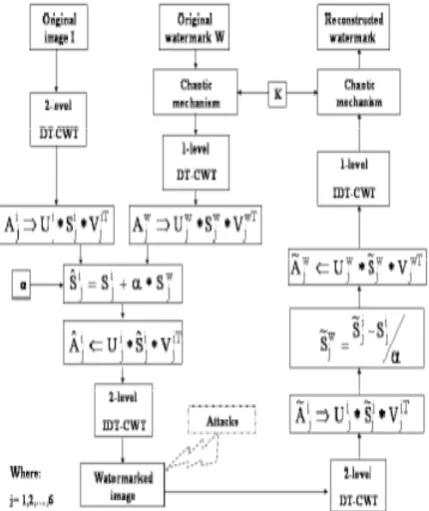
We use in this proposed approach grayscale image for both the host and the watermark image. The steps of the algorithm are as follows. Figure 1 shows a block diagram of the proposed watermarking scheme.4.1 Chaotic mechanism
In recent years, the chaotic data have been used for digital watermarking to increase the security. In our approach, a fast pseudo random number traversing method is used as the chaotic mechanism to change the watermark image W, which is a grayscale image, into a pseudo random matrixWd by using the following equation:
� � � ����������� ��� � ����� ��� �� �� � �����
K presents the first key in our watermark procedure, which is an exclusive key to recreate the watermark image. Figure 2 visualizes an example of watermark image disorder.
Figure 2: The original and disosrder watermark image.
4.2 Chaotic mechanism
The watermark embedding scheme can be described by the following steps:
� Using 2-level DT-CWT, decompose the host image I into 6 subbands.
� Apply SVD to each high-pass sabband image: ���� �
��������� � � �� �� � � �, where j denotes the 6
high-pass subbands of the 2-level decomposition and ��� denotes the corresponding singular values vector.
� To increase the security of the watermarking algorithm, the watermark W should be changed into a pseudo random matrix Wd (see. Sec A). Then the
1-level DT-CWT is applied.
� Apply SVD to each obtained high-pass subband: ��� � � �
�������� ����� � � �� �� � � �, where j, and ��� denotes the 6 high-pass subbands, and the
corresponding singular values vector, respectively.
� Modify the singular values of the host image in each high-pass subband with those of the watermark:
���� � �
��� � ������������������������ � �� �� � � ��������
Where:
��� : are the watermarked SVD coefficients.
��� : are the original SVD coefficients.
� : is an intensity parameter of image watermark.
��� : are the SVD coefficients of the watermark
image.
� Obtain the 6 subbands of modified DT-CWT coefficients: ���� � �
�������������� � � �� �� � � �.
� Finally, apply the inverse DT-CWT using the modified DT-CWT coefficients to obtain the watermarked host image Î.
4.3 Watermark extracting algorithm
The extraction of the watermark image is the inverse process of watermark embedding. The watermark extraction algorithm is described bellow:� Using 2-level DT-CWT, decompose the possibly watermarked image �.
� Apply SVD to each high-pass subband ���� � � ��� � ��� �
���� �� � �� �� � � ��
� Extract the singular values from each high-pass subband:
�� � � �
���� ��
� � ������� � �� �� � � ���������������
� Construct the 1-level DT-CWT coefficients of the six high-pass subbands by using the singular values
��, and the vectors (���� ���) computed at the time
of embedding process: ���� � ����� ��������� � � �� �� � � �.
� The reconstructed watermark image is obtained by using the inverse DT-CWT then the inverse chaotic mechanism with the first secret key K.
5. Simulations
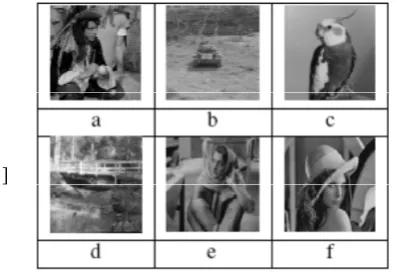
To demonstrate the effectiveness of our algorithm, Matlab simulations are performed by using 256x256 pixels grayscale "Man", "Tank", "Bird", "Stream and bridge", "Barbara", and "Lena" images (shown in figure 3).
artifacts or visual degradation in the watermarked images.
]
Figure 3: Six grayscale test images with size of 256x256 pixels (a) Man, (b) Tank, (c) Bird, (d) Stream and bridge, (e) Barbara, and (f) Lena.
We have made selective use of StirMark4.0 benchmarking technique [20], to test the robustness of our proposed scheme for some attacks : JPEG compression, Median filter, remove line, scaling, rotation, and cropping attacks.
Figure 4: Embedding a watermark into an image. (a) Original image Man, (b) watermark image, (c) watermarked image, (d) shows the constructed watermark.
In this paper, the correlation between the detected watermark and the original watermark W is adopted to measure the robustness.
Some examples of attacked watermarked "Bird" and the extracted watermark with the parameters used for the attacks are presented in figure 5. It can be seen from this figure that the watermark can be extracted under various attacks.
The correlation results are shown in tables 1-6 for different test images. As we can see from these tables our proposed approach detects the watermark correctly for different attacks.
Figure 5: The effect of attacks on watermarked Bird.
Table 1: The experiment results odJPEG compression atacks
Table 2: The experiment results of Median filter attacks.
Table 4: The experiment resuts of Scaling attacks.
Table 5: The experiment results of Cropping attacks.
Table 6: The experiment results of Rotation attacks.
11. Conclusions
In this paper, we introduced a new approach for watermarking of still grayscale images based on Dual tree complex wavelet transform and SVD. Simulations have confirmed that this new scheme is highly robust against various StirMark attacks. Furthermore, it is also a secure scheme, only the one with the correct key can recreate the true watermark image.
12. References
[1] F. P. Gonzalez, J. R. Hernandez. "A tutorial on digital watermarking". In IEEE Annual Carnahan Conference on Security Technology, 1999. [2] I. J. Cox, M. L. Miller. "The first 50 years of
electronic watermarking". Journal of Applied Signal Processing 2002, 2, 126-132.
[3] Juergen Seitz. "Digital Watermarking For Digital Media", Information Resources Press Arlington, VA, USA, ISBN 159140519X, 2005.
[4] Chun-Shien Lu. "Multimedia Security: Steganography and Digital Watermarking Techniques for Protection of Intellectual Property",
Idea Group Publishing, London, ISBN
1591401925, 2004.
[5] N. Nikolaidis, I. Pitas, Robust image watermarking in the spatial domain, Signal Processing, 66 (3), (1998), 385-403.
[6] J.-C. Liu, S.-Y. Chen. "Fast two-layer image watermarking without referring to the original image and watermark", Image and Vision Computing, 19 (14), (2001), 1083-1097.
[7] S.-C. Chu, J.F. Roddick, Z.-M. Lu, J.-S. Pan. " A digital image watermarking method based on labeled bisecting clustering algorithm", IEICE Transactions on Fundamentals of Electronics, Communications and Computer Science, E87-A (1), (2004), 282-285.
[8] J. R. Hernndez, M. Amado, and F. Prez-Gonzlez. "DCT-domain watermarking techniques for still images: Detector performance analysis and a new structure", IEEE Trans. on Image Processing, Special Issue on Image and Video Processing for Digital Libraries, vol. 9, no. 1, pp. 55-68, Jan 2000. [9] J. Kusyk, and A. M. Eskicioglu. "A Semi-blind LogoWatermarking Scheme for Color Images by Comparison and Modification by Comparison and Modification of DFT Coefficients", Multimedia Systems and Applications VIII, MProceedings of the SPIE, vol. 6015, pp. 107-121, 2005.
[10] M. Barni, F. Bartolini, and A. Piva. "Improved Wavelet based Watermarking Through Pixel-Wise Masking", IEEE Transactions on Image Processing, vol. 10, pp. 783-791, 2001.
[11] R.-Z. Liu, T.-N. Tan. "An SVD-based watermarking scheme for protecting rightful ownership", IEEE Transactions on Multimedia, 4 (1), (2002), 121-128.
[12] P. Loo, N. G. Kingsbury. "Watermarking using complex wavelets with resistance to geometric distortion", Proceedings Proceeding of the European Signal Processing Conference, EUSIPCO 2000, 5-8, 2000.
International Workshop, IWDW 2003, 2939/2004, 86-100.
[14] L. Joong-Jae , W. Kim, L. Na-Young , G. Kim. "A New Incremental Watermarking Based on Dual-Tree Complex Wavelet Transform", Journal of the Supercomputing 2005, 33(1-2), 133-140.
[15] X.P. Zhang and K. Li. "Comments on "An SVD-based watermarking scheme for protecting rightful Ownership", IEEE Transactions on Multimedia, vol. 7, no. 2, pp. 593-594, April 2005.
[16] Ganic, E. and Eskicioglu, A. M., "Robust Embedding of Visual Watermarks Using DWT-SVD", Journal of Electronic Imaging, October 2005. (Books and Publications: Peer Reviewed Article) 2005.
[17] A. Sverdlov, S. Dexter, A. M. Eskicioglu. "Robust DCT-SVD Domain Image Watermarking for Copyright Protection: Embedding Data in all Frequencies", EUSIPCO 2005, Antalya, Turkey, September 4-8, 2005.
[18] Rania A. ghazy, Nawal A. Elfishawy, Mohiy M. Hadhoud, M. I. Dessouky, B. M. Salam, and F. E. Abd El-Samie "An Efficient Block by Block SVD based image Watermarking Scheme", The 24th URSI National Radio Science Conference,
NRSC2007, Cairo, Egypt,13-15 March
2007.paper c26.
[19] KE-FENG HE, JUN GAO, LIANG-MEI HU,
HAO-YUAN GAO, " Watermarking for images using the HVS and SVD in the wavelet domain", Proceedings of the 2006 IEEE International Conference on Mechatronics and Automation June 25-28, 2006, Luoyang, China.
[20] F. A. P. Petitcolas, M. Steinebach, F. Raynal, J. Dittmann, C. Fontaine, N. Fats. A public automated web-based evaluation service for watermarking schemes: StirMark Benchmark. In Ping Wah Wong and Edward J. Delp, editors, proceedings of electronic imaging, security and watermarking of multimedia contents III 2001, 4314.
[21] N.G. Kingsbury, "Complex wavelets for shift invariant analysis and filtering of signals". Journal of Applied and Computational Harmonic Analysis, vol. 10, no. 3, pp. 234253, May 2001.
[22] I.W. Selesnick, R.G. Baraniuk and N.G. Kingsbury, "The Dual-Tree ComplexWavelet Transform". IEEE Signal Processing Magazine, vol. 22, no. 6, pp. 123151, Nov. 2005.