
IN THE 21st CENTURY Volume 20, 2010 80
Differences between learning
facts anD complex phenomena:
a learning stuDy in history
baseD on Variation theory
Mona Holmqvist, Karmen Björkman, Malin Ohlin
Kristianstad university, sweden e-mail: mona.holmqvis[email protected]e; [email protected]olvesborg.se;
Karmen.bjorkman@iuc-olofstrom.se
Abstract
This study has been carried out as part of a project entitled “The Pedagogy of Learning” (Holmqvist, 2002) whose objective is to use theory and practice to extend our knowledge of learning and teaching.
The study was implemented at the upper secondary school level and involved students in the first year
of the social science programme. Two classes were evenly divided into three groups. The “learning stu dy” model (Holmqvist, 2006) was employed and three research lessons in history were the focus of the study. The aim was to describe what students could potentially learn, and then compare this with what they actually learned with regard to critical aspects of historical knowledge of the learning object. The
learning object was exemplified by the period when Skåne, the southern part of the present country of Sweden, became Swedish after a period of Danish rule. By examining different aspects of the learning object, the aspects necessary to bring about learning were clarified. The lessons themselves were analy
sed in accordance with Variation Theory (Holmqvist, Gustavsson & Wernberg, 2008; Holmqvist & Mat tisson, 2008), according to the constituent concepts of discernment, simultaneity, and variation. What varies and what is invariant in a learning situation are important in determining what can be learned
(Marton & Booth, 1997). Changes were implemented in how certain critical aspects of the subject were presented to students with the goal of improving the student learning outcomes. The results confirmed
that the nature of what was taught resulted in different learning possibilities. One such element was the
ability to identify with those who lived during the period studied. Creating a kind of compassion for one or more fictitious persons enabled students to discern more easily the critical aspects. One conclusion of
this study was that an effective learning strategy for students is hard to develop because they try to focus both on understanding the learning object itself, and on gathering hints from the teacher about what will be on the upcoming examination (which constitutes a second implicit learning object). This is amounts to a ‘Guess what he is thinking’ game with the teacher, rather than developing a real understanding of the learning object itself. Another conclusion underscored the important role played by the developed un derstanding of the learning object in producing longterm or socalled ‘generative learning’. Our study demonstrated that there is a difference in the long term between decreased learning of isolated facts and increased comprehension of overall historical phenomena.
81 Introduction
Discussions constantly take place about student learning in relation to a teacher’s ability to te ach. Carlgren & Marton (2001) have extended this discussion further to a consideration of society’s expectations of what constitutes a teacher’s most important task. Nowadays teachers seem to be vie wed less as purveyors of knowledge than as managers of student learning. In addition, it has been claimed that computers will one day take over tasks formerly provided by teachers, namely, the pre sentation of the subject matter and the evaluation of learning. Together with the abovementioned authors, we take as our point of departure the belief that a teacher’s most important role – now and in the future – is the facilitation of student learning.
The question considered here is how a teacher’s words and actions affect a student’s possibility to learn. The present study describes what three groups of students learned from a history lesson, whereby the critical aspects (i.e., those needed to understand a phenomenon) are defined. The theo retical framework of our study is variation theory, which assumes that learning is a variation of the critical aspects of the learning object. Discernment of a phenomenon demands the ability to discern it as in some way from other phenomena. In other words, if you discern someone as tanned, you most likely have seen others who you discerned as not tanned. Variation theory has been developed by Marton & Both 1997), along with a number other researchers (Runesson 1999; Marton & Tsui 2004; Holmqvist 2004; Holmqvist, Gustavsson & Wernberg, 2007; Holmqvist, Gustavsson & Wern berg, 2008; Holmqvist, Lindgren, Mattisson & Svarvell, 2008; Holmqvist & Mattisson, 2008).
The study is part of a project called “The Pedagogy of Learning”, and has been carried out by researchers from Kristianstad University College and Gothenburg University. The project was led by Mona Holmqvist of Kristianstad University College, and was funded by the Swedish Research Council. The aim was to examine theoretical and practical aspects of learning and teaching in order to develop knowledge about learning and teaching which could be used in both teacher education programs as well as inservice training.
The present learning study is the first in Sweden to focus on history as a school subject within the project “The Pedagogy of Learning”, which has already conducted studies concentrating on En glish as Second Language (ESL), Swedish, and Mathematics from preschool to upper secondary school. Our aim was to study differences in how students develop an understanding of a learning object on the basis of the variation theory. The study specifically investigated historical phenomena of the seventeenth century, the period when Skåne became Swedish (1650 to 1660). The questions we addressed were:
1. What were students given the opportunity to learn and what did they actually learn? 2. What critical aspects of the learning object impacted student learning?
3. In what ways is a teacher’s ability to offer students dimensions of variation in the learning situation important to bring about learning?
Theoretical Assumptions
Historical awareness is a wellknown concept, but in the secondary school syllabus it is an ad vanced notion. The definition of historical awareness is unclear, both among researchers and on the basis of the syllabus. Researchers in the field of historical didactics and historians have varying con ceptions of historical awareness. This is further complicated by the difference between “historical awareness” and “awareness of history”. Historians have focussed on what has happened in the past (awareness of history), while educational researchers have looked to the past in order to understand the present and prepare for the future (historical awareness).
IN THE 21st CENTURY Volume 20, 2010
82 der Geschichtsdidaktik” [“historical awareness” in the Handbook of Historical Didactics”]. Jensen
(1997) summarizes Jeismann’s main points as follows:
1. Historical awareness is the permanent present knowledge about that all people and all direc tion and shapes of life they created in time i.e., they have an origin and a future and constitu te something unstable, inconstant, and unconditioned.
2. Historical awareness includes the context of interpretations of the past, understanding of the present, and perspectives on the future.
3. Historical awareness is how what has transpired in the past has shaped current views and attitudes.
4. Historical awareness rests on a common understanding of emotional experiences. This com mon understanding is a necessary component in the formation and growth of human socie ties. (Jensen 1997)
The emphasis on the dimension of time is an aspect that divides the four different points. Hart smar (2001) describes the concept of historical awareness as having many interpretations which, in turn, affect the content and methodology used in teaching history. In this paper, the definition of historical awareness is based on awareness of time. Such an awareness of time includes interpreta tions of past events, present situations, and future expectations. Such interpretations may become part of one’s identity. In order to develop historical awareness, the components or ‘small parts of history’ have to be seen as part of the ‘entire history’. Hartsmar is critical of teaching students about the past without making connections to the student’s present reality. Learning about isolated histori cal facts seems to promote role memorization instead of deeper understanding. Tosh (2000) defines historical awareness as:
. . . a general category that covers all shapes of historical thinking. It is a kind of awareness of the surrounding world where the change over time is central. The relationship between the last, present and the future is included as crucial element in this kind of awareness (p. 128).
The educational research tradition has in many ways tried to teach everything to everyone. But is that possible? Säljö (2000) claims acting in different practices means different ways to expe rience the world. Since people have had different experiences, individuals react to new phenomena differently. “If we could discern all aspects and take them into consideration at the same time, each situation would be considered in the same way by all persons” (p. 131). Instead, we know that indivi duals experience the same phenomenon in various ways. It seems as though “to discern something from the context and to relate it to this context – or to other contexts” (Carlgren & Marton 2001, p. 132) [author’s translation] results in different ways of seeing which, in turn, create variations in the possible ways to discern a phenomenon.
Variation theory is still under development (Marton & Both 1997; Runesson 1999; Marton & Tsui 2004; Holmqvist 2004; Holmqvist ed, 2006, Holmqvist, Gustavsson & Wernberg, 2007, Holm qvist, Gustavsson & Wernberg, 2008; Holmqvist, Lindgren, Mattisson & Svarvell, 2008; Holmqvist & Mattisson, 2008). It is used to study people’s different ways to understand or to experience pheno menon. Differences in experiences depend on how the phenomenon is discerned; in terms of parts discerned from the whole and in what way the parts on the other hand are seen as a whole. How to discern a part from the whole and the parts against each other is depending on how one considers a learning object. Or as Runesson (1999) claims ‘in order to know what something is you have to what it is not’ [authors’ translation] (a.a.s.31).
83
read (Holmqvist 2004). In the beginning, the individual letters are the only things in focus, but as the child learns to read the letters become the background: the child’s way of seeing has changed, with the letters now viewed as parts of a whole. Simultaneity is crucial in order to understand the surrounding world. A whole can in itself be a part of another whole, as well as the entirety itself. The meaning of a part or a whole varies, depending on which aspect is the intended focus. For example, 50% can be represented as half a circle; but 50% of a half circle is at the same time 25% of a whole circle. In order to understand this requires simultaneity. Finally, variation means that a phenomenon is discerned because it in some way differs from the ‘natural state’. Thus, in order to know what cold is one must have experienced the contrasting phenomenon, i.e., notcold or warmth (Holm qvist 2004). The critical moment for learning is when ‘we notice a change in understanding the environment’ (Holmqvist 2004, p. 75). In order to find the critical moment in a learning situation, variation of some kind is required. Teaching is not about finding the best general method. Instead, “variation of the critical aspects of a learning object is used in instruction” (Holmqvist 2004, p. 74). In order to facilitate this, a methodology need to be chosen, once the question of what it takes to grasp the learning object has been answered.
An assumption based on variation theory is that in each learning situation students are offered at least one learning object. By offering several dimensions or different aspects of the learning object, it also becomes possible for the individual to discern something against the background of variation. However, if a student experiences too many varying aspects, the result will be the same as if s/he has not experienced variation at all. An abundance of impressions seem to neutralize each other. The teacher’s challenge is to find the critical aspects of the learning object in order to present students with various ways of considering it. What kind of prior knowledge do students possess about the learning object? This must be understood, in addition to identifying the object’s critical aspects. If a student learns to tell time without knowing how the hands are related to each other, it will probably be difficult to understand the concept of the clock. If one of the hands were to remain constant while the other varied to show the hours, it would probably be easier to discern how the hands relate to each other. When students grasp this knowledge, their need to discern new aspects similarity makes the need of variation to increase. It is more important for the teacher to discern which factors may be held constant and which should vary than it is to find the “right” method. Variation theory can be used at school as a tool for the teachers to create better possibilities for the students to learn (Wernberg 2005).
Methodology of Research
The method we used was the learning study model that Marton (2003) describes as follows:
A learning study is a systematic attempt to achieve an educational aim and to learn from this experiment. It is a design experiment that can, but does not have to be, a lesson study. (p. 44)
The aim is to make learning possible for all involved—students, teachers, and researchers (Holmqvist & Nilsson, 2005). Thus, learning study means:
...different ways to present the aspects that are critical for the students in order to unders tand a learning object. (Holmqvist & Nilsson, 2005, p. x).
IN THE 21st CENTURY Volume 20, 2010
84 study as inservice training for teachers aims to develop lifelong educational habits which, when
modelled by the teacher, will hopefully instil curiosity in students to increase their own learning. Holmqvist & Nilsson (2005) see learning as a teacher’s main task. If the teacher does not learn from her/his students, there is a risk that the teacher ceases to develop.
Study design
As part of “The Pedagogy of Learning” research project based on variation theory and using learning study methodology, our study more or less includes the following stages:
1. Choose a learning object. What will students learn? 2. What kind of previous knowledge do students have?
3. Design a lesson on the basis of the knowledge students are supposed to acquire. 4. Implement the lesson according to the plan.
5. Evaluation of Lesson One: what have the students learned?
6. Implement Lesson Two according to a new learning design, based on the findings in Lesson One.
7. Evaluation of Lesson Two.
8. Implement Lesson Three according to a new learning design, based on the findings in Lessons One and Two.
9. Evaluation of Lesson Three. 10. Implement posttest.
11. Complete documentation of all results and evaluations. (Holmqvist & Nilsson 2005, p. 48–51)
Participants
As part of “The Pedagogy of Learning” project, one of the authors of this investigation (MH) contacted a comprehensive upper secondary school in a municipality in southern Sweden where two teachers were interested in participating in this learning study on history education. (A third teacher whom we hoped to include was not available.) Teacher A normally teaches history in both classes included in the survey. Teacher B also teaches history at the same school, but has had no prior contact with students who are participating in the project. Teacher A, therefore, was requested to teach Lessons One and Three, while Teacher B taught Lesson Two. The two classes involved are parallel sections within the social sciences programme (their first year). Students in each class read the same material during the period of this survey, and the course was implemented in the same way in both classes. In total, the two classes consisted of 63 students (47 girls and 16 boys). On the basis of screening, the students were divided as evenly as possible into three groups, which ended up having 16, 17, and 18 students.
Learning object
85
portance of focusing on the difference between students’ historical awareness, as opposed to their awareness of history as laid out in the course plan for the study of history. These were considered difficult concepts to measure, particular in the short term.
Data collection
The data collected for this study came from screenings, pretests, posttests, delayed post tests, video observations, tape recorded group discussions in class, and tape recorded planning session with teachers. The first item was a screening given to all students before their classes before they were divided up into three groups. The students were told of the aim of the study and of why they were not allowed to see the results of the tests. Every time they the results would could be yet anot her opportunity to learn, or a dependent variable which would have complicated the analysis of the students’ learning.
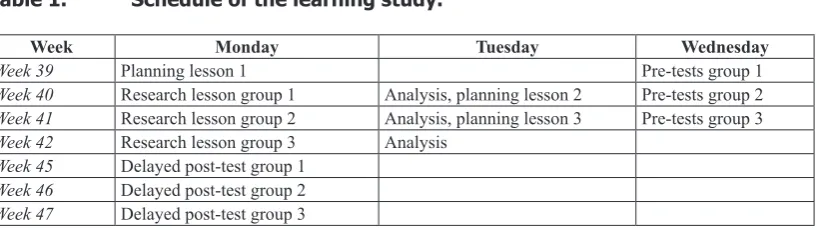
During a period of three weeks, pretests, classroom instruction on historical research, and posttests were carried out in all three groups. In each case, five days were permitted to elapse bet ween the pretest and the lesson. The posttest was administered to students immediately after the lesson, and fi ve weeks later each group was given a delayed post test.
Table 1. Schedule of the learning study.
Week Monday Tuesday Wednesday
Week 39 Planning lesson 1 Pretests group 1
Week 40 Research lesson group 1 Analysis, planning lesson 2 Pretests group 2
Week 41 Research lesson group 2 Analysis, planning lesson 3 Pretests group 3
Week 42 Research lesson group 3 Analysis Week 45 Delayed posttest group 1
Week 46 Delayed posttest group 2
Week 47 Delayed posttest group 3
Only those who took all three tests (pretest, posttest, and delayed post test) have been inc luded in reporting the results. Since screening was not used to analyze the learning outcome, but in order to describe a student’s understanding of the learning object, students who did not take the screening are included in the analysis of the other three test results. The survey produced both qu antitative and qualitative data. Answers to questions 1–8 on the test were analyzed quantitatively, while the screening, tape, and video recordings were analyzed qualitatively.
Screening
Screening was employed to determine what prior knowledge students had of the learning ob ject. This enable us to design the tests and to divide students into three groups with similar levels of knowledge of the subject matter. The screening consisted of two open questions regarding when Skåne became Swedish. It was administered on two different occasions: at the start of the project and at its conclusion. The questions were: 1) When did Skåne become Swedish, and what happened at the time? 2) What do you think life in Skåne was like then?
IN THE 21st CENTURY Volume 20, 2010
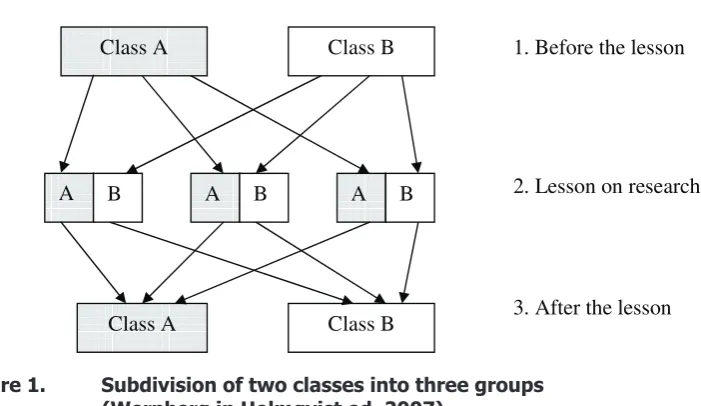
86 Class A Class B
A A A
Class A Class B
1. Before the lesson
2. Lesson on research
3. After the lesson
B B B
Figure 1. Subdivision of two classes into three groups (Wernberg in Holmqvist ed, 2007).
The three categories of knowledge that emerged from the phenomenographic analysis of the screening, as represented in Table 2, were:
A. Developed concept of time, developed historical awareness, developed logical thinking, good analytic ability.
B. Fairly accurate concept of time, average historical view, limited logical thinking, poor ana lytic ability.
C. Undeveloped concept of time, weak historical view, lack of logical thinking ability, defi cient analytical ability.
Table 2. Two classes divided into three groups.
Numbers of students per category after screening
Group/category A B C No answer
1 3 8 5 0
2 3 7 7 1
3 2 7 8 0
In designing the pretest on the basis of the screening results, we used both what student’s knew, as well as their misconceptions about the period, to formulate seven multiple choice ques tions. From the screening it was clear that some students professed general historical knowledge without discerning the period from which the knowledge derived. These students had a nonlinear view of history, i.e., they heaped together all of their historical knowledge but were generally unab le to situate what they knew within a specific time period. The screening also attempted to discern critical elements in the knowledge of the learning object: historical awareness of the decade from 1650 to 1660, when Skåne became Swedish. An analysis of the screening found the following criti cal aspects of the learning aspect:
• The conditions people lived in during those days compared with today.
• The relation between this period, its historical context and time, and the time before and af ter.
• The differences of how wars were conducted at those years compared to nowadays. • What could be the causes of wars at those days.
Test design and implementation
87
meaningful results, since there was a 50/50 chance that students would be guessing as there was that they were demonstrating knowledge. The instructional goal was to convey a general historical understanding to students, along with knowledge of the specific time period. Teachers also sought to develop the abilities of students to a) place their knowledge into context, b) analyze a picture or text, and c) develop some understanding of history’s influence on modern times. Based on the teachers’ aims and the results from the screening, a second attempt was needed to design a pretest, which was then taken by group 1. Analysis revealed that an additional question was required in or der to gain a deeper understanding of the pupils’ analytical ability. Therefore, at the suggestion of the teachers, the following openended question was added to the test: “Why did the Swedish king view the acquisition of Skåne as so successful?” Group 1 began the first lesson by answering this question. For the second and third groups, this question was included on the pretest.
The pretests, posttest, and delayed post tests were identical, apart from the order in which the multiple choice answers were presented. This was done to prevent the students from remembering the order of the answers from test to test and also to make it more difficult for students of different groups to share answers. The test was made up of multiple choice questions (questions 4–7) and open ended questions (questions 1–3, 8 and 9). The first seven were divided into two groups: facts (1–3) and comprehensionbased knowledge (4–7). Questions 4–7 required an ability to relate sin gle facts to their context. The pretest was used to measure the level of initial variability, while the posttest measured the level of variability after the lesson (Hartman, 1998). In some of the learning studies carried out in Kristianstad, a delayed posttest was used to examine patterns of the students’ understanding—how and if it develops, remains stable, or decreases over the long term (Holmqvist, Gustavsson & Wernberg 2007).
Recordings
Video recording was used in the learning study model as one way of gathering data. The three lessons in this study were videotaped by two cameras, one being a digital and one an analogue video camera. The latter camera was used as a backup. During the lesson the audio of the teacher was recorded with a microphone connected to the digital video camera. During all three research lessons, five tape recorders were placed around the classroom to tape record students during both te acherled and group discussions. In this study, tape and video recording of the research lessons was as an observational tool and to collect qualitative data. Both teachers and students appear to have been influenced by the presence of the camera. The camera made some of them feel uncomfortable and, consequently, the lesson may not have been as natural a situation it was hoped to be. At the beginning of the lessons, the teachers felt that the camera influenced their behaviour. They found that being recorded made the lessons more demanding than they would ordinarily have been. In this study each group was equally affected by the process of recording because the method of recording was consistent across groups.
Transcription
IN THE 21st CENTURY Volume 20, 2010
88 Analysis
The analysis consisted of the data from all the tests, the video recorded lessons, and the mee tings with the teachers. This material was analysed several times in order to capture the different dimensions of the teaching situations and to connect these to changes in the students’ knowledge, as shown by the test results. The analysis was based on the variation theory, namely, it described what the students were presented with for discernment, the ways in which simultaneity was used, and the variations offered by the teacher to the students in order to facilitate student discernment of the learning object. Pretests, posttests, and delayed posttests were analyzed on the basis of a template which gave a maximum of 30 points for questions 1–8. The results were compared, both concerning the performance of each group (i.e., between pre, post, and delayed post posttest in the same group) as well as between the different groups, in order to measure differences in the stu dents’ knowledge. By using repeated tests, it was possible to make comparisons of what students knew before and after the research lesson, and five weeks later. Since the aim of the study was to develop historical awareness and describe what it takes to develop this in a teaching situation, both video recordings and audio recordings were analyzed qualitatively to reflect the results of the tests. The analysis of the test results summarized how many correct answers each student gave. Every correct answer gave the student one point. A correct alternative answer which the student has not marked as correct, did not result in any reduction. If a student’s answer was incorrect, this has also not influenced the total sum of correct answers. The incorrect answers were been summarized sepa rately, so that both the correct and incorrect answers could be measured as independent clusters, and also to facilitate assessment of the differences between the two groups.
Results of Research
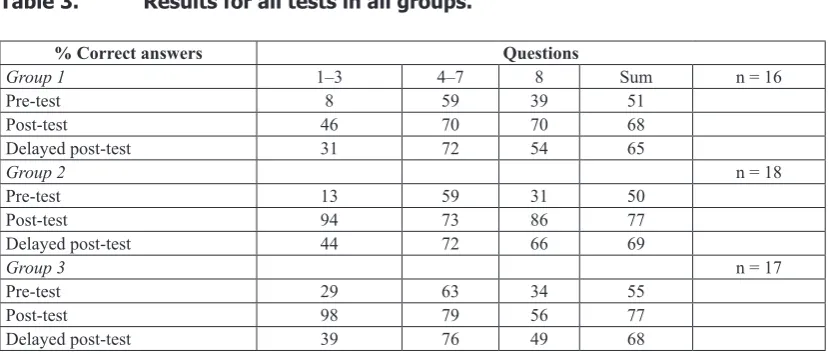
The result of correct student answers from the three research lessons are presented as integers in the table below.
Table 3. Results for all tests in all groups.
% Correct answers Questions
Group 1 1–3 4–7 8 Sum n = 16
Pretest 8 59 39 51
Posttest 46 70 70 68
Delayed posttest 31 72 54 65
Group 2 n = 18
Pretest 13 59 31 50
Posttest 94 73 86 77
Delayed posttest 44 72 66 69
Group 3 n = 17
Pretest 29 63 34 55
Posttest 98 79 56 77
Delayed posttest 39 76 49 68
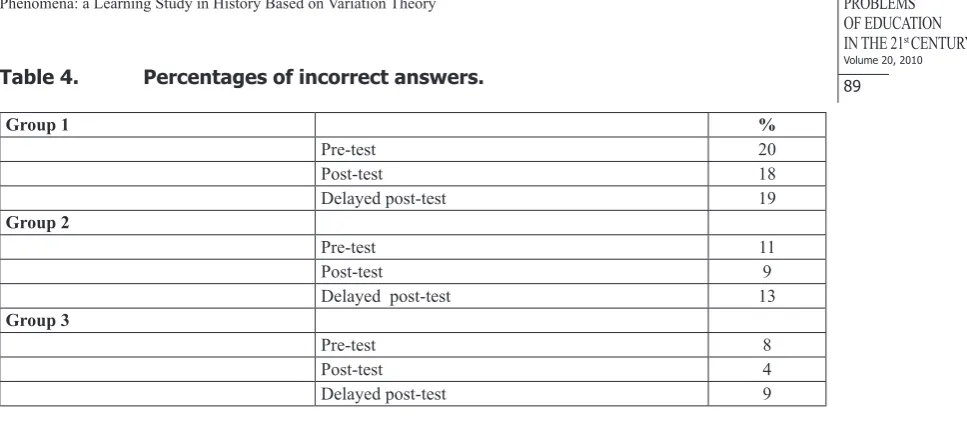
89 Table 4. Percentages of incorrect answers.
Group 1 %
Pretest 20
Posttest 18
Delayed posttest 19
Group 2
Pretest 11
Posttest 9
Delayed posttest 13
Group 3
Pretest 8
Posttest 4
Delayed posttest 9
The results show how the percentage of incorrect answers was more or less the same in all research lessons/groups. In each research lesson the number of incorrect answers showed a minor decrease from pretest to posttest. On the other hand, a minor increase in incorrect answers was found between posttest and delayed post posttest in each research lesson and group. The total sco res seem to be more or less similar in all three groups, but a deeper analysis shows some differences. In order to see the differences more clearly, each lesson’s results have been presented separately by pretest, posttest, and delayed posttest. The account of the result is reflected by an analysis of how the lessons were carried out.
Result of Research Lesson One
The results of the delayed posttest show a minor change in the mean when the sum of correct answers are compared between the two tests; in group 1, this change is from 68% to 65%. There is a minor increase in questions 4–7, from 70% to 72%. These questions all require a deeper understan ding of a phenomenon, a knowledge which seems to have been retained over time. The results of qu estions 1–3 decreased from posttest to delayed post posttest: 46% correct answers on the posttest, compared to 8% on the pretest. On the delayed post posttest, we found 31% of the answers were correct. When comparing those results, the percentage of incorrect answers on questions 4–7 also has to be considered. Only minor changes in the percentage of incorrect answers on these questions are seen, from pretest (20%) to posttest (18%) and delayed posttest (19%).
IN THE 21st CENTURY Volume 20, 2010
90 more opportunities to participate in class. It was assumed that this might be a way to open students
up to new dimensions in learning.
Result of Research Lesson Two
This lesson was also effective, with the results increasing between pre and posttest (+81 and +14 percentage points). In the delayed posttest the overall result for questions 1–8 shows a minor decrease when comparing the number of correct answers between the posttest and delayed post posttest in group two (from 77% to 69%). The major change is found in the delayed post posttest on questions 1–3, which pertained to historical facts. Here student knowledge decreased 50 percen tage points between posttest and delayed posttest (from 94% to 44%). It should be noted that the result for this group on questions 1–3 also shows the largest improvement of all groups from pretest to posttest (from 13% to 94% , that is, +81 percentage points). On questions 4–7 the answers seem to be rather similar between posttest and delayed post posttest (73% and 72%). The interpretation here is that knowledge having the character of facts which students memorized seems to disappear. On the other hand, the students appear to retain knowledge which requires a deeper understanding. In comparing results, the incorrect answers also have to been taken into consideration (questions 4–7). The number of incorrect answers showed a minor decrease (pretests 11% and posttest 9%), but increased again in the delayed posttest (13%).
Since further improvements might be expected by requiring a greater degree of student parti cipation and a stronger focus on the perspective of those people who lived during the period being studied, we discussed this at a meeting in which Lesson Three was designed. A dialog to capture the students’ experiences was not assumed to be sufficient; contrasting perspectives with small differen ces were made. The students’ followed a couple via four texts in two versions per text (one correct and one incorrect) that were almost similar. This was intended to facilitate discussions among stu dents which could expose them to different dimensions of the same phenomenon and offer more learning possibilities for the group.
Result of Research Lesson Three
As in the earlier lessons, an increase in scores between the pre and posttest was noted in Les son Three (+69 and +16 percentage units). The delayed posttest (questions 1–8) showed a decrease in the percentage of correct answers between posttest and delayed post posttest (from 77% to 68%). The largest change was again on questions 1–3, the factual questions, where there was a drop of 59 percentage points on correct answers between posttest and delayed posttest (from 98% to 39%). On the other hand, on questions 4–7, the questions of comprehensionbased knowledge, the results were relatively constant (79% and 76%). The students were able to retain this kind of know ledge. Finally, a comparison was also made between correct and incorrect answers on questions 4–7. Compared with the other two groups, group three had lowest number of incorrect answers on all tests. This number decreases slightly from pretests (8%) to posttest (4%), but increases to more or less the same level in the delayed posttest (9%).
Discussion
The aim of this study was to respond to the following questions:
1. What were students given the opportunity to learn and what did they actually learn? 2. What critical aspects of the learning object impacted student learning?
3. In what ways is a teacher’s ability to offer students dimensions of variation in the learning situation important to bring about learning?
91
students learn. Through offering variation, different perspectives, and empathy (in terms of seeing the world from the perspective of the people who lived at the historical period being studied), stu dents seem to open up for learning. The analysis shows, mostly in the first research lesson, how the student interpretations of what they are supposed to learn are strongly based on those aspects of the learning object concentrated upon during the lesson. On the other hand, if a teacher does not focus on a particular aspect, students tend to interpret their initially correct knowledge as incorrect. The teacher’s ability to create conditions for students to assume the perspective of persons who lived during the targeted period of time, together with the simultaneity offered in a dimension of variation crucial for discernment to occur, shows that the teacher plays a vital role in developing a student’s knowledge. The results also establish a difference in the longterm effect of learning of facts versus and comprehensivebased knowledge. The ability to retain facts appears to decrease quickly, while comprehensionbased knowledge seems to persist. While a teacher’s ability of offering students dif ferent dimensions of variation is important for their learning, evidence for generative learning was not found in this study. Generative learning means learning more and more about the learning object in new situations after the learning situation. Because the learning object might be hard to find spon taneously in other situations (such as outside of school), students might not have had encounters where new learning about the learning object were possible. The generative learningeffect that the contrasting texts used in Lesson Three might have had is thus impossible to assess.
It is difficult to analyze how the historical awareness of students increase. The design of tests is extremely important in order to capture the differences. Teacher cooperation with each other and with the researchers is, therefore, crucial to achieve reliability. It is also difficult to know in which way the contrast between the stories in the learning material in Lesson Three may have influenced the learning outcome, as the teacher introduced another dimension, namely, seeking to understand life from the perspective of the people who lived during that period. A further extension of the pro ject would be to carry out Lesson Three in a few groups, while employing control groups in order to see if the contrasted stories have or do not have an effect on the learning outcome.
To capture the art of teaching everyone everything is a dream. In order to create a situation that parallels the one being considered, we need to not only discern a great many aspects, but also take them into account at the same time–which may be impossible if we must consider things in such a variety of ways (Carlgren & Marton 2001). Nevertheless, by presenting the object of learning with variation and contrast, while emphasizing the perspective of those who lived in earlier historical periods, we may succeed in the art of teaching a greater number of students more content that they will retain. As Carlgren & Marton (2001) write, “Crucial for the most important kind of learning is the pattern of dimensions of variation that characterizes the conditions for learning’ (p. 141). The results of this learning study lend support to such an assumption. Our findings indicate that separa te, isolated facts seem to be quickly forgotten, while comprehensionbased knowledge appears to be retained over the long term. Such knowledge is more complex and requires an ability to separate facts from their context (that is, a part from the whole), as well as relate the parts to each other and to the whole via variation. This promises to be the way to develop comprehensionbased knowledge of the kind that students tend to retain long after they leave the classroom. As the historian of the re naissance, Jakob Burchkardt, has written, “History is not supposed to make us smart for tomorrow, but wise forever.”
References
Carlgren, I., & Marton, F. (2001). Lärare av i morgon. [Teachers of tomorrow] Lund: Studentlitteratur. Hartman, J., (1998). Vetenskapligt tänkande – från kunskapsteori till metodteori. [Scientific thinking – from epistemology to methodology]. Lund: Studentlitteratur.
IN THE 21st CENTURY Volume 20, 2010
92 Holmqvist, M. (2002). kapsrådets utbildningsvetenskapliga kommitté. [Research application to the Swedish Research Council. Lärandets pedagogik. [The Pedagogy of learning]. Forskningsansökan till vetens
Kristianstad: Högskolan Kristianstad.
Holmqvist, M. (2004). En främmande värld om lärande och autism. [A strange world. About learning and Autism]. Lund: Studentlitteratur.
Holmqvist, M., & Nilsson, J. (2005). Hur kan lärare utveckla ett livslångt lärande? [How can teachers develop lifelong learning?] In Lindelöf & Gisby (eds): Lärande hela livet. [Lifelong learning]. Lund: Studentlitteratur.
Holmqvist, M., (red) (2006): Lärande i skolan. Learning study som skolutvecklingsmodell. [Learning at school. Learning study as a school develop model]. Lund: Studentlitteratur.
Holmqvist, M., Gustavsson , L., & Wernberg, A. (2007). Generative learning. Learning beyond the lear ning situation. Educational Action Research, Vol 15, No 2, pp 181208.
Holmqvist, M., Gustavsson, L. & Wernberg, A. (2008) Variation Theory – An Organizing Principle to Guide Design Research in Education. In Kelly, A.E., Lesh, R., &. Baek J. (eds) Handbook of design re search methods in education, pp 111130. New York: Routledge.
Holmqvist, M., Lindgren, G., Mattisson, J., & Svarvell, T. (2008). Instruction built on learners’ previous knowledge by using the Variation theory. Problems of Education in the 21st Century (Recent Issues in
Education), Vol 6, p 8695.
Holmqvist, M., & Mattisson, J. (2008). Variation theory – A tool to analyse and develop learning at scho ol. Problems of Education in the 21st Century, Vol. 7, p 3138.
Jensen, B. E. (1997). Historiemedvetande – begreppsanalys, samhällsteori, didaktik. [History aware ness conceptual analysis, social theory, didactics]. In: Karlegård, C & Karlsson, KG (ed). Historiedi daktik. [History didactics]. Lund: Studentlitteratur.
Marton, F., & Booth, S. (1997). Learning & Awarness. Mahwah, NJ: Earlbaum Assosiates.
Marton,F. (2003). Learning study – pedagogisk utveckling direkt i klassrummet. Forskning av denna världen. Praxisnära forskning inom utbildningsvetenskap. [Learning Study educational development in the classroom. Research in this world. Practicebased research in educational science]. Rapport 2, Ve tenskapsrådet (s 4146). Stockholm.
Marton, F., & Tsui, A. (2004) Classroom discourse and the space of learning. Mahwah: Lawrence Erl baum.
Runesson, U. (1999). Variationens pedagogik. [The pedagogy of variation]. Göteborg: Acta Universita tis Gothoburgensis.
Tosh, J. (2000). Historisk teori och metod. [Historical theory and method]. Lund: Studentlitteratur. Säljö, R. (2000). Lärande i praktiken: ett sociokulturellt perspektiv. [Learning in practice: a sociocultu ral perspective]. Stockholm: Prisma.
Wernberg, A. (2005). Variationsteorin i praktiken. [Variation theory in practice]. In Erixon, P. O. (ed). Forskningsarbete pågår, [Research work in progress] (pp. 316332). Umeå: Umeå universitet.
Adviced by Laima Railienė, University of Šiauliai, Lithuania
Mona Holmqvist Associate Professor, Kristianstad University College, SE-291 88 Kristianstad, Sweden. Phone: +44203241.
E-mail: Mona.Holmqvis[email protected]e
Website: http://www.hkr.se/mona-holmqvist
Karmen Björkman PhD student, Kristianstad University College.
E-mail: Karmen.Bjorkman@iuc-olofstrom.se
Malin Ohlin PhD student, Kristianstad University College.
![L’assimilation de voisement en français : elle vaut pour les non mots autant que les mots (Voice assimilation in French: It applies to nonwords just like to words) [in French]](data:image/gif;base64,R0lGODlhAQABAIAAAP///wAAACH5BAEAAAAALAAAAAABAAEAAAICRAEAOw==)