Evaluation the Effective Factors on Moral Reasoning
of Accounting Students
Maryam Mirzajani
1, Ahmad Ghanbarian
21. M.A. Student of Accounting, Rasht Branch, Islamic Azad University, Rasht, Iran
2. Department of Business Management, Rasht Branch, Islamic Azad University, Rasht, Iran (Corresponding Author)
ABSTRACT” the purpose of this study was to evaluate the Effective Factors on Moral Reasoning of Accounting Students. The research is descriptive and is applied to the target. Based on field data collection is also considered. The tool of data Collection in this study is a questionnaire designed to measure the research variables. The variables are set equal to 5 Likert used. Validity of questionnaire was confirmed by professors and experts comments and reliability of it using Cronbach alpha was confirmed. The population of this study is all students of Accounting in Guilan province. Using the Cochran Formula, 390 students were studied as a final sample of research. To test the hypothesis a Regression test was used. The results showed that Ethical Principles and its dimensions have significant effect on moral reasoning.
Keywords: Ethical Principles, Moral reasoning, Accounting
INTRODUCTION
Ethics is important for accountants and those who rely on information provided by accountants. Because ethical behavior includes getting ethical view points. Also ethics education helps students to identify connection between ethical decision and behavior of real life. Therefore researchers in developed countries have distributed many studies about educating accounting ethics (Cadozier, 2002).
Accountants should be aware that accounting basically besides being a technical subject it is an ethical subject. Accountant for being able to act honestly and perceive extensiveness of a set in which they work, should be educated and taught affairs such as awareness of thinking systems, awareness toward result and having extensive and dynamic thought about their activities and decisions(Sarlak, 2008).
Problems such as concentration of business units for maximizing profit (structuring), confrontation with competitive challenges, emphasis on short-term result and presenting various services of accounting, have placed accountants in an environment of conflict and pressure that leads to unethical consequences for them. Therefore reasons and necessity of entrance of ethics in accounting and evolution and ethical growth can be mentioned in the fallowing cases: Firstly ethical belief of a person may be insufficient. Because it may be simple belief that is not helpful in complicated problems. Ethics study can help a person through making awareness toward applied principles in similar cases. Secondly in some conditions due to existence of contradicted ethical principles determining the work that should be done is difficult. In these cases ethics can present insight toward the way of judgment among contradicted principles and shows that how much especial strategies are better than other strategies. Thirdly people may not have proper belief or be loyal to improper values. Fallowing such believes and values in ethical analysis may manifest failure of those believes and a person should perceive that what he thought incorrect is acceptable or in contrast and after more consideration change his idea about some believes. Finally for studying ethics identification of main ethical rules that can be used in works. These rules should be able to enable people to be able to determine and perceive what to do and why(Duska & Duska, 2003).
Therefore those who are active in accounting field should have not only the professional qualification but also have high degree of honesty and professional integrity and professional reputation should be their most important asset.
Literature review
66 operation and also be aware of future prospect of institute. Characteristics of any skill is: A: accepting duty of serving society: existence of minimum condition determined in advance for entering into skill, such as necessary expertise skill that is achieved through education and experience, C: adherence of members of skill to a set of related principles, rules and values in that skill. Since accounting has above features and skills that needs expertise and has customers that depend on this expertise, therefore it is counted as a skill. For being professional, an accountant commits to care benefits of his different customers (Sarlak, 2008).
Also accounting considers presenting information in relationship with financial situation and degree of profitability of operations. This knowledge is the basis of financial and monetary systems and plays key role at supervision in the direction of making capability of accounting and clarity about economy. However existence of high degree of fraud in which accountants or audits, managers or administrative authorities involves leads to occurrence of ambiguities and defining questions in relationship with honesty and trust of professional accountants. During 20th century accounting skill is counted as a job dependent on ethics and ethical principles. However this claim has been threatened by regulators, legislators, investors and shareholders (Ahmed, 2010).
Because accountants violation of professional ethics has led to occurrence of economic crisis and financial scandal. Separation of management from ownership, have located accountants in a place that moral uncertainty or doubt toward their behavior not only disorder capital markets but also by making uncertainty toward honesty of managers has limited the possibility of doing activities of management(Saghafi et al, 2010).
On the one hand subjects dependent to ethics in different business transactions especially in accounting skill during recent years has got importance severely in recent years. Because ethics especially professional ethics is a comprehensive subject that covers all aspects of life. Also increasing growth of human societies and complexity of relations and social relations creates new needs. In this direction, appearance of different skills is the result of attempt in response to the need that forms by passing time and change of conditions and spends the process of transformation and evolution gradually. Therefore continuity of life of any skill and employment of its members depends on the type and quality of services that presents it is a credit and reliance that is obtained due to presenting these services and this reliance and credit is the main capital of any skill and saving it has high importance. Thus it requires the main goal and function of any skill and its member should be serving society and personal benefits should be allowed in the framework of presenting services. Accounting is not out of this rule. However occurrence of financial crisis and knowing accountants guilty has strengthened vacuumed of ethics in this skill. Because accounting skill is one of the most difficult and disciplines of professions in the world and due to type and nature of service that present it should have credit and reliability. Continuity of this credit and reliance and strengthening it, depends on thinking and practical adherence of members of skill to ethical and behavioral rules (Sarlak, 2008). Because there is strong and serious correlation between goals of accounting and ethics. Presented information by accountants should be significantly efficient, relying, real and without prejudice. Thus accountants should not only have professional conditions, but they should have high degree of professional honesty and professional reputation is their most important assets. Therefore accounting ethics for professional accountants and people who rely on accounting services has high importance. Therefore ethics in accounting is one important aspect in work of accountants (Usurelu et al, 2010). Nowadays the business in which scandals has happened in the area of accounting is not difficult (Armstrong et al, 2003). Therefore regarding recent financial scandals in the world, research about ethical subjects of accounting and ethical decisions in different cultures has increased (Royayi et al, 2009). As most scientific centers and universities throughout the world have entered professional ethics as course unit in their course program. However in Iran course unit is not seen with this title in educational program of accounting (Hejazi and Mesripour, 2012).
67 Figure1: research conceptual model
Regarding all subjects that was identified above and regarding relations that have been shown in studying model of research, hypothesis of current research has been written as below:
H1: Ethical principles have significant effect on Moral Reasoning.
H1-1: honesty has significant effect on Moral Reasoning.
H2-1: secrecy has significant effect on Moral Reasoning.
H3-1: impartiality has significant effect on Moral Reasoning.
H4-1: professional care has significant effect on Moral Reasoning.
METHODOLOGY
This research regarding goal is applied. Based on the way of obtaining required data current research is descriptive-surveying. Statistical society of current research is students of the last year of education of accounting in Guilan University that are 2150 people. Sampling in current research was done through available sampling method and by using Cochran sampling formula sample volume was estimated 374 people. Therefore 400 questionnaires were distributed among statistical samples among which 390 questionnaires was used. In current research atttributional research method (library) and field methods have been used. Research questionnaire has been set in two sections that the first section includes public information related to respondent and second section includes 27 questions that assess research variables. For assessing variable of principles and ethical rules questionnaire of Holmz et al(2012) including 19 questions have been used. For assessing ethical deduction questionnaire of Holmz et al(2012) including 4 questions and for assessing enhancement of professional behavior Holmz et al(2012) including 4 questions have been used. Validity of this questionnaire has been confirmed through using viewpoints of professors and experts and reliability of questionnaire was calculated through cronbach alpha coefficient (table 1).
Table1: calculating reliability of questionnaire Variable No. questions Cronbach alpha
Honesty 5 0.901
Secrecy 4 0.865
Impartiality 4 0.851
Professional care 6 0.891
Ethical principles 19 0.949
Moral Reasoning 4 0.827
RESEARCH FINDING
Firstly for considering independence of errors from each other’s Durbin-Watson test were used. As the results showed, this statistics is located at the range (1.5-2.5). Therefore independence hypothesis is accepted. Another hypothesis is lack of co-linear between independent variables.
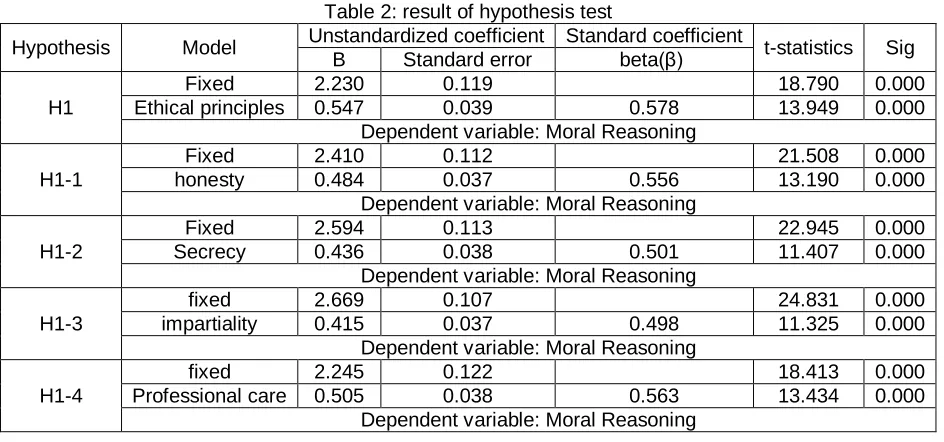
68 Table 2: result of hypothesis test
Hypothesis Model Unstandardized coefficient Standard coefficient t-statistics Sig B Standard error beta)β(
H1
Fixed 2.230 0.119 18.790 0.000
Ethical principles 0.547 0.039 0.578 13.949 0.000
Dependent variable: Moral Reasoning H1-1
Fixed 2.410 0.112 21.508 0.000
honesty 0.484 0.037 0.556 13.190 0.000
Dependent variable: Moral Reasoning H1-2
Fixed 2.594 0.113 22.945 0.000
Secrecy 0.436 0.038 0.501 11.407 0.000
Dependent variable: Moral Reasoning H1-3
fixed 2.669 0.107 24.831 0.000
impartiality 0.415 0.037 0.498 11.325 0.000
Dependent variable: Moral Reasoning H1-4
fixed 2.245 0.122 18.413 0.000
Professional care 0.505 0.038 0.563 13.434 0.000
Dependent variable: Moral Reasoning
CONCLUSION AND SUGGESTION
Regarding the results and confirming hypothesis and observation the positive effect of principles and ethical rules on improvement of Moral Reasoning among students of accounting, the fallowing cases are suggested:
It is suggested to emphasize and pay attention to the importance of commitment in doing duties especially in professional and sensitive jobs such as accounting and auditing and commitment to ethical principles and headlines in university lessons. Is devoted to these subjects. Also honest behavior in working environment, attracting reliance of authorities in the organization and colleagues, adherence to principles and rules and having strong will are such important problems that should be put in university and non-university educational periods and secondly authorities of organizations about attracting and applying and also evaluation of accounting and financial forces they should have many attention.
It is suggested in educational plans of accounting field on necessity of ethical education about strengthening personal will of people and avoiding favoritism tendencies to the benefit of their personal benefits or especial group benefits, avoiding aware or unaware bias in presenting accounting result and emphasis on the primary result without reconsideration and emphasis on working independence and avoiding job and group dependencies should be emphasized and such discussions should be put in educational titles of accounting group.
It is suggested to provide necessary facilities in universities and proper planning for equipping students with proper tools such as applied and expertise software education for accounting, strengthening motivation for students for increasing their accounting knowledge, education of correct thinking toward accounting subjects and problems resulted from lack of correct doing of duties, providing internet systems with proper quality and free access to reliable scientific information database for studying and updating students information, enhancing analytic and deductive power of students of accounting by related period and educating statistical analysis for enhancing research power of accounting students in confronting problems that has ambiguity and educated people of this field enter related skill by high power and professional ethics and proper with human principles.
REFERENCES
1. Ahmed, A. (2010), Ethics in Auditing; And Ethical Studies in Different Accounting Bodies, http://ssrn.com/author=1447219.
2. Armstrong, M. B., Ketz, J. E., & Owsen, D. (2003). Ethics education in accounting: Moving toward ethicalmotivation and ethical behavior. Journal of Accounting Education, 21(1), 1.
3. Blanthorne, C. Stacy, E. K., Dann, G. F. (2007). Accounting educators’ opinions about ethics in the curriculum: An Extensive view, Accounting education, Vol. 22, No. 3, pp. 355-390.
4. Cadozier, V. (2002). The moral profession: A study of moral development and professional ethics, Retrieved from proquest.com. 5. Duska RF, Duska BS (2003). Accounting Ethics. Eight published. Blackwell Publishing. India. pp:5-25.
69
7. Royayi, R., Rahnamaye Roodposhti, F., Jabari, H. (2009). Effect of Culture on Moral Reasoning of Accounting Students, Journal of Cultural Management, Vol. 3, No. 5.
8. Saghafi, A., Rahmani, H., Rahimi, A. (2010). Teaching Ethics in Accounting in Bachelor Course, Ethics in Science and Technology Quarterly, Vol. 5, No. 1.