DeVelopINg a TeaCHeR eDUCaTIoN
pRogRaMMe To pRoMoTe SCIeNTIFIC
lITeRaCY IMpRoVINg a poSITIVe
aTTITUDe aBoUT SCIeNCe
J. Alexandre Pinto polytechnic Institute of porto, porto, portugal e-mail: [email protected]
J. Bernardino Lopes University of Trás-os-Montes and alto Douro, UTaD, Vila Real, portugal e-mail: [email protected]
António Alberto Silva polytechnic Institute of porto, porto, portugal e-mail: [email protected]
Carla A. Santos University of Trás-os-Montes and alto Douro, UTaD, Vila Real, portugal e-mail: [email protected]
Abstract
Usually elementary teacher education has pitfalls in developing important dimensions of scientific liter-acy (SL) through science teaching. So, to refine some Teacher Education Program (TEP) characteristics is important to potentiate their positive attitudes towards links amongst science technology and society themes (STS) so that they may improve their students’ SL. This study aims at identifying characteristics of a TEP that promote teachers’ key attitudes about STS and develop dimensions of teaching practice trans-ferral to teachers’ practices to foster their students’ SL. It reports a longitudinal case study (3 years) to refine characteristics of a TEP, answering the questions: a) what features should a TEP have, to improve consistently positive attitudes of teachers about STS?, (b) which gains in teachers’ attitudes towards the STS were obtained from the implementation of TEP? The TEP incorporated, progressively, findings based on literature and other characteristics resulting from improvements, namely: (a) exploring contexts and using materials and equipment from daily routine; (b) developing epistemic practices related with ex-perimental work in open challenge activities; (c) transferable teacher mediation traits. The TEP, with the referred characteristics, allowed teacher to develop important attitudes about: scientific inquiry, willing-ness to engage in issues related to science and science as a social enterprise.
Key words: teacher education, teachers STS attitudes, scientific literacy.
Introduction
usually elementary teacher education has pitfalls in developing important dimensions of
scientific literacy (SL) through science teaching. over time science teaching has devoted great
135 throughout the time, teachers simply did not develop the other two dimensions (scientific in
-quiry and science as a social enterprise) closely related to the process and the nature of science, and the interpretation of the relationship between science and society (Abd-El-Khalick, 2013; Feinstein, 2011).
Research has revealed the necessity of working with this focus, both with students and teachers, concerning the valuation of attitudes about the nature of Science (Eastwood,Sadler, Zeidler, Lewis, Amiri, & Applebaum 2012; Mas, Alonso & Díaz, 2001). In parallel with this, the investigation has been producing works that aim to support initiatives for teachers’ educa
-tion focused on this matter (Chahal, 2011; Wolter, Lundeberg & Bergland, 2013). However, there is a widespread dissatisfaction regarding the levels achieved by teachers concerning their attitudes about science and, therefore, a general acceptance exists that this must be the subject of intentional work in science teachers’ training courses.
It is also found in literature, that there is a conflict on the interpretation of how these teachers’ conceptions influence their educational practice. While in some studies it is possible to identify a direct influence between the teachers’ beliefs and their practice (Buss, Newman & Martini, 2002), other studies (Abd-El-Khalick, Bell & Lederman, 1998; Nehm & Schonfeld 2007) point out the need to work with teachers and improve their attitudes about the nature of science, and also in an explicit way, point out that it is very important to establish connections and make reflections about how they may influence the dynamics of the classroom.
So, there is a need in enriching the teaching and learning sciences’ process, for develop
-ing important dimensions of scientific literacy. In particular, there is a need of find-ing ways to articulate theoretical orientations, practicable in a teacher education programme contexts, that promote better attitudes of teachers towards STS themes (Eastwood, et al., 2012; OECD, 2013; Nehm & Schonfeld 2007).With this study it will be possible to contribute to the enrichment of elementary teacher education courses, stimulate reflections and provide suggestions about strategies and resources, using the guidelines identified in the literature and find the main char
-acteristics of an effective teacher education programme to promote teachers attitudes towards the STS themes.
Related Literature
Scientific Literacy and Its Relevance
The concept of scientific literacy was used in a wide sense (OECD, 2006; Royal Society, 1985) about which there is some degree of consensus. In such sense, it is the type of literacy that includes: science content (scientific knowledge and its use); scientific inquiry and willing
-ness to engage in issues related to science; and science as a social enterprise (characteristics of science, awareness of how science and technology shape the world).
Following Thomas and Durant (1987), two groups of arguments are pointed out about the relevance of scientific literacy: arguments, related to nations’ income, society and science; and arguments, related to individual’s well-being. About the first ones, it is referred: scientific literacy allows individuals to have a more relevant role in the productive sector of economy (Walberg, 1983); the support given by a population to science stimulates favourable policies and influences their funding (Shortland, 1988); a better scientific literacy builds a better demo
-cratic participation in politics and in the processes of social change (Prewitt, 1983). In the second group of arguments the well-informed people are better prepared to make personal deci
in the 21 century Volume 60, 2014
136 Scientific Literacy and the Challenge of Training Teachers to Improve
Their Attitudes towards STS
the processes of teaching and learning science cannot be seen as a direct application of
the processes of scientific knowledge production. Nevertheless, they should reflect the paths and modes of operation of science and the ways in which it relates within a community, taking into consideration the economic, political and social contexts (Chahal, 2011; Eastwood, et al., 2012; Yore, 2012). It is essential to learn and to reflect about scientific production processes, namely their possibilities and limitations.
Also, teaching of science should be seen not as an end in itself, but rather as a path that brings together the knowledge of people, promoting fundamental competencies, or tools, for the development of individuals and society (Heinsen, 2011).
The achievement of good levels of scientific literacy by students is not possible in poorly diversified teaching practices focused on the acquisition of terms, facts and laws (Hurd, 1998). It is crucial to deal with several dimensions of scientific literacy, taking into account their dialectic interactions in a holistic view related to socially relevant contexts (Feinstein, 2011; Murcia, 2009). It is necessary to carefully design tasks to be accomplished by students in the classroom (Heinsen, 2011; Lopes, 2004), as well as diversified resources and methods that challenge and bring them closer to inquiring and researching approaches. This is the case of those that involve problem solving, collaborative group work and a key role given to students’ questions and initiatives (NAP, 1995).
As highlighted by Hurd (1998): achieving good levels of scientific literacy depends on a “lived curriculum”, rather than on “direct teaching”; experimental work (in the field or the laboratory) focused on accessible but relevant and authentic events, are exercises of citizenship through which students have the opportunity to experience the complexity of scientific process
-es and their implications at various levels (Eastwood, et al., 2012; Feinstein, 2011). The teacher mediation of experimental work in the classroom is crucial for student education (Lopes, 2004; Lopes, Cravino, Branco, Saraiva, & Silva, 2008): when the teacher uses an open experimental work proposal in its classes, the experimental activities involve the analysis and the understand
-ing of the problem, the design and implementation of a plan of experimental procedures and the evaluation and interpretation of the results. In experimental work, the teacher should assume the role of guiding and coordinating students’ work, encouraging discussion and exchange of ideas, and also providing help and answers when needed (Crawford, 2012).
In teaching, it is possible to keep a balance between conventional and rigid approaches and flexible and open ones: it is the teacher who must decide how this is carried out, consider
-ing the constraints of the context of his action (Gräber & Nentwig, 1999). However, if higher levels of scientific literacy are desired, then flexible and open approaches should have some degree of priority. For this, it is necessary to invest in teachers’ training courses that guarantee a permanent scientific and pedagogical update and promote a critical and reflexive position in regard to their practices.
According with this gap the main purpose of this study is: Identify main characteristics of pedagogical practice of an elementary teacher education program (TEP), based on literature and developed empirically, that works in practice to improve the teachers’ attitudes towards the STS themes.
The related literature enables to shape the study balancing in three structural axes to find
the main characteristics of a tep:
a) From the implicit to the explicit in the training process about Science, Technology and their relations with Society;
137
Methodology of Research
Research Focus, Aim and Research Questions
The main study purpose is to refine a teacher education program (TEP) for elementary science teachers that promote teachers’ key attitudes about STS and develop important dimen
-sions of teaching practice transferral to teachers’ practice and can foster their students’ scientific literacy with this in mind. It will be possible to answer the following research questions: (a) what features should a TEP have, to improve consistently positive attitudes of teachers about STS themes?, (b) which gains in terms of teachers’ attitudes towards the STS themes were ob -tained from the implementation of the referred teacher education program?
To answer these two questions a longitudinal case study was designed (Cohen, Manion, & Morrison, 2010) in a qualitative perspective (Denzin & Lincoln, 1994) during three years. It was important to accompany the case for several years to assure that the characteristics of the TEP and students’ characteristics were consistent over years.
The characteristic of a longitudinal study, despite it requires more time, is due to its na
-ture once it was an incremental construction (Chang 2005; Viegas, 2009). The study took place over time, iteratively, searching for ideas, testing and incorporation to prove it productive. This is a process well understood in the light of a research-action which also influenced the work.
Participants
The didactic sequence was implemented over three years by the first author with students
in an initial training graduation program of mathematics and science elementary teachers in a
higher education institution in the north of Portugal. The case is constituted by the teacher with one course per year, each one with different students. In the year prior to implementation, while researching, reviewing literature and looking to the structure of the study, it was possible to develop, in the light of a pilot study, a number of initiatives which allowed firstly look into the characteristics of the students and their conceptions about STS, to observe the students’ recep
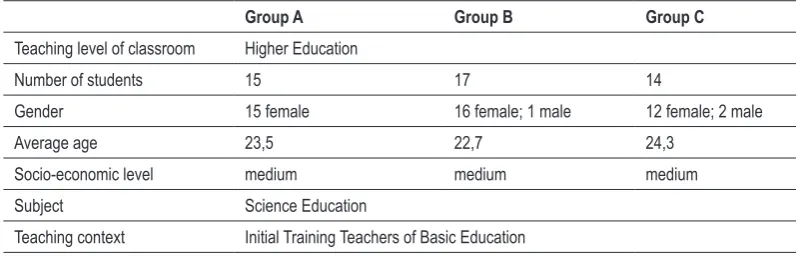
-tiveness to the proposals which are thought to be implemented. It also allowed the researcher to become familiar with the new approach of work, to sketch resources, to improve proposals. The main study took place in the three academic years following (Group A-2008; Group B-2009 and Group C-2010). The extension of the study (along three years) was due to its nature. It is an incremental construction, over time, iteratively, in a growing demand for new ideas, testing and incorporating productive solutions. The course was influenced by the investigation-action methodology. The main characteristics of the three groups of students are presented in Table 1 below.
Table 1. Characteristics of the student groups.
Group A Group B Group C
Teaching level of classroom Higher Education
Number of students 15 17 14
Gender 15 female 16 female; 1 male 12 female; 2 male
Average age 23,5 22,7 24,3
Socio-economic level medium medium medium
Subject Science Education
in the 21 century Volume 60, 2014
138 The teacher who developed the training program has 20 years of teaching experience and also has research experience in physical sciences education projects.
Data Collection and Analysis
The instrument used for the detection of STS attitudes of future teachers was the questionnaire COCTS “(Mas, et al., 2001), an abbreviated version (Mas, Alonso & Díaz, 2004) which was translated and validated into Portuguese language (COCTSvpa). The COCTSvpa comprises 18 questions distributed by the different subjects, in accordance with the Table 2.
The themes explored in COCTS cover the dimensions of scientific literacy previously presented (Royal society, 1985) that are the most important to this research as they are usually less explored (see Table 2).
Table 2. Questions of COCTSvpa by themes.
Dimensions of SL Themes of COCTSvpa COCTS Questions
Characteristics of science Definitions of Science and Technology(definition of science; definition of technology;
interdependence between C&T) 10111; 10211; 10412; 10413
Use of scientific knowledge External Sociology of Science(influence of society on C&T; influence of C&T on the society)
20411; 20511; 20611; 20811; 20821; 40111; 40211
Scientific inquiry Internal Sociology of Science(characteristics of scientists; social
construc-tion of scientific knowledge) 60111; 60511;70211
Scientific inquiry Epistemology of Science(nature of scientific knowledge) 90211; 90511; 90611; 91011
139
Figure 1: Example of a question of the COCTSvpa.
The questionnaire was applied to three groups of practice teachers (A, B, and C) before and after the development of the TEP described in the following section.
The questionnaire comprises a model for analysis of the results, as described by Mas and colleagues (2001), that allows obtaining partial and global attitudinal indices, situated between -1 and 1. The response to each phrase is processed by a scale of predefined valuation according to the type of phrase (appropriate, naive or plausible). This classification resulted from how a group of experts interpreted it. The normalized gains were calculated (Hake, 1998; George & Cowan, 1999) from pre to post test.
in the 21 century Volume 60, 2014
140 Design of the Program
Formative Situation in Curriculum Design: Presenting the Framework
The authors chose the formative situation (FS) as a tool for curriculum planning and management by its heuristic value. The theoretical framework of the FS (Lopes, Cravino & Silva, 2010) takes into account: (a) how the knowledge available to the students is incorporated into teaching; (b) how the tasks are proposed to the students and these are actually performed by them; (c) how and when the teacher provides relevant information; (d) how the teacher supports students in order to achieve the desired learning; (e) how the students are engaged in learning (mobilizing their own knowledge as well as the information that is available); (f) how tasks are contextualized; (g) how a given conceptual field is worked. This extended set of fea
-tures makes the FS a very suitable tool to support the curriculum planning and management for the promotion of SL. There is a tone between the FS characteristics and the dimensions of SL referred before. In particular, the FS is helpful to find a context to the lesson, encourage the use of context to support a problematizing approach as a strategy to activate and support learning and, also, the FS value the role of the teacher mediation that assumes fundamental importance in promoting students epistemic practices. All these aspects are critical in a curriculum design that enables scientific literacy promotion.
Characteristics of the Teaching Sequences
A TEP was conceived with teaching sequences developed in view of: (a) promote knowl
-edge in the different areas of scientific literacy (Murcia, 2009); (b) integrate experimental work related to contexts of everyday life, with a teacher mediation that promotes students’ epistemic practices (Hurd, 1998; Leach & Scott, 2003; Lopes, Branco, & Jimenez-Aleixandre, 2011; Lot
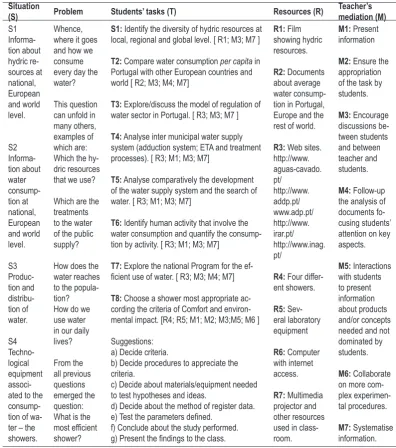
-ter, Harwood & Bonner, 2007); (c) become the teacher as a reflective practitioner (e.g. Zeichner & liston, 2013). The structure of TEP is based on the formative situation framework presented before. The structure of the FS is presented in the Table 3. There is articulation between the different items incorporated in the FS. In particular, the horizontal articulation can be explicit adding in each activity references about resources and teacher mediation strategies (e.g. [R2; M3; M4; M7]), as it can be seen in Table 3.
Decisions were taken at the level of the curriculum design and at the level of teacher’s mediation in the classroom that, together, encapsulate the TEP based on:
- STS approach (Martins & Veiga, 1999), in particular challenging students to reflect on the process of constructing scientific knowledge by exploring possibilities and limitations of Science (Lopes, 2004) and how it relates to the community considering the economic, political and social contexts (Tytler & Symington, 2006);
- Contextualization of tasks (Caamaño, 2005; Redish, 2003), reifying guidelines to oper
-ate in scientific and technological contexts of everyday life (Hurd, 1998).
- Integration of experimental work in the classroom to promote an investigative learning influenced by scientific work, which enhances epistemic practices in students like: interpret, an
-alyze, discuss, argue, make predictions and hypotheses (Lopes, et al., 2011; Richter & Schmid, 2010; Scott, Mortimer, & Aguiar, 2006).
- Conceptual evolution perspective (Posner, Strike, Hewson, & Gertzog, 1982; Scott, Asoko, & Driver, 1992), to promote the mobilization of students’ knowledge (Arons, 1997) with a view of the development of competences (Sabella & Redish, 2007).
- Collaborative learning (Felder & Brent, 2007), in order to teachers be able to build a social environment in the classroom to facilitate the interaction between students and between students and teachers, they should promote collaborative moments.
- Assessment and feedback (Hattie & Timperley, 2007), also tried to find a way to give students feedback on their work as to guide their involvement and effort recognizing and sup
141 An incremental integration of strategies was used, along with resources and procedures that revealed to be adequate over the three years of the intervention (Chang 2005; Viegas, Lopes & Cravino, 2009).
Content of the Teaching Sequences
The chosen theme for the didactic sequence was “water”. The following reasons support
this choice:
• Appears in the elementary education curriculum with great frequency, is referred more or less explicit along the curriculum;
• Has a great ability to promote interdisciplinary connections which is assumed as es
-sential, especially in a level of schooling which refers to a generalist approach in science teach
-ing;
• Facilitates the structuring of formative situations based on the usage contexts since it is very present in the daily lives;
• There is an urgent need for an education for a new water culture (Martínez-Gil, 1996). Figure 2 shows the articulation between the thematic “water” with organizing themes of official curriculum to explore the relations among science technology, society and environment proposed by the national curriculum of elementary education (Figure 2).
Figure 2: Articulation between the thematic “water” with the general
propos-als of official curriculum to explore the relations STSE (adapted from
national curriculum of elementary education).
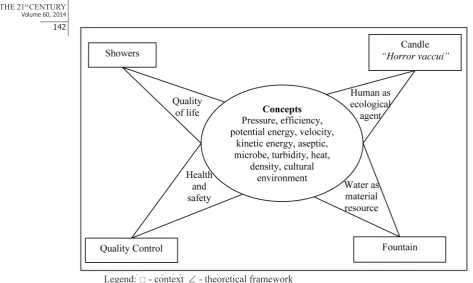
The Figure 3 systematizes concepts and contexts involved in didactic sequence from the four organizing themes.
in the 21 century Volume 60, 2014 142
legend: - context ∠ - theoretical framework
Figure 3: Concepts and contexts involved in didactic sequence (using the con
-ceptual field network scheme of Lopes et al., 2010.
Following an open perspective of curriculum management (Lopes et al, 2010) in op
-position to a “compartmentalized” perspective that displays a succession of units of content “existing” each one basically alone, it was decided to bring to the centre of work contexts of everyday life that have motivated an integrated vision of knowledge through multi, trans and interdisciplinary approaches.
Articulating Teaching Sequences
The TEP developed had five teaching sequences articulated in a spiral path (see Fig
-ure 4). In the beginning was emphasized the conceptual development by implementing the Formative Situation A (SF-A) followed by experimental activities, open and investigative in nature (an example of this are the SF-B, SF-C and SF-D). The SF-Project corresponded at the first moment to design curriculum, resources, or small curriculum units, focused on classroom
implementation of elementary education to be presented and discussed in class in a simulation
143
Figure 4: Articulation of a different formative situation in the teacher education
program (following PERT diagram scheme (Lopes et al., 2010).
The lessons were conducted in order to implement the previously described guidelines, trying to fulfil a structural equilibrium in three axes: (a) from the implicit to the explicit on train
-ing about relations between STS; (b) Train-ing on the different dimensions of scientific literacy in a articulated way and simultaneously; (c) Promotion of educational practices in a dialectical view of theory and practice.
in the 21 century Volume 60, 2014
144 Table 3. Example of a Formative Situation (2009/2010): SF-D: water in daily
lives-Efficiency of a shower (following formative situation specifica
-tion table Lopes (2004) and Lopes and colleagues, 2010).
Models:
Fluid mechanics; Model of regulation of the water sector in Portugal (IRAR); Model of the distribution of water; Model of an WWTP; Models of showers.
Concepts:
Pressure; Flow; Efficiency Relations:
Types of supply and geographic distribution of population; characteristics of the distribution network and waste of resources, environmental degradation and water consumption, new technologies and efficiency in water use. Available knowledge of the students
Sources of drinking water. Quotidian human activities that involve the expenditure of water. Identification of technologi-cal objects in common use associated with water consumption.
Situation
(S) Problem Students’ tasks (T) Resources (R) Teacher’s mediation (M) S1 Informa-tion about hydric re-sources at national, European and world level. S2 Informa-tion about water consump-tion at national, European and world level. S3 Produc-tion and distribu-tion of water. S4 Techno-logical equipment associ-ated to the consump-tion of wa-ter – the showers.
Whence, where it goes and how we consume every day the water?
This question can unfold in many others, examples of which are: Which the hy-dric resources that we use?
Which are the treatments to the water of the public supply?
How does the water reaches to the popula-tion? How do we use water in our daily lives? From the all previous questions emerged the question: What is the most efficient shower?
S1: Identify the diversity of hydric resources at local, regional and global level. [ R1; M3; M7 ]
T2: Compare water consumption per capita in Portugal with other European countries and world [ R2; M3; M4; M7]
T3: Explore/discuss the model of regulation of water sector in Portugal. [ R3; M3; M7 ]
T4: Analyse inter municipal water supply system (adduction system; ETA and treatment processes). [ R3; M1; M3; M7]
T5: Analyse comparatively the development of the water supply system and the search of water. [ R3; M1; M3; M7]
T6: Identify human activity that involve the water consumption and quantify the consump-tion by activity. [ R3; M1; M3; M7]
T7: Explore the national Program for the ef-ficient use of water. [ R3; M3; M4; M7]
T8: Choose a shower most appropriate ac-cording the criteria of Comfort and environ-mental impact. [R4; R5; M1; M2; M3;M5; M6 ]
Suggestions: a) Decide criteria.
b) Decide procedures to appreciate the criteria.
c) Decide about materials/equipment needed to test hypotheses and ideas.
d) Decide about the method of register data. e) Test the parameters defined.
f) Conclude about the study performed. g) Present the findings to the class.
R1: Film showing hydric resources.
R2: Documents about average water consump-tion in Portugal, Europe and the rest of world.
R3: Web sites. http://www. aguas-cavado. pt/ http://www. addp.pt/ www.adp.pt/ http://www. irar.pt/ http://www.inag. pt/
R4: Four differ-ent showers.
R5: Sev-eral laboratory equipment
R6: Computer with internet access.
R7: Multimedia projector and other resources used in class-room.
M1: Present information
M2: Ensure the appropriation of the task by students.
M3: Encourage discussions be-tween students and between teacher and students.
M4: Follow-up the analysis of documents fo-cusing students’ attention on key aspects.
M5: Interactions with students to present information about products and/or concepts needed and not dominated by students.
M6: Collaborate on more com-plex experimen-tal procedures.
145 Knowledge and attitudes to develop:
Develop the conceptual field of hydric resources namely their distribution on the planet and associated characteristics, factors enhancers of pollution, operating - costs systems, benefits, profitability.
How the shower works and implications in characteristics of the jet of water it provides. Develop the concept of efficiency.
Promote a critical attitude in the choice of the shower against several offering in the market. Competencies to develop:
Mobilizing knowledge for understanding the consequences that the use of resources on earth has for individuals, society and the environment.
Analyse critically different possibilities in the acquisition of a certain technological tool/object.
Estimated time (hors) 8 (in classroom) + 5 (autonomous work).
Results of Research
Results about Main Characteristics of TEP That Work to Improve Consistently Positive Attitudes toward the STS Themes
In this section, the modifications implemented during the time on the TEP, as a result from putting into practice of the literature guidelines that work in teaching practice, are de
-scribed. Also, the main characteristics of TEP that work to improve consistently positive at
-titudes toward the STS themes, as will be shown in the next subsection, are identified.
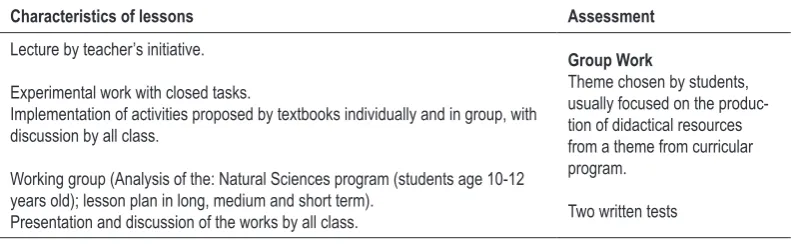
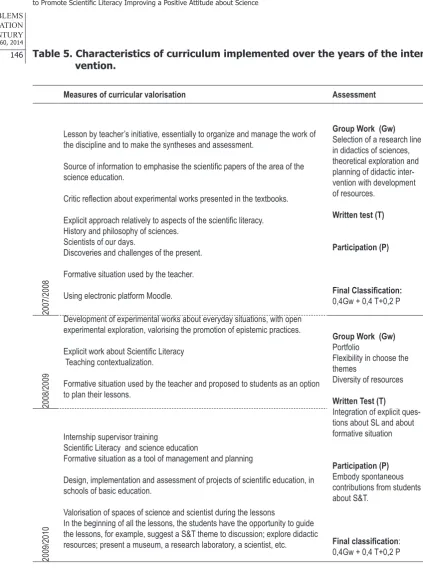
In the Table 4 the work before the intervention is briefly characterized and in the Table 5 the curricular valorisations carried out over the three years of the intervention are summarised.
Table 4. Characteristics of the lessons before the intervention.
Characteristics of lessons Assessment
Lecture by teacher’s initiative.
Experimental work with closed tasks.
Implementation of activities proposed by textbooks individually and in group, with discussion by all class.
Working group (Analysis of the: Natural Sciences program (students age 10-12 years old); lesson plan in long, medium and short term).
Presentation and discussion of the works by all class.
Group Work
Theme chosen by students, usually focused on the produc-tion of didactical resources from a theme from curricular program.
in the 21 century Volume 60, 2014
146 Table 5. Characteristics of curriculum implemented over the years of the
inter-vention.
Measures of curricular valorisation Assessment
2007/2008
Lesson by teacher’s initiative, essentially to organize and manage the work of the discipline and to make the syntheses and assessment.
Source of information to emphasise the scientific papers of the area of the science education.
Critic reflection about experimental works presented in the textbooks.
Explicit approach relatively to aspects of the scientific literacy. History and philosophy of sciences.
Scientists of our days.
Discoveries and challenges of the present.
Formative situation used by the teacher.
Using electronic platform Moodle.
Group Work (Gw) Selection of a research line in didactics of sciences, theoretical exploration and planning of didactic inter-vention with development of resources.
Written test (T)
Participation (P)
Final Classification: 0,4Gw + 0,4 T+0,2 P
2008/2009
Development of experimental works about everyday situations, with open experimental exploration, valorising the promotion of epistemic practices.
Explicit work about Scientific Literacy Teaching contextualization.
Formative situation used by the teacher and proposed to students as an option to plan their lessons.
Group Work (Gw) Portfolio
Flexibility in choose the themes
Diversity of resources
Written Test (T)
Integration of explicit ques-tions about SL and about formative situation
Participation (P) Embody spontaneous contributions from students about S&T.
Final classification: 0,4Gw + 0,4 T+0,2 P
2009/2010
Internship supervisor training
Scientific Literacy and science education
Formative situation as a tool of management and planning
Design, implementation and assessment of projects of scientific education, in schools of basic education.
Valorisation of spaces of science and scientist during the lessons
In the beginning of all the lessons, the students have the opportunity to guide the lessons, for example, suggest a S&T theme to discussion; explore didactic resources; present a museum, a research laboratory, a scientist, etc.
Some excerpts of MN’s are presented, to illustrate some relevant aspects of the imple
-mentation the TEP, in classroom setting.
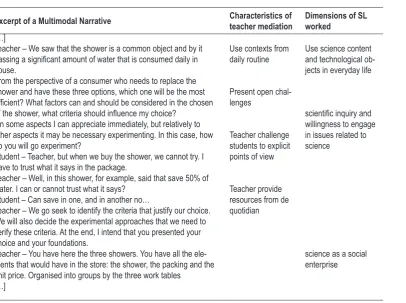
The excerpts presented below, Table 6, 7 and 8, allow to highlighting the main charac
-teristics of the teacher education plan, and also, essential aspects of the dynamics developed showing the roles assumed by the teacher or by the students. In Table 6, the open challenge pro
147
Table 6. Excerpts from NM on the SF-D (Group C) – open challenge proposed and dimension of SL worked.
Excerpt of a Multimodal Narrative Characteristics of teacher mediation Dimensions of SL worked […]
Teacher – We saw that the shower is a common object and by it passing a significant amount of water that is consumed daily in house.
From the perspective of a consumer who needs to replace the shower and have these three options, which one will be the most efficient? What factors can and should be considered in the chosen of the shower, what criteria should influence my choice?
On some aspects I can appreciate immediately, but relatively to other aspects it may be necessary experimenting. In this case, how do you will go experiment?
Student – Teacher, but when we buy the shower, we cannot try. I have to trust what it says in the package.
Teacher – Well, in this shower, for example, said that save 50% of water. I can or cannot trust what it says?
Student – Can save in one, and in another no…
Teacher – We go seek to identify the criteria that justify our choice. We will also decide the experimental approaches that we need to verify these criteria. At the end, I intend that you presented your choice and your foundations.
Teacher – You have here the three showers. You have all the ele-ments that would have in the store: the shower, the packing and the unit price. Organised into groups by the three work tables
[…]
Use contexts from daily routine
Present open chal-lenges
Teacher challenge students to explicit points of view
Teacher provide resources from de quotidian
Use science content and technological ob-jects in everyday life
scientific inquiry and willingness to engage in issues related to science
science as a social enterprise
in the 21 century Volume 60, 2014
148 Table 7. Excerpt from NM on the SF-D (Group C) – Characteristics of teacher
mediator to promote students’ epistemic practices.
Excerpt of a Multimodal Narrative Characteristics of teacher mediation Dimensions of SL worked […]
We begin the work reviewing the criteria to appreciate the decision to purchase the shower more efficient. Were also presented the proposals of the experimental work to appreciation the amount of spend water (consumption), since for this appreciation it was decided to realize an experimental activity.
Teacher – Basically we have two experimental proposals, what are they?
Student A – Connects the hose to the shower and to the faucet of the work table. Allow to pour water during 30 seconds. All the water will collect trough. In the end of this time, we measure the amount of the obtained water, for each shower and in the several functions of the showers. Finally, we compare the values obtained.
Student B – We think otherwise. We thought in taking a bottle of 2 litters of water and see with the hose how long it takes to pass through the shower, also for all the showers and all functions.
[…]
Teacher – So, you have half an hour to accomplish the experiments that have decided. In the end we’ll meet in a round table to know what happened, we do not have to do now for all showers, we make a first assessment and according this we extend to the other showers or proceed to improvements if necessary.
The students started the experimentation. During this work the students had the opportunity to know materials and equipment that were news for them, such as valve of pressure retention, Teflon ribbon, tubes and sealants.
[…]
Promoting creativity, communication skills and argumentation.
Valuing motor skills and equipment handling.
Knowledge of simple materials and equipment used by professionals
Teacher give autonomy to the stu-dents to experiment their ideas
scientific inquiry and willingness to engage in issues related to science
influence of soci-ety on C&T and vice-versa
Scientific inquiry +
science as a social enterprise
The Table 8 below contains an excerpt of a Multimodal Narrative of a classroom relative to the SF-A. It is a part of work on epistemology of science and illustrates the explicit dimen
-sion of training about Science and scientists, that is, an important aspect of scientific literacy. The contact with researchers, the possibility to know about their daily routines, and the dyna
149
Table 8. Excerpt from NM on the SF-A (Group A) – contact with the science and
scientists as it was.
Excerpt of a Multimodal Narrative Characteristics of teacher mediation Dimensions of SL worked […]
In the second part of the lesson, I presented to the class a re-searcher that agreed to my invitation to be in our lesson to talk about herself, her daily life with family, friends and work. She presented some slides that described and complemented with additional information about her qualifications, professional career, and even occupations with family and her group of friends.
[…]
Student – You felt early the desire to devote to research? – student asked to the researcher.
Researcher – I think not, at least I do not remember having a clear idea about it. Very early in the school, I felt attracted for Sciences, but the opportunity to work in research, which is something I like, turned out to be an opportunity. Of course I had to search… Student – And it was very difficult to achieve this?
Researcher – As I told you it was not an objective at the outset for what seemed like a course relatively natural, neither easy nor difficult.
Student – You said that works on two research centers. But it is not difficult to reconcile?
Researcher – Sometimes it’s, when it was convenient to have more time to complete some task, but usually as I know the time I have on each side and as well as in each side they know when I’m available, the things stay organized and therefore it’s not very complicated.
Student – How do you decide what is going investigate?
Researcher – The themes of the work are related a lot with the insti-tution, with a tradition to investigating this or that. And are the more experienced researchers who head teams and they defined priorities that transform in projects.
Student – It seemed to me a lot of space and few people, it is always like this?
[…]
Student – It is easy to reconcile professional life with personal and family life? From the photos that you showed looks like it, but… Researcher – I wish had more time for that, but maybe we all would like. I have tasks in more than one institution and therefore it gets more difficult but always finds time for family and friends. Student – I saw many young people in the photos, I thought they were all a little older.
Researcher – Maybe I has brought examples with people closest but I also have older colleagues.
(…)
Valuing professional activities related to scientific research
Knowing details of the everyday life of a researcher
Explore psychological characteristics of an investigator
Know mechanisms of decision making in research groups
Meet decision mechanisms and coexistence within research groups
known forms of interpersonal relation-ships within a group of researchers
science as a social enterprise
characteristics of scientists
social construc-tion of scientific knowledge
influence of society on C&T and vice-versa
nature of scientific knowledge
In the summary, the training TEP encapsulates the following features that were simul
-taneously workable (guidelines of literature that works in practice) and developer of positive attitudes towards STS themes:
Explorations about science and scientists: Become acquainted with researchers, with details of their everyday life and with professional activities related to scientific process;
in the 21 century Volume 60, 2014
150 Explorations of Science and Technology in real-world contexts: Exploring contexts and using materials and equipment from daily routine;
Students’ involvement in intellectual activities like scientists: developing epistemic
practices such as creativity, communication skills and argumentation in open challenge activi
-ties.
Results about COCTSvpa and Analysis
The obtained results about STS attitudes of practice teachers are presented in Figure 5. It can be shown, that the three groups present (before training) a similar attitudinal profile in the four dimensions studied. This can be explained by the fact, that their formative pathways were similar. Although, at different moments students, in general, come from the same scientific area in secondary school, and attended the same disciplines in higher education. The overall figures show some sensitivity of teachers towards the studied themes, since the values are located at a positive level. For the four dimensions, in all groups (A, B and C) there is a visible gain in terms of the attitudinal index.
Figure 5: Global indices concerning attitudes about STS themes (pre and post
test).
151
Table 9. Gains achieved per themes of COCTS and group concerning attitudes
about STS themes.
Group A (%) Group B (%) Group C (%)
Definitions od S&T 4.6 4.5 11.0
External Sociology of Science 10.5 8.2 5.6
Internal Sociology of Science 12.9 23.0 18.6
Epistemology of Science 10.6 7.7 19.3
Global attitudinal index 9.7 10.9 13.6
It is found, that there is a decreasing trend of the dispersion from the pre-test to the post-test, which is a positive finding. The reduction of dispersion by calculating the interquartile rang (IQR) by theme and group was analysed. The results point that the IQR for the groups A and B, remained constant in themes “Definitions of S&T”; “External Sociology of science” and “Internal Sociology of science” and decreased for the theme “Epistemology of science”. For the group C, the IQR decreased for all themes.
In Table 10, the percentage of answers that were not given by theme and group, are presented. In general, the number of answers that were not given, in the post-test, decreases.
this is an interesting indicator that can be interpreted as evidence of a greater familiarity and
knowledge of the students with the theme after training.
Table 10. Percentage of answers not given, by theme and group.
Group A (%) Group B (%) Group C (%)
Pre-test Post-Test Pre-test Post-Test Pre-test Post-Test
Definitions of S&T 1.9 2.5 2.5 1.7 1.0 0.7
External Sociology of Science 10.5 3.7 4.3 3.3 12.4 3.8
Internal Sociology of Science 15.5 5.1 4.0 5.1 13.8 0.0
Epistemology of Science 15.7 8.4 10.7 7.1 16.8 1.2
Discussion
The data, in general, point to the effectiveness of the training program in the improve
-ment of teachers’ STS attitudes.
The main characteristic of the TEP that was possible to put into practice was inspired by literature (Heinsen, 2011; Lopes, 2004). Additionally, essential aspects of the teaching dynamic developed, showing the roles assumed by the teacher or by the students. In this context, it was particularly relevant the open challenge proposed to the students, providing resources, in order to promote epistemic practices (Eastwood, et al., 2012; Lopes, et al., 2011). The results sug
-gest that students’ epistemic practices are relevant to develop one important scientific literacy dimension; scientific inquiry (related with internal sociology of science). On the other hand, the
interest and relevance given by the teacher to engage students in critical analysis processes and
decision-making in science and technology contexts of everyday life (Feinstein, 2011; Murcia, 2009) was important to develop another scientific literacy dimension: use of scientific knowl
-edge (related with external sociology of science).
in the 21 century Volume 60, 2014
152 by the scientific community (e.g. Alonso, et al., 2002; Caamaño, 2005; Felder & Brent, 2007; Hattie & Timperley, 2007; Lopes, et al., 2011; Martins & Veiga, 1999; Sabella & Redish, 2007; Scott, et al., 1992; Tytler & Symington, 2006), and constructed by an incremental and interac
-tive process, testing and incorporating produc-tive solutions as described in results section and inspired by Viegas and colleagues (2011).
The results point to a valorisation of teacher’s scientific literacy, namely, in terms of their attitudes about scientific inquiry, related with the themes “internal sociology of science” and “epistemology of science”, and science as a social enterprise, related with theme “external
sociology of science”. In fact, clear evidence of progress of teachers’ attitudes about STS in all
the themes referred, was obtained. The results showed some fluctuation and dispersion in the responses in line with other studies (Mas, et al., 2001) that can be explained by the nature of the theme and the diminished tradition that teaching devotes attention. The global attitudinal index
concerning attitudes about sts themes constitutes evidence of student progress from group a
to group C.
Conclusions
The training plan for elementary teacher education to be improved, consistently in differ
-ent groups of stud-ents (future teachers), has the following characteristics:
- Develop work focused on theoretical and conceptual explorations about science, about scientists and about fundamentals of didactics;
- Integrate the reflection about Science in society taking into account the political, eco
-nomic and social contexts in which it operates;
- Use the contexts through the involvement of the students in work, on situations that belong to the routines of everyday life, challenging the students for the use of scientific and technological knowledge in real-world contexts;
- Provide the students with learning experiences comparable and compatible with the dynamic process of science; enable the students to take part in the development of epistemic practice production of scientific knowledge, particularly by conducting experimental work.
The TEP with referred features allowed developing key attitudes with the referred char
-acteristics, allowed the teacher develop important attitudes about: scientific inquiry, willingness to engage in issues related to science and science as a social enterprise.
The most expressive characteristics of the teacher mediation in the classroom that al
-lowed the reification of the TEP were: the promotion of a learning environment with autonomy; the use of contexts and situations of everyday life; challenging students through open activities, stimulating epistemic practices like focusing, describing, communication and argumentation.
Implications for Practice and Learning
Policy makers, in the context of curricular decisions of Teacher Education institutions, should integrate curricular elements (e.g., suggesting planning tools like Formative Situation; fostering collaborations with research institutions and researchers; valuing science spaces like museums) that guide the teacher education for better understanding of science, technology and their relations with society. Particularly, they should value training dimensions such as: “defini
-tions of S&T”; “external sociology of science”; “internal sociology of science” and “
epistemol-ogy of science”.
teacher educators should value and accept the challenge to foster the attitudes of student
teachers on STS issues. Teacher educators should implement a mediation that exploits contexts and uses materials and equipment from daily routine; that promotes epistemic practices such as focusing, describing, communication and argumentation in open challenge activities, giving au
153 issues related to the definition of science and technology and external sociology of science since they proved more resistant to enhancement.
For future studies it would be interesting to refine and extend the findings by application the TEP in other contexts of teacher’s education courses. It would also be important in future studies to explore ways in which learning about science intersects with learning styles of stu
-dents.
Acknowledgements
The authors acknowledge the support of FCT for the project PTDC/CPE-CED/112303/2009, and the scholarships SFRH/BD/28508/2006.
References
Abd-El-Khalick, F. (2013). Teaching With and About Nature of Science, and Science Teacher Knowledge Domains. Science & Education, 22 (9), 2087–2107.
Abd-El-Khalick, F., Bell, R. L., & Lederman, N.G. (1998). The nature of science and instructional prac-tice: Making the unnatural natural. Science Education, 82 (4), 417–436.
Alonso, C., Gallego, D., & Honey, P. (2002). Los estilos de aprendizaje: procedimientos de diagnóstico y mejora [Learning styles: diagnostic and improvement procedures]. Madrid: Mensajero.
Arons, A. B. (1997). Teaching introductory physics. USA: Wiley.
Buss, K. A., Newman, W. J., & Martini, M. (2002). The influence of an instructor’s nature of science beliefs on science methods instruction. Presented at Annual Meeting of the National Association for Research in Science Teaching. New Orleans: NARST.
Caamaño, A. (2005). Contextualizar la ciência [Contextualize science]. Alambique, Didáctica de las cien-cias experimentales, 46, 5-8.
Chahal, M. (2011). Nature of science or nature of reality: What is the purpose of science education? Al-berta Science Education Journal, 42 (1), 33-39.
Chang, W. J. (2005). The rewards and challenges of teaching innovation in university physics: 4 years’ reflection. International Journal of Science Education, 27 (4), 407-425.
Cohen, L., Manion, L., & Morrison, K. (2010). Research methods in education (6th Ed.). London: Routledge.
Crawford, B. (2012). Moving the essence of inquiry into the classroom: Engaging teachers and students in authentic science. In K. C. D. Tan & M. Kim (Eds.), Issues and Challenges in Science Educa-tion Research (pp. 25–42). New York: Springer.
Denzin, N., & Lincoln, Y. (Eds.). (1994). Handbook of qualitative research. Thousand Oaks, USA: Sage publications.
Eastwood, J. L., Sadler, T. D., Zeidler, D. L., Lewis, A., Amiri, L., & Applebaum, S. (2012). Contextu-alizing nature of science instruction in socioscientific issues. International Journal of Science Education, 34 (15), 2289-2315.
Feinstein, N. (2011). Salvaging science literacy. Science Education, 95 (1), 168-185.
Felder, R. M., & Brent, R. (2007). Active Learning. In P. A. Mabrouck (Ed.), Active Learning: Models from the analytical Sciences. Washington: American Chemical Society.
George, J., & Cowan, J. (1999). A Handbook of Techniques for Formative Evaluation. London: Koogan Page.
Gräber, W., & Nentwig, P. (1999). Scientific literacy: Bridging the gap between theory and practice. presented at ATEE conference. Lithuania: Conference of the Association for Teacher Education in Europe ATEE.
Hake, R. (1998). Interactive-engagement vs. traditional methods: A six-thousand - student survey of me-chanics test data for introductory physics courses. American Journal of Physics, 66 (1), 64-74. Hattie J., & Timperley, H. (2007). The power of the feedback. Review of Educational Research, 77 (1),
81-112.
Heinsen, L. D. (2011). Why scientific literacy must be a focus of science education: An argument for the literate citizen. Alberta Science Education Journal, 42 (1), 28-32.
in the 21 century Volume 60, 2014
154 Leach, J., & Scott, P. (2003). Individual and sociocultural views of learning in science education. Science & Education, 12 (1), 91-113.
Lopes, J. B. (2004). Aprender e Ensinar Física [Learning and teaching physics]. Lisboa: Funda��o Ca-Learning and teaching physics]. Lisboa: Funda��o Ca-]. Lisboa: Funda��o Ca-Lisboa: Funda��o Ca-louste Gulbenkian.
Lopes, J. B., Branco, J., & Jimenez-Aleixandre, M. P. (2011). ‘Learning Experience’ Provided by Science Teaching Practice in a Classroom and the Development of Students’ Competences. Research in Science Education, 41 (5), 787–809.
Lopes, J. B., Cravino, J. P., & Silva, A. A. (2010). a model for effective teaching for intended learning Outcomes in Science and Technology (METILOST). In L. E. Kattington (Ed.), Handbook of Cur-riculum Development. New York: Nova Science Publishers, Inc.
Lopes, J. B., Cravino, J. P., Branco, M. J., Saraiva, E., & Silva, A. A. (2008). Mediation of student learn-mediation of student learn-ing: Dimensions and evidences in science teaching. Problems of Education in 21st Century, 9, 42–52.
Lopes, J. B., Silva, A. A., Cravino, J. P., Santos, C. A., Cunha, A., Pinto, A., … Branco, M. J. (2014). Con-Branco, M. J. (2014). Con-structing and using multimodal narratives to research in science education: contributions based on practical classroom. Research in Science Education, 44 (3), 415-438.
Lotter, C., Harwood, W. S., & Bonner, J. J. (2007). The influence of core teaching conceptions on teachers’ use of inquiry teaching practices. Journal of Research in Science Teaching, 44 (9), 1318–1347. Martínez-Gil, F. (1996). La nueva cultura del agua en España [The new culture of water in Spain]. Bil-The new culture of water in Spain]. Bil-].
Bil-bao: Editorial Bakeaz.
Martins, I., & Veiga, L. (1999). Uma análise do currículo da escolaridade básica na perspectiva da Edu-cação em Ciência [an analysis of the curriculum of basic education in the perspective of science education]. Lisboa: Instituto de Inova��o Educacional.
Mas, M. M., Alonso, Á. V., & Díaz, J. A. A. (2001). Avaluació dels temes de Ciència, Tecnologia i Soci-etat [Assessment of issues of Science, Technology and Society]. palma de mallorca: conselleria d’Educació i Cultura del Govern de les Illes Balears.
Mas, M., Alonso, A., & Díaz, J. (2004). Evaluación de las actitudes del professorado respecto a los temas CTS: Nuevos avances metodológicos [Assessment of teachers’ attitudes towards STS issues: New methodological advances]. Enseñanza de las ciências, 22 (2), 299-312.
Murcia, K. (2009). Re-thinking the Development of Scientific Literacy Through a Rope Metaphor. Re-search in Science Education, 39 (2), 215-229.
National Academy of Science (1995). National science education standards. Washington: National Acad-emy Press.
Nehm, R. H., & Schonfeld, I. S. (2007). Does increasing biology teacher knowledge of evolution and the nature of science lead to greater preference for the teaching of evolution in schools? Journal of Science Teacher Education, 18 (5), 699–723.
OECD. (2006). PISA 2006 Science Competencies for Tomorrow’s World. France: Organization for Eco-nomic Co-operation and Development.
OECD, (2013). The PISA 2013: Draft Science Framework. Retrieved May 4, 2014, from: http://www. oecd.org/pisa/pisaproducts/Draft%20PISA%202015%20Science%20Framework%20.pdf. Posner, G. J., Strike, K. A., Hewson, P. W., & Gertzog, W. A. (1982). Accommodation of a scientific
con-ception: Toward a theory of conceptual change. Science Education, 66 (2), 211–227. Prewitt, K. (1983). Scientific illiteracy and democratic theory. Daedalus, 112 (2), 49–64. Redish, E. (2003). Teaching physics with the physics suite. USA: John Wiley & Sons, Inc.
Richter, T., & Schmid, S. (2010). Epistemological beliefs and epistemic strategies in self-regulated learn-ing. Metacognition and Learning, 5 (1), 47-65.
Royal Society. (1985). The public understanding of science. London: The Royal Society.
Sabella, M., & Redish, R. F. (2007). Knowledge organization and activation in physics problem solving. American Journal of Physics, 75 (11), 1017-1029.
Scott, P., Asoko, H., & Driver, R. (1992). Teaching for conceptual change: A review of strategies. In R. Duit, F. Goldberg, & H. Niedderer (Eds.), Research in Physics Learning: Theoretical Issues and Empirical Studies (pp. 310-329). Kiel, Germany: University of Kiel.
Scott, P. H., Mortimer, E. F., & Aguiar, O. G. (2006). The tension between authoritative and dialogic discourse: A fundamental characteristic of meaning making interactions in high school science lessons. Science Education, 90 (4), 605–631.
155 Silva, A. A. (2010). Ciência é cultura [science is culture]. Porto: Edi�ões Politema.
Thomas, G., & Durant, J. (1987). Why should we promote the public understanding of science. Scientific Literacy Papers, 1, 1-14.
Tytler, R., & Symington, D. (2006). Science in school and society. Teaching Science, 52 (3), 10–15. Viegas, C., Lopes, J. B., & Cravino, J. P. (2009). incremental innovations in a physics curriculum for
Engineering Undergraduates. In W. Aung, K.-S. Kim, J. Mecsi, J. Moscinski, & I. Rouse (Eds.), Innovations 2009 - World Innovations in Engineering Education and Research (pp. 175–186). Arlington, USA: iNEER.
Walberg, H. J. (1983). Scientific literacy and economic productivity in international perspective. Daeda-lus, 112 (2), 1–28.
Wolter, B., Lundeberg, M., & Bergland, M. (2013). What makes science relevant?: Student perceptions of multimedia case learning in ecology and health. Journal of STEM Education: Innovations & Research, 14 (1), 26-35.
Yore, L. D. (2012). Science literacy for all: More than a Slogan, Logo, or Rally Flag! In K. C. D. Tan & M. Kim (Eds.), Issues and Challenges in Science Education Research (pp. 5-23). springer Netherlands.
Zeichner, K. M., & Liston, D. P. (2013). Reflective Teaching: An Introduction. New York: Routledge.
Advised by Clara Viegas, Polytechnic Institute of Porto, Portugal
received: May 09, 2014 accepted: June 22, 2014
Alexandre Pinto MSc Pedagogical Supervision in Science Education, Adjunct Professor, Polytechnic Institute of Porto, Rua Dr. Roberto Frias, 602, 4200-465 Porto, Portugal.
E-mail: [email protected]
J. Bernardino Lopes PhD, Associate Professor with aggregation, University of Trás-os-Montes and Alto Douro, UTAD, Quinta de Prados, 5000-801 Vila Real, Portugal. E-mail: [email protected]
António Alberto Silva PhD, Coordinator, Professor, Polytechnic Institute of Porto, Rua Dr. Roberto Frias, 602, 4200-465 Porto, Portugal.
E-mail: [email protected]
Carla A. Santos PhD Student at University of Trás-os-Montes and Alto Douro, UTAD, Quinta de Prados, 5000-801 Vila Real, Portugal.