APPLICATION OF FUZZY LINEAR REGRESSION MODELS FOR PREDICTING TUMOR SIZE OF COLORECTAL CANCER IN MALAYSIA‟S
HOSPITAL
MUHAMMAD AMMAR BIN SHAFI
A thesis submitted in
fulfillment of the requirement for the award of the Degree of Master of Science
Faculty of Science, Technology and Human Development University Tun Hussein Onn Malaysia
ABSTRACT
ABSTRAK
CONTENTS
TITLE i
DECLARATION ii
DEDICATION iii
ACKNOWLEDGEMENT iv
ABSTRACT v
CONTENTS vii
LIST OF TABLES x
LIST OF FIGURE xii
LIST OF ABBREVIATIONS/ SYMBOLS xiii
LIST OF APPENDICES xvii
CHAPTER 1 INTRODUCTION 1
1.1 Introduction 1
1.2 Research background of regression analysis 1 1.3 Research background of colorectal cancer 2 1.4 A brief history of fuzzy regression 5
1.5 Problem Statement 6
1.6 Research Objectives 7
1.7 The Scope of Study 8
1.7.1 Data Scope 8
1.7.2 Model Scope 11
1.8 Research Contribution 12
1.9 Thesis Organisation 13
2.1 Introduction 14 2.2 Statistical modeling in colorectal cancer area 14 2.3 Application of fuzzy modeling 18 2.3.1 fuzzy modeling in medical 18 2.3.2 fuzzy linear regression models 21
2.4 Variables review 22
2.5 Summary 23
CHAPTER 3 RESEARCH METHODOLOGY 30
3.1 Introduction 30
3.2 Introduction of fuzzy sets and membership function 32
3.3 Fuzzy logic models 32
3.4 Multiple linear regression 33
3.5 Fuzzy linear regression 36
3.5.1 Fuzzy linear regression (Tanaka, 1982)) 36 3.5.2 Fuzzy linear regression (Ni, 2005) 43 3.5.3 Extended fuzzy linear regression 43
under benchmarking model
3.5.4 Fuzzy linear regression with symmetric 44 parameter (Zolfaghari, 2014)
3.6 Cross validation technique 45
CHAPTER 4 FINDINGS AND DATA ANALYSIS 47
4.1 Introduction 47
4.2 Demographic profile of patients 47
4.21 Categorical Variables 47
4.22 Continuous Variables 52
4.3 Strength of the data 52
4.4 Multiple linear regression 52
4.5 Analysis of multiple linear regression 56 4.5.1 Assessment for significance of 56
individual predictor variables
4.5.2 Analysis of variance (ANOVA) 58 4.6 Fuzzy Linear Regression (Tanaka) 58 4.7 Fuzzy linear regression (Ni) 61 4.8 Extended fuzzy linear regression 63
under benchmarking models
4.9 Fuzzy linear regression with 65 symmetric parameter
4.10 Comparation of study 68
4.10.1 Measuring mean square error 68 4.10.2 Comparing of root mean sqaure 69
error
4.11 Summary of results 69
CHAPTER 5 CONCLUSIONS AND RECOMMENDATIONS 71
5.1 Introduction 71
5.2 Conclcusions 71
5.3 Recommendations for further research 74
REFERENCES 75
Appendices A 82
LIST OF TABLES
Table 1.1: Description of data 10
Table 2.1: Summary o literature review in colorectal cancer area 25 Table 2.2: Summary of fuzzy model in medical 28
Table 3.1: Summary of ANOVA 36
Table 3.2: Input-output data 38
Table 4.1: Socio demographic characteristics of patients 49 (n=180) for categorical
Table 4.2: Socio demographic characteristics of patients 52 (n=180) for continuous
Table 4.3: Summary stength of data 52
Table 4.4: Residual Statistic 53
Table 4.5: Coefficients of tolerance values and eigenvalues 55 and explanationvariances for actual data.
Table 4.6: Summary of parameter estimate multiple linear regression 57 Table 4.7: ANOVA for multiple linear regression 58 Table 4.8: Fuzzy parameter, Tanaka (H=0.5) 59
Table 4.9: Summary of model Tanaka 60
Table 4.10: Fuzzy parameter, Ni (H=0.5) 61
Table 4.11: Summary of model Ni 62
Table 4.12: Fuzzy parameter, Chung 64
Table 4.14: Fuzzy parameter, Zolfaghari (H=0.5) 66
Table 4.15: Summary of model Zolfaghari 66
Table 4.16: Result for MSE for models 68
Table 4.17: Result for RMSE for models 69
LIST OF FIGURES
Figure 1.1: Colon cancer and polyp 4
Figure 1.2: Stages of colorectal cancer 4
Figure 3.1: Flow chart of research framework 31 Figure 3.2: Mapping of input space to output space 33
Figure 3.3: Fuzzy set of parameter A:A
“approximate ” 38 Figure 3.4: Explanation of fuzzy linear regression model Ye A0 A1xe 40
Figure 3.5: Degree of fitting of * e
Y to a given fuzzy data Ye 41
Figure 3.6: Membership function of symmetrically 44 triangular fuzzy number
Figure 4.1: Scatter plot of constant variance 53
Figure 4.2: Q-Q plot of normality 54
LIST OF ABBREVIATIONS/ SYMBOLS
A - Fuzzy set of A
AHP - Analytical hierarchy process ANOVA - Analysis of variance
B - Level of existence corresponds to the level membership BMI - Body mass index
CI - Condition index
CI - Confident interval CRC - Colorectal cancer
ci - Width of fuzzy parameter
Cii - ith diagonal element of matrix (XTX)-1
DM - Data mining
EFLRBM - Extended fuzzy linear regression under benchmarking model
EORTC - European Organisation for Research and Treatment of Cancer
FCM - Fuzzy c-mean model FCRM - Fuzzy c-regression model FIT - Fecal immunochemical test FLR - Fuzzy linear regression
FOBT - Fecal occult blood test )
, (x A
f - Fuzzy function of set A
f(X, A) - Fuzzy model
gFOBT - Guaiac based fecal occult blood test ICU - Intensive care unit
icd10 - Place where CRC existed by patient IDA - Intelligent data analysis
IRFC - Iterative relative fuzzy connectedness MANOVA - Multivariate analysis of variance MF - Membership function
MLR - Multiple Linear Regression
Mm - Milimetre
MOHM - Ministry of Health Malaysia MOS - Malaysian Oncology Society MRA - Magnetic resonance angiography MRI - Magnetic resonance imaging MSE - Mean sqaure error
MSR - Mean square regression NCR - National Cancer Registry Q-Q plot - Plot of quartile
R - Right reference function R2 - Coefficient of determination RMSE - Root mean sqaure error
RS2337107 - Gene of polymorphism on risk colorectal cancer Sig. - Significant value
SSE - Sum of error SSR - Sum of regression SST - Sum of total
TNM - Tumor, nodes and metastases VIF - Variance inflation factor
WHI - Waist circumference to height index WHO - World Health Organization
α - Center for fuzzy parameter
βi - Coefficient in multiple linear regression
Βi - Vector of constants
e - Index regression number from 1 to n ε - Random error of parameter
ε - Vector of independent normal random variables - Infinite dimensional feature space
f - Index regression number from 1 to n
H - Height of fuzzy triangular
ith - Sample of i
J - An nxn matrix
n - Number or the respondents less than 30
N - Number of observations 30 and above
P - Amount of predictor variables
s symmetric measurement
S - Standard deviation )
(a
A
- Membership function of element ain set A
Xi - Parameter of independent variables Xi - Matrix parameters
XT - Transpose for matrix X
Y - Dependent variables/ observations
yi - Observation of data
yˆ - Output of fuzzy model
i
yˆ
-Predicted data
y*i - Estimated value for y Yi - Vector of responses
LIST OF APPENDICES
APPENDIX TITLE PAGE
A List of publications 81
B Data for CRC patients in general 84
CHAPTER 1
INTRODUCTION
1.1 Introduction
This chapter presents the introduction on research background of regression analysis, colorectal cancer, history of fuzzy regression, problem statement, research objectives, scope of study, research contribution and research organization. Lastly, a brief summary is included at the end of chapter.
1.2 Research background of regression analysis
Regression analysis has become one of the standard models in analysing data. It‟s popularity comes from several sources. The statistical equation is derived obtained from the analysis which explains the relationship of dependent and independent variables. It provides much explanatory power, especially due to its multivariate nature. It is widely available in computer packages and can be easily interpreted. It is extensively used in applied sciences, economic, engineering, computer, social sciences and other fields ( Agresti, 1996).
1.3 Research background of colorectal cancer
Colorectal cancer (CRC) is a term of cancer in the colon and/or rectum. The colon and rectum are two different parts in the human body which play an important role to digest food and past waste. Colorectal cancer is one of the commonest diseases malignancies in the world (Malaysian Oncological Society, 2007). According to World Health Organization (WHO) (2012), colorectal cancer was the fourth leading cause of death among cancer patients. The risk of this particular cancer is rising in many countries, especially in the Asian Region of Malaysia (Yusoff et al., 2012).
Colorectal cancer is the third leading cause of cancer deaths in Malaysia. According to the data of 2010 from WHO, lung cancer is the highest rated cause of cancer deaths by 17.93% and followed by breast cancer 15.83% and colorectal cancers 13.10%. Data from the Ministry of Health of Malaysia showed that in 1995, colorectal cancer admission rates increased from 8.1% in 1987 to 11.9%. Recent studies also showed an incremental trend in colorectal cancer among Asian population (Wendy, 2008 and Radzi, 2008). According to Second Paper of the National Cancer Registry (2003), there were 14.2% of male and 10.1% of female colorectal cancer patients were identified in Malaysia. It can be concluded that colorectal cancer is the commonest cancer among men and the second most common cancer among women.
At present, cause of CRC is not completely clear. However, it involves many factors contributing in developing the cancer such as incresing age, lack of nutritions, family history, body weight and so on. People with colorectal cancer may develop a number of non-specific symptoms. Symptoms of colorectal cancer typically include rectal bleeding and anemia which are sometimes associated with weight loss and changes in bowel habits (Cappell, 2005).
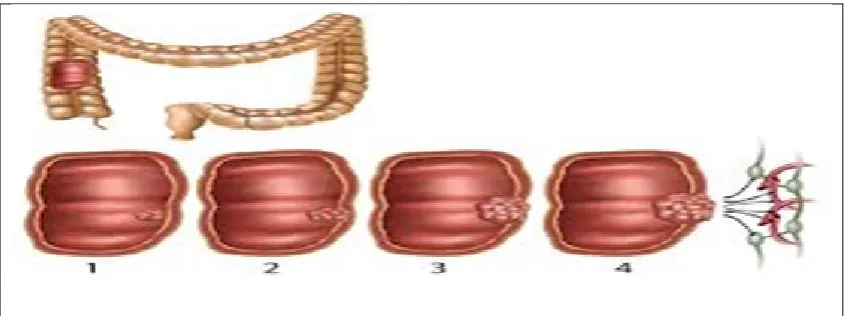
occult blood testing, sigmoidoscopy, biopsy and complete blood count. CRC includes four stages from an early stage until final stage. Stage I indicates that the cancer is confined to the inner lining of the colon or rectum. Stage II is cancer spreads through the wall of the colon or rectum while in stage III, cancer spreads to nearby lymph nodes and the final stage, IV is cancer spreads to distant parts of the body, such as liver or lungs (Malaysian Oncological Society, 2007).
European Organisation for Research and Treatment of Cancer (EORTC) in 2014 stated that the colorectal cancer (CRC) is also increasing significantly in other countries. It is the second most common cancer in the United Kingdom after lung cancer as well as in the United States of America. More than 50,000 people from each year dies of colorectal cancer (Jemal et al., 2008). Colorectal cancer is the leading killer among smokers in the world (Frieden et al., 2002). In the Asian population, there is a rapid increase in the trend of CRC, where it becomes the most common cancer among male superseded lung cancer (National Cancer Registry, 2006).
In Asia, screening with faecal occult blood test is a national policy only in Japan, Taiwan and Korea (Hyodo et al., 2010). Currently, in Malaysia, the awareness of the importance of CRC screening is very low, especially among the general population as well as the policy makers resulting in inadequate resources allocation for faecal occult blood test and colonoscopy. The advances in the treatment of colorectal cancer and effectiveness of the screening program, especially in the developed countries resulted increasing number of colorectal cancer survivors. Not only the disease could be cured but patients can also survive longer with the disease. Therefore, the paradigm of outcome in colorectal cancer treatment in the past decade has slowly shifted towards improving the patients‟ quality of lives, survival and disease free survival. This shows that health is related to quality of life and it is one of the fundamental aspects in colorectal cancer management while survival and disease free survival remains (Bottomley, 2002).
habit”, followed by “weight loss” and “abdominal pain”. The rectum was the most frequent site of the primary tumor followed by sigmoid colon and the rectosigmoid. Figure 1.1 and Figure 1.2 shows the tumor sites and stages.
Figure 1.1: Colon cancer and polyp
1.4 Research background on fuzzy regression
A fuzzy regression model is used in evaluating the functional relationship between the dependent and independent variables in a fuzzy environment. In many cases of fuzzy regression, the linear regression is recommended for practical situations when decisions often have to be made on the basis of imprecise and/or partially available data. Several methods have been presented to estimate fuzzy regression models. At first, fuzzy regression was developed by Tanaka et al. in year 1982 for linear case by focusing on extension principle (Taheri, 2003).
Making sense of data is an ongoing task for researchers and professionals in almost every practical endeavor. The age of information technology, characterized by a vast array of data, has enormously amplified this quest and made it even more challenging. Data collection has become the reality of our lives at any time and from everywhere. It is reported that understanding the data, revealing underlying phenomena, and visualizing major tendencies are the major undertakings to pursue in intelligent data analysis (IDA), data mining (DM), and system modeling (Pedryoz, 2005).
1.5 Problem statement
This research is carried out to detect size of the tumor of colorectal cancer which are in stage I and stage II in Malaysia. There are several studies about colorectal cancer (Varela, 2010). However, solutions for early stage detection is still not found.
In Malaysia, only a few studies were done to access the quality of life among CRC patients. Natrah (2012) conducted a study to determine the quality of life in CRC patients, especially those under treatment. The respondents in this study were mainly from stage III and IV, which are considered the tumor size in final stages of the disease and no respondents were from stage I and II from the public tertiary level general hospitals. This finding shows that the awareness of tumor size of colorectal cancer screening in Malaysia to detect the early stage of CRC is still very poor and not implemented as a nation‟s wide program. This correlates with findings from a study made by Kong et al. (2010), where it claimed that it is close to zero awareness of CRC screening tumor size among general population.
People, whose family members have colorectal cancer, especially at an old age, have a higher risk of developing this disease. A woman who has had cancer of the ovary, uterus or breast is more likely to develop colorectal cancer. Many people do not know about the CRC program and also there are people who know that they are having the symptoms of CRC but refuse to go for screening. For the screening program to be effective, an “at-risk” population has to be identified. The incidence of colorectal cancer increases exponentially with age and current figures from the developed world show that 90% of cases arise from those aged over 50 years old. In developed nations, the condition is thus too rare below the age of 50 years old to make screening test (Bennet, 1996).
1.6 Research objectives
This research is an attempt to find the most appropriate colorectal cancer model in order to predict the size of tumor among CRC patients. The specific objectives of this study are detailed as below:
(i) To apply the existing latest model of fuzzy linear regression with symmetric parameter in order to identify the factors and symptoms of CRC patients. (ii) To apply the existing models which are multiple linear regression, fuzzy
linear regression (Tanaka), fuzzy linear regression (Ni), and extended fuzzy linear regression by benchmarking models under fuzziness (Chung) in order to identify the factors and symptoms of CRC patients.
(iii) To make comparison among the linear regression models as mention above in order to find the best model for predicting tumor size in colorectal cancer. (iv) To identify the factors and symptoms that give most significant influence to
1.7 The scope of the study
The scope of the study will discuss about two sections which are the scope of the data and followed by the scope for the model.
1.7.1 Data scope
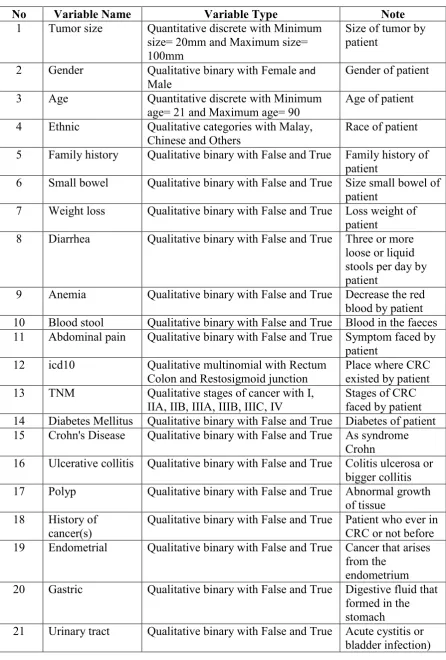
This study used secondary data obtained from the general hospital in Kuala Lumpur. This data consists of 180 patients as respondents for colon cancer. It was recorded by nurses and doctors using cluster sampling. Dependent variable or outcome is the size of tumor. Actually, there were twenty five independent variables which are gender, ethnic, age, classification of diseases and related health problems (icd10), tumor nodes metastases (TNM) staging, family history of colon cancer, diabetes mellitus, crohn's disease, ulcerative colitis, polyp, history of cancer, endometrial, gastric, small bowel, hepatobiliary, urinary tract, ovarian, other cancer, intestinal obstruction, colorectal, weight loss, diarrhea, anaemia, blood stool and abdominal pain.
The range value size of the investigated tumor is 20mm till 100mm. The patient‟s feedback on colorectal cancer was interviewed face to face by doctors and the answers were obtained immediately. The questions covered twenty four variables except for TNM staging.
Stage of colorectal cancer focuses on how big the cancer is and whether it is spread in the bowel of human body from polyp. Doctors and nurses used test and scanned to determine the stage of colon cancer faced by the patients. TNM stands for tumor, node and metastases. This way is widely used by medical cancer fields in the world. TNM describes the size of a primary tumor (T), any lymph contain cancer cells (N) and the spread of cancer to another part of body (M).
which are M0 indicating that the cancer is not spread to other organs, M1 denotes that the cancer is spread to other parts of the body (American Cancer Society, 2012).
Table 1.1: Description of data
No Variable Name Variable Type Note
1 Tumor size Quantitative discrete with Minimum size= 20mm and Maximum size= 100mm
Size of tumor by patient
2 Gender Qualitative binary with Female and Male
Gender of patient 3 Age Quantitative discrete with Minimum
age= 21 and Maximum age= 90 Age of patient 4 Ethnic Qualitative categories with Malay,
Chinese and Others
Race of patient 5 Family history Qualitative binary with False and True Family history of
patient
6 Small bowel Qualitative binary with False and True Size small bowel of patient
7 Weight loss Qualitative binary with False and True Loss weight of patient
8 Diarrhea Qualitative binary with False and True Three or more loose or liquid stools per day by patient
9 Anemia Qualitative binary with False and True Decrease the red blood by patient 10 Blood stool Qualitative binary with False and True Blood in the faeces 11 Abdominal pain Qualitative binary with False and True Symptom faced by
patient 12 icd10 Qualitative multinomial with Rectum
Colon and Restosigmoid junction
Place where CRC existed by patient 13 TNM Qualitative stages of cancer with I,
IIA, IIB, IIIA, IIIB, IIIC, IV
Stages of CRC faced by patient 14 Diabetes Mellitus Qualitative binary with False and True Diabetes of patient 15 Crohn's Disease Qualitative binary with False and True As syndrome
Crohn
16 Ulcerative collitis Qualitative binary with False and True Colitis ulcerosa or bigger collitis 17 Polyp Qualitative binary with False and True Abnormal growth
of tissue 18 History of
cancer(s)
Qualitative binary with False and True Patient who ever in CRC or not before 19 Endometrial Qualitative binary with False and True Cancer that arises
from the endometrium 20 Gastric Qualitative binary with False and True Digestive fluid that
formed in the stomach
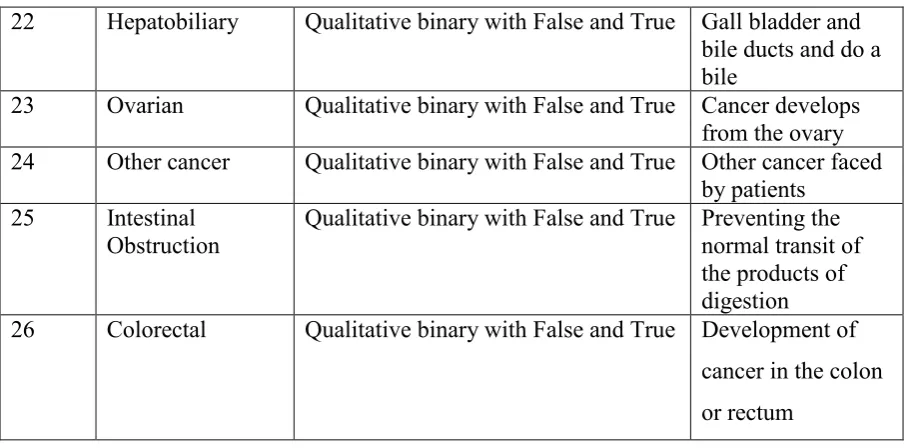
Table 1.1 (Continued): Description of data
22 Hepatobiliary Qualitative binary with False and True Gall bladder and bile ducts and do a bile
23 Ovarian Qualitative binary with False and True Cancer develops from the ovary 24 Other cancer Qualitative binary with False and True Other cancer faced
by patients 25 Intestinal
Obstruction Qualitative binary with False and True Preventing the normal transit of the products of digestion 26 Colorectal Qualitative binary with False and True Development of
cancer in the colon or rectum
1.7.2 Model Scope
Firstly, data filtering should be carried out to determine either the data is suitable or not suitable to use in colorectal cancer case. In this study, we will use the coefficient of determination, R2 and R-value to check the correlation in a data set that is accounted for by a statistical model.
Then, multiple linear regression should fulfill the assumptions before proceeding with the analysis. The assumptions are made as constant variance, normality distributed and multicollinearity. Thereafter, analysis will be applied by finding the significant variables, mean square error and root mean square error. The significant variables are important to identify the factors and symptoms to provide a higher effect in colorectal cancer prediction.
[image:25.595.108.562.119.343.2]intestinal obstruction, colorectal, weight loss, diarrhea, anemia, blood stool and abdominal pain.
The comparison among multiple linear regression and four models of fuzzy linear regression will be based on the mean square error (MSE) and root mean square error (RMSE). The model with the smallest value of MSE and RMSE will be chosen as the best model. In order to get the best model, it is important to obtain the approximation of the solution which is closed to predict the size of tumors, especially in the early stage (stage I and II) faced by patients.
1.8 Research contribution
The benefits of this study can contribute to the general hospital oncology specialist. The contributions are stated as follows:
(i) The application of fuzzy linear regression using continuous data produces accurate prediction.
(ii) The suggestion of mean square error and root mean square error using the best model could be as high prediction tumor size of CRC patient. Hence, medical decision in Oncology Department about predicting tumor size of CRC can be more reliable and accurate, especially in early stage of CRC. (iii) The application of multiple linear regression, fuzzy linear regression (Tanaka
1982), Fuzzy Linear Regression (Ni, 2005), extended fuzzy linear regression by benchmarking models under fuzziness (Chung, 2012) and fuzzy linear regression with symmetric parameter (Zolfaghari, 2014) for the colorectal cancer in the general hospital.
1.9 Thesis organization
This study comprises of five chapters. Chapter 1 is the introduction of the thesis. This chapter contains research background of regression analysis and colorectal cancer, history of fuzzy regression, problem statement, research objectives, scope of the study, research contribution and research organization.
Chapter 2 is the literature review that reviews the current and previous researches on medical field, especially on colorectal cancer in the general hospital. The applications of fuzzy linear regression also presented in medical field.
Chapter 3 is a detailed explanation about five models used in this study. The discussed models are multiple linear regression, fuzzy linear regression (Tanaka 1982), fuzzy linear regression (Ni, 2005), extended fuzzy linear regression by benchmarking models under fuzziness (Chung, 2012) and fuzzy linear regression with symmetric parameter (Zolfaghari, 2014).
Chapter 4 discusses the analysis of the applied five models. The results of significant variables from multiple linear regression, mean square error and root mean square error for five models is carried out. The procedure of the analysis must be fulfilled to get the best model to predict the size of tumor by factors and symptoms variables.
CHAPTER 2
LITERATURE REVIEW
2.1 Introduction
This chapter presents the review of several relevant studies on factors and symptoms that affected patients of colorectal cancer from the general hospital in Kuala Lumpur. This chapter also presents the review of the literature on colorectal cancer in data, included review of statistical analysis on colorectal cancer study and review application of fuzzy analysis. Colorectal cancer is a common disease happens in Malaysia and other countries. Usually, researcher uses basic statistics to analyze case of colorectal cancer such as logistic regression, descriptive analysis or linear regression and statistics modeling. Since the basic statistics analysis usually used in the research, the improvement statistic in analysis of colorectal cancer will be applied such as fuzzy linear regression as the latest model of linear regression in statistic.
2.2 Statistical modeling in colorectal cancer area
Brand et al. (2006) studied the risk of colon cancer in hereditary non-polyposis CRC and predicted by fuzzy modeling. The aim of the study is to identify if fuzzy logic model can be used to predict CRC risk especially in smokers. Fuzzy logic method is used for analysis. The general results showed that smoking habit significantly increases the CRC risk, usually among male. They also said fuzzy modeling may enable formulation of clinical risk scores and allows individualization of CRC prevention strategies.
The main goal of the study was to understand the factors contributing to CRC and the results stated that the facilitators and barrier are the main factors toward CRC.
Stefani et al. (2011) researched on dietary patterns and risk of colorectal cancer in Uruguay. They examined the risk of colorectal cancer, such as prudent, traditional, drinker and others using logistic regression and polynomial regression. The factors, prudent, western and drinker are the main factors for colorectal cancer to eventuate.
Pereira et al. (2011) explored anxiety, depression, traumatic stress and quality of life in colorectal cancer after different treatments. The purpose of the study is to examine the impact of treatment on anxiety, depression, traumatic stress and quality of life in colorectal cancer patients. 114 samples of oncology patients from Hospital in the North of Portugal were used. The samples used three modes of treatment: surgery, surgery plus chemotherapy or surgery followed by radiotherapy. Measurements of the study included gender, anxiety, depression, traumatic stress and quality of life by using MANOVA test. The findings exposed that the patients who received only surgery as treatment had lower levels of depression, anxiety and traumatic stress symptoms compared to patients who received surgery and chemotherapy or surgery plus radiotherapy. They also discussed that the research of colorectal cancer illness is important and need to be improve over a year to get the lower risk of cancer.
Qureshi et al. (2012) evaluated the effective mass screening for colorectal cancer in Malaysia based on consensus or clinical practice guidelines. They recorded the race and region as variables and used descriptive analysis as methodology. The results of the study concluded that low incidence of colorectal cancer in Malaysia for mass screening is still low for average risk individuals.
Roslani et al. (2012) researched on screening for colorectal neoplasias with fecal occult blood test: false positive impact of non-dietary restriction. The main objective of the study was to evaluate and compare the validity and suitability between two screening methods, which are Fecal Immunochemical Test (FIT) and Guaiac Based Fecal Occult Blood Test (gFOBT) rely on detection of fecal occult blood (FOBT). gFOBT is common method that used in colorectal cancer screening and detected any pseudo peroxidase activity in the feces and this method is cheaper and suitable in Malaysia for screening rather than FIT. It requires large number of patients of colorectal cancer in Malaysia. The use of FIT is to detect intact globin protein portion of human hemoglobin and more specific screening test but it is costly. They use only descriptive analysis for demographic part and use several variables such as age, race, sex, types of fecal occult blood and others. Furthermore, the result showed that FIT is the best screening with low-false of positivity and better sensitivity and specific rates.
Lavdaniti et al. (2012) developed an evaluation of depression level in colorectal cancer patients. They stated colon cancer is the third most common cancer in male and female and depression is the most factor related to colorectal cancer. They used sample in Greece with lowest number of cases of colon cancer in Europe The aim of the study was to get the frequency of depression among patient in colon cancer and to evaluate the contributing factors. Depression and comorbid disabling syndrome are the most influential factors with 15-25% of effects on colorectal cancer. The variables that they used were gender, age, profession, educational level, marital status, place of residence, time since diagnosis and score of depression by using descriptive analysis and multiple linear regression with stepwise method. After analysis done, they got score for depression as dependent variable and the results showed it was no significant variables related to score of depression. It is concluded that depression has no effect on colorectal cancer. They recommended for more researches to be carried out in the future to determine the patterns of depression and characteristics in colorectal cancer.
shortness of breath, red or dark blood in stool, constipation, cramps or bloating, narrow stool, weight loss, and change in level of alertness. They also recommended to create fuzzy logic membership functions that defines the value of input/output terms used in the rules.
Phillips et al. (2013) studied on initiating the colorectal cancer screening at the age of 50. Their aim was to get the factors associated with colorectal cancer screening among persons age 50-75 by using descriptive and logistic regression analysis. Independent between categorical variables, chi-squared and one-way ANOVA methods were applied in this study. The variables included in this study were screening initiation, health status indicators, healthcare utilization, age, sex, education and race. The results showed almost 75% of the 50 years old and above had initiated colorectal cancer. The researchers in this study suggested that health care in colorectal cancer screening must be encouraged according to guidelines.
Nishihara et al. (2013) studied on long-term colorectal-cancer incidence and mortality after lower endoscopy. The purposed of the study was to examine the lower endoscopy with colorectal cancer incidence and colorectal cancer mortality among patients. The variables used were gender, sex, baseline history of cancer, ulcerative colitis, colorectal polyps, familial polyposis syndromes and previous lower endoscopy by using descriptive analysis and cox-proportional hazards model (multivariate model) to evaluate hazard ratio and 95% confidence intervals. The general findings showed that the colonoscopy and sigmoidoscopy were associated to reduce the incidence of colorectal cancer and only colonoscopy associated to reduce the mortality colorectal cancer among patients.
RS2337107 on the risk of CRC with clinic pathological features. They concluded that SMAD7 gene and RS2337107 are not potential contributors to the risk of colorectal cancer and suggested for a large scale study of colorectal cancer to validate their results.
Kaneko et al. (2014) studied on new index of abdominal obesity which effectively predicts the risk of colon tumor development among female Japanese. Obesity caused by accessing intake of fat-rich foods and less exercise which is known as statistically significant risk factor for colorectal cancer. The aim of the study is to obtain relationship between abdominal obesity and colorectal cancer tumor among CRC patients. 657 of patients were used as samples of the study. Several variables used such as age, sex, waist circumference to height index (WHI score), body mass index (BMI score) and others. Descriptive analysis and logistic regression were chosen in the study. From the results, the general conclusion of the study can be concluded as the risk factors for colon tumor are different between women and men and WHI is a main factor for women to get colon tumor among Japanese.
2.3 Application of fuzzy modeling
Many researchers have used fuzzy modeling in many fields to analyze cases such as in medical, science, engineering and others. Commonly, fuzzy modeling used to analyze the cases with more complexes and it is reliable. Several previous studies used fuzzy modeling since fuzzy created by Lotfi A. Zadeh in 1965 with fuzzy set theory (Tanaka, 1982).
2.3.1 Fuzzy modeling in medical
clusters identification is to determine the clusters into blood vessel or other tissues in magnetic resonance angiography (MRA) image.
Liu et al. (2005) studied on application of fuzzy c-means and fuzzy integral theories to a proposed two-step machinery fault diagnosis model. They combined fuzzy measures and fuzzy integral and applied to diagnose results into a consensus final decision. Vibration signals from rolling element bearings were used to validate the method. The results showed that using fuzzy c-means and fuzzy integral techniques improved the diagnosis accuracy and reduced the computation load.
Baig et al. (2011) identified a model to control strategies in the medical field with the aim to diagnosis the diseases. They identified fuzzy logic medical diagnosis control system is suitable to control diagnosis of hemorrhage and brain tumor. This model used design and simulation as control system. As general results, fuzzy logic medical diagnosis control system developed a control system to enhance the efficiency to diagnose a disease related to human brain.
Ibrahim et al. (2011) founded Optimized Fuzzy Control For Natural Trajectory Based Fes-Swinging Motion. The study was to get the swinging of legs during movement happened. Fuzzy trajectory tracking control of swinging motion with genetic algorithm was applied. After the analysis was done, the results showed its effectiveness in controlling swinging motion in the simulations as well as in the practical environment.
Rajeswari and Vaithiyanathan (2011) discussed the variation of preliminary inquiry information obtained from patients of a diabetic and research center using fuzzy relation based model. The parameters were modeled using a fuzzy approach. After normalization, it was classified by using artificial neural networks as „Close to Type 2 diabetic‟ or not. This result in this study, collected in stage I are not enough to classify type 2 diabetes of patients and further stages are required for improvement.
cases, it was found that the AHP technique appeared to be the best model with the lowest mean square error (MSE). Moreover, AHP technique can increase the accuracy of modeling prediction.
Elizabeth and Sujatha (2013) proposed a fuzzy medical diagnosis network for decision making in medical diagnosis. They applied medical diagnosis under fuzzy environment using triangular fuzzy number and membership of matrix. Function of the model is to determine the contradiction of transitivity of the ranking. This form of transitive ranking can be accommodated by means of relativity function. This study able to help patients with accurate medical diagnostic process and decision making process.
Yilmaz and Ayan (2013) studied on cancer risk analysis by adopting fuzzy logic approach and performance status of the model. This study applied the fuzzy logic created by Zadeh in 1965 on cancer risk. Three cancer risks were selected which are breast cancer, lung cancer and colon cancer. Analyses were carried out with proposed method of fuzzy logic, rating formula and fuzzification, rule processing unit and defuzzification. This study helps people to measure the developing cancer and simultaneously, the rate of suffering from cancer can be decreased.
El-Melegy and Mokhtar (2014) proposed a new fuzzy approach for the automatic segmentation of normal and pathological brain magnetic resonance imaging (MRI). The model is fuzzy c-means (FCM) algorithm. Constrained minimization function using the lag range multiplier was constructed. There are 2 steps to approach FCM which are solution estimation and prior information guided solution. FCM algorithm boosts the performance under noise and unexpected data acquisition conditions. The results of FCM were considerable better segmentation with accuracy, robustness against noise, and faster response compared to several well-known fuzzy and non-fuzzy techniques.
precise definitions of each body region and organ and delineating them following these definitions, building hierarchical fuzzy anatomy models of organs for each body region, recognizing and locating organs in given images by employing the hierarchical models and delineating the organs following the hierarchy. The results showed that fuzzy model-based IRFC are effective concepts which allowed to demonstrate the feasibility of a general AAR system that works in different body regions on a various organs and on different modalities.
2.3.2 Fuzzy linear regression models
In this study, there are four models of fuzzy linear regression applied to analyze colorectal cancer stages in Malaysia.
Tanaka et al. (1982) proposed linear regression analysis with fuzzy model. This structure is represented fuzzy linear function by fuzzy sets. Fuzzy linear functions proposed by Zadeh‟s extension principle. They used input and output data concerning house price as the data and using fuzzy linear regression model. They concluded that fuzzy linear function to the linear regression model was an established method for vague phenomena.
Ni (2005) proposed a new linear programming for fuzzy linear regression extension by Tanaka (1982). The purpose of this research is to revisit the ongoing research work that people have already done on this issue and to develop new models related to fuzzy data correlation and regression. The research used Intel Corp. 2003 stock price as data and the author concluded that fuzzy regression models could be applied in short term stock price prediction. Moreover, he found that fuzzy regression gives more consistent results, since it successfully modeled the inherent vagueness which exists in the application by formulated form.
showed that fuzzy linear regression model can be used to build a benchmarking model.
Zolfaghari et al. (2014) proposed a new linear programming fuzzy linear regression with symmetric parameter. This linear programming proposed to determine relationship between overall acceptance and sensory characteristics (aroma, surface color, porosity, hardness, oiliness, and flavor) of 36 different types of fried donut. Modeling was done by assuming that independent variables are crisp and coefficients are triangular fuzzy number. This study proposed two models which are fuzzy linear regression with symmetric parameter and fuzzy linear regression with asymmetric parameter. The results showed that symmetrical fuzzy parameter provided the best fitting of sensory data.
2.4 Variables review
Zhang (2004) studied the patients‟ age for a modest positive correlation with incident colorectal cancer. The older the people age may just a generational effect of colorectal cancer. While some study have found that race also has significant correlation with incident colorectal cancer. This study used 14 factors as predictors by logistic regression which are age, gender, race, stage of colorectal cancer, tumour size and many more.
Wendy& Radzi (2008) proposed national cancer patient registry of colorectal cancer. In Malaysia, no such comprehensive report on all aspects of colorectal cancer exists. This issue is raised in Ministry of Health in registry of colorectal cancer field and 197 cases of colorectal cancers were reported in the database between October 2007 and February 2008. The collected data were demographic details, family history, pathology staging, follow-up details, therapy offered, presenting symptoms and concomitant medical problems. This study analyzed using multi centre project.
diarrhea, abdominal mass, rectal, ascending colon, sigmoid colon, rectum and many more.
Varela et al. (2010) studied the factors and causes of colorectal cancer incident. The study was conducted to understand the factors related to colorectal cancer (CRC) screening among urban Hispanics. The included factors were country of origin and race, family history of CRC and relationship with colorectal cancer. This study used descriptive analysis to achieve the goal of the study.
Stefani et al. (2011) in the period of 1996-2004 case control colorectal cancer was conducted in Montevido, Uruguay. Recently, the case controls have frequency matched for age, sex, family history and residence. All cases were conducted from the same general hospitals. This study was conducted to determine the risk of factors on colorectal cancer analysis in Uruguay using Kaiser Method.
Roslani et al. (2012) found that blood tool is one of the main factor causes colorectal cancer in human body. The screening for colorectal neoplasias with fecal occult blood test: false-positive impact of non-dietary restriction. The aimed of this study to evaluate and compare the validity of guaiac-based fecal occult blood test (gFOBT) and fecal immunochemical test (FIT) in Asian population. gFOBT has many advantages compared to FIT, in terms of the cost of the treatment. There were two categories to test blood tool using gFOBT which are structural exam and fecal test. The findings showed that the gFOBT test was positive.
Phillips et al. (2013) studied on examining the differences in rates of initiating colorectal cancer screening across age. This study found that the screening colorectal cancer remain low among adults age 50 and older in the United States. However, this study used logistic regression as solutions because that model widely applied in many biomedical fields. The rest of various factors are sex, education, race, body mass index, colorectal screening and others.
2.5 Summary
However, fuzzy linear regression model is also often used in medical research at the present time.
In the past research, many methods used colorectal cancer analysis in general hospitals which are descriptive analysis, logistic regression and linear regression. Only some researchers used fuzzy model in solving the colorectal cancer cases but not fuzzy linear regression. Therefore, fuzzy linear regression will be one of the best model and tends to contribute in the study to detect tumor size of colorectal cancer by factors and symptoms.
There are several different between this study and previous study such as this study applied all stages of colorectal cancer (I, II, III and IV) and using all the fuzzy linear regression models as methodology. The use of tumor size in colorectal cancer has a great potential of methods to enhance predicting tumor size by factors and symptoms of colorectal cancer; therefore the fuzzy linear regressions should be develop based on mean square error and root mean square error in colorectal cancer.
REFERENCES
Agresti, A. (1996). An Introduction to Categorical Data Analysis.New York : John Wiley & Sons, Inc.
Akbari Zahra, Safari-Alighiarloo Safari and Montazer Mahdi.(2014). Lack of Influence of the SMAD7 Gene rs2337107 Polymorphism on Risk of Colorectal Cancer in an Iranian Population.Asian Pacific Journal of Cancer
Prevention, (15), 4437-4441.
Aliev, R. A., Fazlollahi, B. and Vahidov,R. (2002). Genetic algorithms-based fuzzy regression analysis. Journal of Soft Computing, (6), 470 – 475.
American Cancer Society. (2012). How is colorectal cancer staged? American Cancer Society.
American Cancer Society. Cancer Facts & Figures 2014 Atlanta.(2014). American
Cancer Society.
Baig Faran, Khan M. Saleeem, Noor Yasir and Imran M.. (2011). Design Model of Fuzzy Logic Medical Diagnosis Control System. International Journal of
Computer Science and Engineering (IJCSE),(3), No.5, 2093-2108.
Bennet, D.H. and Hardcastle JD.(1996). Early Diagnosis and Screening.Colorectal
Cancer.Ed Williams NS. Churchill Livingstone, 21-37.
Bezdek, J. C. (1974). Cluster validity with fuzzy set. Journal Cybernetic, (3), 58–72. Bezdek, J. C. (1981). Pattern recognition with fuzzy objective function algorithms.
USA,Kluwer Academic Publishers.
Bottomley A. (2002). The cancer patient and quality of life. The Oncologist Cancer
Brand M. Rhonda, David D Jones, Henry T Lynch, Randali E Brand, Patrice Watson, Ramesh Ashwathnayaran and Hmeant K Roy. (2006). Risk of Colon Cancer in Hereditary Non-Polypsis Colorectal Cancer Patients as Predicted by Fuzzy Modeling: Influence of Smoking. World J Gastroenterol , 12(28), 4485-4491. Cappell S. Mitchell. (2005). The pathophysiology, clinical presentation and diagnosis of coloncancer and adenomatous polyps. The Medical Clinics of North
America, (89), 1-42
Center MM, Jemal A and Ward E. (2009). International trends in colorectal cancer incidence rates. Cancer Epidemiology Biomarkers, (19), 1688-94.
ChungWilliam.(2012). Using the Fuzzy Linear Regression Method to Benchmark the Energy Efficiency of Commercial Buildings. Applied Energy, 45-49.
Chung William. (2012). Construction of Benchmarking Models Using Fuzzy Linear Regression Techniques. International Conference on Fuzzy Systems and
Knowledge Discovery (FSKD 2012) IEEE. 555-559.
Dubois, D. J. and Henry. (1980). Fuzzy set and systems: Theory and applications. Academic Press Inc.
Dunn, J. (1974). A fuzzy relative of the ISODATA process and its use in detecting compact well separated cluster. J. Cybernetics, 3(3), 32-57.
Elizabeth S. and Sujathan L. (2013). Apllication of Fuzzy Membership Matrix in Medical Diagnosis and Decision Making. Applied Mathematical Sciences,(7), No. 127, 6297-6307.
El-Melegy Moumen T. and Mokhtar Hashim M. (2014). Tumor Segmentation in Brain MRI Using A Fuzzy Approach with Class Center Priors. Journal on
Image and Video Processing. 1-14.
European Organisation for Research and Treatment of Cancer (EORTC). (2014).
Frieden. (2002). Physical Activity, Dietary Fat and Colorectal Cancer. PhD Thesis Martina Perše University of Ljubljana, Faculty of Medicine, Institute of Pathology, MEC,Slovenia.
Hata. (1998). Medical Image Segmentation by Fuzzy Logic Techniques. IEEE 1998 Department of Computer Engineering, Himeji Institute of Technology, Japan,
4098-4103.
Hyodo I, Suzuki H and Takahashi K. 2010. Present status and perspective of colorectal cancer in Asia.Colorectal Cancer Working Group Report in 30th Asia-Pacific Cancer Conference.Jpn J ClinOncol, (40), 38-43.
Ibrahim B.S.K.K, Tokhi M.O., Huq M.S and Gharooni S.C.. (2011). Optimized Fuzzy Control for Natural Trajectory Based Fes-Swinging Motion.
International Journal of Integrated Engineering, (3), No. 2, 17-23.
Jemal A, Siegel R and Ward E. (2008). Cancer Statistics. C.A. A Cancer J Clin, (58), 71-96.
Kaneko Rena, Nakazaki Natsuko, Tagawa Teppei and Ohishi Chitose. (2014). A New Index of Abdominal Obesity which Effectively Predicts Risk of Colon Tumor Development in Female Japanese. Asian Pasific Journal of Cancer
Prevention, (5), 1005-1010.
Kong CK, Roslani AC and Law CW. (2010). Impact of Socioeconomic Class on Colorectal Cancer Patient Outcomes in Kuala Lumpur and Kuching, Malaysia.APJCP, (11), 969-74.
Kutner H. Michael, Nachtsheim, Neter John and Li William.(2004).Applied Linear Statistical Models.Fifth Edition. Applied Linear Statistical Models Mc Graw
Hill, 197-209.
Lazim and Nadia.(2012). Matrix Driven Multivariate Fuzzy Linear Regression Model in Car Sales.Journal of Applied Sciences, 1-8.
Liu, Xiaofeng, Ma, Lin, Zhang, Sheng, & Mathew, Joseph. (2005). Using fuzzy c-means and fuzzy integrals for machinery fault diagnosis. In International
Conference on Condition Monitoring, Cambridge, England.1-9.
Malaysian Oncological Society Novartis Corporation (Malaysia). (2007). The Lancet
Oncology,(8), 773-783.
Ministry Of Health, Malaysia. (1995). Information and Documentation System Unit. Planning & Development Division.
Natrah MS, SharifaEzat WP, Syed MA, Mohd Rizal AM and Saperi S. (2012). Quality of Life in Malaysian Colorectal Cancer Patients: A Preliminary Result. APJCP, (13), 1-6.
National Cancer Registry, Ministry of Health Malaysia. (2006). Malaysian Cancer
Statistics – Data and Figure Peninsular Malaysia.
National Cancer Registry, Ministry of Health Malaysia. (2010). Malaysian Cancer Statistics – Data and Figure Peninsular Malaysia.
Ni Yongshen. (2005). Fuzzy Correlation and Regression Analysis. PhD Thesis of
University of Oklahoma Graduate College, UMI number:3163014.
Nishihara Reiko, Wu Kana and Lochhead Paul. (2013). Long Term Colorectal Cancer Incidence and Mortality After Lower Endoscopy. The New England
Journal of Medicine, (369), No. 32, 1095-1105.
Nwoye, E., Khor L.C., Dlay S.S. and Woo W.L. (2008). Spectral and Statistical Features in Fuzzy Neural Expert Machine for Colorectal Adenomas and Adenocarcinoma Classification.
Obi J. C. and Imianvan A. A.. (2012). Fuzzy Neural Approach for Colon Cancer Prediction. Scienta Africana, (11), No.1, 65-76.
Pereira M. Graca, Ana Paula Figuiredo and Frank D. Fincham. (2011). Anxiety, Depression, Traumatic Stress and Quality of Life in Colorectal Cancer after Different Treatments: A Study With Portuguese Patients and Their Partners.
European Journal of Oncology Nursing, 1-6.
Phillips L. Karon and Smith Lee Matthew. (2013). Correlates of Initiating Colorectal Cancer Screening Beginning at Age 50. J Community Health,(38), 23-30. Qureshi Mohammed Akhtar, Mahendra Raj and Jayaram Menon. (2012). Screening
for Colorectal Cancer in Malaysia Consensus/ Clinical Practice Guidelines.
Academy of Medicine, Malaysia, 2-12.
Rajeswari K. and Vaithiyanathan V.(2011). Fuzzy Based Modeling for Diabetic Diagnosis Decision Support using Artificial Neural Network. International
Journal of Computer Science and Network Society, (11), No. 4, 126-130.
Roslani April Camilla, Taufiq Abdullah and Kulenthran Arumugam. (2012). Screening for Colorectal Neoplasias with Fecal Occult Blood Tests: False-positive Impact of Non-Dietary Restriction. Asian Pacific Journal of Cancer
Prevention, (13), 237-241.
Rousseeuw, Peter J., Annick M. Leroy. (1987). Robust regression and Outlier Detection. John Wiley & Sons.
Rusiman Saifullah, Robiah Adnan, Efendi Nasibov and Kavikumar Jacob.(2012). Adjustment of an Intensive Care Unit (ICU) Data in Fuzzy C-Regression Models. Journal of Science and Technology, 4 (2), 99-108.
Second Paper of the National Cancer Registry.(2003). Case Studies on Decision for Cervical Cancer Screening among Working Women.
Stefani De Eduardo, Hugo Deneo-Pellegrini and Alvaro L Ronco. (2011). Dietary Patterns and Risk of Colorectal Cancer: a Factor Analysis in Uruguay. Asian
Pacific J Cancer Prev,(12), 753-759.
Taheri S. Mahmoud. (2003). Trends in Fuzzy Statistics.Austrian Journal Of
Statistics,(32), Number 3, 239-257.
Tanaka, H. (1987). Fuzzy Data Analysis by Possibilities Linear Models. Fuzzy Set Syst, (24), 363-375.
Tanaka Hideo, Uejima Satoru and Asai Kiyoji. (1982). Linear Regression Analysis with Fuzzy Model. IEEE Transactions On Systems, Man and Cybernetics, SMC-12, 903-907.
Udupa Jayaram K., Odhner Dewey and Zhao Liming. (2014). Body-Wide Hierarchical Fuzzy Modeling, Recognition and Delineation of Anatomy in Medical Images. Medical Image Analysis, (18), 752-771.
Vanagunas. (2011). Role of Endoscopy in the Staging and Management of Colorectal Cancer. Gastrointestinal Endoscopy,(78), No. 1, 8-12.
Varela Alejandro, Lina Jandrof and Katherine DuHamel. (2010). Understanding Factors Related to Colorectal Cancer (CRC) Screening Among Urban Hipanics: Use of Focus Groups Methodology. J Cane Edu, (25), 70-5.
Wendy and Radzi. (2008). Editorial Cell Therapy Centre, Universiti Kebangsaan Malaysia Medical Centre.Med J Malaysia, (63), No 4, 57-58.
World Health Organization. (2012).Publications of the World Health Organization are available on the WHO web site (www.who.int).
World Health Organization Data. (2010).Publications of the World Health Organization are available on the WHO web site (www.who.int).
Yilmaz Atinc and Ayan Kirsat. (2013). Cancer risk analysis by fuzzy logic approach and performance status of the model. Turkish Journal of Engineering &
Computer Science, (21), 897-912.
Yusoff Harmy Mohamed, Norwati Daud, Norhayati Mohd Noor and Amry Abdul Rahim. (2012). Participants and barriers to colorectal cancer screening in Malaysia. Asian Pacific J Cancer Prev, (13), 3983-3987.
Zadeh, L.A.. (1965). Fuzzy sets. Inform Control,(8), 338-358.
Zhang Wei. (2004). Hospital Quality and Patient Trust in Care for Colorectal Cancer.
Certificate Degree of Doctor Philosophy Harvard University, Cambridge,
Massachusetts, United States.