Volume-5 Issue-1
International Journal of Intellectual Advancements and
Research in Engineering Computations
Finger vein based advanced driving system
Kannan.K.R
1,S.V.Ramya
2,S.Sangeetha
3,N.Suganya
4, S.Santhosh Kumar
51,
Assistant Professor, Department of ECE, Hindusthan Institute of Technology
2,3,4 & 5
Student, Hindusthan Institute of Technology, Coimbatore
[email protected]
ABSTRACT - - In our life surly everyone faced incident of vehicle theft. Because most of our vehicle have unreliable security system. This less secured system made easy way to steal vehicle. In this project, we used some security-based technology, which gives prevention methods from vehicle theft problems. One of our technologies is RFID based security system. RFID card has license details of person. In vehicle there is RFID reader module was placed. If any unknown person wants access that vehicle without proper RFID card, it does not allow starting the ignition of that vehicle. Another technology is Finger Vein based security system. This system requires finger vein image of person who wants to access that vehicle. That person must insert his finger into appropriate place on Finger Vein security system for accessing that vehicle. That system will detect that person is authorized or unauthorized. If he is unauthorized person, will not allow starting the ignition of vehicle. If that person has both appropriate details to access that vehicle. Both systems allow starting the ignition otherwise it does not allows starting the ignition.
Key Words- Finger vein authentication, IR sensor, PI Camera, Raspberry Pi, RFID.
I. INTRODUCTION
In this technical era, Finger Vein recognition is a biometric authentication that based on images of vein patterns beneath the skin surface. The Camera records
the image, data is digitized and database record of individuals is registered. This technology is used for
wide variety of applications in credit card
authentication, automobile security, employee time and
attendance tracking, computer and network
authentication and so on.
However, fingerprints can be cheated by dummy finger fitted with a copied fingerprint, but the finger vein based identification system is highly secure for authentication.
Radio- frequency identification uses
electromagnetic fields to identify and track the information automatically. Unlike the barcode, the tags contain electronically stored information. RFID tags with unique serial numbers could be linked to an individual credit card number. RFID technology is
mostly used in applications like e-passport,
transportation payments, IT asset tracking, government, healthcare, manufacturing and aerospace industries. RFID and finger vein were interfaced with the help of Camera and Sensors. Sensors are used to sense electromagnetic waves and vein of a finger. Information about the individuals is registered in the database, which includes license information.
II. LITERATURE SURVEY
Biometric systems are the best authentication systems that are used to identify a person. Finger vein authentication is the anti-forgeable. When a person wants to drive, will just press their finger in the biometric system. When the finger vein are match
automobile get ignited, this will be keyless authentication system. If the matching fails GSM get triggered on and transmits warming message. Same automobile has the facility to detect fatigue and intake of alcohol by the diver. GSM, camera and buzzers are interfaced with Raspberry pi. Raspbian OS is loaded with python and open CV. Arduino is interfaced with alcohol gas sensor. This two embedded boards are bridged by I2C bus. Arduino will turn off the relay ignition system.
1. Finger Vein Recognition Based Driver
Authentication and Alertness System Using GSM. In this paper author suggested that with the assistance of biometric framework we can secure our car. We need to begin the motor by squeezing their finger in the biometric framework. There are two conceivable outcomes that finger vein match or neglect to coordinate. In the event that the finger vein is match vehicles begin working appropriately. On the off chance that it neglects to match it cautions the auto proprietor by sending the message through GSM system. This framework additionally alarms about the driver liquor admission and sleepiness. This framework depends on the Raspberry pi innovation.
2.Smart Surveillance Monitoring System Using Raspberry PI and PIR Sensor. In this paper author recommended that keen observation using so as to check framework is actualized Raspberry pi and PIR sensor. There is infrared sensor to identify the vicinity of number of persons in the room. Camera is naturally turned on when the vicinity of individual is distinguished. At that point the data is caught and sends it to the advanced mobile phone of approved individual
through 3G Dongle..
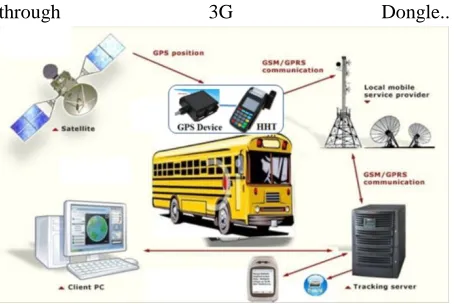
Figure 1: Overview of solar-wind system
GPS MODULE:
Global Position System (GPS) is a space-based satellite navigation that provides location and time information in all weather conditions, anywhere on or near the Earth. The GPS receiver tracks 51 satellites simultaneously. The module is mounted on the PCB along with the 3.3V low drop voltage regulator, transmit, receive and power indication LEDs, Schmitt trigger based buffer for 5V to 3.3V logic level conversion. This GPS receiver gives data output in standard National marine electronics association
(NMEA) format. The GPS receiver gives -157dBm.
III. EXSISTING WORK
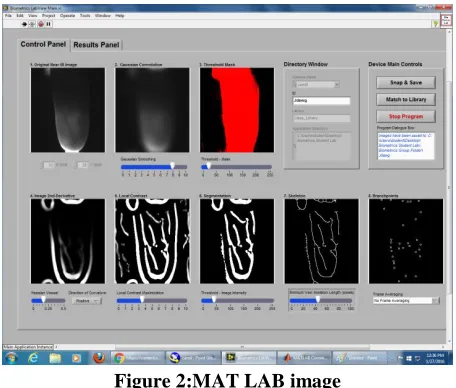
Figure 2:MAT LAB image
IV. PROPOSED METHOD
In our paper we try to merge the both RFID and finger vein recognition for the security purpose by using raspberry pi.The main advantage of this method is the kit can be easily carried and easily implemented and coding is easy. This method proposes the finger vein security system by the use of RASPBERRY PI.
Radio- frequency identification(RFID):
It uses electromagnetic fields to identify and track the information automatically. Unlike the barcode, the tags contain electronically stored information. RFID tags with unique serial numbers could be linked to an individual credit card number. RFID technology is
mostly used in applications like e-passport,
transportation payments, IT asset tracking, government, healthcare, manufacturing and aerospace industries. .
RASPBERRY PI:
The Raspberry Pi is a series of credit card–sized single-board computers developed in England, United Kingdom by the Raspberry Pi Foundation with the intent to promote the teaching of basic computer science in schools and developing countries. The original Raspberry Pi and Raspberry Pi 2 are manufactured in several board configurations through licensed manufacturing agreements with Newark element14 (Premier Farnell), RS Components and Egomania.In our project it is used to convert the finger
vein image captured by the PI camera and save the image automatically and it cannot be deleted automatically. If we want to again search the image we can detect automatically.
Figure3 : Overview block diagram
V.
V. FLOWCHARTVein Print Module Setup:
which enables to read the IR signals from the biometric object. Basic idea behind the setup is to get the absorption behavior of hemoglobin is different for different person and the vein prints of the fore finger is captured which is followed by the image processing stage.
Figure 4: IR Filter free Web Camera
The IR platform consists of 14 equally, spaced IR LED is which are serially connected and are powered by the ARM processor. In the present, 9V battery is served as power source.
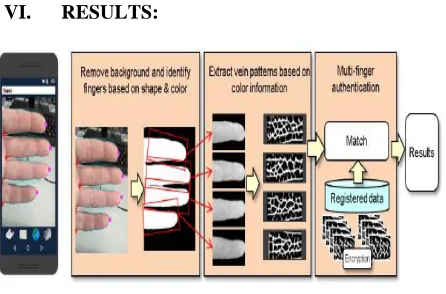
VI. RESULTS:
VII. CONCLUSION:
A new absorption based vein pattern recognition system. The system is subjected for an attempt to handle issues such as effects of rotation and translation
on acquired images, minimizing the manual
interruption. The system ensures the accurate extraction of finger vein pattern, which is an essential
in developing finger vein, based biometric
authentication systems. Finger veins have textured patterns, and the directional map of a finger vein image represents an intrinsic nature of the image. Our method extends traditional image segmentation
methods, by extracting vein object from the oriented filter enhanced image.
VI. REFERENCES
[1] Zhi Liu., Shangling Song., “An Embedded Real-Time Finger-Vein Recognition System for Mobile Devices”, IEEE Transactions on Consumer Electronics, Vol. 58, No. 2, May 2015
[2] Roma Goregaonkar., Snehal Bhosale., “Safe Driving and Accidental Monitoring Using GPS System and Three Axis Accelerometer”, International Journal of Emerging Technology and Advanced Engineering Website, ISSN 2250-2459,Certified Journal, Volume 3, Issue 11, November 2013.
[3] Jose Anand., T. G. Arul Flora., Anu Susan Philip., “Finger Vein based Biometric Security System”, International Journal of Research in Engineering and Technology (IJRET eISSN: 2319-1163 | pISSN: 2321-7308).
[4] RFID Based Security and Access Control System Umar Farooq, Mahmood ul Hasan, Muhammad Amar, Athar Hanif, and Muhammad Usman Asad (IACSIT International Journal of Engineering and Technology, Vol. 6, No. 4, August 2014)
[5] S. Lahiri, RFID sourcebook, IBM Press, Westford, Massachusetts, 2006.
[6] F. Lourenco and C. Almeida, “RFID based monitoring and access control system,” in Proc. INFORUM, 2009.
[7] R. Weinstein, “RFID: A technical overview and its application to the enterprise,” IT Professional, vol. 7, no. 3, May-June 2005, pp. 27-33.
[8] X. L. Meng, Z. W. Song, and X. Y. Li, “RFID-Based security authentication system based on a novel
face-recognition structure,” in Proc. WASE
International Conference on Information Engineering, 2010, pp. 97-100.
[10] M. A. Mazidi, J. C. Mazidi, and R. D. Mckinaly, The 8051 Microcontroller and Embedded Systems, Pearson Education, 2006
[11]David Mulyono, and Horng Shi Jinn, “A Study of Finger Vein Biometric for Personal Identification”, Proceedings of the IEEE International Symposium on Biometrics and Security Technologies (ISBAST 2008), pp. 1-8, 2008.