Adedeji et al. World Journal of Engineering Research and Technology
COMPARATIVE ANALYSIS OF FACE, IRIS AND FINGERPRINT
RECOGNITION SYSTEMS
Adedeji Oluyika Titilayo*, Falohun Adeleye Samuel, Alade Oluwaseun Modupe, Omidiora Elijah Olusayo, Olabiyisi Stephen Olatunde
Department of Computer Science and Engineering, Ladoke Akintola University of Technology, Ogbomoso, Nigeria.
Article Received on 09/05/2018 Article Revised on 30/05/2018 Article Accepted on 20/06/2018
ABSTRACT
Biometrics is the science of establishing the identity of an individual based on the physical chemical or behavioural attributes of the person. Among these face, iris and fingerprint have remained the most researched and commonest means of biometric recognition. This paper conducted a comparative analysis of face, iris and fingerprint recognition systems on images captured in an uncontrolled environment. The images were first preprocessed and features were extracted using Discrete Wavelet Transform while Euclidean distance was used for classification at both training and testing stages. The performance of the developed system was evaluated using training time, accuracy and testing time. Experimental results revealed that Iris recognition system has the highest recognition accuracy of 85.5% while the least average recognition time of 1.28sec was recorded with Fingerprint recognition system.
KEYWORDS: Biometrics, Biometric system, Recognition System, Discrete Wavelet Transform.
1.0 INTRODUCTION
Identification of individuals by means of what they know (like password) or what they have (like smartcards) is not sufficient to meet today’s increased demand for enhanced security systems. This is due to the fact that passwords can be forgotten or guessed and tokens can be
World Journal of Engineering Research and Technology
WJERT
www.wjert.org
SJIF Impact Factor: 5.218*Corresponding Author
Adedeji Oluyika Titilayo
lost or stolen. In contrast, biometrics provides a convenient means of human identification as it is based on what you are that cannot be stolen, lost or forgotten. Biometrics is the science of establishing the identity of an individual based on the physical, chemical or behavioural attributes of the person (Krishnewari and Arumugam 2012a). These characteristics include features like fingerprints, face, iris, DNA, gait and so on. A biometric system is essentially a pattern-recognition system that recognizes a person based on these characteristics (Valavan and Kalaivani, 2014; Adedeji et. al., 2015). Among these traits, face, fingerprint and iris are the most researched and most commonly used for personal identification.
Facial attributes are the most common biometric features used by humans to recognize one another (Omidiora, 2006). Face recognition deals with automatic recognition of human beings by comparing their faces with already stored ones in the face database (Jain and Ross, 2004; Omidiora, 2006; Omidiora, Fakolujo, Ayeni and Adeyanju, 2008; Adedeji, 2012; Adedeji, Omidiora, Olabiyisi and Adigun, 2012). The iris is a thin circular diaphragm, lying between the cornea and the lens of the human eye. It is bounded by the pupil and sclera (white of the eye) on either side. Iris controls the amount of light that enters the pupil.
It contains complex pattern which are unique to individual, also these patterns have been proved to be stable throughout lifetime. Even iris pattern of both eyes of the same person are not the same (Daugman, 2004; Kim, Shin, Lee and Park, 2012; Adegoke, Omidiora, Ojo and Falohun, 2013).
An iris recognition system involves utilizing the information stored in an iris pattern for human identification and verification. Iris recognition is considered to be one of the most efficient biometric technologies due to its high inter-class variability and low intra-class variability which implies a very high accuracy (Falohun, 2012; Kim et. al., 2012; Ali et. al., 2016). Humans have used fingerprints for personal identification for many decades. A fingerprint is the pattern of ridges and valleys on the surface of a fingertip. It has also been emprically determined that no two people have been found to have the same fingerprints not even identical twins.
2.0 Related Works
An assesment of PCA and DCT feature extraction alogrithms was carried out by Omidiora et.
0.0609 respectively for an acess control system. Ojo and Adeniran (2011) developed an alogrithm for one-sample face recognition using HMM Model of fiducial areas. It used 2D Discrete Wavelet Transform to extract features from images and Hidden Markov Model was used for training, recognition and classification. 90% recognition accuracy was recorded when tested on a subset of AT&T face database. Adedeji et. al., (2012) carried out a performance evaluation of Optimized PCA (OPCA) and projection Combined PCA (PC)2A on facial images based on recognition accuracy, total training time and average recognition time. The results obtained indicated that OPCA performed better than (PC)2A. Aluko et. al.
(2015) also carried out a performance evaluation of seleceted Principal Component Analysis-based techniques for face image recognition. The performances of the techniques were evaluated based on recognition rate and recognition time. The results showed that PCA-ANN technique gave the best recognition rate with a trade-off in recognition time.
3.0 MATERIALS AND METHODS
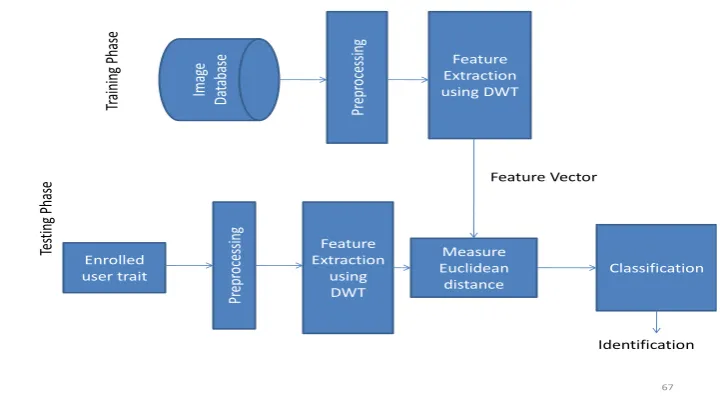
67 Ima ge Da tab as e Pr ep ro ce ss in g Feature Extraction using DWT Enrolled user trait Pr ep ro ces sing Feature Extraction using DWT Measure Euclidean distance Classification Feature Vector Tr ain in g Phas e Te sti ng Phas e Identification
Figure 1: The Process of a Biometric System.
3.1 Implementation of the Proposed Biometric System
The implementation of the proposed biometric system was done with MATLAB version 12 with a system specification of 1.80GHz processor, 500GB of HDD (hard disk drive), 4GB of RAM, and 64 bit operating system on window 7 platforms.
3.2 Description of the Database Used
The proposed systems were validated on a subset of LAUTECH Non-Chimeric Multimodal database. This database consists of 924 images each of faces, left and right eye, left & right thumbprints of 154 individuals taken in an uncontrolled condition. Each biometric trait contains six samples. For this paper, 100 individuals were considered making a total of 600 images each for face, iris and fingerprint database. The whole image database was randomly partitioned into training and testing set. For each of the subjects in each database, 4 images were randomly selected as training samples stored in training folders and the remaining 2 images as testing samples were stored in the testing folders.
3.3 Preprocessing
This refers to a number of operations performed on images before feature extraction is done. This is done to boost the probability of undefeated recognition. For this work, the following were performed.
and fore-head without distortion. All images used were then resiezed to 100x100 pixels for uniformity.
b. Photometric Normlization: The aim of photometric normalization is to eliminate illumination effects, improve contrast, and enhance visual quality and to obtain a uniform histogram of the images. Histogram equalization was used to achieve this.
c. Iris Segmentation: Segmentation was performed using the Circular Hough Transform since it performs better than other localization techniques in case of occlusion due to eyelids and eyelashes. It is an automatic segmentation algorithm employed to deduce the radius and center coordinates of the pupil and iris region. Its parameters are the center coordinates xc and yc, and the radius r, which are able to define any circle according to the equation 1.
0
2 2 2
y
r
x
c cd. Iris Image Normalization: Normally, Irises from different people vary in size, even the irises from a single person, and this difference in size is due to illumination variation, pupil size and distance of the eye from the camera. To compensate for these different conditions and improve the precision of matching, Daugman’s rubber sheet model was used which project the segmented disk into a rectangular region of fixed size. It unwraps the circular region of iris into a rectangular block of constant dimension.
3.4 Feature Extraction
This stage describes the extraction of unique characteristics which can represent an image. The goal of feature extraction is to bring out a set of features which can maximize the recognition rate with the least number of elements. Discrete Wavelet Transform (DWT) was adopted for a transformation based feature extraction two level decomposition was performed on the preprocessed images. The DWT coefficient matrices extracted forms an efficient representation of the images in a lower dimension space. The output of DWT was converted to feature vector to serve as input into the classification component.
3.5 Recognition of Biometric Traits
image vector is determined. The test image is assumed to fall in the same class that the closest training image belongs.
3.6 Performance Evaluation Metrics
The performance metrics considered in this paper are recognition accuracy, recognition time and Total training time.
i. Recognition Accuracy: This is the percentage of all images that are correctly recognized out of the total images to be identified.
ii. Recognition Time: This is total finite time (in seconds) taken for the system to identify and display results.
iii. Total Training Time: This is the total training time taken to master each trait in the system.
4.0 Experimental Results and Discussion
The summary of the experimental results obtained for the developed system is presented in Table 1.
Table 1: Summary of Experimental results obtained.
Biometric System Average Training Time (s)
Average Recognition Accuracy (%)
Average Recognition Time (s)
Face Recognition 5.84 83.33 5.11 Iris Recognition 3.65 85.50 3.05 Fingerprint Recognition 1.27 82.75 1.28
It was observed from the Table that fingerprint recognition system has the least training time of 1.27s while Face recognition system has the highest training time of 5.84s. It thus can be deduced from this result that face contains more features to be trained than any of Iris and fingerprint Therefore, the more the features to be trained, the more the training time.
recognition accuracy achieved by the three systems is more than the 80% performance benchmark prescribed in Phillips work (Phillips, Wechsler, Haung and Rauss, 1998).
Moreover, average recognition time of 5.11sec, 3.05sec and 1.28sec were obtained for face, iris and fingerprint system respectively. Fingerprint recognition system has the least average recognition time which is a very good attribute for a real time recognition system.
CONCLUSION AND FUTURE WORK
In this paper, performance evaluation of Face, Iris and Fingerprint recognition systems was carried out. Iris recognition system has the highest accuracy of 85.5% while the least average recognition time of 1.28sec was recorded with fingerprint, with images taken in an uncontrolled condition. This notwithstanding, all the systems performed more than the 80% accuracy and 60sec recognition time benchmark (Phillips, Wechsler, Huang and Rauss, 1998). However, future work can be tailored towards improving the time taken for recognition and training by incorporating a feature selection module into the systems to reduce the size of features used for training and testing. Also, effect of multiple instances of these traits on recognition accuracies can be investigated.
REFRENCES
1. Adedeji, O. T. Performance Evaluation of Selected PCA-Based Face Recognition Algorithms. M.Tech Thesis, Department of Computer Science and Engineering, Ladoke Akintola University of Technology Ogbomoso, Nigeria, 2011.
2. Adedeji, O. T, Omidiora E. O, Olabiyisi, O. S, & Adigun, A. A. Performance Evaluation of Optimised PCA and Projection Combined PCA methods in Facial Images. Journal of
Computations & Modelling, 2012; 2(3): 17-29.
3. Adedeji O. T, Falohun A. S, Alade O. M, Omidiora E. O. and Olabiyisi S. O. Development of a Modefied Clonal Selection Algorithm for Feature Level Fusion of Multibiometric System, LAUTECH Journal of Engineering and Technology, 2015; 9(2): 80-85.
4. Adegoke, B. O, Omidiora, E. O, Ojo, J. A. and Falohun, A. S. Iris Feature Extraction: A Survey, Computer Engineering and Intelligent Systems, 2013; 4(9): 7-13.
6. Aluko J. O, Omidiora E. O, Adetunji A. B. and Odeniyi O. A. Performance Evaluation of Selected Principal Component Analysis-Based Techniques for Face Image Recognition. International Journal of Scientific and Technology Research, 2015; 4(1): 35-41.
7. Daugman J. How Iris Recognition Works, IEEE Transaction on Circuit System and Video Technology (CSVT), 2004; 14(1): 21-30.
8. Falohun A. Development of a Feature Extraction Method for Iris Recognition using Enhanced Inverse Analytical Fourier-Mellin Transform. Unpublished Ph. D. Thesis.
Ladoke Akintola University of Technology, Ogbomoso, Nigeria, 2012.
9. Falohun A, Omidiora, E, Fakolujo, A., Afolabi, O., Oke, A., & Ajala, F. Development of a biometrically-controlled door system (using iris), with power backup. AJSIR, 2012; 3(4): 203-207.
10.Jain A. K and Ross A. Multibiometric systems, Communications of the ACM, Special issue on Multimodal Interfaces, 2004; 47(1): 34-40.
11.Kim Y. G., Shin K. Y., Lee E. C. and Park K. R., Multimodal Biometric System based on the Recognition of faces and Both Irises, International Journal of Advanced Robotic Systems, 2012; 9(65): 1-6.
12.Krishneswari K. and Arugman S. Multimodal Biometrics Using Feature Fusion, Journal of Computer Science, 2012; 8(3): 431-435.
13.Ojo J. A. and Adeniran S. A. One-sample Face recognition using HMM Model of Fiducial Areas. International Journal of Image Processing (IJIP), 2011; 5(1): 22-37. 14.Omidiora E. O. A Prototype of Knowledge-based System for Black Face Recognition
System using Principal Component Analysis and Fisher Discriminant Algorithms, Unpublished Ph. D. Thesis, Ladoke Akintola University of Technology, Ogbomoso, Nigeria, 2006.
15.Omidiora, E., Fakolujo, O., Ayeni R., Olabiyisi, S., & Arulogun, O. Quantitative evaluation of principal component analysis and fisher discriminant analysis techniques in face images. Journal of Computer and its Application, 2008;15(1): 22-37.
16.Phillips P. J., Wechsler H., Haung J. and Rauss P. J. The FERET database and Evaluation Procedure for Face Recognition Algorithms, Image and Vision Computing, 1998; 16(5): 295-306.