(UDC: 621.822.5:620.191.35)
Effect of Surface Roughness on the Performance of a Magnetic Fluid
Based Parallel Plate Porous Slider Bearing with Slip Velocity
N. D Patel1*, G. Deheri2
1*Department of Mathematics, Sardar Patel University, V.V.Nagar-388120, India
e-mail: [email protected]
2Department of Mathematics, Sardar Patel University, V.V.Nagar-388120, India
e-mail: [email protected] *Corresponding Author
Abstract
An endeavour has been made to investigate the performance of a transversely rough porous parallel plate slider bearing with slip velocity taking a magnetic fluid as the lubricant. The associated Reynolds equation is stochastically averaged with respect to the random roughness parameter characterizing the roughness. In view of suitable boundary conditions this equation is solved to obtain the pressure distribution resulting in the calculation of load carrying capacity. Besides, friction on the slider is also computed. The computed results presented in graphical form indicate that the magnetic fluid lubricant improves the performance of the bearing system. The negatively skewed roughness further increases the already increased load carrying capacity due to magnetization. This effect becomes more sharp when variance (-ve) is involved. Although, porosity, slip velocity and standard deviation decrease the load carrying capacity, this negative effect can be minimized by the magnetic fluid lubricant in the case of negatively skewed roughness. In addition, the friction remains unaltered.
Keywords: Parallel Plate Slider, Magnetic Fluid, Roughness, Slip Velocity, Porosity, Pressure.
1.Introduction
theoretically analyzed the effects of slip velocity and a magnetic fluid lubricant characterized by material parameter on a parallel plate porous slider bearing. Here, it was shown that the increase in the slip parameter failed to alter the load capacity and the position of centre of pressure on the other hand, increase in the material parameter caused reduced friction. Recently, Patel and Deheri (2011) studied the Shliomis model based ferrofluid lubrication of a plane inclined rough slider bearing with slip velocity. It was concluded that although, the transverse surface roughness adversely affected the bearing system the magnetization sharply increased the load carrying capacity. Further, the slip parameter not only decreases the load but also decrease the friction on the slider.
Owing to elastic, thermal and uneven wear effects the configurations encountered in practice are usually not smooth. In fact, the bearing surface develops roughness after receiving some run in and wear. The roughness appears to be random in character. The stochastic model adopted by Tzeng and Saibel (1967) to analyze the effect of surface roughness was refined and modified further by Christensen and Tonder (1969 a., 1969 b., 1970) to present a comprehensive study on the effect of both transverse as well as longitudinal surface roughness. The roughness was characterized by a stochastic random variable with non zero mean, variance and skewness. This method of Christensen and Tonder found its application in a number of contributions (Gupta and Deheri (1996), Andharia, Gupta and Deheri (1997), Deheri, Patel and Patel (2011), Ting (1975), Prakash and Tiwari (1982), Prajapati (1995), Guha (1993).
Here, it has been sought to deal with the performance of a rough porous parallel plate squeeze film slider bearing under the presence of a magnetic fluid lubricant considering velocity slip. The analysis found here is based on Jenkins model.
2.Analysis
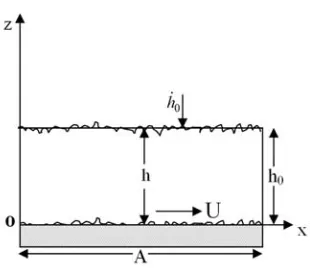
Fig. 1. Parallel Plate Slider Bearing
Jenkins (1972) proposed a model to describe the flow of a magnetic fluid. With Maugin’s modification, equation of the model for steady flow is (Jenkins, 1972) and (Paras Ram and Verma, P.D.S, 1999)
q M
M M
α ρ
H . M
μ
q
η
p q . q
ρ
2 2 0
2
(1)
q. q p η q μ
M.
Hρ 2 0
together with
0
.
q ,H 0,M H ,.
H M
0,(Bhat, 2003), α being a material constant. From Equations (1) and (2) we conclude that Jenkins model is a generalization of N-R model with an additional term
q H
H H μ α ρ M q M M α ρ 2 2 2 2 (3) which modifies the velocity of the fluid. Thus, N-R model modifies the pressure while Jenkins
model modifies both the pressure and velocity of the ferrofluid. In a one dimensional flow, as in a slider bearing with
r φ φ
H
H cos ,0,sin , It follows that
2 2 0 2 2 1 1 2 2 H μ μ p x η H μ ρα η z u (4) Following the assumptions of Bhat (2003), solving this under the boundary conditions
u=o at z=0 and u=U at z=h one obtains
h Uz H μ μ p x η H μ ρα η hz z
u
2 2 0 2 2 1 2 2 (5) Substituting this value of u in the integral form of the continuity equation
h w
h w udz
x0 0 0
(6) one gets
w wh
dx dh U H μ μ p dx d η H μ ρα h dx
d
0 12 6 2 2 0 2 2 1 3 (7) So incorporating the effect of porosity and slip, the associated Reynolds type equation comes
0 12 6 2 2 0 2 2 1 h dx dh U H μ μ p dx d η H μ ρα h g dxd
(8) where
sh sh h h h h h g 2 4 12 3 2 3 2 2 3 2 33
(9)
Taking H2 Kx
Ax
and introducing the dimensionless quantitiesA h h h A p h P K A U A h K h h h A x X 0 2 3 0 1 , 0 2 3 0 , 2 2 2 , 2 0 0 * , 0 , 0 4 3 0 h A w h W
, 0
20h L f h F
, 0 0 h03
ε ε , h σ σ , h α α
, ssh0,
3 0 h h
Equation (8) yields on integration.
h X Q X X
h g X X P dx d 1 2 1 1 6 1 * 2
1
(10) where
h s h s h h h h g 2 4 12 3 2 3 2 2 3 2 33
(11)
In a parallel plate slider bearing hh0then h=1. So taking h =1 in Equation (10) the film
pressure p̄is given by the equation
X X Q X g X X P dx d 1 2 1 1 1 1 6 1 * 21
(12) where
s s g 2 4 12 3 2 3 2 2 3 3 11
(13) Solving Equation (12) under
P (0) =P (1) =0 yields,
2 1 3 4 5
2 2 1 2 1 1 6 1 * 2 1 A X A A X A A X g X X
P
where , 2 8 1 8 1 2 2 1 1
A
sin 1
2 1
, 8 1 1 4 1 22 X X X X A
, 4 3 1 3 3 1 8 1 8 3 X X X X X X XA 2
8 1 1 8 1 2 2 1 2 8 4 A and 2 8 1 8 1 2 2 1 2 1 16 5 A
The load capacity W, frictional force F are respectively expressed in dimensionless form as
4 5
2 1 1 2 128 7 6 1 1 2 128 5 3 1 1 6 24 * A A A g
W
(15) and 1 1 0 1 2 dX h dX dP h F (16)
3.Results and Discussion
It is clearly seen that the dimensionless pressure distribution is determined from Equation (14) while the non dimensional load carrying capacity is obtained from Equation (15). Besides, the variation of friction is given by Equation (16). For a non porous smooth bearing this study reduces to the investigation of Bhat (2003) in the absence of slip velocity. From equations (14) and (15) it is observed that the dimensionless pressure increases by
*1
2 X X
while the dimensionless load carrying capacity gets enhanced by *
12
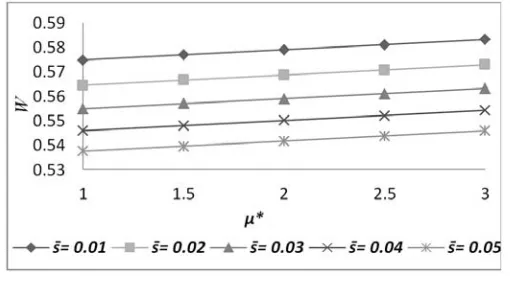
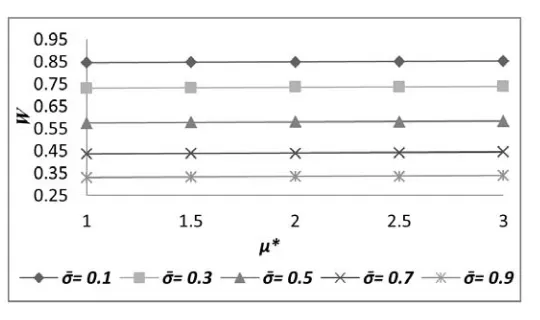
The variation of load carrying capacity with respect to the magnetization parameter displayed in Figures 2-7 indicates that the magnetization increases sharply the load carrying capacity in case of s̄, ᾱ, σ, ̄ ε̄ and ψ while in case of β- this increase is negligible.
Figure 2 Variation of load carrying capacity with respect to μ*and s̄
Figure 3 Variation of load carrying capacity with respect to μ*and ᾱ
Figure 5 Variation of load carrying capacity with respect to μ*and σ̄
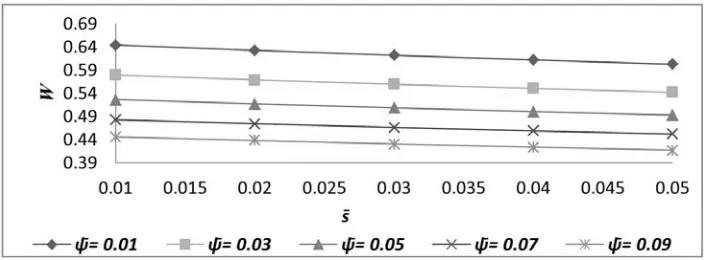
Figure 6 Variation of load carrying capacity with respect to μ*and ψ̄
Figure 7 Variation of load carrying capacity with respect to μ*and
value of slip parameter. This decrease in the load carrying capacity is more in the case of skewness.
Figure 8 Variation of load carrying capacity with respect to s̄ and ᾱ
Figure 9 Variation of load carrying capacity with respect to s̄ and ε̄
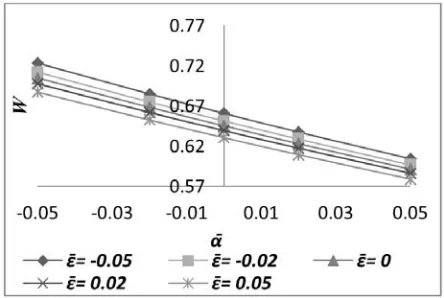
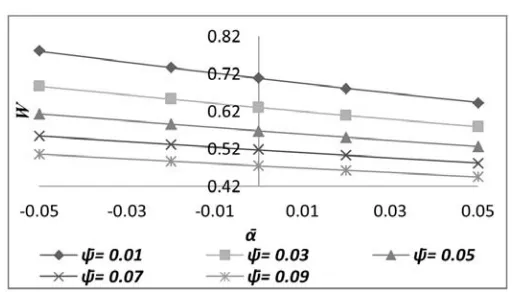
The effect of the variance ᾱ on the distribution of load carrying capacity is depictad in Figures 11-14. It becomes clear that variance (+ve) decreases the load carrying capacity while variance (-ve) increase the load carrying
Figure 11 Variation of load carrying capacity with respect to ᾱand ε̄
Figure 12 Variation of load carrying capacity with respect to ᾱ and σ̄
Figure 14 Variation of load carrying capacity with respect to ᾱand
The effect of standard deviation presented in Figures 15-16 suggests that the standard deviation has considerably adverse effects on the performance of the bearing system in the sense that it decreases the load carrying capacity considerably
Figure 15 Variation of load carrying capacity with respect to σ̄ and ε̄
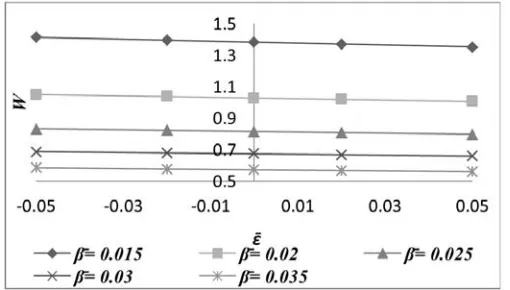
Figures 17-18 representing the effect of skewness indicate that the skewness follows the path of the variance regarding the trends of load carrying capacity.
Figure 17 Variation of load carrying capacity with respect to ε̄and ψ̄
Figure 18 Variation of load carrying capacity with respect to ε̄and
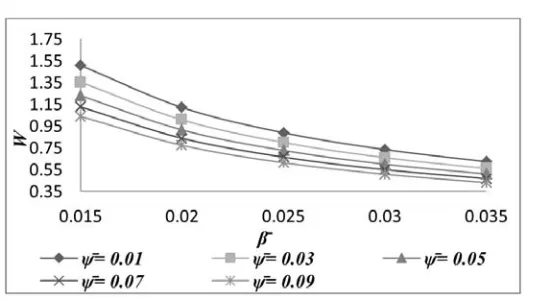
Figure 19 Variation of load carrying capacity with respect to
and ψ̄Figure 20 Variation of load carrying capacity with respect to
and
A close scrutiny of some of the graphs presented here makes it clear that the negative effect of porosity, standard deviation and material constant can be compensated up to some extent by the positive effect of magnetization in the case of negatively skewed roughness, particularly, when negative variance occurs.
A comparison of this study with the investigation of Shah and Bhat (2005) reveals that the overall performance is relatively better here in spite of the fact that the transverse roughness affects the performance adversely.
4.Conclusion
5.Acknowledgements
We acknowledge with thanks the quick responses from the Editors and Reviewers, particularly their promptness.
Nomenclature
f Frictional force
h Fluid film thickness at any point k Permeability of porous matrix p Lubricant pressure s Slip parameter
u X component of film fluid velocity w Load carrying capacity F Dimensionless frictional force H Magnitude of the magnetic field A Length of the bearing
P Dimensionless pressure U Velocity of slider
W Dimensionless load carrying capacity X̄ X coordinate of the centre of pressure h0 Fluid film thickness at x=0
H
External magnetic fieldq (u, v, w) is the fluid viscosity in the film region
s̄ Dimensionless slip parameter
β Material Parameter
The fluid viscosityσ Standard deviation
α Variance
ε Skewness
ψ Porosity
φ Inclination of M with the x-axes
σ̄ Dimensionless standard deviation
ᾱ Dimensionless variance
ε̄ Dimensionless skewness
0
The permeability of the free spaceμ* Magnetization parameter in non dimensional
form
Извод
Ефекат
храпавости
површине
на
перформансе
клизећег
порозног
лежаја
са
две
паралелне
стране
,
магнетним
флуидом
и
брзином
клизања
N. D Patel1*, G. Deheri2
1*Department of Mathematics, Sardar Patel University, V.V.Nagar-388120, India
e-mail: [email protected]
2Department of Mathematics, Sardar Patel University, V.V.Nagar-388120, India
e-mail: [email protected] *Corresponding Author
Резиме
Учињен јенапорда се истраже перформансе трансверзално храпавогпорозног клизног
лежаја садве паралелне странеибрзином клизања, коришћењеммагнетног флуидакао
подмазивача. ОдговарајућаРејнолдсоваједначинајестохастичкиусредњенауодносуна
случајни параметер храпавости који карактерише храпавост. Са гледишта погодних
граничнихусловаоваједначинајерешенадабиседобиораспоредпритисакакојидолази
из рачунања носивости. Поред тога, трење на клизачу је такође рачунато. Срачунати
резултатипредстављениграфичкиуказујудамагнетнифлуидни подмазивачпобољшава
перформансе носећег система. Негативно закошена храпавост даље повећава ионако
увећану носивост због магнетизације. Овај ефекат постаје израженији када јеварианса
(-ve) укључена. Мада, порозност, брзина клизања и стандардна девијација умањују
носивост, овај негативан ефекат може бити минимизован магнетним флуидом као
подмазивачем у случају негативно закошених неравнина. Поред тога, трење остаје
непромењено.
Кључне речи: Клизач са паралелним странама, магнетни флуид, храпавост, брзина
клизања, порозност, притисак
References
Andharia P, Gupta J, Deheri G (1997). Effect of longitudinal surface roughness on hydrodynamic lubrication of slider bearings, Proc. Tenth International Conference on Surface Modification Technologies, the Institute of Materials, 872-880.
Bhat M (2003). Lubrication with a magnetic fluid, Team Spirit (India) Pvt. Ltd.
Bhat M (1978). Optimum profile for the magneto hydrodynamic parallel-plate porous slider, Wear, 51, Issue 1, 49-55.
Christensen H, Tonder K (1969 a). Tribology of rough surfaces: Stochastic models of hydrodynamic lubrication, SINTEF Report No. 10/69-18.
Christensen H, Tonder K (1969 b). Tribology of rough surfaces: parametric study and comparison of lubrication, SINTEF Report No. 22/69-18.
Deheri G, Patel H, Patel R (2011). Load carrying capacity and time height relation for squeeze film between rough porous rectangular plates, Annals of Faculty Engineering Hunedoara International J. of Eng, Tome IX.
Guha S (1993) Analysis of dynamic characteristics of hydrodynamic journal bearings with isotropic roughness effects, Wear, 167, Issue 2, 2,173-179.
Gupta J, Deheri G (1996). Effect of roughness on the behavior of squeeze film in a spherical bearing, Tribol Trans. 39, 99-102.
Jenkins J (1972). A magnetic fluid, Arch. Ration., Mech. Anal,46(1) 42.
Paras Ram, Verma P (1999). Ferrofluid lubrication in porous inclined slider bearing, Indian J.pure appl. Math., 30(12), 1273-1281.
Patel N, Deheri G (2011). Shliomis model based ferrofluid lubrication of a plane inclined slider bearing with slip velocity, International J. of fluids engineering, 3, No 3, 311-324.
Prajapati B (1995). On certain theoretical studies in hydrodynamics and electro magneto hydrodynamics lubrication, Dissertation, S.P.University, Vallabh Vidyanagar.
Prakash J, Tiwari K (1982). Lubrication of a Porous Bearing with Surface Corrugations, Jour. of Lubr. Tech.104, 127.
Ramanaiah, Gundala (1967). Optimum Load Capacity of a Parallel Plate Slider Bearing with Non uniform Magnetic Field, Japanese Journal of Applied Physics, Volume 6, Issue7, 797. Shah R, Bhat M (2003). Ferrofluid lubrication of a parallel plate squeeze film bearing, Theoret.
Appl. Mech., Vol.30, No.3, 221-240, Belgrade.
Shah R, Bhat M (2005). Lubrication of porous parallel plate slider bearing with slip velocity, material parameter and magnetic fluid, Industrial Lubrication and Tribology, Vol. 57 Issue 3, 103 – 106.
Ting L (1975). Engagement behavior of lubricated porous annular disks. Part I: Squeeze film phase -- surface roughness and elastic deformation effects, Wear, Volume 34, Issue 2, 159-172.