© Global Society of Scientific Research and Researchers http://ijcjournal.org/
Improvement of an Interoperable and Adaptable
Middleware using IoT Semantic Web Technologies
Nay Min Htaik
a*, Nyein Aye Maung Maung
b, Win Zaw
ca,b,cDepartment of Computer Engineering and Information Technology, Yangon Technological University,
East Gyogone, Insein Township, Yangon, Myanmar
aEmail: [email protected]
bEmail: [email protected]
cEmail: [email protected]
Abstract
In today changing world, Internet of Things (IoT) is creating a new world, where people and businesses can make more timely and better informed decisions about what they want or need to do. Over the last years, agriculture industry in few countries has been expended to smart agriculture. Nevertheless, the agricultural industry in Myanmar needs to be modernized with the involvement of IoT technologies for crops’ growth monitoring, irrigation decision and harvesting system. However, due to the complexity of IoT middleware, most of the middleware frameworks are designed to be used by IT experts. To allow non-IT experts (e.g. farmers, plant scientist) to configure the sensor devices easier and faster, without knowing the background knowledge of technical details, sensor-level configuration of heterogeneous devices needs to be fully interoperable (network, syntactic, and semantic interoperability) due to the huge number of sensor devices integrated and their diversity in term of data formats, communication protocols, nature of components etc. In this work, we propose a fully interoperable middleware framework that incorporates semantic web technologies with the existing Global Sensor Network middleware to solve the above challenges. The proposed system supports horizontally semantic interoperability which addresses the challenge of adaptability of our approach to different domains. Performance of the proposed system will be implemented and evaluated mainly in crops’ growth of agriculture area of Myanmar.
Keywords: Internet of Things (IoT); middleware; semantic web technologies; sensor devices; smart agriculture.
---
1. Introduction
Internet of things (IoT) is a huge network, which combines the Internet and a variety of sensing devices, such asradio frequency identification (RFID), infrared sensors, global positioning systems, laser scanners and other various devices. IoT refers to physical and virtual objects that have unique identities and are connected to the Internet to facilitate intelligent applications. Internet of Things (IoT) technology becomes rapidly developed in recent years. In 2005, a report of the International Telecommunication Union (ITU) on IoT, proposed that any objects can exchange information and communicate at any moment and any place, thus extending the concept of IoT [15].
IoT allows people and things to be connected anytime, anywhere, with anything and anyone, ideally using any path/network and any service. The four pillars of IoT are wireless sensor networks (WSNs), machine-to-machine (M2M) communications, radio frequency identification (RFID), and supervisory control and data acquisition (SCADA). Among them, WSN middleware is a kind of middleware providing the desired services for sensor-based pervasive computing applications.
Generally, a middleware abstracts the complexities of the system or hardware, allowing the application developer to focus all his effort on the task to be solved, without the distraction of orthogonal concerns at the system or hardware level [8,2]. In the IoT, there is likely to be considerable heterogeneity in both the sensor-level communication technologies and the system sensor-level technologies, and a middleware should support both perspectives as necessary. Through a middleware system, applications and users may access data from interconnected objects and things, hiding the internal communication and low-level acquisition aspects. So, IoT middleware solutions help to retrieve data from sensor devices and feed them into applications easily by acting as a mediator between the hardware layer and the application layers. Moreover, middleware solutions need to be configured themselves depending on the context information and user requirements. The requirements for a middleware to support the IoT are grouped into two sets: middleware service requirements and middleware architectural requirements. And then, interoperability, one of the middleware architectural requirements, can be classified under three different categories like network interoperability, syntactic interoperability and semantic interoperability [13]. This work is considered on an interoperable requirement for WSN middleware of IoT system.
maintain soil health intact by applying only required amount of fertilizers. Soil moisture analysis helps to apply the water whenever necessary avoiding wastage of water. Also environmental conditions such as temperature and moisture also affect the crop production and crop diseases.
The remainder of this study is organized as follows. Section 2 presents related works in the loT middleware including semantic approaches. Section 3 describes the background and motivation behind our work. Section 4 describes overview design of the proposed middleware framework. Section 5 presents the implementation of the proposed middleware framework. Section 6 discusses and concludes this work.
2. Literature Review
Some research groups has attracted in smart agriculture using IoT technology. In particular, smart agriculture, built with diverse wireless sensor devices and actuators, is able to monitor the environmental conditions and control the deployed devices according to the collected data through wireline and wireless access networks. Lin and Liu [5] presented a remotely controlled farm farmer which can monitor and control using smartphones or tablets without visiting. Kaewmard and his colleagues [11] designed an automation system based on wireless sensor network techniques to monitor the agriculture environment. They also developed an irrigation system based on environmental data and supported remote control of the operation via mobile devices.
The IoT system is constituted of heterogeneous devices (sensors) that interact and collaborate with each other to realize a common task and exchange messages. In this case, the middleware should be as interoperable as possible so that it can accept the existing heterogeneous things as well as other new smart objects that can occur in the future. Middleware in IoT is a very active research area. Many solutions have been proposed and implemented, especially in the last couple of years. In this related works, some existing middleware solutions are reviewed for the following.
Hydra [10] is a middleware for ambient intelligence (AmI) services and systems. Hydra seamlessly provides network, syntactical and semantic level interoperability using semantic web services. The LinkSmart middleware [9], developed in the Hydra project, enables the integration of heterogeneous physical devices into applications via a Web service interface for controlling any type of physical device irrespective of its network technology such as Bluetooth, RF, ZigBee, RFID, WiFi, etc. LinkSmart is based on a semantic model-driven architecture and enables the use of devices as services both by embedding services in devices and by proxy services for devices. The semantic description of devices is based on ontologies using web ontology language (OWL).
framework for using semantic web technologies in the Internet of Things. It supports interoperability. However, they did not consider the interoperability between different service discovery protocols.
GSN [6] is a high popular middleware amongst developers and researchers, and it has been integrated in other projects (e.g., OpenIoT). GSN provides simple and uniform access to the host of heterogeneous technologies available and is easy to deploy. Although GSN is adaptive, it is not autonomous and it does not support for network, syntactic and semantics interoperability. XGSN [3] is an extension of the GSN middleware that supports semantic annotation of both sensor data and metadata. XGSN processes the data and publishes them using a semantic model based on the SSN ontology. Thus, it provides semantic interoperability. However, it does not consider network interoperability to modify GSN. CASCoM [4] is a significant improvement over the existing GSN middleware. They have only focused on developing a system-level configuration model by incorporating semantic technologies. CASCoM does not consider sensor-level configuration (network interoperability) with knowledge in semantic ontologies. Therefore, the proposed framework is another improvement over the existing GSN middleware mentioned above.
Most existing middleware solutions do not support fully interoperability. Some researchers [16,12] have proposed the use of semantic middleware to interoperate the different classes of devices communicating through different communication formats. The semantic model typically uses XML and ontologies to establish the metadata and meaning necessary to support semantic interoperability. Like the semantic web, semantic middleware seeks to create a common framework that enables data sharing and exchange across distributed devices, applications and locations. But, they do not support network interoperability.
In this work, the semantic middleware framework is proposed to support fully interoperability (network, syntactic and semantic interoperability) over the existing GSN middleware. The purpose of this study is to build a smart agriculture system, which can provide suitable environment for regularly growing crops based on the IoT systems.
3. Background and Motivation
communicate with the physical sensor when first initialized, ii) what to do in order to read data from the sensor, and iii) what to do with the data when it is received from the sensor. GSN provides an SQL-based database that stores all the raw sensor data if the permanent storage attributes of the virtual sensor is specified as “true” in the XML specification. In addition, each virtual sensor contains a key-value pair which can be registered and discovered in GSN.
In GSN, sensor data can be processed in three layers: 1) virtual sensors layer, 2) query processing layer, and 3) application and services layer. In layer 1, the virtual sensors layer allows to apply data processing operation over the sensor data. In the existing GSN, all the data processing components in layer 1 need to be deployed by the user and need to be manually selected based on the user requirement. In layer 2, the query processing layer can perform filtering and integration tasks based on SQL specification. But, data processing tasks that cannot be accomplished using SQL need to be performed either in layer 1 or 3. In layer 3, it consists of sophisticated applications and services that take specific data streams and perform complex data processing operations.
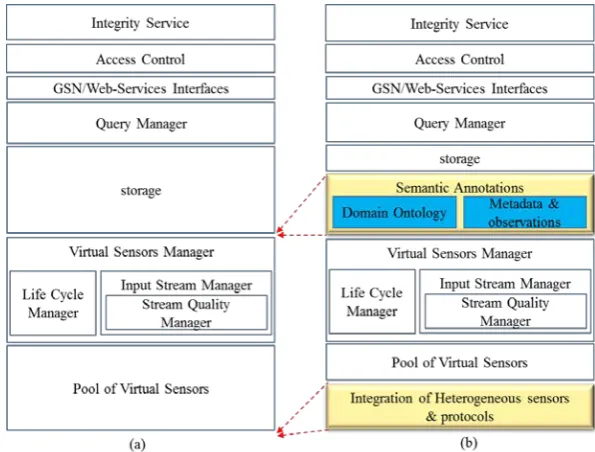
Fig. 1 shows the layered architectures of existing GSN middleware and the proposed middleware. There are several challenges in the existing GSN approach.
• There is no network interoperability to seamlessly integrate heterogeneous sensors and different communication protocols on a gateway.
• There is no semantic interoperability to internally handle sensor configuration without the user involvement.
Figure 1: layered architectures of (a) existing GSN middleware and (b) proposed middleware
• building an interoperable middleware framework by integrating existing Open Service Gateway initiative (OSGi) and Global Sensor Networks (GSN) middleware with semantic technology,
• creating network interoperability to seamlessly integrate heterogeneous sensors and different communication protocols on a gateway,
• providing semantic interoperability to internally handle sensor configuration without the user involvement,
• helping end-users to configure heterogeneous sensors and data processing components without knowing the underlying technical details of different sensors, and
• extending semantic interoperability across different IoT domains by providing a horizontal integration.
4. Proposed Middleware
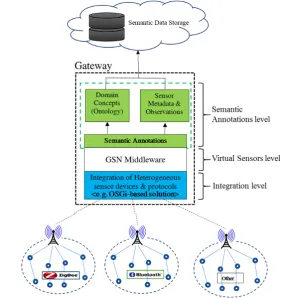
In this section, based on the challenges that identified in section III, we proposed a fully interoperable middleware framework based on the existing GSN middleware to explain how to integrate with heterogeneous sensors and provides quick adaption and interoperability for semantic computation in IoT system. Fig. 2 shows the design architecture of proposed middleware.
In the gateway, at the bottom is the integration level of heterogeneous sensors and communication protocols, where the physical devices are located. And then, we develop a semantic model to improve the existing GSN middleware.
4.1.Integration level
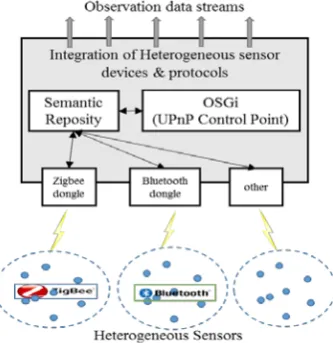
This subsection solves the interoperability problem bypassing the networking protocol interoperability challenge, based on Open Service Gateway initiative (OSGi) solutions. Fig. 3 illustrates the integration of heterogeneous sensors and protocols. There is a need to work in a unified way with devices using different protocols and networking technologies (e.g. Bluetooth, Zigbee). This framework contains the communication technology adapters and one driver listener for each communication technology, such as Bluetooth, Zigbee, etc.
Figure 3: Integration of heterogeneous sensors and communication protocols
When the proposed framework receives a signal from a new sensor device, irrespectively of the used network technology, it parses the information conveyed by the basic notification, which includes a device instance unique identifier, and its respective type-model identifier. Having retrieved the appropriate device description, the framework now holds all necessary information about the specific device, i.e., the specification of the services and actions offered by the device specified in Universal Plug and Play (UPnP). Thus, it framework as a bundle. Using OSGi-based solution, applications or components can be remotely installed, started, stopped, updated, and unistalled without required a reboot. Thus, the integration is a vital component of the proposed middleware as it significantly supports network interoperability in the GSN middleware.
4.2.Virtual Sensors Level
Figure 4: Virtual sensor acquisition and data stream provision
4.3.Semantic Annotations level
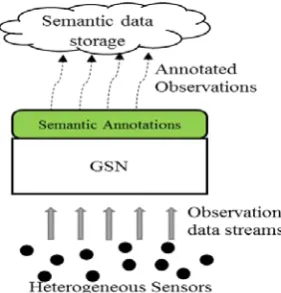
This subsection is one of the contributions over GSN that supports semantic annotation of both sensor data and metadata using SSN ontology. Two main types of semantic annotations have been added in the proposed semantic middleware. The first are metadata annotations, related to sensors, sensing devices and their capabilities, which could not be described before in the existing GSN. The other type of annotations are related to the observations or measurements produced continuously by the sensors. This includes the semantic information that describes the time and context when the observation happened, the observed property, unit, the values themselves, etc. Fig. 5 presents the annotation of sensor observations.
The proposed middleware framework automatically generates semantic annotations for the incoming data streams using SSN and links them with the corresponding domain concepts, i.e., agriculture domain in Myanmar. The semantic annotated data is stored in the data storage. And then, users are able to use a user Interface (UI) for visualizing data associated with the registered services from the semantic data storage.
Figure 5: Semantic annotation of observations
5. Implementation and Results
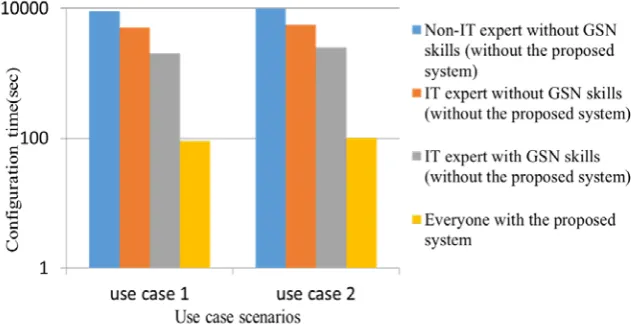
IDE) as GSN (source code:gsn-gsn-release-1.1.8) also natively supports Java. We implemented zigbee network, bluetooth network and wifi network using Arduino Uno, zigbee modules, bluetooth modules, wifi modules and 20 sensors (i.e., soil moisture sensors, humidity and temperature sensors, etc.) description according to Semantic Sensor Network ontology. In test-bed consideration, we evaluated two use case scenarios in agricultural site: (1) monitor soil condition and (2) monitor environmental pollution. And then, we selected three types of users: (1) an IT expert who was familiar with GSN configuration process, (2) an IT expert who was not familiar with the GSN and (3) an non-IT expert. In fig. 3, it can be seen that everyone using the proposed middleware saves configuration times and is easy to use it than others.
Figure 6: The test-bed for the proposed middleware
The proposed user interface hides the complexities of semantics and ontological representations from the user by presenting concepts that the user is familiar with and understands. The proposed system supports single-click configuration by eliminating sequences of manual activities needed to be carried out by users. It results in smart agriculture that suits crop’s growth, reduces human interference and eventually achieves more accurate farming processes.
6. Discussion
The proposed middleware is possible to offer a sophisticated configuration model to support non-IT experts. Semantic technologies are used extensively to support this proposed system. The semantic technologies allow capturing user requirements and configuring the sensors and data processing components accordingly by handling the low-level technical details without overwhelming the users. We used ontologies to model sensor descriptions and data processing component descriptions. We also developed ontology to organic additional knowledge this is required for understanding user requirements.
GSN approach, it diminishes when users use the proposed middleware system to configure GSN.
7. Conclusion
In this work, we have presented an interoperable and configurable middleware system based on semantic techniques in IoT. As a result of the integration of semantic interoperability into the GSN middleware, the proposed middleware helps end users to configure sensors and data processing components without knowing the background knowledge of technical details of different sensors. This middleware not only supports network interoperability to seamlessly integrate heterogeneous sensors and different communication protocols on a gateway, but also provides semantic interoperability to internally handle sensor configuration without the user involvement. And then, it allows end users to configure IoT middleware efficiently and effectively. As future work, we would like to provide the use of the proposed middleware system to more diverse services in agriculture domain. Moreover, the proposed system is also extended semantic interoperability across different IoT domains by providing a horizontal integration.
8. Recommendations
This work describes a middleware to build a smart agriculture system that can be utilized for crop’s growth of Myanmar traditional agriculture area.
Acknowledgments
The authors would like to thank his deep appreciation to Dr. Win Zaw and Dr. Nyein Aye Maung Maung for their valuable supervisions and fruitful discussions. This work is funded by U Nyi Hla Nge Foundation, Yangon Technological University, Myanmar.
References
[1] A. Katasonov, O. Kaykova, O. Khriyenko, S. Niktin, and V. Terziyan, “Smart semantic middleware for the internet of things”, In 5th International Conference on Informatics in Control, Automation and Robotics, May 2008, pp.169-178.
[2] A.H. Ngu, M. Gutierrez, V. Metsis, S. Nepal, and Q.Z. Sheng, “IoT middleware: a survey on issues and enabling technologies,” IEEE Internet of Things Journal, vol.4, pp.1-20, 2017.
[3] C. Jean-Paul, S. Sofiane, E. Julien, and A. Karl, “XGSN: an open-source semantic sensing middleware for the web of things”, Faculty of Computer Science and Communication Systems, EPFL, Switzerland, 2012.
[4] C. Perera, A. Zaslavsky, M. Compton, P. Christen and D. Georgakopoulos, “Semantic-driven configuration of internet of things middleware,” in Ninth International Conference on Semantics, Knowledge and Grids, IEEE, Sep 2013, pp.66-73.
[6] K. Aberer, M. Hauswirth, and A. Salehi, “Infrastructure for data processing in large-scale interconnected sensor networks,” in International Conference on Mobile Data Management,May 2007, pp.198-205.
[7] L.M.S. de Souza, P. Spiess, D. Guinard, M. Kohler, S. Karnouskos and D. Savio. Socrades: “A web service based shop floor integration infrastructure”, In The Internet of Things, Lecture Notes in Computer Science, Springer Berlin/Heidelberg, 2008.
[8] M.A. Razzaque, M. Milojevic-Jevric, A. Palade and S. Clarke, “Middleware for internet of things: a survey”, IEEE Internet of things journal, vol. 0, no. 0, pp.1-26, January 2016.
[9] M. Eisenhauer, P. Rosengren & P. Antolin, “A development platform for integrating wireless devices and sensors into ambient intelligence systems”, 2009.
[10]M. Eisenhauer, P. Rosengren, and P. Antolin, “Hydra: a development platform for integrating wireless devices and sensors into ambient intelligence systems,” in The Internet of Things. Springer New York, pp.367-373, 2010.
[11]N. Kaewmard and S. Saiyod, “Sensor data collection and irrigation control on vegetable crop using smart phone and wireless sensor networks for smart farm,” in Proceedings of the International Conference on Wireless Sensors (ICWiSE), 2014, pp.106-112.
[12]P. Prakash Jayaraman, D. Palmer, A. Zaslavsky and D. Georgakopoulos, “Do-it-yourself digital agriculture applications with semantically enhanced loT platform,” 2015 IEEE Tenth International Conference on Intelligent Sensors, Sensor Networks and Information Processing (ISSNIP), Singapore, April 2015, pp. 7-9.
[13]S. Bandyopadhyay, M. Sengupta, S. Maiti and S. Dutta, “Role of middleware for internet of things: a study”, International Journal of Computer Science and Engineering Survey (IJCSES), vol.2, no.3, pp.94-105, August 2011.
[14]T. Liu and M. Martonosi, “Impala: a middleware system for managing autonomic, parallel sensor systems,” in ACM SIGPLAN Notices, vol. 38, no. 10, pp. 107–118, 2003.
[15]“The Internet of Things”, ITU Internet Reports, 2005.