Research Article
Effect of head space, processed water and
vitamin C on pasteurized hot filled orange
juice during storage
Qaiser Ali Sultan
1*, Said Wahab
1, Muhammad Noor uddin
1, Yasser
Durrani
1, Ali Muhammad
1, Haris Bilal
1and Mukhtar Ud Din
21. Department of Food Science and Technology,The University of Agriculture Peshawar-Pakistan 2. Department of Human Nutrition,The University of Agriculture Peshawar-Pakistan
*Corresponding author’s email:[email protected] Citation
Qaiser Ali Sultan, Said Wahab, Muhammad Noor uddin, Yasser Durrani, Ali Muhammad, Haris Bilal and Mukhtar Ud Din. Effect of head space, processed water and vitamin C on pasteurized hot filled orange juice during storage. Pure and Applied Biology. Vol. 8, Issue 2, pp1008-1015. http://dx.doi.org/10.19045/bspab.2019.80041
Received: 06/01/2019 Revised: 26/03/2019 Accepted: 29/03/2019 Online First: 04/04/2019
Abstract
This study is revealed on pasteurized Hot-fill orange juice the sequel of ascorbic acid, processed water and head space for 90 days during storage at room temperature. Outcomes were exhibited the significant reduction of the Alicyclobacillus growth with the addition of an amount of 150mg/lit of vitamin C and head space finishing of thermosetting container. While, initial bacterial count was controlled by ozonated and ultraviolet light processed water. Savour and color impermeability in the pasteurized Hot-fill orange juice were significantly (p < 0.05) pompous by both addition of vitamin C and leaving no head space. While in contrast the non- significant effect on acidity, pH, 0Brix, reducing and non-reducing sugar were observed during the storage. Hence, concluded that
during processing as well as in storage the microbial growth especially Alicyclobacillus could be inhibited by processed water, leaving no head space and ascorbic acid fortification.
Keywords:Pasteurized orange juice; Processed water; Sensory analysis; Vitamin C
Introduction
Orange (Citrus sinensis ) is the fruit of the citrus species belongs to the the family rutaceae. Orange is a hybrid
ofpomelo (Citrus maxima) and
mandariin (Citrus reticulata) genus, its being cultivated since ancient times [1].Orange bears seasonal fruits that measure about 3 inches in diameter and weigh about 100-150 g, evergreen small flowering tree growing to about 5 to 8 m tall tropical to semitropical.In Pakistan, total area under orange cultivation is 193977 hectares, with annual production of 2147340 tones. Punjab province contributes
more than 94 % towards total production [2].
Fresh fruits are a source of rational income as well as healthy supplement to the diet. But due to the high moisture content the fruits are short lived. Hence many recent developments were made to overcome these losses but these efforts proved to be non-result oriented [3].The contamination of Alicyclobacillus
sugar content, low oxygen contents and low pH the concentrated fruit products are supposed to be resistant to microbes [6]. In contrast, Alicyclobacillus development in a medium also depends on the available oxygen which can be can be rendered by adding vitamin C [7].
This is accomplished that the pasteurized juice is mainly spoiled by the
Alicyclobacillus spores forming bacterium which can survive pasteurization temperature. The bacterium is soil inhabited and can only grow when the oxygen is available. This suggests that if the contamination from the soil is controlled and render the oxygen availability in orange juice filled in any air tight container the chances of spoilage might be reduce to a safe level. Pasteurization, using processed water and then do hot filling without leaving the head space in the bottle and closed the bottle air
tight to create anaerobic condition will further preserve/enhance shelf life of the orange juice.
Materials and methods
This experimentation was thoroughly conducted in the laboratory of Department of Food Science and Technology, The University of Agriculture Peshawar. Fresh Oranges were bought from the local market of Peshawar in tardy spring 2013. Oranges were washed, peeled, and the juice was extracted by utilizing a juice extractor. Formulation of orange juice
The juice was formulated as narrated by Glevitzky [8].
Juice= (50)%, Water= (50)% , Citric acid= 2.5 g/L , Sugar= 45g /L
Research study plan
Juice was yare according to the research plan below (Table 1) [14, 27]
Table 1. Treatments wise samples study plan
Treatments Pasteurized Head space Water Vitamin C
PO0 Done Present Unprocessed Omit
POU Done Omit Unprocessed Omit
POT Done Omit Processed Omit
POTC Done Omit Processed Present(150mg/l)
POUC Done Omit Processed Present(150mg/l)
Orange juice preparation
Juice was heated without leaving the head space to 88± 2°C for 2 min and was filled in the bottles at that temperature. Thermosetting plastic bottles of 500ml containing Samples were stored at ambient temperature. The interval for the analyzing of product was 15 days with the 90 days storage period
Chemical analysis
The standard method of [9] of pH as communicated with the avail of pH meter for the culled samples pH was quantified. The standard method of AOAC [9] was utilized for the resoluteness of total soluble solids.Titration of titratable acidity was resolute against the prototype alkali solution by prototype procedure of AOAC [9]. The
ascorbic acid was tenacious by the volumetric analysis pattern as described in AOAC [9]. The reducing sugar and non-reducing sugar was resolute by lane Eynon method as communicated in AOAC [9]. A morsel of orange sap was evaluated organoleptically for overall acceptability, savor and color by the method as described by [10].
Microbial tests
The microbial test for yeast and bacteria was performed by the prototype procedures as communicated by Javed [11].
Statistical analysis
Design (CRD), and denotes was disunited by LSD test as described by [12].
Results and discussion Chemical analysis
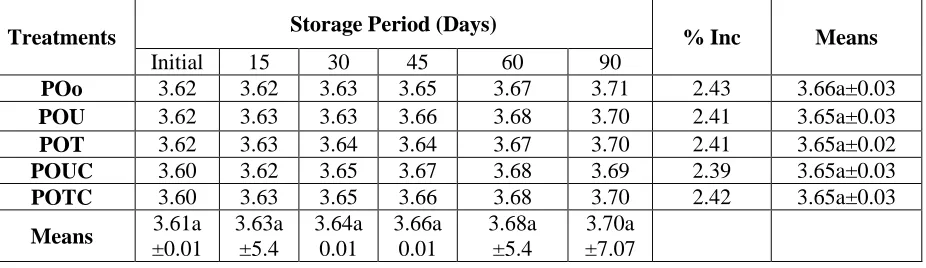
The pH of pasteurized orange juice during storage by the sequel of treatments like head space, processed water and Vitamin C is conceal in (Table 2) at room temperature. Ascribed to treatments and storage non-significant differences were perceived in the pH. Vitamin C fortification might be the cause of samples POUC and POTC initial low pH [13]. Same pH (7.4) of processed and unprocessed water at beginning did not exploit samples pH of POU and POT. Owing to the destruction of spoilage microorganisms by pasteurization the slightest disturbance in pH with storage was noted [14]. Processed water, head space and Vitamin C merely checks the Alicyclobacillus which did not changed the pH of juice the treatments [15].
Similarly [16] also noted a non-significant variation in pasteurized orange carrot blend juice pH. Consequently, concluded that the pH in pasteurized orange juice doesn’t pompous the treatments and storage.
Titratable acidity of pasteurized orange juice during room temperature storage caused due to processed water, Head space, and Vitamin C is shown in (Table 3). In the acidity of pasteurized orange juice the non-significant changes statistically originated by the treatments and storage. The pH of the juice was non-significant may be the reason the fact that titratable acidity and pH are vice versa [17]. Likewise, during storage of pasteurized apple juice [18] noted no significant changes in the acidity. Pasteurization and pulsating electric field did not produced significant effects on orange carrot blend juice acidity. It was noted that Titratable acidity did not vitiate with storage and treatments.
The Vitamin C content of pasteurized orange juice at room temperature storage is pronounced in (Table 4) by the aftermath of
Head space, Processed water and Vitamin C. The treatments and storage was pretentious significantly (p<0.05) on the concentration of Vitamin C of the juice. In fruit juices the storage causes the Vitamin C to decomposed [19]. Similarly, higher Vitamin C content was retained in Vitamin C fortified orange juice compared to un-fortified pasteurized orange juice [20].
Total soluble solid was significantly increased with storage perceived from the results. However, on the TSS of juice samples treatments of no headspace, addition of vitamin C and processed water has no significantly effects. Storage causes the inversion of polysaccharides in the presence of acids and high temperature might be due to this significant increase in TSS [21]. Non-significant increase in the TSS of orange carrot pasteurized blend juice was found by [22].
The reducing sugars of pasteurized Hot-fill orange juice demonstrated in (Table 5). The treatments sequel on reducing sugars were non-significantly (p>0.05) whereas the storage ramifications were significant (p<0.05) on reducing sugar. [21] reported the conversion of non-reducing sugar to reducing sugar was impede by high temperature& Acid. Changes in acidity because of treatments were not effective (Table 6). No significant changes in reducing sugars were noted. Non-reducing sugars changes to reducing sugars in storage [23]. Reducing sugars of orange juice increases in storage [17]. Study found that storage affects the reducing sugars.
temperature the non-reducing sugars are converted into reducing sugars. Non-reducing sugars was reduced in the juices [17]. It is found that during storage the reducing sugars are reduced in pasteurised Hot-fill orange juice.
The (Table 8) shows the effect of processed water, Head space and Vitamin C on flavor retention in pasteurized orange juice during storage. Retention of flavor is affected by treatments and storage significantly (P <0.05) in pasteurized orange juice. These assumptions are in close agreement with the results by [24], who reported reduction in organoleptic attributes of pasteurized orange juices, kept in transparent glass bottles.In pasteurized hot fill orange juice the fortification of Vitamin C and leaving no head space could be allude to positive correlated of flavor.
In (Table 9) signifies the stability of color of pasteurized orange juice due to treatments. Juice color was highly (p<0.05) effected by treatments and storage.
Color and viscosity of water melon juice which was processed with higher intensity pulse electric field and heat, major reduction in the color of water melon was detected [25]. This shows that no head space and Vitamin C fortification could be retained in the pasteurized orange juice.
Overall acceptability regularly reduced during storage for pasteurized orange juice samples as shown in (Table 10). During storage the overall acceptability mean scorewassignificantly (p<0.05) decreased direct effect on quality of juice might be due to oxygen caused the fairly less acceptability of the unprocessed sample PO0 compared to POU and POT [17]. The results of comparative effect of heat pasteurization to pulse electric field on the quality of orange juice, are in agreement with those of [14].
Addition of Vitamin C and no head space caused product microbiolly and physio-chemically accepted.
Microbial tests
In (Table 11) separation of Alicyclobacillus
colonies with storage indicated an increase. During storage the colony forming unit was take note of a Significant (P < 0.05) increase. Parallel the bacterial development pompous significantly by treatments on the other hand. Due to sternly aerobic nature of
Alicyclobacillus microbes the presence of oxygen in the head space of control sample PO0 might be perceive relatively more bacterial growth [26]. During storage the development of Alicyclobacillus in the pasteurized apple juice significantly pretentious by head space was divulge [27].
Table 2. The Effect of processed water, Vitamin C & head space on the pH of pasteurized orange sap at ambient temperature during storage
Treatments Storage Period (Days) % Inc Means
Initial 15 30 45 60 90
POo 3.62 3.62 3.63 3.65 3.67 3.71 2.43 3.66a±0.03
POU 3.62 3.63 3.63 3.66 3.68 3.70 2.41 3.65a±0.03
POT 3.62 3.63 3.64 3.64 3.67 3.70 2.41 3.65a±0.02
POUC 3.60 3.62 3.65 3.67 3.68 3.69 2.39 3.65a±0.03
POTC 3.60 3.63 3.65 3.66 3.68 3.70 2.42 3.65a±0.03
Means 3.61a
±0.01
3.63a ±5.4
3.64a 0.01
3.66a 0.01
3.68a ±5.4
Table 3. Effect of Head space, processed water and Vitamin C on the acidity of pasteurized orange juice at room temperature storage
Treatments Storage Period (Days) % Dec Means
Initial 15 30 45 60 90
PO0 0.726 0.726 0.724 0.720 0.716 0.708 2.63 0.720a±7.04
POU 0.726 0.724 0.724 0.718 0.714 0.710 2.58 0.719a±6.40
POT 0.726 0.724 0.722 0.722 0.716 0.710 2.60 0.720a±5.93
POUC 0.730 0.726 0.720 0.716 0.714 0.712 2.65 0.719a±6.03
POTC 0.730 0.724 0.720 0.718 0.714 0.710 2.67 0.718a±6.02
Means 0.728a
±1.41
0.725a ±1.09
0.721a ±2
0.718a ±2.28
0.715a ±1.09
0.711a ±1.41
Table 4. The Effect of processed water, Vitamin C &head space on the ascorbic acid of pasteurized orange sap at ambient temperature during storage
Treatments Storage Period (Days) % Dec Means
Initial 15 30 45 60 90
POo 10.03 6.44 3.95 2.13 1 1 90 4.24b±3.57
POU 10.04 7.10 4.79 2.98 1.52 1 90 4.85b±3.49
POT 10.07 7.26 4.43 2.65 1.34 1 90 4.67b±3.58
POUC 17.91 16.45 15.07 14.21 13.59 12.10 32.89 14.96a±2.07
POTC 18.11 17.04 16.21 14.92 14.06 12.86 32.39 15.19a±1.95
Means 13.21a
±4.36
10.65b ±5.38
8.17c ±6.18
7.23cd ±6.57
6.46de ±6.87
5.49e ±6.29
Table 5. Total Soluble Solids Scenario after the application of Vitamin C, Head space and processed water to the pasteurized orange juice
Treatments Storage Period (Days) %
Increase Means
Initial 15 30 45 60 90
PO0 11 11.1 11.1 11.3 11.3 11.4 3.07 11.20a±0.15
POU 11 11.1 11.2 11.3 11.4 11.4 3.07 11.19a±0.16
POT 11 11.1 11.2 11.2 11.3 11.3 2.35 11.18a±0.11
POUC 11 11 11.1 11.2 11.4 11.4 3.07 11.18a±0.18
POTC 11 11 11.2 11.3 11.3 11.3 2.35 11.18a±0.14
MEANS 11.00d
±0.00
11.06d ±0.05
11.16c ±0.05
11.26b ±0.05
11.34a ±0.05
Table 6. The Effect of processed water, Vitamin C &head space on the reducing sugar of pasteurized orange sap at ambient temperature during storage
Treatments Storage Period (Days) % Inc Means
Initial 15 30 45 60 90
PM0 4.5 4.6 4.7 4.9 5.1 5.5 40.00 4.88a±0.37
POU 4.6 4.6 4.7 4.0 5.1 5.3 26.92 4.88a±0.45
POT 4.5 4.6 4.8 4.0 5.1 5.4 36.63 4.88a±0.48
POUC 4.5 4.6 4.6 4.1 5.2 5.3 30.00 4.88a±0.45
POTC 4.4 4.6 4.7 4.9 5.3 5.5 45.83 4.90a±0.42
Means 4.50d
±0.07
4.60cd ±0.00
4.76c ±0.07
4.96b ±0.47
5.16ab ±0.08
5.40a ±0.10
Table 7. The Effect of processed water, Vitamin C &head space on the non-reducing sugar of pasteurized orange sap at ambient temperature during storage
Treatments Storage Period (Days) % Dec Means
Initial 15 30 45 60 90
PO0 5.3 5.1 5.0 4.7 4.5 4.2 17.46 4.75a±0.40
POU 5.4 5.2 5.9 4.6 4.4 4.3 17.18 4.78a±0.63
POT 5.2 5.1 5.0 4.7 4.4 4.3 16.51 4.78a±0.37
POUC 5.1 5.0 5.9 4.8 4.5 4.2 18.75 4.75a±0.58
POTC 5.2 5.1 5.9 4.7 4.5 4.2 17.46 4.77a±0.60
Means 5.26a
±0.11
5.13b ±0.07
5.95b ±0.49
4.70bc ±0.07
4.48c ±0.05
4.24c ±0.05
Table 8. The Effect of processed water, Vitamin C & head space on the flavor of pasteurized orange sap at ambient temperature during storage
Treatments Storage Period (Days) % Dec Means
Initial 15 30 45 60 90
POo 8 7.1 6.0 5.6 4.3 2.7 62.19 5.73b±1.91
POU 8 7.4 7.0 6.2 5.4 5.0 37.50 6.46b±1.17
POT 8 7.5 6.8 6.3 5.7 5.1 35.80 6.61b±1.09
POUC 8 8 7.9 7.8 7.7 7.7 6.20 7.78a±0.13
POTC 8 8 8 7.9 7.9 7.8 2.43 7.93a±0.08
Means 8.00a
±0.00
7.66ab ±0.39
7.14abc ±0.82
6.74bcd ±1.03
6.26cd ±1.55
5.82d ±2.43
Table 9. The Effect of processed water, Vitamin C &head space on the color stability of pasteurized orange sap at ambient temperature during storage
Treatment Storage intervals (Days) % Dec Means
Initial 15 30 45 60 90
PM0 8.2 7.5 6.5 5.6 3.1 2 62.19 5.73b±2.46
POU 8.2 7.6 7.2 6.5 5.8 5.3 37.50 6.61b±1.10
POT 8.2 7.8 7.3 6.4 5.9 5.1 35.00 6.46b±1.18
POUC 8.2 8.2 8 7.9 7.9 7.9 5.00 7.82a±0.14
POTC 8.2 8.2 8.1 8.1 8.0 8.0 3.75 7.88a±0.08
Means 8.00a
±0.00
7.66ab ±0.32
7.24abc ±0.65
6.74bcd ±1.06
6.26cd ±1.99
Table 10. The results for overall acceptability of pasteurized orange juice samples
Treatment Storage Intervals % Dec Means
Initial 15 30 45 60 90
POo 8.1 7.2 6.1 5.0 3.8 2.2 60.24 5.72d±2.19
POU 8.1 7.8 7.3 6.5 6.2 5.4 35.52 6.12c±1.03
POT 8.1 7.7 7.1 6.4 6 5.5 34.71 6.48b±1
POUC 8.1 8 7.9 7.7 7.7 7.6 5.22 7.85a±0.19
POTC 8.1 8.1 8 7.8 7.7 7.7 4.76 7.90a±0.18
Means 8.10a
±0.00
7.62b ±0.35
7.00c ±0.76
6.12cd ±1.14
5.90d ±1.60
5.63de ±2.23
Table 11. The isolation of Alicyclobacillus colonies with storage per 10-2 ml
Treatment Storage intervals (Days) % Inc Means
Initial 15 30 45 60 90
PM0 17 46 78 92 122 304 95.13 94.33a±109.8
POU 15 21 26 34 47 83 86.36 39.83b±24.83
POT 2 5 14 21 37 53 94.60 35.00b±19.69
POUC 19 23 31 35 41 48 64.44 34.66b±10.88
POTC 3 5 7 10 16 19 61.34 8.50b±6.32
Means 11.00b
±8.07
21.20b ±16.85
32.40b ±27.83
41.54b ±31.67
55.78ab ±40.51
101.18a ±115.51
Conclusion
Careful observations revealed that best keeping qualities during room temperature storage maintained by samples POUC and POTC. While keeping in mind the initial count and the microbial development the sample POTC may have prolonged shelf life. The positive influence of head space and Vitamin C on the color, flavor and Vitamin C retention perceive in the samples while the control of Alicyclobacillus initial count only be done by processed water.
Authors’ contributions
Conceived and designed the experiments: QA Sultan & S Wahab, Performed the experiments: QA Sultan, Analyzed the data: QA Sultan, Contributed reagents/ materials/ analysis tools: S Wahab, MN uddin, Y Durrani, A Muhammad, H Bilal & MU Din, Wrote the paper: QA Sultan.
References
1. Nicolosi EZN, Deng A, Gentile L, Malfa, Continella G & Tribulato E (2000). Citrus phylogeny and genetic origin of important species as investigated by molecular
markers. Theoretical and Applied
Genetics 100(8): 1155-1166.
2. Agriculture Statistic of Pakistan (2012). Gov. of Pakistan. Ministry of Food Agri and Live Stock Economic Wing Islamabad 90.
3. Liu FW (1999). Postharvest handling in Asia
2. Hort. R Crops Dept of Hort. National Taiwan Uni.
4. Pontius AJ, Rushing JE & Foegeding PM (1998). Heat resistance of Alicyclobacillus acidoterrestris spores as affected by various
pH values and organic acids. J Food Protec
61: 41–46.
5. Johnson BD & Okibe N (2003).
Thermo-acidophilic bacteria isolated from
geothermal sites in Yellowstone National
Park: J Physiolo & Phylogenetic
Characteristics Arch Microbiol 180: 60–68
6. Maldonado MC, C Belfiore & A
RNavarro(2008). Temperature, soluble
solids and pH effect on Alicyclobacillus acidoterrestris viability in lemon juice concentrate. J Indus Microbiol & Biotech
35: 141-144.
marketed in SpainÁrea de Nutrición y Bromatología.
8. Glevitzky M, Bogdan I, Brusturean, GA &
Silaghi Perju D (2007). Use of
pasteurization units or equivalent for the quality estimation of fruit juices submitted to
different thermal treatments. Chem Bull
Politeh Univ (Timişoara).52(66): 18-20.
9. AOAC (2000). Official methods of analysis
of the association of official and analytical chemists. Arlingto, USA, 17th edition
chapter17.
10. Larmond E (1977). Laboratory method of
sensory evaluation of food. Publication of Deptt: Agri. Ottawa, Canada, pp177-183.
11. Javed A (2011). Microbiology Manual.
National Institute of Food Science & Technology, University Of Agriculture Faisalabad .Golden Jubilee Edition. 47-51 12. Steel RG, Torrie JH & Dickey D (1997).
Principles and procedures of statistics a biometrical approach.3rd Ed., McGraw Hill
Pub. Comp. Inc. New York. USA.
13. Savaş K, Bahçeci & Acar J (2007).
Modeling the combined effects of pH, temperature and ascorbic acid concentration on the heat resistance of Alicyclobacillus acidoterrestis. Inter J Food Microbiol 20: 266–273
14. Hye WY, Charles B, Streaker Q, Zhang H & Min DB (2000). Effects of Pulsed Electric Fields on the Quality of Orange Juice and
Comparison with Heat Pasteurization. J
Agric Food Chem 48: 4597-4605
15. Brown KL (2000). Control of bacterial
spores. J British medi Bulletin (56): 158-171.
16. Rivas A, Rodrigo AD, Martıneza A, Barbosa
Ca novasb GV & Rodrigo M (2005). Effect of PEF and heat pasteurization on the
physical–chemical characteristics of
blended orange and carrot juice Washington State University, Pullman, WA 99164-6120.
17. Gilani SN (2002). Development of Mango
squash from four different cultivars of
mango. M.Sc. Thesis. Agric.Univ.
Peshawar.
18. Zarate RE & Ortega RE (2000). Quality changes in apple juices as related to
non-thermal processing. J Food Quality 23: 337–349.
19. Stešková A, Morochovičová M & Lešková
E (2006).Vitamin C degradation during storage of fortified foods. J Food and Nutri
45(2): 55-61.
20. Choia MH, Kima GH & Leeb HS (2002). Effects of ascorbic acid retention on juice color and pigment stability in blood orange (Citrus sinensis) juice during refrigerated storage. J Food Research Inter (l35): 753– 759.
21. Kinh AEH, Dunne CP & Hoover DG (2001).
Preparation & preservation of apple pulp with chemical preservatives, & mild heat. J of Food Prot 28(6): 111-114.
22. Rivas A, Rodrigo AD, Martıneza A, Barbosa
Ca novasb GV & Rodrigo M (2005). Effect of PEF and heat pasteurization on the
physical–chemical characteristics of
blended orange & carrot juice Washington
State Univer, Pullman, WA 99164-6120.
23. Pruithi JS, Manan JK & Teotia MS (1984). Studies on the utilization of kinnow and malta oranges. J Food Sci Tech 21(3): 123-127.
24. Martin JJ, Solances, Solances E, Bota E & Sancho J (1995). Chemical and organoleptic changes in pasteurized orange juice.
Alimentaria 216: 59-63.
25. Augllio I, Aguayo & Robert (2010). Color and viscosity of water melon juice treated by high intensity pulse electric field and heat. J Food Sci 11(2): 299-305.
26. Chen S, Q Tang, X Zhang, Zhao G, Hu X,
Liao X, Chen F, Wu J & Xiang H (2005). Isolation and characterization of thermo-acidophilic endospore-forming bacteria
from the concentrated apple
juice-processing environment. State Key
Laboratory of Microbial Resources, Institute of Microbiology, Chinese Academy of Sciences, Beijing 100080, China.
27. Walker M & Phillips CA (2005). The effect of intermittent shaking, headspace &
temperature on the growth of