C s h o r t
Short Communication
Socio-Environmental Impacts of Coal Mining: A Case Study of Cherat Coal Mines Pakistan
Kausar Sultan Shah
1*, Abdur Rahman
2, Sajid Khan
31*Department of Mining Engineering, University of Engineering & Technology, Peshawar, Pakistan 2 Government College of Technology Khar, Bajaur Agency, FATA, Pakistan
3Department of Mining Engineering, Balochistan University of Information Technology, Engineering and Management
Sciences, Quetta, Pakistan
*Email:[email protected]
Received: 10 December, 2018 Accepted: 05 September, 2019
Abstract: Coal mining is one of the elemental industries that not only helps in economic development of a country but also causes social and environmental problems. Coal is the primary source of energy due to which it becomes essential to meet the energy requirements of the country. It is mined through underground and surface methods, which significantly affect worker’s health and water resources. Coal mining is responsible for discharging huge amount of mine water, mine diseases and accidents which are the constituent of these social and environmental problems. The empirical data of this research comprised of results from literature, workers interviews and field notes. Data about water quality, various diseases among workers and workers health condition were collected from literature and workers interviews. Similarly, the data about all and occurred accident were collected from field notes. From this study it is concluded that coal mining will not only help in providing energy requirements and employments, but it is also responsible for various social and environmental problems.
Keywords: Mine water, mine disease, energy and accidents.
Introduction
Coal mining plays an elemental role in economic development of a country but it puts huge effect on human health and environment. Pakistan has massive coal reserves identified up to 186 billion tonnes; comprising 175 billion tonnes estimated at Thar coalfield. In energy sector of Pakistan the share of coal is 10% (2011-2012) but the major consumer of coal is brick kiln and cement industry, which consume 41% and 58% (2012) respectively (Malkani 2012). Hence coal mining has large contribution to economic establishment in Pakistan but it is considered as one of the most dangerous occupation all over the world. Due to continuous results of setting of land, ground water quality, block of water because of ash dump, workers health problems, worker injuries, disabilities and deaths (Jiskani, Ullah et al. 2019). This research study was mainly focused on social and environmental impacts of coal mining. Social impacts include employments, health and family life while in environmental impacts water resources quality and land degradation were considered.
Cadmium (Cd) can affect both plants and animals by producing disease related to kidneys, liver, gastrointestinal tract, pancreas, reproductive system and blood system (Thwin, Htun et al. 2019). Arsenic (As) may leads to anemia, hyper pigmentation, developmental disabilities, heart diseases and cancer (Vrijheid 2000). Exposure to high concentration of cobalt may leads to goiter and chromium can causes skin irritations, dermatitis, gastrointestinal ulcers and
irritation of mucous membranes. Further, exposure to lead (Pb) beyond TLV affects lactation, menopause and pregnancy and damaged kidneys. Coal contains all these elements in large concentration (Gupta 1999, Spitz and Trudinger 2019).
In coal mines diseases Bronchitis is a disease that is found among coal miners and conditions for bronchitis and pneumoconiosis are different (Morgan 1978). Pneumoconiosis is the most dangerous occupational disease found among coal miners. Silicosis and asbestos are the types of pneumoconiosis (McCunney, Morfeld et al. 2009). One of the major risks related to coal mining is the mine accident which is responsible for workers injuries and resulting in deaths. According to National Institute of occupational safety and health about four million mine workers suffered from mining relating illnesses and injuries. National Institute of occupational safety and health and Bureau of Labor statistics made a survey and report that averagely fifteen workers die from injuries and about 200 workers were hospitalized on daily basis. From very beginning in mining industry main causes of mine accidents are coal dust explosion, mine inundation, firedamp, fire, roof fall, mine machinery and Co and CH4 explosion etc.(Küçük and Ilgaz 2015). Extraction
of minerals by underground methods produce void which some time creates ground instability leading to collapse of the overlying strata called subsidence which affects both the manmade structures and natural environment (Howladar 2016).
ISSN: 2223-957X
Acid mine drainage is the most effective environmental pollutant due to occurrence of sulphide and pyrite minerals associated with coal seams. Acid mine drainage (AMD) is unavoidable by product of mining activity which result into high concentration of dissolved sulphate, heavy metals and low PH values. This may leads to continuous water pollution all over the world (Kumari, Udayabhanu et al. 2010).
Study Area
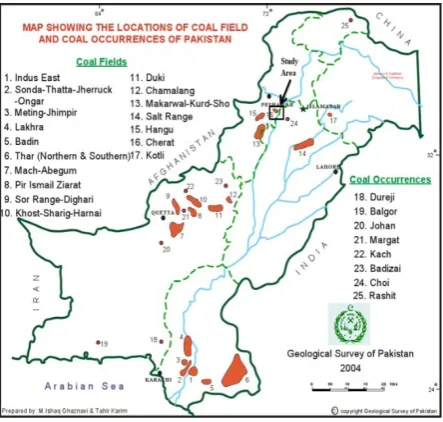
The study area Cherat is a hill station situated in the District Nowshera of Khyber-Pakhtunkhwa in Pakistan located 34 miles south east to the city of Peshawar (Fig. 1). There are six coal areas identified in Cherat coal field, these are Shahkot-1, Shahkot-2, Jaba khusk, Jaba thar, Bakhtai and Dag Ismael khel. The data required for this study is only taken from Shahkot-1, Shahkot-2 and Bakhtai coal mines located in district Nowshera, situated in 33°51'44.39"N latitude and 71°53'26.07"E longitude. The geology of the study area contains inter bedded slaty shale, dark gray limestone and quartzite of Devonian and Silurian age (Hussain, Khan et al. 1990, Turab¹, Riaz¹ et al. 2011). The total numbers of mines in these three leases are thirty-five, which are in production or development stages. In 2016 Inspectorate of Mines and Minerals department started a model mine in Shahkot-1. The thickness of coal seams varies from 0.19 to 1.7 m, volatile matter 4.5 to 21%, moisture content 1 to 5%, ash 21.7 to 45 % and sulfur 1 to 5 %. The coal has calorific value of 6400 to 9000 BTU/lb. and classified as Sub-Bituminous coal (Hussain, Khan et al. 1990).
Fig. 1 Location Map showing sample point of Cherat coal field (GSP).
Materials and Methods
This study was conducted on Cherat coal mines to evaluate the social and environmental impacts of coal mining in Pakistan. Initially data about acid mine drainage, metal deposition, diseases among coal
miners and coal miner’s health problems were collected from literature. Furthermore, workers interviews about health condition and diseases were carried out to recheck the data collected from the literature. Multi gas detector was used to collect data of mine gases from various mines of different area. Mine accidents record related to Cherat coal mines were collected from Inspectorate of Mine and Minerals KPK and field notes.
We have identified the main factors responsible for accidents from 1994 to 2015 using data analysis tool.
Results and Discussion
Metals deposition
Coal comprised of toxic metals which become mobile due to mining activity and leads to surface and ground water contamination. From six mines of Cherat about twenty one representative coal samples were randomly collected and analyzed for metals such as cobalt (Co), arsenic (As), chromium (Cr), cadmium (Cd), iron (Fe), copper (Cu), lead (Pb), nickel (Ni) and zinc (Zn) using atomic absorption spectrophotometer (AAS).The concentration ranges of various elements found in Cherat coal mines from experiments are given in Table (Hussain, Khan et al. 1990). Comparing the concentration of various traces metals, some consequences are observed; that in Shahkot-1 cadmium, cobalt, copper, nickel and zinc are in high concentration while in Bakhtai arsenic, lead and chromium is in high concentration.
Table 1 Trace Metals in Cherat coal mines
Metals (mg/kg) Shahkot-1 Shahkot-2 Bakhtai Arsenic (As) 2.24-3.99 2.85-6.15 1.65-12.77
Cadmium (Cd) 1.1-5.2 0.9-1.45 0.20-4.3
Cobalt (Co) 8.9-59.1 3.25-6.5 1.8-24.1
Chromium (Cr) 24.4-11.31 26.65-63.65 19.5-68.3
Copper (CU) 4-74.5 2.1-16.6 1.3-28.85
Iron (Fe) 1115-3522 1140-3125 295-3325
Nickel (Ni) 6.5-53.4 6.5-17.45 5.35-20.75
Lead (Pb) 59.7-117.7 33.75-105.95 48.85-119.85
Zinc (Zn) 5.7-139.25 2.8-12.65 2.8-12.65
Acid Mine Drainage
Table 2 Comparison of water quality of Cherat with WHO*.
Metals Cherat coal (mg/l) WHO (mg/l)
Arsenic (As) 0.012 0.01
Cadmium (Cd) 0.221 0.03
Cobalt (Co) 0.217 Not known
Chromium (Cr) 0.236 0.05
Copper (CU) 0.559 2
Nickel (Ni) 0.472 0.07
Lead (Pb) 0.145 0.01
Zinc (Zn) 24.21 3
WHO*: World Health Organization
In Cherat coal mines due to AMD, surface and ground water both are polluted. The concentration of heavy metals in drinking water of Cherat (Table 2) and compared with limit given by World Health Organization (WHO) (Shah, Khan et al. 2016). The amount of sulfur found in Cherat coal is 5.16%, which is also responsible for water pollution (Ali 2011).
Coal Miner’s Diseases
In coal mines pneumoconiosis is the most dangerous occupational diseases found in underground coal mines workers. It was found that the leading cause of this disease is airborne coal dust containing high concentration of free silica (McCunney, Morfeld et al. 2009).The other two diseases such silicosis and tuberculosis found among the coal mines workers are the types of pneumoconiosis (Morgan 1978). To check the diseases among coal mines workers of Cherat coal field pulmonary function tests (PFTs) and chest X-rays of 200 workers were conducted to estimate the prevalence of mine diseases. From the results it is found that the prevalence of pneumoconiosis was high among the mine workers (49.50%). The diseases found among the coal mines workers of Cherat are given in Figure 2(Ishtiaq, Nawaz et al. 2014).
Fig. 2 Graph showing diseases among coal miners of Cherat coal field (n = 200) (Ishtiaq, Nawaz et al. 2014).
Coal Miner’s Health Problems
Coal mining is considered one of the most dangerous occupations all over the world, because it poses various health problems to mine workers due to heavy physical work, coal dusts, mine gases and severity of the work conditions. This section includes studying the frequency of occupational health problems related to coal mines workers of Cherat coal mines. The
cross-sectional study of Cherat coal mines among 200 miners was conducted and data were collected using physical examination, investigation and questionnaires. The various health problems found among the mine workers are given in Figure 3. From the results it found that the frequency of health problems among the workers in Cherat coal mines is in high range (Ishtiaq, Hussain et al. 2014).
Fig. 3 Health problems Cherat coal mines workers (Ishtiaq, Hussain et al. 2014).
Mine Accidents
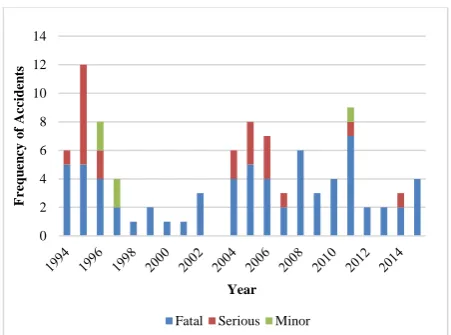
Analysis of accidents at Cherat coal mines Khyber Pakhtunkhwa was carried out to study minor, serious and fatal accidents from underground coal mining. Roof fall, noxious gases, electric current and oxygen deficiency are the major causes of accidents found in the study area. Frequency of accidents from 1994 to 2015 at Cherat coal mines are given in Figure 4. Mine workers involves in fatal accidents are mostly general workers, driller and coal cutters. From the study it is observed that 85% causes of accidents are due to unsafe condition and 15% are due to unsafe act. This revealed that in Cherat coal mines working condition is not safe for mine workers life. It is estimated that up to 100% of compensation cases are not reported as fatality occurs due to mining diseases. Compensation of Rs. 300,000 is given to worker’s family in case of mine accident, which is very stumpy.
Fig. 4 Frequency of accidents from 1994 to 2015 at Cherat coal mines.
0 20 40 60 80 100 120 140 160 180 200
Nl PN BR Nl HIL MNOB
F
req
u
en
cy
0 20 40 60 80 100 120 140 160
MS RS GIT FS/N Eye T&N Ear CNS CVS MH US
Fr
eque
nc
y
Health problems
0 2 4 6 8 10 12 14
F
req
u
en
cy
o
f A
cci
d
en
ts
Year
Mine Gases
According to international standard the allowable working hours are 8 a day and 40 a week, while permissible limit of coal dust exposure is 2 mg/m3, but
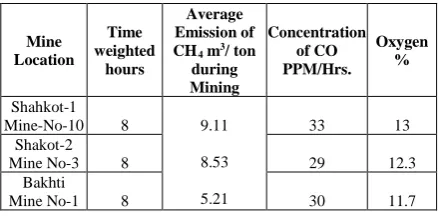
in Cherat Coal mines the dust exposure is twice as per international standard. The presence of mine gases such carbon monoxide, methane and sulfur dioxide was detected using multi gas detector in selected mines (Table 3). The results shows that the gases limit are greater an amount then the standard given by Mine Safety Health Administration (MSHA).
Table 3 Emission of CH4, CO and O2 at Cherat Coal mines.
Mine Location
Time weighted
hours
Average Emission of CH4 m3/ ton
during Mining
Concentration of CO PPM/Hrs.
Oxygen %
Shahkot-1
Mine-No-10 8 9.11
8.53
5.21
33 13
Shakot-2
Mine No-3 8 29 12.3
Bakhti
Mine No-1 8 30 11.7
The percentage of oxygen is comparatively low in the area where coal seam is exposed, unventilated area, the decay of burning timber, the burning of open light, breathing of men also reduce oxygen concentration. The mine workers are allowed to work in the area where oxygen content of the area is 18% or above. In Cherat coal mine oxygen deficiency is mainly due improper ventilation system. Carbon monoxide (CO) leads to headache at 20–30% and dizziness, nausea, muscular weakness and danger of collapse occurs at 30 to 50%.
Mine Waste and Subsidence
At study area coal mining wastes with high concentration have been piled on over 75 dumps. The serious problem associated with surface coal disposal is generation of acidity and oxidation of pyrite. The concentration ranges of various elements found in Cherat coal mines from experiments are given in Table 1. From coal wastes dumps these metals drain off with water streams produce contamination of ground-surface water, soils and affect the quality of ecosystem at Cherat area. In Shahkot-1 area about 0.40 km2 has
been subsides due loose strata, excess of water and numbers of mining activity. Although subsidence did not affect any human life but there is loss of mine machinery and coal.
Conclusion
Mine water quality of the study area is found acidic, contains high concentration of sulfate and heavy metals such as arsenic (As), Cadmium (Cd), Cobalt (Co), Chromium (Cr), Copper (CU), Iron (Fe), Nickel (Ni), Lead (Pb) and Zinc (Zn). The PH value of these mines water is relatively very low and responsible for
polluting both the surface and ground water of surrounding. From the result of PFTs and Chest X-rays found that the frequency of various occupational diseases and health problems is high among the mine workers. The major responsible factors found for these diseases and health problems are heavy trace metals, mine gases, coal dust, low PH drinking water and heavy physical work. From the study, it is observed that 85% causes of accidents are due to unsafe condition and 15% are due to unsafe act, which clearly indicate that Cherat coal mining working conditions are not safe for mine workers life. The results show that the gases limits are greater in amount than the standard given by Mine Safety Health Administration (MSHA). In Shahkot-1 area about 0.40 km2 has been
subsides due loose strata, excess of water and numbers of mining activity. Hence this research work revealed that coal mining will not only help in providing energy requirements and employment, but it is also responsible for various social and environmental problems.
References
Ali, K. (2011). Raw mix designing for coal as a fuel in cement kiln as a major fuel and its impact on clinker parameters. Journal of the Chemical Society of Pakistan, 33 (2), 147-151.
Gupta, D. (1999). Environmental aspects of selected trace elements associated with coal and natural waters of Pench Valley coalfield of India and their impact on human health. International Journal of Coal Geology,
40 (2-3), 133-149.
Howladar, M. F. (2016). Environmental impacts of subsidence around the Barapukuria Coal Mining area in Bangladesh. Energy, Ecology and Environment, 1
(6), 370-385.
Hussain, A., Khan, S. Saeed, G. (1990). A new look at the coal occurrence in Cherat area. Proc. First SEGMITE Indust. Min. Peshawar: 34-37.
Ishtiaq, M., Hussain, H., Gul, S., Jehan, N., Ahmad, I., Masud, K., Rehman, Z. U., Nawaz, R., Khan, S. A., Sarwar, G. (2014). Frequency of occupational health problems among coal miners. Gomal Journal of Medical Sciences, 12 (2).
Ishtiaq, M., R. Nawaz, K. U. Khan, H. U. Khan, S. Zakir, G. Sarwar, N. Jehan (2014). Prevalance of pneumoconiosis among coal miners of Cherat, district Nowshera-Pakistan. Journal of Postgraduate Medical Institute (Peshawar-Pakistan), 28 (2), 139 - 144.
Küçük, F. Ç. U., Ilgaz, A. (2015). Causes of coal mine accidents in the world and Turkey. Turkish Thoracic Journal, 16 (Suppl 1), S9 - S14.
Kumari, S., Udayabhanu, G., Prasad, B. (2010). Studies on environmental impact of acid mine drainage generation and its treatment: an appraisal. Indian Journal of Environmental Protection 30 (11), 953-967.
Malkani, M. S. (2012). A review of coal and water resources of Pakistan. Journal of Science, Technology and Development, 31 (3), 202-218.
McCunney, R. J., P. Morfeld and S. Payne (2009).What component of coal causes coal workers’ pneumoconiosis. Journal of occupational and environmental medicine 51 (4), 462-471.
Morgan, W. (1978). Industrial bronchitis. Occupational and Environmental Medicine, 35 (4), 285-291.
Shah, I., Khan, T., Hanif, M., Shah, A., Siddiqui S., Khattak, S. A. (2016). Environmental aspects of selected heavy and trace elements of Cherat Coal deposits. Journal of Himalayan Earth Science, 49 (1), 77 - 85.
Spitz, K., Trudinger, J. (2019). Mining and the environment: from ore to metal. London, UK, CRC Press: 797.
Thwin, O., Htun, W. W., Wai, K. M. (2019). Environmental and Social Impacts of Mining in the Mogok Area, Pyin Oo Lwin District, Mandalay Region, Myanmar. Population, Development, and the Environment, Springer, 155-169.
Turab, S. A., Riaz, M., Abbas Z., Ali, F. (2011). A study of deformation phases in slates of Manki Formation, Eastern Attock-Cherat Range, Pakistan. Journal of Himalayan Earth Sciences, 44 (2), 81-90.