Research Article
Control of different weeds through
various weed control methods for
improving growth and yield of hybrid
maize Pioneer-1543
Tofique Ahmed Bhutto
1, Safdar Ali Wahoocho
2, Mahmooda Buriro
1,
Abdul Qadir Gola
2*, Niaz Ahmed Wahoocho
2, Muhammad Ali
Ansari
1, Islamuddin Majeedano
5, Muhammad Nawaz Kandhro
1,
Muzamil Hussain Soomro
4, Sanam Kumbhar
1, Nadeem Ahmed
Buledi
1and Khuda Bux Bhutto
31. Department of Agronomy, Sindh Agriculture University Tandojam-70060-Pakistan 2. Department of Horticulture, Sindh Agriculture University Tandojam-70060-Pakistan 3. Department of Soil Science, Sindh Agriculture University Tandojam-70060-Pakistan 4. Department of Plant Protection, Sindh Agriculture University Tandojam-70060-Pakistan 5. Agronomy Section, Agriculture Research institute Tandojam-Pakistan
*Corresponding author’s email: [email protected] Citation
Tofique Ahmed Bhutto, Safdar Ali Wahoocho, Mahmooda Buriro, Abdul Qadir Gola, Niaz Ahmed Wahoocho, Muhammad Ali Ansari, Islamuddin Majeedano, Muhammad Nawaz Kandhro, Muzamil Hussain Soomro, Sanam Kumbhar, Nadeem Ahmed Buledi and Khuda Bux Bhutto. Control of different weeds through various weed control methods for improving growth and yield of hybrid maize Pioneer-1543. Pure and Applied Biology. Vol. 8, Issue 1, pp718-726. http://dx.doi.org/10.19045/bspab.2019.80013
Received: 21/11/2018 Revised: 11/01/2019 Accepted: 14/01/2019 Online First: 24/01/2019
Abstract
This study was conducted, the effects of various weed control methods to suppress the growth and development of weeds for enhancing growth and yield of maize, at the experimental area of Agronomy section, Agriculture Research Institute, Tandojam, during winter season 2011-12. The experiment was comprised of five treatments viz; T1= Weedy check, T2= Hand hoeing, T3= Mechanical, T4= Cultural
and T5= Chemical weed control in randomized complete block design (RCBD) with four replications.
Different weed species were found in the experimental field viz; 1Chenopodium album L, 2Rumex dentatus L., 3Phalaris minor, 4Anagallis arvensis, 5Convolvulus arvensis, 6Chenopodium morale L,
7
Cynodon dactylon, 8Cyperus rotundus. Results indicated that the Leaves plant-1, Cobs plant-1, Plant
height (cm) and Grain yield kg ha-1 of maize were significant (p<0.05) and days to tasseling and silking
were non-significant (p>0.05) in all treatments except weedy check. Hand hoeing weed control method effectively reduced weeds as compared to other weed control methods. On the other hand, when weeds frequency increased significantly decreased parameters of maize. It was concluded that the hand hoeing weed control method was found suitable and effective to suppress weeds and improved grain yield of hybrid maize crop as compare to other weed control methods.
Keywords:Grain yield kg ha-1; Hybrid corn (Zea mays L); Weeds; Weed control methods
Introduction
Maize (Zea mays L.) is the third ranked an essential cereal crop after wheat and rice of Pakistan and getting valuable position in agriculture sector because it has possessed
etc. Maize contributes 2.7 percent to the value added in agriculture and 0.5 percent to GDP. The under area during (2016-17) 1334 (000) hectares cultivated, production 6.130 million tonnes and 3458 kg ha-1 average yield of maize in Pakistan (Pakistan Economic Survey, 2016-17). The grain yield kg ha-1 of maize is very low of Pakistan as compared to other corn growing countries such as, Italy, USA, Canada, Argentina and China (9530, 8600, 6630, 5650, 4570 kg ha-1 reported by [1]. The available favorable condition for high yielding cultivars of maize, still that average yield is very of Pakistan. The highly reduction of 66–80% in crop yields due to more growth of weeds density. Among the considering factors, main responsible factor for low yield as weed competition which competes with plants for available growth resources. Weeds are fighting with the crop plants for space, light, dampness, supplements and carbon dioxide, which decreased not just the yield, grain quality and prevent harvest activities yet additionally increment the cost of production. Different weed control practices have resulted about around 77-96% higher yield [2, 3]. Today, integrated weed management (IWM) program is a mean combined (hand hoeing, Mechanical, cultural and chemical control) techniques and under attention, after environmental and health damages of herbicides were revealed to the public and weeds become resistant to herbicides. Researchers are working on alternative methods to replace them instead of the chemical method and reduce the need for herbicide application
[4, 5]. Herbicide dose can be decreased by 15-30% without significant reduction in yield reported by [6, 8]. While the authentic mechanical and cultural methods they are parts of IWM and can be used integrated farming practice [9, 10]. Among the integrated weed management practices the hoeing with the hand is a best historical weed control method in agriculture before activation of technology and it has been continually used in crop production for
maximum crop yield [11]. This practice is effective for all crops, sometime when crops and weeds, both become mature in the standing crop due to less attention of farmers then they cannot be controlled completely using chemicals and famous weedicides products provides failure results
and it is recommended for getting maximum yields and Hand hoeing practice was done at pre-emergence weeds in the crop [21].
The present study was targeted, the effect of different weed control methods to suppress the growth and development of weeds for improving growth and yield of hybrid maize.
Materials and methods
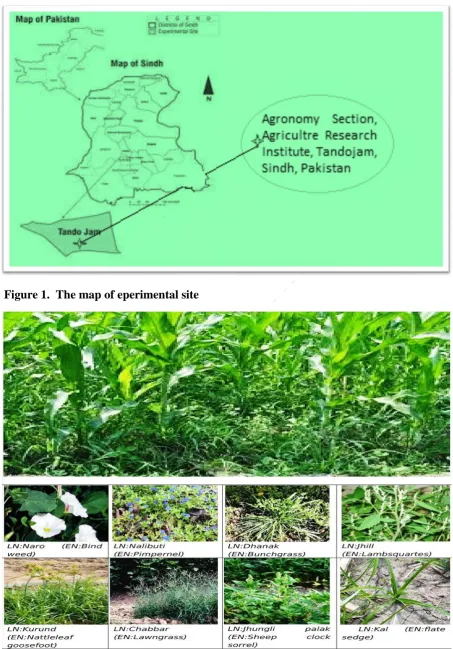
This study was performed at Agronomy section, Agriculture Research Institute, Tandojam, Sindh, Pakistan (Figure 1) “the effect of different weed control methods to suppress growth and development of weeds for improving growth and yield of hybrid maize”. The experiment was comprised of five weed control methods viz; T1= Weedy check, T2= Hand hoeing, T3= mechanical, T4= Cultural and T5= Chemical control (Mark @ 1000 ml ha-1) with randomized complete block design having net plot size 3 x 5m with three replications. Maize (Pioneer-1543) was sown on during in Winter Season 2011-12 year. The recommended seed rate of maize 25 kg ha-1 (two seeds per hill) with the row to row 75 cm and plant to plant distance of 20 cm was applied. Land preparation was done properly at recommended depth plough for better root penetration and equal distribution of irrigation and fertilizers. Initially disc plough was used to break the hardpan, followed by leveling and planking. After soaking dose, when the land came in proper moisture condition, the seedbed was prepared by using disc harrow, followed by motivator. Entire phosphates (DAP) and potassium (MOP) and 1/4 of Nitrogen (Urea) fertilizers were applied at the time of sowing and remaining 1/4 reach at knee height stage, 1/4 at pollination stage and remaining 1/4 was applied at grain filling stage.
Observations were recorded
The observations on Weeds frequency m-2 15,30,45 DAS, leaves plant-1, days to tasseling and silking (50%), cobs plant-1,
plant height (cm), grain yield kg ha-1 were recorded. The different weed flora species were found in the experimental field and noted their Local, English and Technical names as shown in (Table 1) as well as their images are displayed in (Figure 2). Weeds frequency m-2 was counted at 15, 30 and 45 days after sowing by using the wooden frame in all plots. The leaves plant-1 were counted of five randomly selected plants from each treatment. Days to tasseling and silking (50%) was recorded by counting the number of days from sowing to 50% of a plant developed tassels and silking. Cobs plan-1 were obtained at the time of maturity of maize from selected plants. Plant height (cm) was recorded at physiological maturity of the maize crop in five randomly selected plants, using measuring tape from ground to tip of the tassel. The grain yield kg ha-1 received from each plot then weighed based on grain yield kg ha-1 per plot according to formula:
Grain yield (kg ha-1) = Yield plot-1 of given treatment (kg)/Plot area (m-2) x 10000.
Statistical analysis
The data statistical analysis was analyzed the variances in treatment means. L.S.D (Least significant difference) test was applied for the statistical differences within treatments, following the method developed by [22].
Results and discussion
(p<0.05) except days to tasseling and silking (50%) as indicated in (Table 2).
1st weeds frequency 15 DAS
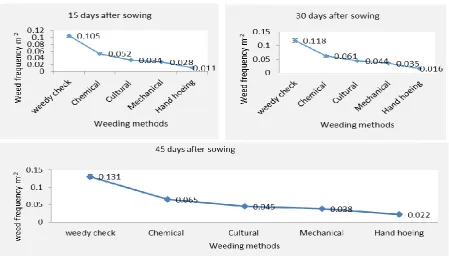
The data of weeds frequency of 15 days after sowing revealed that the minimum reduction of weeds frequency (11.0 m-2) was recorded in hand hoeing, followed by (28.0, 34.0 and 52.0 m-2) observed in mechanical, cultural and chemical weed control method respectively. However, maximum weeds frequency (105.0 m-2) was observed in weedy check plot presented in (Figure 3).
2nd weeds frequency 30 DAS
The results of weeds frequency of 30 days after sowing was difference. The lowest weeds frequency (16.0 m-2) was noticed in hand hoeing, followed by (35.0, 44.0 and 61.0 m-2) recorded in mechanical, cultural and chemical control methods respectively
[24]. While, highest weeds frequency (118.0 m-2) obtained from weedy check plot as shown in (Figure 3).
3rd weeds frequency 45 DAS
According to the data of 45 days after sowing, the lower weeds frequency (13.7 m-2) was recorded in hand hoeing and higher (118.0 m-2) was observed in the weedy check plot, Moreover, the weeds frequency (33.0, 41.0 and 59.0 m-2) were noted in mechanical, cultural and chemical weed control methods respectively as displayed in (Figure 3). In this regard, the chemical weed control was not effective as compared to hand hoeing, mechanical and cultural weed control methods. This result indicated that the hand hoeing weed control was more effective to reduced weeds as compared to other weed control methods. These results are agreed with [25], who observed that the significantly variations in weeds frequency of various weeding methods and had negatively affected the weed growth. According to this the hoeing with hand produced maximum grain yield and appropriately eradicates the weeds reported [26].
Leaves plant-1
The results of leaves plant-1 in maize was significantly affected by different weed
control methods are given in (Table 3). The results showed that maximum leaves plant -1 (14.0 and 12.3) obtained in hand hoeing
and mechanical weed control methods respectively, followed by (9.0 and 7.0) leaves plant-1 observed in cultural and chemical weed control method respectively. However, more reduction in leaves plant-1 (4.5) noted in weedy check plot. This might be attributed to severe competition of high weed densities for resources viz; sunlight, moisture and nutrients thereby making maize plants weaker. These results are in accordance with findings of reported by [27], higher leaves plant-1 due to lesser weed competition during early and critical stages of crop leads to better resource use efficiency. Increasing LAI due to an increased competition and increased leaves plant-1 of maize crop.
with [28], who observed that the better weed control method could be effectively control of weeds in early growth stages of the maize crop, therefore, that crop plants will be provided better environment to utilize by crop for growth and development. The higher days of tasseling and silking could be long-term duration and take more days to physiological maturity.
Cobs plant-1
Cobs plant-1 of maize are a main of major yield component and with linear affected on grain yield of maize. The data of cobs plant -1 was significantly influenced by different
weed control methods as given in (Table 3). The higher cobs plant-1 (1.8) was recorded in hand hoeing weed control method, followed by (1.3, 1.2 and 1.1) were obtained from mechanical, cultural and chemical control methods. However, the lower cobs plant-1 (1.0) recorded in the weedy check. These results of our study are agreed with [29],observed that the numbers of cobs plant-1 were significantly affected by various weed control methods.
Plant height (cm)
Tallness in maize plant is mostly associated with the better growth and development of maize plant that could be due to effective weeds control method. Plant height has been reported to be positively correlated with the productivity of plants reported by
[30]. The results showed that the tallest plant height (179.0 cm) was noted in hand hoeing weed control method and shortest
(79.0 cm) recorded in weedy check plot. However, different plant heights (155,115 and 103 cm) were observed mechanical, cultural and chemical weed control methods respectively which demonstrated in (Table 3). Although, this study revealed that chemical weed control method had not effectively to reduce weeds for production of taller plant. These results are confirmed to findings of the higher plants were observed due to effective weed control method. Whereas, shorter plants were found when weed control method was delayed reported by [31].
Grain yield (kg ha-1)
The grain yield of maize is the ultimate objective of all research such as cobs plant -1 and number grain cob-1. The data revealed
that the different weed control methods significantly affect on grain yield of maize crop as mentioned in (Table 3). The highest grain yield of maize (6400.0 kg ha-1) was recorded in hand hoeing weed control method, followed by (6032.0, 5900.0 and 5700.0 kg ha-1) observed in mechanical, cultural and chemical weed control methods respectively. Moreover, lowest grain yield (5520.0 kg ha-1) was obtained by weedy check plot. These results occurrence with those of other researchers [32], suggested that the nonchemical weed control practice resulted in higher grain yield than that of chemically weed control method.
Table 1. Different weeds flora in the experimental field of maize.
Local Name English Name Botanical Name Life of Span
Naro Bind weed Convolvulus arvensis Biennials
Nalibuti Pimpernel Anagallis arvensis Annual
Danak Bunch grass Phalaris minor Annual
Jhunli palak Sheep clock sorrel Rumex dentatus L. Biennial
Jhill Lambs quartes Chenopodium album L. Annual
Kurund Nattleleaf goosefoot Chenopodium morale L. Biennial
Chabbar Lawn grass Cynodon dactylon Perennials
Figure 1. The map of eperimental site
Figure 3. Effect of different weed control methods on weeds frequency m-2 of 15, 30 and
45 days after sowing
Table 2. Mean square ANOVA of weed frequency m-2 15,30,45 DAS, leaves plant-1, days
to tasseling and silking (50%), cobs plant-1, plant height (cm) and grain yield kg ha-1 Sources
of variation
DF WF/15
DAS
WF/30 DAS
WF/ 45
DAS LP
DT 50%
DS
50% CP
PH (cm)
GY (kg ha
-1)
Rep 3 145.43 132.05 170.32 0.5107 104.721 4.0267 0.08390 119.05 61811
Weeding 4 5156.20NS 6142.05NS 7254.25 59.1367 14.859 38.8593 0.39550 6418.66 451405
Error 12 93.74 180.72 157.15 4.0078 13.071 5.7446 0.04056 60.87 132335
Total 19 --- --- --- --- --- --- --- --- ---
Whereas. Df= degree of freedom, WF= weed frequency, LP= leaves plant-1, DT= days to tasseling, DS= days to
silking, CP= cobs plant-1, PL= plant height (cm), GY=grain yield kg ha-1
Table 3. Effects of different weed control methods on leaves plant-1, days to tasseling and
silking (50%), cobs plant-1, plant height (cm) and grain yield kg ha-1 of maize
Weed control methods
Leaves plant-1
Days to tasseling
(50%)
Days to silking (50%)
Cobs plant-1
Plant height (cm)
Grain yield kg ha-1
Weedy check 4.5 c 70.0 a 76.0 a 1.0 c 79.9 d 5520.0 b
Chemical 7.0 bc 66.0 a 72.0 ab 1.1 bc 103.1 c 5700.0 b
Cultural 9.0 b 66.0 a 71.0 bc 1.2 bc 115.0 c 5900.0 ab
Mechanical 12.3 a 66.0 a 69.0 c 1.3 b 155.0 b 6032.0 ab
Hand hoeing 14.0 a 65.0 a 68.0 c 1.8 a 179.0 a 6400.0 a
LSD 0.05 3.0843 NS(5.5701) NS(3.6926) 0.3103 12.020 5604.6 b
SE:± 1.4156 2.5565 1.6948 5.5168 0.1424 257.23
Conclusion
It was concluded that the hand hoeing weed control method was found suitable and effective to suppress weeds and improved grain yield of hybrid maize crop as compared to other weed control methods, because this method effectively controls weeds at the early growth stage and when weeds become mature in standing crop of maize.
Authors’ contributions
Conceived and designed the experiments: TA Bhutto AQ Gola & M Soomro. Performed the experiments: TA Bhutto, SA Wahocho, MN Kandhro, AQ Gola & NA Wahocho. Analyzed the data: NA Wahocho, M Soomro, I Majedano & M Buriro. Contributed reagents/ materials/ analysis tools: S Kumbhar, N Buladi, KB Bhutto, AQ Gola & MA Ansari. Wrote the paper: TA Bhutto.
References
1. Anonymous, World Agriculture Production in Dec (2001). Production estimates and crop assessment Div, FAS, USDA (2005).
2. Rutta A, Vanderlip RL, Higgins RA, Moshier IJ & Feyerherym AM (1991). Suitability of corn growth models for incorporation of weed and in set stress.
Agron J 13(83): 757-763.
3. Khan MA & Haq NU (2004). Effect of pre-emergence herbicides on weed control in maize grain yield. Sarhad J Agric 9(5): 415- 421.
4. Devlin DL, Long JH & Maddux LD (1991). Using reduced rates of post emergence herbicides in soybean.
Weed Technol 4(5): 834-840.
5. Blackshaw RE, Donovan JT, Harker KN, Clayton GW & Stougaard RN (2006a). Reduced herbicide doses in field crops. A review. Weed Biol Manage 6(1): 10-17.
6. Ahmed SAS, Din RN & Metwally IM (2001). Weed management practices for cereals. Annals Agric Sci Mosh
2(39): 805-823.
7. Kirkland KJ, Holm FA & Stevenson FC (2000). Appropriate crop seeding
rate when herbicide rate is reduced.
Weed Technol 1(14): 692-698.
8. Lesnik M (2003). The impact of maize stands density on herbicide efficiency.
Plant Soil Environ 5(49): 29-35. 9. Barros JFC, Basch G & de-Carvalho M
(2007). Effect of reduced doses of a post-emergence herbicide to control grass and broad-leaved weeds in no-till wheat under Mediterranean conditions.
Crop Prot 1(26): 1538-1545.
10. Baumann D (1992). Mechanical weed control with spring tine harrows (weed harrows) in row crops. IXth International Symposium on the Biology of Weeds, Dijon France. 123-128.
11. Pleasant JM, Burt RF & Frisch JC (1994). Integrating mechanical and chemical weed management in corn (Zea mays L.). Weed Technol 5(8): 217–223.
12. Rakesh KS & Shirvastava UK (2002). Weed control in soybean (Glycine max). Indian J Agron 2(47): 269-272. 13. Blackshaw RE, Donovan JT, Harker
KN, Clayton GW & Stougaard RN (2006b). Reduced herbicide doses in field crops. A review. Weed Biol Manage 6(1): 10-17.
14. Gruber S, Pekrun C, Mohring J & Claupein W (2012). Long-term yield and weed response to conservation and stubble tillage in SW Germany. Soil Tillage Res 3(121): 49-56.
15. Hossein B, Mahmoud G, Amin AM, Afshin S & Saman A (2014). Investigate the effect tillage methods and chemical weed control on the yield of forage corn. Int J Agric Crop Sci
7(14): 1385-1391
16. Tollenaar M, Dibo AA, Aguilera A, Weise SF & Swanton CJ (1994). Effect of crop density of weed interference in maize. Agron J 10(86): 591-595. 17. Mishra JS (1997). Critical period of
18. Pannel DJ (2004). The human dimensions of integrated weed management. Sustainability and Economics in Agriculture. (SEA) SEA Working Paper 02/04.
19. Khan MA, Marwat KB, Hassan G & Khan N (2002). Impact of weed management on maize (Zea mays L.) planted at night. Pak J Weed Sci Res
2(8): 57-62.
20. Khan MA & Haq NU (2004a). Effect of pre-emergence herbicides on weed control in maize grain yield. Sarhad J Agric 9(5):415- 421.
21. Khoso AW (1977). BOOK, Crops of sindh, fifth adition. Bhitai Computer Composers, Hyderabad, Sindh, Pakistan.
22. Galal AH (2003). Effect of weed control treatments and hill-spacing on soybean and associated weeds. Assiut J Agric Sci 4(34):15-32.
23. Vander DA, Schans PO, Bleeker L, Molendijk M, Pletinger RYW, Vander LAP, Lotz R, Bauermeister R, Total & Bauman DT (2006). Practical weed control in arable farming and outdoor vegetable cultivation without chemicals. Appl Pl Res. Pp1-5. Wageningen University and Research Centre, Lelystad, Netherlands.
24. Gardiol JM, Serio LA & Maggiora AID (2003). Modelling evapotranspiration of corn (Zea mays
L.) under different plant densities. J Hydrol 11(271): 188-196.
25. Carruthers K, Fe Q, Cloutier D & Smith DL (1998). Intercropping corn with soybean, lupin and forages weed control by intercrops combined with interrow cultivation. Eur J Agron 8(2): 225-238.
26. Pandey AK, Prakash V, Singh RD & Mani VP (2000). Effect of herbicide
mixtures and cultural practices on maize and associated weeds under mid-hills of N-W Himalayas. Annals Agric Res 3(2): 58-64.
27. Shahid R & Khan MH (2016). Growth and yield of maize (Zea mays L.) as influenced by integrated weed management under temperate conditions of North Western Himalayas. American J Exp Agric
14(1): 1-9.
28. Akhtar M, Aslam M & Malik HN 1998. Effect of various weed control methods on maize (Zea mays L.) growth and yield in heavily populated weed fields of Islamabad. Sarhad J Agric 14(4): 345-350.
29. Saeed IM, Abbasi K & Kazim M (2001). Response of maize to nitrogen and phosphorus fertilization under agronomic condition of Rawalokot Azad Jammu and Kashmir. Pak J Biol
7(4):3 949-952.
30. Umme EK, Kakar SD, Khan MA, Hussein Z & Khan A (2012). Response of maize and three perennial weeds to different combinations of macro-nutrients. Pak J Weed Sci Res 18(4): 433-443.
31. Stefanovic L, Milivojevic M, Husic I, Samic M & Hojka Z (2004a). Selectivity of the sulfonylurea herbicide group in the crop of commercial KL maize inbred lines. Institute-ze-Kukuruz, Herboglia, Serbis and Montenegro. 5(1): 53-63. (CAB Abstract).
32. Singh AP & Singh PC (2003). Effect of different weed control methods on growth and yield of rabi-sown hybrid maize cv. hybrid 4640. J Living World