VOL.6 ISSUE 5, 2018; 499 – 508 ; http://ijpda.com; ISSN: 2348-8948
Review Article
A Review on
Anticancer
Activity of
1, 3, 4-oxadiazole
Manpreet Kaur, Mandeep Kaur, Satvir Singh* Department of Pharmaceutical Chemistry,
A.S.B.S.J.S.M. College of Pharmacy,
Bela, 140111(Punjab), India
Date Received: 16th April 2018; Date accepted: 5th May 2018; Date Published: 6th May 2018
Abstract
In this review we are presenting the Anticancer activity of the 1, 3, 4 Oxadiazole. Designing new anti-cancer drugs with high efficiency and broad spectrum activity is a significant need of today. Drug resistance, generally caused because of long term cancer treatment is rapidly becoming a major worldwide problem. The design of new compounds to deal with the resistance problem has become one of the most important goals of anti-cancer research today. This review article describes the anticancer activity of 1, 3, 4 Oxa-diazole ring being reported on various cancer cell lines and will be useful in guiding the re-searchers across the world working on this moie-ty and consequently will be instrumental in the advancement of 1, 3, 4-oxadiazole chemistry.
Keywords: 1, 3, 4-oxadiazole, Anticancer, Drug resistance
INTRODUCTION
Cancer is not a single disease, but a large group of diseases characterized by uncontrolled, rapid and pathological proliferation of abnormally transformed cells. Despite recent advances in cancer therapy, cancer is still the second leading cause of death after cardiovascular disorders throughout the world. Resistance to chemothe-rapeutic agents remains a key challenge in the
fight against cancer. Another challenge for che-motherapy is lack of selectivity. Generally anti-cancer drugs destroy normal cells as well as can-cer cells and often cause serious adverse effects [1-2]. The design of new compounds to deal the resistance problem has become one of the most important goals of anti-cancer research today [3]. Oxadiazole is a versatile heterocyclic nucleus, which has attracted a wide attention of the me-dicinal chemists for development of new drugs. Oxadiazole is a five-membered heterocyclic, aromatic chemical compound having two car-bons, two nitrogens and one oxygen atom with two double bonds having general formula C2H2ON2. 1,3,4-oxadiazole rings have been in-troduced into drug discovery programs for sev-eral different purposes. For example, in some cases, they have been used as an essential part of the pharmacophore, favourably contributing to ligand binding, and in other cases, oxadiazole moieties have been shown to act as a flat, aro-matic linker to place substituents in the appro-priate orientation, as well as modulating molecu-lar properties by positioning them in the peri-phery of the molecule [4]. 1,3,4-oxadiazole is more widely studied by researchers because of their many important chemical biological activi-ties such as Anti-inflammatory [5], Analgesic [6], Antimicrobial [7], Anti-convulsant [8], An-ti-proliferative [9], mycobacterial [10], Anti-protozoal [11], Anti-diabetic [12], Anticancer [13], and pesticidal property [14].
Anticancer activity of 1,3,4-oxadiazole
which can serve as a useful template for the gen-eration of a related new class of molecules as potential anticancer drugs [15].
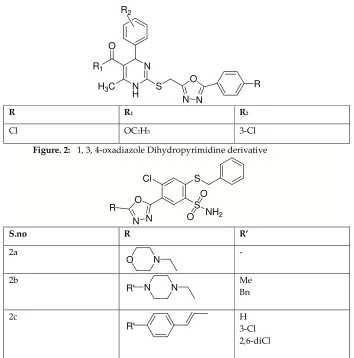
Fatma A.F. Ragab et al. (2017)reported a series of dihydropyrimidine (DHPM) derivatives bear-ing 1, 3, 4-oxadiazole moiety as monastrol analo-gues. The new compounds (Figure 2) were screened for their cytotoxic activity toward 60 cancer cell lines according to NCI (USA) proto-col. Seven compounds were further examined against the most sensitive cell lines, leukemia HL-60(TB) and MOLT-4. The most active com-pounds were1-(6 Methyl-4-Phenyl-2((5-Phenyl-1, 3, 4-oxadiazole-2-yl) methyl thio)-1,4-dihydropyrimidin-5-yl) ethanone against HL-60(TB) (IC50 = 56 nM. The pro-apoptotic activity of 2a was inferred by the significant increase in the percentage of annexin V-FITC-positive apop-totic cells. [16].
Jaroslaw Slawinski et al. (2017) prepared a se-ries of novel 2-benzylthio-4-chloro-5-(5-substituted 1,3,4-oxadiazol-2-yl)benzene sulfo-namides (Figure 3) as potential anticancer agents. MTT assay was carried out to determine the cytotoxic activity against three human cancer cell lines: colon cancer HCT-116, breast cancer MCF-7 and cervical cancer HeLa as well as to determine the influence on human keratinocyte cell line HaCaT [17].
Partha Pratim Roy et al. (2017) synthesized compounds (Figure 4) showed significant result in different parameters of EAC bearing mice and markedly increase the average life span of expe-rimental animals. From the present study, result indicate that the oxadiazole compounds can po-tentially be developed into useful anticancer agents [18].
Juan Sun et al. (2017) synthesized class of 1,3,4-oxadiazole-2(3H)-thione derivatives containing piperazine skeleton with improved potency to-ward FAK. All of the newly synthesized com-pounds were assayed for the anticancer activities against four cancer cells, HepG2, Hela, SW116 and BGC823. Compound (Figure 5) showed the most potent biological activities and its anti-FAK inhibitory activity was also the best. The results of FAK inhibitory assay, we could find that com-pound 4 exhibited the most potent FAK inhibito-ry activity with IC50 of 0.78 μM. In order to study the structure-activity relationships ob-served at the FAK, molecular docking of com-pound 5 into the binding site of FAK was
per-formed on the binding model based on the FAK structure. This study showed that compound was nicely bound into active site of FAK [19].
Wael A. Elsayedet al. (2017) synthesised of 4-(5- (5-(1-ethyl-1H-indol-3-yl)-1-phenyl-1H-pyrazol-3-yl)-1,3,4-oxadiazol-2-yl thio)butane-1,2-diol based (indolyl)pyrazolyl ring system, their de-rived thioglycosides and acyclic C-nucleoside analogus. The anticancer activity of the newly synthesized compounds was studied against colorectal carcinoma (HCT116), breast adenocar-cinoma (MCF7) and prostate cancer (PC3) hu-man tumor cell lines and a number of com-pounds (Figure 6) showed moderate to high ac-tivities. The anticancer and docking results indi-cated the importance of the attachment of sugar moieties to Oxadiazole ring system in a number of most active compounds, particularly, those incorporating a thioglycosyl moiety [20].
Naveen Polkamet al. (2017) synthesised a series of regioisomeric (2,5-dimethoxybenzoic acid, veratric acid) analogues were prepared by swapping the carboxylic motif to its oxadiazole bioisostere and have been screened for in vitro anticancer studies by using MTT (3-(4,5-dimethylthiazol-2-yl)-2,5-diphenyltetrazolium bromide) colorimetric assay. Among the screened compounds (Figure 7) (2-(2,5- dimethoxyphenyl)-5-(5-phenylthiophen-2-yl)-1,3,4-oxadiazole) demonstrated superior activity against MDA231 cells. All the compounds pre-sented varied degree of anticancer profiles. It might be due to the synergetic effect of lipophi-licity and aryl hydrophobic interactions. Com-parison among the two reported series 7a and 7b, veratric acid off shoots displayed higher anti-cancer activity against MDA453 cell lines [21].
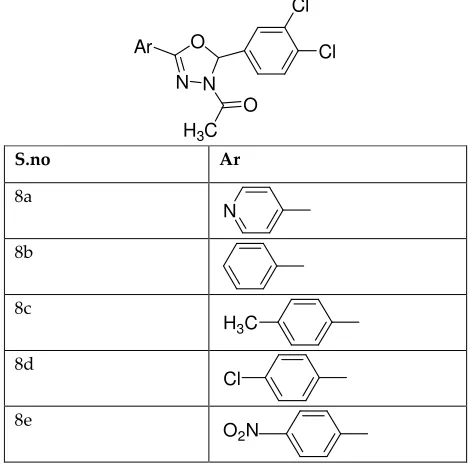
Francesco O. et al. (2016) synthesised a series of new compound 1-(2-3,4-dihydro phenyl)-5-aromatic-1,3,4-oxadiazole-3(2H)-yl) ethanone (Figure 8) potent and selective monoamine oxi-dase B (MAO-B) inhibitors, molecular interaction field analysis has been applied to a MAO-B complex with 3-acetyl-2, 5-diaryl-2,3-dihydro-1,3,4-oxadiazole chemical structure, known as a privileged scaffold for this target. Several com-pounds displayed potent in vitro activity, exhi-biting IC50 values in the medium to low nano molar range [22].
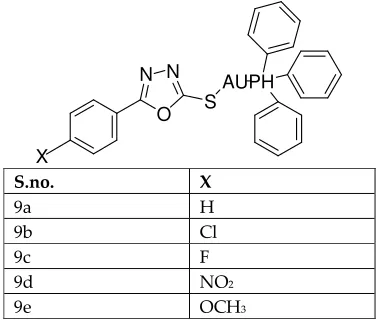
9) and evaluated their anticancer and antileish-manial activities. The compound (9b) was more active murine melanoma B16F10 and colon can-cer CT26.WT cell lines [23].
S. Kavitha et al. (2016) synthesized a series of new 2, 5-disubstitued 1,3,4 oxadiazole deriva-tives bearing urea, amide, sulphonamide and their anticancer activities were evaluated in vitro. The fifteen synthesized compounds showed moderate to good activity against anticancer ac-tivities. Among them, compound (Figure 10) was found to be effective anticancer agents. The cur-rent research is considered to synthesize 1,3,4 oxadiazole derivatives for their improves the biological activity [24].
Bereket Mochonaet al. (2016) synthesized 1,3,4-oxadiazole derivatives and their antiproliferative properties have been studied. The in vitro screening was performed against androgen de-pendent (LNCaP) and androgen indede-pendent (PC-3) prostate cancer cell lines. Most of the compounds showed promising activity. Among them, compounds (Figure 11) have shown signif-icant activities on PC-3 and LNCaP cell lines re-spectively but the study evidently identified the potency of compound 8d as potential anti-prostate cancer agent [25].
Vijaya Rao Pidugu et al. (2016) synthesized of a series of novel 2,5-disubstituted 1,3,4-oxadiazoles (Figure 12) as class I histone deace-tylase (HDAC) inhibitors. 2-amino-N-((5-phenyl-1,3,4-oxadiazol-2-yl)methyl)propanamide showed substantial HDAC8 inhibitory activity and better anticancer activity which is compara-ble to the positive control, a FDA approved drug, vorinostat (SAHA). The study warranted further investigations to develop HDAC8-selective inhi-bitory molecule as a drug for neoplastic diseases. Novel 1,3,4-oxadizole substituted with gly-cine/alanine showed HDAC8 inhibition [26].
S. Raju D et al. (2015) synthesised a new pound of 1,3,4-oxadiazoles derivative. The com-pound were also screened for their antioxidant and anticancer activity. Three compounds (Fig-ure 13) (13b, 13c, 13f) were found active against HepG2 cells and two compounds (13d, 13e) against Hep 2 cells. Thus promising molecules were identified for their anticancer activity [27].
D. Q Qi et al. (2015) synthesised a series of py-razole-based 1, 3, 4-oxadiazole derivatives (Fig-ure 14). The fluorescence properties of all the compounds were analysed in dimethyl sulfoxide
media and were evaluated for their n vitro inhi-bitory activity against commercial enzyme xan-thine oxidase (XO) by measuring the formation of uric acid from xanthine [28].
Rashid et al. (2015) synthesised a series of 3-((5- (3-(1Hbenzo[d]imidazol-2-yl)-3-oxopropyl)-1,3,4-oxadiazol-2-yl)methyl)-5-methyl pyrimi-dine 2,4(1H,3H)-dione (Figure 15) which exhi-bited significant antiproliferative activity with GI50 value of 0.09μM. The ability of oxadiazole derivatives to induce apoptosis of cancer cells. FDA has approved a number of drugs for the treatment of different types of cancer. The devel-opment of new anticancer agents due to increas-ing cases of drug resistance [29].
F. Zhang et al. (2014) synthesized a series of new (3,4-dihydroxybenzylidene)-2-(5-(pyridin-4-yl)-1,3,4-oxadiazol-2-ylthio) acetohydrazide (Figure 16) containing pyridine and acylhydrazone moieties as potential telomerase inhibitors. The compounds exhibited significant broad-spectrum anticancer activity against the four cancer cell lines (HEPG2, MCF7, SW1116 and BGC823) [30].
S. Valente et al. (2014) have reported 1,3,4-oxadiazole series of N-hydroxy-3-(4-((5-methyl-1,3,4-oxadiazol-2-yl)methyl)phenyl) acrylamide (Figure 17) as anticancer agents by inhibition of HDAC. Structural activity relationship revealed that the inhibitory potency of 1,3,4-oxadiazole derivative increase by addition of 1-naphthyl ring at the C-5 position of oxadiazole and inser-tion of one methylene unit between the aryl ring and the C-5 position of the oxadiazole [31].
Kai Zhang et al. (2014) synthesised a series of novel hybrid molecules containing 1,3,4-oxadiazole and 1,3,4-thiadiazole bearing Schiff’s bases and evaluated their anti-tumour activity against human hepatoma carcinoma cell line (SMMC-7721), breast cancer cell line (MCF-7), lung cancer cell line (A549) by CCK-8 assay. Compounds (Figure 18) (18a) displayed highly effective anti-tumor activities against MCF-7 cells, with IC50 value of 4.56μM. Compounds (18b) exhibited significant anti-proliferative ac-tivity against A549 cells, with IC50 value of 4.11 μΜ [32].
bio-logical assay revealed that majority of com-pounds displayed modest inhibitory activity against thymidine phosphorylase at low micro-molar concentrations (IC50). The most active compounds were (Figure19) 19a and 19b with IC50 values [33].
References
1. G Mathur, S Nain, PK Sharma, “Cancer: An Overview”. Acad. J. Cancer Res. 2015;8: 1 9336.
2. K Nepali, S Sharma, “Rational approaches, design strategies, structure activity relation-ship and mechanistic insights for anticancer hybrids”. Eur. J. Med. Chem. 2014;77: 422– 487.
3. www. World Health Organization. Com. 4. RR Somani, PY Shirodka, Der. Pharma.
Chemica. 2009;1(1): 130-140.
5. BS Orlek, FE Blaney, Comparison of azbi-cyclic esters and oxadiazole as ligands for the muscarinic receptors, P. J. Med. Chem. 1991; 34: 2726.
6. A Aziz-ur-Rehman, N Fatima, MA Abbas, KM Abbasi, M Khan, IA Ashraf, Synthesis, characterization and biological screening of 5-substituted-1,3,4-oxadiazole-2yl-N-(2-methoxy-5-chlorophenyl)-2-sulfanyl acetamide. Pak. J. Pharm. Sci. 2013;26: 345– 352.
7. SZ Aziz-ur-Rehman, N Siddiqui, MA Abbas, KM Abbasi, MKhan, SY Mahmood, Synthe-sis, antibacterial screening and hemolytic acitvity of S-substituted derivatives of 5-benzyl-1,3,4-oxadiazole-2-thiol. Int. J. Pharm. Sci. 2012;4: 676–680.
8. B Shivi, M Gupta, 1, 3, 4-oxadiazole as an-timicrobial agents, Journal of Chemistry and Pharmaceutical Research. 2011; 3(3): 137-147. 9. MO Ahmed, A Mahmud, T Hasan, T
Mah-moud, Synthesis, antibacterial, antifungal and genotoxic activity of bis-1,3,4-oxadiazole derivatives, Polish Journal of Pharmacology. 2002;54: 55-59.
10. C Rakesh, A Anshu, KP Manoj, CS Prabodh, M Sukumar, KR Thengungal, Synthesis of novel 1,3,4-oxadiazole derivatives as poten-tial antimicrobial agents, Act Poloniae Pharmaceutica-Drug Research. 2010;3(67): 247-253.
11. NN Farshori, MR Banday, A Ahmad, AU Khan, A Rauf, Synthesis, characterization, and in vitro antimicrobial activities of 5-
alkenyl/hydroxyalkenyl-2-phenylamine-1,3,4-oxadiazoles and thiadiazoles, Bioor-ganic & Medicinal Chemistry Letter. 2010;20: 1933-1938.
12. N Bhardwaj, P Saraf, SK Sharma, P Kumar, Synthesis, evaluation and characterization of 1,3,4oxadiazoles as antimicrobial agents, Eur. Journal of Chemistry. 2009;6(4): 1133-38. 13. HS Yathirajan, MN Anil, B Narayana, BK Sarojini, S Kumari, Synthesis and
antimicro-bial studies on new substituted
1,3,4-oxadiazole derivatives bearing 6-bromonaphthalene moiety. International Journal of Chemistry. 2010;2(1): 38-54. 14. O Parkash, M Kumar, C Sharma, KR Aneja,
Hypervalent iodine (III) mediated, synthesis of novel unsymmetrical 2,5-disubstituted 1,3,4-oxadiazoles as antibacterial and anti-fungal agents. European Journal of Medici-nal Chemistry. 2010;45(9): 4252-4257. 15. B Madhavilatha, D Bhattacharjee, G Sabitha,
BVS Reddy, JS Yadav, N Jain, BJM Reddye, Synthesis and in vitro anticancer activity of novel 1,3,4-oxadiazole linked 1,2,3-Triazole/Isoxazole hybrids, Journal of Hete-rocyclic Chemistry. 2018;1-8.
16. FAF Ragab, M Sahar, Design, synthesis and anticancer activity of new monastrol analo-gues bearing 1,3,4 oxadiazole moiety. 2017: 2-21.
17. J Slawinski, K Szafranski, A Pogorzelska, B Zolnowska, Novel 2-benzylthio-5-(1,3,4-oxadiazol-2-yl)benzenesulfonamides with anticancer activity, Synthesis, QSAR study, and metabolic stability, European Journal of Medicinal Chemistry. 2017;132: 236-248. 18. PP Roy, S Bajaj, TK Maity, Synthesis and
evaluation of anticancer activity of 1, 3, 4-oxadiazole derivatives against ehrlich ascites carcinoma bearing mice and their correlation with histopathology of liver, Indian Journal of Pharmaceutical Education and Research. 2017;51(2): 260-269.
19. J Sun, SZ Ren, XY Lu, JJ Li, FQ Shen, C Xu, HL Zhu, Discovery of a series of 1,3,4-oxadiazole-2(3H)-thione derivatives containg piperazine skeleton as potential FAK in-hibitors, Bioorganic & Medicinal Chemistry. 2017;1-24.
21. N Polkam, B Kummari, P Rayam, U Brahma, VGM Naidu, S Balasubramanian, JS Anired-dy, Synthesis of 2,5-Disubstituted-1,3,4-oxadiazole Derivatives and Their Evaluation as Anticancer and Antimycobacterial Agents, ChemistrySelect. 2017;2: 5492-5496. 22. O Francesco , D Simona, F Cristina, Drug
design, synthesis, in vitro and in silico eval-uation of selective mono amino oxidase B
inhibitors based on
3-acetyl-2- dichlorophenyl-5-aryl-2,3-dihydro-1,3,4-oxadiazole chemical scaffold, European Journal of Medicinal Chemistry. 2016;108: 542-552.
23. JDS Chaves, LG Tunes, CHdeJ Franco, TM Francisco, CC Correa, Novel gold(I) com-plexes with 5-phenyl-1,3,4-oxadiazole-2-thione and phosphine as potential anticancer and antileishmanial agents, European Jour-nal of MediciJour-nal Chemistry. 2016;1-28. 24. S Kavitha, K Kannan, S Gnanavel, Synthesis,
characterization and biological evaluation of novel 2, 5 substituted- 1, 3, 4 oxadiazole de-rivatives, Saudi Pharmaceutical Journal. 2016;1-26.
25. B Mochona, X Qi, S Euynni, D Sikazwi, N Mateeva, KF Soliman, Design and evalua-tion of novel oxadiazole derivatives as po-tential prostate cancer agents, Bioorganic & Medicinal Chemistry Letters.2016;1-5. 26. VR Pidugu, NS Yarla, SR Pedada, AM. Kalle,
Design and synthesis of novel HDAC8 inhi-bitory 2,5-disubstituted-1,3,4-oxadiazoles containing glycine and alanine hybrids with anticancer activity, Bioorganic & Medicinal Chemistry. 2016;24: 5611–5617.
27. S Raju D, TNV Ganesh Kumar, J Mathew, Jeyaprakash, Synthesis & biological evalua-tion of 1, 3, 4- oxadiazoles as anticancer
agents, Indo Global Journal of Pharmaceuti-cal Sciences. 2015;5(1): 1-5.
28. DQ Qi, CM Yu, JZ You, GH Yang, XJ Wang, YP Zhang. Synthesis, crystal structures, fluo-rescence and xanthine oxidase inhibitory ac-tivity of pyrazole-based 1, 3, 4-oxadiazole derivatives, Journal of Molecular Structure. 2015;8: 421.
29. M Rashid, A Husain, R Mishra, S Karim, S Khan, M Ahmad, N Al-wabel, et al. Design and synthesis of benzimidazoles containing substituted oxadiazole, thiadiazole and tri-azolo-thiadiazines as a source of new anti-cancer agents, Arabian Journal Chemistry. 2015.
30. F Zhang, XL Wang, J Shi, SF Wang, Y Yin, YS Yang, WM Zhang, HL Zhu, Synthesis, molecular modelling and biological evalua-tion of N-benzylidene-2-(5-(pyridin-4-yl)-1,3,4-oxadiazol-2-yl)thio) acetohydrazide de-rivatives as potential anticancer agents, Bio-organic & Medicinal Chemistry. 2014;22: 468–477.
31. S Valente, D Trisciuoglio, TD Luca, A Neb-bioso, D Labella, A Lenoci, C Bigogno, et al. 1,3,4-oxadiazole-containing histone deacety-lase inhibitors: anticancer activities in cancer cells, J. Med. Chem.2014; 57: 6259−6265. 32. K Zhang, P Wang, LN Xuan, XY Fu, F Jing,
YM Liu, BQ Chen, Synthesis and antitumor activities of novel hybrid molecules contain-ing 1,3,4-oxadiazole and 1,3,4-thiadiazole bearing Schiff base moiety, Bioorg. Med. Chem. 2014;24(22): 5154-5156.
33. SA Shahzad, M Yar, M Bajda, B Jadoon, et al. Synthesis and biological evaluation of novel oxadiazole derivatives: a new class of thy-midine phosphorylase inhibitors as potential anti-tumor agents, Bioorganic & Medicinal Chemistry. 2014;22: 1008–1015.
O N N
O N N
N
R1
R
S.no. R R1
1a H H
1b CH3 H
1c CH3 o-F
N H
N
S H3C
R1
O
N N
O R
R2
R R1 R2
Cl OC2H5 3-Cl
Figure. 2: 1, 3, 4-oxadiazole Dihydropyrimidine derivative
N N O
Cl
S S
NH2 O
O
R
S.no R R’
2a
O N -
2b
N N
R' Me Bn
2c
R'
H 3-Cl 2,6-diCl
Figure. 3: 2-benzylthio-4-chloro-5-(5-substituted 1,3,4-oxadiazol-2-yl)benzene sulphonamides derivatives
O N N
N
Br CH
OH
Figure. 4: 4-((5-(3-bromophenyl)-1,3,4-oxadiazol-2-ylimino)methyl)phenol
O O
O N N
S
N N
CF
N
N N Ph
O N N
S
OH HO
Figure. 6: 4-(5-(5-(1-ethyl-1H-indol-3-yl)-1-phenyl-1H-pyrazol-3-yl)-1,3,4-oxadiazol-2-yl thio)butane-1,2-diol
O N N
Ar
R
S.no. R
7a 2,5-dimethoxy
7b 3,4-dimethoxy
Figure. 7: 2,5-disubstituted 1,3,4-oxadiazole derivatives.
N N O Ar
Cl
Cl
H3C
O
S.no Ar
8a
N
8b
8c
H3C
8d
Cl
8e
O2N
O N N
S
X
AUPH
S.no. X
9a H
9b Cl
9c F
9d NO2
9e OCH3
Figure. 9: 5-phenyl-1,3,4-oxadiazole-2-thione derivative
NH O
NH H3C
O N N
Figure. 10: 1-[3-(5-Cyclohexyl-[1,3,4]oxadiazol-2-yl)-phenyl]-3-p-tolyl-urea
N
O N
NH O
Figure. 11: 5-phenyl-1,3,4-oxadiazol-2-yl)benzamide
H
O N
N HN CH3
H2N
O
N N
O R2
R1
N
N N
O S
HN
O N
OH
OH
Figure. 14: (3,4-dihydroxybenzylidene)-2-(5-(pyridin-4-yl)-1,3,4-oxadiazol-2-ylthio) acetohydrazide
N N N N
O S R
S.no. R
15a 4-FC6H4
15b 4-CLC6H4
15c 4-NO2 C6H4
15d 4-BrC6H4
Figure. 15 : pyrazole-based 1, 3, 4-oxadiazole derivatives
N H
N
O N
N N
HN
CH3
O
O
O
Figure .16 : 3-((5-(3-(1H-benzo[d]imidazol-2-yl)-3-oxopropyl)-1,3,4-oxadiazol-2-yl)methyl)5-methylpyrimidine2,4(1H,3H)-dione
S.no. R1 R2
13a C13 H12 C5H5N
13b C13 H12 C6H4F2
13c C13 H12 C7H8O
13d C13 H12 C8H8O2
13e C6H6ClN C6H5F
N N
O
NH O
R H3C
S.no. R
17a OH
17b O-toluidine
Figure. 17 : N-hydroxy-3-(4-((5-methyl-1,3,4-oxadiazol-2-yl)methyl) phenyl) acrylamide derivatives
N N
S N S
CH OH O
N N
R
S.no. R
18a OCH3
18b H
Figure. 18 : 1,3,4-oxadiazole and 1,3,4-thiadiazole bearing Schiff’s bases derivatives
N N O
H N
R' R
S.no. R R’
19a 2-bromophenyl 2-methoxyphenyl
19b 4-methylphenyl 2-methoxy-5-nitrophenyl