International Journal of Trend in Scientific Research and Development (IJTSRD)
Volume 4 Issue 1, December 2019 Available Online: www.ijtsrd.com e-ISSN: 2456 – 6470
Comparative Analysis of Destructive and Non-Destructive
Testing Method of Concrete Strength using Compressive
and Rebound Harmmer Testing Method
Onyeka, F. C
1; Mama, B. O
21
Department of Civil Engineering, Edo University, Iyamho, Edo State, Nigeria
2Department of Civil Engineering, University of Nigeria, Nsukka, Nigeria
ABSTRACT
This work presents a study on the comparison between Destructive (Compressive test) and Non-destructive testing techniques (Schmidt Rebound Hammer). Tests (moisture content, Sieve analysis, particle density for aggregate and cement paste, bulk density, standard consistency of cement, slump test) were performed on both the aggregate and cement to compare their accuracy of both methods and test the quality of the material to be used for concrete casting and estimating the strength of concrete. Seventy samples (cubes of 150 x 150 x 150mm) were prepared using mix designs of 1:2:4 with a constant w/c ratio of 0.45 and were tested at 7, 14, 21 and 28 days respectively. From the results, the rebound number increased from an average of 12 for 7days to an average rebound number of 17.7 for 28days which is similar to the increment in compressive strength from an average of 24.3 for 7days to an average of 32 for 28days which show that the increment in the strength is uniform but 5% difference in value obtained. The slump test was between 62 - 78mm. From the results of the analysis, it was observed that the strength obtained from destructive process conformed to targeted mix value, whereas that of the Rebound hammer was below these values. Statistical analysis of the results obtained showed that 5% difference exists between the results obtained from the two methods. Hence, there was no significant difference between the means of the two methods for both mixes at a 0.05 level of significance. Non-destructive Testing is observed to be more economical as it required no electricity and can also be used directly in the field.
KEYWORDS: Concrete, Non-Destructive Testing, Compressive Strength, Rebound Hammer, Destructive Testing method
How to cite this paper: Onyeka, F. C | Mama, B. O "Comparative Analysis of Destructive and Non-Destructive Testing Method of Concrete Strength using Compressive and Rebound Harmmer Testing Method"
Published in International Journal of Trend in Scientific Research and Development (ijtsrd), ISSN: 2456-6470, Volume-4 |
Issue-1, December 2019, pp.1-7, URL: https://www.ijtsrd.com/papers/ijtsrd29 389.pdf
Copyright © 2019 by author(s) and International Journal of Trend in Scientific Research and Development Journal. This is an Open Access article distributed under the terms of
the Creative Commons Attribution
License (CC BY 4.0) (http://creativecommons.org/licenses/by /4.0)
1. INTRODUCTION
Non-destructive test (NDT) is the way of obtaining the information about the state, properties of materials without interfering with the attributes of the object or structure. They are those tests that do not alter the concrete and after conducting they do not destroy the concrete.
Non-destructive test is a method of testing existing concrete structures to assess the strength and durability of concrete structure. In the non-destructive method of testing, without loading the specimen to failure (i.e. Without destructing the concrete) we can measure the strength of concrete.
In 1984, Ernest Schmidt, a Swiss engineer developed a device for testing concrete based on the rebound principle
(Malhotra, 1976, 2004). Now days, this method has become a
part of quality control process. This method of testing also helps us to investigate crack depth, micro cracks and deterioration of concrete (Rangaraju, 2003).
It can also be seen as the cause of inspecting, testing or evaluating materials, component assemblies without destroying the serviceability of the part or system (Workman and O. Moore, 2012). Generally, the purpose of
non-destructive testing is to determine the quality and integrity of materials, components or assemblies without affecting the ability to perform their intended functions.
In the other hand, Destructive tests are usually carried out either on test specimens made for that purpose or may be made on one specimen taken as representative of several similar items. They are done in laboratories, workshops or training centre and can be chemical or mechanical in nature (Rangaraju, 2003). Destructive tests are usually quantitative measurements of load for failure, significant distortion or damage, or life to failure under given load and environmental conditions. They are carried out to the specimen’s failure, in order to understand behaves under different loads which consequently yield numerical data useful for design purposes or for establishing standards or specifications.
Destructive testing is a testing technique in which the application is made to be failing in an uncontrolled manner to test the robustness of the application and also to find the point of failure. Destructive testing is performed under the most severe operating conditions and it is continued until
the application breaks. Destructive tests are widely applied to study mechanical properties and integrity of concrete structures (Rauin Drarajah, 1997; Naza Man et al.., 1997; Proverbio and Venture, 2005; IAEC, 2005).
Catastrophic strength failure has occurred in some structures as a result of some concrete made of low strength ductile materials and some made of high strength but low toughness materials. This has led to more demand levels and to increase the use of destructive and non-destructive test in manufacture. These defects can be the result of initial flows in the materials, production deficiencies and service condition, e.g. fatigue cracks or stress corrosion cracks. It is as a result of these that the need to test the in-place strength of concrete arises.
In this research work, the rebound hammer method and compressive strength are used to test the strength of a particular concrete. This work also addresses the question “which method is cheaper” which method is more accurate”.
This research work is carried out in order to determine the in-place strength of concrete using the rebound hammer method and the compressive strength. The research is therefore imperative as it tries to compare destructive and non-destructive testing methods in order to deduce which of the methods gives more features on the characteristics of concretes. A comparison of the two methods above is done in order to identify the best procedure to predict strength and durability of concrete. Also to identify the most economical and reliable method to be applied.
The objectives of this research work is to determine a method between destructive and non-destructive test that can be more suitable for estimating the strength of concrete using Rebound hammer method and Compressive strength. To identify the potential and limitations of the various methods in investigating the strength of concrete and to identify the most economical method for investigating the strength of concrete.
This was done by grouping the test specimen (concrete cubes of 150mm by 150mm by 150mm) into 100 to compare the result among the NDT techniques against the normal testing methods of cube crushing (destructive test).
2. MATERIALS AND METHODS
The materials that were used in this research work are River uncrushed fine aggregate collected From a sand depot at Ikwuano L.G.A Abia State, crushed coarse aggregate of 40mm
maximum size collected from Ahiaeke Ndume Umuahia North L.A.G, Abia state and a 42.5 cement grade (Ordinary Portland Cement), this includes aggregate classification test.
Cubes with a mix ration 1:1.5:2, 1:2:4, 1:3:6, was cast, cured and crushed with the comprehensive strength result as a basis for testing concrete non-destructively using rebound hammer methods.
2.1. Laboratory Procedures
The test that was carried out include moisture content for both fine and coarse aggregate sieve analysis for fine aggregate, particle density for fine and coarse, bulk density, slump test, strength test (Rebound hammer and compressive strength)for hardened at various ages, and standard consistency (setting time of cement) In addition to the tests, mix design was also carried out.
2.2. Tests on hardened concrete
The tests carried out on the hardened concrete were the Rebound Hammer test and the cube compressive test. Before the compressive tests were carried out, the cubes were subjected to testing using the Rebound hammer on the specimen. A total of 10 readings was taken on each test surface as recommended by ASTM C805 and the average rebound number was then obtained. Each cube was then placed in the testing machine in between two metal plates. Having properly positioned each cube, the load was gradually applied without shock until the cube failed and the loads at failure were recorded for each sample. The load at failure was then divided by the effective area of the cube in square millimetres to obtain the compressive strength of the cube.
3. PRESENTATION, ANALYSIS OF RESULT AND
DISCUSSION
The various results obtained from table 1 – table 5 showed that the material for concrete production conformed to EN1881 and ASTM 33 standard for testing material readily for concrete production. These results serve as bases for the mix design for the work as shown below. The mix design is then carried out using a characteristic mean strength of 20N/mm2.
Maximum aggregate size 20mm, maximum water/cement ratio 0.5, workability 30-60mm slump, exposure condition, mild, minimum cement content 350kg/m3, specific gravity of
cement, coarse and fine aggregate (3.15, 2.76, 2.46) and that of saw dust 0.68.
3.1. Result Moisture Content of Aggregate
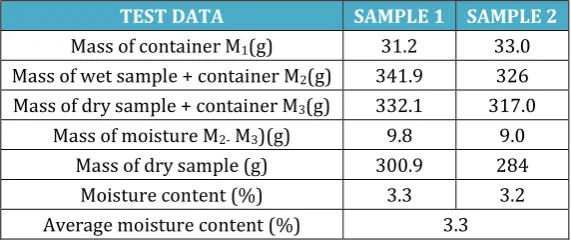
Table 1a: Moisture Content of Fine Aggregate
TEST DATA SAMPLE 1 SAMPLE 2
Mass of container M1(g) 31.2 33.0
Mass of wet sample + container M2(g) 341.9 326
Mass of dry sample + container M3(g) 332.1 317.0
Mass of moisture M2- M3)(g) 9.8 9.0
Table 1b Moisture Content of Coarse Aggregate
TEST DATA SAMPLE 1 SAMPLE 2
Mass of container M1(g) 31.2 25.5
Mass of wet sample + container M2(g) 590.89 490.6
Mass of dry sample + container M3(g) 580.4 483.1
Mass of moisture M2- M3)(g) 10.4 7.5
Mass of dry sample (g) 549.2 457.6 Moisture content (%) 1.9 1.6 Average moisture content (%) 1.8
3.2. Sieve Analysis on Fine and coarse Aggregates:
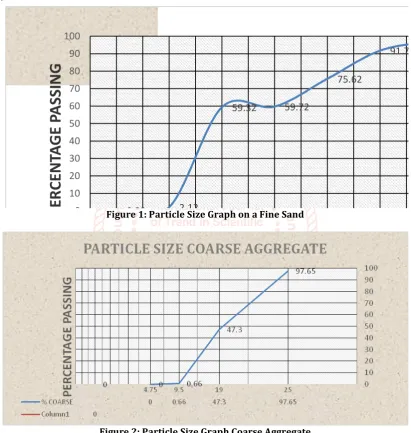
The following results were obtained from the sieve analysis carried out on both fine aggregate, and coarse aggregate on dry mass process.
91.76
75.62
59.72
59.32
2.12
0.22
0
10
20
30
40
50
60
70
80
90
100
PE
RC
EN
TA
G
E
PA
SS
IN
G
Figure 1: Particle Size Graph on a Fine Sand
Figure 2: Particle Size Graph Coarse Aggregate
3.3. Specific Gravity of Aggregate
The specific gravity of the various which was carried out at room temp thus yielding the following results.
Table 2a: Specific Gravity of Sand
DESCRIPTION SAMPLE A SAMPLE B
Mass of vessel (g) 618.7 618.7 Mass of vessel + sample (g) 1054.3 1023.9
Mass of sample (A) (g) 435.6 405.2 Mass of vessel + sample + water (B) (g) 1749.0 1704.9
Mass of vessel + water (C) (g) 1493.0 1493.0
P= = 2.42 = 2.10
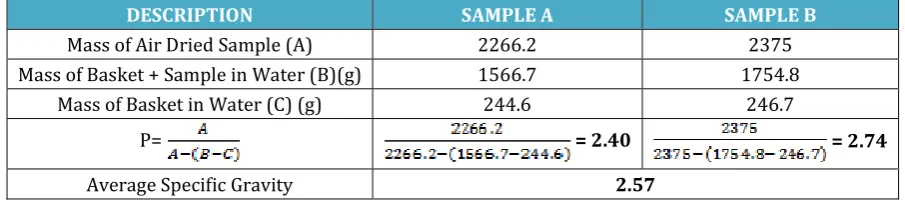
Table 2b: Specific Gravity of Coarse Aggregate
DESCRIPTION SAMPLE A SAMPLE B
Mass of Air Dried Sample (A) 2266.2 2375 Mass of Basket + Sample in Water (B)(g) 1566.7 1754.8
Mass of Basket in Water (C) (g) 244.6 246.7
P= = 2.40 = 2.74
Average Specific Gravity 2.57
3.4. Bulk Density of Aggregate
Table 3a: Bulk Density of fine Aggregate
DESCRIPTION Un-compacted Compacted
Weight of Mould + sample (g) 16140 17315 Weight of mould (g) 6420 6420 Volume of mould (Cm3) 7226.6 7226.6
Bulk density (g/Cm3) 1.34 1.51
Table 3b: Bulk Density of coarse aggregate
DESCRIPTION Un-compacted Compacted
Weight of Mould + sample (g) 16590 18155 Weight of mould (g) 6420 6420 Volume of mould (Cm3) 7226.6 7226.6
Bulk density(g/cm3) 1.41 1.62
3.5. Specific gravity of Ibeto Cement:
The specific gravity was determined on relative paraffin value for the OPC cement (IBETO) at room temperature to obtain the results below:
Table 4: Specific Gravity of IBETO Cement
DESCRIPTION SAMPLE A SAMPLE B
Mass of empty bottle(W1) (g) 28.0 27.6 Mass of bottle +cement (W2) (g) 50.1 49.5 Mass of bottle +cement + kerosene (W3) 85.0 85.4 Mass of bottle +kerosene (W4) (g) 68.4 68.0 Mass of bottle + water (W5) (g) 77.8 78.4 SP of kerosene= = 0.81 0.80
SP of Cement = 3.06 3.13 Average specific gravity 3.09
3.6. Consistency of Cement
Table 5:Setting Time and Fineness of Dangote Cement
DESCRIPTION Result Limit of specification Remark
Weight of cement(g) 400g Minimun200g Good Weight of water(g) 103g Minimum50g Good Initial setting time 60mins Minimum 45 mins Good Final setting time 90mins Maximum 600mins Good
Fineness of cement using BS sieve NO. 170
Weight of sample 100g Minimum of 50g Good Fineness of cement 2% Maximum 10% Good
Table 6: Quantity of Constituent to Normal Concrete for Experimental Mix Mould Volume M3 Cement kg/M3 Water litres Fine aggregate
(kg/M3)
Coarse Aggregate (Kg/M3)
3.7. Analysis Result on Destructive Compressive and Rebound Number of Non-Destructive Test.
0
5
10
15
20
25
30
SAMPLE 1
SAMPLE 2
SAMPLE 3
COMPRESIVE 7 DAYS
Figure 3: Compressive for destructive and rebound number 7 day curing.
Table 7: ANOVA Analysis for 7 days strength
From figure 3 and table 7, the various compressive strength had an average strength of (21.3 28.4 and 23.1) for destructive testing while (12.7 11.2 and 10.9) were rebound values of the Result from above Mat Lab 2 way ANOVA test below shown below with the following data; different within column 49.877, between Row5.966; Fcal within = 14.52 and P=0.1956 Degree of freedom D1=3-1= 2, D2= 32-2 = 30
F tabulated = 3.32. The Fcal fall at the critical region showing mean difference in strength at the 5% level of significance. Also the strength had a small p value which indicates significance in different strength.
0
20
40
SAMPLE 1
SAMPLE 2
SAMPLE 3
COMPRESIVE 14 DAYS
DESTRUCTIVE COMPRESSIVE
REBOUND NUMBER
Column1
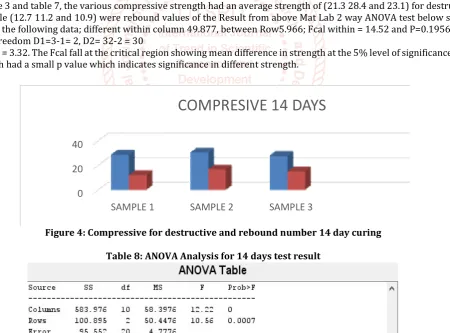
Figure 4: Compressive for destructive and rebound number 14 day curing
Table 8: ANOVA Analysis for 14 days test result
From figure 4 and 8 the various compressive strength had average strength of (28.9 30.7 and 28.0) for destructive test while (12.6 17.1 and 15.5) were rebound values of the Result from above Mat Lab 2 way ANOVA test below shown below with the following data; diff within column 58.397, between Row50.448 ; Fcalwithin = 12.22 and P=0.0007
Degree of freedom D1=3-1= 2, D2= 32-2 = 30
Figure 5: Compressive for destructive and rebound number 21 day curing
Table 9: ANOVA Analysis for 21 days test result
From figure 5 and 9, the various compressive strength had an average strength of (32.4 29.3 and 33.3) for destructive test which meet up with the designed strength while (15.5 15.9 and 14) were rebound values the Result from above Mat Lab 2 way ANOVA test below shown below with the following data; different within column 79.03, between Row7.56; Fcal within = 10.24, Fcal between rows: 0.98 and P=0 and 0.3297
Degree of freedom D1=3-1= 2, D2= 32-2 = 30
F tabulated = 3.32. The Fcal within the data fall at the critical region showing mean difference in strength at the 5% level of significance but Fcal between rows shows no significant difference. Also the strength had a small p value which indicates significance in different strength.
0
20
40
SAMPLE 1
SAMPLE 2
SAMPLE 3
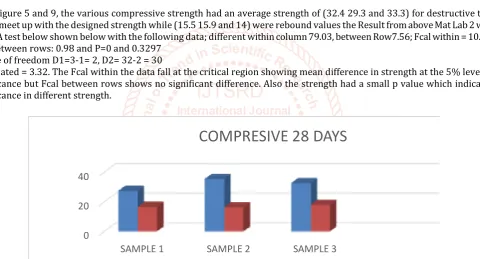
COMPRESIVE 28 DAYS
Fig 6: Compressive for destructive and rebound number 28 day curing.
Table10: ANOVA Analysis for 28 days test result.
From figure 6 and table 10, the various compressive strength had an average strength of (27.6 35.6 and 32.9) for destructive test which exceeded the designed strength while (16.8 16.3 and 18.3) were rebound below design values.
The Result from above Mat Lab 2 way ANOVA test below shown below with the following data; different within column 63.54, between Row 9.89; Fcal within = 9.72, Fcal between rows: 1.51 and P=0 and 0.224
Degree of freedom D1=3-1= 2, D2= 32-2 = 30
4. CONCLUSION /RECOMMENDADATION
From the result shown and analyzed for the null hypothesis H0(there is no mean different between the compressive
strength values obtained by destructive test and the value obtained from rebound number) draws the conclusion that at 5% significant level, there is a mean difference in the values obtained from rebound number and destructive strength for curing period of 7-28 days thus we reject the null hypothesis and accept H1 that the two process are
different and had no correlated value at 5% significant level.
Nevertheless, there was no significant value within the values of rebound number from 14-28 days curing period. The strength obtained by destructive process conformed to the targeted mix value whereas that of the rebound number was below these values.
From the result of the analysis, the rebound hammer increased from an average of 12 per 7days to an average rebound number of 17.7 for 28days which is similar to the increment in compressive strength from average of 24.3 for 7days to average of 32 for 28days which show that the increment in the strength is uniform but 5% difference in value obtained.
Non-Destructive Testing is observed to be more economical as it required no electricity and can also be used directly in the field.
It is therefore recommended that both methods be used but not as a substitute for the other as both do not give exactly the same result.
REFERENCES
[1] ACI Committee (1998). Non-destructive test methods
for evaluation of concrete in structures. ACI 228.2R. American concrete institute, Farmington Hills, MI.
[2] ACI Committee (2003). In-place methods to estimate
concrete strength, ACI 228.1R. American concrete institute, Fermington Hills, MI.
[3] ASTM (2002a). Standard test method for pulse velocity
through concrete. ASTM C597, ASTM International, West Conshohocken PA.
[4] ASTM (2004a). Standard practice for estimating
concrete strength by maturity method, ASTM C1074. ASTM International, West Conshohocken, PA.
[5] Carino N. J. (1944). Non-destructive testing of concrete, history and challenges. In concrete technology past, present and future. Proceedings of U. Mohan Malhotra Symposium, ACI SP-144, Pp, 623-678. American concrete institute, Fermington Hills, MI.
[6] Malhotra V and Carette G. (2004). Penetration
resistance methods. In V. Malhotra and N. Carino handbook on non-destructive testing of concrete. pp 10-23. New York: CRC press.
[7] Malhotra V. M. (2004). Surface hardness methods in
handbook on nondestructive testing of concrete, 2nd ed., Malhotra V. M. and Carino N. J. Eds. CRC press, Bocarato, FL.
[8] Malhotra, U. M. (1976). Testing hardened concrete,
Nondestructive methods, ACI Monograph No. 9. IOWA state University press, Ames.
[9] Proverbio, E., and Venture, V. (2005). Reliability of Non-destructive test for concrete strength’ 10 DBMC lyou 17-20
[10] Rangaraju P.R. (2003). “Development of Some Performance-Based Material Specifications for High-Performance Concrete Pavement,” Transportation
ResearchRecord, No. 1834, pp. 69-76.
[11] Ravingrarajah, R. S. (1997). “Strength evaluation of high-strength concrete by ultrasonic pulse velocity method” NDT Int., 30, 4.
[12] Workman G., and O-Moore P. (2012). Nondestructive