S m i t h , H e l e n ( 2 0 0 8 ) As s e s si n g s t u d e n t c o n t r i b u ti o n s t o o nli n e
d i s c u s sio n b o a r d s . P r a c ti tio n e r R e s e a r c h i n H i g h e r E d u c a tio n , 2
( 1). p p . 2 2-2 8 .
Do w n l o a d e d fr o m : h t t p ://i n si g h t . c u m b r i a . a c . u k /i d/ e p ri n t/ 2 9 2 /
U s a g e o f a n y i t e m s f r o m t h e U n i v e r s i t y o f C u m b r i a’ s i n s t i t u t i o n a l r e p o s i t o r y
‘I n s i g h t ’ m u s t c o n f o r m t o t h e f o l l o w i n g f a i r u s a g e g u i d e l i n e s .
Any it e m a n d it s a s s o ci a t e d m e t a d a t a h el d i n t h e U niv e r si ty of C u m b r i a ’s in s ti t u ti o n al
r e p o si t o r y I n si g h t ( u nl e s s s t a t e d o t h e r wi s e o n t h e m e t a d a t a r e c o r d ) m a y b e c o pi e d ,
di s pl ay e d o r p e rf o r m e d , a n d s t o r e d i n li n e wi t h t h e JIS C f ai r d e a li n g g ui d eli n e s ( av ail a bl e
h e r e
) fo r e d u c a t i o n al a n d n o t-fo r-p r ofi t a c tiviti e s
p r o v i d e d t h a t
• t h e a u t h o r s , ti tl e a n d full bi blio g r a p h i c d e t ail s of t h e it e m a r e ci t e d cl e a rly w h e n a n y
p a r t
of t h e w o r k is r ef e r r e d t o v e r b a lly o r i n t h e w ri t t e n fo r m
• a h y p e rli n k/ U RL t o t h e o ri gi n al I n si g h t r e c o r d of t h a t it e m is i n cl u d e d i n a n y
ci t a ti o n s of t h e w o r k
• t h e c o n t e n t is n o t c h a n g e d i n a n y w a y
• all fil e s r e q ui r e d fo r u s a g e of t h e it e m a r e k e p t t o g e t h e r wi t h t h e m a i n it e m fil e.
Yo u m a y n o t
• s ell a n y p a r t of a n it e m
• r e f e r t o a n y p a r t of a n it e m wi t h o u t ci t a ti o n
• a m e n d a n y it e m o r c o n t e x t u ali s e it i n a w a y t h a t will i m p u g n t h e c r e a t o r ’s
r e p u t a t i o n
• r e m ov e o r a l t e r t h e c o py ri g h t s t a t e m e n t o n a n it e m .
T h e full p oli cy c a n b e fo u n d
h e r e
.
Alt e r n a t iv ely c o n t a c t t h e U niv e r si t y of C u m b ri a R e p o si t o ry E di t o r b y e m a ili n g
Assessing student
contributions to online
discussion boards
Helen Smith
University of Cumbria [email protected]
Abstract
The use of online learning is prevalent in higher education, in particular the use
of Blackboard and other similar virtual learning environments (VLEs). Students’
participation in online discussion forums is a common activity and the online
threaded discussion tool provides opportunities for students to:
• form collaborative groups for problem-based learning
• discuss learning experiences
• ponder over assessment issues
• debate topics of interest.
There is no shortage of research on the perceived effectiveness of online discussion forums;
however, this paper evaluates the potential for assessing the content of online discussions as
a means of contributing to summative assessment.
Introduction
The use of online learning is prevalent in higher education, in particular within virtual learning environments (VLEs), such as Blackboard; participation in online discussion forums is a common activity. Considerable research exists on the potential of using the discussion board for socialisation (Fauske and Wade, 2003), discussing learning experiences (Hammond, 2000), assessment issues, and debating topics of interest (Laurillard, 2003). Within my institution, discussion boards have been used as a collaborative tool across a range of information communications technology (ICT) modules to promote discussion and refl ection. The nature of the subject often requires a disproportionate amount of time developing skills in using software tools, to the detriment of discussion and reading time.
Opportunities for wider reading and discussion are crucial to the learning and they afford opportunities for students to discuss and question key research in the fi eld, by observing the contributions of others and offering alternative viewpoints. As student commitment and co-operation is crucial to this process, it was hoped that by making discussion board participation an assessed element, student engagement would increase in both quantity and quality. This feasibility study therefore looks at the issues that arise in applying a content analysis tool (the Newman model) to assess students’ contributions to online discussion forums.
Numerous publications exist on the benefi ts of eLearning, online learning and use of computer mediated discussion (Salmon, 2000), but information focusing on analysing and assessing discussion threads is not so well researched (Hora and Kling, 1999). Existing research in health-related journals focuses on discussion board use as a tool for initiating discussion and engaging students in problem-based learning scenarios (Braidman et al., 2008), where the participation in online discussion is qualifi catory (some contribution is required to obtain a pass), and not contributory (counts towards the fi nal grade awarded). Analysing discussion postings for purposes of assessment that would derive quantitative results requires a specialised tool, some of which are discussed here.
in Higher Education Copyright © 2008 University of Cumbria
Within the subject of ICT education, in my institution, many assessments comprise coursework portfolios and/or the development and creation of a physical resource with accompanying narrative. Historically, student teachers have often focused on skills development of learning new software for the portfolio resource, rather than engaging with the wider reading about how the created resource contributes to pupil learning. Despite weekly discussion-board topics being set up, students often fail to participate in this element of the course, and thus arrive at sessions ill-prepared to contribute to the ongoing discussions. The revalidation of the ICT education degree courses provided an opportunity to take a fresh look at assessment issues, and the idea of piloting students’ postings to the discussion board as a compulsory assessed element, was considered.
The research and review of literature
Considerable research has been undertaken on how the use of a discussion board can be used more productively to contribute to learning and teaching (Benigo and Trentin, 2000; Meyer, 2003), but little has been written on how it can inform course assessment. Encouraging students to participate in online discussion is problematic, but the use of effective questioning techniques (scaffolding the discussion) has been shown to elicit higher-quality responses and fewer off-task postings (Cho and Jonassen, 2002; Wang, 2005). Others perceive this scaffolding as enforcing a constrained forum and directing students down one particular path (Rush, 2004). Wang’s study (2005) demonstrated that the use of effective questioning techniques elicited better-quality responses from students and also encouraged higher-order thinking.
Similarly Im and Lee’s (2004) topic-related discussion resulted in substantial learning because students had time to refl ect before participating in online discussion forums. Garrison, Anderson and Archer (2001) also supported the use of online discussion as being signifi cant in developing critical thinking skills, resulting in a more structured forum than face-to-face communications. There is no doubt that as a tool for socialisation, the use of online discussion boards allows students extended opportunities to contribute to discussion ideas (Salmon, 2000; Garrison et al., 2001). The concern, however, is that these ‘results’ may be viewed as subjective, unless the data can be analysed with a tool that would make the system transparent.
Early work in the fi eld (Henri, 1992) analysed the content of online postings by measuring four factors: • social
• interactive • metacognitive • cognitive.
with the cognitive factor being further broken down into fi ve types of reasoning skills. Fisher (1997) identifi ed types of discussion as:
disputational, cumulative and exploratory
resulting in the ‘dialogical’ framework as described by Wegerif and Mercer (1997). More recently, Riley (2006) argued that his:
…content analysis of the online discussion through a dialogical framework for social modes of thinking to measure social reasoning...
and
…keyword identifi cation and concept mapping connectivity to measure conceptual transfer from the online discussion to individual students and higher order thinking...
(numerical frequencies of participation, talk type and triangulation of data using concept mapping) could be applied as an evaluative tool to assess the quality of the discussion exchange, by assigning a ‘talk type’ from the dialogical framework. However, as with many other methods, the qualitative measure cannot easily produce quantitative results for the purpose of summative assessment. The amount of subjectivity involved also has to be taken into account. Riley’s study commented upon:
…determining the progression of thinking and social interactions taking place online...
but a fl aw in this study was the mechanism by which Riley extracted his quantitative data. Using the AutoSummarise tool in Microsoft Word he identifi ed and determined key points and key words by analysing documents and assigning a score to each sentence. If the ‘key words’ were used often, then the score was increased.
Research by Ahern, Peck and Laycock (1992) studied the whole message, assessing the interaction levels and complexity of response. Zhu (1997) looked at the whole theme of the message, with the elements of:
• participation • social • cognitive • metacognitive
being the variables investigated, but the reliability of those studies is not reported. Mason (1992) in her study, reported on the data derived from the VLE-generated statistics, outlining the number of postings per student and the number of times each was read in the overall discussion forum. Ascertaining the quality of the postings, however, would be diffi cult to achieve using any of these methods.
Methodology
Preliminary discussions were conducted with 20 ICT subject specialist student teachers across a range of programmes:
• undergraduate primary (pupils 4–11 years) • undergraduate secondary (pupils 11–18 years) • postgraduate ICT courses
about the feasibility of assessing their contributions to the discussion board as part of the summative assessment process. To ascertain ‘what if?’ discussion-board content contributed to 15% of the fi nal assessment mark, discussion on the feasibility of assessing online discussion content ran concurrently with other discussion topics on Blackboard. The fi rst forum posted to all module discussion boards consisted of the following statement:
Online discussion is considered to be a suitable medium to discuss key readings prior to face-to-face sessions. As this is part of the learning process, should your contributions be assessed or not?
The second forum was a structured question relating to the pre-reading for the module. Students were given a research paper (Ogborn, 1998) and the question posed was:
Is computer-based modelling more viable as an individual activity or as a group activity? Argue the case for group activity.
Students used questioning techniques to facilitate initial discussion and were invited to consider the assessment of each other’s postings by applying the Newman content-analysis tool to gain an understanding of how a raw mark could be derived for assessment purposes. They were reassured this was primarily an experiment to determine how easily the content could be graded.
From the outset, students were aware that they were part of a pilot in determining the feasibility of assessing the content of their online discussions using a quantitative tool. The student cohorts agreed to have their data analysed using a range of tools for this small-scale study. Initially, this was going to be tutor led, with the tutor applying the tools and deriving a ‘mark’ dependent on the results of the data analysed. After many attempts at applying various tools, the plan was amended and students were asked to peer review the data, thus allowing them to develop an understanding of the transparency of the process.
For the purpose of deriving a mark for the content, it was evident that a tool that could be applied in a quantitative way was required. Two tools that appeared to be fi t for purpose were the Interaction Analysis Model (IAM) (Gunawardena, Lowe and Anderson, 1997) and the Critical Thinking Model (Newman, Webb and Cochrane, 1997). Although Newman’s original model was fairly dated it has been extended by Kirschner et al. (2004) who proposed four elements:
• contribution • verifi cation • clarifi cation • elaboration.
SMITH: ASSESSING STUDENT CONTRIBUTIONS
Following the debate on computer modelling as a group activity, and subsequent postings to the discussion board, students applied the analysis tool to the content by selecting ten categories as defi ned by Newman:
1 relevance 2 importance 3 novelty
4 outside knowledge 5 ambiguities 6 linking 7 justifi cation 8 critical assessment 9 practical utility
10 width of understanding.
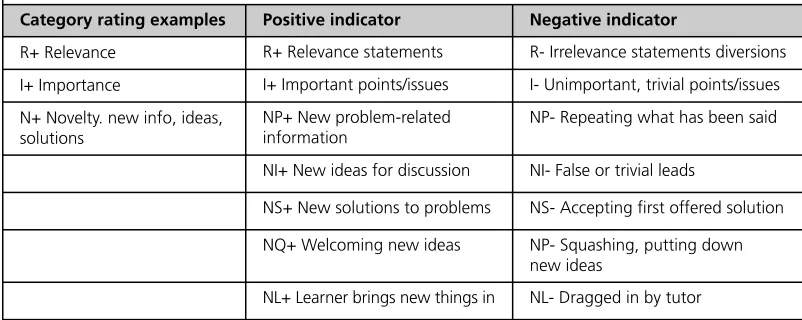
For each statement or paragraph, students had to apply a plus (+) or minus (-) factor to specifi c statements.
Figure 1 Subset of Newman et al. codes (1996)
Category complete list
Relevance; Importance, Novelty, Outside knowledge, Ambiguities, Linking, Justifi cation, Critical assessment, Practical utility, Width of understanding
Category rating examples Positive indicator Negative indicator
R+ Relevance R+ Relevance statements R- Irrelevance statements diversions
I+ Importance I+ Important points/issues I- Unimportant, trivial points/issues
N+ Novelty. new info, ideas, solutions
NP+ New problem-related information
NP- Repeating what has been said
NI+ New ideas for discussion NI- False or trivial leads
NS+ New solutions to problems NS- Accepting fi rst offered solution
NQ+ Welcoming new ideas NP- Squashing, putting down new ideas
NL+ Learner brings new things in NL- Dragged in by tutor
The decision to concentrate on the Newman model afforded a calculation feature that allegedly measured the quality of the data and not the frequency of postings as in other methods. The ten categories also had coding subsets to further exemplify the data if required. By applying a code to each sentence or paragraph, the positive indicators and negative indicators could be calculated and results obtained.
Results
Conclusion
Using an asynchronous discussion tool as a means of providing quantitative results for assessment purposes is fraught with diffi culty, none less than the strategic stance learners might take in ‘writing for the grade’ (Elbow, 1997). Statistical data counting the frequency of postings can be easily analysed. The validity of this data, however, is problematic. Student success could not, and should not, be defi ned to the number of postings, but rather to the quality of the content of those postings.
The Newman model, while the most appropriate tool to date for this task, still resulted in considerable ambiguity. Students analysing their own postings had a clear indication of what they meant and had no diffi culty with their own analysis. They were however troubled with the thought that this could be used to derive a grade for assessment purposes, as often their interpretation of other students’ postings were diffi cult to quantify and, by their own admission, were often subjective. The task of analysing the data was onerous and resulted in a wide variety of opinion. Peer agreement of categories was achieved in only three of the ten categories, but the amount of time and effort to derive this result was onerous.
While all the tools provided different types of results, concerns remained about the lack of any mechanism to analyse the literacy aspect within the postings. If these discussions were to form part of the summative assessment, then surely attention to detail (grammar, spelling, sentence construction) would also have to be taken into account? Interestingly enough, part of what is encouraged within higher education (good academic writing; attention to detail; structure) may be largely ignored in an online environment. Messages (or similar) stating:
… don’t worry about spelling or grammar when using the online environment...
often appear as introductions to online activities. Why should the discussion board environment be any less important if it is to contribute to the overall learning and teaching process, and to assessment in particular? It could be argued, however, that the mulling over grammatical detail could detract from the spontaneous use of the discussion board.
This is a ‘work in progress’, but the indications are that it is not feasible to derive a ‘mark’ for such an activity. Taking into account the literacy issues, quality of content (where students determine the criteria factors and have added substantially to the Newman categories), quantity of initial posting and responses to other postings, there is still some way to go in developing an ideal tool fi t for purpose. While 30% of the students would welcome credit for their contributions to online discussions, the remainder demonstrated a variety of concerns; namely the cumbersome workload, the level of subjectivity, and the fact that they could never be fairly graded. All students conceded, however, that the use of the discussion tool enhanced session participation and were in agreement about pursuing the research further.
As a cognitive tool, the discussion board affords time for the learners to: • refl ect
• share ideas
• learn through observing and interacting with others • create their own view of the topic.
Isolating a component part of using the VLE and the discussion board tool, in particular for assessment purposes, appeared to detract from the main purpose of engaging with course content to foster deeper learning.
SMITH: ASSESSING STUDENT CONTRIBUTIONS
References
All websites accessed 08.06.08.
Ahern, T., Peck, K. and Laycock, M. (1992) The effects of teacher discourse in computer-mediated discussion. Journal of Educational Computing Research 8(3): 291–309.
Benigo, V. and Trentin, G. (2000) The evaluation of online courses. International Journal of Computer Assisted Learning 16(3): 259–270.
Braidman, I., Boggis, C., Dornan, T. et al. (2008) Analysis of online refl ective learning in undergraduate medical students. E-Portfolios, identity and personalised learning in healthcare education conference proceedings. March, 2008 (www.heacademy.ac.uk/health/news/detail/2008-03-eportfolio-conference-proceedings).
Cho, K. L. and Jonassen, D. H. (2002) The effects of argumentation scaffolds on argumentation and problem solving. Educational Technology Research and Development 50: 5–22.
Elbow, P. (1997) Grading student writing: making it simpler, fairer, clearer. New Directions for Teaching and Learning 69. Spring, 1997
(www.lagcc.cuny.edu/CTL/dfl /dfl 0405/midyear/pdfs/grading%20student%20writing.pdf).
Fauske, J. and Wade, S. E. (2003) Research to practice on-line: conditions that foster democracy, community and critical thinking in computer mediated discussions. Journal of Research in Technology Education 36(2): 137–153.
Fisher, E. (1997) Educationally important types of children’s talk. In Wegerif, R. and Scrimshaw, P. (eds) Computers and Talk in the Primary Classroom. Clevedon: Multilingual Matters.
Garrison, D. R., Anderson, T. and Archer, W. (2001) Critical thinking, cognitive presence, and computer conferencing in distance education. American Journal of Distance Education 15: 7–23.
Gunawardena, C. N., Lowe, C. A. and Anderson, T. (1997) Analysis of global online debate and the development of an interaction analysis model for examining social construction of knowledge in computer conferencing. Journal of Educational Computing Research 17(4): 397–431.
Hammond, M. (2000) Communications within on-line forums: the opportunities, the constraints and value of communicative approach. Computers and Education 25: 251–262.
Henri, F. (1992) Computer conferencing and content analysis. In Kaye, A. R. (ed.) Designing environments for constructivist learning. Collaborative Learning Through Computer Conferencing. Berlin: Springer-Verlag: 117–136.
Hora, N. and Kling, R. (1999) Students Frustrations with a Web-based Distance Education Course (www.fi rstmonday.org/issues/issue4_12/hara/index.html).
Im, Y. and Lee, O. (2004) Pedagogical implications of online discussion for preservice teacher training. Journal of Research on Technology in Education 36:155–170.
Jonassen, D. H. and Kwon, H. (2001) Communication patterns in computer mediated versus face-to-face group problem solving. Educational Technology Research and Development 49(1): 1042–1629.
Kirschner, P. Strijbos, J. Kreijns, K. and Beers, P. (2004) Designing electronic collaborative learning environments. Educational Technology Research and Development 52(3): 47–66.
Laurillard, D. (2003) Rethinking University Teaching: A Framework for the Effective Use of Learning Technologies. 2nd edn. New York: RoutledgeFalmer.
Mason, R. (1992) Evaluation methodologies for computer conferencing applications. In Kaye, A. R. (ed.) Collaborative Learning Through Computer Conferencing. Berlin: Springer-Verlag: 105–116.
Meyer, K. A. (2003) Face-to-face versus threaded discussions: the role of time and higher order thinking. Journal of Asynchronous Learning Networks 7(3): 55–65.
Newman, D. R., Webb, B. and Cochrane, C. (1997) A content analysis method to measure critical thinking in face to face and computer supported group learning. Interpersonal Computing and Technology 3:56–77 (www.qub.ac.uk/mgt/papers/methods/contpap.html).
Ogborn, J. (1998) Cognitive development and qualitative modelling. Journal of Computer Assisted Learning 14: 292–307.
Riley, N. (2006) Methods for evaluating critical learning using on-line discussion forums. Technology, Pedagogy and Education 15(1): 63–78.
Salmon, G. (2000) E-Moderating: The Key to Teaching and Learning On-Line. London: Kogan Page.
Wang, C. (2005) Questioning skills facilitate online synchronous discussions. Journal of Computer Assisted Learning 21: 303–313.
Wegerif, R. and Mercer, N. (1997) A dialogical framework for researching peer talk. In Computers and Talk in the Primary Classroom. Clevedon: Multilingual Matters.