69 |
P a g e
ANALYSIS THE PERFORMANCE OF MULTI-CARRIER
CDMA SYSTEM WITH FADING AND INTERFERENCE
Harsh Singh
1, Nitish Yadav
2 1,2UG Students of Department of ECE AIMT, Greater Noida (India)
ABSTRACT
:Multi Carrier Code Division Multiple Access (MC-CDMA) is a relatively new concept to improve the performance over
multipath links .It is a modulation method which is used to transmite multi carrier transmission of DS-CDMA type
signals and an MC-CDMA transmitter spreads the original data stream in the frequency domain over different sub
carriers using a given spreading code.It offers better frequency diversity to combat frequency selective fading. In this
paper we evaluate the performance results of MC-CDMA in terms of bit error rate, power, length, code length and no. of
subscriber.
Keywords:
Bit Error Rate (BER), Code Division Multiple Access (CDMA), Multi Carrier Code Division Multiple Access(MC-CDMA), Multipath propagation.
I.INTRODUCTION
A multicarrier system is that system where several subcarriers are used for parallel transmission of data packets.
In the field of wireless communications, the combinations of Multi-Carrier (MC) modulation [6] and Code Division
Multiple Access (CDMA) [7] have gained considerable interest due to their excellent performance .In the former,
referred to as Multi-Carrier Direct Sequence CDMA (MC-DS-CDMA), spreading is performed in the time-domain,
whereas in the latter, named Multi- Carrier CDMA (MC-CDMA), spreading is performed in the frequency-domain
[9-10].
Again MC-CDMA based communication system has some limitation. Bandwidth, Noise and Fading are some major
limitation of the system.
Bandwidth limitation means restricting the quantity of information transmitted from sender to receiver per
second. Itmeans the information arrives slower.
Noise will also affect intelligibility. The noise is additive, i.e., the received signal equals the transmit signal plus
some noise, where the noise is statistically independent of the signal.
Fading is a fluctuation in the received signal strength at the receiver or a random variation in the received signal
is known as fading due to reflection,refraction of information signal. There are two types of fading limitations.
70 |
P a g e
II.SYSTEM MODEL FOR MULTI CARRIER CODE DIVISION MULTIPLE ACCESS
MC-CDMA is a modulation method that uses multi carrier transmission of DS-CDMA type signals in frequency domain
over different sub-carrier using a given spreading code.
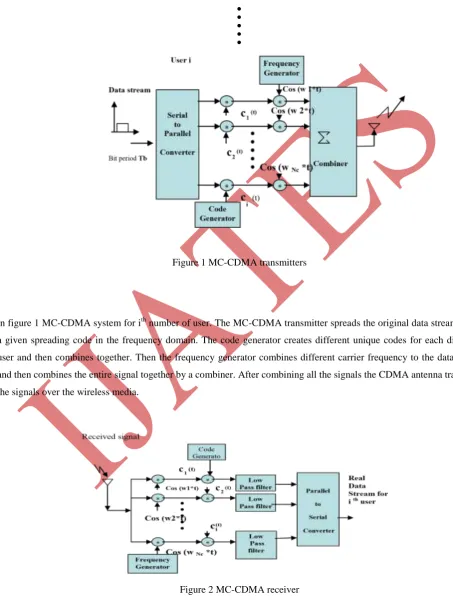
Figure 1 MC-CDMA transmitters
In figure 1 MC-CDMA system for ith number of user. The MC-CDMA transmitter spreads the original data stream using
a given spreading code in the frequency domain. The code generator creates different unique codes for each different
user and then combines together. Then the frequency generator combines different carrier frequency to the data signal
and then combines the entire signal together by a combiner. After combining all the signals the CDMA antenna transmits
the signals over the wireless media.
71 |
P a g e
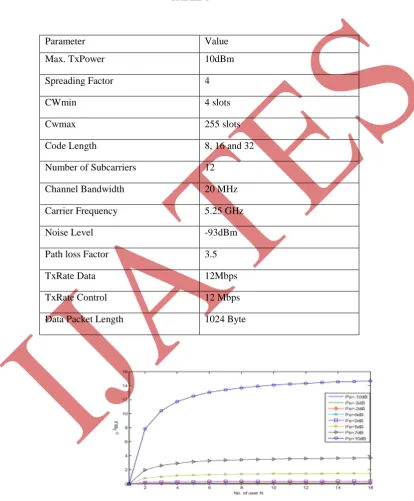
In figure 2 the MC-CDMA receiver is designed by the capacity of ithnumber of user. MC-CDMA receiver also receives
the transmitted signal as a summation of i number of users. At first demodulates the received signal by the same career
frequency of each signal and then the signals multiply with the specific codes given by the receiver code generator. Then
we get the signal of ith user which is same for transmitter and receiver. After that low pass filter remove the high
frequencies portion of the signal. Finally, the P/S converter presents the actual digital data signal.
In receiver side, combining all sub-carrier signals we get the received signal with MUI , Noise and ICI is ,
X =Xₒ + XMUI+XIC1+ XNoise………(1)
Where,
Xₒ= wanted signal;
XMUI= Multi user interference due to imperfect restoration of the sub- carrier amplitude;
XICI=Inter carrier interference due to crosstalk β (m,n) between α(n) and ym and Xnoise
By the help of some analyses, we get
Xₒ = m,n𝜔n,ncₒ[n]cₒ[n-m])……….. [2]
Where,
N=number of subscriber
n=subscriber number
βm,n= crosstalk between the user,
Ts= sampling time
𝜔n,n= weight factors which is constant
cₒ[n]cₒ[n-m]=orthogonal spreading code
whenxₒ= 0 for large no. of user so system like non-fading channel .
III. THEORATICAL ANALYSES OF MC-CDMA
By the analyses of MC-CDMA, We get relation between no. of user, variance .code length .
Variance due to MUI signal is,
σ2
MUI =(N-1)Ts/N [M22+ M11 2
] ……... [3]
Variance due to ICI, Ơ2ICI = M02T2 S ………[4]
EN/N0 = M112/(M22+M112)+M02 [ ……….[5]
72 |
P a g e
IV.RESULT AND DISCUSION
The system described above is simulated using Matlab. For the convenience of the readers the parameters used for
computation in this paper are shown in table 1.
TABLE 1
Parameter Value
Max. TxPower 10dBm
Spreading Factor 4
CWmin 4 slots
Cwmax 255 slots
Code Length 8, 16 and 32
Number of Subcarriers 12
Channel Bandwidth 20 MHz
Carrier Frequency 5.25 GHz
Noise Level -93dBm
Path loss Factor 3.5
TxRate Data 12Mbps
TxRate Control 12 Mbps
Data Packet Length 1024 Byte
73 |
P a g e
Figure 3 shows the plots of σMUI2 versus number of user in MC-CDMA system. This figure comes from equation[3] . We
see that if we increase the number of user then the interference between different user increases. The variance of the
multi user interference depends on signal power. If we increase the power then the interference increases gradually. For
example, in this graph variance of MUI for 10dB power is very high and it is more than 14. Whereas for low power like
5dB variance of MUI is less than 2. And it is close to zero for very low power like -10dB. Figure 4: Plots of σICI2 versus
number of user in MC-CDMA system
Figure 4 plots of σICI2 verses no. of user
Figure 4 shows the plots of σICI 2
versus number of user in MC-CDMA system. This figure comes from equation 4. We
see that if we increase the number of user then the variance of ICI increase. The variance of the ICI also depends on the
signal power. If power is low then the interference between the carrier is very low but when we increase the power then
the inter carrier interference also increase and that case the crosstalk between the sub carrier occurs very rapidly.
V. CONCLUSION
In this paper we used some basic equation to find out our expected results. From the overall analysis we found that the
performance result for Multi-user interference and Inter carrier interference for certain number of user. If we increase the
user then the MUI and ICI occurs more and more. The major problem of MC-CDMA is Multi carrier interference and
inter carrier interference occur. Near far problem and Multi-path fading also another disadvantage of this system. We
saw that in CDMA system due to code difference between the users they can easily share the same frequency.
VI. REFERENCES
1.
Jean-Paul M. G. Linnartz – “Performance Analysis of Synchronous MC-CDMA in Mobile Rayleigh Channel with Both Delay and Doppler Spreads”, IEEE transactions on vehicular technology, vol. 50, no. 6, November74 |
P a g e
2.
L. B. Milstein. Wideband code division multiple access. IEEE J. Select. Areas Commun, 18(8):1344–1354, Aug. 2000.3.
T. Bianchi and F. Argenti. Analysis of filterbank and wavelet transreceivers in the presence of carrier frequencyoffset. In Proc. ICC 2004, pages 2852–2856, Paris, France, June 2004.
4.
S. Hara and R. Prasad, “Overview of multicarrier CDMA,” IEEE. Communication Magazine., vol. 35, no. 12, pp. 126–133, Dec. 19975.
Linnartz, J., “Performance Analysis of Synchronous MC-CDMA in Mobile Rayleigh Channel With Both Delay and Doppler Spreads”, in IEEE Trans. On Vehicular Technology, vol. 50, issue 6, Nov. 2001.6.
J. A. C. Bingham. Multicarrier modulation for data transmission: An idea whose time has come. IEEE Commun.Mag., 28(5):5–14, May 1990.
7.
SaimoonAra Amin and Md.MahbubulAlam – “Performance analyses of Multi-Carrier DS-CDMA wireless communication systems.”8.
H. Steendam and M. Moeneclaey. The effect of synchronization errors on MC-CDMA performance. In Proc. ICC ’99, pages 1510–1514, Vancouver, BC,Canada, June 1999.9.
Yi, S. and Tsimenidis, C. and Hinton, O. and Sharif, B., “Adaptive Minimum Bit Error Rate Multi-user Detectionfor Asynchronous MC-CDMA Systems in Frequency Selective Rayleigh Fading Channels”, in Proc. IEEE
PIMRC 2003, Sept. 7-10, 2003.