Cognitive engineering and the
rationalisation of the flight strip
John Dowell
U niversity College London
1993
ProQuest Number: 10017709
All rights reserved
INFORMATION TO ALL USERS
The quality of this reproduction is dependent upon the quality of the copy submitted.
In the unlikely event that the author did not send a complete manuscript and there are missing pages, these will be noted. Also, if material had to be removed,
a note will indicate the deletion.
uest.
ProQuest 10017709
Published by ProQuest LLC(2016). Copyright of the Dissertation is held by the Author.
All rights reserved.
This work is protected against unauthorized copying under Title 17, United States Code. Microform Edition © ProQuest LLC.
ProQuest LLC
789 East Eisenhower Parkway P.O. Box 1346
Abstract
Cognitive Engineering has been advocated as the discipline w hich could ensure the effective use of interactive com puting technologies. Yet Cognitive Engineering currently exists only as an idea; the present day design of cognitive tools and w ork is a m uch more informal practice.
Developm ent of the Air Traffic M anagem ent system typifies current practices of cognitive design. The informality and inconsistent success of those practices is particularly apparent in efforts m ade to replace the paper flight progress strip w ith an interactive software system. Controllers use the flight strip in m onitoring, planning and controlling traffic m ovem ents, and so far, all attem pts to design its replacem ent have m et w ith rejection.
This thesis is intended to contribute tow ards a Cognitive Engineering discipline. The idea of Cognitive Engineering is first investigated and essential com ponents of the discipline identified. One com ponent is a 'conception'; this is a technical expression of the discipline's ontology. A conception w ould provide the general concepts needed for reasoning about cognitive design problem s. A second com ponent is 'exemplars'; these are form ulations of particular cognitive design problem s - form ulations which use, and so exemplify, the conception.
Acknowledgement
I am grateful for the opportunity to learn from, and learn w ith my co-workers at U niversity College London. I hope this thesis can contribute to their continuing research. Professor John Long supervised the w ork. My debt to John only ever increases; I hope he likes w hat it has produced. Ian Salter specified then
Contents
Abstract ... 2
A ck n o w led g em en t... 3
C ontents ... 4
Figures ... 7
C hapter 1 The idea of a discipline of Cognitive E ngineering... 10
1.1 Looking for a discipline of Cognitive Engineering... 11
1.2 Defining Cognitive E ngineering... 15
1.3 Cognitive Engineering: the m aturation of a craft d isc ip lin e ... 24
1.4 Requirem ents for the evolution of Cognitive Engineering... 28
1.5 O utline of a research program m e... 32
C hapter 2 A conception for Cognitive E ngineering ... 37
2.1 Origin and locus of the p ro b lem ... 37
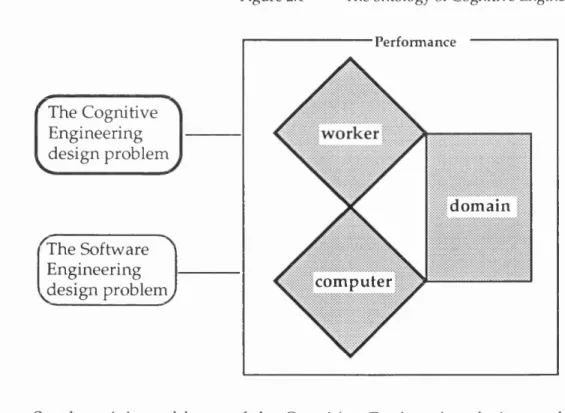
2.2 The d o m a in ... 39
2.3 The interactive w orksystem ... 43
2.4 The Cognitive Engineering design problem ... 53
Chapter 3 The Air Traffic M anagem ent system: a case for Cognitive Engineering..;...;...;...;...;...»...;..».. 58
3.1 Air traffic m anagem ent: a "kind of high speed, 3D chess"... 58
3.2 The need: operational issues of effectiveness... 63
3.3 The response: autom ation and evolutionary d e v e lo p m e n t... 65
3.4 Impasse in the response: not w hat is 'know n', but w hat is 'tried and tested'...66
3.5 An illustration of the impasse: the replacem ent of the paper flight progress strip...69
Chapter 4 O bservation of the Ring way ATM system ... 78
4.1 M ethod and scope of the field stu d y ...78
4.2 Overview of traffic on the sector...80
4.3 Inform ation devices of the control suite... 82
4.4 G roup w orking and com m unication aspects of the ATM w orksystem ... 82
4.5 Cognitive activities of the executive controller... 84
4.6 The use of the flight strip by the executive c o n tro ller... 89
C hapter 5 R econstructing the ATM sy ste m ...96
5.1 Specifying the sector for traffic m anagem ent scen ario s... 97
5.2 Specifying the traffic for traffic m anagem ent scen ario s... 98
5.3 Specifying the task goals for traffic m anagem ent scen ario s...100
5.4 Device interface to the rATM system ...102
5.5 Perform ing the reconstructed traffic m anagem ent task ...105
5.6 Com parison of the reconstructed and operational ATM system s...112
C hapter 6 The rATM d o m a in ...120
6.1 C urrent understandings of the ATM d o m a in ...121
6.2 A characterisation of the rATM dom ain...126
C hapter 7 The rATM w orksystem ... 138
7.1 C urrent understandings of the ATM w orksystem ...138
7.2 Concepts of reactive planning and requirem ents for characterising the rATM w orksystem ... 146
7.3 A characterisation of the rATM w orksystem ...150
C hapter 8 O bservation of the rATM sy ste m ...162
8.1 Selecting an instance of the rATM system ... 162
8.2 M ethod and data collection...165
C hapter 9 An exem plar for Cognitive E n g in eerin g ...171
9.1 M odelling the irATM dom ain and analysing Air Traffic M anagem ent Q u ality ...171
9.2 M odelling the irATM w orksystem and analysing cognitive co sts... 185
9.3 A form ulation of the irATM design problem ... 199
9.4 Generalising the design p ro b lem ... 201
C hapter 10 R ationalising the flight strip design issues... 204
10.1 Rationalisation in the absence of design p rin cip les... 204
10.2 The nexus of flight strip design issues as diagnosing specific perform ance deficits... 207
10.3 The nexus of flight strip design issues as diagnosing specific perform ance g a in s... 209
10.4 Assessing the rationalisation ... 212
C hapter 11. Cognitive Engineering, betw een the idea and the
rea lity ... 218
References ...225
Glossary ...238
A ppendices ... 240
A ppendix A Post-task verbal protocol from the observational study at the Ringway Control Centre...241
A ppendix B irATM dom ain model: flight plans for the irATM task scen ario ...255
A ppendix C irATM dom ain model: traffic m anagem ent protocol... 256
A ppendix D irATM dom ain model: goal and initially projected states of airtraffic event profiles...259
A ppendix E irATM dom ain model: illustrative section of the event vector m atrix and collation of irATMQ(int) results... 260
A ppendix F . irATM dom ain model: exit task attribute values and irATMQ(fl)...262
A ppendix G Post-task plan elicitation: response sheet...263
A ppendix H Post-task plan elicitation results: planned interventions and executed interventions... 264
Figures
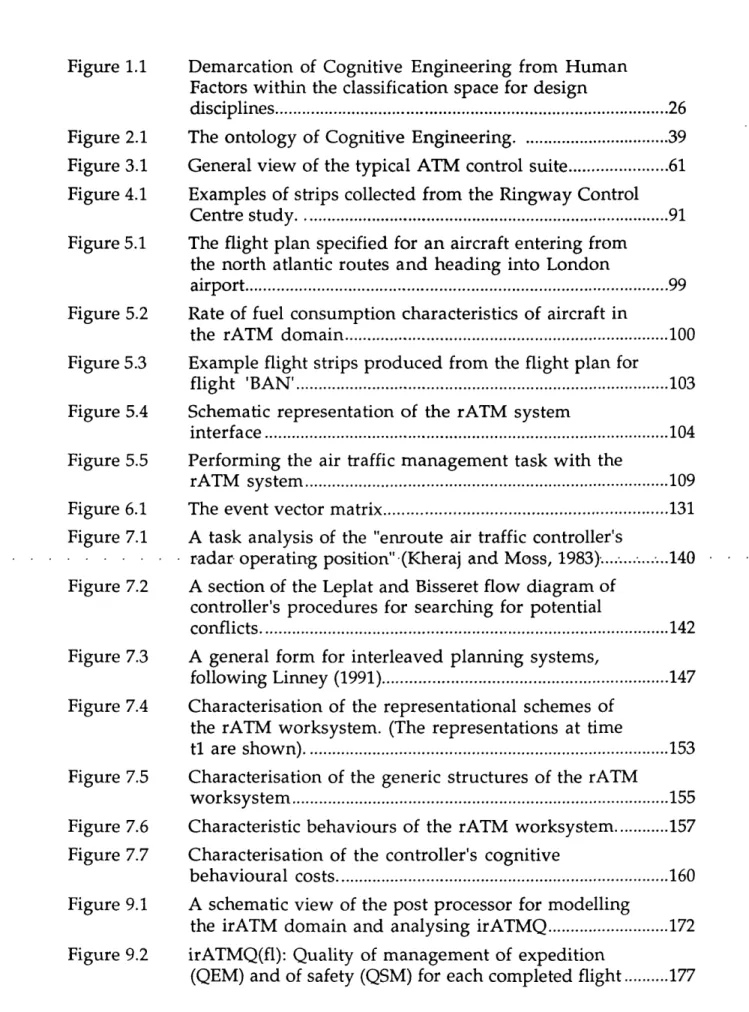
Figure 1.1 D em arcation of Cognitive E ngineering from H um an Factors w ithin the classification space for design
disciplines... 26 Figure 2.1 The ontology of Cognitive E ngineering... 39 Figure 3.1 General view of the typical ATM control suite...61 Figure 4.1 Examples of strips collected from the Ringway Control
Centre study...91 Figure 5.1 The flight plan specified for an aircraft entering from
the north atlantic routes an d heading into London
airport...99 Figure 5.2 Rate of fuel consum ption characteristics of aircraft in
the rATM dom ain... 100 Figure 5.3 Example flight strips produced from the flight plan for
flight 'B A N '... 103 Figure 5.4 Schematic representation of the rATM system
in terface ... 104 Figure 5.5 Perform ing the air traffic m anagem ent task w ith the
rATM system ... 109 Figure 6.1 The event vector m atrix... 131 Figure 7.1 A task analysis of the "enroute air traffic controller's
radar operating position" (Kheraj and Moss, 1983)...140 Figure 7.2 A section of the Leplat and Bisseret flow diagram of
controller's procedures for searching for potential
conflicts...142 Figure 7.3 A general form for interleaved planning systems,
following Linney (1991)... 147 Figure 7.4 C haracterisation of the representational schemes of
the rATM worksystem . (The representations at time
tl are show n)... 153 Figure 7.5 Characterisation of the generic structures of the rATM
w o rk sy stem ... 155 Figure 7.6 Characteristic behaviours of the rATM w orksystem ...157 Figure 7.7 C haracterisation of the controller's cognitive
behavioural costs...160 Figure 9.1 A schematic view of the post processor for modelling
the irATM dom ain and analysing irATM Q... 172 Figure 9.2 irATMQ(fl): Quality of m anagem ent of expedition
(QFM) and of safety (QSM) for each completed flig h t... 177
Figure 9.3 irATMQ(fl): Qualities of m anagem ent of fuel use
(QFM) and flight progress (QPM) for each flight... 178 Figure 9.4 irATMQ(fl): Q uality of m anagem ent of exit height
achievem ent (QXM) and of num ber of m anoeuvres
(QMM) for each completed flight... 179 Figure 9.5 irATMQ(int): Qualities of m anagem ent of expedition
(QEM) and safety (QSM) w ith each intervention... 182 Figure 9.6 irATMQ(int): Qualities of m anagem ent of fuel use
(QFM) and flight progress (QPM) w ith each
in te rv e n tio n ... 183 Figure 9.7 A verage of qualities of m anagem ent of Expedition, of
Fuel Use, and of Flight Progress at each traffic density
le v e l... 184 Figure 9.8 M odel of the planned interventions for each aircraft
over the period of the traffic m anagem ent ta s k ... 189 Figure 9.9 M odel of the irATM w orksystem behaviours... 194 Figure 9.10 C um ulative assessm ent of each class of cognitive
behavioural cost... 196 Figure 9.11 C ontinuous assessm ent of cognitive behavioural
costs... 197
For Helen Letitia
What we call the beginning is often the end And to make an end is to make a beginning. The end is where we start from.
Chapter 1 The idea of a discipline of Cognitive Engineering
1.1 Looking for a discipline of Cognitive E ngineering 11 1.2 Defining Cognitive E ngineering...15
1.2.1 Cognitive Engineering: a general problem, praxis and
know ledge 15
1.2.2 The single stream view: Cognitive Engineering as
applied science 17
1.2.3 lÊ e tw o stream view: Cognitive Engineering as a
discipline o f design 22
1.3 Cognitive Engineering: the m aturation of a craft
discipline...24 1.4 R equirem ents for the evolution of Cognitive
E n gineering... 28 1.5 Outline of a research p ro g ram m e... 32
1.5.1 Aims 33
1.5.2 Six stage-w ise research activities 33
Applications of com puting technology have created both the need and the o pportunity for a discipline of Cognitive Engineering. The need is for more effective systems in w hich w orkers use com puters to perform cognitive tasks. More accurately, the need is for consistently successful solutions to the design problem s presented by these systems. The opportunity for a discipline of Cognitive Engineering is in the potential offered by com puting technology for extending the capability of w orkers in perform ing cognitive tasks.
Yet Cognitive Engineering currently exists more as an idea than a tangible discipline. As an idea, it has been separately advocated and p u rsued by Donald N orm an, David W oods, Emilie Roth, Eric Hollnagel, and Jens Rasmussen. This chapter investigates the idea of a discipline of Cognitive Engineering, and suggests how the idea m ight gain substance. It first sum m arises w hat has been said in support of the idea. Next, from consideration at a very abstract level of disciplines and the relationship betw een science and technology. Cognitive Engineering is identified w ith regard to Cognitive Science and H um an Factors. In particular, in the contrast betw een craft and engineering disciplines, it is suggested that Cognitive Engineering may be expected to evolve from the inherently craft like discipline of H um an Factors. The requirem ents for that evolution are suggested by considering the Cognitive Engineering 'discipline matrix'. This thesis is an account of a research program m e whose principal aim was to
Chapter 1 10
investigate those requirem ents. The chapter concludes w ith an explanation of the program m e.
1.1 Looking for a discipline of Cognitive Engineering
The idea of Cognitive Engineering em erges not so m uch from the
extraordinary advances in com puting technology, as in the issues of putting that technology to work. Applications of com puting technology have
radically changed the w ork environm ent and the cognitive dem ands placed on the worker; they are creating a novel environm ent of cognitive tasks. As Long (1992) has said: "the question now is how we should direct, control and use com puting technology effectively to achieve ou r ow n aims." In other w ords, if once the issue was one of 'getting the com puter to w ork at alT, it m ight now be said to be one of 'p u ttin g the com puter to work effectively for us'.
Concerns over effectiveness, heightened by the public failure of systems w here com puting technology is em ployed, increasingly em phasise the issues of the w orker's interaction w ith the com puter. As notions of the 'paper-less office' and the 'worker-less factory' are exposed for being
nothing m ore than m yths, the m ore sensible b u t no less intractable problem is to establish the proper relationship betw een w orkers and the com puting technology they use to perform their w ork (Long, 1992). t h is is the
challenge for Cognitive Engineering.
Cognitive Engineering is a term used by N orm an to describe a discipline w hich is currently more apparent by its contrasts (Norm an, 1986). N orm an suggests that Cognitive Engineering is neither Cognitive Science nor
H um an Factors, although he omits to explain the distinction. Rather, Cognitive Engineering is said to be a type of "applied Cognitive Science" whose aims are first, "to understand the fundam ental principles behind hum an action and perform ance that are relevant for the developm ent of engineering principles of design," and second, "to devise system s that are pleasant to use." The critical phenom ena of Cognitive Engineering are said to include tasks, user action and user conceptual m odels and system image. The critical m ethods of Cognitive Engineering are said to include
approxim ation, and treating design as a series of trade-offs including giving different priorities to design decisions. N orm an alerts us to tw o general points. First, Cognitive Engineering as a discipline rem ains to be
Chapter 1 11
constructed: "the science and engineering disciplines necessary for a proper design of the interface do not yet exist." Second, that constructing such a discipline means acquiring engineering principles: "we need principles that get the design to a pretty good state the first time around."
The idea of Cognitive Engineering has been consistently advocated and p u rsu ed by Hollnagel, Woods and Roth (Hollnagel and W oods, 1983; W oods and Roth, 1988). They define the question to w hich Cognitive Engineering is addressed as one of "how w e should deploy ... new
capabilities for tool building to ... 'couple' hum an intelligence and machine pow er in a single integrated system that maximises overall performance" (Woods and Roth, 1988). This question m ay not be answ ered simply by applying ever greater degrees of com puting power. Moreover, W oods and Roth contrast such a technology-driven approach w ith a problem -driven approach w herein the "requirements and bottlenecks in cognitive task perform ance drive the developm ent of tools to su p p o rt the hum an
problem solver." Yet w hether such an approach m ay be developed rem ains an open question: w hether designers m ight be provided w ith the "concepts and techniques to determine w hat will be useful, or are we condem ned to sim ply build w hat can be practically built and w ait for the judgem ent of experience?" W oods and Roth re-state this as ultim ately a question of w hether "principle-driven design is possible."
Principle-driven design, as discussed by W oods and Roth, is taken to m ean that understanding of the design problem s confronted in one instance can be applied prescriptively and w ith assurance to solving design problems in other instances. Yet understanding of design problem s, and the
generalisation of that understanding, are both currently absent. W oods and Hollnagel (1987) see this dual absence as stem m ing from the lack of a
"cognitive language of description" for escaping the languages of particular application w orlds and com putational mechanism s. Such a language w ould enable generalisation across design problem s w hilst ensuring relevance to specific design problems. In such a language, 'pragm atic reasoning
situations' could be identified w hich are both general and abstract relative to particular design problems, yet pragm atic "because the reasoning
involves know ledge of the things being reasoned about" (Woods and Roth, 1988). For Hollnagel, W oods and Roth, Cognitive Engineering principles appear to be one and the same as pragm atic reasoning situations.
Chapter 1 12
Five essential characteristics of this discipline of Cognitive Engineering are proposed by Woods and Roth (1988) and m ay be sum m arised here, (a) "Cognitive Engineering is about hum an behaviour in complex worlds." The force of this statem ent is that the concern is not w ith workers' behaviour in isolation, b u t rather, w ith th at behaviour as it reflects the complexity of the w orld in which w orkers perform tasks. Cognitive
Engineering m ust develop m ethods for coping analytically w ith complexity. W oods and Roth make veiled criticism of studies of hum an-com puter interaction in w ord-processing tasks, given the un-representative simplicity of these tasks, (b) "Cognitive Engineering is ecological." This m eans th at concern m ust be for the relationship betw een w orker behaviour and the w orld in w hich w ork is perform ed. This will require a "semantic and pragm atic analysis of environm ent-cognitive agent relationships w ith respect to the goals/resources of the agent and the dem ands/constraints in the environm ent." Accordingly, design should begin w ith an
understanding of the contents or sem antics of the dom ain. W oods and Roth contrast this approach w ith purely syntactic and tool driven
approaches to developing systems - w hich risk solving the w rong design problems, (c) "Cognitive Engineering is about changing
behaviour/perform ance." The contrast here is betw een understanding cognitive phenom ena and solving cognitive design problem s through im proving performance. It follows that concepts in Cognitive Engineering are only confirm ed through "generating treatm ents that make a difference in the target world." (d) "Cognitive Engineering is about systems." W oods and Roth observe a major confusion in the definition of the system of interest. The system as commonly u n derstood in hum an-com puter
interaction studies is the software program , and concern is for the software interface, and such issues as learning and ease of use. This view de-
emphasises the "application world." The second view of the system, and one which W oods and Roth treat as essential for Cognitive Engineering (see also Hollnagel, 1991), distinguishes the software program from the
application world. This application w orld is the larger context in which tasks arise. U nderstanding this w orld, for example, the world of air travel, is essential for designing systems, for exam ple, an airline ticket reservation system. The com puter provides a representation of this application w orld and a m edium through w hich the w orker acts on that world: "tasks are properties of the w orld in question." Here, the w orker is not a "passive user of a com puter program , b u t an active problem solver in some world"; W oods and Roth purposely discard the term 'user'. W ithin this view, the
Chapter 1 13
w orker and com puter are treated as a "joint hum an-m achine" system w ith com plem entary roles in perform ing tasks, (e) "Cognitive Engineering is problem driven, tool constrained." This characteristic requires the explicit form ulation of design problem s as a basis for reasoning about design
solutions, in contrast w ith reasoning about design solutions purely through prototyping. Making design problem s explicit is said to require the analysis of workers' tasks, and the sources of good and bad perform ance to be
understood. This understanding is used to define solutions which,
constrained by the technological possibilities, enhance perform ance of the total system.
Rasmussen sees Cognitive Engineering as responding to a kind of design problem which has existed throughout earlier technological periods of 'autom ation' (pre-sem iconductor) and 'centralisation' (Rasm ussen, 1988). This is the problem "of m atching technology to the m ental processes" of workers. How ever, only the present period of com puterisation enables solutions to these design problem s to be found, and so only now m ight we contemplate a discipline of Cognitive Engineering. Rasm ussen sees H um an Factors as essentially concerned w ith the design of physical interactions of workers and technology. He suggests that such issues pale into
insignificance w hen com pared w ith the issues of cognitive design. Accordingly, "Hum an Factors m ust be extended into a sort of Cognitive Engineering." Rasm ussen (1986) identifies the scope of Cognitive
Engineering as including the w ork dom ain, decision m aking tasks, and the hum an resource profile : "a very characteristic feature is the em phasis on analysis of the relationships betw een different concepts related to work requirem ents and hum an behaviours, w hich are norm ally studied separately in different departm ents of research " (Rasmussen, 1988).
To sum m arise, in looking for a discipline of Cognitive Engineering, we find an idea advocated, rather than a set of tangible current activities. A lthough W oods and Roth im ply the current emergence of this nascent discipline, N orm an and Rasmussen suggest its emergence has yet to occur. All
advocates of Cognitive Engineering agree that it is not H um an Factors nor HCI, although Rasm ussen suggests it m ay evolve from these disciplines. All advocates of Cognitive Engineering agree that it is not Cognitive
Science, although N orm an assum es the direct and essential contribution of Cognitive Science. If there is one feature by w hich Cognitive Engineering can be dem arcated, it is the com m itm ent to developing and applying
Chapter 1 14
engineering principles for design. Such principles w ould support a problem driven approach to design based on the specification of solutions in advance of their im plem entation.
1.2 D efining Cognitive Engineering
If the idea of Cognitive Engineering is to be advanced beyond the existing w ellspring of com m entary and speculation, its more coherent definition will be needed. This requires some general view of the nature of disciplines. Further, if Cognitive Engineering is to be more than a new term applied to a set of already existing activities or disciplines, w hether H um an Factors, Software Engineering or Cognitive Science, then any definition m ust m ake clear the dem arcation betw een these disciplines. This at least requires some view of the relations betw een technology and science.
1.2.1 Cognitive Engineering: a general problem, praxis and
know ledge
A discipline can be defined in the association of three prim ary
characteristics: a general problem; a praxis; and knowledge (see Long and Dowell, 1989).
Disciplines are constructed over a set of objects or concerns (Kuhn, 1970; Foucault 1972). These concerns we m ight express as a class of problem , d r general problem (Long and Dowell, 1989). For example, science m ay be said to address the general problem of explaining and predicting phenom ena (Popper, 1963). Science seeks solutions to this problem , that is to say, particular explanations and predictions.
"Science starts w ith problem s and not from observations; though observations m ay give rise to problem s, especially if they are unexpected; that is to say, if they clash w ith our expectations or theories. The conscious task of the scientist is always the solution of a problem through the construction of a theory which solves the problem; for example, by explaining unexpected and unexplained observations. Yet every w orthw hile new theory raises new
problems; problem s of reconciliation we are led back to the view of science and of the grow th of knowledge as always starting from and always ending w ith problem s - problem s of an ever increasing depth and an ever increasing fertility" (Popper, 1963).
But further, a general discipline problem has a specific scope. For example, the general problem for Psychology concerns providing "a systematic
Chapter 1 15
explanation of the behaviour and behavioural capacities of organisms. ... such explanations .... show that w hat an organism does is determ ined in som e complicated way by specified features of its environm ent, on the one h an d , and by its m ental states, processes, events, operations, and so forth on the other" (Fodor, 1968). Hence the scope of the general problem for
Psychology differentiates that problem from the general problem for, say - Genetics, even though both problem s concern explanation and prediction. Clearly, the scope of a general discipline problem m ay change over time, and although Foucault (1972) considered this ontology to be definable and by the discipline itself, Fodor (1968) does not.
A second irreducible characteristic of disciplines is their praxis, that is to say, their activities w hich construct and solve their problems. For example, the praxis of Psychology includes perform ing experiments. A lthough a m ore precise notion of praxis will not be attem pted here, we m ay distinguish the technical and institutional praxis of disciplines, w here the latter m ay have a less direct addressal of the general discipline problem. Disciplines also "link bodies of know ledge to forms of action" (Layton, 1988). Disciplines may have know ledge w hich is formal and codified as in theories, laws and principles (for example. Hick's Law), and m aintained in journals or learning systems. Disciplines also have know ledge which is tacit and experiential (Polanyi, 1964) em bodied in procedures and tools.
Given this definition of disciplines. Cognitive Engineering can be defined as the association of a general problem , a praxis and knowledge. As concerns the general problem for Cognitive Engineering, N orm an suggests it is "to devise systems that are pleasant to use." Woods and Roth suggest it is one of "how we should deploy ... new capabilities for tool building to ... couple' hum an intelligence and machine pow er in a single integrated system that maximises overall performance." Rasm ussen sees it as a problem of
"matching technology to the m ental processes" of workers. As concerns the praxis of Cognitive Engineering, N orm an suggests this includes
approxim ation, and treating design as a series of trade-offs including giving different priorities to design decisions. As concerns the knowledge possessed by Cognitive Engineering, N orm an, W oods and Roth all agree that it m ust ultim ately include engineering principles for design.
To this point then. Cognitive Engineering is defined through statem ents m ade by its advocates, structured w ith ideas about the nature of disciplines
Chapter 1 16
in general. This definition is unsatisfactory in at least two respects. First, such a partial traw l over the statem ents m ade by the Advocates does not guarantee the completeness of the definition. Second, the definition is not p ro p o sed through consideration of the relations betw een Cognitive
E ngineering and other disciplines, therefore the exclusiveness of the definition is not guaranteed.
The view of disciplines as the association of general problems, praxis, and know ledge enables alternative views of science and technology relations to be identified. This in tu rn enables a m ore complete and exclusive definition of Cognitive Engineering to be proposed.
1.2.2 The single stream view: Cognitive Engineering as applied science
Technology is alm ost universally assum ed to result directly from the application of science, if not always in predictable or explicit ways (Gibbons an d Johnson, 1970). This 'single stream ' view of science-technology
relations has it that technology and science lie in a single stream , and a flow of ideas and theory from science supporting the praxis of applied science, culm inate in technological developm ent. W ithin this view. Cognitive E ngineering is view ed as applied science.
The single stream view of science and technology, as originally conceived, assum ed that scientific knowledge directly and inevitably produces
technological innovation. This view can be traced back to Bacon, and if today it is rarely questioned, it m ust be rem em bered that in the seventeenth century, neither science nor technology w ere sufficiently developed to make such a view anything more than a speculation about the future (Hall, 1961). All the same, as the technological successes of the first industrial revolution came to be claimed as the achievements of science, the single stream view w as installed as fact (Gibbons, 1983). Later, and w ith the m aturation of science and technology, it was apparent that the goals of each did not necessarily coincide, and that scientific theory may not so directly produce technological developm ent. A refinem ent of the single stream view was therefore to emerge, w herein pure science and applied science were distinguished. The single stream now consisted of a flow of ideas, theory and m ethods of pure science to the praxis of applied science, and so to technological developm ent. The view has been articulated by Bunge, am ongst others:
Chapter 1 17
"The m ethods and theories of science can be applied to increasing our knowledge of the external and internal reality, or to enhancing our welfare and power. If the goal is purely cognitive, pure science is obtained; if prim arily practical, applied science. Thus whereas cytology is a branch of pure science, cancer research is one of applied research. The chief divisions of contem porary applied science are the physical technologies (e.g., mechanical
engineering), the biological technologies (e.g., pharm acology), the social technologies (e.g., operations research) and the thought technologies (e.g., com puter science)" (Bunge, 1961).
Further refinem ent of the single stream view concerned the explanation of its dynamics, that is to say, the w ay in w hich the stream operates.
Specifically, two kinds of explanation can be identified (Barber, 1988;
Broadbent, 1980) w hich we m ight term the 'trickle-down' explanation and the 'technology-puir explanation. The trickle-dow n explanation is simply the original dynamic envisioned by Bacon, w herein the curiosity-oriented research' of pure science naturally stim ulates applied science to technical innovation (Gibbons and Johnson, 1970). The developm ent of radar is often cited as an example of the trickle-dow n of pure science. However, such an explanation sits uncom fortably over m any notable technological
innovations. For exam ple, therm odynam ics, a pure axiomatic system deriving m athem atically from a few sim ple principles, enabled major im provem ents in the efficiency of heat engines, yet was developed only following the w idespread industrial exploitation of that technology. The im plausibility of the trickle-down explanation for such cases led to the 'technology-puir explanation, w herein the 'm ission-oriented research' of applied science w ith the aim of technological innovation, is seen to
stimulate pure science into supplying the theory required for that innovation (Gibbons and Johnson, 1970).
Cognitive design, particularly of hum an-com puter interactions, is generally viewed as an applied science (e.g., Carroll and Campbell, 1988; Barnard, 1991), and so as occuring w ithin a single stream view of science and
technology. Long (1986, 1987) has articulated a com prehensive fram ework for this single stream view of cognitive design. The fram ework
distinguishes a 'real w orld' of w ork (of people, technology and tasks), a representational w orld of system s developm ent, a representational w orld of engineering research, and a representational w orld of science (Cognitive Science, etc). Science supports engineering research w hich supports systems developm ent in changing the w orld of work. Scientific know ledge is
transform ed into an 'applications representation' by a process of being
Chapter 1 18
'particularised' which renders it as design principles for tasks, technology and the environm ent. Systems developm ent applies these principles in line w ith criteria concerning well-being and productivity to optim ise the
relationship betw een w orkers and their work. Long suggested that
principles are validated in tw o ways. First, validation comes through the utility of principles - through their supporting effective developm ent. Second, the validation of principles comes from their explanation by science: "the role of science research is to provide a rationale for (that is, to explain) the principles developed by engineering research and applied by interaction developm ent practice." Long's fram ew ork relates concern for the practical application of Psychology (e.g., Broadbent, 1980), and concern for strengthening the theoretical basis of cognitive design practices (e.g., Barnard, 1991).
So, w ithin the single stream view. Cognitive Engineering is an applied science, a praxis w hich applies scientific theory (interpreted as design principles) to im proving the relationship of w orkers and their tasks. Yet tw o sorts of 'Difficulty' are associated w ith this view of Cognitive
Engineering, and are so serious as w arrant asking w hether there m ight not be an alternative view. These difficulties are not peculiar to Cognitive Engineering, but occur across the range of sciences and technologies.
The first Difficulty concerns the general probleni of Cognitive Engineering. Simply, the single stream view requires th at the applied science of
Cognitive Engineering, and the pure science of Cognitive Science, arise in the same general problem and so ultim ately address the same goals. This seems untenable, both by reason and evidence. The general problem for Psychology is, as noted earlier, held to be one of explanation and prediction, yet the general problem for Cognitive Engineering is seen to be one of the design of systems in w hich the w orker and com puter are coupled to
maximise overall perform ance (Woods and Roth, 1988). Few are prepared to agree w ith Thimbleby (1989), that these problem s are com m ensurate, and that design is really a problem of explanation and prediction. The more common, and carefully considered argum ents suggest that design problem s and the problems of science are quite distinct. Simon (1969), for example, suggests that engineering, being centrally concerned w ith the goals and utility of artificial systems, differs from science as the norm ative differs from the descriptive. Simon describes natural science as excluding the norm ative and concentrating solely on explaining "how things are and how
Chapter 1 19
they work". Hence Simon sees the characteristic praxis of science as one of analysis. By contrast, engineering is seen to be essentially concerned w ith the norm ative, w ith "how things should be to obtain utility"; its
characteristic praxis is one of synthesis. Layton (1974) also points to a consensus that the "common denom inator" of technology is "design and the ability to design." Discussion of the differences betw een the goals and respective problems of science and technology can also be found in Drucker (1961), Price (1965), Beer, (1965), Aggassi (1966), Fores (1988) and Channell (1988).
The second Difficulty concerns the know ledge supporting the praxis of Cognitive Engineering. The single stream view suggests that Cognitive Engineering praxis applies the theories of Cognitive Science translated into design principles. Yet scientific know ledge has so far been of little value in cognitive design (Boff, 1988); as Carroll (1989) states:
"The most sustained, focussed and sophisticated attem pts to develop explicit extensions of academic inform ation processing psychology for HCI have had no discernible im pact on design practice. Indeed, even the m ore m undane efforts to adapt the laboratory m ethods of experim ental psychology have often foundered: to get clear and statistically strong results, too m any investigators have been led to 'discover', for exam ple, that organised m enus are better than disorganised menus." (Carroll, 1989)
So, father than applying scientific know ledge, cognitive design practice has proceeded essentially through the accum ulation of design experience. For example, the seminal innovation of the Xerox Star ow ed its success to the careful application of experience cast as design heuristics, such as: "though modes can be helpful in guiding users through unfam iliar procedures or for handling exceptional activities, they should be used sparingly and carefully" (Johnson, Roberts, Verplank, Irby, Beard and Mackey, 1989). The single stream view cannot account for such technological know ledge, since the knowledge applied in cognitive design is seen to be provided by Cognitive Science. Of course, it has been suggested (see 1.1) that Cognitive Engineering knowledge w ould take the form of design principles, rather than simply design heuristics. All the same, design heuristics suggests that the sort of knowledge needed for technological innovation arises, not in scientific explanations of the (cognitive) behaviour of organism s, b u t rather, in the space of design problem s and solutions engendered by coupled cognitive and software systems. It m ay well be that Cognitive Science can eventually provide explanations of existing design heuristics (Simon, 1987), and so
Chapter 1 20
perhaps contribute to their reform ulation as formal, general and testable design principles. However, it is extremely difficult to provide explanations for design heuristics from scientific theory. Long and Dowell (1989)
exam ined in depth an attem pt by H am m ond and Allinson (1988) to use 'encoding specificity' theory to form ulate a design heuristic. Encoding specificity asserts that m aterial can be recalled if it contains distinctive retrieval cues that can be generated at the time of recall. O n the basis of this psychological knowledge, H am m ond and Allinson constructed the
heuristic: 'provide distinctive and m ultiple forms of representation'. This heuristic was then used in the design of a learning system, using a graphical dynam ic presentation of inform ation. Long and Dowell note that although the heuristic m ight have been expected to m odify learning behaviour tow ards an easier recall of m aterials, the use of the heuristic w ould still have had to proceed by trial and error because "the theory of encoding specificity does not address the problem of the design of effective learning ... . Effective induction learning m ight follow from application of the
guideline, but equally it m ight not - in spite of materials being recalled" (Long and Dowell, 1989). In contradiction of the single stream view then, it appears that Cognitive Engineering know ledge is likely to arise, not so m uch in the theories of Cognitive Science, as in the space of Cognitive Engineering design problems.
This second Difficulty is quite general. Recent re-exam inations of the
industrial revolution now suggest th at its innovations were principally the result of "inspired tinkering" (Landes, 1969), rather than the application of scientific know ledge (Gibbons, 1983). Studies of more recent technological innovations point to the same fact; for example, Vincenti (1984) concluded that the (technically significant) introduction of flush riveting in aircraft owed little to theories provided by m aterials science; rather, it proceeded from know ledge gained in prior problem s of joining highly-stressed, thin materials. Generally, "empirical research into the sources of the ideas on which technological innovations are based shows that these lie m ainly in previous technology" (Gibbons, 1983). Hence the fundam ental error of the single stream view of science and technology is, according to Layton (1974), its "denial of a significant thought com ponent to technology": thought is taken to be the province of science w herein "technological know ledge is essentially identical w ith natural philosophy"; m eanw hile technology is reduced to a mere "history of techniques." According to Layton (1974), the
Chapter 1 21
m ore correct analysis is that technology can and does possess its ow n "body of technological theory."
So, Cognitive Engineering as understood w ithin the conventional single stream view of science-technology relations is an applied science (see N orm an, 1986), that is, a praxis w hich applies knowledge deriving from Cognitive Science to im proving the relationship of w orkers and their tasks. Difficulties following from this view have been discussed. These are so serious as to suggest the need for an alternative view of science-technology relations, and therein, of Cognitive Engineering. Such an alternative is the 'tw o stream ' view.
1.2.3 The tw o stream view: Cognitive Engineering as a discipline o f design
The tw o stream view of science and technology relations posits disciplines of design, parallel with, b u t autonom ous from, science^ disciplines.
Disciplines of design include both engineering disciplines and craft disciplines. By this view. Cognitive Engineering is a discipline of design.
If we take seriously the objection th at technology engenders general
problem s which cannot be conceived as explanation and prediction, and the observation that the ideas behind technological innovations commonly have their source in previous technology, then the single stream view becomes untenable. An alternative is the tw o stream view in which disciplines of design exist alongside science disciplines (Layton, 1974;
Gibbons and Johnson 1970; Gibbons, 1983). A discipline of design possesses knowledge (both formal and informal), has its ow n praxis, and addresses its ow n general problem. This separation removes the tension betw een w hat are apparent as the necessary goals of technological developm ent and the need for those goals to appear respectable to some scientific orthodoxy. Equally, the two stream view legitimises the different forms of
technological knowledge. It allows th at technological know ledge may have m any forms, even those w hich are experiential and tacit, as possessed by crafts. It is unconstrained by scientific theory. Layton (1974) notes: "the laws of science refer to nature, the rules of technology refer to artifice. The
function of technological rules is to provide a rational basis for design, not to enable m an to u n d erstan d the universe."
^ It is interesting to recall that it w as only in the late 19th century that 'natural philosophy' was renamed as 'science', a "stunning act of ideological imperialism" (Layton, 1988)
attributed to W illian W hew ell.
Chapter 1 22
Layton (1974) locates the origins of the two stream view in the earlier work of Alexandre Koyre. Koyre did not reduce technology to technique, but rather insisted it was a system of thought independent of science. Koyre believed that science does influence technology, b u t not necessarily through its theories. Rather, the influence is m ore m etaphysical, consisting of the translation of scientific presuppositions, such as universal causality, from one m edium to another. "To Koyre, the result was not sim ply the grafting of a scientific result onto technology, b u t rather, a transform ation of the very structure of technology's ow n system of thought" (Layton, (1974).
The tw o stream view provides for a m ore satisfactory account of technology as a historical process. It is well recognised that engineering disciplines tend to evolve from prior craft disciplines, as in the case of Software Engineering (Hoare, 1981). The single stream view cannot account for craft disciplines, and instead sees engineering disciplines as em erging from science. By contrast, the two stream view characterises the evolution of engineering disciplines from prior craft disciplines as a change in the knowledge base and praxis of design disciplines. How ever, the tw o stream view does not suggest that science cannot contribute to engineering. Rather, it allows for the influence of science on technological developm ent w ithout requiring science to be the source of that developm ent. Hence, disciplines of design and science "flow through time, essentially independently, b u t because they are not hermetically sealed from one another, there are times w hen they do interact" (Gibbons, 1983). There may then be periods of grow th w hen the two streams may interact m ore than at other times. Gibbons (1983) suggests that the nascent discipline of design, the craft, is unable to exploit scientific knowledge, w hilst the m ature engineering discipline m ay have no need to exploit scientific knowledge. It is during some interm ediary period that science m ight m ost contribute to engineering.
This thesis adopts the interpretation of Cognitive Engineering as a discipline of design, following from the two stream view of science- technology relations. By this interpretation. Cognitive Engineering is a discipline of design, possessing its ow n know ledge to support its praxis of solving the general design problem of Cognitive Engineering. The general design problem of Cognitive Engineering can be identified as the problem of designing coupled systems in which w orkers and com puters achieve a requisite perform ance (Woods and Roth, 1988). A dopting the tw o stream
Chapter 1 23
view . Long (1989) distinguishes this problem from the general scientific problem of Psychology, that is to say, the explanation and prediction of the behaviours of organisms. The praxis of Cognitive Engineering can be identified as those activities w hich construct and solve design problem s and, as well as developm ent, these m ay include research - that is, design research. Knowledge supporting the praxis of Cognitive Engineering w ould include design principles deriving from the design problem and design practices of the discipline. How ever, a prior form of that know ledge w ould be the design heuristics currently in use in the design of hum an-com puter interactions. More generally then. Cognitive Engineering w ould be
anticipated to evolve from the current craft-like discipline w hich will here be referred to as H um an Factors. This evolution of Cognitive Engineering from H um an Factors is considered in greater detail in the following section. The final section will consider the pre-requisites for that evolution to occur.
1.3 Cognitive Engineering: the m aturation of a craft discipline
Disciplines of design are ranged according to the 'hardness' or 'softness' of their respective general design problem s (Dowell and Long, 1989). H ard' and 'soft' m ay have various m eanings in this context. For example, h ard design problem s m ay be understood as those which include criteria for their 'optim al' solution (Checkland, 1981). In contrast, soft design problem s are those w hich do not include such criteria; any solution is assessed as 'better or worse' relative to other solutions. Simon (1973) has similarly
distinguished problem s according to w hether they are well- or ill-
structured. W ell-structured problem s are recognised: (i) by having criteria for testing any solutions, (ii) by there being at least one problem space in which can be represented the problem , the solution and all interm ediate states, (iii) by the explicit representation of legal state changes (moves) as transitions betw een states, (iv) by the potential for any aquireable
knowledge about the problem to be represented in the problem space, (v) by their conformance w ith the requirem ent th at should the problem involve acting on the external w orld, then the definition of state changes and the effects of applying any operator, reflect w ith complete accuracy, in one or more problem spaces, law s of nature that govern the w orld, (vi) by the fact that all inform ation is available to the solver, and search spaces are of a practicably com putable size. We m ay dem ur from the appropriateness of this characterisation for design problem s, since it assum es (a) that the complete set of alternatives is clear at each node, and (b) that it does not
Chapter 1 24
m atter at which node designing begins. H ere, a less categorical (and weaker) distinction between hard and soft design problem s will be adopted. Simply, h ard and soft problems will be generally distinguished by their determinism
fo r the purpose, that is, by the need for design solutions to be determ inate.
In this distinction betw een problem s is implicated: the proliferation of variables expressed in a problem and their relations; the changes of variables and their relations, both w ith regard to their values and their num ber; and more generally, complexity, w here it includes factors other than those identified. The variables im plicated in the Cognitive
Engineering design problem are principally those of hum an behaviours and structures.
A discipline's praxis constructs solutions to its design problems.
C onsideration of the praxis of different disciplines indicates m uch variation in the prescription of design solutions before im plem entation occurs
(Dowell and Long, 1989). At one extreme, some disciplines prescribe
solutions completely before im plem entation: their design practices m ay be described as 'Specify then Im plem ent' (an exam ple m ight be Electrical Engineering). At the other extreme, disciplines appear not to prescribe their solutions at all before im plem enting them: their design practices m ay be described as 'Invent and Test' (an exam ple m ight be Graphic Design). Other disciplines, such as Software Engineering, appear characteristically to
prescribe solutions partially before im plem entirig théni: their design practices may be described as 'Specify and Im plement'. So, Specify then Im plem ent and. Invent and Test, w ould appear to represent the extremes of a dim ension by which design disciplines m ay be distinguished by their design practices. It is a dim ension of the degree to which design solutions are prescribed.
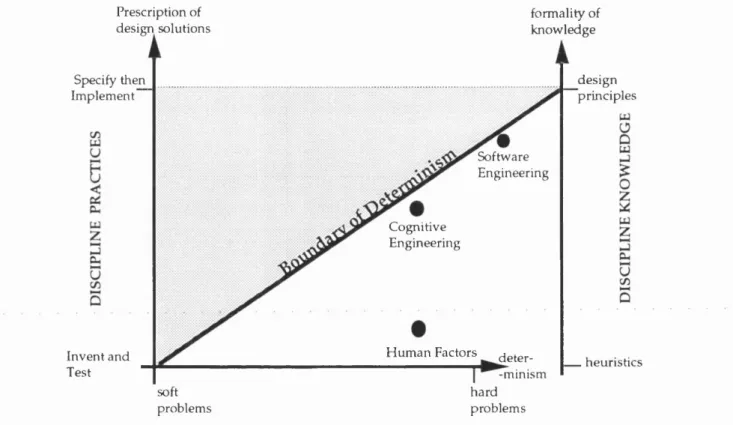
Taken together, the dim ension of problem hardness, characterising general design problems, and the dim ension of prescription, characterising design practices, provides a classification space for design disciplines (Dowell and Long, 1989). The space is show n in Figure 1.1, including for illustrative purposes, the speculative location of Software Engineering.
Two conclusions are prom pted by Figure 1.1. First, a general relation m ay be apparent betw een the hardness of a general design problem and the possible prescription of its solutions. That is to say, there is likely a boundary
condition beyond which solutions could not be more prescribed for a
Chapter 1 25
problem of given hardness. The shaded area of Figure 1.1 is intended to indicate this condition, term ed the 'Boundary of Determinism' - because it derives from the determinism of the general design problem. It suggests that whilst very soft problems may only be solved by Invent and Test design practices, very hard problems may be solved by Specify then Im plement design practices.
Figure 1.1. Demarcation of Cognitive Engineering from
Human Factors within the classification space for design disciplines
Prescription of form ality of
design solutions k n ow led ge
Specify ther^ Im plem ent
d esig n principles
Software Engineering
C ognitive Engineering
H um an Factors Invent and
Test
deter--m inism
heuristics
soft hard
problem s problem s
GENERAL DESIGN PROBLEMS
Second, it is concluded from Figure 1.1 that the actual completeness w ith which solutions to a general design problem are prescribed, and the possible completeness, might be at variance. Accordingly, there may be different possible forms of the same discipline - each form addressing the same problem but with characteristically different design practices. Hence, the contemporary discipline of H um an Factors, a craft, will characteristically solve the cognitive design problems mainly by invention and testing. If solutions are prescribed at all, they will be incomplete before being implemented. Yet depending on the hardness of this general design problem, it may be possible, to some degree, for solutions to be prescribed
-Chapter 1
The idea of a disciplin e of C o g n itiv e E n g ineerin g
an d so a future Cognitive Engineering, w ith design practices more
characteristically those of Specify then Im plem ent, m ay be possible. H um an Factors and Cognitive Engineering are located speculatively in the figure.
W hilst the possible completeness w ith w hich a discipline m ay prescribe design solutions is governed by the hardness of the general design problem, the actual completeness w ith w hich it does so is governed by the kind of know ledge it possesses. C onsideration of the traditional engineering disciplines supports this assertion. Their m odern-day design practices are characteristically those of Specify then Im plem ent, yet historically, their antecedents were Specify and Im plem ent practices, and earlier still - Invent an d Test practices. For example, the early steam engine preceded formal know ledge of therm odynam ics and w as constructed by invention and testing. Yet designs of therm odynam ic m achines are now relatively completely prescribed before being im plem ented, a practice supported by design principles. Such progress then, has been m arked by the increasing form ality of know ledge, a move from heuristics to design principles. It is also in spite of the increasing complexity of new technology - an increase w hich m ight only have served to m ake the general design problem more soft, and the boundary of determ inism m ore constraining. The dim ension of the form ality of a discipline's know ledge - ranging from heuristics to design principles, is show n in Figure 1.1 and completes the classification space for design disciplines.
Figure 1.1 suggests that there exists no pre-ordained relationship betw een the form ality of a discipline's know ledge and the hardness of its general design problem. In particular, the design practices of a (craft) discipline supported by experience - that is, by informal knowledge - m ay address a h ard problem . But also, w ithin the boundary of determ inism , that discipline could acquire design principles to enable the prescription of designs.
This section has sought a better purchase on the question of w hether and how Cognitive Engineering m ight evolve from H um an Factors. The potential w ould appear to be governed by the hardness of the cognitive design problem s w hich both address, that is, by the determ inism of the hum an behaviours which it implicates (at least w ith respect to any solution of those problem s). And clearly, hum an behaviour is, in some respects and to some degree, deterministic. For example, drivers' behaviour on the roads
Chapter 1 27
is determ ined, at least w ithin the limits required by a particular design solution, by traffic system protocols. A training syllabus determ ines, w ithin the lim its required by a particular solution, the behaviour of the trainees - both in terms of learning strategies and the level of training required.
Hence, there is at least to some degree the potential for design principles for prescribing solutions to cognitive design problems. The potential for
Cognitive Engineering to evolve from H um an Factors is therefore
concluded. The requirem ents for that evolution are considered in the final section of this chapter.
1.4 R equirem ents for the evolution of C ognitive E ngineering
Cognitive Engineering has now been defined as a discipline of design. The supposed autonom y of this discipline is based on the argued for
independence of the design problems it addresses. Its praxis has been characterised, albeit crudely, as the prescription of design solutions. Its ability to prescribe is seen to be determ ined by its knowledge, characterised as design principles. By these characteristics. Cognitive Engineering is distinguished from H um an Factors, the prior - and essentially craft
discipline, from which Cognitive Engineering m ight be expected to evolve. In this section, the requirem ents for that evolution are considered, w ith guidance from Kuhn's analysis of the progress of science disciplines.
In a postscript later added to The Nature of Scientific Revolutions, K uhn (1970) reconsidered his original discourse on paradigm s in science. A paradigm had been discussed as being "what m em bers of a scientific com m unity share, and, conversely, a scientific com m unity consists of people w ho share a paradigm." W ith this definition, Kuhn developed a characterisation of the process by which science grows, a process of
generating, confirming, rejecting and replacing paradigm s. Perhaps part of K uhn's w isdom had been his avoidance of a definition of scientific
com m unities, and the conceptual snares this m ust entail. Yet the absence of such a definition, and the "vicious circularity" it created in the
understanding of paradigm s, led Kuhn in his Postscript to seek a new definition of paradigms. By this new definition, a paradigm was most precisely described as a 'disciplinary matrix' composed of four ordered elem ents.
Chapter 1 28
The first elem ent of the disciplinary m atrix is "symbolic generalisations." These are the form al components of discipline know ledge, and although often found in symbolic form (e.g., New ton's Second Law), may also be expressed verbally (e.g., action equals reaction). Such generalisations function both as laws and definitions (tautologies), a balance w hich m ay change. For exam ple. Ohm 's Law legislates a relation betw een variables, b u t also re-defined the concepts of current and resistance. The attachm ent of techniques of logical and m athem atical m anipulation to such law s enables scientists to solve problems. The second elem ent of the disciplinary m atrix is a "shared com m itm ent to models." This elem ent is said to be at a m ore m etaphysical level than the first (i.e., it is not empirically verifiable). K uhn illustrates his notion of this second elem ent w ith the exam ple of the m odel of heat as the kinetic energy of the constituent parts of masses. Am ong other things, such m odels are said to supply the discipline w ith analogies and m etaphors, to enable problem s to be identified, to determ ine w hat will be accepted as an explanation and a solution, and to help evaluate the im portance of each. The third element of the disciplinary m atrix is
"values." Values are said to be more w idely held in a discipline th an either sym bolic generalisations or models. K uhn presents the notion of values th ro u g h exam ples, the m ost outstanding exam ple of a value in science being the im portance attached to prediction, and particularly, th at accurate, quantitative predictions are preferable to qualitative ones. The fourth elem ent of the disciplinary m atrix is "exemplars." Exemplars are instances of problem s and their solutions w ithin the purview of the discipline that em body and illustrate the use of symbolic generalisations, m odels and values. Exem plars, and their differences, provide the "fine-structure" of science. Exem plars w ould include the application of Newton's second law to the analysis of the simple pendulum , the paired harm onic oscillator, and the gyroscope. Exemplars w ork both by illustrating the instantiation of m odels and symbolic generalisations, and by sim ilarity relations w ith new and unsolved problem s. By exemplars, scientists learn "to see situations as like each other, as subjects for the application of the same scientific law or law-sketch." They engender a "knowledge of nature acquired while learning the sim ilarity relationship and thereafter em bodied in a w ay of view ing physical situations rather than in rules or laws." W hat is said to result from this process is "tacit knowledge learned by doing science, rather than by acquiring the rules for doing it."
Chapter 1 29
Kuhn's analysis offers guidance in reasoning about the know ledge possessed by Cognitive Engineering, and so also in reasoning about the requirem ents for the discipline's evolution. At base, those requirem ents are to establish a disciplinary matrix. Since K uhn's concern is w ith scientific disciplines, and these have been distinguished from engineering disciplines (1.2.2), a degree of interpretation is needed in obtaining guidance from K u h n .
Symbolic generalisations are a first com ponent of the science disciplinary matrix. For Cognitive Engineering, these are assum ed to be design
principles. Principles w ould function b o th as laws and definitions for the prescription of solutions to design problem s. The attachm ent of techniques to such design principles w ould be expected to enable the prescription of solutions to design problems. Principles m ight be substantive or
m ethodological (c.f., Checkland, 1981). In the current absence of anything more than guidelines for user interface design, it is difficult to be more specific about Cognitive Engineering design principles^. It is particularly unclear as to w hether principles m ight be expressed other than verbally. Principles are one requirem ent for establishing Cognitive Engineering.
A shared com m itm ent to m odels is a second com ponent of the science disciplinary matrix. For Cognitive Engineering, these models are assum ed to be a conception^. A conception w ould be a technical expression of the discipline's ontology (Carroll, 1989; van Gisch and Pipino, 1986). Since Cognitive Engineering is interpreted as a discipline of design, its ontology w ould consist of (classes of) design problems. A technical expression of this ontology w ould be one which is explicit, coherent and complete; it w ould provide the concepts for explicitly, completely and coherently form ulating particular design problems. Because a conception w ould have the scope of the entire discipline's ontology, it w ould also be required to be general. Hence, it w ould be a technical expression of the general design problem of Cognitive Engineering.
^ Cognitive Engineering principles are further discussed in Chapter 11.
^ "To hit upon a right conception is a difficult step. But w hen the step is made, the facts assum e a different aspect from w hat they had before. That done, they are seen from a different view point, and the catching of this view p oin t is a special mental operation requiring special mental endow m ents and habits of thought. Before this n ew state of affairs occurs, facts are seen as detached, separate, lawless: afterwards as possessing innumerable new relationships before unseen." W illiam W hew ell, Philosophy of D iscovery, 1861.
Chapter 1 30