University of Pennsylvania
ScholarlyCommons
Publicly Accessible Penn Dissertations
2017
Making Waves: An Exploration In Learning
Through Art, Science, And Making
Emma Jane Anderson
University of Pennsylvania, [email protected]
Follow this and additional works at:https://repository.upenn.edu/edissertations
Part of theArt Education Commons, and theScience and Mathematics Education Commons
This paper is posted at ScholarlyCommons.https://repository.upenn.edu/edissertations/2166 For more information, please [email protected].
Recommended Citation
Anderson, Emma Jane, "Making Waves: An Exploration In Learning Through Art, Science, And Making" (2017).Publicly Accessible Penn Dissertations. 2166.
Making Waves: An Exploration In Learning Through Art, Science, And
Making
Abstract
For nearly one hundred years, from progressive education to critical pedagogy, philosophers, researchers, and educators have advocated for listening, respecting, and providing space for the learner’s voice within
education. When teaching challenging science content, it is vital to provide both a context for the knowledge and a reason for learning the content. It can be difficult to provide a learning environment that allows learners to gain an understanding of demanding content while being able to have creative
self-expression—agency—without turning youth culture into a static banal concept. This study aimed to tackle the challenge of providing context, a reason for learning, and space for youth voice for a diverse group of teenagers. I explored how a multidisciplinary art and science maker workshop focused on sound encouraged a diverse set of young people to understand sound as energy and creatively express themselves. As part of outreach programming for a large, northeastern science museum in the United States, ten rising sophomores participated in a workshop where they created original sound pieces and built homemade speakers as part of an art exhibit. This mixed-methods early stage/exploratory study found youth exerting their agency through the sound pieces, homemade speakers, and artist statements. There is also evidence of youth gaining understanding of the science of sound. In the discussion, I address how these findings begin to push against two criticisms of the maker movement: what artifacts count as maker projects, and who is considered to be a maker. I go on to examine how, for some youth, learning the science of sound through a multidisciplinary workshop led to having a purpose for understanding challenging science content.
Degree Type
Dissertation
Degree Name
Doctor of Philosophy (PhD)
Graduate Group
Education
First Advisor
Susan Yoon
Keywords
Agency, Equity, Making, Science of Sound, Sound Art
Subject Categories
Art Education | Education | Science and Mathematics Education
MAKING WAVES:
AN EXPLORATION IN LEARNING THROUGH ART, SCIENCE, AND MAKING
Emma Jane Anderson
A DISSERTATION
in
Education
Presented to the Faculties of the University of Pennsylvania
in
Partial Fulfillment of the Requirements for the
Degree of Doctor of Philosophy
2017
Supervisor of Dissertation:
_____________________________________ Susan Yoon, Associate Professor of Education
Graduate Group Chairperson:
___________________________________ J. Matthew Hartley, Professor of Education
Dissertation Committee
Susan Yoon, Associate Professor of Education
Yasmin Kafai, Professor of Education
MAKING WAVES: AN EXPLORATION IN LEARNING THROUGH ART,
SCIENCE, AND MAKING
COPYRIGHT
2017
Emma Jane Anderson
This work is licensed under the
Creative Commons Attribution-
NonCommercial-ShareAlike 3.0
License
To view a copy of this license, visit
iii
ACKNOWLEDGMENTS
I would like to express my gratitude and appreciation to my advisor Susan Yoon.
Without your mentorship and high expectations over the last five years, I would not be
the scholar I am today. Thank you for helping me to see my potential and pushing me to
achieve it. Thank you for believing in me and advocating for me.
I am grateful for the guidance and mentorship I have received from my committee
members Yasmin Kafai and Dottie Lasky. Yasmin, thank you for sharing your depth of
knowledge and love of inventiveness. Dottie, your positive nature, encouragement, and
style have helped me to see the beauty in this whole process. Thank you both for helping
to craft me as a scholar.
There is no way I could have made it through graduate school without the support
of my fellow graduate students. Thank you to Cat McManus and Gideon Dishon for
cheering me on when I felt lost, for making me show up and write even when I didn’t
want to, and for helping me tackle the obstacles on the road to graduation. Thank you to
Joyce Lin who shared her wisdom and knowledge; to Deb Lui who listened to me talk in
circles about my research and helped me find a path out of the weeds; to Miyoung Park
who helped me to recognized all the knowledge and skills I have gained over the last five
years.
Finally, I want to thank my friends and family who cheered for me and never lost
their faith in my abilities. To my friends, Sam Berliner, Amelia Cass, Abby Getman, Kim
iv
me and helped me find the humor in this journey. To my father, Peter Anderson, who
helped to craft me into the writer I am today. To my mother, Ilona Anderson, who
instilled in me a love for the arts. To my brother, Joshua Anderson, who shares a
curiosity and thirst to learn. To my wonderful wife, Lis Pardi, who listens to my depths of
despair in the middle of the night and helps me find the light in the morning. Thank you
to this vast village of scholars, friends, and family that has helped me become who I am
v
ABSTRACT
MAKING WAVES: AN EXPLORATION IN LEARNING THROUGH ART,
SCIENCE, AND MAKING
Emma Anderson
Susan Yoon
For nearly one hundred years, from progressive education to critical pedagogy,
philosophers, researchers, and educators have advocated for listening, respecting, and
providing space for the learner’s voice within education. When teaching challenging
science content, it is vital to provide both a context for the knowledge and a reason for
learning the content. It can be difficult to provide a learning environment that allows
learners to gain an understanding of demanding content while being able to have creative
self-expression—agency—without turning youth culture into a static banal concept. This
study aimed to tackle the challenge of providing context, a reason for learning, and space
for youth voice for a diverse group of teenagers. I explored how a multidisciplinary art
and science maker workshop focused on sound encouraged a diverse set of young people
to understand sound as energy and creatively express themselves. As part of outreach
programming for a large, northeastern science museum in the United States, ten rising
sophomores participated in a workshop where they created original sound pieces and
built homemade speakers as part of an art exhibit. This mixed-methods early
vi
homemade speakers, and artist statements. There is also evidence of youth gaining
understanding of the science of sound. In the discussion, I address how these findings
begin to push against two criticisms of the maker movement: what artifacts count as
maker projects, and who is considered to be a maker. I go on to examine how, for some
youth, learning the science of sound through a multidisciplinary workshop led to having a
vii
Table of Contents
ACKNOWLEDGMENTS ... iii
ABSTRACT ... v
List of Tables ... xi
List of Illustrations ... xii
Chapter 1: Introduction ... 1
Chapter 2: Literature Review ... 4
Creating Relevance in Learning Through Connecting to Students Lived Experiences ... 4
Artistic Expression as a Form of Youth Agency ... 9
Providing a Purpose for Learning through Making ... 12
Electronic crafts intersect multiple disciplines. ... 13
Critique of making – who is entitled to be a maker and what is privileged to be a maker object. ... 18
Common Challenges in Understanding the Science of Sound ... 20
Chapter Summary ... 25
Conceptual Framework and Research Questions ... 26
Chapter 3: Methodology ... 30
Methodology ... 30
Context and Participants ... 31
viii
Daily Workshop Activities ... 37
Artifacts created in the workshop. ... 46
Data ... 47
Artist statement. ... 49
Field notes. ... 49
Photos of speakers. ... 49
Pre/posttest. ... 49
Semi-structured interview. ... 50
Data Analysis ... 51
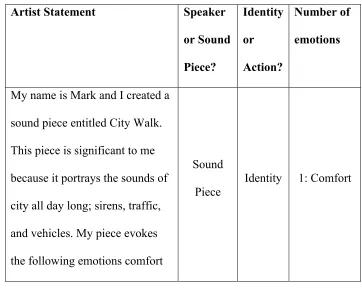
Artist statement. ... 52
Field notes. ... 54
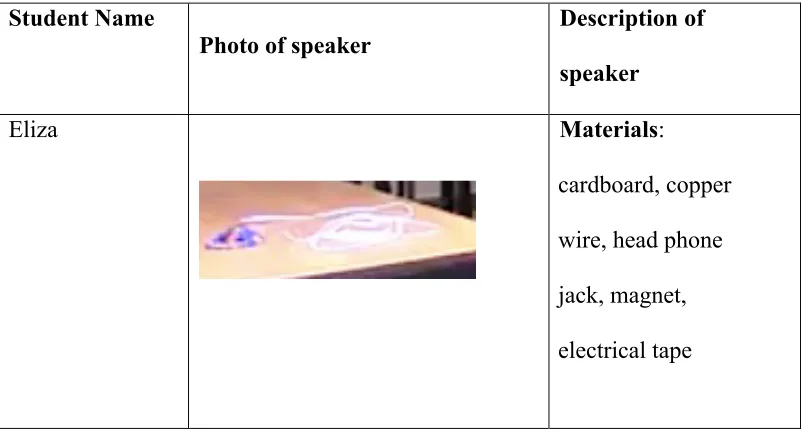
Photos of speakers. ... 54
Pre/posttest. ... 56
Semi-structured interview ... 57
Triangulation ... 72
Validity and Reliability ... 73
Chapter Summary ... 74
Chapter 4: Results ... 75
Yarrow’s and Tom’s Workshop Experiences ... 75
Yarrow: Hidden creative self-expression ... 76
Tom: Grappling with understanding sound through creating, breaking, and making. ... 81
ix
Evidence of Agency and Learning through the Maker Projects Across the Cohort ... 88
Evidence of youth agency in their sound pieces. ... 89
The role of creating a sound piece on youth learning about sound. ... 96
Evidence of youth agency as seen in their homemade speakers. ... 98
The role of deconstruction and construction on youth learning about sound. ... 106
Evidence of youth agency as found in their artist statement. ... 111
Summary of agency and learning through the maker projects across the cohort. ... 114
Youth’s Perceptions of Self-Expression and Science Learning within the Workshop ... 115
Was having room for self-expression important to youth’s workshop experience? ... 115
What aspect of the workshop helped youth learn? ... 120
Summary of youth perceptions of self-expression and science learning. ... 125
Youth Understanding of Sound as Energy ... 126
Comprehension of sound as energy. ... 126
Summary of youth understanding of sound as energy. ... 129
Chapter Summary ... 129
Chapter 5: Discussion ... 131
Equity Oriented Maker Environment ... 131
Art-Forward Maker Activities ... 136
Science Learning through Making ... 140
Summary of Workshop Design Decisions ... 143
Improvement to the Design of the Workshop ... 144
x
Future Studies ... 146
Conclusion ... 148
APPENDIX A ... 150
APPENDIX B ... 167
APPENDIX C ... 171
xi
List of Tables
Table 1 ... 33
Table 2 ... 48
Table 3 ... 53
Table 4 ... 55
Table 5 ... 58
Table 6 ... 65
Table 7 ... 69
Table 8 ... 70
Table 9. ... 90
xii
List of Illustrations
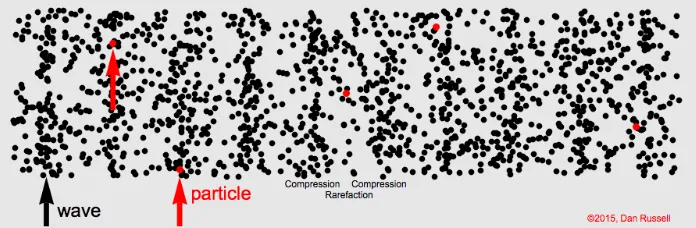
Figure 1 Illustration of layer cake of dense and less dense zones of a medium as sound
energy moves through the medium. The wave is the movement of energy. ... 22
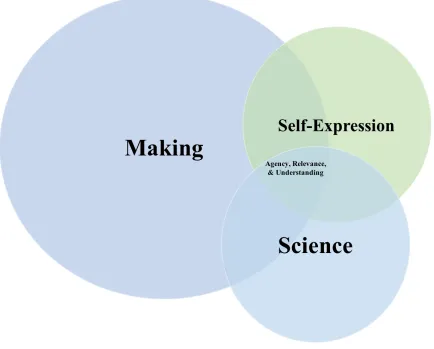
Figure 2 Conceptual framework diagram. ... 27
Figure 3. Workshop day-to-day activities: the yellow highlighted squares are activities for the sound pieces creation, the blue highlighted squares relate to building the speakers, the grey are science-specific activities, the white played a dual role (for example, learning about both the science and the art of sound), and the green are activities related to the art exhibit. ... 37
Figure 4 Critique sheet for youth sound pieces. ... 41
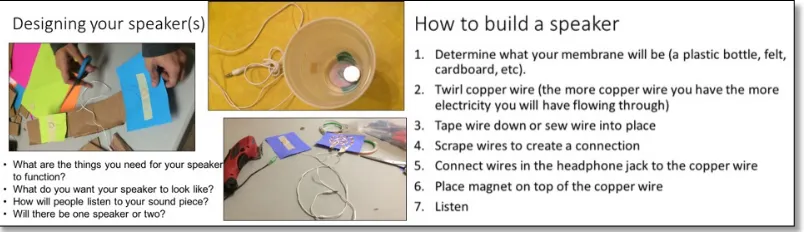
Figure 5 Instruction youth were given for designing and building their speaker(s). ... 43
Figure 6 Design worksheet for speaker(s). ... 43
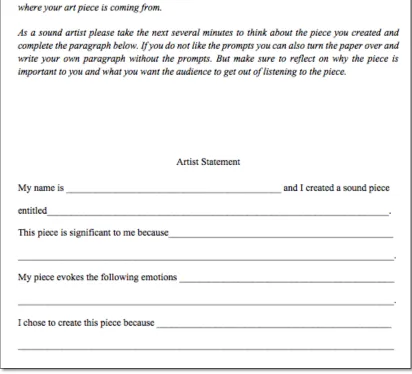
Figure 7. Example artist statement presented to the youth to model what was expected from their artist statements. ... 44
1
Chapter 1: Introduction
Educational philosophers, theorists, and researchers have time and again called
for teaching that connects to learners’ lived experiences, allows for agency, and respects
the learner (Dewey, 1938/1963; Esach & Schwartz, 2006; Papert, 1980; Sieler, 2000). As
these recommendations have been made for almost one hundred years, it is clear that it is
not easy to achieve such a learning environment. This study explores a novel approach to
connecting learning to youth’s lives, creating space for agency, and improving science
knowledge, all through a multidisciplinary art and science maker workshop. In particular,
this study synthesizes ideas of funds of knowledge (Moll, Amanti, Neff, & Gonzales
1992) and constructionism (Papert, 1980) along with self-expression through art, in a
project on sound. I chose sound as it is easily relatable to individuals’ lived experiences
and is also a challenging science concept to understand (Asoko, Leach, & Scott, 1991;
Esach & Schwartz, 2006; Houle & Barnett, 2008; Linder, 1992; Pejuan, Bohigas, Jaen, &
Periago, 2012; Wittmann, Steinberg, & Redish, 2003).
Many physics education researchers point to the need to contextualize sound to
help students understand this concept (e.g., Esach & Schwartz, 2006; Hernandez, Couso,
& Pinto, 2012; Linder, 1992). There are several prominent ways to create context in a
learning environment. Progressives and critical pedagogues alike have advocated for
allowing learners to have voice in their education (Dewey, 1900/1956; Moll, Amanti, &
2
skills, they engage and grapple with challenging science content (Basu & Barton, 2007;
Basu, Barton, Clairmont, & Locke 2009; Seiler, 2001). Another proven way to create
context is through incorporating making in a learning environment. Making comes out of
Papert’s theory of constructionism (1980) which suggests that individuals learn best
through the production of artifacts, digital or physical, while conversing about these
experiences. Making provides context by giving students a purpose to learn vital
information in order to complete their artifact (Fields, Kafai, & Searle, 2012; Kafai et al.,
2013b).
Along with providing context for learning, it is important to respect the learner.
Respecting the learner means the educator has to honor the diverse experiences that
students bring into the learning environment. However, this comprehensive respect can
be challenging. For example, studies that focus on individuals’ funds of knowledge tend
to only privilege a few persons’ experiences (Hammond, 2001) instead of the broad array
of individuals in the learning environment. It can also be challenging to create a learning
experience that does not assume a static notion of youth culture in an attempt to create a
connection to youth (Ares, 2006). One approach to combat these issues could include
multidisciplinary STEAM (science, technology, engineering, art, and math) projects.
Incorporating art into a learning experience could potentially allow for the expression of
a diverse set of experiences and knowledge. Expression through the creation of artifacts
has been successful in bringing youth voice into learning environments (Barton et al.,
self-3
expression using the knowledge and practices of a particular context which helps
individuals develop their identities and perhaps advance their positions in the world is
agency (Barton & Tan, 2010; Basu, Barton, Claremont, & Locke 2009; Hoechsmann &
Poyantz, 2012; Sheridan, Clark, & Williams, 2013). Along with engaging youth agency,
incorporating the production of art into a learning experience allows making to become a
part of the learning environment. Making of a physical object is inherently
multidisciplinary (Blikstein, 2013) requiring engineering, design, mathematics, and more
to complete a project. When making is combined with art this often results in increased
engagement with the learning experience (Kafai et al., 2013a).
This study investigates how an art and science making workshop helps youth gain
in science knowledge and have agency over the learning experience. In particular, this
study explores an electronic crafting project focused on sound. Youth built their own
functioning speaker and created their own sound recording as part of a collaborative art
installation. Through conversations, writing, and making, youth explored both the science
of sound and how sound artists create environments through sound. The following
research questions underpin this study:
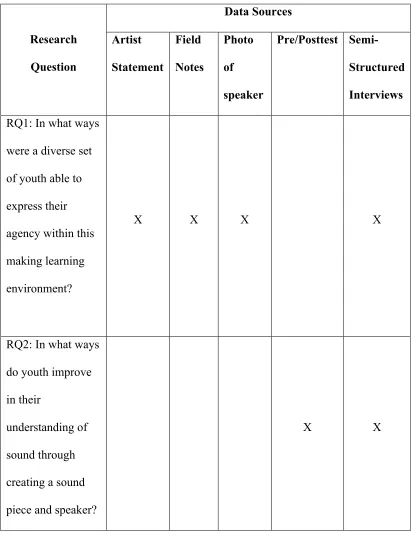
1. In what ways were a diverse set of youth able to express their agency within this
making learning environment?
2. In what ways did youth improve in their understanding of sound through creating
4
Chapter 2: Literature Review
The literature review will begin with a brief explanation of Dewey’s notion of
experiential learning and Moll’s concept of funds of knowledge will follow. Both point to
the importance of connecting learning to learners’ lived experiences and giving room for
agency. I will make an argument for integrating arts into STEM (science, technology,
engineering, and math) education as a means for including agency, a key aspect of funds
of knowledge studies. Including art in STEM allows making to become part of the
learning environment. An explanation of constructionism will follow, which emphasizes
ownership and intention in the learning processes and is one of the major theoretical
foundations of making. A review of several electronic crafting studies and an
investigation into two primary critiques of the maker movement ensue. The literature
review will close with an exploration of the common challenges to learning sound, as
well as recommendations for improving instruction.
In the following section I will briefly delve into Dewey’s experiential learning
and Moll’s funds of knowledge in order to emphasize the importance of creating a
connection to learning and helping to encourage youth agency.
Creating Relevance in Learning Through Connecting to Students Lived
Experiences
Dewey was an advocate for intentional experiential learning. An intentional
5
teacher crafts to provide an authentic moment of learning. To be an educative experience,
it must lead to gains in knowledge and understanding (Dewey, 1938/1963). For Dewey
(1900/1956), education is about more than preparing for the future; it is about being
engaged in the present. To obtain this level of engagement, a child must experience all of
the following: conversation, inquiry, making things, and artistic expression (Dewey,
1900/1956). Furthermore, learning and progress take place when the ideas of the present
build upon the ideas of the past. Since learning builds on past experiences, knowledge is
accumulated over time through intentional learning moments, which are found both
within and through the society in which one lives. Dewey (1938/1963) notes, "[W]e live
from birth to death in a world of persons and things which in large measure is what it is
because of what has been done and transmitted from previous human activities" (p. 39).
Knowledge is transmitted from individual to individual through intentional, authentic
experiences. Likewise, learning builds and grows out of the information and knowledge
held not only within the individual but also within the larger community.
Dewey emphasizes the importance of having due regard for students and where
they are coming from. This is what Moll et al. (1992) call funds of knowledge. In
defining funds of knowledge, Moll et al. (1992) state that the notion of funds of
knowledge pertains to the specific “social, economic, and productive activities of people
in a local region” (p. 139). Acknowledging the resources and information that families
and communities have does not mean that schools should be teaching these same skills
6
practice can build on the familiar knowledge bases that students can manipulate to
enhance learning in…other content areas” (Gonzalez, 2005, p. 43). The instructor’s role
is to create a bridge between the information and skills that learners already have from
being part of a community and family, and the institutional knowledge they need to gain
(Moll et al., 1992).
Funds of knowledgeare the wealth of information and skills that individuals pick
up from their day-to-day experiences. The information and skills could include, among
other things, how to sew a quilt, how to find the healthy snacks at the corner store, how to
cook a meal with vegetables from a household’s kitchen garden, or how to walk safely
from home to school. Knowledge and skills gained from the community are learned, in
context, from individuals one trusts (Moll et al., 1992). Utilizing this resource enables
learners to engage deeply with the experience and have agency in the learning. Learning
then takes place in context of prior knowledge and experiences, instead of remaining
abstract and detached.
The creation of bridges from learners’ funds of knowledge to institutional
knowledge is often achieved by listening, hearing, and respecting the individual (Basu &
Barton, 2007; Gonsalves et al., 2013; Hammond, 2001; Seiler, 2001), leading to a new
space of shared respect and understanding. Openness is also necessary while making
room for the learner to have ownership—whether the learner helps to create curriculum
(Basu et al., 2009; Barton and Tan, 2009; DeGennaro & Brown, 2009); or plays an active
7
artifact, be it a house (Hammond, 2001) or a video (Barton et al., 2013), the learner’s
active role in the learning process helps to construct the bridge.
These bridges can lead to increases in students’ learning in science. Some
researchers have argued that urban youth fail to perform well in science because no
bridge is built between learners’ funds of knowledge and scientific knowledge (Bouillion
& Gomez, 2001; Brickhouse, 1994). However, many researchers have found that if one is
able to tap into youth’s funds of knowledge, youth increase their conceptual
understanding of science (Basu & Barton, 2007; Basu, Barton, Clairmont, & Locke 2009;
Seiler, 2001) and may even develop a sustained interest in science (Basu & Barton,
2007).
While these studies on funds of knowledge show highly interesting
accomplishments, and suggest the importance of lived experience for learning, they all
tend to privilege only a few individuals’ funds of knowledge. For example, a teacher
invites just a few students to participate in curriculum creation instead of asking all of the
students to help (Barton & Tan, 2009), or works with one minority community instead of
engaging all of the various community groups at a school (Hammond, 2001).
Furthermore, Barton and Tan (2009) point to the need to “…identify more teaching
practices and pedagogies that foster the creation of hybrid spaces that are more practical
and can be carried out on a more frequent basis” (p. 71) than are currently employed.
When creating curriculum that attempts to connect to youth, it is vital to avoid
8
curriculum that relates to Pokémon, a popular card game, does not mean that teaching
through Pokémon creates a connection to all youth’s lived experiences, nor that the game
will continue to be significant to youth in the next implementation of that curriculum.
This raises the question: How do educators create a place where all participants have a
chance to express their own knowledge, expertise, and agency without reducing the
learner’s funds of knowledgeto a meaningless, trite notion (Ares, 2006)? This question
has important ramifications, not least of these being that a flexible, pluralistic approach to
what constitutes knowledge provides the validity of youth’s funds of knowledge. One
solution may be through including self-expression. Self-expression does not require the
teacher to recreate the curriculum each year due to a new population of learners (Basu &
Barton 2010; DeGennaro & Brown, 2009), nor does it take on a prescriptive notion of
youth culture (Ares, 2006). Importantly, instead of just privileging a few individuals’
funds of knowledge, making self-expression part of the learning environment allows all
individuals an opportunity to bring their own knowledge into the learning environment.
The following section will focus on art as a form of expression that is centered on
the individual. By adding a dimension of art to science, technology, engineering, and
math—turning STEM into STEAM—it may be possible, in such truly multidisciplinary
projects, to create learning environments that give voice and privilege to youths’ funds of
knowledge, while also providing space for youth to co-create the experience and learn.
For, if art is a form of expression, it is able to give voice and agency to the maker in its
9
Artistic Expression as a Form of Youth Agency
In funds of knowledgestudies, expression has proven to be an important way to
connect to one’s experience, for example, through the co-creation of lesson plans (Barton
& Tan, 2009), through the creation of a collage (Gonsalves et al., 2013), or through the
making of a video on green energy (Barton et al., 2013). Art as a form of communication
(Dewey, 1900/1956) is a way to increase room for expression in the classroom for all
students.Art, as used in this study, does not simply involve traditional practices such as
life drawing or watercolor painting, practices which might be judged in terms of the
learners’ ability to draw or paint. Instead this study views art as universal practices of
elemental creativity which, arguably, everyone has though may not always use. Art is not
purely the craft of drawing a picture or the skill of building a sculpture. Art is the practice
of creativity which, as understood in this study, means noticing problems and finding
unique and unexpected solutions that are manifest in an artifact (Finke, Ward, & Smith,
1992; Kelly, 2001; Sawyer, 2012; Tardif & Sternberg, 1988).
There are multiple ways of learning with the arts: in, about, and through.
Learning in the artsrefers to acquiring particular techniques, such as how to paint with
watercolors (Upitis, 2011). Learning about the arts refers to learning about various
domains of art, such as cubism, modernism, or the history of tango (Upitis, 2011).
Learning through the arts uses the arts as an entry point for other subject matter; for
example, learning about plant morphology through a drawing class (Halverson, 2013;
10
through – are valuable. In this study, I am interested in learning through artistic
production.
In viewing art as a form of self-expression, it is important to view it like other
forms of communication that improve with critique and reworking. Fleming (2008)
explains that one pitfall of perceiving art as only expression is that it can lead to a
challenging place where there is no room for critique of the creation. The result is a very
shallow learning of art (Fleming, 2008). However, to view art as a form of expression,
one need not reduce it totally to self-expression, which can be so defensively personal
that it opposes all critique. To the extent that personal expression is aimed at
communication, it is open to critique. Art, as understood in this study, is a form of
communication centered on the individual, and in this sense an expression of the
individual. Art as an expression of the individual means the artists are referencing
personal, or internal, ideas or notions in their work, rather than established knowledge
(Milbrant & Milbrant, 2011). Just as writing an essay takes work, time, and critique in
order to become the best it can be, so the creation of a piece of art needs to go through
similar processes of critique and revision. If artwork is to be an expression of the self in
the interest of communicating the individual’s funds of knowledge, then it is vital to
afford art equal value and respect with other elements in the learning process.
If art is an expression of the individual, then it can be a means for allowing youth
agency into a learning environment. Agency as understood in this study is creative
11
which helps individuals develop their identities and perhaps advance their positions in the
world (Barton & Tan, 2010; Basu, Barton, Claremont, & Locke 2009; Hoechsmann &
Poyantz, 2012; Sheridan, Clark, & Williams, 2013). Focusing on agency within a
learning environment highlights how learning is “…a complex social activity” (Arnold &
Clarke, 2014, p. 736). This is not a surprising statement, as funds of knowledge studies
emphasize the complexity of learning in terms of where knowledge comes from and
whose knowledge is privileged. In looking at art as means for youth agency, the question
is raised if art gives all learners a space for creative self-expression and a way to bring in
their own ideas into the learning environment, thus creating a connection for learning.
Many have touted the creation of a connection to one’s lived experience as an important
step to teaching challenging content (Basu & Barton, 2010; Esach & Schwartz, 2006;
Hernandez, Couso, & Pinto, 2012; Linder, 1992; Seiler, 2001). However, it is also
important to have intention or a purpose for learning the material at hand. Making can
provide intention for learning (Peppler & Glosson, 2013).
The following section focuses on making which is anchored in constructionism
and provides several examples of making that have led to an increase in knowledge,
engagement, and purpose for learning science content. For these reasons, this study
focuses on making as an important aspect of the learning environment on sound. This
section ends with a discussion of two of the primary critics against the maker movement
12
Providing a Purpose for Learning through Making
Learning takes place through the processes of making and discussing the creation
of things which are digital or physical (Papert, 1980; Harel & Papert,1990). The
construction of digital or physical objects, and discussions that occur around them, have
fueled the theory of constructionism, where the two main goals are “developing new
kinds of activities in which children can exercise their doing/learning/thinking” and an
“...emphasis on project [activities] which [are] self-directed by the student within a
cultural/social context that offers support and help in particularly unobtrusive ways.”
(Harel & Papert, 1990, p. 2). It is through agency over the project, produced within a
certain context and with support, that a student learns. Learning happens in the physical
creation of artifacts that take into account the “cultural/social” (Harel & Papert, 1990, p.
2) context of the learner.
It is the making, together with reflecting, that is important to learning. For the best
results, Papert argues that one must not only do or create something in order to learn, but
one must also participate in conversations about the experience (Harel & Papert, 1990).
According to Papert, one learns best through thinking, listening, and making something.
Since Papert first expressed his theory of constructionism there have been a multitude of
studies exploring making and its affordances for learning. Researchers have found, for
example, that making in education results in students feeling a greater reason for learning
in order to complete the project at hand (Resnick, Berg, & Eisenberg, 2000). Other
13
to learning (Bennett & Monahan, 2013). In addition to the making, the processes of
getting stuck and unstuck while completing one’s final product can lead to a rich learning
experience (Petrich, Wilkinson, & Bevan, 2013).
Electronic crafts intersect multiple disciplines. There are many different
examples of making, ranging from the fabrication labs that are popping up in schools
across the country (Blikstein, 2013) to building electronic puppets (Peer, Nitsche, &
Schaffer, 2014) to tinkering at a science museum (Petrich, Wilkenson, & Bevan, 2013).
This study focuses on the making of electronic crafts to examine if the production of art
is able to build bridges between learners’ funds of knowledge through youth agency
while providing purpose for learning STEM content. An electronic craft is a project that
combines electronic parts such as LED lights, sensors, or other such high-technology
pieces with low-technology crafting skills.
Electronic crafts have the unusual distinctions of bridging disciplines (e.g., Kafai
& Peppler, 2014) while teaching physical science (e.g., Peppler & Glosson, 2013), and
building connections between home knowledge and institutional knowledge (e.g., Fields
& Lee, 2014) while lying at the intersection of engineering and art (Peppler, 2013).
Electronic crafts have the ability to be truly multidisciplinary projects with the potential
to connect with each learner’s funds of knowledge by allowing for expression through
agency and providing a purpose for engaging in learning STEM content knowledge. For
all of these reasons, my workshop uses a multidisciplinary electronic crafting project as
14
STEAM learning through electronic crafts. The next several paragraphs
explore existing research on learning through electronic textiles, a kind of electronic craft
along four dimensions. I’ll begin with a discussion on the importance of artistic vision for
student engagement, followed by an investigation on how the concrete creation of
electronic textiles encourages learning. This section will continue by looking at how
artistic design allows for all students to express their funds of knowledge. Finally, the
closing paragraph explains how these STEAM projects have been able to overcome some
of the challenges characteristic of research that deploys funds of knowledge.
Artistic vision encourages engagement and pride resulting in STEM
learning. Including the arts increases engagement and contributes to motivation to learn
scientific content knowledge. Giving room for making in a learning environment
encourages youth to think creatively and bring new ideas into the space (Lasky & Yoon,
2011). In these new ideas, there is often a tension between the individuals’ artistic design
and required technical function which can stretch youth to grapple with both their artistic
desires and their technical knowledge. This tension can result in a failed first attempt at a
project. However, failure to create a functioning piece, accompanied by time for the
learner to redesign and create a working project, is a rich learning experience (Fields,
Kafai, & Searle, 2012). Failure and redesign resulted in youth learning complex coding
(Fields et al., 2012) and electrical engineering concepts (Peppler, Sharpe, and Glosson,
2013). The inner imperative for self-expression results in a need to learn more advanced
15
envisioned, creating a strong connection between the artistic creation and the STEM
learning (Fields et al., 2012; Kafai et al., 2014a, Peppler et al., 2013). Youth exhibited
increased motivation to learn challenging concepts “just in time” (Gee, 2003). The desire
to complete one’s artistic vision along with the space to fail and try again not only led to
learning STEM concepts, but often resulted in more sophisticated projects than the
researchers had first expected the youth to be able to complete (Kafai, Fields, & Searle,
2014a).
Working with concrete materials facilitates STEM learning. Not only does
the final artistic vision push individuals to learn, but the actual making forces youth to
tackle challenging concepts. Peppler and Glosson (2013) found that youth (ages 7-12)
who engaged in creating projects with electronic textiles made significant gains in their
ability to diagram a circuit while increasing their understanding of current flow, polarity,
and connections. Peppler and Glosson (2013) claim that this gain in knowledge is due in
part to constructing with persnickety materials. The delicate nature of the materials
requires learners to understand more fully how circuits work to ensure that their projects
succeed. For example, in order to make a path that electricity can flow through, they must
pay attention to avoid crossing threads so as not to short the circuits. This level of detail
is not needed when using insulated alligator clip wires for creating circuits.
The physical production of the projects allows learners to “literally see the
connections between physical actions, visual patterns, and relevant theories from physics,
16
2). It is through the production of the object, including figuring out how to work
successfully with the finicky materials, that individuals learn. The creative production
forces youth to make connections and understand the theoretical concepts being taught in
order to successfully complete their project. By having a project that youth are invested
in finishing, and that depends upon the correct handling of delicate materials, learners
are, in a sense, forced to grasp challenging scientific concepts so they can complete a
functional project.
STEAM privileges all students’ funds of knowledge. The arts construct a
bridge between the learner’s funds of knowledge and STEM learning. For example, in a
college-level course on making, with a focus on circuitry, coding, and crafting, one of the
projects was to create a quilt that included electronic textiles. Through such projects, the
class became a “space where…[students’] out-of-school experiences were legitimized
and valued” (Fields & Lee, 2014, p. 11). Knowledge that is often not valued within
academic settings, such as the craft skills needed to sew a quilt, suddenly had a place of
high regard (Fields & Lee, 2014). Artistic skills of quilting were valued, placing a
traditional home craft into an academic setting. Respecting individuals’ funds of
knowledge provided the learners space to feel like experts, and encouraged them to spend
time engaging with the technological aspects of the project (Fields & Lee, 2014). Art
created space for students’ funds of knowledge.
In a study looking at Native American youth’s indigenous funds of knowledge
17
from their indigenous cultural knowledge in the creation of their projects. The Native
American youth used complex stitching and sophisticated designs to hide the lights and
microcomputer behind pieces of felt, tapping into the craft knowledge of their community
-- but not necessarily into the historic cultural knowledge of the community (Kafai,
Searle, Martinez, & Brayboy, 2014b). The authors of this study make the important point
that “culture is not static; its dynamic nature allows that the integration of electronic
technology and popular culture need not necessarily be at odds with the culture of one’s
ancestors” (Kafai et al., 2014b, p. 245). It was through the artistic design of the projects
that youth had the opportunity to show self-expression, voice, and agency in the project
by tapping into their funds of knowledge. The youth created connections to STEM by
learning computing and electrical engineering and getting to express their culture. In and
through the production of art, funds of knowledge are given a space of legitimacy within
the traditional classroom, creating an entry point and motivation for learning challenging
STEM content.
Electronic textile STEAM studies overcome challenges found in funds of
knowledge studies. The key advancement over the earlier examples of funds of
knowledgeendeavors highlighted in this study is that these STEAM studies allow all
learners a voice, unlike the privileged few in the former. For the youth, the inclusion of
the arts, as an academic discipline valued equally with science, opens the possibility for
self-expression, which in turn helps to create a bridge from the student’s funds of
18
the potential to be a readily practical option for an educator to create context and purpose
for learning. No doubt there are other projects that could be similarly effective. For the
purposes of this study, however, it is the epistemological shift to a disciplinary pluralism
that intermingles art with science and technology. This shift seems to point the way to
one very viable approach to utilize the resources of funds of knowledge and include
making in a learning environment by privileging youth agency. However, to ensure that
all youth learn, it is vital to respect the knowledge and experiences youth bring with them
into the learning environment (and not to assume a deficit), and to remain open to a range
of creative products.
In the next section I explore critiques of making in terms of who is a privileged to
be a maker and what projects are viewed as maker projects.
Critique of making – who is entitled to be a maker and what is
privileged to be a maker object. In a critique of Make magazine, the branded popular
media voice of the maker movement, Buechely (2013) found that over 80 percent of the
magazine covers featured white boys and men. Make magazine has a particular idea of
who is considered an exemplar maker. Beyond the popular media, there is a larger view
of makers as middle-class individuals who have leisure time and money to spend on
creating things (Buechely, 2013; Rose, 2014). Yet, creating things by hand is a necessity
for a large portion of the population, as Rose (2014) points out:
19
the road is a mechanic, or is wise about home remedies, or does tile work, and you can swap your own skills and services for that expertise (p. xxv).
Rose is not the first to notice that when the middle class “discovers” practices of the
working class this can result in an erasure of the working-class within that space. In a
feminist critique of the Do-It-Yourself (DIY) movement Dawkins (2011) points out a
similar class and race bias towards who is considered a “crafter.” In both of these
instances, with the middle class “uncovering” creation through their own labor, the
working class and non-whites are frequently ignored as participants in the movement.
The concept that working with ones’ hands as a rich learning experience is
nothing new. Learning through doing was a centerpiece of progressive education, and
during the Arts and Crafts movement of the 19th century there was a similar push to make
personal objects, as seen in the maker movement of today (Rose, 2014; Vossoughi et al.,
2016). Even though creating artifacts is not new and has been a rich part of working-class
culture for a long time, the education community has a tendency to view
“…working-class communities of color…as targets of intervention rather than as sources of deep
knowledge, and skill…” while dominant communities are seen as having “something to
teach or offer rather than something to learn” (Vossoughi et al., 2016, p. 212). Within the
maker research community little is known about how non-dominant youth interact and
experience maker activities and maker spaces (Barton, Tan, & Greenberg, 2016). This
speaks to a need to create maker learning environments that give voice to all learners and
20
Along with analyzing who was on the covers of Make, Buechely (2013) found
three main areas of projects on the covers: robots, electronics, and vehicles. This focus on
tech-forward projects eliminates a wide variety of artifacts that still incorporate STEM
concepts, skills, and knowledge, are created by youth, but could be art-focused instead of
tech-focused. Making is more than flashy tools or particular projects (Vossoughi &
Bevan, 2014). The rich learning through arts is often ignored even though studio art
classes promote learning by doing and creating artifacts (Halverson & Sheridan, 2014)
and many maker spaces are set up using similar pedagogy practices to those found within
the studio arts (Vossoughi & Bevan, 2014). Yet there have been few studies that explore
the arts side of making (Halverson & Sheridan, 2014). My study speaks to a need to
embrace the multidisciplinary nature of making that values all of the disciplines involved,
not just the technology used to create a product; along with the need to respect all of the
learners’ knowledge and experiences, no matter their class or race, through providing
space for agency within the learning environment.
In the following section I will highlight common challenges to learning about the
science of sound and recommendations from physics educators for improving instruction.
Common Challenges in Understanding the Science of Sound
By studying sound, scientists have gained insight into how whales communicate
(Parks, Clark, & Tyack, 2007), how urban centers affect animal populations
(Slabbekoorn & den Boer-Visser, 2006), how to more accurately map the subsurface of
21
experience is a difficult concept to understand (Asoko, Leach, & Scott, 1991; Esach &
Schwartz, 2006; Houle & Barnett, 2008; Linder, 1992; Pejuan, Bohigas, Jaen, & Periago,
2012; Wittmann, Steinberg, & Redish, 2003) and is often poorly taught (Hreptic,
Zollman, & Rebello, 2010).
Sound is energy; or, as stated slightly differently, “sound is conceived as the event
produced by the vibrations of an object called the sound source. These vibrations are
propagated through an elastic medium which gradually transmits its state of compression
or dilation, without transport of matter” (Hernandez, Couso, & Pinto, 2012, p. 703).
Imagine the sound event as a drum being hit by a mallet. As the mallet hits the surface of
the drum, the surface vibrates. This vibration causes air molecules to collide creating a
zone of dense air (compression). Where the air molecules were before the vibration is
now less dense (rarefication). This “layer cake” effect of dense and less dense air ripples
through the medium. It is this movement through the elastic medium, in this case, air, that
is transferred outward. The individual air molecules stay more or less in the same place,
but the mechanical energy of the vibration continues to move concentrically away from
the sound source. Only when one’s ear interprets these layer cakes of dense and less
dense air can one hear the drum beat. Figure 1 is an illustration of this phenomenon. It is
important to understand that mechanical energy is pulsing through the medium and the
22
Figure 1 Illustration of layer cake of dense and less dense zones of a medium as sound energy moves through the medium. The wave is the movement of energy.
Sound is a process of energy transfer (Lawrence, 2008) and as such is an abstract
concept. Comprehending sound as energy is very challenging. Many individuals hold the
common misconception or preconception that sound is a physical object being moved
through space. This is true for elementary students (Mazens & Lautrey, 2003), for middle
school students (Houle & Barnett, 2008), for secondary students (Eshach & Schwartz,
2006) and for undergraduate physics students (Hreptic, Zollman, & Rebello, 2010).
Typical methods for teaching about sound involve explaining the macroscopic
functions of mechanical waves (frequency, amplitude, etc.) and a microscopic description
of how molecules move when vibrations of sound energy pass through (Hernandez,
Couso, & Pinto, 2011). This is a very theoretical and abstract approach to teaching and
learning. Previous examples of curriculum that have attempted to create context for
learning sound include connecting to the human body through a unit focused on auditory
health (West & Wallin, 2013), and focusing on the local natural environment through a
unit that explored how birds’ songs change in an urban environment, compared to a more
23
West and Wallin (2013) implemented their curriculum through written
assignments, experiments, group work, and discussions. The discussions included
students figuring out how to draw the transmission of sound. West and Wallin (2013)
provided little space for youth agency within their curriculum, but did find an increase in
understanding of sound as energy after their intervention. Houle and Barnett (2008) used
their unit to challenge their students to “explore how birds living in the city adapt their
communication systems to deal with urban noise” (p. 243). Students posed research
questions, and collected and analyzed data using sound visualization software and sound
recordings. Houle and Barnett (2008) created the potential for youth to express their own
agency by having them create their own experiments. However, as this study did not
explore agency, it’s unclear if students felt they could express it. Unlike West and Wallin
(2013), Houle and Barnett (2008) found no significant gain in students’ understanding of
sound. They attribute this non-gain in knowledge, in part, to the robust preconceptions
students have with regard to sound.
There have been several recommendations concerning how to improve youth’s
understanding of sound. West and Wallin (2013) found that classes that used formative
assessments had students who performed better in overall understanding of sound
compared to classes that did not utilize formative assessments. In the classes that
implemented formative assessments, the teachers either gave encouraging feedback to
students, or carefully adjusted the next day’s instructions based on students’
24
waves behave the same as water waves could be due, in part, to the colloquial
understanding of the term “wave,” as associated with water that appears to have a
sinusoidal action. A sound wave is a mechanical compression wave and does not travel
the same way as an ocean surface wave. Along with cautioning against confusion over
the word “wave,” Hrepic, Zollmand, and Rebello (2010) recommend saying “propagate”
rather than “travel” or “loudness” rather than “volume” to proactively avoid possible
misunderstandings. Other researchers have pointed out how common demonstrations,
such as using a Slinky to show wave propagation, can confuse rather than enlighten the
learner on how waves move (Houle & Barnett, 2008; Linder, 1992). Leite and Afonso
(2001) note that most textbook illustrations of sound movement support common
misconceptions instead of refuting them.
Along with these more detailed recommendations, many physics education
researchers have pointed out the need to connect learners’ lives to learning about sound,
therefore creating context for learning (e.g., Esach & Schwartz, 2006; Hernandez, Couso,
& Pinto, 2012; Linder, 1992). It is unclear from previous studies if youth felt a
connection to the learning, or reason for learning, about sound— a key idea for
improving learning about sound (Esach & Schwartz, 2006; Hernandez, Couso, & Pinto,
2012; Linder, 1992). My hope is that, in this multidisciplinary science and art workshop,
25
Chapter Summary
Progressive educators and cultural pedagogues advocate for respecting the
knowledge and skills learners bring with them and giving agency to learners (Barton &
Tan, 2010; Dewey, 1938/1963; Moll et al., 1992). While these ideas are well established,
it can be challenging to create such a learning environments. For example, just trying to
provide a connection to learning particular content can be hard to do (Seiler, 2001).
Providing context and a purpose to learning content has been suggested by many as a
way to help learners understand the science of sound, a particularly challenging science
concept (Asoko, Leach, & Scott, 1991; Esach & Schwartz, 2006; Linder, 1992; Pejuan,
Bohigas, Jaen, & Periago, 2012; Wittmann, Steinberg, & Redish, 2003). Funds of
knowledge researchers have found that when youth are given a space for
self-expression—agency—learners feel valued, and more engaged and interested in learning
STEM content (Basu & Barton, 2007; Basu et al., 2009; Hammond, 2001). When trying
to create a connection to the taught content, educators face the challenge of boiling down
to pithy details the learner knowledge and skills (Ares, 2006). Including the production of
art in a learning environment can give youth a means for creative self-expression. Maker
activities through multidisciplinary projects can provide both a purpose for learning
content (Field et al., 2012; Pepper & Glosson, 2013) and a way to value the skills youth
have (Kafai et al., 2014b) while helping youth feel engaged in learning (Kafai et al.,
2014a). Yet we as a research community know little about how non-white
26
There has been a tendency within the maker community to assume that white
middle-class individuals have more knowledge and skills in terms of making compared to
working-class non-white individuals (Buechley, 2013; Rose, 2014; Vossoughi et al.,
2016).
My study presumes that a multidisciplinary art and science maker workshop,
where youth learn about sound from both a science and art perspective while building
their own functioning speakers, will give a diversity of youth both agency and a purpose
for learning the science content. In the following section, I explain the conceptual
framework underlying the design decisions I made in creating such a learning
environment for all youth.
Conceptual Framework and Research Questions
This study aims to determine if youth are able to have agency and find relevance
and intention for understanding challenging science content by participating in a
multidisciplinary art and science maker workshop. Research on funds of knowledge,
electronic crafts, and challenges to learning sound underpin the curriculum for this study,
along with Dewey’s experiential learning, Papert’s learning theory of constructionism,
and the view of art as means of self-expression. Error! Reference source not found.
shows a visual of my conceptual framework, which gives making more space than
self-expression and science. It is my hypothesis that the intersection of self-self-expression and
science through making will allow youth to experience their agency while finding
27
Figure 2 Conceptual framework diagram.
In the funds of knowledge literature, it has been pointed out that when learners are
given room for self-expression, oftentimes through production of an artifact, they are able
to bring in their own knowledge and feel respected (e.g., Barton & Tan, 2010; Hammond,
2001; Seiler, 2000). This maker workshop incorporates self-expression primarily through
28
and edit these into a piece of their own choosing. These sound pieces will be played
through a handmade speaker. To help the sound piece communicate well with others,
they will also be critiqued and reworked (Fleming, 2008). By providing an aspect of the
project where the youth, with a few constraints, have control over the end result, I believe
participants will be able express their agency without the project attempting to create a
superficial connection to them (Ares, 2006). By providing a space for self-expression, my
hope is that a diverse group of workshop attendees would be able to have agency in the
learning experience, and a space that honors their knowledge and life experiences.
The science aspect of the project follows the recommendations of providing a
reason for learning how sound propagates along with careful use of language and
demonstrations (Esach & Schwartz, 2006; Hernandez, Couso, & Pinto, 2012; Linder,
1992). Formative assessment of student knowledge has been shown to improve student
learning (West & Wallin, 2013); for this reason, each day ends with the participants
filling out an exit ticket which includes, among other questions, “What did you learn
today? Tell me in a sentence or two.” Based on the individuals’ responses to this
question, the following session’s activities will be adjusted. The time devoted to
understanding how sound is mechanical energy will be greater than half an hour (Houle
& Barnett, 2008).
The making aspect of the project includes times for discussion, as well as time for
deconstruction and construction (Papert, 1980). Each participant will build a functioning
29
electrical tape. As the sound pieces and speaker are part of an art installation, each artist
will write an artist statement. The speaker will play the sound piece that the youth
themselves created at the end of the workshop, during the art exhibit. Through framing
the workshop’s culmination in an art exhibit I hoped, to honor the multidisciplinary
nature of the experience.
This study aims to answer the following questions:
1. In what ways are a diverse set of youth able to express their agency within this making learning environment?
30
Chapter 3: Methodology
This chapter discusses the methodology I used to answer my research questions. I
begin by explaining why I conducted a mixed-methods study. Following, I describe the
site where my workshop took place along with the participants who attended my
workshop. I explain the day-to-day activities I designed to teach about sound from both
an artistic and scientific perspective. Finally, I delineate the data collection and data
analysis performed to answer my research questions. In brief, I conducted a concurrent
embedded design, mixed methods, Early-Stage/Exploratory research study (Creswell,
2009; IES, 2013).
Methodology
The Common Guidelines for Educational Research and Development (IES, 2013)
has six stages of research, beginning with foundational research and ending with scale-up
research. My study falls into stage two: Early-Stage/Exploratory research. The goal of
this level of research is to examine “…important constructs in education and learning to
establish logical connections that may form the basis for future interventions or strategies
to improve education outcomes” (IES, 2013, p. 9). Exploratory research builds on
existing research to explore the “development, modification, or evaluation of an
31
using previously studied tools and theories, this study was an exploration of the proposed
intervention to determine if it was a worthwhile learning experience for youth.
This study aimed to determine if youth were able to gain knowledge, and to
explore if youth were able to have agency. I answered these two inquiries through the use
of a mixed methods study. A major advantage of mixed methods is that multiple forms of
data allow for a triangulation of results. Triangulation relates to having multiple kinds of
data to better understand a particular phenomenon (Creswell, 2012), just as sailors use
multiple points in the sky to locate where they are on a map.
In particular, this study followed a concurrent embedded design (Creswell, 2009)
in which both qualitative and quantitative data are collected concurrently, but the overall
study primarily uses one type of data. In this study, both research questions involve
qualitative data, with only my second question using a small sample of quantitative data.
Therefore, the quantitative measure is embedded within a larger qualitative study.
In the following section I describe the setting and participants.
Context and Participants
This study was part of the summer workshops for an outreach program conducted
by a large science museum in the Northeastern United States. My decision to work with
this outreach program was fueled by an interest in broadening the places being studied as
part of the Maker Movement. The Maker Movement has been portrayed as democratizing
access to science and engineering by providing tools, community, and knowledge to
32
underprivileged youth of color (Barton et al., 2016; Vossoughi & Bevan, 2016). In an
effort to increase the scholarship on the broad range of makers, I chose the science
museum’s outreach program as a partner.
Teenagers from the metropolitan region volunteer to apply to be a part of this
outreach program for their entire high school career. Each fall, it admits 15 promising
freshmen who are passionate about various STEM fields, have a GPA of at least 3.5, and
who come from “challenging socioeconomic backgrounds1.” The program provides
weekly STEM enrichment throughout the academic year, summer workshops that run
Monday through Thursday in July and August, and, for junior and senior participants,
help with ACT preparation and college applications. The larger program has participants
from 14 different high schools and 23 different area codes, with the following racial
makeup: 72% African-American, 12% Hispanic, 7% Caucasian, and 9% youth who
identify as Other2.
My workshop ran over four days in July of 2016. I worked with the rising
sophomores who traditionally spend a week of their summer learning about sound. This
allowed my workshop to easily slip into the curriculum plan of the larger program. Table
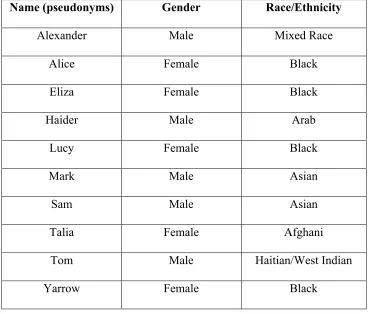
1 shows the demographic makeup of the youth who participated in my workshop. There
1 This is the language used in recruitment material for the outreach program.
33
were ten participants: five male and five female who were all fifteen years old. No
individual identified as White.
Table 1
Demographic data of workshop participants
Name (pseudonyms) Gender Race/Ethnicity
Alexander Male Mixed Race
Alice Female Black
Eliza Female Black
Haider Male Arab
Lucy Female Black
Mark Male Asian
Sam Male Asian
Talia Female Afghani
Tom Male Haitian/West Indian
Yarrow Female Black
Workshop Curriculum
Through four 3.5-hour sessions, youth learned about sound from a scientific and
artistic perspective while making a functioning speaker. In honoring the multidisciplinary
nature of making, I followed a hybrid pedagogy (Vossoughi & Bevan, 2013), picking and
34
aspects from studio art teaching practices including demonstrations, critique, and
open-ended projects (Hetland, Winner, Veenema, & Sheridan, 2007). A typical studio arts
class involves a brief demonstration-lecture, in which the instructor provides information
that is immediately useful to the students and then leaves them ample time to create.
While the students work on the assignment, the teacher walks around providing
as-needed instruction. Time is also set aside for reflection and discussion through critiques
of student work.
Time for reflection is not only an important aspect of studio arts education, but an
integral part of learning as understood from a constructionist perspective (Papert, 1980).
The act of making things is a major aspect of constructionism, and so I also included
parts of the engineering design cycle (Tayal, 2013) to help facilitate youth making. The
engineering process includes time to brainstorm, design, analyze, build, test and iterate.
In particular, my curriculum required that the participants draw a plan (Tayal, 2013) of
their speaker before they could build it.
In terms of learning about the science of sound, I heeded the advice of physics
education researchers (e.g., Houle & Barnett, 2008; Linder, 1992). For example, I
included formative assessment (West & Wallin, 2013), ending each day with an exit
ticket that asked, “In a sentence or two tell me what you learned today,” and adjusted the
next day’s lesson (if necessary) based on the formative assessment. I included a dynamic
visualization instead of the more traditional Slinky demonstration for how sound travels.
35
& Barnett, 2008; Linder, 1992). I chose to use an animation of how sound travels through
a medium, as animations have been shown to improve youth understanding of science
concepts (Hoffler & Leutner, 2007) while many static images of sound movement have
been shown to be confusing (Leite & Afonso, 2001).
I made all of these pedagogical choices to allow for self-expression, space for
making, and learning science; and to help facilitate agency, relevance, and understanding.
Along with mapping the curriculum onto my conceptual framework, I also aligned the
content of the activities with national standards for science, language arts, and studio arts.
37
Figure 3. Workshop day-to-day activities: the yellow highlighted squares are activities for the sound pieces creation, the blue highlighted squares relate to building the speakers, the grey are science-specific activities, the white played a dual role (for example, learning about both the science and the art of sound), and the green are activities related to the art exhibit.
Daily Workshop Activities. Figure 3 shows a visual of the daily activities. The
youth produced three artifacts over four days: sound piece, speaker, and artist statement.
Creating the sound piece (yellow squares) stretched over three days, while building the
speaker (blue squares) took two days and the artist statement (green squares) was written
on the morning of last day. Below I describe in detail the day-to day-activities that took
place during the workshop.
Day 1: Silence
Activity 1: Introduction and paper work (15 min)
I introduced myself and the projects which would be created over the course of
the week: a sound piece and speaker which would be displayed in an art exhibit on
Thursday afternoon. Youth took the pretest on the understanding of sound as energy
(please see the section on Data for more information on this survey instrument).
Activity 2: What is silence? (45 min)
I asked youth to define the term “silence.” We held a discussion around what this
term means and if one can experience silence on earth. Three sound audits were
completed: one of the lobby of the museum, one on the front steps of the museum, and
one in the workshop classroom. Youth were instructed to sit quietly and write down
everything they heard over the course of two minutes. We held a discussion about what