A CLINICAL STUDY ON MUTRASHMARI
Jyoti1, Gajanana Hegde21. PG Scholar, Dept. of Kayachikitsa, Govt. Ayurveda Medical College, Mysore, Karnataka, India.
2. Head, Dept. of Kayachikitsa, Govt. Ayurveda Medical College, Mysore, Karnataka, India
INTRODUCTION
The formation of stone like sub-stance within the mutravaha srotas is called as Mutrashmari1. In ayurvedic lit-eratures Mutrashmari is considered as one among the Ashta Mahagada2. Majority of signs and symptoms of the disease Mutrashmari resembles with that of Uro-lithiasis. It is the third most common af-fliction of the urinary tract. The annual in-cidence is about 1-2 cases per 1000 people. Men are more commonly affected than female with a male to female ratio of 3:1. The peak age for developing calculi is between 30-50yrs, and recurrence is
com-mon3. The treatment principle of urolithia-sis in contemporary science is flush ther-apy in case of stones up to 5mm, in larger stones the advanced procedures like ESWL(Extracorporeal shock wave litho-tripsy) and operative procedures like PCNL(Percutaneous nephrolithotomy), Pyelolithotomy, Nephrolithotomy, Ex-tended pyelolithotomy, Pyelo nephro-lithotomy, Partial nephrectomy, Nephrec-tomy are done4. But these procedures have limitations in various aspects. They are expensive and many a times leads to com-plications such as injury to colon, injury to blood vessels and sepsis5. On the other ABSTRACT
Mutrashmari is one of the prime disease affecting mutravaha srotas (urinary system) involv-ing the basti marma (bladder). Majority of signs and symptoms of the disease Mutrashmari resembles with that of Urolithiasis. It is the third most common affliction of the urinary tract with increased rate of recurrence. In Urolithiasis surgery will be the choice many a times, though they are useful, have limitations in various aspects. They are expensive and involve considerable amount of risk. Considering this situation it is relevant to search for an alterna-tive management, which is both effecalterna-tive and economical. Various measures are described in Ayurveda for the management of Mutrashmari. Hence this study was taken up for the effec-tive management of Mutrashmari vis-à-vis Urolithiasis. Present study was conducted on 35 patients, who were administered with the combination of Shunthyadi churna and Badarashma pishti, for the duration of 30 days. Out of 35 patients, maximum 16 patients had complete remission, 8 patients had marked improvement, 8 patients had moderate improvement, 2 pa-tients had mild improvement and 1patient had no improvement. Overall results on reduction in symptom and size of calculi showed statistically highly significant result at the end of in-tervention with P value of 0.003.
hand, many medicinal formulations men-tioned in ayurvedic literature for the man-agement of Mutrashmari, are cost effec-tive, devoid of complications and provide wide scope for the successful treatment of Urolithiasis. The Ayurvedic formulations Shunthyadi churna mentioned in Gada-nigraha6 and Badarashma pishti (hajarul yahud pishti) mentioned in Rasamritam7 are specifically indicated in Mutrashmari and the drugs of these yogas possess ash-maribhedana and mutrala properties. In addition to this it has kapha-vata pradhana tridoshahara action. These two drugs were selected in combination because; mutrashmari is a chirakari and krichra sadhya vyadhi. Hence the present study was undertaken as an attempt to evaluate the combined effect of Shunthyadi churna and Badarashma pishti in the management of Mutrashmari.
MATERIALS AND METHODS
In the present clinical study, Badarashma was procured from Abdul Ravoof pansari, unani & ayurvedic herbal shop, mandimo-halla, Mysore. Badarashma pishti was pre-pared as per the classical method in GAMC pharmacy, Mysore. Ingredients of Shunthyadi churna were procured and pre-pared by Abdul Ravoof pansari, unani & ayurvedic herbal shop, mandimohalla, My-sore. The patients were incidentally se-lected from the OPD and IPD of Govern-ment Ayurveda Medical College Hospital, Mysore, India. Total 41 patients between the age group of 16 to 70 years, fulfilling the criteria for the diagnosis of the disease were registered for the study. Out of which 6 patients dropped out and the study was conducted on remaining 35 patients who were assigned into single group. Data was collected as per the proforma of the case sheet.
OBJECTIVE OF THE STUDY
To evaluate the combined effect of Shunthyadi churna and Badarashma pishti in the management of Mutrashmari vis-à-vis Urolithiasis
Study design: The study was a clinical study with pre and post test design.
Inclusion criteria
Patients between the age group of 16 to 70 yrs were selected for the study, irre-spective of gender.
Patients with or without the clinical features of Mutrashmari, diagnosed to be having urinary calculi by USG of KUB were included for the study.
Both fresh and treated cases were taken for the study.
Patients with solitary or multiple uri-nary calculi irrespective of location and size were included for the study.
Patients of Urolithiasis with mild to moderate hydronephrosis were selected for the study.
Exclusion Criteria
Patients suffering from renal patholo-gies like renal failure, severe hydro-nephrosis, pyonephrosis and renal tu-mors were excluded.
Co-morbidity of obstructive diseases of urinary system like urethral stricture ,CA ureter ,CA prostate ,meatal steno-sis and bladder neck contracture were excluded.
Pregnant & Lactating women were ex-cluded.
Patients of Urolithiasis with other ma-jor systemic disorders such as tuber-culosis, uncontrolled diabetes which interfere with the treatment were ex-cluded.
Diagnostic Criteria Objective criteria
www.iamj.in IAMJ: Volume 3; Issue 12; December- 2015 This was considered as the primary criteria
for diagnosis. Subjective criteria
Basti Shoola (pain in abdomen or flanks)
Sarakta mutrata (haematuria)
Mutra daha (burning micturition)
Mutradhara sanga (obstruction in the flow of urine)
Mutrakrichrata (difficulty in micturi-tion).
These symptoms were considered as the secondary criteria for diagnosis.
Investigations
Blood–HB%, TC, DC, ESR, RBS.
Urine–Microscopy, sugar, albumin.
Specific investigation -Ultrasonogra-phy of Kidney, ureter and blad-der(USG of KUB).
Intervention
Shunthyadi churna–
shunthi, agnimantha, pashanabheda, varunatwak, gokshura, abhaya, arag-wada phala kashaya -30ml with 1gms of equal quantity of shuddha hingu,
yavakshara and saindhava lavana churna, thrice daily, before food, for 30 days.
Badarashma pishti – 500mg, twice daily before food with honey, for 30 days.
Statistical analysis
Data was collected before and after inter-vention and was statistically analysed for the improvement in symptoms and change in size of calculi, using Contingency coef-ficient test, paired sample t test, Chi square test and Descriptive statistics using SPSS for windows software.
Assessment parameter: Objective parameter
USG of KUB was done before (0th day) and after intervention (31st day) for the as-sessment of change in size of urinary cal-culi.
Subjective parameter
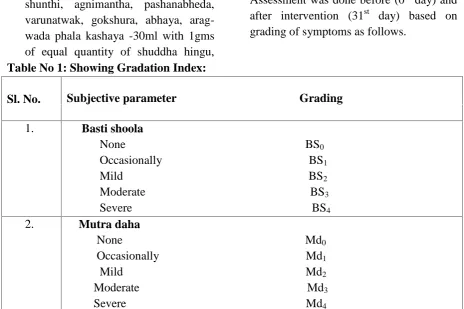
Assessment was done before (0th day) and after intervention (31st day) based on grading of symptoms as follows.
Table No 1: Showing Gradation Index:
Sl. No. Subjective parameter Grading 1. Basti shoola
None BS0
Occasionally BS1
Mild BS2
Moderate BS3
Severe BS4
2. Mutra daha
None Md0
Occasionally Md1
Mild Md2
Moderate Md3
3. Mutradhara sanga
None Mds0
Occasionally Mds1
Mild Mds2
Moderate Mds3
Severe Mds4
4. Sarakta mutrata
None Srm0
Occasionally Srm1
Mild Srm2
Moderate Srm3
Severe Srm4
5. Mutrakrichrata
None Mkr0
Occasionally Mkr1
Mild Mkr2
Moderate Mkr3
Severe Mkr4
Assessment of overall effect of therapy: Overall effect of the therapy was as-sessed in terms of complete remission, marked improvement, moderate ment, mild improvement and no improve-ment by adopting the following criteria.
Complete Remission: 100% relief in Chief complaints and absence of cal-culi in USG of KUB.
Marked improvement: More than 75% and less than 100% improvement in chief complaints and reduction in size of stone was recorded as marked improvement.
Moderate improvement: Less than 75% and more than 50% improvement in chief complaints and reduction in size of stone was recorded as moderate improvement.
Mild improvement: Less than 50% and more than 25% improvement in chief complaints and reduction in size of stone was considered as mild im-provement.
No improvement: less than 25% im-provement in chief complaints and
re-duction in size of stone was recorded as no improvement.
OBSERVATIONS AND RESULTS General observation
In the present study totally 41 patients were registered, out of which 6 patients discontinued intervention at different levels of the clinical study. 3 patients discontinued as the symptoms relieved before the intervention completed, 2 patients could not complete the course of intervention because of their occupational schedules and another 1 patient discontinued after one week of intervention for unknown reasons.
Thus these observations were based on the clinical trial on 35 patients registered in the study. The data was collected in the case sheet specially designed for the present study and were analysed after the completion of the study.
www.iamj.in IAMJ: Volume 3; Issue 12; December- 2015 In the present study, 26 (74.28%) cases
were freshly detected, with Chronicity be-low 1 month in 24(68.57%) patients. It was observed that, 31 (88.57%) patients had mixed type of food habit, 20(57.14%) patients had the habit of excess consump-tion of tea – coffee, 20(57.14%) patients had the history of water intake less than 1.5 litres, 10(28.57%) patients had the history of withholding of micturition urge. It was observed that, 19(54.28%) patients had unilateral calculus, 20(57.14%) patients had multiple calculi. In the present sample of patients, the size of calculi ranged from minimum of 3mm to maximum of 17mm. Majority of cases
developed calculi more than 4mm in diameter and multiple in number. More number of calculi was seen in the kidneys followed by vesico-ureteric junction (VUJ). It was observed that the calculus in vesico-ureteric junction and Ureter were expelled faster. The number of the calculus was considerably reduced in many of the patients. The main symptom basti shoola was reduced in maximum number of patients in the mid of intervention itself, which was quite encouraging.
Subjective parameters and objective pa-rameters were assessed before intervention (0th day) and after intervention (31stday).
Table 2: Showing the results on Basti shoola
Before intervention After intervention Basti shoola No of patients Valid Percent No of patients Valid Percent
No Basti shoola 4 11.4 28 80.0
Occasional Basti shoola 1 2.9 5 14.3
Mild Basti shoola 0 0.0 2 5.7
Moderate Basti shoola 12 34.3 0% 0.0
Severe Basti shoola 18 51.4 0% 0.0
Total 35 100.0 35 100.0
Symmetric Measures
Value Approximate Signifi-cance
Nominal by Nominal Contingency Coefficient .655 .000
N of Valid Cases 70
The result on basti shoola showed statistically highly significant result with P value 0.000.
Table No 3: Showing the Results on Mutradaha
Before intervention After intervention Mutradaha No of
pa-tients Valid Percent No of patients Valid Percent
No Mutradaha 16 45.7 34 97.1
Occasional Mutradaha 1 2.9 1 2.9
Moderate Mutradaha 12 34.3 0 0.0
Severe Mutradaha 4 11.4 0 0.0
Total 35 100.0 35 100.0
Symmetric Measures
Value Approximate Significance
Nominal by Nominal Contingency Coefficient .509 .000
The result on mutradaha showed statistically highly significant result with P value 0.000.
Table No 4: Showing the Results on Mutradharasanga
Before intervention After intervention
Mutradharasanga No of
pa-tients
Valid Per-cent
No of pa-tients
Valid Per-cent
No Mutradharasanga 23 65.7 33 94.3
Occasional Mutradharasanga 0 0.0 1 2.9
Mild Mutradharasanga 1 2.9 0 0.0
Moderate Mutradharasanga 9 25.7 1 2.9
Severe Mutradharasanga 2 5.7 0 0.0
Total 35 100.0 35 100.0
Symmetric Measures
Value Approximate Significance
Nominal by Nominal Contingency Coefficient .385 .016
N of Valid Cases 70
The result on mutradharasanga showed statistically significant result with P value 0.016.
Table No 5: Showing the Results on Saraktamutrata
Before intervention After intervention
Saraktamutrata No of
pa-tients
Valid Per-cent
No of pa-tients
Valid Per-cent
No Saraktamutrata 34 97.1 35 100
Occasional Saraktamutrata 1 2.9 0 0.0
Mild Saraktamutrata 0 0.0 0 0.0
Moderate Saraktamutrata 0 0.0 0 0.0
Severe Saraktamutrata 0 0.0 0 0.0
Total 35 100.0 35 100.0
www.iamj.in IAMJ: Volume 3; Issue 12; December- 2015
Value Approximate Significance
Nominal by Nominal Contingency Coefficient .120 .314
N of Valid Cases 70
The result on saraktamutrata showed statistically non-significant result with P value 0.314. Table No 6: Showing the Results on Mutrakrichrata
Before intervention After intervention
Mutrakrichrata No of
pa-tients
Valid Per-cent
No of pa-tients
Valid Per-cent
No Mutrakrichrata 19 54.3 35 100.0
Occasional Mutrakrichrata 0 0.0 0 0.0
Mild Mutrakrichrata 2 5.7 0 0.0
Moderate Mutrakrichrata 9 25.7 0 0.0
Severe Mutrakrichrata 5 14.3 0 0.0
Total 35 100.0 35 100.0
The result on mutrakrichrata showed statistically highly significant result with P value 0.000. Table No 7: Showing the Results on Number of calculus Before and After
Intervention
Before intervention After intervention Stone Number No of patients Percentage No of patients Percentage
Single 15 42.9 14 40.0
Two stones 9 25.7 13 37.1
Three stones 7 20.0 4 11.4
Four stones 4 11.4 4 11.4
Nil 0 0.0 0 0.0
Total 35 100.0 35 100.0
The result on number of calculi showed statistically highly significant result with P value 0.000.
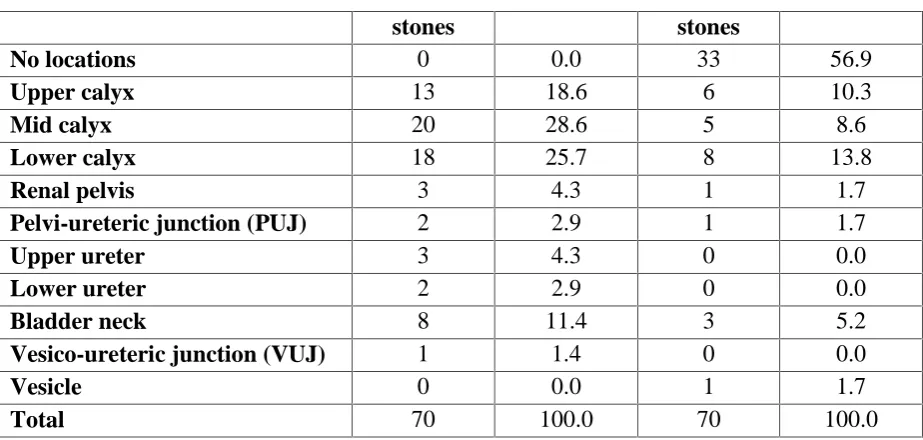
Table No 8: Showing the Results on location of calculus Before and After Intervention
Before intervention After intervention
Location No of Percentage No of Percentage
Symmetric Measures
Value Approximate Significance
Nominal by Nominal Contingency Coefficient .478 .000
N of Valid Cases 70
Symmetric Measures
Value Approximate Significance
Nominal by Nominal Contingency Coefficient .479 .000
stones stones
No locations 0 0.0 33 56.9
Upper calyx 13 18.6 6 10.3
Mid calyx 20 28.6 5 8.6
Lower calyx 18 25.7 8 13.8
Renal pelvis 3 4.3 1 1.7
Pelvi-ureteric junction (PUJ) 2 2.9 1 1.7
Upper ureter 3 4.3 0 0.0
Lower ureter 2 2.9 0 0.0
Bladder neck 8 11.4 3 5.2
Vesico-ureteric junction (VUJ) 1 1.4 0 0.0
Vesicle 0 0.0 1 1.7
Total 70 100.0 70 100.0
The result on change in location of calculi showed statistically highly significant result with P
value 0.000.
Table No 9: Showing the Results on Size of Stone Before and After Intervention
Symmetric Measures
Value Approximate Significance
Nominal by Nominal Contingency Coefficient .548 .000
N of Valid Cases 140
The result on reduction in size of calculi showed statistically highly significant result with P value 0.000.
Paired Samples Statistics
Mean N Std. Deviation Std. Error Mean
Pair 1 B_Size 5.9971 70 2.75770 .32961
A_Size 2.5043 70 3.62369 .43311
Paired Samples Test
Paired Differences t df Sig. (2-tailed) Symmetric Measures
Value Approximate Significance
Nominal by Nominal Contingency Coefficient .560 .000
N of Valid Cases 128
Before Intervention After Intervention No of stones Percentage No of stones Percentage
Nil 0 0.0 41 58.6
< 4 mm 9 12.9 3 4.3
4-6 mm 28 40.0 15 21.4
6-8 mm 18 25.7 4 5.7
8-10 mm 9 12.9 3 4.3
> 10 mm 6 8.6 4 5.7
www.iamj.in IAMJ: Volume 3; Issue 12; December- 2015 Mean Std. Deviation
Pair 1 B_Size -A_Size
3.49286 2.57286 11.540 69 .000
The average size of stone before the intervention was 5.9971 mm which came down to 2.5043 mm after the intervention, mean of stone size before and after intervention is 3.49286. As the data was in pairs, paired T-test was also applied. The result on reduction in size of calculi showed statistically highly significant result with P value 0.000.
Assessment of objective parameter:
Table No 10: Showing the Assessment of Objective parameter Assessment of Objective No of patients Valid percent
Complete remission 16 45.7
Marked improvement 3 8.6
Moderate improvement 8 22.8
Mild improvement 3 8.6
No improvement 5 14.3
Total 35 100.0
The result on assessment of the objective parameter showed statistically significant result with p value 0.008
Assessment of subjective parameter:
Table No 11: Showing the Assessment of Subjective parameter Assessment of subjective No of patients Valid percent
Complete remission 28 80
Marked improvement 4 11.4
Moderate improvement 2 5.7
Mild improvement 1 2.9
No improvement 0 0.0
Total 35 100.0
Symptom
Chi-Square 43.343
df 4
Asymptotic Significance .000
The results on assessment of the subjective parameter showed statistically highly significant result with p value .000
Table No 12: Showing Assessment of Overall effect of Intervention Size
Chi-Square 13.383
df 6
Overall improvement of Treatment
No of patients Valid percent
Complete remission 16 45.7
Marked improvement 8 22.8
Moderate improvement 8 22.8
Mild improvement 2 5.7
No improvement 1 2.8
Total 35 100.0
OVERALL
Chi-Square 16.687
df 3
Asymptotic Significance .003
In the present study, overall assessment of the therapy was done based on reduction in symptoms and size of calculi. Out of 35 patients, maximum 16 (45.7%) patients had complete remission, 8 (22.8%) pa-tients had marked improvement, 8 (22.8%) patients had moderate improvement, 2(5.7%) patients had mild improvement and 1(2.8%) patient had no improvement.
Overall results on reduction in symptom and size of calculi showed sta-tistically highly significant effect at the end of intervention with P value of 0.003. DISCUSSION
The incidence of urolithiasis is more in patients between 30-50years8 of age the same is observed in the present study. Males were more affected than females, the ratio in this study almost correlates with the male – female ratio (3:1) men-tioned in the text, which may be due to higher mean of plasma oxalate concentra-tion and kidney calcium oxalate deposi-tion, which are influenced by androgens in men9. Occupation wise it was more com-mon in labourers, as they are prone to de-hydration because of excess sweating. Higher incidence was observed in poor, as people from lower socio economic group often have poor standards of hygiene and
infection and this is one of the causes for the formation of urolithiasis. Non-vege-tarians or the patients with mixed food habit are at higher risk for developing cal-culi due to intake of animal protein which is rich in calcium oxalate, phosphate and purine, the same is observed in this study, as maximum number of patients had mixed type of food habit.
The individuals who had the habit of with-holding of urge and less water intake were prone to develop urinary calculi which may be as a result of increased concentra-tion and retenconcentra-tion of urine, which leads to increased precipitation of urinary salts. People who are habituated to the intake of tea-coffee and milk are prone to develop hypercalcemia and hence have high risk of developing Mutrashmari, the same is ob-served in the present study.
Probable mode of action of drugs
in reducing symptoms and size of
calculi
Shunthyadi churna
www.iamj.in IAMJ: Volume 3; Issue 12; December- 2015 disintegration of calculi. Haritaki16,
Gokshura17 and Aragvada18 have antimi-crobial action, which helps in reduction of infection in the urinary tract. Gokshura19 has diuretic property, there by helps in ex-pulsion of calculus. Most of the drugs of Shunthyadi churna possess ash-maribhedana, shoolahara and mutrala properties. In addition to this it has kapha-vatahara action. Thus, this formulation acts against Mutrashmari by virtue of its dosha pratyaneeka and vyadhi pratyaneeka prop-erty.
Badarashma pishti20
Mutrala property of this drug helps in flushing the calculi. Analgesic effect of this drug helps in reducing basti shoola. The ashmarihara/ litholitic property of this drug helps in disintegration of calculi. Pit-tahara property of this drug helps in main-taining the pH of urine. Anti inflammatory action of this drug reduces the inflamma-tion, caused due to impaction of calculi anywhere in the urinary tract. Immuno-modulatory effect of this drug arrests the infection and prevents the formation of calculi due to recurrent urinary tract infec-tion (UTI). Thus, this formulainfec-tion acts against Mutrashmari by virtue of its vyadhi pratyaneeka property.
CONCLUSION
The intervention was found to be more ef-fective in calculus upto 8mm in diameter. The treatment protocol was effective in single as well as multiple calculi. The in-tervention was also found to be effective in calculus of all locations but was more ef-fective in calculus of ureter and vesico-ureteric junction (VUJ). This combination of drugs found to be very effective in re-ducing the symptoms of mutrashmari i.e basti shoola, mutrakrichrata, mutradaha, saraktamutrata and mutradhara sanga.
Overall assessment of the intervention re-vealed that Out of 35 patients, maximum 16 (45.7%) patients had complete remis-sion, 8 (22.8%) patients had marked im-provement, 8 (22.8%) patients had moder-ate improvement, 2(5.7%) patients had mild improvement and 1(2.8%) patient had no improvement.Overall results on reduc-tion in symptom and size of calculi showed statistically highly significant ef-fect at the end of intervention with P value of 0.003.
With the obtained results it can be con-cluded that the Shunthyadi churna and Ba-darashma pishti can be safely and effec-tively carried out in patients of Mutrash-mari with good results.
REFERENCES
1. Ayurveda shabdakosha, ven-imadhava joshi and N.H.Joshi, Maharashtra sahitya Sanskriti mandala, Mumbai, 1968.
2. Sushruta, Sushruta Samhita with Dalhana’s nibandha sangraha commentary edited by yadavaji trikamji acharya, surabharati Pra-kashana, Varanasi 2008.pp144. 3. http://www.patient.co.uk/doctor/uri
nary-tract-stones-urolithiasis 4. Manipal Manual of Surgery,
Rajgopal shenoy k, Anita Nileshwara new delhi CBS pub-lishers,2nded.2005,pp 616-620. 5. Essentials of surgery by sunil
chumbar, jaypee brothers medical publishers (p) ltd, New Delhi.pp 1290.
7. Rasamritam of vaidya yadavaji trikamji acharya, English transla-tion by Dr.Damodar joshi ,chawkhamba Sanskrit bhavan, 1st ed.1998.pp127.
8. http://www.patient.co.uk/doctor/uri nary-tract-stones-urolithiasis
9. 169. Mohammed reza naghii 1 ,Manasour babaei2 Mehdi he-dayayi3 “Androgens involvement in the pathogenesis of renal stones formation” PLoS One’v.9(4);2014’PMC3973622 www.ncbi.nlm.nih.gov/.../PMC397 3622
10. Suekawa M, Ishige A, Yuasa K, The compounds gingerol and 6-shogaol have been shown to have a number of pharmacological activi-ties, including antipyretic, analge-sic, antitussive, and hypotensive ef-fects. et al. Pharmacological studies on ginger. I. Pharmacological ac-tions of pungent constituents,(6)-gingerol and (6)-shogaol. J Phar-macobiodyn 1984; 7:836-848. 11. Parvin Rahnama1*, Ali Montazeri2,
Hassan Fallah Huseini3, Saeed Kianbakht3and Mohsen Naseri4 Effect of Zingiber officinale R. rhi-zomes (ginger) on pain relief in primary dysmenorrhea: a placebo randomized trial
http://www.biomedcentral.com/147 2-6882/12/92.
12. R.Vijayamirtharaj*, S.Vincent and N.Senthilkumar Analgesic activity of clerodendrum phlomidis linn. (Aerial parts) Department of Phar-maceutical chemistry, JKKMMRF College of Pharmacy, Ko-marapalayam, Ethirmadu, Namak-kal, Tamilnadu, Inida. International Journal of Research in
Pharmaceu-tical and Biomedical Sciences ISSN: 2229-3701
13. Shumaila Bashir, Mahboob Alam, Bashir 1 1 2 Ahmad, 1Akhtar Aman and 3Javid Ali Screening of Ferula narthex Boiss Crude Meth-anolic Extract for Analge-sic,Gastrointestinal Motility and Insecticidal Activity Department of Pharmacy, University of Peshawar, KPK, PakistanMiddle-East Journal of Scientific Research 14 (4): 471-475, 2013
14. 1 Shiv Ji Gupta,2 A. K. Saxena,3 Neelam Gupta,4 and Shweta Agarwal5 Urolithic property of Varuna (Crataeva nurvala): An ex-perimental study
15. Samra Bashir, Anwar H. Gilani∗ Antiurolithic effect of Bergenia ligulata rhizome: An explanation of the underlying mechanisms De-partment of Biological and Bio-medical Sciences, The Aga Khan University Medical College, Kara-chi 74800, Pakistan. www.elsevier.com/locate/jeth-pharm
16. Manoj kumar, R.C. Agarwal, San-jay Dey, V.K.Rai , Benito Johns On antimicrobial activity of aque-ous extract of terminalia chebula RETZ. ON Grampositive and Gramnegative microorganisms Ja-wahar Lal Nehru Cancer Hospital and Research Centre, Idgah Hill, Bhopal, M.P., India International Journal of Current Pharmaceutical Research Vol 1 Issue 1, 2009 17. Firas A. Al-Bayati and Hassan F.
Al-Mola, Antibacterial and antifun-gal activities of different parts of
www.iamj.in IAMJ: Volume 3; Issue 12; December- 2015 Iraq, J Zhejiang Univ Sci B. Feb
2008; 9(2): 154–159.
18. Mst Rikta Banu * 1, Rishikesh 2, Drishti Rani Ghosh 3, Md.
Anwarul Haque 1,
Md.Mofizur Antibacterial and anti-fungal activities from leaf extracts
of casia fistula..
www.ncbi.nlm.nih.gov › NCBI › Literature › PubMed Central (PMC)
19. Murthy AR1, Dubey SD, Tripathi K. Anti-hypertensive effect of Gokshura (Tribulus terrestris Linn.) - A clinical study, Anc Sci Life.2000 Jan;19 (3-4):139-45.
20. http://www.cancernaturalthera- pyfoundation.org/health-articles-view.php?id=7
Dr. Jyoti
PG Scholar, Dept. of Kayachikitsa, Govt. Ayurveda Medical College, Mysore,
Kar-nataka, India
Email: [email protected]