Improved Customer Service
Using RFID Technology
Patrick Jaska, University of Mary Hardin-Baylor, USA Don Bosco Adarsh Johnson, University of Mary Hardin-Baylor, USA
Jithender Nalla, University of Mary Hardin-Baylor, USA Nandikonda Vinod Kumar Reddy, University of Mary Hardin-Baylor, USA
Raghavender Tadisina, University of Mary Hardin-Baylor, USA
ABSTRACT
Customer service is an important aspect of the service supply chain. Radio frequency identification (RFID) can be used to improve customer service in the service supply chain. This paper examines the use of RFID in the service supply chain by examining case studies and illustrating RFID usage with respect to both internal and external customer service.
Keywords: Radio Frequency Identification (RFID), service supply chain, customer service
INTRODUCTION
he use of technology in the delivery of service has changed the way services are designed and delivered The use of technology to improve customer service include self-service technologies such as automated teller machines or self-service fuel dispensers. This has been made possible through the use of computers and the Internet. Radio frequency identification (RFID) technology has also improved the day-to-day delivery of service operations. With these ubiquitous technologies service operations will expand to new levels.
RFID is a technology that can create strategic advantage and improve customer service. With Wal-Mart and the US Department of Defense‟s decision to move RFID to the forefront as a strategy for improving supply chain operations, RFID has become an efficient and effective tool for both internal and external customers in those organizations (Reyes and Jaska, 2006). While the use of RFID in different business applications has been around for several decades (Reyes and Frazier, 2007), its emerging use as automatic identification has moved into different logistics contexts (Holmqvist and Stefansson, 2006). Today‟s RFID applications range from saving lives in the hospitals by tracking patients, equipment, and staff at one end of the spectrum to improving inventory management and manufacturing operations at the other end of the spectrum.
This paper will examine the effect of RFID on the delivery of customer service in organizations. The service profit chain (Heskett, 1994) will be used to analyze four case studies where RFID has been employed. The next section of the paper gives an overview of RFID technology. In the following section, some of the literature is examined related to RFID in the service sector. The next section is an explanation of the service profit chain followed by a review of the four case studies. The last two sections will be a discussion of the service profit chain in relation to the case studies followed by conclusions and suggestions for further research.
RFID TECHNOLOGY
RFID (Radio frequency identification) refers to small electronic devices, i.e., a tiny chip, that can be attached to an item. The basic components of RFID are software, antenna, and the tag. There are two types of tags called active and passive tags. The active tags send out a signal while the passive tags receive a signal sent by a reader. RFID reduces manual intervention while tracking items.
In World War II the British used RFID to identify incoming planes (Carlson, 2004). Although RFID technology is still emerging, governments and companies are already exploring a number of proof-of-concept applications. RFID technology has been identified as a tool that has the capability of increasing the visibility of materials in a supply-chain (Angeles, 2005).
RFID has taken business to new heights and has given new dimensions and standard for business. Supply chain management plays a major role in business; therefore it is compulsory for a company to maintain records of suppliers and also to track its inventories. RFID not only provides services like tracking and security internally within the organization but also it provides security to customers. RFID has made businesses more flexible and transparent (Zhekun et al, 2004, Barua et al, 2006, Reyes and Jaska, 2007).
RFID IN THE SERVICE SECTOR
RFID is an emerging technology intended to complement or to replace traditional barcode technology to identify or track products/services automatically. RFID adds intelligence and minimizes human intervention in the item identification process. The U.S. Department of Defense, with 43,000 suppliers, began changing its entire supply chain in 2005 because it believed that RFID would reduce losses due to lack of information. Today the U.S. Department of Defense is using RFID technology integrated with GPS to track the shipments of major supplies (Asif & Mandviwalla, 2005).
RFID has improved health care by enhancing patient safety reducing medication errors by storing data about the patient in the RFID tag attached to patient. In the health sector there are four RFID functional domains in which RFID can be supplemented or complemented by other technologies:
i) Object/person identification
ii) Data transfer from RFID tags to other tags/ the environment/ back-office applications iii) Sensing/ telemetry/ diagnosis
iv) Integrating health-information infrastructures (Vilamovska, et al., 2009)
RFID technology has reduced automobile theft and secured transactions. Silicon chips are using to secure data and cryptographic algorithms are used to protect RFID data between the chip and reader (Smith, 2006). According to author Ian Smith (2006) many experts believe RFID technology will change the way we think about industry, business; and supply chain development.
THE IMPACT OF RFID ON SERVICE ORGANIZATIONS AND THE SERVICE PROFIT CHAIN
Many organizations are implementing RFID to speed up their business processes in real time applications. According to a Gartner research report (Petty, 2008), RFID revenues may exceed $3.5billion by 2012 compared to $1.2 billion for 2008. One European research firm reported market value could increase up to $25 billion by 2017. Retailers alone could benefit by reducing inventory saving 5 percent of their costs in storage and warehouse expenses (Jeffery et al., 2009).
The impact on service organizations is outlined by a framework (service profit chain) developed by Haskett et al. (1994, 1997). In service organizations, according to the service profit chain, the impact of RFID yields quality of service, employee performance, customer-perceived value, customer loyalty and customer satisfaction. In service organizations good communication is needed between management and employees. For example, Southwest Airlines has good rapport with customers and employees. Fare costs are low compared to the other airlines and loss of baggage is 2% for passengers. Bane One, Intuit Corporation, Southwest Airlines, ServiceMaster, USAA, Taco Bell, and MCI give top priority to customers and employees to manage market needs (Heskett et al., 1994, 1997).
chain deals with the internal functions of the organization. The employees should be loyal and productive. The organization/management should place the right person in the right job which will result in employee satisfaction. When the employee has job satisfaction, productivity and loyalty increase. Phase 2 emphasizes that a productive and loyal employee will be more likely to provide good customer service and will also educate the customer about the product/service. Phase 3 shows that when a customer receives good service, then customer satisfaction will increase and the customer will be more likely to come back to receive service in the near future and/or will guide other customers toward the organization, which results in customer loyalty and new customers. More loyal customers increase revenue and profit (Heskett et al 1997 & Smith et al 2009).
Figure 1. [Adapted from “The Links in Service Profit Chain by Heskett et al (1997) and Theoretical framework by Smith et al.( 2009)]
CASE STUDIES ILLUSTRATING RFID FOR CUSTOMER SERVICE
RFID Enhancing Library Systems
RFID has improved the functionality and services for customers in libraries since 2003. Customers can now self checkout a desired item, when the item passes through a self checkout desk the RFID readers read the tag and records the information about the item and the customer borrowing it into the integrated library system (Ward et al, 2006, Boss 2007).
Library systems have restricted their security access of customer details because of privacy issues (Boss 2007). Tags contain the information about the author and about the customer. This process saves time for customer, but potential privacy issues arise with the interface of RFID tag with the integrated library system after the book is returned (Boss 2007).
In 2005 University of Nevada implemented RFID in its library, it found 500 lost items reporting a saving of $40,000 (Asif & Mandviwalla, 2005). The services and openness of the library system provided by RFID technology was a decision point for big capacity libraries with regard to cost and security. RFID has made it easy for the customers to find books, check for availability of a book, and to reserve in advance the item they want. RFID has improved the flexibility and architecture of the library by its ability to track and make the re-shelving process faster.
Retail Theft Prevention Using RFID
Before RFID technology, theft prevention was done through observation. Employees were responsible for monitoring customers by observing their behavior to prevent theft. Also, customer behavior can be observed by cameras located throughout the store. In the past and even today, some stores use two way mirrors to allow staff to view customers from high above the shopping floor. With the introduction of RFID tags, employees can track products/services to prevent theft in stores.
RFID has made shopping more convenient for the customers. RFID tagging of individual items improves access to data, making it easier to find the item. RFID tags can be helpful to retail stores and provide better customer service through better product/service identification.
Prada‟s flagship store in New York puts e-tags (RFID tags) on all its garments. When the customer selects the product, the employee working in the store can monitor the customer and provide a complete image and other characteristics of the product. (Bednarz, 2002)
RFID tags are used at the University of Hyderabad to prevent fraud and theft of academic credentials. The University is awarding its masters and doctorate degrees embedded with an RFID tag containing the name of the person receiving the degree, year received, type of degree, transcript, and even a picture of the student. Some individuals were fraudulently providing fake degrees for employment. After the introduction of RFID tags it is easier to prevent thefts of degrees and fraudulent behavior (Swedberg, 2007)
Handing at Airports
Quesada (2004) discusses RFID technology implemented in airport baggage tracking at Jacksonville‟s McCarran Airport. The tags on the baggage have read and write capabilities. Security personnel can track the route traveled by the baggage as the tags transmit data.
In 2005 McCarran Airport decided to change its bar code technology to RFID technology. The necessity for this change was the reliability and accuracy achieved by using RFID technology. Previously barcode technology was used to track baggage, around 15 to 30 percent of the baggage was not properly read (tracked) and this baggage had to be read manually. After implementing RFID technology in their baggage section, they had 99.5 percent accuracy in reading baggage (Quesada, 2004).
In the RFID process, first, each and every bag is checked for explosives with the help of RFID readers or interrogators mounted on the conveyors and then the luggage or bag is routed to its appropriate airplane. If an explosive device is detected in any of the luggage, then the security personnel determine the source with the help of the RFID tag (O'Connor, 2005).
and every bag is scanned automatically. Implementing RFID in this area provides accuracy, security and also transparency for the customer.
European airports have implemented RFID to its fullest extent and have completely removed barcode technology. From the check-in point of the luggage until the delivery point, the luggage is tracked using RFID.
Electronic Payments Using RFID
Credit cards with RFID allow shopping without contact to devices or with store personnel. In the future RFID credit cards may be used for online shopping. RFID will be more secure than magnetic strip credit cards for electronic payments”(Venkataramani, Geethapriya.G & Srividya, April 2007).
A Japanese credit card company introduced a two month trial version on contactless payments, called QUIC pay, using cellular phones. The range of QUIC pay RFID is approximately 10 centimeters. The payment is automatically deducted from the customer‟s account and the balance will be billed to their existing credit card like any other card purchase (Berni.D, 2004). Most customers in Japan prefer using cellular phones to pay instead of credit cards. The Kanachu Hire Taxi Company is using the contactless payment method and they are getting more reliable and user friendly results for their customers (Berni, 2004).
QUIC pay skips the authorization process and directly shows the available balance on the chip. One good thing about the system is propinquity or closeness to the customers. For example when shopping there is no need to stand in the line to finalize the transaction, the payment transaction can be done in seconds and no signature is required. In the future, the Japanese are expecting to introduce these technologies to all convenience stores (Berni, 2004).
SERVICE PROFIT CHAIN FOR CASE STUDIES
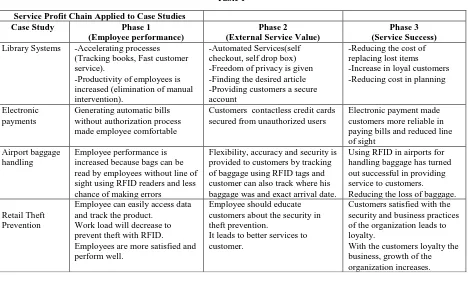
Table 1 summarizes the service profit chain analysis for the four cases. Following the table is a brief explanation of the cases in their relationship to the service profit chain.
Table 1
Service Profit Chain Applied to Case Studies
Case Study Phase 1
(Employee performance)
Phase 2 (External Service Value)
Phase 3 (Service Success)
Library Systems -Accelerating processes (Tracking books, Fast customer service).
-Productivity of employees is increased (elimination of manual intervention).
-Automated Services(self checkout, self drop box) -Freedom of privacy is given -Finding the desired article -Providing customers a secure account
-Reducing the cost of replacing lost items -Increase in loyal customers -Reducing cost in planning
Electronic payments
Generating automatic bills without authorization process made employee comfortable
Customers contactless credit cards secured from unauthorized users
Electronic payment made customers more reliable in paying bills and reduced line of sight
Airport baggage handling
Employee performance is increased because bags can be read by employees without line of sight using RFID readers and less chance of making errors
Flexibility, accuracy and security is provided to customers by tracking of baggage using RFID tags and customer can also track where his baggage was and exact arrival date.
Using RFID in airports for handling baggage has turned out successful in providing service to customers. Reducing the loss of baggage.
Retail Theft Prevention
Employee can easily access data and track the product.
Work load will decrease to prevent theft with RFID. Employees are more satisfied and perform well.
Employee should educate customers about the security in theft prevention.
It leads to better services to customer.
Customers satisfied with the security and business practices of the organization leads to loyalty.
Service Profit Chain (SPC) Analysis of Library Systems
The analysis of SPC on library systems gives an insight on how the organization works internally and externally. Fulfilling the requirements of every phase in SPC will improve the revenue growth and profitability. For the Employment Performance Phase of SPC, analyzing the functions of library systems we can see that the library systems use RFID as a tool to improve efficiency. The processes are accelerated with respect to tracking and faster customer service. RFID has enhanced employee productivity as manual interventions are no longer necessary.
For the External Service Value Phase, when the processes are accelerated the outcome is increasingly productive with regard to customer service. Customers can now find their articles or books they want very easily, as the information about the required article or book is provided in full detail (the author of the book or article, the row where the book or article is available, the rack where the book is, and the number of the book). Customers are comfortable and materials can be found easily with the automated RFID system (self check out systems and self drop box systems). The customers are provided a secure account and guaranteed privacy.
For the Service Success Phase, when technology makes processes easy and comfortable (automated services, security, privacy), the percentage of loyal customers increases. The cost of replacing lost items is reduced with RFID. The cost of planning the information systems architecture is reduced as upgrading becomes flexible.
Electronic Payments and the Service Profit Chain
The case study on electronic payments using RFID follows the service profit chain philosophy. Employee performance is enhanced by generating automatic billing without an authorization process and shows the current balance on the card. This method reduces manual intervention in generating bills to customers.
External service value follows from employee performance with contactless cards secured from hackers or unauthorized users. Security and convenience are important to customers.
Service success is delivered by aiding customers with electronic payments and more reliable bill paying. Using RFID for electronic payment reduces direct customer contact and improves customer security and convenience.
Retail Theft Control Using RFID and the Service Profit Chain
Retail theft prevention using RFID allows employees to track the products/services in the organization. If the employee is satisfied with his/her work, it leads to good products/service.
In the second phase, organization employees should educate the customers about the security and presence of RFID tags in their organization. The service provided to the customers is explained to the customer in this phase.
In the third phase the main role is played by customers. They have to be satisfied with the security measures taken by organization. This leads to loyalty, with customer preference for this company increasing. This leads to success in profit and growth for the organization.
SPC for Airport Baggage Handling
Employee Performance is improved and accelerated by the use of RFID technology as a tool; with manual intervention eliminated. The possibility of errors is reduced. The scanning of individual baggage becomes more flexible as the necessity of line of sight is eliminated. Using RFID as tool reduces errors and improvises performance, accuracy, and efficiency.
Service Success follows with the reduction and elimination of manual intervention reducing the labor requirement making the process more automated. The rate of loss for baggage is reduced. Customers are comfortable with the service; as they experience flexibility, security and accuracy.
CONCLUSIONS AND SUGGESTIONS FOR FURTHER RESEARCH
The use of RFID in the service sector delivers accuracy, efficiency, and flexibility. Business processes in service organizations are transformed from complex form to simple form. The openness and transparency in monitoring services is achieved in these organizations. RFID on a whole has accelerated business processes and has also improved business performance.
This study is limited by its analysis of only four case studies. A larger number of RFID applications should be considered. Another option for analyzing the effect of RFID in service organizations is to interview employees (internal customers) and external customers to determine the success of RFID in those organizations. RFID is helping service organizations deliver better and more effective customer service.
AUTHOR INFORMATION
Patrick Jaska (Ph.D. in Business Administration) is the Chair of the Department of Business Computer Information Systems at the University of Mary Hardin-Baylor. Dr. Jaska has authored and co-authored many articles in the business disciplines.
The late Don Bosco Adarsh Johnson was a Master of Science in Information Systems student at the University of Mary Hardin-Baylor. He graduated posthumously in July 2010. Johnson was an excellent student and friend. He will be missed by family, friends, and fellow students.
Jithender Nalla graduated with a Master of Science in Information Systems in May 2010 from the University of Mary Hardin-Baylor. He is pursuing a career in database administration.
Nandikonda Vinod Kumar Reddy is Master of Science in Information Systems student at the University of Mary Hardin-Baylor.
Raghavender Tadisina graduated with a Master of Science in Information Systems from the University of Mary Hardin-Baylor in July 2010. He is pursuing a career in information systems.
REFERENCES
1. Angeles, R., 2005. “RFID technologies: Supply-chain applications and implementation issues,”
Information Systems Management, 22 (1), 51–65.
2. Asif & Mandviwalla (2005). “Integrating the supply chain with RFID: a technical and business analysis.” Retrieved from http://ibit.temple.edu/programs/RFID/RFIDSupplyChain.pdf
3. Barua, A., Mani, D., and Whinston (2006), A. B. “Assessing the Financial Impacts of RFID Technologies on the Retail and Healthcare Sectors”, McCombs School of Business.
4. Bednarz, A. (2002). “Wireless technology reshapes retailers,” Network World (19) 32, August, 23, 2002 5. Boss, R. W. (2007). “RFID technology for libraries”, Library Technology Reports (Chicago: American
Library Association)
6. Carlson, S. (2004). “Talking tags,” The Chronicle of Higher Education, August 6, 2004. Retrieved from http://chronicle.com/free/v50/i48/48a02901.html
7. Heskett, J.L, Sasser, W.E and Schlesinger, L.A.(1997), The Service Profit Chain, The Free Press, New York, NY
8. Heskett, J.L, Jones, T.O., Loveman, G.W., Sasser, W.E, Jr., and Schlesinger, L.A. (1994). “Putting the service profit chain to work”, Harvard Business Review
10. Jeffery, S.S., Lorraine, L., Mark, G. (2009), “The impact of RFID on service organization: a service profit chain perspective.” Retrieved on June 20, 2009 from www.emeraldinsight.com/0960-4529.htm
11. Meredith, J. (1998), “Building operations management theory through case and field research”, Journal of Operations Management, Vol. 16 No. 4 pp. 441-54
12. O'Connor, M. C. Oct. 25, 2005 “McCarran Airport RFID System Takes Off,” RFID Journal. Retrieved from http://www.rfidjournal.com/article/view/1949/1/1
13. Pettey, C. (2008). “Gartner Says Worldwide RFID Revenue to Surpass $1.2 Billion in 2008,” Gartner, February 28, 2008. Retrieved from http://www.gartner.com/it/page.jsp?id=610807
14. Quesada,T. (2004). “Radio frequency tags may prevent luggage woes,” Jacksonville Business Journal, retrieved online at http://www.bizjournals.com/jacksonville/stories/2004/03/22/story3.html
15. Reyes, P. M. and Frazier, G. V. (2007). “Radio Frequency Identification: Past, Present, and Future Business Applications,” International Journal of Integrated Supply Management, 3(2), 125–134. 16. Reyes, P. M. and Jaska, P. (2007) “Is RFID Right for Your Organization or Application?” Management
Research News, 30(8), 570-580.
17. Reyes, P.M. and Jaska, P. (2006) “A Research agenda for RFID integrated supply chain management studies,” International Journal of Global Logistics & Supply Chain Management, 1(2), 98-103. 18. Smith, I. (2006). “Identifying a need,” Engineer (00137758), 293(7696), 23, March 27, 2006. Retrieved
June 16, 2009, from Business Source Complete database.
http://0search.ebscohost.com.umhblib.umhb.edu:80/login.aspx?direct=true&db=bth&AN=20990250&site= ehost-live
19. Smith, J. S., Lee, L., and Gleim, M. (2009). “The impact of RFID on service organizations: a service profit chain perspective”, Emerald Group, 19(2), 179-194.
20. Swedberg. C (2007). “University of Hyderabad awards e-diplomas,” RFID Journal, October 23, 2007. Retreived from http://www.rfidjournal.com/article/articleview/3699/1/1/
21. Swedberg. C, “Hong Kong Airport Says It Now Uses Only RFID Baggage Tags”, RFID Journal, May 12, 2009, Retrieved from http://www.rfidjournal.com/article/view/4885/
22. Venkataramani, Geethapriya.G & Srividya, (2007). “Mobile phone based architecture for secure electronic payments using RFID credit cards.” Retrieved from:
http://ieeexplore.ieee.org/xpl/freeabs_all.jsp?arnumber=4159855
23. Vilamovska, A.-M., Hatziandreu, E., Schindler, H.R., van Oranje-Nassau, C., de Vries, H., and Krapels, J. (2009). “Study on the requirements and options for RFID application in healthcare,” RAND Corporation, retrieved from http://www.rand.org/pubs/technical_reports/2009/RAND_TR608.sum.pdf
24. Ward, M., van Kranenburg, R., and Backhouse, G. (2006). “RFID: Frequency, standards, adoption and innovation”, JISC Technology and Standards Watch, May 2006, p. 16
![Figure 1. [Adapted from “The Links in Service Profit Chain by Heskett et al (1997) and Theoretical framework by Smith et al.( 2009)]](https://thumb-us.123doks.com/thumbv2/123dok_us/9152001.1452689/3.612.77.436.242.500/figure-adapted-links-service-profit-heskett-theoretical-framework.webp)