100 | P a g e
FEASIBILITY STUDY ON USING GROG WASTE IN
PRODUCTION OF ECOFRIENDLY BUILDING
MATERIAL
Charvi S. Patel
1, Prof. Poonam I. Modi
21
M.E. Student, 2Assistant Professor, Applied Mechanics Department, , L.D.College of Engineering, Ahmedabad (India)
ABSTRACT
The study covered in the present paper is an attempt to ascertain the technical feasibility of utilizing an
industrial waste material ( Grog i.e. crushed fired brick waste ) for manufacturing of the construction building
material i.e. Burnt clay bricks. Bricks are prepared by replacing the conventional base material i.e. clay by
grog in varying percentages of 0%, 10%, 15%, 20% and 25% by wt. The ingredients are mixed and moulded
into the size of actual brick unit. The demoulded bricks are sun dried for the period of 7 days followed by
baking of bricks in kiln at a temperature of approx 900ºC. The bricks thus prepared were tested for the
functional efficiency in terms of surface finish, hardness, soundness, efflorescence, water absorption, bulk
density and compressive strength. The test results shows that strength upto 7.34 N/mm2 is obtained which is not
only higher than that of conventional control mix but also higher than strength required for minimum class of
bricks as per Indian standard code. Also water absorption is less than 20% which satisfies codal requirement
and much less than the conventional control mix.
Keywords: Base material, Feasibility, Grog, Industrial Waste, Sustainable Construction.
I. INTRODUCTION
In the last few years, a lot of research has been focused on look out for innovative and alternative building
material in construction industry. It is the outcome of this research that various types of wastes such as
agricultural waste, industrial waste, mine waste, construction and demolition waste etc. have been channelized
form land fills to labs and back to land with better efficiency and effectively in form of new building material.
These alternative building materials are not only eco friendly and cost effective but they also add to the strength
and durability of the structure. Here grog is used as an alternative material for the production of bricks by
replacing virgin material clay. Grog is a granular material that has been crushed down from fired brick, or other
pre-fired ceramic product. firebrick, or refractory brick is a block of refractory ceramic material used in foundry
bed and walls, and lining of chimney, cooking chamber in wood fired ovens etc. Fire bricks are mostly used in
inside lining of Crucible furnace ,Cupola furnace ,Induction furnace etc. that are used for melting the metal to be
101 | P a g e cupola, being usually made of steel, has inside fire brick lining to resist temperature. The size of a cupola is
generally 12-15 feet long arranged vertically. Raw materials for metal casting are dropped from the top of
furnace and day by day as production increases , lining of fire bricks gets damaged. When the degree of damage
to the lining of furnace becomes such that the stable operation of the furnace can no longer be ensured, lining is
broken down and discarded. These leads to generation of waste. After 25 to 30 tonne production of metal ,
inside fire brick lining of furnace needs to reconstruct. This reconstruction of lining generates about waste of
300 bricks around every month and as no proper solution for disposal of these waste we can think for
sustainable development by reusing it. Therefore here attempt is made to reuse of waste in production of burnt
clay bricks. In case of brick-making activity, at present top soil equivalent of 300 mm from 100,000 hectares
(1000 sq km) of fertile land are consumed annually. continuous use of such virgin materials in manufacturing
the building materials is causing continuous depletion and environmental problem. Therefore it becomes
inevitable to steadily switch over to the use of energy efficient building materials and technologies and
mechanisms to recycle and reuse of building wastes for the manufacture of building materials and products for
the sustainable construction practices. The brick sector consumes about 24 million tonnes of coal per year which
is about 8 % of the total coal consumption of the country. The large coal consumption of the brick industry is
the cause of significant air pollution in terms of carbon dioxide (CO2), carbon monoxide (CO), sulphur dioxide
(SO2), nitrogen oxides (NOx) and suspended particulate matter (SPM) which cause considerable health
problems. Hence there is a necessity of using construction materials that have minimum environmental burdens
is useful in the sustainable development of a nation.
II. LITERATURE REVIEW
C.M.F. Vieira, S.N. Monteiro(2006) [1]: Have examined the effect of grog addition up to 20 wt% on
properties and microstructure of bricks fired at 700°C. Grog was added in 5, 10, 15 and 20 wt% to the clayey
body and cylindrical test specimens were casted with a diameter of 31 mm and 11 mm thick, were prepared by
uniaxial pressing at 20 MPa, with 8 wt% water. Then these specimens were then fired in an electric laboratory
furnace at 700°C. Tests of linear shrinkage, water absorption and mechanical strength were carried out as per
Brazilian standard. Result showed that the grog addition slightly increases the water absorption of the industrial
ceramic body. The mechanical strength first increases with up to 5% of grog addition and then decreases for
higher amounts of addition. So after all evaluated properties it is clear that the additions of grog may be
performed up to 5 wt% without impairing either the processing or the quality of the final ceramic.
C. M. F. Vieira, J. Alexandre, S. N. Monteiro(2006)[2]: In this papergrog screened at two different particle
size, 840 μm (20 mesh) and 420 μm (80 mesh), was used in mixtures with clayey body in 0, 5,10, 20 wt% to
make typical red ceramics for bricks. Cylindrical test specimens, with a diameter of 31 mm and 11 mm thick,
were prepared by uniaxial pressing at 20 MPa, with 8 wt.% water and then electically fired at 700°C and linear
shrinkage, water absorption and mechanical strength were carried out. Result showed that according to the
evaluated properties, additions of grog screened at 20 mesh performed up to 5 wt.%. With a finer particle size,
screened at 80 mesh, additions may be done up to 10 wt.% without compromising the quality of the ceramic.
102 | P a g e Taner Kavas, Bekir Karasu, Ozlem Arslan(2006)[3]: In this paper the refractory bricks waste of a rotary
cement furnace containing of alumina and magnesium chromite were studied in order to determine whether they
could be used in the concrete production as aggregates. Three mortars were prepared by mixing 1 part cement, 3
part aggregate(Alumina ,magnesium chromite waste refractory bricks and standard silica as an aggregate
materials), 0.5 part water by weight. The compressive and bending strength of samples were determined after 2
and 28 days curing. Resistance to chemicals were established by calculating the weight gain of mortars stored in
2 % HCl solution for 1 h and 24 h. Physical integrity against high temperatures were also determine. Result
showed that mortar containing magnesium chromite waste as an aggregate has slightly lower compressive
strength than standard mortar but much higher than mortar containing alumina waste. Bending strength of
mortar containing magnesium chromite waste was much higher than remaining mortar also HCl absorption
percentages were lower compared to other mortars. Also it has retained its physical integrity up to 1200°C
whereas mortar containing alumina waste was chipped off at 1050°C. So, it is clear that the properties of
magnesium chromite based refractory waste aggregate are comparable to those of the conventional concrete.
III. EXPERIMENTAL PROCEDURE
3.1 Materials and its properties
The raw materials used in this study were the base material and waste material grog. Base material was the
agricultural soil, used in kiln had 72% of fines and remaining content of sand which was confirmed by
performing wet sieve analysis as per I.S. standard [4]. Grog ( refractory waste ) was obtained from Foundry
located at Naroda G.I.D.C.(Gujarat). In this study the fire brick waste was crushed and screened by passing
425µm I.S. sieve generating a powder material, which is denoted here as grog. Physical and chemical analysis
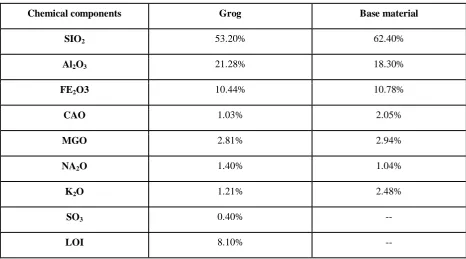
of both the base material and grog was carried out. Result of chemical analysis shows that grog has good silica
content which confirm its feasibility for production of bricks with base material. All the tests were carried out in
accordance with the relevant Indian standards. The results of the tests are listed below
.
Table 1. Physical properties of base material Table 2. Physical properties of grog
Properties value
Bulk Density 1809 kg/m3
Specific Gravity 2.23
Water absorption 4%
Free Swelling ratio 0.9
Properties value
Wet sieve analysis Average fines =72%
Free swelling ratio 1.2
Standard proctor test OMC=13.61%
103 | P a g e Table 3. Chemical analysis of grog and base material
Chemical components Grog Base material
SIO2 53.20% 62.40%
Al2O3 21.28% 18.30%
FE2O3 10.44% 10.78%
CAO 1.03% 2.05%
MGO 2.81% 2.94%
NA2O 1.40% 1.04%
K2O 1.21% 2.48%
SO3 0.40% --
LOI 8.10% --
3.2 Sample Preparation
Grog was added in 10, 15, 20, 25 wt% with base material and first dry mixing was done. Then water was added
to the prepared mix of sufficient moisture, as per requirement [5]. Also one control mix was prepared without
addition of grog with experimental bricks for the purpose of clear comparison of various physical and
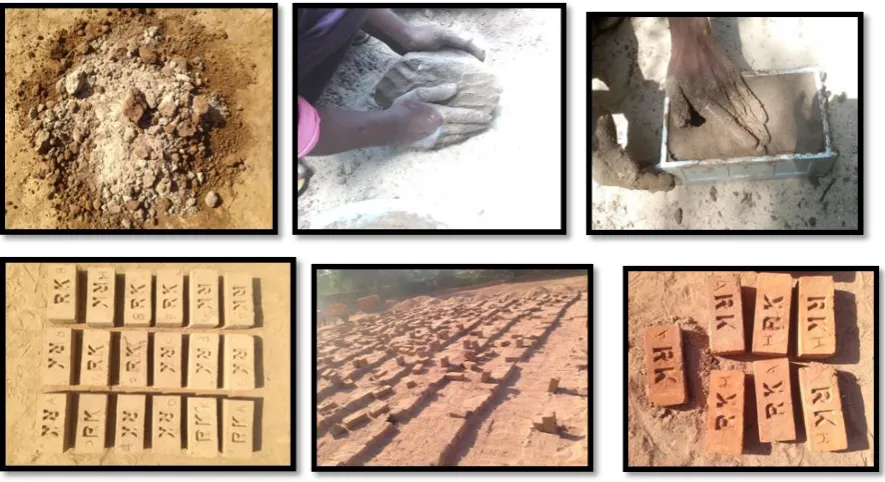
mechanical properties between convention brick and bricks with addition of grog. After mixing of ingredients a
dough was prepared and it was thrown with force into the moulds prepared as per Indian standard. The extra
remaining soil was then scraped out with a leveler and then the mould was inverted and brick was removed
easily without force. Here three bricks specimen were casted for each mix of size 220 mm X 100 mm X 75 mm.
Bricks thus prepared were sun dried for 7 days and then fired in the kiln for 7 days at temperature of approx
900°C. Name of mix is given in terms of BM and G. i.e. BM90G10 indicates mix with 90% base material and
10% grog.
Table 4. The proportions of the mixtures for brick making
Mix Grog Base Material
BM90G10 10% 90%
BM85G15 15% 85%
BM80G20 20% 80%
104 | P a g e
Fig. 1 procedure of making bricks
3.3 Tests and Results
3.3.1 Hardness, Soundness, and efflorescence test
Hardness test of the bricks was performed by scratching the surface of bricks with metal nail and there was not
seen any deep indentation. Soundness test was performed in which the bricks were struck with each other and
the sound recorded was ringing. Lastly the efflorescence test was performed as per IS 3495 – 3 (1992) in which
bricks were immersed in water of depth 25mm. Bricks were kept as it is until all the water was absorbed and
again same water was added and allowed it to evaporate as done before. Efflorescence was recorded after
second evaporation and it was absolute nill as there was no deposition of salt on the surface of bricks. So bricks
were passed through all the physical tests.
3.3.2 Water absorption
Water absorption test was carried out as per IS 3495 – 2 (1992). Weight of bricks removed from the kiln were
recorded. Then bricks were immersed completely in clean water for 24 hours. increase in weight of the bricks
was noted and water absorption was calculated. Value has to be less than 20% as per Indian standard code.
Result of water absorption is shown in Fig. 2. which shows that all mixes satisfy codal provision. Water
absorption of control mix is higher than that of bricks made by addition of grog with base material, which
105 | P a g e Fig. 2 Water absorption of the bricks versus percentage of grog
3.3.3 Compressive strength test
Compressive strength tests of the bricks was carried out as per IS 3495-1 (1992). The aim was to achieve the
brick with compressive strength grater of 3.50 Mpa to satisfy the strength criteria for at list lower class of
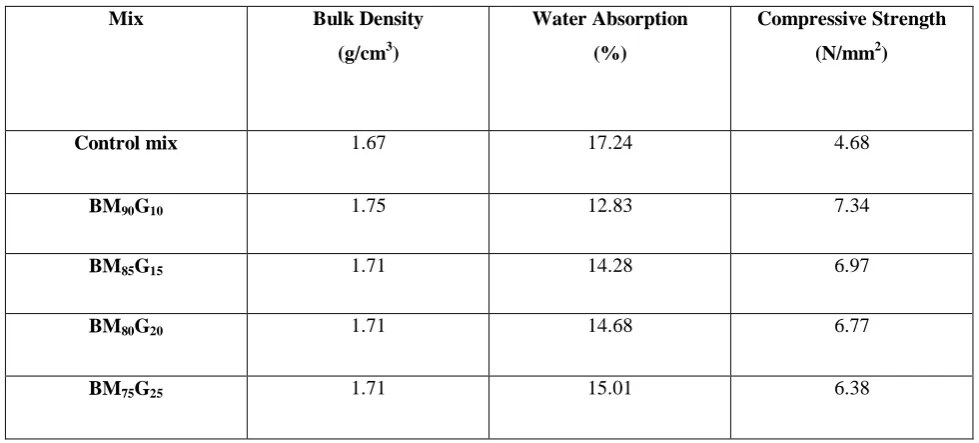
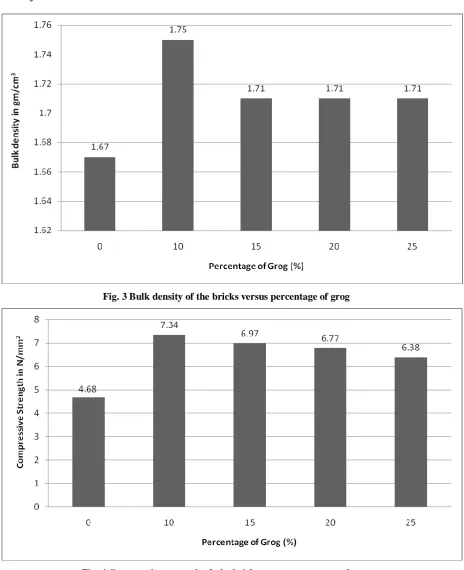
bricks as per classification of brick[6]. Result shows that the maximum strength was achieved of 7.34 N/mm2
for mix of 10% grog and 90% base material. other mixes also gave higher class of bricks above 5.
Table 5 Summary of results
Mix Bulk Density
(g/cm3)
Water Absorption
(%)
Compressive Strength
(N/mm2)
Control mix 1.67 17.24 4.68
BM90G10 1.75 12.83 7.34
BM85G15 1.71 14.28 6.97
BM80G20 1.71 14.68 6.77
106 | P a g e Fig. 3 Bulk density of the bricks versus percentage of grog
107 | P a g e IV. CONCLUSION
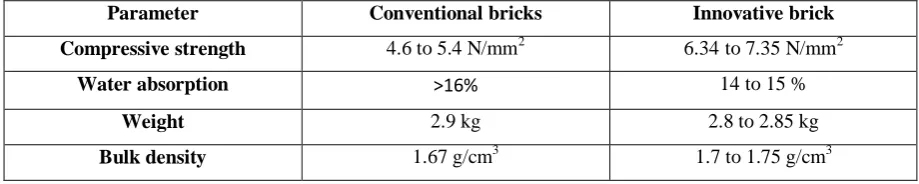
Table below indicates the parameters of conventional bricks Vs. innovative bricks using grog.
Table 6 Comparative range of various parameters
Parameter Conventional bricks Innovative brick
Compressive strength 4.6 to 5.4 N/mm2 6.34 to 7.35 N/mm2
Water absorption >16% 14 to 15 %
Weight 2.9 kg 2.8 to 2.85 kg
Bulk density 1.67 g/cm3 1.7 to 1.75 g/cm3
This study demonstrated that it is possible to utilize grog as partial replacement for clay in burnt clay
bricks.
Here study is expanded beyond the research work done in literatures by using actual brick size as
specimens in order to draw conclusion for manufacturing commercial bricks for Indian context. Result shows that bricks produced for all mixes satisfy the minimum codal requirements as per Indian
Standard Codes.
Compressive strengths of the grog added bricks are higher than the grog free reference brick.
Better value of bulk density and water absorption gives clear indication of dense packing of materials
and less porosity of bricks made with addition of grog with clay.
The study shows that as the replacement of grog percentage increases the compressive strength
reduces, however the strength was still higher than that of control mix which proves the efficiency of
grog material in enhancing the characteristic properties of burnt clay bricks.
The reuse of grog waste in brick production shows highly positive results in terms of environmental
protection, waste management , and saving of raw materials for the production of eco-friendly building
material.
REFERENCES
[1] C.M.F. Vieira, S.N. Monteiro, “Effect of grog addition on the properties and microstructure of a red ceramic body for brick production” , Construction and Building Materia 21 (2007) 1754–1759.
[2] C. M. F. Vieira, J. Alexandre, S. N. Monteiro, “ Effect of the Particle Size of the Grog on the Properties and Microstructure of Bricks” , Materials Science Forum · November 2006.
[3] Taner Kavas, Bekir Karasu, Ozlem Arslan,”Utilization Of Refractory Brick Wastes In Concrete Production As Aggregates”, The Minerals, Metals & Materials Society, VOLUME 5, 2006.
[4] IS: 2720-4 (1985) - Methods of test for soils, Part 4: Grain size analysis [CED 43: Soil and Foundation
Engineering], Bureau of Indian Standards, New Delhi, India.
[5] IS 2117 (1991) - Guide for manufacture of hand-made common burnt-clay building bricks [CED 30: Clay
108 | P a g e [6] IS: 1077 (1992) - Common Burnt Clay Building Bricks -Specification [CED 30: Clay and Stabilized Soil
Products for Construction], Bureau of Indian Standards, New Delhi, India.
[7] IS: 3495-1 to 4 (1992) - Methods of tests of burnt clay building bricks: Part 1 - Determination of
compressive strength, Part 2 - Determination of water absorption, Part 3 - Determination of Efflorescence,
Part 4 - Determination of warpage [CED 30: Clay and Stabilized Soil Products for Construction], Bureau
of Indian Standards, New Delhi, India.
[8] IS 2720-7 (1980): Methods of test for soils, Part 7: Determination of water content-dry density relation
using light compaction [CED 43: Soil and Foundation Engineering], Bureau of Indian Standards, New
Delhi, India.
[9] Prakash, K. and Sridharan, A. (2004). “Free Swell Ratio and Clay Mineralogy of Fine-grained Soils”,