Volume No 03, Special Issue No. 01, March 2015 ISSN (online): 2348 – 7550
1489 |
P a g e
STUDY OF CRYOGENIC ROCKET ENGINE
Yash Muthe
1, Suhas Mali
2, Swapnil Ambekar
3 1,2SE Mech, Sandip Institute of Engineering & Management, (India)
3
Assistant Professor, Sandip Institute, (India)
ABSTRACT
This paper is all about Cryogenic Technology used in rocket’s engine for allit's space missions& it's applications. This technology consists ofuse of two basic elements of universe Liq. Hydrogen(-253°C)&Liq. Oxygen(-183°C ).This engine follows engine follows Newton’s basic 3rd law of motion. This is the only engine that gives 100% efficiency without any green house emissions or pollutionup to the date on earth. This engine gives a trust of 15000 lb. when basic methods are used. This trust can be increased to great extent if research in proper field is done.
When these fuels are mixed at theircryogenic temperatures they give out huge energy which is can be utilised to:
Take off of a Space vehicle it's escape velocity.
Launch a missile across continents.
Generate electric energy.
Keyword : Rocket engine, Cryogenic technology, Cryogenic temperature, Liquid hydrogen and
oxygen, Newton’s third law of mechanics.
I. INTRODUCTION
Cryogenic Technology which mainly deals with temperatures below -150 C is the main working principle
behind the cryogenic engines. When elements cooled at these temperatures they change their properties. Same is
the case with one used in rocket engines when oxygen is cooled below -183 degree centigrade it changes it's
state to liquid & it's properties, similarly when hydrogen is cooled below -253 degree centigrade.
During these temperatures when these liquid are clashed against in a controlledcondition in a combustion
chamber it gives a huge trust which has a specific impulse of near about 450. No other engine can. Generate this
amount of energy in negligible about of fuel. Since it's invention in USAis used in all space mission by every
country due to it's reliability. Cooling used for trust chamber during combustion is also provided by liquid fuel
which saves a lot of energy used for cooling[].
As compared to other fossil fuel the cryogenic fuel requirement is far less to produce same amount of energy.
II. HISTORY OF TECHNOLOGY
This Rocket Technology has a great History involving many giant nations including USA, Russia, Japan,
France etc. A close competition was lead in later half of 20th Century for this technology since it's invention by
USA. When USA successfully launched it's 1stAtlas V rocket in 1963 boosted up the cold war between between
1490 |
P a g e
After USA Russia started it's tests of launch vehicles. Firstly Russia carried a dog named ‘Lynus’ in space in
1983. Russia was first to take human in space using sputnik.
During this period lot of European countries were trying their rockets with same technologies &succeeded later,
But no human being till 1985.
Here's the detail review of the competition
Engine/Rocket
used
Nation
Year
RL-10
USA
1963
LE5
Japan
1977
HM7
France
1979
N1
Russia
1983
GSLV-D5
India
2013
2.1.
India
Indian Space Research Organisation was also trying it's hand on this technology in 20thCentury. ISRO’s then
Chairman U.R.Rao in 1993 announced that it's Cryogenic engine will have a launch in just 4 years. But it took
more than 20 years to Ignite it's Cryogenic Engine so we joined the competition much late in 21st Century due
to its frequent failure & no technological support from other developed Countries.
But now ISRO is working good with successful launch of Mangalyaan in it's first attempt, being the first
country of this kind.
III.CONSTRUCTION
Cryogenic Engine involves:
I. Two Tanks for Liq. Oxygen &Liq. Hydrogen respectively.
II. A turbo Pump.
III. A Gas generator.
IV. A Combustion chamber.
V. A nozzle with a cooling jacket.
In this setupa turbo pump is used to give a high velocity to the fines droplets of fuel in combustion chamber. A
gas generator is used to drive the turbo pump. Gas generator uses the energy from fuel to generate energy for
1491 |
P a g e
IV.WORKING
4.1. Gas Generator
The gas generator is used in order to drive the turbo by a gas flow. The gas generated produces this energy by
pre burning some amount of liq. Fuel. Use of Gas generator aligned with Turbo pump increses the efficiency of
this engine to a great Extent
4.2.Turbo Pumps
The working of this engine is very easy to understand as it does not involve any complicated cycles or any
reciprocating mechanism. The fuel from tanks is firstly passed through the turbo pumps which rotates at a speed
of about 14000 rpm by which the mass flow rateof fuel increases to about 2.4 tons before reaching the
combustion chamber.
4.3. Injector
Injector plays the most important role in the rocket engine it is like heart of the engine that pumps out the
appropriate amount of fuel from the turbo pump to the combustion chamber as per requirement. Injector ensures
the stability of the combustion chamber therefore deigning of injector is the most challenging part of the designs
department of cryogenic engine even today. The frequency of the combustion chamber is to be maintained
between 100-500 cycles per second. If this rate is affected even slightly shifted above or below leads to the
failure of engine which has been seen in tragedy of ‘Discovery Spacecraft’.But if injector is so designed so as to
increase the specific impulse more than 700 Space crafts can travel much long distances in the universe. Injector
is the only component of this engine which is still under constructionyet.
4.4.
Combustion Chamber
Finally when this finely distributed fuel droplets enter into the thrust chamber at such high velocities & at their
cryogenic temperatures they colloid to each other in the trust chamber, this reaction at such specific conditions
increases the pressure of chamber to about 250 bar with a release of huge amount of thrust which is more than
15000 lb.
This high amount of trust is then manipulated bya narrow opening towards the nozzle. The opening is kept
narrow so as to follow law of rate of discharge which states that ‘velocity is inversely proportional to area’. By
this technique we get the desirable amount of thrust which helps a space craft to achieve it's escape velocity.
Due this reaction in continues period of time the temperature of Combustion Chamber as well as nozzle raises
up to 3000-4000°C. To withstand such a high temperature for long period of time without any deformation a
cooling Jacket is required.
4.5. Cooling Jacket
Cooling Jacket is the necessity of this engine but this facility is provided by the fuel of the engine itself so no
external energy is to be used. The mechanism usually used in cooling jackets is active cooling.[6] In this
Technique the cooling jacket is made such that a flow if liq. Proponents is passed through the tubes provided
from between the jackets. Theliq. propellant passed are already at their cryogenic temperature so provide a very
effective cooling. This simple mechanism permitsthe. Use of this technology throughout it's journey without any
deformation in Combustion chamber or Nozzle.
When all these components work in their perfect algorithm ,only then we can achieve our goal a successful
1492 |
P a g e
4.6.
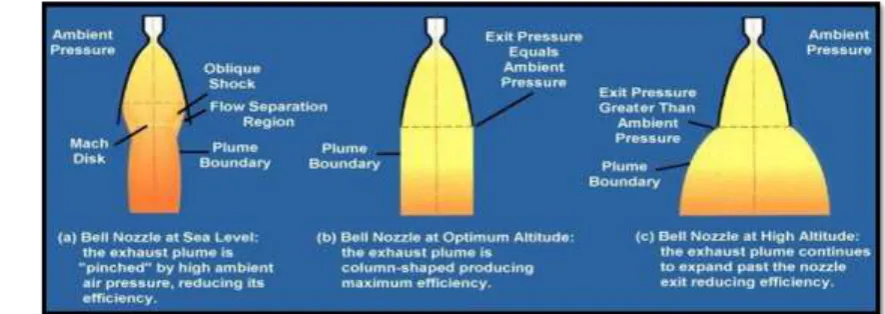
Plume characteristics
After the reaction in trust chamber Tremendous amount of energycomes from the nozzle through the small
opening in the form of plumes. These plumes have a very high temperatureduring theiremissions. Therefore
nozzle is also provided with cooling jacket. As the rocket heads from ground the shape of plumes also changes
with respect to height achieved by the rocket
.
Fig. 4.6.1
When the height of rocket is near to sea altitude the ambient pressure acting on rocket & in directly on engine is
more , hence more energy is required to overcome it, so the plume area is less than nozzle diameter at this
altitude also efficiency is less.
When the Rocket advances to a optimum altitude the plume boundary equals the diameter of nozzle that means
ambient pressure equals exhaust pressure.Therefore maximum efficiency is achieved i.e. 100% this phasegives
full efficiency which is only possible in cryogenic engine. After heading this altitude the rocket advances toward
vacuum environmental , this area gives optimum efficiency near about 88% which remain constant here
onwards.
V ADVANTAGES
1) High Energy per unit mass Propellants like LOX and LH2 give very high amounts of energy
per unit mass.
2) Clean Fuels: Their product give out only water thrown out of the nozzle in the form of very
hot vapour.
3) Economical: LOX & LH2 costs less than gasoline.
VI DISADVANTAGES
1) Boil off rate
2) High reactive gases
3) Leakage
4) Hydrogen embrittlement
1493 |
P a g e
VII. FUTURE SCOPE
Being the most reliable engine & its use in all space missions a lot of advancement in this technology is made
every day. This technology involves fuel which cheaper than even fossil fuel therefore this technology can give
humans safe & reliable technology in near futures. Generally any rocket engine burns their respective fuels to
generate the thrust[4]. If any other engine has capacity to generate thrust efficiently then it can be called rocket
engine.
Currently NASA scientists are working on ‘Xenon Ion Engine’ which accelerates the ions or atomic particles to
extremely high to create thrust more effectively and efficiently by usage of electrostatic or electromagnetic force
by the principle of Lorentz force or Columbian force.min this technology ions are powered towards the anion at
a speed of 30 km per second
VIII. CONCLUSION
Cryogenic Rocket Engine is a simple engine based on laws of Cryogenic science & Newton’s 3rd law of motion.
Cryogenic Technology ensures the stability of fuel & by following Newtons 3rd law the trust is generated. These
two principles work hand in hand to make this engine a mega success of 20th& 21st Century. Also while
comparing Rocket engine with jet engine , thrust produced in rocket engine is outwards and that in the jet engine
is inwards. Hence this efficiency cannot be achieved by any other engine.
REFERENCES
[1] Dario Pastrone, Approaches to Low Fuel Regression Rate in Hybrid Rocket Engines, International Journal of
Aerospace Engineering, 2012, Article ID 649753, 10.1155/2012/649753,2012.
[2]Indian Cryogenics Council, Indian Journal of Cryogenics, Vol. 35A, ISSN 0379-0479, 2010.
[3]Richard Cohn , Developments in Liquid Rocket Engine Technology, Air Force Research Laboratory, 2012.
[4] AkhilChhaniyara, Cryogenic Engine,international Journal of Mechanical engineering & Robotics
Research,Vol 2ISSN 2278 – 0149 www.ijmerr.com Vol. 2, No. 4, October 2013
[5] https://www.google.co.in/images/ cryogenicrocketengine