https://doi.org/10.5194/se-10-1519-2019
© Author(s) 2019. This work is distributed under the Creative Commons Attribution 4.0 License.
Modeling active fault systems and seismic events by using a fiber
bundle model – example case: the Northridge aftershock sequence
Marisol Monterrubio-Velasco1, F. Ramón Zúñiga2, José Carlos Carrasco-Jiménez1, Víctor Márquez-Ramírez2, and Josep de la Puente1
1Barcelona Supercomputing Center, Jordi Girona 29, C.P. 08034, Barcelona, Spain
2Centro de Geociencias, Universidad Nacional Autónoma de México, Juriquilla, Querétaro, 76230, México Correspondence:Marisol Monterrubio-Velasco ([email protected])
Received: 27 March 2019 – Discussion started: 16 April 2019
Revised: 5 August 2019 – Accepted: 6 August 2019 – Published: 10 September 2019
Abstract. Earthquake aftershocks display spatiotemporal correlations arising from their self-organized critical behav-ior. Dynamic deterministic modeling of aftershock series is challenging to carry out due to both the physical complexity and uncertainties related to the different parameters which govern the system. Nevertheless, numerical simulations with the help of stochastic models such as the fiber bundle model (FBM) allow the use of an analog of the physical model that produces a statistical behavior with many similarities to real series. FBMs are simple discrete element models that can be characterized by using few parameters. In this work, the aim is to present a new model based on FBM that includes ge-ometrical characteristics of fault systems. In our model, the faults are not described with typical geometric measures such as dip, strike, and slip, but they are incorporated as weak regions in the model domain that could increase the likeli-hood to generate earthquakes. In order to analyze the sensi-tivity of the model to input parameters, a parametric study is carried out. Our analysis focuses on aftershock statistics in space, time, and magnitude domains. Moreover, we ana-lyzed the synthetic aftershock sequences properties assuming initial load configurations and suitable conditions to propa-gate the rupture. As an example case, we have modeled a set of real active faults related to the Northridge, California, earthquake sequence. We compare the simulation results to statistical characteristics from the Northridge sequence de-termining which range of parameters in our FBM version reproduces the main features observed in real aftershock se-ries. From the results obtained, we observe that two param-eters related to the initial load configuration are determinant in obtaining realistic seismicity characteristics: (1) parameter
P, which represents the initial probability order, and (2) pa-rameterπ, which is the percentage of load distributed to the neighboring cells. The results show that in order to repro-duce statistical characteristics of the real sequence, larger
πfrac values (0.85< πfrac<0.95) and very low values of
P (0.0< P ≤0.08) are needed. This implies the important corollary that a very small departure from an initial random load configuration (computed byP), and also a large differ-ence between the load transfer from on-fault segments than by off-faults (computed byπfrac), is required to initiate a rup-ture sequence which conforms to observed statistical proper-ties such as the Gutenberg–Richter law, Omori law, and frac-tal dimension.
1 Introduction
observed that earthquakes are strongly correlated in space around the active fault systems (Kroll, 2012).
Fault systems have a statistical self-similar structure over a wide range of scales (Kagan and Knopoff, 1980; Sadovskiy et al., 1984; Hirata and Imoto, 1991) which can be described by means of fractal geometry, as introduced by Mandelbrot and Pignoni (1983). Geometrical fractal structures such as faults arise from self-organized criticality (SOC) phenomena over large temporal periods (Bak and Creutz, 1994).
Moreover, earthquakes follow power statistical laws for their observed scaling properties such as the Gutenberg– Richter (GR) distribution (Gutenberg and Richter, 1942; Scholz, 2002), the modified Omori (MO) law, (Omori, 1894; Godano et al., 1996; Hirata and Imoto, 1991), or the fractal dimension of their spatial distribution (Turcotte, 1997; Roy and Ram, 2006).
SOC systems have been studied as a means to ex-plain seismicity by several authors (Barriere and Turcotte, 1994; Scholz, 1991). In particular, models based on cellu-lar automata have been used to describe SOC behavior in earthquake series (Aki, 1965; Barriere and Turcotte, 1994; Castellaro and Mulargia, 2001; Georgoudas et al., 2007; Adamatzky and Martínez, 2016). The fiber bundle model (FBM), a model based on cellular automata (Peirce, 1926; Daniels, 1945; Coleman, 1956), provides a conceptual and numerical description of the rupture process in heteroge-neous media (Kun et al., 2006b). In this article, we present a model that improves over the base model presented in Monterrubio-Velasco et al. (2017) by projecting the geomet-rical fault systems in a FBM algorithm. We developed a novel and powerful simulation model with simple and straightfor-ward input parameters that is capable of providing simula-tion scenarios that are statistically consistent with real cases. The model circumvents the high complexity related to the derivation of deterministic models of by including faults as an abstraction that try to explain weaker regions that are more likely to generate earthquakes. In this version of the model, the faults are represented as a projection on the surface as a 2-D approximation. The extension to 3-D is being con-sidered for a later phase of the study. We test the FBM’s ability to capture the statistics coming from empirical laws (i.e., the GR law, the fractal capacity dimension, the MO law, and the Hurst exponent) by means of a parametric study. As a case study, we consider the Northridge aftershock se-quence (17 January 1994,MW=6.7) along with the geome-try of its fault system. The statistical characteristics from the Northridge aftershock sequence are compared with the statis-tics obtained in synthetic catalogs generated with our FBM. Even though we focus on one aftershock case, the applicabil-ity of our model can be extended to analyze other aftershock sequences using particular fault system as input configura-tion. For example, in Monterrubio-Velasco et al. (2018), this model was applied to classify, via machine learning algo-rithms, three different aftershock sequences. Lastly, we study
the event productivity as function of on-fault (or weakling ar-eas) and off-fault parameters.
2 Background
This section gives a general description of the fiber bundle model and the statistical relations used in this work.
2.1 Fiber bundle model: general description
The basic components necessary to construct an FBM are (Andersen et al., 1997; Phoenix and Beyerlein, 2000; Prad-han and Chakrabarti, 2003; Sornette, 1989; Kloster et al., 1997):
1. Defining a discrete set of cells located in a regular (n -dimensional) lattice. For our purpose, this lattice will be two-dimensional, representing the geographical study area in an azimuthal view.
2. Assigning a probability distribution function for the in-ner properties of each cell. This failure law will define the probability distribution function of the stress (in the static case) or the probability distribution function of the rupture time (in the dynamic version) (Hansen et al., 2015).
3. Establishing the load-sharing rule. This component is crucial in a FBM since the model shows a fundamental change depending on the manner of the load transfer af-ter a cell fail (Pradhan et al., 2010). The most used shar-ing rules are the equal or global load sharshar-ing (Turcotte et al., 2003) and the local sharing rule (LLS). This last sharing rule favors the stress concentrations and pro-motes nearest neighbors to reach a critical rupture state. FBM was developed in two versions that simulate ma-terial rupture by different effects: (1) the static version in which the fiber strength is time independent (Vázquez-Prada et al., 1999; Kun et al., 2006a; Pradhan et al., 2010), and (2) the dynamic version where the study of the material rup-ture is a time-dependent process, such as stress ruprup-ture, creep rupture, static fatigue, or delayed rupture (Coleman, 1956; Moral et al., 2001b). In this research work, we will use a dynamic FBM with LLS in the probabilistic formulation de-veloped in Moreno et al. (2001).
Probabilistic FBM
According to laboratory studies, the Weibull distribution de-scribes the hazard rate (κ) on materials subjected to a con-stant load or stress,σ (Coleman, 1956; Moreno et al., 2001):
κ(σ )=ν0
σ σ0
ρ
, (1)
(Yewande et al., 2003; Kun et al., 2006a; Nanjo and Turcotte, 2005). In the present work, we use a dimensionless represen-tation of quantities, so that we can use normalized stresses and Eq. (1) can be written asκ(σ )=σρ, following Moreno et al. (2001) and Monterrubio-Velasco et al. (2017).
Gómez et al. (1998) introduced a probabilistic approach as an alternative formulation to the dynamic FBM which we follow here.
The FBM model simulation starts by discretizing a hy-pothetical surface in a bi-dimensional array (Nx×Ny). At the first step, the load of the cells in the bundle is as-signed following a uniform distributionσ(x,y)=U[0,1), x= 1, . . ., Nx, andy=1, . . ., Ny. The notation U[0,1) is a mathe-matical form to represents a uniform distribution with values in the range equal to or greater than 0 and lower than 1. This assumption simulates an initial heterogeneity in the load cell properties. The hazard rate assigned at each cell is computed using Eq. (1) (Moreno et al., 1999; Pradhan et al., 2010). Fur-thermore, a rupture probability,F(x,y), is computed for each individual element or cell, and at each step. This value is load dependent and is defined by
F(x,y)=σ(x,y)ρ δ , (2) where δ is the time interval (or inter-event time) until the next rupture occurs, valid for any load-sharing rule (Moral et al., 2001a), computed as (Moreno et al., 2001; Moral et al., 2001a)
δ= 1
PNx,Ny
x=1,y=1σ ρ (x,y)
. (3)
From Eq. (3), δ is a dimensionless quantity sinceσ(x,y) andρare dimensionless.
The time of occurrence or cumulative timeT (k)is defined as
T (k)= k X
i=1
δi, (4)
wherek=1, . . ., kmax, beingkmaxthe maximum number of steps. Our model uses Eqs. (2), (3), and (4) to compute the rupture probability and the inter-event time.
2.2 Previous aftershock models
In our previous work, we developed a FBM version to simu-late spatial and magnitude aftershock patterns. Following the general assumptions proposed in Correig et al. (1997), we modified it in order to define a computational domain that describes a particular geographical area. Moreover, the initial load values are ordered according to a probability valueP.
P =0 represents a random spatial distribution of initial loads (heterogeneous), and P =1 implies a homogeneous distri-bution in agreement with a proxy of Coulomb stress changes produced by a main event in the center of the computational domain(Monterrubio-Velasco et al., 2017).
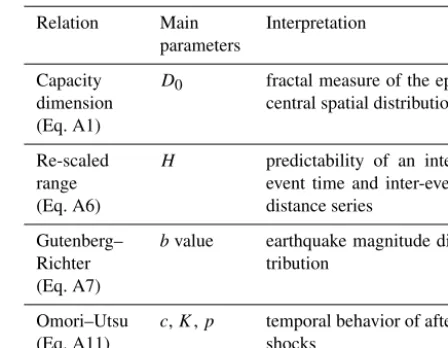
Table 1.Empirical relations, interpretation, and main parameters.
Relation Main parameters Interpretation Capacity dimension (Eq. A1)
D0 fractal measure of the epi-central spatial distribution
Re-scaled range (Eq. A6)
H predictability of an inter-event time and inter-inter-event distance series
Gutenberg– Richter (Eq. A7)
bvalue earthquake magnitude dis-tribution
Omori–Utsu (Eq. A11)
c,K,p temporal behavior of after-shocks
A local load-sharing rule including the eight nearest neigh-bors, and a threshold load (σth≡1) are established a priori. When the load in a cell exceeds this threshold load, a crit-ical point is reached and a imminent rupture occurs (called avalanches). If more than one cell exceedsσth, the cell to fail is that which exhibits the maximum load. The rupture algo-rithm is sequential, since at each time step one cell has to fail. The inter-event time (δ) must be updated at each discrete step as described in Eq. (3). After a cell fails, they distribute its respective percentage of load (σT=σF·π) to its eight neigh-bors. Perpendicular neighbors will receive the largest amount of load ((σT·0.98)/4), while diagonal neighbors get a load of(σT·0.02)/4. The different weights were chosen consider-ing what is expected for the maximum shear stress directions with respect to the main stress orientation that gives rise to both synthetic and antithetic faulting (e.g., Stein et al., 1994). In Monterrubio-Velasco et al. (2017), a large number of nu-merical experiments were carried out to define the appropri-ate values of these quantities. Varying the weights results in slight changes but as long as the main directional properties in weight are preserved the output does not change signifi-cantly.
2.3 Statistical and fractal relations
3 Methodology
3.1 Extending the model
In our previous work (Monterrubio-Velasco et al., 2017), we did not incorporate the information of the fault geome-try which is a fundamental property to describe a particular tectonic region. Therefore, the main contribution of this re-search work is extending the model by the addition of the fault system geometry by prescribing parameters that quan-tify “weakness” properties, i.e., the capacity to produce load concentrations that generate a rupture. In contrast to the clas-sical definition that uses measures such as dip, strike, and slip, here, the faults are considered the weakest parts of the Earth’s crust. The parameter π quantifies the load transfer and it controls the amount of load distributed from a failed cell to its neighbors. Since the seismic rupture is not conser-vative, the parameterπ(x, y)defines the percentage of load lost at each discrete step. The output of the model is a syn-thetic catalog with statistical properties that change depend-ing on the input parameters.
Algorithm
In the Appendix, three pseudo-codes are included to describe the model algorithm. Our model is coded in Julia language (Bezanson et al., 2017) for the sequential version and in Python language for the paralleled version of the loops.
– The initial conditions are as follows:
In this work, and as a first attempt, we simplified the real 3-D domain by choosing a bi-dimensional surface to represent the epicentral distribution. Moreover, we assume that considering that the seismicity of southern California is shallow and mostly restricted to the pla-nar strike-slip faults, the two-dimensional approach can be used as a simplification. Therefore, the 2-D Carte-sian grid is a rectangular domainofNx×Ny=NT square cells. The domain is a planar representation of the study area for which we define three values at each cell in x∈ [1, . . ., Nx] and y∈ [1, . . ., Ny] that assign their properties:
a. σ(x,y): a discrete value of load where the initial load distribution is taken from a uniform distribu-tion funcdistribu-tion with values in the range [0,1). b. π(x,y): a load-transfer value that defines the
per-centage of the load distributed to the neighbors after a cell fails. Since the fault geometry is an abstrac-tion that simulates weaker regions in the model do-main, the values ofπ(x,y) that define the percent-age of load distributed after a cell fails have either a background value (πback) or a fault value (πfrac). c. F(x,y): a rupture probability described in Eq. (2).
d. The Weibull index,ρ(Eq. 1): Monterrubio-Velasco (2013) carried out an exhaustive study to analyze the effect ofρon the generated time series (Eq. 3). It was found that an appropriate value of this pa-rameter must fall within the range 30≤ρ≤50. e. P, the heterogeneity of the initial load distribution:
this parameter has a global influence on the final scenario but we have used the best configuration as tested in Monterrubio-Velasco et al. (2017). No external load is received after the initial load assig-nation, so that our model describes the relaxation pro-cess after a mainshock. Therefore, we do not discuss or simulate the mainshock or foreshocks. The load in-crease in a cell is due to internal load transfer pro-cesses. In a companion study (Monterrubio-Velasco et al., 2019), we present the TREMOL v0.1 code which studies the case of asperities. That model was developed as a mainshock simulator based on the FBM to analyze the case of Mexican subduction earthquakes. A version of our model that includes the effect of tectonic loading is still in progress.
– The rupture conditions are as follows:
In this work, we choose the values proposed in Monterrubio-Velasco et al. (2017, 2019) in order to re-duce the degrees of freedom. The only two parameters that change during the execution of the model areσ(x,y) andF(x,y). Throughout the iterations of the simulation, we identify two possible outcomes: normal events, i.e., minor or background ruptures, and avalanches, i.e., a collection of spatiotemporally clustered events that re-sult in large rupture (Monterrubio-Velasco et al., 2017). We remark that, in the present work, avalanches are ac-tual secondary ruptures, whereas normal events are mi-nor events of low magnitude that produce the rupture of a single cell. The consecutive rupture of avalanches events will produce a rupture cluster with a size deter-mined by their area in (cell) unitsS(NA).
– The completion of a simulation is as follows:
A FBM simulation is terminated when any cell in the system is unable to exceed the thresholdσth. We have empirically determined that the total number of steps
kmax when this situation occurs is typically kmax ≈ 3NT/4. Beyond this value, the system no longer gener-ates loads that overpassσth. Hence, we take this value as a terminal condition in our simulations. After the simu-lation is completed, we obtain a synthetic seismic cata-log which includes the number of simulated earthquakes (NA) with their corresponding areaS(NA)(number of events that produces a single rupture), occurrence time
realizations with identical parameters result in differ-ent seismic catalogs due to the random compondiffer-ent in the initial load. A detail procedure is explained in the pseudo-codes provided in Appendix A2.
3.2 Experimental procedure
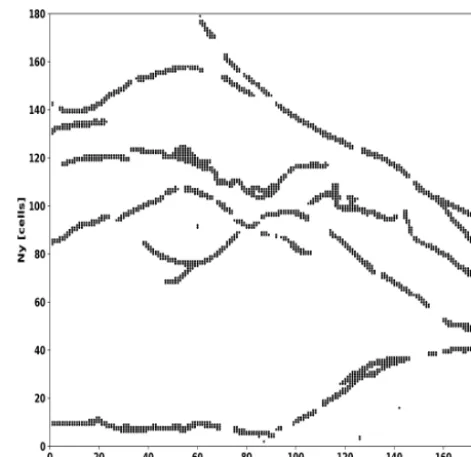
The discrete planar faults of a particular region are modeled by using an image of the real fault system. This image is mapped in the domain(see the example in Fig. 1). A para-metric study is employed to determine the best range of val-ues to produce synthetic catalogs with appropriate statistical characteristics. In this work, we use the following param-eters: ρ=30,σth=1, σD=0.02/4, and σN=0.98/4. We also fix a backgroundπback=0.65 value for all non-faulted cells and assume a square grid, with same lateral size on the
x axis and y axis, i.e.,Nx=Ny= √
NT. These values are considered from the results obtained in Monterrubio-Velasco et al. (2017). The reasons to choose these values are summa-rized as follows:
– 30< ρ≤50 produces features observed in real after-shock time series (Monterrubio-Velasco, 2013; Monter-rubio et al., 2015).
– σth=1 is the upper bound of the uniform distribution and appears as a natural threshold.
– In Monterrubio-Velasco (2013), Monterrubio et al. (2015), and Monterrubio-Velasco et al. (2017), a range of 0.63< π <0.70 was determined experimentally to produce ruptures that mimic features of real catalogs without considering any difference between regions (i.e., no difference between faulting and non-faulting regions). We considered πback=0.65 as a mid-range value to be assigned to background cells.
The map of faults has a real physical size in km2. So, after executing the Algorithm 1 in Sect. A2.1 (Appendix A2), in the post-processing analysis, we assign an area at each cell in km2, namelyAcell. To compute the avalanche areaS(NA) in km2, we use the relation
Aj =S(j )·Acell, (5)
forj=1, . . ., NA. We computed an equivalent magnitude us-ing the scale magnitude–area relation proposed by Hanks and Bakun (2008) in Eq. (6).
MW=4/3 logA+(3.07±0.04) , (6) whereAj, forj =1, . . ., NAis the rupture area expressed in km2andMWis the moment magnitude. This relation is spe-cific for events in a crustal-plate-boundary tectonic regime (Stirling and Goded, 2012).
Careful attention has been given to minimum magnitudes which depend on size of the cellAcell, i.e., are proportional to
Figure 1.Map (azimuthal view) of the Northridge fault system. It is digitalized to include in our computing domain where each pixel of the map corresponds to a cell (x, y) in our array.
N−2Monterrubio-Velasco et al. (2018). In order to make re-sults comparable for different grid sizes, we filter out events rupturing less than a minimum amount of cells for the finer grids. This is done because we want to show the influence of different grid sizes over the statistical results, and we want to compare our results with real cases where the smallest mag-nitudes are not resolved by the seismograph networks.
We are left with three freely varying parameters for our study. Based on previous results, we useNx = [180, 240, 300] cells,πfrac= [0.6, 0.65, 0.7, 0.75, 0.8, 0.85, 0.9, 0.95, 1.0], andP = [0.0, 0.08, 0.16, 0.24, 0.32, 0.38] (Monterrubio-Velasco et al., 2018). This results in 162 samples in the para-metric space.
The epicentral location of the simulated aftershocks is the position of the first avalanche event ((Ex(j ), Ey(j ))) in the cluster.
We define 1(r) as series of the Euclidean distance be-tween two consecutive epicenters and τ (t ) the inter-event time series corresponding to two consecutive avalanches (see Eq. 4).
Table 2 defines the model parameters and provides optimal search ranges.
4 Test case: Northridge aftershock sequence
Table 2.Model parameters.
Parameter Search range or value Definition
σ (x, y) random initial value
U[0,1)
load at each cell in (x, y) position
π(x, y) [0.65, 0.70, 0.75, 0.80, 0.85, 0.90, 0.95, 1.0]
load transfer value
F (x, y) Eq. (2) rupture probability
P [0, 0.08, 0.16, 0.24, 0.32, 0.38]
initial order probabil-ity
NT 32 400, 57 600, 90 000
total number of cells
ρ Eq. (1) Weibull index
mainshock (MW=6.7) occurred on 17 January 1994 at 04:31 UTC. The earthquake shook the San Fernando Valley, which is 31 km northwest of Los Angeles, near the commu-nity of Northridge. This earthquake is the largest recorded in the Los Angeles metropolitan area in the last century. The depth of the hypocenter was 18±1 km. The seismic mo-ment, Mo, was estimated at 1.58×10²³N m, with a stress drop of 27 MPa (Thio and Kanamori, 1996). The mainshock occurred due to the rupture of a previously unrecognized blind reverse fault with a moderate southward dip (Savage and Svarc, 2010; Scientists of the U.S. Geological Survey, 1994). The Northridge mainshock occurred at a fault belong-ing partly to a large fault system in the transverse ranges. This fault system is under compression in the NNW direc-tion related to the “big bend” of the San Andreas Fault (Nor-ris and Webb, 1990; Hauksson et al., 1995). The Northridge earthquake was followed by a sequence of aftershocks, be-tween 17 January and 30 September 1999, including eight aftershocks of magnitude MW≥5 and 48 of 4≤MW≤5. We computed the statistical parameters of the aftershocks using the data recorded by the Southern California Seismic Network. We consider the aftershock time period from the mainshock (17 January 1994 at 04:31 UTC) until 1 year later (17 January 1995). In space, we consider events that occur in a square area of 0.6◦×0.6◦taking as center the mainshock epicenter (Turcotte, 1997) In Fig. 2, we show the spatial rep-resentation of the faults analyzed in this work, and the seis-micity of magnitude larger than 2.0 during 1981–2006. We also assumed that the faulting area is the same, independently of the model domain size. However, the number of cells modify the size of each cell, resulting in 0.077, 0.043, and 0.027 km2forNx=[180, 240, 300] cells, respectively.
In Table 3, we show the statistical parameters for the Northridge sequence computed for different threshold mag-nitudes from Mmin=1.5 toMmin=3.5. These values will be used as a reference to determine the sets of FBM
param-Table 3.Statistical parameters of the real catalog of Northridge af-tershocks using different threshold magnitudes (Mmin).
Parameter Mmin>1.5 >2.0 >2.5 >3.0 >3.5
N 5334 2412 970 373 151
D0 1.58 1.48 1.49 1.40 1.27
hMWi 2.15 2.59 3.07 3.57 4.55
bvalue 0.73 0.81 0.84 0.84 0.88
pOmori 1.35 1.32 1.31 1.24 1.18
cOmori 3.22 1.19 0.40 0.13 0.03
KOmori 3485.76 976.15 256.03 63.76 17.64
H1 0.61 0.62 0.61 0.60 0.69
Hτ 0.92 0.90 0.83 0.81 0.76
HMag. 0.75 0.75 0.76 0.71 0.71
Figure 2.Map that includes the seismicity of magnitude larger than 2.0 during 1981–2006. The yellow star indicates the Northridge epi-center (MW6.7, 1994). Red lines depict the faults of this region considering an approximated area of 0.6◦×0.6◦. Blue circles indi-cate aftershock locations and the size of their magnitude.
eters that best reproduce the Northridge statistics. Figures 3 and 4 show the fitting of the GR law, MO law, and Hurst ex-ponents (H1,Hτ, andHMag) for different minimum magni-tudes (Mmin>1.5,>2.0,>2.5,>3.0, and>3.5). We note that Wiemer and Wyss (2000) calculated the minimum mag-nitude of completeness in the Los Angeles area asMc≈1.5.
5 Results
We divide the results and their analysis in three domains: – space: fractal capacity dimension,D0, for the epicentral
distribution of synthetic earthquakes, and Hurst expo-nent for epicentral distance between consecutive syn-thetic earthquakes,H (1);
Figure 3. Fitting of the (a) GR law and (b) MO law to the Northridge aftershocks (NOR) considering different minimum magnitudes: Mmin, 1.5 (dark blue markers), 2.0 (turquoise), 2.5 (green), 3.0 (red), and 3.5 (pink), respectively.
– time: inter-event timesH (τ )and MO parameters (p,c,
K).
5.1 Parametric analysis over the synthetic series For each parameter, we list its observed properties to facili-tate the reading. We are analyzing simultaneously three pa-rameters (the size of the domainN measured in cells units, the initial order configurationP, and the percentage of trans-fer load in a fault-on cellπfrac). However, it is worth noting that they are coupled between them. Then, we analyze how these three parameters are modifying the statistical and the fractal properties of synthetic catalogs.
5.1.1 Fractal dimensions of synthetic catalogs
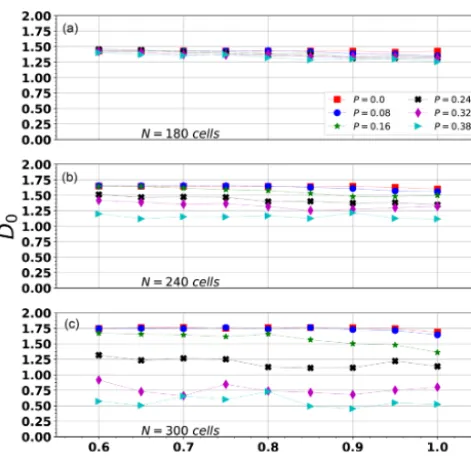
The first analysis is related to the fractal capacity dimension,
D0(Sect. A1.1), shown in Fig. 5.
– AsNincreases,D0becomes more sensitive toP(where
P is the initial load values ordered according to a proba-bility value), because the larger the area, the more abun-dant and scattered the events, and the effect ofP over the simulated events increases. The effect of an increase inP is a reduction ofD0. On the other hand, asP tends
to zero, the events are more scattered because random-ness in the initial load causes sparsity in the event dis-tribution.
– πfracdoes not seem to have a large impact inD0across our experimental range.
– For P ≤0.16 and πfrac>0.9 (for all N values), our FBM simulations yield aD0compatible with that com-puted for the Northridge series with a Mmin≈2 (Ta-ble 3).
5.1.2 Thebvalue, mean, and maximum magnitude of synthetic catalogs
Thebvalue is clearly influenced by all three parameters (N,
P, andπfrac), as is shown in Fig. 6.
– The smallest array ofN=180 cells tends to produce similarbvalues, independently ofP andπfrac. On the other hand, asNincreases, thebvalue is more sensitive toP andπfrac.
– For values of N=240 and 300 cells, the b value shows a clear dependency onπfrac. In these finer grids (N=240), we consider an initial random load distribu-tionP =0, we observe that the syntheticbapproaches
b values computed for the Northridge sequence, if
πfrac>0.90. This last observation is important to jus-tify the influence of include fractures regions in our model. Becauseπfrac>0.90, it indicates a clear “non-conservative” properties in the fault-on cells, and under this assumptionsbvalue is closer to the expected value computed for Northridge.
The difference in theb values as a function ofN might be due to two possible causes:
1. the number of events included in the statistical fit and 2. the size of the earthquake-simulated avalanches,S(NA).
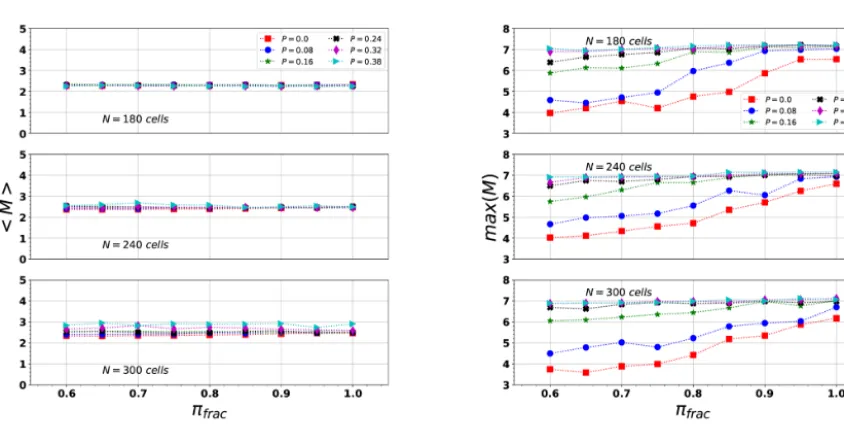
In fact, related to this observation in Fig. 7, we observe that asP increases, the maximum magnitude also in-creases, also modifying the frequency–magnitude dis-tribution and thebvalue.
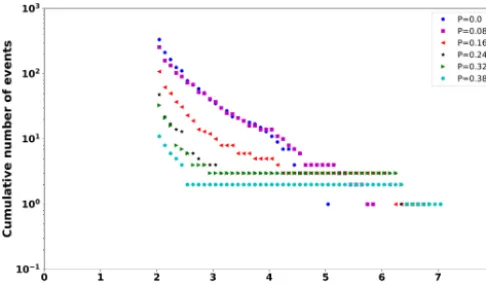
As an example, Fig. 8 shows the frequency–magnitude dis-tribution forP=[0, 0.08, 0.16, 0.24, 0.32, 0.38],πfrac=0.9,
πfrac=0.65, andN=300. We observe that asP increases, the productivity of intermediate size events decreases, and the maximum magnitude increases. Large P values imply that the probability to find cells with large loads clustered in the middle increases (Monterrubio-Velasco et al., 2017). So, in this condition, it is more likely to generate larger earth-quakes. This behavior is similar to that observed in the char-acteristic earthquake distribution (Wesnousky, 1994).
Figure 4.Fitting of the Hurst exponents (Sect. A1.2) for three time series of the Northridge aftershocks:(a)inter-event distance,(b) inter-event time, and(c)magnitude, considering different minimum magnitudes (Mmin).
– From Fig. 7a, we observe that the mean magnitude is independent of πfrac and to a lesser extent ofP. It is worth pointing out that thebvalues are similar to those shown in Table 3 whenMmin≈2 or 2.5.
– Fig. 7b shows that, in our model, an aftershock with a magnitude such as that of the largest Northridge af-tershock magnitude (MW=5.9) is obtained for a non-unique combination of parameters. When P >0.08 andπfrac>0.7, this magnitude is overestimated. Given that the largest aftershock has a magnitudeMW=5.9, larger-magnitude values are not described in the series. From Figs. 6 and 7, we observe that the best range ofb val-ues, similar to that obtained for Northridge sequence, is for
P <0.16, πfrac>0.90, andN≥240.
5.1.3 Hurst exponent of synthetic catalogs
Figure a and b show the results of the Hurst exponent for inter-event distance H (1) and inter-event time H (τ )
(Eq. A6).
– The re-scaled range analysis of the1(r)series reveals their independence onN andπfracbut shows a slightly higher dependence withP. In general, asP increases,
H (1) also increases. As P decreases, H (1)→0.5, implying that the system tends to a random behavior of the inter-event epicentral distribution. However,H (1)
always remains similar to the values of Table 3 forP ≈ 0. Gkarlaouni et al. (2017) showed that the seismicity in the Corinth rift (Greece) corresponded toH (1)→0.5 as the threshold magnitude decreased.
– The analysis ofH (τ )reveals in general values>0.5, which implies a persistence in the dynamic system of inter-event times; i.e., the behavior of future inter-event time can be extrapolated from previous behavior. AsP
Figure 5.Fractal capacity dimension, D0 (Sect. 5.1.1) computed for different synthetic series considering three input parameters: the domain size,N (a–c:N=180,N=240, andN=300 cells per lateral size); the initial load order distribution,P; and on-fault load-transfer value,πfrac.
5.1.4 MO parameters in synthetic catalogs
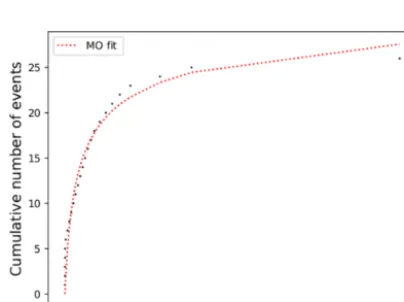
The MO empirical law requires careful analysis in our FBM implementation. First of all, we must take into account that we are using dimensionless time (see Eq. 3). Our cumu-lative time, Tj, is computed using Eq. (4). For example, considering the input values ofP =0.08,πfrac=0.90, and
Nx=180, if we include all simulated events (minor events and synthetic aftershocks) together (e.g., Fig. 10a), we get a satisfactory MO fit, withp=1.1,c=1.5,K= 11 991.3, and rms=675.0. But if we use only the time occurrence of the simulated aftershocks (S(NA)), the parameters depart from the expected trend (e.g., Fig. 10b), obtainingp=1.9,
c=4.9, K=1571.9, and rms=10.8. From Fig. 10b, two regions are distinguished by the density of events, since for the first interval of time the density is larger (blue) than for the subsequent region (green). As a consequence, the MO fit is deviated adjusting for events in the blue region. Real after-shocks do not always follow a single MO decay trend (Utsu and Ogata, 1995). Moreno et al. (2001) developed an alterna-tive model to understand this phenomenon called leading and cascade (LA-CAS) events. This model proposes a separation of earthquakes in two groups: one that strictly follows the MO hypothesis (called leading aftershocks; LAs) and those called cascades, which are the events that occur between two consecutive LAs. Note that to obey the MO relation, the inter-event times must increase monotonically. In our previ-ous work (Monterrubio et al., 2015), we tested the LA-CAS
algorithm to study the temporal behavior of three real after-shock sequences. We applied the LA-CAS algorithm to the synthetic earthquakes series, as illustrated in Fig. 10b. After segregating the events in LA and CAS, we obtain a better fit to the MO relation for the LA series (Fig. 11, LA:p=0.9,
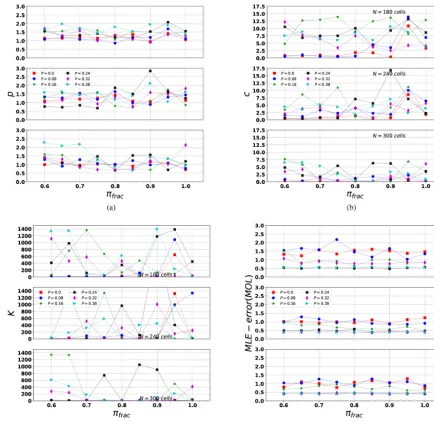
c=0.1,K=5.1, and rms=1.2). The full parametric results computed from the MO relations are shown in Fig. 12a and b.
The MO parametric results provide information of the temporal behavior in the simulated series. We observe that
P <0.08 implies p and c values close to the expected Northridge values (see Table 3). However, after segregat-ing LA and CAS, the number of events decreases, so the value ofK is much lower than expected. These results in-dicate that series with an initial load configuration organized with a probabilityP >0.08 depart from a typical MO be-havior. This occurs because the aftershock series produced with larger initial organization probabilities (P >0.08) tend to generate temporal series with very short elapsed times (Eq. 3), and larger avalanche clusters, which does not fol-low a typical MO distribution. The closest behavior to the observed MO parameters of Northridge (Table 3) occurs for
P ≤0.08 andπfrac>0.7.
5.2 Trigger and shadow regions
The load-transfer valueπ(x, y)is highly relevant to repro-duce temporal, magnitude, and spatial patterns of real series (Monterrubio et al., 2015). Considering this fact, we are also interested in studying the implication of this value in the af-tershock productivity, in particular for off-fault regions. To test the productivity as a function ofπbkg, two extreme values are considered forπbkg=0.25 andπfrac=0.65. In Fig. 13, we observed that activity in background (non-faulting) cells largely decreases for smallπbkgvalues. This occurs because for lowπ values, the probability to produce an event with larger ruptured area decreases (Fig. 14). The results suggests that variations inπbkgfor different regions of the domain can lead to producing shadow and triggered regions, giving a sce-nario closer to a real case (King et al., 1994; Stein, 1999; Hainzl et al., 2014). The lack of the depth (3-D) in our model could produce bias in the shadow region interpretation and is a limitation to a closer description of the phenomenon. However, in this study, our first attempt is more focused on the parametric implications of the fault regions included in the model as “weak” areas. We expect that the integration of triggered and shadow regions will be plausible in future implementations to improve the results.
5.3 Results summary: synthetic catalogs
Lastly, we estimated the error between the real and synthetic statistical values using a measure similar to the Euclidean distancerE−Mmin. However, in our case,rE−Mminis referred
Figure 6. The(a)bvalue (Eq. A8) and(b) theb-value error (Eq. A9) computed for different synthetic series considering three input parameters (N,P,πfrac). From top to bottom,N=180,N=240, andN=300 (cells per lateral size in the domain).
Figure 7. (a)Mean magnitude (hMi) and(b)maximum magnitude (max(M)) computed for different synthetic series considering three input parameters (N,P,πfrac). From top to bottom,N=180,N=240, andN=300 (cells per lateral size in the domain).
units in the parameters, and it is defined as
rE−Mmin=
v u u t
9 X
i=1
(ps[i] −ps Mmin[i]) ps[i]
2
, (7)
whereps=[D0,hMWi,bvalue,Mmax,Mmin,H (1),H (τ ),
p,c] is the vector that contains the values of the series gen-erated with a given set of input parameters P , πfrac, and
N. Similarly, the vectorpsMmin contains the values for the
Northridge series considering four different minimum
mag-nitudes Mmin= [1.5,2.0,2.5,3.0] (Table 3). We computed
rE−Mmin for the 162 combinations ofP , πfrac, andN, each
one with three realizations. In Table 4, we show the min-imum ofrE−Mmin for Mmin= [1.5,2.0,2.5,3.0]. The
mini-mum Euclidean distance occurs when we consider the NOR series withMmin=2.0. It is worth mentioning that the min-imum magnitude of the synthetic aftershocks considered in this work is also≈2.0. The results show that the most ap-propriate set of parameters to model this data series isP =0,
Eu-Figure 8.Frequency–magnitude distribution computed in one syn-thetic series as example. Each marker indicates differentP values,
P =0 (dark blue circles), P=0.08 (magenta squares),P =0.16 (red triangles),P = 0.24 (black stars),P=0.32 (green triangles), andP =0.38 (turquoise circles). AsP decreases, the distribution approaches a Gutenberg–Richter type relation (Eq. A7).
Table 4.Minimum Euclidean distancerE−Mmin(Eq. 7) using four
differentMminNOR series (Table 3).
Mmin rE−Mmin N P πfrac
1.5 0.78 240 0.16 0.6 2.0 0.63 300 0 0.95 2.5 0.88 300 0.08 0.9 3.0 1.53 300 0.16 0.7
clidean distance between the sequence generated by NOR using the set of parameters obtained with Mmin=2.0 and its real values. In Fig. 16, we show an example of a spatial distribution of events and its related GR relation, using the setP=0,πfrac=0.95, andN=300. As shown in Fig. 16, the largest aftershocks have its epicenter on the fault’s cells (M >3.5). The epicenters are depicted with a blue star. This scatter plot also shows that the smallest events usually occur spread out. The relation of the magnitude and the cumulative number of events, generated in this example, shows a GR fit with a similarbvalue to that computed in Table 3.
6 Discussion
The main goal of this study is to integrate prior knowledge of the spatial geometry of faults in the implementation of the FBM algorithm, improving the model previously pro-posed in Monterrubio-Velasco et al. (2017). As it was pointed out, to introduce the fault system geometry we assume some cells to be weaker than the rest representing faults in the bi-dimensional array. This “weakness” is assigned by a sin-gle parameter calledπfrac. The lack of the depth dimension may leave out information about the full phenomenon. How-ever, it is a first attempt to test the FBM as an aftershock
Figure 9.Hurst exponent values(a)H (1)and(b)H (τ )computed for different synthetic series considering three input parameters (N,
P,πfrac). From top to bottom,N=180,N=240, andN=300 (cells per lateral size in the domain).
geome-Figure 10. Modified Omori relation (Eq. A11) (dashed red line) fitting for one simulation with P =0.08,πfrac=0.90,N=180. (a)Synthetic aftershocks series forMmin=2.0 (black dots). Two regions are distinguished, where the density of events in the blue region is much larger than that in the green. (b) All events gen-erated (minor normal and avalanches) (in black dots). A high and homogeneous data density along the plot is observed.
Figure 11.MO fitting for the leading aftershock (LA) series com-puted for the same synthetic series of Fig. 10.
try of the Northridge fault system and the statistics of the aftershocks. Note that this model version describes the re-laxation process after a mainshock. Therefore, we do not discuss or simulate the mainshock or foreshocks. In partic-ular, we explored the power laws’ exponents (D0, b, H, p parameters) in relation to the model parameters (Sect. A1). Other models have been proposed to describe, with a sim-plified mechanism, the statistics of earthquakes, such as the two-fractal overlap model (Bhattacharya et al., 2009) or the Olami–Feder–Christensen (OFC) model (Olami et al., 1992). In particular, the OFC model has a very similar algorithmic to our proposed model (Kawamura et al., 2012), but our model yields similar results with fewer input parameters and it is simpler to implement. As a statistical modeling tool, we need a parametric analysis to properly fit observational data. In our study, we have searched the range of values that gen-erate synthetic series capable of reproducing the statistical relations of real aftershock series. In particular, we explored three (πfrac, P andN) of the five free parameters to quan-tify their leading role in the model. We point out thatπbkg andρare assumed as constants following results in Monter-rubio et al. (2015) and MonterMonter-rubio-Velasco et al. (2017). In agreement with Monterrubio et al. (2015), we also confirm that the transferred load valueπ is the most critical param-eter in order to reproduce temporal, magnitude, and spatial patterns of real series. Our results also suggest that varia-tions inπfor different regions of the domain might generate shadow regions (King et al., 1994; Stein, 1999; Hainzl et al., 2014). The initial load configuration, controlled byP, results as a determinant to describe the final statistical features in the model. In particular, the results indicate thatP andπfracare inversely proportional. As we increaseπfrac, a small value of
P is required to reproduce aftershock statistics. If the fault geometry is not considered in the model (πbkg=πfrac), the particular range of 0.60< π <0.70 found in Monterrubio-Velasco et al. (2017) is required to capture statistical patterns. The results are sensitive to the size of the domain. An ex-haustive parametric analysis using machine learning tech-niques to classify the synthetic series as function of the input parameters (the size N, P, and πfrac) was carried out in Monterrubio-Velasco et al. (2018). In Fig. 17 from Monterrubio-Velasco et al. (2018), we show the mean er-ror of three different ML classification algorithms (random forests, supported vector machine, and flexible discriminant analysis) as a function of the domain (grid) size. The fig-ure shows that as the grid size is increased, the classifica-tion error decreases, meaning that large grid sizes allow us to distinguish among the different properties. In other words, for small grid size, the difference is indistinguishable, while larger grid sizes are able to capture the differences. We ob-serve the results using as classification two input parameters:
Figure 12.Modified Omori parameters computed in theLAsynthetic series:(a)p,(b)c,(c)K, and(d)rms. Each marker is obtained by different synthetic series considering three input parameters (N,P,πfrac). From top to bottom,N=180,N=240, andN=300 (cells per lateral size in the domain).
the synthetic catalogs consideringπfrac, the figure shows that the error classification reaches a minimum value for lower grid sizes N≥200. So, if we consider the case of P =0, and the classification is based on πfrac, then a proper grid size used to model aftershocks, including faults, isN≥200. We can confirm that an optimization of the parametric search using classification machine learning techniques can be very useful in this stochastic model.
Considering the example of Northridge, our results sug-gest that the best combination of parameters to approximate to real cases depends on the minimum magnitude of the real catalogs, as shown in Table 4. Related to the complete-ness magnitude, Davidsen and Baiesi (2016) define the short-term aftershock incompleteness (STAI) as a phenomenon
Figure 13.Epicentral spatial distribution for two examples:(a)P= 0,πfrac=0.95,N=180, andπbkg=0.25; and(b)P =0,πfrac= 0.95,N=180, andπbkg=0.65. The different circles sizes repre-sent the equivalent magnitude according to the legend. The center of each circle is the epicentral or nucleation point of each synthetic event. The major events occur over the faults.
Figure 14.Gutenberg–Richter fit of simulated events for the same series used in Fig. 13. In blue circles,P =0,πfrac=0.95, andN= 180,πbkg=0.25, and in magenta,P =0,πfrac=0.95, andN= 180,πbkg=0.65.
Figure 15.Euclidean parametric distancerE−Mmin (Eq. 7)
com-puted for the synthetic series (Mmin=2.0) considering three input parameters (N,P,πfrac). From panel(a)to(c),N=180,N=240, andN=300 (cells per lateral size in the domain).
Figure 17. Mean error of three different ML classification algo-rithms (random forests, supported vector machine, and flexible dis-criminant analysis) as a function of the domain size (figure from Monterrubio-Velasco et al., 2018).
and in our approach we are not considering this physical pro-cess. To modify the minimum magnitude in the synthetic cat-alogs, we only filter the events with small rupture areas.
The usefulness of this stochastic model is its capability to generate a large number of scenarios with statistical proper-ties similar to real cases, with low computational cost and a low number of free parameters.
7 Conclusions
We present a novel model simulation of aftershock sequences that incorporates a 2-D spatial distribution of faults. The rep-resentation of faults is carried out by assigning weak cells embedded in a background of “normal” cells. However, this model fulfills statistical properties of aftershock when it is well tuned. We choose statistical relations which describe the aftershocks’ behavior in space, magnitude, and time. By means of a parametric study, we have found the range of values that generates synthetic series capable of reproducing the statistical relations of real aftershock events. In particu-lar, we have used the Northridge fault system geometry pro-jected on the surface and its aftershock sequence as a study case. We conclude that the initial load configuration (quan-tified by parameter P), which specifies the randomness in the background load distribution and the ratio of transferred load for a faulting cellπfracare the key parameters that con-trol the earthquake’s statistical patterns in FBM-simulated events. Moreover, these parameters are complementary; i.e., in absence of fault geometry information (πfrac=πback), val-ues in the range 0.08< P <0.32 ensure statistical compat-ibility with real aftershocks. In particular, for πfrac=π and
N =180, we recover the results obtained previously without fault information (Monterrubio-Velasco et al., 2017). On the other hand, when fault geometry is available, as in the case of the Northridge fault system, the results obtained in this work show that, in order to reproduce statistical characteristics of the real sequence, larger πfrac values (0.85< πfrac<0.95)
and very low values ofP (0.0< P ≤0.08) are needed. This implies the important corollary that a very small departure from an initial random load configuration is required to ini-tiate a rupture sequence which conforms to observed statis-tical properties such as the Gutenberg–Richter law, Omori law, and fractal dimension. In summary, the proposed model is a useful tool to model aftershock scenarios by means of its inherent statistical patterns in time, space, and magni-tude. Moreover, the model circumvents the high complex-ity related to the derivation of deterministic models of earth-quake rupture phenomena. We demonstrated the ability of the model to simulate statistically consistent data with those of real scenarios using only a few input parameters. Our model can be an alternative to the study of the complex behavior of earthquakes. Future work will focus on optimization of the parametric search using machine learning techniques and extensions towards a 3-D FBM version that incorporates the depth dimension into the model.
Appendix A
A1 Statistical and fractal relations A1.1 Fractal dimension
Fractured systems, including lithospheric faults, are scale invariant in a large scale range being characterized by the power law (Turcotte, 1997; Mandelbrot, 1989). The frac-tal dimension is an important parameter used to character-ize fracture patterns in heterogeneous materials (Hirata and Imoto, 1991). In seismicity, it provides a quantitative mea-sure of the spatial clustering of epicenters and hypocenters (Roy and Ram, 2006). There are many fractal dimension defi-nitions and descriptions used to characterize a dynamical sys-tem, for example, the capacity dimension,D0(Nanjo et al., 1998; Legrand et al., 2004), the information dimension,D1, or the correlation dimension,D2 (Grassberger and Procac-cia, 1983). For the purpose of our study, we will use only the capacity dimension,D0, since it is one of the most studied fractal dimensions for the spatial distribution in earthquakes (epicenter and hypocenter); also, we are interested in eval-uating the capacity of the spatial distribution to occupy the space in which it is embedded. Future research could con-sider a multifractal analysis for synthetic and real series.
The generalized fractal dimension,Dq, is used to compute different fractal dimensions (Eneva, 1994; Márquez-Rámirez et al., 2012).
Dq=lim r→0
logCq(r)
log(r) , (A1)
where
Cq(r)= 1 N N X
i=1 "
1
N−1 X
j6=i
H(r− ||xi−xj||) #q−1
1
q−1 , (A2)
withq is a positive or negative real number,N the number of samples, ||xi−xj ||the inter-event distance for consec-utive events,Hthe Heaviside step function, andra thresh-old distance value to evaluateH. With this method, we com-pute the probability of a pair of points in the system being closer than the threshold r. Equation (A2) has the property thatD(q=0)=D0,D(q=1)=D1, andD(q=2)=D2. Barriere and Turcotte (1994) assume that if the spatial distribution of earthquakes is fractal, then the faults must have a fractal dis-tribution as well. Turcotte (1997) showed that the capacity di-mension of epicentral and hypocentral distributions yields a fractal distribution with an exponentD0≈1.6 andD0≈2.5, respectively.
A1.2 Re-scaled range analysis and Hurst exponent The re-scaled range (R/S) analysis, and more specifically the Hurst exponentH (Hurst et al., 1965), offers a criterion for
evaluating the predictability of a complex dynamic system (Feder, 1988; Goltz, 1997). TheR/Sanalysis can be inter-preted as a method to measure the long-range correlation in time series. Some applications of this fractal technique in dif-ferent fields of geophysics and geology are given in Korvin (1992) and Turcotte (1997).R/S analysis on earthquake se-quences was first implemented by Lomnitz (1994) and ap-plied to an analysis of the seismicity of the south Iberian Peninsula (Lana et al., 2005), the Corinth rift and Mygdonia graben in Greece (Gkarlaouni et al., 2017), or aftershocks in southern California (Monterrubio-Velasco, 2013).
WithX∈(X1, X2, . . ., Xn)a set of observations in a time series, the mean,m, of the series is computed and a mean adjusted series is created, following
Yt=Xt−m , (A3)
fort=1, . . ., n. Then, a cumulative deviate seriesZ can be computed as
Zt= t X
i=1
Yi. (A4)
Then,R/Sis the ratio between the rangeRt and standard deviationSt, where the range is computed as
Rt=max(Z1, Z2, . . ., Zt)−min(Z1, Z2, . . ., Zt) , (A5) andSt is the standard deviation of Z1, . . ., Zt. Hurst used the following power-law relationship to determine the pre-dictability of time series (Hurst et al., 1965):
log(Rt/St)=C+H·log(t ) , (A6)
whereH=0.5 indicates randomness in the series; i.e., the samples are not correlated with one another.H >0.5 indi-cates some degree of predictability or temporal persistence in the system. Lastly, 0< H <0.5 indicates anti-persistence; i.e., an increasing (decreasing) trend in the past implies a de-creasing (inde-creasing) trend in the future (Correig et al., 1997). A1.3 Gutenberg–Richter law
The GR (sometimes referred to as the Gutenberg–Richter Ishimoto–Ida) law is considered one of the major manifes-tations of self-organized criticality in a natural system. It has been observed that earthquake magnitude distributions fit a GR power law (Gutenberg and Richter, 1942):
log10N (≥M)=a−bM , (A7)
In particular,bis one of the most useful statistical param-eters for describing the size scaling properties of seismicity. For example, Ozturk (2012) concludes that this parameter can be used to differentiate tectonic regions. Similarly, Zu-niga and Wyss (2001) used thebvalue to identify most and least likely locations of earthquakes in the Mexican subduc-tion zone.
In the rest of the present work, we apply the maximum likelihood method (MLE) to estimateb(Aki, 1965):
b= log 10(e)
| hMi −(Mmin−1M/2)|
, (A8)
where Mmin is the minimum magnitude of events consid-ered in the study, and1M is related to the precision of the recorded magnitude; in our case, we consider 1M=0.1. The standard error ofb,σ (b), is computed as (Shi and Bolt, 1982):
σ (b)=2.30b2σ (hMi) , (A9)
whereσ (hMi)is the standard deviation of the magnitude se-ries
σ (hMi)= n X
i=1
(Mi− hMi)2/n(n−1) , (A10)
wherenis the number of elements in the series.
A1.4 Modified Omori law
The temporal behavior of aftershocks is commonly described by the MO law (Omori, 1894; Utsu and Ogata, 1995) defined as
n(t )= K
(t+c)p, (A11)
wheren(t )is the generation rate of aftershocks at timet af-ter the mainshock, whereas K, c, andp are parameters to be determined. Thepparameter controls the aftershock ac-tivity decay and is related to the physical conditions in the fault zone (Kisslinger, 1996; Ogata, 1999). Its value is typ-ically p≈1. The constant c eliminates the uniqueness of occurrence rate att=0 (Kisslinger, 1996), the productivity
K is a constant that depends on the total number of after-shocks. Then the cumulative number of aftershocks,N (t ), of the earthquake count at timet since the mainshock att=0, can be obtained by integrating Eq. (A11), resulting in
N (t )=
t Z
0
n(s)ds=
K{ln(t+c)−ln(c)} p=1
K
(c+t )(1−p)−c(1−p)
1−p p6=1
A2 Algorithm
The main algorithm (Algorithm 1; Sect. A2.1), for each dis-crete stepk, updates the rupture probabilityF of each cell, finding the cell boasting the largest load and then finding whether that load exceeds the given load threshold σth. If so, rupture is initiated and an avalanche occurs due to recur-rent load transfer and rupture of neighboring cells. Whenever no cell has sufficient load to reach σth, a regular, i.e., mi-nor, event is triggered, which ensures load transfer and hence makes it more likely that an avalanche, i.e., major, event will occur in the next time steps. The initialization step is shown in Algorithm 2 (Sect. A2.2) and the rupture process is de-picted in Algorithm 3 (Sect. A2.3). Notice that rupture relies on a transfer-ratio weightσN for the horizontal and vertical transfer andσDfor diagonal transfer, which are further global parameters to prescribe.
A2.2 Algorithm 2
Author contributions. MMV developed the numerical code. MMV, FRZ, JCCJ, VMR, and JdlP provided guidance and theoretical ad-vice during the study. All the authors contributed to the analysis and interpretation of the results. All the authors contributed to the writing and editing of the paper.
Competing interests. The authors declare that they have no conflict of interest.
Acknowledgements. We would like to thank the editor and the re-viewers for their insights and suggested improvements of this work. Marisol Monterrubio-Velasco thanks CONACYT for initially sup-porting this research project. This project has received funding from the European Union’s Horizon 2020 research and innovation pro-gram under Marie Skłodowska-Curie grant agreement no. 777778 MATHROCKS and from the Spanish Ministry Project TIN2016-80957-P. Initial funding for the project through grant UNAM-PAPIIT IN108115 is also gratefully acknowledged. This project has received funding from the European Union’s Horizon 2020 Pro-gramme under the ChEESE Project (https://cheese-coe.eu, last ac-cess: 30 August 2019), grant agreement no. 823844.
Financial support. The research leading to these results has re-ceived funding from the European Union’s Horizon 2020 Pro-gramme under the ChEESE Project (https://cheese-coe.eu/), grant agreement no. 823844. This research has been supported by the CONACYT (grant no. 220969), the European Commission (Hori-zon 2020 (grant nos. 823844 and 777778)), the Spanish Ministry Project (grant no. TIN2016-80957-P), and UNAM-PAPIIT (grant no. IN108115).
Review statement. This paper was edited by CharLotte Krawczyk and reviewed by Philippe Jousset, CharLotte Krawczyk, and one anonymous referee.
References
Adamatzky, A. and Martínez, G. J.: Designing beauty: The art of cellular automata, Vol. 20, Springer International Publishing AG, Switzerland, 2016.
Aki, K.: Maximum likelihood estimated of b in the formula logN=
a−bMand its confidence limits, Bull. Earthq. Res. Inst. Tokyo Univ., 43, 237–239, 1965.
Andersen, J. V., Sornette, D., and Leung, K.-T.: Tricritical behav-ior in rupture induced by disorder, Phys. Rev. Lett., 78, 2140, https://doi.org/10.1103/PhysRevLett.78.2140, 1997.
Bak, P. and Creutz, M.: Fractals and self-organized criticality, in: Fractals in science, 27–48, Springer-Verlag Berlin Heidelberg, Germany, 1994.
Barriere, B. and Turcotte, D.: Seismicity and self-organized criticality, Phys. Rev. E, 49, 1151, https://doi.org/10.1103/physreve.49.1151, 1994.
Bezanson, J., Edelman, A., Karpinski, S., and Shah, V. B.: Julia: A fresh approach to numerical computing, SIAM Rev., 59, 65–98, https://doi.org/10.1137/141000671, 2017.
Bhattacharya, P., Chakrabarti, B. K., and Samanta, D.: Fractal mod-els of earthquake dynamics, Reviews of Nonlinear Dynamics and Complexity, edited by: Schuster, H. G., 107–158, Wiley – VCH Verlag GmbH & Co. KGaA, Weinheim, Germany, 2009. Castellaro, S. and Mulargia, F.: A simple but effective cellular
au-tomaton for earthquakes, Geophys. J. Int., 144, 609–624, 2001. Coleman, B. D.: Time dependence of mechanical breakdown
phe-nomena, J. Appl. Phys., 27, 862–866, 1956.
Correig, A. M., Urquizu, M., Vila, J., and Marti, J.: Analysis of the temporal ocurrence of seismicity at deception Island (Antarc-tica). A nonlinear approach, Pure and Applied Approach, 149, 553–574, 1997.
Daniels, H.: The statistical theory of the strength of bundles of threads. I, P. Roy. Soc. Lond. A Mat., 183, 405–435, 1945. Davidsen, J. and Baiesi, M.: Self-similar
af-tershock rates, Phys. Rev. E, 94, 022314, https://doi.org/10.1103/PhysRevE.94.022314, 2016.
Eneva, M.: Monofractal or multifractal: a case study of spatial dis-tribution of mining-induced seismic activity, Nonlin. Processes Geophys., 1, 182–190, https://doi.org/10.5194/npg-1-182-1994, 1994.
Evernden, J.: Study of regional seismicity and associated problems, B. Seismol. Soc. Am., 60, 393–446, 1970.
Feder, J.: Fractals (physics of solids and liquids), Plennum, New York, 1988.
Georgoudas, I. G., Sirakoulis, G. C., and Andreadis, I.: Modelling earthquake activity features using cellular automata, Math. Com-put. Model., 46, 124–137, 2007.
Gkarlaouni, C., Lasocki, S., Papadimitriou, E., and George, T.: Hurst analysis of seismicity in Corinth rift and Mygdonia graben (Greece), Chaos Soliton. Fract., 96, 30–42, 2017.
Godano, C., Alonzo, M., and Bottari, A.: Multifractal analysis of the spatial distribution of earthquakes in southern Italy, Geophys. J. Int., 125, 901–911, 1996.
Goltz, C.: Fractal and chaotic properties of earthquakes, in: Fractal and Chaotic Properties of Earthquakes, 3–164, Springer, Berlin, Heidelberg, Germany, 1997.
Gómez, J., Moreno, Y., and Pacheco, A.: Probabilistic approach to time-dependent load-transfer models of fracture, Phys. Rev. E, 58, 1528, https://doi.org/10.1103/PhysRevE.58.1528, 1998. Grassberger, P. and Procaccia, I.: Measuring the strangeness of
strange attractors, Physica D, 9, 189–208, 1983.
Gutenberg, B. and Richter, C. F.: Earthquake magnitude, intensity, energy, and acceleration, B. Seismol. Soc. Am., 32, 163–191, 1942.
Hainzl, S., Moradpour, J., and Davidsen, J.: Static stress triggering explains the empirical aftershock distance decay, Geophys. Res. Lett., 41, 8818–8824, 2014.
Hanks, T. and Bakun, W. H.: M-log A observations of recent large earthquakes, B. Seismol. Soc. Am., 98, 490–494, 2008. Hansen, A., Hemmer, P. C., and Pradhan, S.: The fiber bundle
model: modeling failure in materials, John Wiley & Sons, Hobo-ken, New Jersey, USA, 2015.
Hirata, T. and Imoto, M.: Multifractal analysis of spatial distribution of microearthquakes in the Kanto region, Geophys. J. Int., 107, 155–162, 1991.
Hurst, H. E., Black, P. P., and Simaika, Y. M.: Long-term storage: an experimental study Constable, London, 1965.
Kagan, Y. and Knopoff, L.: Spatial distribution of earthquakes: the two-point correlation function, Geophys. J. Int., 62, 303–320, 1980.
Kawamura, H., Hatano, T., Kato, N., Biswas, S., and Chakrabarti, B. K.: Statistical physics of fracture, fric-tion, and earthquakes, Rev. Mod. Phys., 84, 839–884, https://doi.org/10.1103/RevModPhys.84.839, 2012.
King, G. C., Stein, R. S., and Lin, J.: Static stress changes and the triggering of earthquakes, B. Seismol. Soc. Am., 84, 935–953, 1994.
Kisslinger, C.: Aftershocks and fault zone properties, Geophys. J. Int., 38, 1–36, 1996.
Kloster, M., Hansen, A., and Hemmer, P. C.: Burst avalanches in solvable models of fibrous materials, Phys. Rev. E, 56, 2615– 2625, https://doi.org/10.1103/PhysRevE.56.2615, 1997. Korvin, G.: Fractal models in the earth sciences, Elsevier Science
Ltd, Amsterdam, the Netherlands, 1992.
Kroll, K. A.: Complex Faulting in the Yuha Desert: Implications for Fault Interaction, University of California, Riverside, 2012. Kun, F., Hidalgo, R. C., Raischel, F., and Herrmann, H. J.:
Exten-sion of fibre bundle models for creep rupture and interface fail-ure, Int. J. Fractfail-ure, 140, 255–265, 2006a.
Kun, F., Raischel, F., Hidalgo, R., and Herrmann, H.: Extensions of fibre bundle models, Modelling critical and catastrophic phe-nomena in geoscience, Springer, Berlin, Heidelberg, Germany, 57–92, 2006b.
Lana, X., Martínez, M. D., Posadas, A. M., and Canas, J. A.: Fractal behaviour of the seismicity in the Southern Iberian Peninsula, Nonlin. Processes Geophys., 12, 353–361, https://doi.org/10.5194/npg-12-353-2005, 2005.
Legrand, D., Villagómez, D., Yepes, H., and Calahorrano, A.: Multifractal dimension and b value analysis of the 1998– 1999 Quito swarm related to Guagua Pichincha volcano ac-tivity, Ecuador, J. Geophys. Res.-Sol. Ea., 109, B01307, https://doi.org/10.1029/2003JB002572, 2004.
Lomnitz, C.: Fundamentals of earthquake prediction, Wiley, New York, USA, 1994.
Mandelbrot, B. B.: Multifractal measures, especially for the geo-physicist, Pure Appl. Geophys., 131, 5–42, 1989.
Mandelbrot, B. B. and Pignoni, R.: The fractal geometry of nature, Vol. 173, WH Freeman, New York, 1983.
Márquez-Rámirez, V. H., Nava Pichardo, F. A., and Reyes-Dávila, G.: Multifractality in Seismicity Spatial Distributions: Sig-nificance and Possible Precursory Applications as Found for Two Cases in Different Tectonic Environments, Pure Appl. Geophys., 169, 2091–2105, https://doi.org/10.1007/s00024-012-0473-9, 2012.
Monterrubio, M., Lana, X., and Martínez, M. D.: Aftershock se-quences of three seismic crises at southern California, USA, sim-ulated by a cellular automata model based on self-organized crit-icality, Geosci. J., 19, 81–95, 2015.
Monterrubio-Velasco, M.: Análisis estadístico y comportamiento fractal de las réplicas sísmicas del Sur de California, PhD the-sis, Universitat Politècnica de Catalunya, Spain, 2013.
Monterrubio-Velasco, M., Zúñiga, F., Márquez-Ramírez, V., and Figueroa-Soto, A.: Simulation of spatial and temporal proper-ties of aftershocks by means of the fiber bundle model, J. Seis-mol., 21, 1623–1639, https://doi.org/10.1007/s10950-017-9687-8, 2017.
Monterrubio-Velasco, M., Carrasco-Jiménez, J., Castillo-Reyes, O., Cucchieti, F., and de la Puente J.: A Machine Learning Approach for Parameter Screening in Earthquake Simulation, High Per-formance Machine Learning Workshop, 24–27 September 2018, Lyon, France, https://doi.org/10.1109/CAHPC.2018.8645865, 2018.
Monterrubio-Velasco, M., Rodríguez-Pérez, Q., Zúñiga, R., Scholz, D., Aguilar-Meléndez, A., and de la Puente, J.: A stochastic rup-ture earthquake code based on the fiber bundle model (TREMOL v0.1): application to Mexican subduction earthquakes, Geosci. Model Dev., 12, 1809–1831, https://doi.org/10.5194/gmd-12-1809-2019, 2019.
Moral, L., Gomez, J., Moreno, Y., and Pacheco, A.: Ex-act numerical solution for a time-dependent fibre-bundle model with continuous damage, J. Physica A, 34, 9983, https://doi.org/10.1088/0305-4470/34/47/305, 2001a.
Moral, L., Moreno, Y., Gómez, J., and Pacheco, A.: Time dependence of breakdown in a global fiber-bundle model with continuous damage, Phys. Rev. E, 63, 066106, https://doi.org/10.1103/PhysRevE.63.066106, 2001b.
Moreno, Y., Gómez, J., and Pacheco, A.: Self-organized criticality in a fibre-bundle-type model, Physica A, 274, 400–409, 1999. Moreno, Y., Correig, A., Gómez, J., and Pacheco, A.: A model for
complex aftershock sequences, J. Geophys. Res.-Sol. Ea., 106, 6609–6619, 2001.
Nanjo, K. and Turcotte, D.: Damage and rheology in a fibre-bundle model, Geophys. J. Int., 162, 859–866, 2005.
Nanjo, K., Nagahama, H., and Satomura, M.: Rates of aftershock decay and the fractal structure of active fault systems, Tectono-physics, 287, 173–186, 1998.
Norris, R. M. and Webb, R. W.: Geology of California, John Wiley & Sons, Inc., New York, USA, 1990.
Ogata, Y.: Seismicity analysis through Point-process modeling, Geophys. J. Int., 155, 471–507, 1999.
Olami, Z., Feder, H. J. S., and Christensen, K.: Self-organized criticality in a continuous, nonconservative cellular automa-ton modeling earthquakes, Phys. Rev. Lett., 68, 1244–1247, https://doi.org/10.1103/PhysRevLett.68.1244, 1992.
Omori, F.: On the after-shocks of earthquakes, Journal of the Col-lege of Science, Imperial University of Tokyo, 7, 111–120, 1894. Ozturk, S.: Statistical correlation between b-value and fractal di-mension regarding Turkish epicentre distribution, Earth Sci. Res. J., 16, 103–108, 2012.
Peirce, F. T.: Tensile tests for cotton yarns: “the weakest link” the-orems on the strength of long and of composite specimens, J. Textile Inst., 17, 355–368, 1926.
Phoenix, S. L. and Beyerlein, I.: Statistical strength theory for fi-brous composite materials, Comprehensive Composite Materi-als, 1, 559–639, 2000.
Pradhan, S. and Chakrabarti, B. K.: Failure properties of fiber bun-dle models, Int. J. Mod. Phys. B, 17, 5565–5581, 2003. Pradhan, S., Hansen, A., and Chakrabarti, B. K.: Failure
Roy, P. and Ram, A.: A correlation integral approach to the study of 26 January 2001 Bhuj earthquake, Gujarat, India, J. Geodyn., 41, 385–399, 2006.
Sadovskiy, M., Golubeva, T., Pisarenko, V., and Shnirman, M.: Characteristic dimensions of rock and hierarchical properties of seismicity, Izvestiya, Academy of Sciences, USSR, Physics of the Solid Earth, 20, 87–96, 1984.
Savage, J. and Svarc, J.: Postseismic relaxation follow-ing the 1994 Mw6. 7 Northridge earthquake, south-ern California, J. Geophys. Res.-Sol. Ea., 115, B01401, https://doi.org/10.1029/2010JB007754, 2010.
Scholz, C.: Spontaneous formation of space-time structures and criticality, edited by: Riste, T. and Sherrington, D., Springer, New York, USA, p. 41, 1991.
Scholz, C. H.: The mechanics of earthquakes and faulting, Cam-bridge University Press, UK, 2002.
Segall, P. and Pollard, D.: Mechanics of discontinuous faults, J. Geophys. Res.-Sol. Ea., 85, 4337–4350, 1980.
Shi, Y. and Bolt, B. A.: The standard error of the magnitude-frequency b value, B. Seismol. Soc. Am., 72, 1677–1687, 1982. Sornette, D.: Elasticity and failure of a set of elements loaded
in parallel, J. Phys. A, 22, L243, https://doi.org/10.1088/0305-4470/22/6/010, 1989.
Stein, R. S.: The role of stress transfer in earthquake occurrence, Nature, 402, 605–609, https://doi.org/10.1038/45144, 1999. Stein, R. S., King, G. C., and Lin, J.: Stress triggering of the 1994
M= 6.7 Northridge, California, earthquake by its predecessors, Science, 265, 1432–1435, 1994.
Stirling, M. and Goded, T.: Magnitude Scaling Relationships, GNS Science Miscellaneous Series, 42, 1–35, 2012.
Svalova, V.: Earthquakes: Forecast, Prognosis and Earth-quake Resistant Construction, BoD – Books on Demand, https://doi.org/10.5772/intechopen.71298, 2018.
Thio, H. K. and Kanamori, H.: Source complexity of the 1994 Northridge earthquake and its relation to aftershock mechanisms, B. Seismol. Soc. Am., 86, S84–S92, 1996.
Turcotte, D. L.: Fractals and chaos in geology and geophysics, Cam-bridge University Press, UK, 1997.
Turcotte, D. L., Newman, W. I., and Shcherbakov, R.: Micro and macroscopic models of rock fracture, Geophys. J. Int., 152, 718– 728, 2003.
Scientists of the U.S. Geological Survey: The Magnitude 6.7 Northridge, California, Earthquake of 17 January 1994, Science, 266, 389–397, 1994.
Utsu, T. and Ogata, Y., M. R.: The centenary of the Omori formula for a decay law of aftershock activity, J. Phys. Earth, 43, 1–33, 1995.
Vázquez-Prada, M., Gómez, J., Moreno, Y., and Pacheco, A.: Time to failure of hierarchical load-transfer models of fracture, Phys. Rev. E, 60, 2581–2594, https://doi.org/10.1103/PhysRevE.60.2581, 1999.
Wallace, R. E.: Active faults, paleoseismology, and earthquake haz-ards in the western United States, Earthquake Prediction, Amer-ican Geophysical Union, Maurice Ewing Series 4, Washington, D.C., USA, 209–216, 1981.
Wesnousky, S. G.: The Gutenberg-Richter or characteristic earth-quake distribution, which is it?, B. Seismol. Soc. Am., 84, 1940– 1959, 1994.
Wiemer, S. and Wyss, M.: Minimum magnitude of completeness in earthquake catalogs: Examples from Alaska, the western United States, and Japan, B. Seismol. Soc. Am., 90, 859–869, 2000. Yewande, O. E., Moreno, Y., Kun, F., Hidalgo, R. C., and
Herrmann, H. J.: Time evolution of damage under vari-able ranges of load transfer, Phys. Rev. E, 68, 026116, https://doi.org/10.1103/PhysRevE.68.026116, 2003.