United Kingdom
Vol. II, Issue 4, 2014
Licensed under Creative Common Page 1
http://ijecm.co.uk/
ISSN 2348 0386
THE DISPARITY BETWEEN ONE’S WILLINGNESS TO ACCEPT AND WILLINGNESS
TO PAY
Valian, Guyane
University of California, San Diego, United States
Abstract
There is controversy in behavioral economics regarding the gap between one’s willingness to
pay (WTP) and willingness to accept (WTA). Economic theory states that WTA and WTP should
be the same, but they are almost always different when observed. Some economists believe
this is due to an individual’s risk attitudes. Some believe experience and age are factors. Others
are convinced that there really is no disparity. This paper will outline several experiments for
each disparity factor considered and show that there is still no consensus among researchers. I
also conducted my own experiment among college students which shows there is a significant
gap between WTA and WTP when emotions are taken into consideration. Overall, in order to
better understand consumer behavior, researchers should focus less on what causes this gap
and more on which factors affect the gap most significantly given the type of good and the
market the good is in.
Keywords: Willingness to pay, Willingness to accept, Consumer behavior, Behavioral
economics
INTRODUCTION
A loss feels worse than a gain feels good. Essentially, this explains the endowment effect. Once
an item is endowed to you, it is harder for you to give that item up. In other words, your
willingness to pay (WTP) to gain the item will be less than your willingness to accept (WTA) the
loss of that item. There is a controversy in Behavioral Economics about what causes this
disparity (and if there really is one) between WTA and WTP and why and in which situations does this ratio fluctuate. “Despite the overwhelming volume of evidence on the WTA-WTP gap
accumulated to date, researchers are still far from agreement on the nature of the disparity and even on its very existence” (Georgantzís & Navarro-Martínez, 2010).
According to standard economic theory, WTA should equal WTP, but in behavioral
economics, this is not a commonly observed result. There are many explanations for what might
be causing this disparity. Some say, this gap could be explained by the income effect. The
Licensed under Creative Common Page 2
Another is that experience with getting and giving goods will shape people’s preferences. As experience increases, the gap between one’s willingness to accept and willingness to pay
should decrease. Furthermore, there will be a bigger observed gap when subjects are in
negative or difficult emotional states. Other explanations include how familiar subjects are with
the good, their risk attitudes and morals. There are many more predicted answers regarding the
gap between WTA and WTP. No consensus is yet reached by the economic community. Even
though a lot of research has been carried out on this topic, the field of Experimental Economics
is a relatively new field.
The majority of economists agree that the endowment effect plays a role in the
relationship between WTA and WTP, but that exact relationship is unclear. Daniel Kahneman and his colleagues conducted an experiment which showed people’s WTA>WTP through the
analysis of the endowment effect (Kahneman, Knetsch & Thaler, 1990). Suppose you are given
a UC San Diego mug. The blue and yellow, Triton embroidered mug is now yours. The fact that
it is yours causes you to form an attachment to it, and assign it a value almost instantaneously
after receiving it. Now your reference point, or your point of view, has changed because you
have the mug as opposed of not having it. Since the mug is now in your reference point, selling
it would be a loss to you because the mug would no longer be yours. And because a loss feels
worse than a gain, you want to be compensated for your loss, thus resulting in your WTA to be
higher than your WTP. Kahneman also used the buying and selling of mugs in his experiment
and experienced these results. He and his team found the selling price for a mug was twice that of the buying price. It was concluded that people’s choices depended on their reference points
and that their WTA>WTP because of the endowment effect.
Kahneman only focused on the endowment effect and whether it was a player in the gap
controversy. However, Harbaugh, Krause, and Vesterlund (2001) took the experiment one step
further by studying the relationship between the gap and the subjects’ age. They agreed with
Kahneman that WTA>WTP, but wanted to see if the width of the gap would decrease once
people became older and had more experience gaining and giving up goods. Referring back to the mug example - let’s say you continued buying and selling the same type of mug for twenty
years. Harbaugh and his team would guess that since you have been dealing with the loss of
giving up the mug for a long while now, you will lower your selling price because you do not feel
as bad to give it up for the 2,473rd time than you did the first few times. This hypothesis seems
to make sense; however, results showed otherwise. Four groups were observed in this
experiment: kindergarteners, third-graders, fifth-graders, and college undergraduates. Each
group was given 3 pairs of objects and asked whether they wanted to keep the item or trade it
for the other. Then, the endowment effect was measured for each group and assigned a
numerical value. The results revealed that the effects were quite similar among each group,
Licensed under Creative Common Page 3
opposite of what economists expected. They thought that the inexperienced, younger children
would more likely stay with the item they were endowed with, much more than give it away
because they simply did not know any better. However, that was not the case. The endowment
effect did not decrease, but stayed strong with age despite how the undergraduates were much
older than the kindergarteners and had over three times the amount of experience in dealing
with gaining and giving goods. Thus, the endowment affect is a true phenomenon and the
WTA/WTP gap is not affected by age.
On the other hand, some economists believe that the endowment effect does not
support the disparity between WTA and WTP. Also, is there really even a gap between these
two? Zeiler and Plott (2005) concluded from their experiment that confusion among subjects
was the reason behind the observed WTA/WTP gaps. They argued that prior experiments
regarding this gap have never controlled for all the things that could be causing it. They decided
to use the same type of study that Kahneman and his team used (buy/sell mugs in two groups:
WTA and WTP), except they would control five different areas. To control for all misconceptions,
Zeiler and Plott first made sure that subjects had an incentive to participate and do their best.
Each subject was given $5 for just showing up to the experiment. Also, it was explained that
along with the $5, each subject had the chance of winning a considerably large additional sum
of money which was completely contingent on the choices they made in the experiment.
Knowing that their reward was based on the decisions they made, the subjects were more likely
to focus on the instructions to fully and accurately understand how everything was going to
operate. Now that everyone knew their goal was to maximize their profits, the researchers
conducted a training period. The training period consisted of the researchers thoroughly
explaining the instructions to the subjects and giving them the opportunity to ask any questions
they might have. Also, the experimenters provided examples of the types of decisions that could
be made with each situation and what the resulting outcome or reward would be. The next step
taken to control for misconceptions was to have paid practice rounds. This gave subjects a
chance to apply their decisions and take note of the consequences without having their results
recorded. Again, rounds were paid to give people an incentive to choose their best decision.
Lastly, all choices and rewards were kept completely confidential. This helped ensure that people’s true valuations for the mugs were recorded. The subjects did not have to worry about
how others viewed them based on the decisions they made in the experiment.
After controlling these aspects of the experiments, the average price for the WTA group
was $5.69 and $5.20 for the WTP group. Statistical analysis showed that these results were not
even close to showing a significant difference between the two groups. No gap was observed.
If the endowment effect was causing the disparity between WTA and WTP, Zeiler and Plott
Licensed under Creative Common Page 4
was not. Therefore, these economists argue that subject misconceptions account for a hundred percent of the gap between people’s willingness to accept and willingness to pay.
Jonah Lehrer advised, “To make difficult decisions…always listen to your feelings. They know more than you do” (Lehrer, 2004). Seeing that there were many different opinions regarding the disparity between people’s willingness to accept and willingness to pay, economists turned more to psychology. Jennifer Lerner and her team looked at subjects’
emotions and how they altered the gap between WTA and WTP, specifically the endowment
effect (Lerner, Small, and Loewenstein, 2004). One group was given a good and given the
option to sell it (WTA). The other was not endowed with a good, but shown the object and asked
if they want the item or various amounts of money (WTP). Three emotional states were being
tested: disgust, sadness, and neutral.
During stage one of the experiment, subjects watched a four minute video clip illustrating
one of these emotions. Individuals afterwards recorded how much (on a scale of 1 to 5) they
currently identified with twenty-seven different emotions, including blue, downhearted (applied to
sad group) and repulsed (applied to disgust group). The disgust group erased the endowment
effect with similar buy and sell prices observed, compared to the neutral group (WTA=WTP).
Even more interesting, in the sad group, sell prices were lower and buy prices were higher
relative to the neutral group. The complete opposite of the endowment effect was observed.
Feelings of sadness reversed the endowment effect (WTP>WTA!). Feeling disgusted pushed
people away from their target goal so not much action took place. Sad individuals had more feelings of sympathy and more “aww” moments so they were more giving. This result was
significant because it showed that people’s emotions greatly impact their economic decisions.
This is why marketing agencies use sad themes to get more people to buy their product.
Besides emotion, other factors such as familiarity with a good, risk attitudes, and
personality were also linked to the gap between WTA and WTP (Georgantiz &
Navarro-Martinez, 2010). There was a similar design to the other experiments mentioned, where the
WTP group valued bottles of wine that they were not endowed with and the WTA group valued
wine that they were endowed with. Factors considered were: 1. attitudes of subjects toward the
bottles of wine before and after they owned them 2. Feelings of subjects regarding being
endowed with bottles of wine (there were four negative emotions to choose from and four
positive ones) 3. Familiarity with the wine which was measured by asking if the subject would
normally buy a bottle of wine like the one presented 4. Whether the subjects were risk loving,
risk neutral, or risk averse and lastly 5. Personalities of the subjects (neuroticism, extraversion,
openness to experience, agreeableness and conscientiousness). After taking these factors into
consideration, these economists observed interesting results.
Regarding attitudes, the economists hypothesized that if there were changes in attitude
Licensed under Creative Common Page 5
difference in subject attitudes when they were endowed with wine and when they weren’t. Owning the wine during the experiment did not change subjects’ attitudes about the wine itself,
indicating that attitudes about the target good (in this case bottles of wine) have no effect on the
gap between WTA and WTP. On the contrary, feelings made a difference in the gap. The
subjects felt good simply because they were endowed with the good. Same as how you felt
good when you were given the Triton mug. These happy feelings were positively linked with
how you valued the mug. These subjects felt happy when there given bottles of wine.
Additionally, being familiar with the wine had a negative relationship with monetary
valuations whereas risk aversion provided a positive correlation. Subjects who were less familiar
with the wine felt more uncertain, which led to feel risk averse. Those experiencing more risk
aversion were observed with having a drastically higher WTA showing that familiarity affects risk
attitudes which in turn plays a huge part in the WTA/WTP gap.
Finally, personality traits had also a lot to do with the gap. Agreeableness positively
affected the gap whereas extraversion and conscientiousness negatively affected it.
Extraversion in particular played an extra significant role as it mirrored the results regarding
familiarity and risk attitudes. When people feel uncertain they are more risk averse which in turn raises their WTA. So in fact, personality traits have an impact on the gap between people’s
willingness to accept and willingness to pay. Overall, it is observed that different psychological
processes significantly affect the disparity between WTA and WTP. This shows that economists must pay more attention to the psychology of people’s choices to help fully explain this gap and
how people construct their valuations for goods.
Along with the psychological factors considered above, a group of economists also
looked at morality to help explain the WTA/WTP gap (Biel & Johanson-Stenman, 2006) . They
focused on public goods in the experiment. A public good is referred to anything where
consumption of the good by another individual does not lower the availability of the good for
you, and no one can stop you from consuming the good. Examples of public goods are, public
libraries, or in the case of this experiment, a donation to a charity. From previous experiments,
Andreas Biels and his team noticed that the WTA/WTP ratio was the highest when looking at
public goods. They looked at one specifically regarding lottery tickets. People purchased the
lottery tickets that brought on the strongest emotions. Therefore, Biels concluded that loss aversion from the endowment effect couldn’t be the only reason for the substantial gap between WTA and WTP. He believed that the differences are because of people’s emotions along with
specific moral standards.
Biels and his team wanted to see how emotions affected how individuals donated to
charity. Subjects were divided into two groups: a WTA and a WTP group, similar to the other
Licensed under Creative Common Page 6
would be donated to a non-profit organization advocating for environmentalism. The WTP group
was given $150 for participating. Then both groups were given a choice. The subjects in the
WTA group could either keep the original deal or just keep all the money to themselves instead
of donating it. Of the fifty-one people in the group, twenty three donated to the cause. On the
other hand, the WTP group has a choice to keep their original deal or to donate $100 and keep
$50. Only nine out of forty eight people donated. The money went into their reference points so
it was harder for them to give up then the group who did not have the money in the first place.
Again, think of the Triton mug. Giving up what was yours felt bad.
Most people did not donate because of the endowment effect, but the ones that didn’t
donate in WTA group felt more negative emotions such as shame. Not donating in the WTA
group is seen more immoral than not donating in the WTP group because the money was never
yours so the endowment effect is not pushing you. The emotions observed in this experiment were directly linked to morality. Subjects’ morals affected the emotions that they felt in this
experiment. They felt negative emotions when they did not donate because they knew it was the
right thing to do. The fact that donating to a charity is a public good makes the gap between
wider because people might think someone else will donate and they do not have to be the
ones. These economists concluded that emotions and moral standards were responsible for the
huge difference seen between WTA and WTP.
RESEARCH METHODOLOGY
I was quite interested in Andreas Biels’ research regarding public goods and emotions, so I
conducted my own study similar to his. However, I focused specifically on students because the
gap observed among them is lower than average. My experimental variable was emotion
because it seemed to a have a great impact on the gap. My hypothesis was that the big shift in
the gap from different emotions would cause the overall gap in the student subjects to be
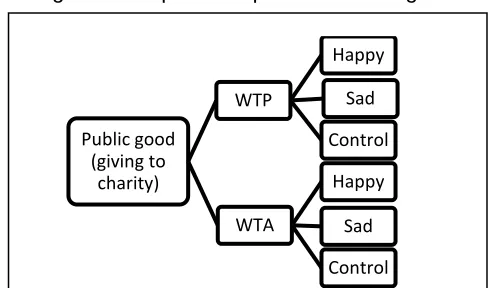
greater than previous experiments have observed. Below is a figure that illustrates the
experimental design.
Figure 1: Proposed Experimental Design
Public good (giving to
charity)
WTP
Happy
Sad
Control
WTA
Happy
Sad
Licensed under Creative Common Page 7 Experiment-administration and Findings
Subjects started off differently depending which group they were in. The WTA group got $30 for
participating and was told that $60 would be donated to a non-profit organization advocating for
environmentalism. The WTP was given $90 for participating. These two groups were then
further branched into either the happy, sad, or neutral group. Subjects in the happy group were
asked to focus on an image of colorful, vibrant balloons in the sky. In the sad group, subjects
looked at a picture of old, drooping sunflowers in a vase. The neutral group had no image.
After focusing on their images (if they one), subjects forwarded to the next page where
they were given a choice. The subjects in the WTA group could either keep the original deal or
keep all the money to themselves instead of donating it. The WTP group has a choice to keep
their original deal or to donate $60 and keep $30. In the end, subjects were asked what emotion
the image elicited for them. It seemed as if the sad group was not as affected by the image as
the happy group. This might have been because some subjects interpreted the picture to be
peaceful or hopeful rather than gloomy or sad. Another possibility could be that the subjects
who participated in my experiment were all very giving for within the WTP control group, most
people donated. Overall, my sample size for each group was small so I cannot say that my
results were accurate. The most significant result that I observed was within the WTA happy
group. In this group, an overwhelming majority (85.7%) chose to donate to charity showing that
people are more likely to donate when they are joyful. Thus, emotions have a great effect on
how individuals make their decisions.
Discussions
There are all these opinions of how, when, and why the gap exists between people’s willingness
to accept and willingness to pay. John Horowitz and Kenneth McConnell looked at different
situations and how the WTA/WTP ratio changes in each one (Horowitz & McConnell, 2000).
Forty-five different studies were observed using all sorts of various items for subjects to be
endowed with: some including hunting licenses and chocolate. They found that students have
lower WTA-WTP then the general public. Also, experiments involving money have lowest ratio.
The nearer an item becomes to being money, the smaller the WTA/WTP ratio. On the contrary,
non-ordinary market goods have a higher ratio because people are less familiar with the object,
causing uncertainty, which leads to risk aversion. Overall, public goods have the highest ratio,
as noted as a part of the argument above. According to UCSD professor Richard Carson, this could be because “there is not typically a market to sell public goods and hence they cannot be traded back and forth like marketed goods” (personal communication, November 2011). Trading
can lead to taking advantage of a price in different markets resulting in WTA and WTP to be
Licensed under Creative Common Page 8
Furthermore, the economists analyzed survey design in these 45 experiments (Pearce,
Atkinson and Mourato, 2006). Real experiment results are not significantly different from
hypothetical experiment results. If subjects tried to form the best portfolio of decision strategies
rather than stating their true valuations, then we would expect these experiments to have lower
ratios than the ones actually observed. There is such a controversy regarding the gap between
WTA and WTP that this group of economists attempted to review all types of experiments.
Within each one, they considered the type of goods used, the experimental design, the types of
subjects used, and the results received. These economists believed it necessary to summarize
all the types of experiments that exist especially because a consensus cannot be reach
regarding this issue. This overview might be helpful for economists to look at and see where
results are different, the same, or just need more research and data.
The disparity between one’s willingness to accept and their willingness to pay has been
a hot topic in the field of experimental economics for quite some time now. However,
economists cannot agree what causes this disparity. It was not until 1963 when WTA-WPT
became focused on the contingent valuation method, which shows that the value of any good
can be expressed in monetary terms (Sayman & Onculer, 2011). As a result, the WTA-WTP gap
was first noted in 1964 by Peter Louis Henderson. Now experts are wondering whether the gap
is due to the endowment effect, emotions, risk attitudes, familiarity with the good, personality or
morality. It seems it is a combination of all these factors. Not one behavior, aspect, or
characteristic results in this gap to form. Perhaps, instead of focusing on where the gap comes
from now, more emphasis should be placed on which aspect more heavily influences the gap
given the type of good used and the group of subjects used. Once we figure out what the gap is
from, we can change the way we look at market goods and more importantly how consumers
make decisions.
REFERENCES
Biel, A., Johansson-Stenman, O., & Nilsson, A. (2006). Emotions, Morality and Public Goods: The WTA-WTP Disparity Revisited.
Georgantzís, N., & Navarro-Martínez, D. (2010). Understanding the WTA–WTP gap: Attitudes, feelings, uncertainty and personality. Journal of Economic Psychology.
Harbaugh, W. T., Krause, K., & Vesterlund, L. (2001). Are adults better behaved than children? Age, experience, and the endowment effect. Economics Letters, 175-181.
Horowitz, J. K., & McConnell, K. E. (2001). A Review of WTA/WTP Studies. SSRN Electronic Journal. doi:10.2139/ssrn.257336
Kahneman, D., Knetsch, J. L., & Thaler, R. H. (1990). Experimental Tests of the Endowment Effect and the Coase Theorem. Journal of Political Economy. doi:10.1086/261737
Lehrer, J. (2009). How we decide. Boston: Houghton Mifflin Harcourt.
Licensed under Creative Common Page 9 Loewenstein, G. (2007). Exotic preferences: Behavioral economics and human motivation. Oxford: Oxford University Press.
Pearce, D. W., Atkinson, G., Mourato, S., & Organisation for Economic Co-operation and Development (2006). Cost-benefit analysis and the environment: Recent developments. Paris, France: Organisation for Economic Co-operation and Development.
Plott, C., & Zeiler, K. (2005). The willingness to pay-willingness to accept gap, the "endowment effect," subject misconceptions, and experimental procedures for eliciting valuations. American Economic Association.