INTERNATIONAL RESEARCH JOURNAL OF PHARMACY
www.irjponline.com
ISSN 2230 – 8407
Research Article
EFFECT OF SOLID DISPERSIONS, HP-
β
&
γ
- CYCLODEXTRIN INCLUSION COMPLEXES
ON THE DISSOLUTION RATE OF SIMVASTATIN AND FORMULATION DEVELOPMENT &
EVALUATION OF SIMVASTATIN ODTs
Sr. Nirmala Jyothi. G *, A.Rajendra prasad, S. Swati, Pratyusha Gandrapu
Department of Pharmaceutics, Nirmala College of Pharmacy, Atmakur (V), Guntur, Andhra Pradesh, India
*Corresponding Author Email: [email protected]
Article Received on: 13/02/18 Approved for publication: 17/03/18
DOI: 10.7897/2230-8407.09341
ABSTRACT
The objective of the present work was to study the effect of solid dispersions prepared Hydroxy Propyl - β (HP-β) & γ- cyclodextrin (CD) inclusion complexes and poly ethylene glycols(PEG) 3550 and 6000 on the dissolution rate of simvastatin and formulation & evaluation of simvastatin orally disintegrating tablets (ODTs). Simvastatin, a hypolipidemic drug is widely used in the treatment of hyperlipidemia. Simvastatin is a BCS Class II drug having low solubility (1.45µg/mL) and therefore low oral bioavailability. In the present study, Solid dispersions were prepared with drug and PEG 3350 & 6000. These two polymers are used in 1:2 ratio (drug: polymer) and in combinations (Drug :PEG 3350:PEG 6000) in the ratio 1:2:1 & 1:1:2 respectively solid dispersions of simvastatin with HP-β , (1:1,1:2,1:3) & γ cyclodextrins (1:1,1:2) with different drug : carrier ratios were prepared by kneading technique . And finally the ODTs were prepared with drug: γ CD solid dispersion in the ratio 1:2 along with the super disintegrating agents such as crospovidone, sodium starch glycolate and croscarmellose sodium in different amounts were used for different formulations F1-F9. Formulations were evaluated for physical appearance, weight variation, thickness, hardness, friability, content uniformity test, disintegration test and in vitro release studies. From the prepared formulations, it was observed that F3 shows Disintegration rate 48.16sec±0.75 and Dissolution rate 99.89±0.31 for 20 minutes (min). So that Formulation F3 was found to be quicker in disintegration and faster in drug releasing, so this was optimized for its enhanced dissolution profile and bioavailability.
Keywords: Simvastatin ODTs, PEG 3550, PEG 6000 HP-β and γ cyclodextrins Crospovidone, Sodium Starch Glycolate and Croscarmellose sodium.
INTRODUCTION
Solubility behavior of a drug is one of the key determinants of its oral bioavailability. In recent years, the number of poorly soluble drug candidates has increased tremendously. The formulation of poorly soluble drugs for oral delivery presents a challenge to the formulation scientist 1. The most promising method for promoting
dissolution is the formation of a solid dispersion in a proper carrier. The solid dispersion reduces particle size and therefore increases the dissolution rate and absorption of drugs 2.
Solid dispersion is the dispersion of one or more active ingredients in an inert carrier or matrix at solid-state prepared by the melting (fusion), solvent, or melting–solvent method. Water-soluble polymers are used as carriers or matrix materials in the preparation of solid dispersions 3. Among the various approaches,
the solid-dispersion technique has often proved to be the most successful in improving the dissolution and bioavailability of poorly soluble, active pharmaceutical ingredients because it is simple, economical, and advantageous 4-5. Solid dispersions
increase drug surface area, reduce drug crystallinity and stabilize the system in vitro and in vivo to inhibit drug recrystallization. Cyclodextrins (sometimes called cycloamyloses) are a family of compounds made up of sugar molecules bound together in a ring (cyclic oligosaccharides) 6. These cyclic oligosaccharides consist
of (α-1, 4)-linked α-D-glucopyranose units and contain a somewhat lipophilic central cavity and a hydrophilic outer surface. The central cavity is lined by the skeletal carbons and ethereal oxygen’s of the glucose residues, which gives it a lipophilic character. 7
The natural α, HP-β- and γ-cyclodextrin consist of six, seven, and eight glucopyranose units, respectively 8. The natural
cyclodextrins, in particular HP-β-cyclodextrin, are of limited aqueous solubility meaning that complexes resulting from interaction of lipophiles with these cyclodextrin can be of limited solubility resulting in precipitation of solid cyclodextrin complexes from water and other aqueous systems 9.
Cyclodextrins are starch derivatives and are mainly used in oral and parenteral pharmaceutical formulations. They are also used in topical and ophthalmic formulations. Cyclodextrins are not irritant to the skin and eyes, or upon inhalation. Immediate release drug delivery system is also conventional type of drug delivery system and it is defined as immediate release tablets are designed to disintegrate and release their medicaments with no special rate controlling features such as special coatings and other techniques10. ODT serves as an alternative dosage form for
patient experience dysphasia (difficulty in swallowing) or for where compliance is a known issue and therefore an easier dosage form to take ensures that medication is taken 11.
MATERIALS AND METHODS
Simvastatin was gift sample obtained from VRL Pharma lab Hyderabad, India., PEG 3350 and PEG 6000 was purchased from Sun Pharmaceutical Pvt. Ltd, India., HP-β - cyclodextrin and γ - cyclodextrin was obtained from Roquette Pharma Pvt. Ltd, India., Sodium Starch Glycolate, Sodium lauryl sulfate and Cross Carmellose Sodium was acquire from Yarrow chemic products India.
Construction of calibration curve
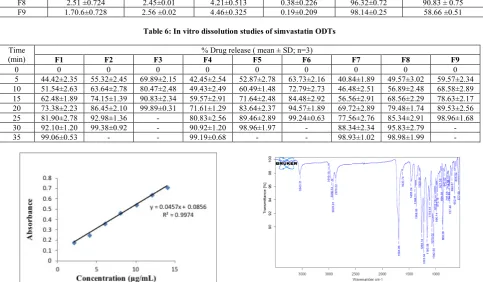
Standard solution was prepared by taking a series of concentrations of 2, 4, 6, 8, 10, 12 and 14µg/ml of Simvastatin using 7.0 pH buffers. Absorbances of these solutions were measured at λ max 247.9nm using Ultra Violet (UV)-Visible spectrophotometer and standard plot was plotted between concentration and absorbance. Calibration curve was shown in below Figure 1.
Preparation of solid dispersions
Solid dispersions are prepared separately and in combination with PEG 3550 and PEG 6000 by fusion method. In ratios of 1:2 with the drug and polymer and in combination, ratios of 1:2:1 and 1:1:2 with the drug were prepared. The fusion method is used for the preparation of solid dispersions. In this method accurately weighed amount of polymers were placed in glass beaker which is kept on a hot plate and melted with constant stirring at a temperature of about 50 to 60 0C and accurately weighed amount
of simvastatin was incorporated into this melting carriers constantly stirring to ensure homogeneity13. The mixture was
heated until a clear homogenous melt was obtained. Glass beaker was removed from the hot plate and allowed to cool under room temperature. After drying, the solid dispersions was taken from the glass beaker carefully and grounded by using mortar and pestle.
Preparation of simvastatin - HP-β cyclodextrin inclusion complex
Simvastatin and HP-β - cyclodextrin were taken in the ratios of 1:1, 1:2 and 1:3 respectively. The kneading method was used for the preparation of these inclusion complexes. In this method drug and HP-β-cyclodextrin were triturated at different ratios in a mortar with a small volume of ethanol. The thick slurry was kneaded for 15 mins, and then the mass was air dried at room temperature for one day and further dried in desiccators for 2 days. The dried product was crushed, pulverized and sieved through # 44 mesh. Simvastatin - HP-βcyclodextrin inclusion complex, thus obtained were stored in a well closed container and kept in desiccators 14-17.
Preparation of simvastatin - γ-cyclodextrin inclusion complex
Simvastatin and γ -cyclodextrin were taken in the ratios of 1:1and 1:2 respectively. The kneading method was used for the preparation of simvastatin – γ-cyclodextrin inclusion complexes. In this method drug and γ-cyclodextrin were triturated at different ratios in a mortar with a small volume of ethanol. The thick slurry was kneaded for 15 mins, and then the mass was air dried at room temperature for one day and further dried in desiccators for 2 days. The dried product was crushed, pulverized and sieved through # 44mesh. Simvastatin – γ-cyclodextrin inclusion complexes, thus obtained were stored in a well closed container and kept in a desiccators.18
Evaluation of solid dispersions and cyclodextrins inclusion complexes
Infrared (IR) spectroscopic analysis
Fourier-transform infrared (FTIR) spectra of moisture free powdered samples of simvastatin, its solid dispersions and inclusion complex with γ–cyclodextrins were obtained using a spectrophotometer (BRUKAR) by potassium bromide (KBr) pellet method. The scanning range was 4000cm-1 to 400 cm-1.
X-Ray diffraction (XRD) analysis
The physical state of simvastatin in the various preparations was evaluated by X-ray diffraction. X-ray diffraction patterns of the samples were determined using with a Cu anode at 40 kV and 30 mA and at a scan rate of 0.30 sec, 2θ range from 10to 800.The
positions and intensities of diffraction peaks were considered for the identification and comparison of crystallinity of the drug and the polymers.
In vitro dissolution studies of solid dispersions
In vitrodissolution study for solid dispersions equivalent to 40 mg of simvastatin was performed in standard USP dissolution apparatus type II. The bowls of the dissolution apparatus was filled with 900mL of pH 7.0 phosphate buffer with 0.5% sodium lauryl sulfate and maintain data temperature of 37± 0.5 0C and
carried out at 50rpm. Aliquots of 5 mL of samples were withdrawn at specified time intervals of 5, 10,15,30,45 and 60 mins. An equal volume of fresh dissolution medium was replaced to maintain the volume of dissolution medium. The collected samples were filtered through 0.45 micron filters. The filtered samples were analyzed spectrophotometrically for drug content using UV spectrophotometer at 247.9 nm.
Invitro dissolution studies of Drug – HP-β cyclodextrin inclusion & Drug- γ-cyclodextrin complexes
Invitrodissolution study for drug - HP-β cyclodextrin and drug- γ-cyclodextrin inclusion complexes equivalent to 40 mg of simvastatin were performed in standard USP dissolution apparatus type II. The bowls of the dissolution apparatus was filled with900 mL of pH 7.0phosphate buffer with 0.5% sodium lauryl sulfate and maintained at a temperature of 37± 0.5 0C and
carried out at 50 rpm. Aliquots of 5 mL of samples were withdrawn at specified time intervals of 5, 10, 15 and 20 mins. An equal volume of fresh dissolution medium was replaced to maintain the volume of dissolution medium. The collected samples were filtered through 0.45 micron filters. The filtered samples were analyzed spectrophotometrically for drug content using UV spectrophotometer at 247.9 nm 19-21.
Evaluation of lubricated granules Angle of repose
Angle of repose is defined as the maximum angle is possible between the surface of a file of granules and horizontal plane. Place a cylinder on a graph sheet. Now take small quantity of powder. Measure the height and radius of heap calculate the angle of Repose.
Bulk density
Carr’s Index
The Compressibility Index of the powder blend was determined by Carr’s compressibility index. It is a simple test to evaluate of a powder, the rate at which it packed down by calculating loose bulk density (LBD) and tapped bulk density (TBD). The formula for Carr’s Index is as below
Carr’s Index (%) = [(TBD-LBD) x100/TBD]
Hausner’s Ratio
The Hausner’s ratio is a number that is correlated to the flowability of a powder or granular material.
Hausner’s Ratio = TBD / LBD x 100
Evaluation of Simvastatin Oral Disintegrating Tablets Weight variation test
In this method 20 tablets are randomly selected and weighed individually. The average weight of individual tablets was determined with respect to average weight and percentage weight variation is calculated and noted 22.
Weight variation= Individual weight – average weight/ Individual weight
Thickness of the tablets
The thickness of the tablet is influenced by the amount of fill material in the die cavity, due diameter and the compaction force applied. The thickness specification is characteristic to each tablet product but in general the tablet thickness is required to be within ±5% of the prescribed value. The inconsistent thickness of the tables leads to problem in its packaging. The measurement of tablet thickness was done by using a micrometer and values were noted.
Hardness of tablets
The hardness of the tablets was measured by Pfizer hardness tester. This test was required to know force required to break the tablet when such force is applied diametrically. The values are recorded and noted 23.
Friability test
The Friability of tablets was usually measured by using Roche Friabilator. This test gives the information regarding the tablet resistance to shock, and abrasion encountered during the process of manufacturing, packaging etc.
Drug Content
Ten tablets were taken and triturated well. Powder equivalent to 20 mg of simvastatin was taken in 100 mL of volumetric flask and dissolved in 80 mL of pH 7.0 phosphate buffer solution. This solution shaken for 30 min and volume was adjusted with pH 7.0 phosphate buffer solution. After thorough shaking, solution was sonicated and filtered through 0.45µm filter. Clear solution was taken and after suitable dilution, absorbance was measured using UV-Visible spectrophotometer at 247.9 nm 24-25.
Disintegration time
It is the time taken by the tablet to breakup into smaller
particles. The disintegration test is carried out in an apparatus containing a basket rack assembly with six glass tubes of 7.75 cm in length and 2.15 mm in diameter, the bottom of which consists of a 10 mesh sieve. The basket is raised and lowered 28 – 32 times per minute in a medium of 900 mL which is maintained at 370c 26-27. Six tablets were placed in each of the
tubes and the time required per complete passage of tablets fragments through the 10 mesh was considered as the disintegration time of the tablet.
In vitro dissolution studies of simvastatin ODTs
The in vitro drug release study for simvastatin ODTs was performed in standard USP dissolution apparatus type II. The bowls of the dissolution apparatus was filled with 900 mL of pH 7.0 phosphate buffer with 0.5% sodium lauryl sulfate and maintained at a temperature of 37± 0.5oc and carried out at 50 rpm 28. Aliquots of 5 mL of samples were withdrawn at specified time
intervals of 5, 10, 15, 20, 25, 30 and 35 mins. An equal volume of fresh dissolution medium was replaced to maintain the volume of dissolution medium. The filtered samples were analyzed
spectrophotometrically for drug content using UV
spectrophotometer at 247.9 nm.
RESULTS AND DISCUSSIONS FTIR study
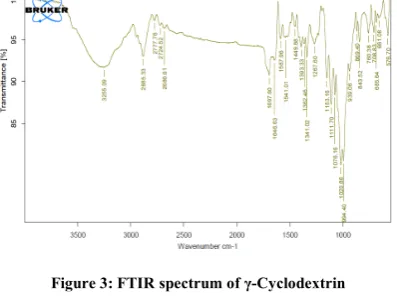
FTIR has been used to assess the interaction between drug and polymers. The peaks were detected in the spectrum of pure simvastatin presented characteristic peaks at 3543.21cm-1(alcoholic O-H stretching vibration), 2870.52cm-1 (methyl and methylene C-H asymmetric and symmetric stretching vibration), 1694.86cm-1(lactone C=O and ester C=O stretching), 1465.24cm-1(methyl and methylene C-H bending vibration) and 1265.14 cm-1 and 1160.18 cm-1 (lactone and ester C-O-C bending vibration) respectively. IR analysis revealed that the frequencies of functional groups of pure drug remained unaffected in physical mixture containing polymers, hence there was no chemical interaction occurred between the drug and polymers. Results are shown in below Figures 2 to 5.
XRD study
The XRD patterns of simvastatin, γ-cyclodextrin and simvastatin - γ-cyclodextrin inclusion complexes are depicted in Figures 6 to 8. The diffraction pattern of simvastatin shows a highly crystalline nature and shows numerous distinctive peaks at a diffraction angle of 2θ (18.70°, 17.13°, 16.480, 15.540 and 10.86°)
at the scanning range. Theses distinctive peaks of simvastatin were reduced in XRD of simvastatin – γ cyclodextrin inclusion complexes. This indicates that the degree of crystallinity of simvastatin was reduced and may be partially converted in to amorphous form.
In vitro Dissolution Studies Solid dispersions
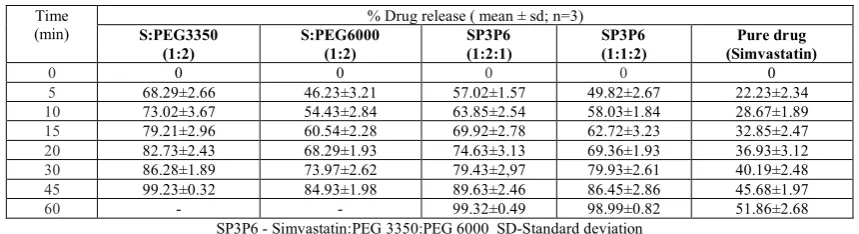
3350 and PEG 6000. Dissolution profile was shown in Table 1 and graphical results are shown in figures 9 to10.
Drug - HP-β cyclodextrin inclusion complexes
Drug - HP-β cyclodextrin inclusion complexes were prepared by using drug and β- cyclodextrin with different ratios of 1:1, 1:2 and 1:3 and the dissolution profile was studied. About 97- 98 % of the drug was released within 30 min. The drug - HP-β cyclodextrin inclusion complex of 1:3ratio showed the better release than the 1:1 and 1:2 ratio of the complex. Dissolution profile was shown in Table 2 and graphical results are shown in figures 11 to 12.
Drug – γ cyclodextrin inclusion complexes
Drug– γ cyclodextrin inclusion complexes were prepared by using drug and γ- cyclodextrin with different ratios of 1:1 & 1:2 .Invitrodissolution studies were performed in pH 7.0 phosphate buffer. About 98- 99 % of the drug was released within 20 min .The drug –γcyclodextrin inclusion complex of 1:2 ratio showed the better release than the 1:1 ratio of the complex. Drug- γ CD inclusion complexes prepared with 1:2 ratio showed better release among all solid dispersions and drug- HP-β CD inclusion complex & drug- γ CD inclusion complexes (1:1). Dissolution profile was shown in Table 2 and graphical results are shown in figures 11 to 12.
Evaluation of lubricated granules Pre compression parameters
The pre compression parameters such as bulk density, tapped density, Carr’s index, Hauser’s’ ratio and angle of repose were evaluated and found to be in satisfactory range before compression of the prepared powder. Results are shown below given Table 3.
Bulk density
Bulk densities of all the formulated blends were carried out and the results were tabulated in the Table 4. The entire formulations were found to be in the range of 0.46 ±0.01 to 0.38 ± 0.02 and it concludes that all formulations are having passable flow property. Results are shown below given Table 3.
Tapped density
Tapped densities of all the formulated blends were carried out and the results were tabulated in the Table 4. The entire formulations were found to be in the range of 0.49 ±0.01 to 0.58 ± 0.02anditconcludesthat all formulations are having passable flow property. Results are shown below given Table 3.
Carr’s Index
Carr’s index for the formulated blends was carried out and the results were tabulated in the Table 4. The entire formulations were found to be in the range of 16.32 ± 0.39 to 25.32± 0.61 and it concludes that all formulations are having good flow property. Results are shown below given Table 3.
Hausner’s ratio
Hausner’s ratio for the formulated blends was carried out and the results were tabulated in the Table 4. The entire formulations were found to be in the range of 1.26 ± 0.01 to 1.36 ±0.01 and it concludes that all formulations are having passable flow property. Results are shown below given Table 3.
Angle of repose
The angles of repose for the formulated blends were carried out and the results were tabulated in the Table 4. The entire formulations were found to be in the range of 28.73 ±0.47 to 33.51 ±0.09 and it concludes that all formulations are having passable flow property. Results are shown below given Table 3.
Evaluation of Simvastatin ODTs
Simvastatin ODTs were prepared with the Drug and γ- cyclodextrin complexes in the ratio 1:2 respectively and the formula shown in Table 4 by using superdisintegrants such as crospovidone, sodium starch glycolate and croscarmellose sodium. For the direct compression of the formulations, 16 station tablet compression machine (cad mach) with 8mm punch was used. The compressed tablets were evaluated for quality control tests like physical appearance, thickness, weight variation, hardness, friability, disintegration time and in vitro dissolution rate.
Post compression parameters of Simvastatin Oral Disintegrating Tablets
Physical appearance
The compressed tablets appeared white in color and smooth in texture. No manufacturing defects and good quality of compressed tablets was observed. The compressing problems such as picking, sticking, lamination, chipping, capping and cracking were not noticed.
Thickness
Minimum deviation was observed with thickness of the tablets 2.438 ± 0.01 to 2.587± 0.14 and weight variation was controlled within the limits. Results are shown below given Table 5.
Weight variation test
The percentage weight variation of the compressed tablets was within the limits of pharmacopoeia. The percentage weight variation was uniform with low standard deviation values and variation was between 1.13 ± 0.348 to 2.51 ± 0.724. Results are shown below given Table 5.
Hardness test
The measured hardness of tablets of all the formulations (F1-F9) ranged in between3.64 ± 0.532to4.56 ± 0.327kgcm2. This
urges good handling characteristics of all formulations. Results are shown below given Table 5.
Friability test
The % friability of all formulations was less than 0.5% ensuring that the tablets were mechanically stable. Results are shown below given Table 5.
Drug Content
Drug content of all the formulations were in the range of 96.32 – 99.90%. It complies with official specifications. Results are shown below given Table 5.
Disintegration test
dissolving property as the tablet is expected to disintegrate rapidly in the oral cavity and release the drug within a few seconds of the administration. The formulations F1, F2, F4, F5, F7 and F8 showed more than 1 min whereas formulations F3, F6 and F9 showed less than 1 min. F3 showed the lowest disintegration time (48 sec) among all the formulations.
In vitro dissolution study
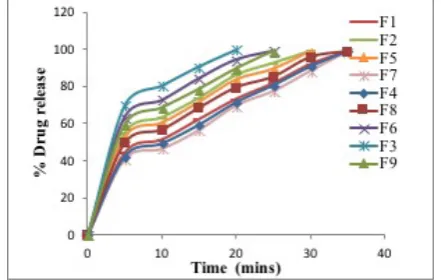
The Tablet formulations F1, F2 &F3 were prepared with 10%, 15% and 20% of crospovidone respectively. F3 containing 20 % of crospovidone showed more release than F1 & F2. Formulation F3 is released more than 99% of the drug within 20mins, which is also showed comparatively less disintegration time of 48 sec prepared with only crospovidone as superdisintegrant at 20 % concentration.
The formulations F4, F5 &F6 were prepared with 10%, 15% and 20% of sodium starch glycolate, respectively. F6 containing 20 %
croscarmellose sodium showed more release than F4 & F5. F6 is released more than 99 % of the drug within 25 min which is also showed comparatively less disintegration time prepared with only sodium starch glycolate as superdisintegrant at 20 % concentration.
The formulations F7, F8 & F9 were prepared with 10%, 15% and 20% of croscarmellose sodium, respectively. F9 containing 20 % croscarmellose sodium showed more release than F7 & F8. F9 is released more than 98 % of the drug within 25 min which is also showed comparatively less disintegration time prepared with only croscarmellose sodium as superdisintegrant at 20 % concentration. From overall study it was confirmed that the formulation with crospovidone at higher concentration (20%) released the drug in faster rate with less disintegration time. The other quality control parameters of this formulation were found to be good. Drug release profile was shown in Table 6 and graphical plots of drug release were given in Figure 13 to14.
Table 1: In vitro dissolution data of simvastatin solid dispersions
Time
(min) S:PEG3350 % Drug release ( mean ± sd; n=3) (1:2)
S:PEG6000 (1:2)
SP3P6 (1:2:1)
SP3P6 (1:1:2)
Pure drug (Simvastatin)
0 0 0 0 0 0
5 68.29±2.66 46.23±3.21 57.02±1.57 49.82±2.67 22.23±2.34
10 73.02±3.67 54.43±2.84 63.85±2.54 58.03±1.84 28.67±1.89
15 79.21±2.96 60.54±2.28 69.92±2.78 62.72±3.23 32.85±2.47
20 82.73±2.43 68.29±1.93 74.63±3.13 69.36±1.93 36.93±3.12
30 86.28±1.89 73.97±2.62 79.43±2,97 79.93±2.61 40.19±2.48
45 99.23±0.32 84.93±1.98 89.63±2.46 86.45±2.86 45.68±1.97
60 - - 99.32±0.49 98.99±0.82 51.86±2.68 SP3P6 - Simvastatin:PEG 3350:PEG 6000 SD-Standard deviation
Table 2: In vitrodissolution data of simvastatin (S) -γ cyclodextrin and simvastatin – HP-β cyclodextrin inclusion complexes
Time (minutes)
% Drug release
S:γ-CD (1:1) S:γ-CD (1:2) S:HP-β-CD (1:1) S:HP-β-CD (1:2) S:HP-β-CD (1:3) Pure drug (Simvastatin)
0 0 0 0 0 0 0
5 67.853±2.85 70.493±1.46 52.457±1.45 56.532±2.17 59.456±2.18 22.235±2.34 10 78.421±2.32 84.563±2.84 65.864±2.67 68.746±2.43 71.754±1.78 28.673±1.89 15 89.625±1.75 93.294±1.82 72.542±2.83 76.743±1.90 80.849±2.53 32.854±2.47 20 99.237±2.02 99.898±3.13 89.473±3.10 93.942±.189 97.378±2.01 36.937±3.12 30 - - 98.108±2.69 98.563±2.78 98. 901±2.61 40.193±2.48 45 - - - 45.683±1.97 60 - - - 51.867±2.68
Table 3: Evaluation of lubricated granules
Formulations Bulk Density (g/ml)
Tapped Density (g/ml)
Carr’s Index Index (%)
Hausner’s Ratio Angle of Repose (degrees) F1 0.46 ±0.01 0.58 ± 0.01 20.98 ± 0.13 1.34±0.02 33.51 ±0.09 F2 0.38 ± 0.02 0.49 ± 0.01 16.32 ± 0.39 1.36 ± 0.01 29.43 ±0.06 F3 0.39 ± 0.01 0.53 ± 0.02 25.32 ± 0.61 1.35 ± 0.01 28.73 ±0.47 F4 0.41 ± 0.01 0.52 ± 0.02 21.15 ± 0.13 1.26 ± 0.01 32.33 ±0.17 F5 0.38 ± 0.02 0.49 ± 0.01 22.44 ± 0.58 1.28 ± 0.01 30.81 0.18 F6 0.43 ± 0.01 0.58 ± 0.02 25.86 ±0.64 1.34 ± 0.01 29.64 ±0.07 F7 0.40±0.01 0.52 ± 0.01 21.29 ± 0.51 1.31 ± 0.01 34.66±5.58 F8 0.46 ± 0.01 0.58 ± 0.02 24.73 ± 0.58 1.26 ± 0.01 32.09±0.78
Table 4: Formulation of simvastatin ODTs
Composition F1 F2 F3 F4 F5 F6 F7 F8 F9
Simvastatin, γ-cyclodextrin
complex (1:2) 120 120 120 120 120 120 120 120 120 Microcrystalline
Cellulose
80 67.5 55 80 67.5 55 80 67.5 55
Crospovidone 25 37.5 50 - - - - Sodiumstarch glycolate - - - 25 37.5 50 - - - Croscarmellose sodium - - - 25 37.5 50
Povidone 20 20 20 20 20 20 20 20 20 Magnesium stearate 2.5 2.5 2.5 2.5 2.5 2.5 2.5 2.5 2.5 Talc 2.5 2.5 2.5 2.5 2.5 2.5 2.5 2.5 2.5 Total weight 250 250 250 250 250 250 250 250 250
*Quantity in mg for one tablet as per formula
Table 5: Quality control parameters of simvastatin ODTs
Formulation
Weight variation (mg) (mean ± sd; n=20)
Thickness (mm) (mean ± sd;n =10)
Hardness (Kg/cm2)
(mean± sd; n=10)
Friability (%) (mean ± sd; n=3)
Drug Content (%) mean± sd; n=10)
Disintegration time (sec) (mean ± sd; n=6) F1 1.13 ± 0.348 2.49±0.02 4.56±0.327 0.39±0.210 97.79±0.48 96.51 ± 1.22 F2 2.49±0.645 2.48± 0.03 3.73±0.276 0.22±0.122 97.62±0.53 70.31 ±0.81 F3 1.50±0.826 2.47 ± 0.01 4.08±0.405 0.13±0.132 99.90±0.95 48.16 ±0.75 F4 2.49 ± 0.173 2.43 ± 0.01 3.84±0.397 0.40±0.235 96.52±0.67 102.16± 0.75 F5 2.49±0.682 2.44 ± 0.02 3.91±0.425 0.36±0.267 98.35±0.10 78.16 ±1.16 F6 2.30±0.260 2.45± 0.03 4.48 ± 0.367 0.15±0.183 99.17±0.13 53.33 ± 0.81 F7 1.96± 0.959 2.58± 0.14 3.64 ±0.532 0.30±0.216 97.91±0.39 110.6± 1.86 F8 2.51 ±0.724 2.45±0.01 4.21±0.513 0.38±0.226 96.32±0.72 90.83 ± 0.75 F9 1.70.6±0.728 2.56 ±0.02 4.46±0.325 0.19±0.209 98.14±0.25 58.66 ±0.51
Table 6: In vitro dissolution studies of simvastatin ODTs
Time (min)
% Drug release ( mean ± SD; n=3)
F1 F2 F3 F4 F5 F6 F7 F8 F9
0 0 0 0 0 0 0 0 0 0
5 44.42±2.35 55.32±2.45 69.89±2.15 42.45±2.54 52.87±2.78 63.73±2.16 40.84±1.89 49.57±3.02 59.57±2.34 10 51.54±2.63 63.64±2.78 80.47±2.48 49.43±2.49 60.49±1.48 72.79±2.73 46.48±2.51 56.89±2.48 68.58±2.89 15 62.48±1.89 74.15±1.39 90.83±2.34 59.57±2.91 71.64±2.48 84.48±2.92 56.56±2.91 68.56±2.29 78.63±2.17 20 73.38±2.23 86.45±2.10 99.89±0.31 71.61±1.29 83.64±2.37 94.57±1.89 69.72±2.89 79.48±1.74 89.53±2.56 25 81.90±2.78 92.98±1.36 - 80.83±2.56 89.46±2.89 99.24±0.63 77.56±2.76 85.34±2.91 98.96±1.68 30 92.10±1.20 99.38±0.92 - 90.92±1.20 98.96±1.97 - 88.34±2.34 95.83±2.79 - 35 99.06±0.53 - - 99.19±0.68 - - 98.93±1.02 98.98±1.99 -
Figure 1: Calibration curve of simvastatin in pH 7.0 phosphate buffer
Figure 3: FTIR spectrum of γ-Cyclodextrin Figure 4: FTIR spectrum of PEG 3350
Figure 5: FTIR spectrum of Drug- γ Cyclodextrin inclusion complex (1:2)
Figure 6: XRD of Pure Simvastatin
Figure 7: XRD of Pure γ-Cyclodextrin Figure 8: XRD of Drug - γ-Cyclodextrin inclusion complex (1:2)
Figure 9: Zero order drug release profile simvastatin of solid dispersion
Figure 11: Zero order drug release profile of of simvastatin – HP-β cyclodextrin and simvastatin – γ cyclodextrin inclusion complexes
Figure12: First order drug release of simvastatin – HP-β cyclodextrin and simvastatin – γ cyclodextrin inclusion complexes
Figure 13: Zero order in vitro drug release from the simvastatin
ODTs Figure 14: First order in vitroODTs drug release from the simvastatin
CONCLUSION
Among numerous ways of enhancing drug dissolution rate, solid dispersion and cyclodextrin inclusion complexes of drug are one of the promising techniques. Simvastatinis insoluble in water and in aqueous fluids. As such dissolution is the rate limiting step in the process of drug absorption, to improve the dissolution of simvastatin, the solid dispersions with different polymers Solid dispersions were prepared with drug and PEG 3350 & PEG 6000. These two polymers are used alone in 1:2 ratio and in combinations (Drug :PEG 3350:PEG 6000) in the ratio 1:2:1 & 1:1:2 respectively .in the drug and PEG 3350 shown optimised result i.e. 99.23%release in 45 min. And drug - HP-β CD inclusion complex and drug- γ CD inclusion complexes were prepared and evaluated for their efficiency in increasing the dissolution rate of the drug. Drug- γ CD inclusion complexes prepared with 1:2 ratio showed better release 99.898% at 20 min among all solid dispersions and drug- HP-β CD inclusion complex & drug- γ CD inclusion complexes (1:1). Hence a drug- γ CD inclusion complex (1:2) was taken for the preparation of simvastatin ODTs.
This study clearly shows that the dissolution rate of simvastatin enhanced to a greater extent by γ cyclodextrin inclusion complexes. This is due to the reason that the γ cyclodextrins increased the aqueous solubility of poorly soluble drug by forming inclusion complexes with their polar functional groups. Drug- γ CD inclusion complex prepared with 1:2 ratio showed the highest improvement in dissolution rate of simvastatin. FTIR analysis revealed that the frequencies of functional groups of pure drug remained unaffected in physical mixture containing polymers, hence there was no chemical interaction occurred
between the drug and polymers. The distinctive peaks of simvastatin were reduced in XRD of simvastatin – γ cyclodextrin inclusion complexes. This indicates that the degree of crystallinity of simvastatin was reduced and may be partially converted in to amorphous form.
Crospovidone, sodium starch glycolate and croscarmellose sodium were used as superdisintegrants in alone with different concentrations for the preparation of simvastatin ODTs. Among all the formulations F3 where Crospovidone was a superdisintegrant was proved to be quicker in disintegration and faster in releasing the drug so which is optimized as best formula.
ACKNOWLEDGMENT
The authors are grateful to Sr. Alphonsa, Correspondent and Dr. Sk. Abdual Rahaman, principal for proving the facilities to carry out this research work in Nirmala college of Pharmacy
REFERENCES
1. Monica Rao, Yogesh Mandage, Kaushik Thanki, Sucheta Bhise . Dissolution Improvement of Simvastatin by Surface Solid Dispersion Technology. Dissolution Technologies 2010; 27 -34.
2. Margrit ayoub, Azza Hasan, Hanan el Nahas, Fakhr-eldin Ghazy . Enhancing oral bioavailability of carvedilol using solid dispersion technique. International Journal of Pharmacy and Pharmaceutical Sciences 2016; 8 (7):193-197.
aripiprazole by fusion method. International Journal of Pharmacy and Pharmaceutical Sciences 2016; 8(2): 187-192. 4. Ghulammurtaza. Solubility enhancement of simvastatin. A review : Acta Poloniae Pharmaceutica ñ Drug Research 2012; 69 (4): 581-590.
5. Gosai AR, Patil SB, Sawant KK . Formulation and evaluation of orodispersible tablets of ondansetron hydrochloride by direct compression using superdisintegrants. International Journal of Pharmaceutical Sciences and Nanotechnology 2008; 1(1): 106 – 111.
6. Ansel, Loyd V. Allen, Nicholas G Popovich . Ansel’s Pharmaceutical Dosage-forms and Drug Delivery System. Lippincott Williams & Wilkins 8 th ed. Baltimore ;2005. p 268-69.
7. B.G. Shiyani, R.B. Dholakiyal, B.V. Akbari, D.J. Lodhiyal, G.K. Ramani . Development and evaluation of novel immediate release tablets of Metoclopramide HCI by direct compression using treated gellan gum as disintegration-accelerating agent. Journal of Pharmacy Research 2009; 2(9): 1460 - 1464.
8. A Magnúsdóttir, M. Másson, T. Loftsson.Cyclodextrines . Journal of Inclusion Phenomenon and Macrocyclic Chemistry 2002; 44: 213 – 218.
9. SekarV,Chellan VR . Immediate release tablets of telmisartan using superdisintegrant-formulation, evaluation and stability studies. Chemical and Pharmaceutical Bulletin (Tokyo) 2008; 56(4): 575 - 577.
10.Aulton M.E. The science of dosage form design. 2 nd ed
Churchill Livingstone 2002; p 322-334.
11.RubiaYasmeen B. et al .Preparation and evaluation of oral fast dissolving films of Citalopram hydrobromide. International Journal of Bio pharmaceutics 2012; 3(2): 103-106.
12.M. Tamizhmozhi . A novel and rapid method for the analysis of Citalopram hydrobromide in tablet dosage form development and validation. Journal of Advanced Scientific Research 2012; 3(1): 62-64.
13.Khan KA.Effect of disintegrants type upon the relationship between compressional pressure and dissolution efficiency. Journal of Pharmacy and Pharmacology 1976; 28(8): 633 - 636
14.Sastry SV, Nyshadham JR, Fix JA. Recent technological advancements in oral drug delivery. A review Pharmaceutical Science & Technology Today 2000; 3: 138-145.
15.B.G. Shiyani, R.B. Dholakiyal, B.V. Akbari, D.J. Lodhiyal,G.K. Ramani. Development and evaluation of novel immediate release tablets of Metoclopramide HCI by direct compression using treated gellan gum as disintegration-accelerating agent. Journal of Pharmacy Research 2009; 2(9):1460 -1461.
16.Chong P, Seeger JD and Franklin C . Clinically Relevant Differences between the Statins. Implications for therapeutic Selection. American Journal of Medicine 2001; 111:390 – 400.
17.Duggan DE, Vickers S. Physiological disposition of HMG-CoA reductase inhibitors. Drug Metabolism Reviews 1990; 22: 333-362
18.Gerson RJ, Mac Donald JS, Alberts AW, Majka JA, BokelmanDL. Animal safety and toxicology of simvastatin and related Hydroxy-3- methylglutaryl-CoA reductase inhibitors. American Journal of Medicine 1989; 87: 285-295. 19.VreeTB, Dammers E, UlcI, MerkxI, Ryska Metal .Variable plasma/liver and tissue esterase hydrolysis of simvastatin in healthy volunteers after a single oral dose. Clinical Drug Investigation 2001; 21: 643 - 652.
20.PreuksaritanontT, MuL,QuiY, MichelK, Brunner Jetal. Inter conversion Pharmacokinetics of Simvastatin and its hydroxylacid in dogs. Effects of Gem fibrogil. Pharmaceutical Research 2005; 22: 1101-1109.
21.Lijuan Hu, Na Zhang & Gengliang Yang . Effects of Tween-80 on the Dissolution Properties of Daidzein Solid Dispersion. International Journal of Chemistry 2011; 3(1): 1-73
22.S. Swati, G. Nirmala Jyothi, N. Jyothi. Formulation and evaluation of fast dissolving tablets of olanzapine. Indo American Journal of Pharmaceutical Research 2016:6(03): 4617-4627.
23.N. Lakshmi Prasanthi et al.Formulation and Evaluation of Gastroretensive Floating Tablets of Venlafaxine HCL .Indo American Journal of Pharmaceutical Research 2016; 6(7): 6171-6181.
24.R. Naresh babu, D. Bindu madhuri, P. Sambasiva rao, G. Raveendra babu, B. Sivasai kiran . Formulation and evaluation of duloxetine hydrochloride by using press coating technology. World Journal of Pharmacy and Pharmaceutical Sciences 2015; 4 (suppl 10): 808-816
25.Mohammed jafar, Dehghan, adilshareef . Enhancement of dissolution of an anti-inflammatory effect of meloxicam using solid dispersions. International Journal of Applied Pharmaceutics 2010; 2(suppl 1):162-173.
26. Sandhiya Jatwani, Avtar Chand Rana, Gurpreet Singh, GeetaAggarwal. Solubility and Dissolution enhancement of simvastatin using synergistic effect of hydrophilic carriers. Rayat Institute of Pharmacy 2011; 3 (suppl 6): 280-293. 27. Miyoko Kamigauchia, Narumi Kanbaraa, Makiko Sugiuraa,
KinukoIwasaa, Hirofumi Ohishib,Toshimasa Ishidab Berberine . Cyclodextrin Inclusion Structure Studied by 1H-NMR Spectroscopy and Molecular-Dynamics Calculations. Helvera chemical Acta 2004; 87: 264- 274.
28.Harjeet Singhb, Betty Philipa,KamlaPathakb . Preparation, Characterization and Pharmacodynamic Evaluation of Fused Dispersions of Simvastatin using PEO-PPO Block Copolymer. Iranian Journal of Pharmaceutical Research 2012; 11 (2): 443-445.
Cite this article as:
Sr. Nirmala Jyothi. G et al. Effect of solid dispersions, HP-β & γ- cyclodextrin inclusion complexes on the dissolution rate of simvastatin and formulation development & evaluation of simvastatin ODTs. Int. Res. J. Pharm. 2018;9(3):44-52 http://dx.doi.org/10.7897/2230-8407.09341
Source of support: Nil, Conflict of interest: None Declared